Showing posts with label Harold McGee. Show all posts

Monday, February 07, 2022

Where some interesting food names come from

Why it's called a Bing Cherry 

Cherries at the Ann Arbor Farmers Market.
I had never thought much about where the Bing Cherry got its name, though I've definitely eaten them with pleasure for much of my life. It's the kind of thing you don't think about until someone tells you, and then you wonder why you never wondered about it. 

In the current issue of the New Yorker, the author John McPhee, who has been writing for this magazine since 1963, published a brief memoir titled  “Tabula Rasa” in which he mentioned the history of this very popular variety of cherries:
"This cherry had been bred in 1875 at an orchard in Oregon, on the Willamette River, just south of Portland. In an open-pollination cross, its mother was a Black Republican and its father a Royal Ann (sic). The orchard foreman was Ah Bing. A Manchurian well over six feet tall, he spent several decades in the United States, sending home to his wife and children money from his long employment at what had been one of Oregon’s pioneer nurseries. Its founder, Henderson Lewelling, brought his fruit trees and his family overland by oxcart from Iowa.

"In a memoir written many years after the fact, a member of the Lewelling family recalled that Ah Bing had under his personal supervision the row of test trees in which the successful cultivar appeared. In any case, he was the foreman and the cherry was named for him. Taxonomy went elsewhere. The Bing cherry, of the species Prunus avium, has the medicinal implications of a prune. Ripening, it tends to split if too much rain falls on it. Hence this red cherry, by far the most popular in America, is mainly grown in the dry-summer valleys of Washington, Oregon, and California." (source

Why it's called a McIntosh Apple

After reading about the Bing Cherry, I wondered where popular varieties of apples get their names. New types of apples are constantly being developed, especially at three agricultural establishments: the University of Minnesota Agricultural Experiment Station, Washington State University, and Cornell University. The Minnesota scientists developed the Honeycrisp apple in the 1980s, and named it for its main characteristics: sweetness and crispness. Honeycrisps are now among the most popular of apples (source). The Idared apple, similarly, was developed at the University of Idaho in the 1930s. I hate "delicious" apples, so I don't care how they got their undeserved name.

Many older varieties of apple got their names from the farmer in whose orchard the particular apple first appeared, or from someone the farmer knew. (Apples are grown by grafting the fruit-bearing twigs onto a different root stock, so all apples of a named variety are a single clone.)  Traditional varieties often date to the 19th century, for example, the McIntosh apple, which is still widely grown and very well-liked. From The Canadian Encyclopedia:
"The McIntosh apple (Malus domestica 'McIntosh') is often called the national apple of Canada. Discovered in 1811 by John McIntosh on his Ontario farm, the McIntosh apple has been commercially available since the 1880s. It is grown mostly in eastern Ontario, British Columbia’s Okanagan Valley, and the northeastern United States. The skin of this medium-sized apple is mostly bright red, but often includes green and white areas. The flesh is white, crisp and tart tasting. The McIntosh is one of the top 10 apples sold in North America." (source)

The origin of bergamot flavor and its name

Earl Grey tea is characterized by a flavor called “bergamot,” which comes from a citrus fruit called the bergamot. In Nose Dive: A Field Guide to the World's Smells, author Harold McGee describes this fruit as "a cross between lemon and sour orange." McGee cites several uses for the flavor derived from the bergamot in perfume and in food flavorings.

There’s a commonly held belief that this exotic member of the citrus family was named for the town of Bergamo in Italy. (I was in Bergamo once, after a red-eye flight from the US to the Milan airport, which is not far from Bergamo, so I've always been a bit curious about the fruit and its name.)

McGee explains the real origin of the name Bergamot, which is even more exotic than the incorrect attribution to the little town of Bergamo:
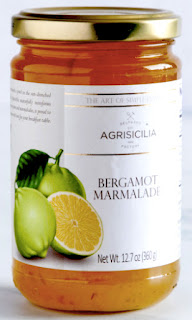
"The fruit's unusual name apparently comes not from the Italian city Bergamo, but from the resemblance of its slightly elongated shape to that of another highly regarded fruit, the bergamot pear, whose name came from the Turkish beg-ármûdi "the prince's pear." It may have arisen somewhere in the Mediterranean and is now produced mainly in the southern Italian region of Calabria. The whole fruit is sometimes made into a fragrant marmalade." (p. 326)

I am finding McGee's book very interesting, though challenging to read. I have read about half of it, and will no doubt find a few more obscure things to mention in my blog as I continue. I may never feel confident enough to write a review of the entire book! 

 Blog post © 2022 mae sander.

Saturday, February 05, 2022

What I did while the snow was falling or not falling

My cart at Trader Joe's: note the delicious jelly candy along with healthy lettuce and tofu.

Monday of this week the weather reports threatened us with a terrible storm, expected Wednesday. I decided to go to Trader Joe's and stock up my kitchen before the crowds that always descend on all shopping venues one day in advance of a big snowfall. There were plenty of other shoppers (almost all masked) but not overwhelming numbers, and the shelves had everything I wanted. 

The quite well-stocked produce and dairy shelves at TJ's.

I think the markets really did get crowded on Tuesday, but as the weather was still clear, we finally (after many months) went to the appliance store and ordered a replacement for our over-the-range microwave oven, which stopped working exactly a year ago. As soon as I had shopped, we started eating the goodies from TJ's.

Lunch Tuesday: strawberries and yogurt from Trader Joe's.

Dinner Tuesday: mushroom pancakes testing out my new griddle.
It works perfectly!

Wednesday was the scheduled storm. Indeed, in its wake the the snow and wind left many people across the South and the Midwest stranded and without electricity, but we had only a modest amount of snow and it was no big deal. 

Frost on our window: it's really rather cold outside!

Thursday we acted as if we were shut in, but that was in fact our own choice. All week, I spent most of the time reading, and writing blog reviews of the books I read: Tucci's Taste was the most exciting. Friday, I started reading Nose Dive by Harold McGee. It's a challenging book full of chemistry diagrams, but I'm persisting.

Friday the new microwave installation took place. In our house, any installation is fraught with uncertainty, but this time there were no obstacles. (We hired our favorite contractor, not the installer sent by the appliance store!)

The new microwave oven, installed.

Saturday morning we tested the new microwave by making oatmeal. Yay! It works. A year ago, when we bought a countertop microwave oven as a temporary replacement for the over-the-range one that stopped working, we did the same thing. The countertop oven was a space hog!

The space-hog countertop oven one year ago.

Back to normal: here's the freed-up space in use by the crock pot, making stock from a TJ's chicken.
The countertop oven occupied the space for a year. Today is a good day!

Blog post and all photos © 2021,2022,  mae sander.

Wednesday, March 04, 2020

"The Curious Cook"

Harold McGee's book The Curious Cook was published in 1992. That didn't stop me from learning all kinds of interesting new things when I read it this week.

As in his earlier book, On Food and Cooking, McGee's main interest is the science of cooking. He looks at currently interesting issues like salmonella in eggs or how to keep lettuce leaves or guacamole from turning brown. He also explores older questions such as whether searing meat really keeps in "the juices" or whether ice cubes freeze faster if you start with boiling water instead of tap water.

The Curious Cook also has an interesting focus on unusual histories such as the history of persimmons or jerusalem artichokes. He offers summaries of earlier food science such as the work of Benjamin Thompson, Count Rumford (1753-1814), and on the history of food words such as the word mayonnaise.

Let me start by telling you a few things I learned from McGee about mayonnaise.
I am a lover of mayonnaise; these are the two I have on hand.
  • Purists insist that mayonnaise must be made from egg yolks, olive oil, and a hint of lemon juice or vinegar. McGee points out that the definition of this sauce was once much broader, including some very surprising ingredients, like mashed potato.
  • Mayonnaise was first mentioned in print near the beginning of the 19th century. An important early discussion of mayonnaise appeared in the work of the famous chef Antoine Carême (1784-1833). 
  • By the end of the 19th century, says McGee, mayonnaise was a very popular condiment in both Europe and America: an example of American use is Waldorf Salad, first offered in around 1895.
  • The chemistry of mayonnaise involves emulsifying oil and egg yolk. McGee did extensive research on how this process works, including exploring the limits of how much oil can be emulsified into a small amount of egg yolk. Techniques for salmonella-safe mayo using cooked egg are also provided in his hands-on report. As he does with many topics, he challenges conventional cooking wisdom and long-standing myths.
  • Where did the word mayonnaise originate? McGee cites a wide variety of theories. Some people, says McGee, think that it's named after the battle of Mahon, which the French won in 1756. Others believe that this is unlikely because the word wasn't used for around 50 years after the battle, and because the city of Mahon isn't known for its gastronomic successes. Another French word could be the root: moyeu, egg yolk; but that word obsolete by the 19th century. 
  • "The true root word according to Carême, is manier: to work to manipulate," because of the process of working the liquids together. And "The most recent educated guess ... derives mayonnaise from the old verb mailler, meaning to beat, crush, or grind." (p. 130) 
  • Modern bottled mayonnaise dates to near the beginning of the 20th century. This started when growing interest in photography caused a surplus of egg yolks -- albumen from large quantities of egg whites was essential in the booming photographic industry. To cope with the surplus, it was discovered that frozen egg yolks kept very well. Then it was discovered that the frozen yolks were a fine ingredient in long-lasting mayonnaise. Throughout the 20th century mayo became more and more widely used in American cuisine.
I pursued the topic of mayo history, and discovered that in 2013, the popular American brand Hellman's Mayonnaise celebrated 100 years of production. In honor of that anniversary, many writers discussed the same history that McGee had covered 20 years earlier, as well as topics like why some people love mayo and some hate it; why some think its blasphemy to use it on corned beef; or why others find it totally improper to put mayo on a BLT. Here are a few links to the articles I found useful: "On the Etymology of the Word Mayonnaise" from Bon Appétit, "A Brief History of Mayonnaise" from Slate, and a history of the word mayonnaise from the blog Word Histories.

You might be a curious cook yourself, so I'll tell you what McGee said about searing meat, freezing ice cubes, and keeping green stuff from turning brown. If you want to read about his very careful experiments and discoveries on these subjects, you need to get a copy of the book for yourself! His conclusions:
"Searing meat does not seal in juices. Nor does searing reduce the loss of juices. The juiciness of meat is determined by the doneness to which the meat is cooked: the rarer the juicier." (p. 21)
"Hot water can sometimes freeze faster than cold water. In my freezer, ice-cube trays filled with hot or cold water take about the same time to freeze." (p. 190)
"Blemished lettuce leaves darken more rapidly in a salad than leaves with intact surfaces.  ... As long as your knife is sharp, it doesn't matter whether you cut or tear the leaves ... Both vinegar and oil harm the appearance of lettuce, but oil acts more rapidly. ... Leaving the avocado pit in the bowl will keep green only the guacamole in direct contact with it." (p. 72) 
You may think you know how a lot of things work in the kitchen, but McGee doesn't let myths, traditional authorities, or old-wives' tales get in the way of his experiments. While TV food science programs and many others have redone some of the tests, especially about searing steaks to "keep the juices in," his ideas are still intriguing and many are not well-known. He may have made a few mistakes (especially about the physics of heat, according to my husband, a physicist), but his results are mostly still very useful.

The copy of The Curious Cook that I read came from the library -- I think I once owned a copy but I don't think I have it any more, and I have no idea why it took me so long to get around to reading such an interesting book!

This Wordy Wednesday blog post copyright © 2020 mae sander for maefood dot blogspot dot com.

Monday, February 24, 2020

Food Books from the Library


Here’s what I plan to read soon... I’ll report on these food and cooking books if they are good reading. The Bloomsbury Cookbook looks full of wonderful art reproductions. I’m already intrigued by some of Harold McGee’s essays in The Curious Cook.

Thursday, January 18, 2018

Guest Post on Kitchen Torch Chemistry by Len

Kitchen Torch Chemistry

We have been having great fun with our new kitchen torch. I have found it amusing to look into what it does to food.  I have found that knowing a little about the chemistry of browning food has helped in finding ways to use the gadget.

When we brown food with the torch we are enabling two different chemical processes depending on what we are cooking: caramelization of sugar or browning of protein (the Maillard reactions). In both cases the goal is the same: the heat of the torch turns simple flavors into complex ones; that’s what cooking is mostly about. The background material to this is completely standard. A good source is Harold McGee’s classic book, On Food and Cooking, Chapter 14.

Caramelization:  Sugar has a very simple flavor, detected by receptors in the taste buds on the tongue. Table sugar is a colorless crystal which has no odor. If you heat it rapidly to 320F (160C) it melts to form a colorless liquid. However, around that temperature it also starts to break apart due to the heat. This is a slow process until about 338F (170C) when the rate of decomposition increases rapidly. The syrup turns brown – it becomes caramel and smells delightful. What’s happening is that the fragments of sugar recombine to make more than 100 different products, many of which can be sensed by our olfactory bulb. That’s how we sense complex flavors.

There’s are problem though: sugar burns at 350F (177C). We need to work in a narrow temperature range, which sounds tricky. In fact, it can be done, and  American children (or at least the patient ones) are trained to do it when they learn to toast marshmallows. Remember, brown them, don’t burn them.
Fig 1:  A torch is a great way to toast marshmallows in the winter.
Well, I guess we did burn them a bit.
The second problem is more serious. Water is usually present In food, and water boils at 212F (100C). If the torch is used on a wet surface, all the heat will go into evaporation, and the temperature will stick at 212F (100C), well below the caramelization temperature. A torch is a really bad tool for boiling water.

In crème brûlée this difficulty is avoided in an elegant way. The dish is made of a custard (flan or crème pâtissière) which is allowed to gel. Then sugar is put on top and caramelized. The custard is quite moist, but the surface need not be because the of the “skin” on the surface. A dense surface layer is quite common in gelation, and it seems to seal in the water. Making crème brûlée with a torch is dead easy, and the torch is an ideal tool. The contrast between the solidified caramel surface and the smooth custard underneath is wonderful. This has been one of my favorite desserts for a long time. See Mae’s previous post (link) for our success in the first try.

Encouraged, we decided to broaden our scope. We looked on the web and found two recipes that somehow made caramel in wet surfaces. The first is grapefruit brûlée, allegedly grapefruit with a nice crisp top. However, when you cut a grapefruit you release juice, and the surface is simply wet. We failed on our first attempt to make this dish. We followed a recipe that said to just put sugar on and torch it.  We did this, but the crisp texture of a caramel was simply not there. We made things worse by following our habit of pre-cutting the grapefruit sections to make them easier to eat.

Of course, there is a nice thing about this kind of experiment: you can eat the failures. A warmed-up, sugared grapefruit is fine for breakfast.

All undaunted we decided to use our insight into the mechanisms involved. We melted some butter and brushed it on the surface so that this would seal in the water long enough to make caramel. Then we sprinkled sugar on top and torched. It worked, and the dish was delicious.

Fig 2: Grapefruit brûlée made with melted butter.
Note the flake of caramel.
Even stranger was the claim that you can make oatmeal brûlée. We make oatmeal by boiling rolled oats in water in the microwave. It’s a wet dish. We did the straight-forward thing that recipes suggested (using drier oatmeal than we usually do). We failed. The result was sugared oatmeal – no bad thing, and we ate it, but not what we were after.

Following a suggestion by Evelyn we decided to seal this surface in a different way, by adding honey. Honey is a supersaturated solution of sugars (glucose and fructose). A thick honey doesn’t have much water, and is known to caramelize. We melted thick honey in the microwave, poured it on top of our oatmeal, and torched vigorously. We could easily smell caramel as we proceeded, and the result was extremely nice.


Fig 3: Oatmeal brûlée made with honey.
Caramelized honey has a nice, complex flavor.
Maillard Reactions: The Maillard reactions occur when a small sugar is heated in the presence of an amine (nitrogen-containing) group. Proteins are made of amino acids, and are usually the target of the reaction. The sugars occur naturally in the food. The temperature required for rapid reaction is 280-330F (140 – 165C). When the reaction proceeds many hundreds of reaction products are made. They are very complex: the wonderful odor and taste of grilled meat is produced this way, as is the brown crust of bread or cookies (they smell good too.)

The problem of moist surfaces is not usually present in this case. Broiled meat may be moist inside, but the surface is dry. We have shown in a previous post how we torched a steak after broiling. We put more black pepper on the steak than we usually do, and the result was quite interesting because we liberated the aromatic oils in the pepper. Our next experiment will be to use green peppercorns. There is a classic French recipe for steak with green pepper sautéed in a hot pan. We want to try broiling and then torching. Stay tuned.

The reductio ad absurdum of this kind of thing is something we have read about, sous-vide cooking of steaks. Professional chefs put steaks in plastic pouches and heat them in water baths at 135F (55C) to for an hour or two. There is no Maillard browning at all, but uniform cooking. Then the steak is torched on the surface. The photos we have seem make a steak look like an industrial product, some kind of plastic molding. We have no idea how these productions taste.

A simple example of Maillard is the browning of toast, and a torch can do it, though it’s a bit perverse. However, we can nicely combine the two browning reactions by making cinnamon toast. We buttered bread, sprinked on sugar, and torched. Excellent result.


Fig 4: Cinnamon toast came out very well.
Notes on technique: We use a butane torch made by Iwatani that we bought on Amazon. It’s fine for our purposes. Professional chefs use more powerful propane torches, the kind that plumbers use to solder pipes. I have been strictly forbidden to even think about bringing such a thing into our small, not very fireproof kitchen.

Fig 5. Our torch.
That said, I have found that I do want a pretty hot flame. I turn the gas all the way up and adjust the air so that the flame roars. The exception is for marshmallows and crème brûlée. For these dishes almost anything will do.

Do you need a torch? Of course not. Unless you want to solder pipes, anything a torch can do can be done with an oven broiler or a toaster oven. (Okay, not the marshmallow). But playing with fire is really cool, and I highly recommend it.

NOTE FROM MAE: The guest author of this post is my husband Len, a Professor of Physics at the University of Michigan and (now) dedicated kitchen torch user. All photos and text copyright 2018 by Mae E. Sander and Len Sander. Published at maefood dot blogspot dot com. If you read this elsewhere, it has been stolen.

Friday, April 28, 2017

Spring Pleasures

Chocolate chip cookies... one of the most perfect foods, no?

I made them from the recipe on the Toll House Chocolate Chips package.
The eagles at Magee Marsh on Lake Erie east of Toledo are raising eaglets again this year. Warblers are just returning.
We enjoyed a beautiful day with friends, birdwatching, fleeing a downpour, eating in Toledo, and going to the museum.
I brought some of my chocolate chip cookies to share with the friends (not with the birds).

... the eaglet's head popped up now and then as I watched the nest.

Spring flowers at West Lake Preserve near Chelsea, MI.
That's what I've been doing this week!

Sunday, November 08, 2015

Do molecules from the soil directly affect the flavors of wine or food?

I am reading the book Tasting French Terroir: The History of an Idea by Thomas Parker. The topic of this book is the study of French literary, culinary, and agricultural texts, mainly from the 16th through 19th centuries. The focus of the book is limited to these texts and how they displayed varying attitudes over time towards the value of local qualities -- terroir -- in food and wine. Parker is concerned primarily with the way that the development of the concept of terroir played a role in the development of French national identity and language.

In reading Tasting French Terroir, I felt as if the author never addressed the question of whether there was objectively and measurably a taste imparted to wine by the minerals and other substances in the soil where the grapes were grown. The writers whose texts he analysed believed in such a taste, and that’s the only thing that concerns him. However, I was curious so I looked it up a little bit.

No one disputes that wines from different vineyards have varied flavor. However, experts discuss at great length which wines reflect strong characteristics arising from local differences in soil, cultivation, and climate, and which wines display more less of this so-called taste of terroir/goût de terroir.

Any such discussion ultimately depends on a key question: In actuality are humans actually able to discriminate soil flavors in wine? To quote the much-respected food chemistry writer Harold McGee:

“It’s hard to have a conversation about wine these days without hearing the French word terroir. Derived from a Latin root meaning ‘earth,’ terroir describes the relationship between a wine and the specific place that it comes from. For example, many will say the characteristic minerality of wines from Chablis comes from the limestone beds beneath the vineyards (although, when pressed, they generally admit that they’ve never actually tasted limestone). The idea that one can taste the earth in a wine is appealing, a welcome link to nature and place in a delocalized world; it has also become a rallying cry in an increasingly sharp debate over the direction of modern winemaking. The trouble is, it’s not true.”

Ultimately, McGee agrees in a way with the central idea of Tasting French Terroir: he states that not just the minerals in the soil (or as he calls them, “rocks”) provide locally made wines their distinctive characteristics, but that the entire process of growth and winemaking combine to provide them. McGee says:

“If rocks were the key to the flavor of ‘somewhereness,’ then it would be simple to counterfeit terroir with a few mineral saltshakers. But the essence of wine is more elusive than that, and far richer. ... ‘Somewhereness’ is given its meaning by ‘someoneness’: in our time, by the terroirists who are working hard to discover and capture in a bottle the difference that place can make.” (from Harold McGee, “TalkDirt to Me,” New York Times, May 6, 2007.

Food writer Robert Hass wrote about the question in 2008:
“…terroir in its current use has taken on a new importance.  The expanding employment of vineyard designations on New World wine labels is a sign of our current efforts to give specific ‘somewhereness’ to both varietally labeled wines and blends. We are using terroir in a positive sense as a tool to emphasize a wine's taste characteristics determined by soils and climate as opposed to those specific to a given grape varietal or those which come from cellar manipulations. Cellar manipulations, and the sameness that these can produce in wines from different areas (and even different grapes), are coming more and more under fire from a growing number of consumers and press as a misstep in the search for more ‘natural’ wines.” (from “Terroir, Then and Now” by Robert Hass)
The idea of goût de terroir is more broadly applied to many other foodstuffs, and the question of which local characteristics contribute to local flavor distinctions can also be asked more broadly. “Artisanal crops for which terroir is studied include wine, coffee, tobacco, chocolate, chili peppers, hops, agave (for making tequila and mezcal), tomatoes, heritage wheat, maple syrup, tea, and marijuana.” The ideal of special local flavors extends even to chickens grown in specific places, like poulet de Bresse from France; oysters from varying seacoasts, cheeses, mushrooms, and so forth. (Quote from Wikipedia.)

Discussions of goût de terroir relate to the general interest in eating locally grown foods. Products valued for their regionally-unique flavors are often shipped great distances and valued well beyond their region of origin. The reasons for eating locally go well beyond the question of discriminating such tastes.


My more conventional book review of Tasting French Terroir will deal with the questions that Parker did study rather than with this one which he did not discuss. I’m writing the review for Repast, the journal of the Ann Arbor Culinary Historians.

Monday, March 04, 2013

A New Look at Canned Goods


From Harold McGee, "Age Your Canned Goods," a very eccentric article about the way that the flavor of canned goods changes as they age: not always for the worse. In fact, he cites a number of experiments where people liked older canned goods better than more recent ones. Aged canned tuna! Aged canned sardines! Even Spam! His subtitle summarizes this view: "Why I now think of best-by dates as maybe-getting-interesting-by dates."

Mc Gee writes:
"As far as I can tell, European connoisseurship in canned goods goes back about a hundred years. It was well established by 1924, when James H. Collins compiled The Story of Canned Foods. Collins noted that while the American industry—which started in the 1820s and took off during the Civil War—focused on mechanization and making locally and seasonally abundant seafood and vegetables more widely available, the European industry continued to rely on handwork and produced luxury goods for the well-off, who would age their canned sardines for several years like wine. Today, Rödel and Connetable, both more than 150 years old, are among the sardine makers that mark select cans with the fishing year and note that the contents 'are already very good, but like grand cru wines, improve with age' for up to 10 years.
"But the appreciation of can-aged foods wasn’t unknown in the United States. Collins recounts an informal taste test conducted by a New York grocer who rounded up old cans from a number of warehouses, put on a luncheon in which he served their contents side by side with those from new cans, and asked his guests to choose which version they preferred. Among the test foods were fourteen-year-old pea soup and beef stew, and twelve-year-old corned beef and pigs’ feet. The guests preferred the old cans 'by an overwhelming majority.'"
McGee, of course, always explores the chemical and mechanical details of his subject matter, so the details in the article are absolutely fascinating!

Tuesday, May 10, 2011

Is expensive sea salt worth its salt?

I've often wondered about the eye-popping prices for things like Himalayan sea salt (for one thing, there's no sea in those mountains) and hand-gathered fleur de sel from France. I've never been energetic enough to buy some and taste-test it -- besides, I'm too cheap. Finally, an article by Harold McGee a couple of weeks ago reported on this topic offering to sort out the "whirlwind of obfuscatory hype" that surrounds the labeling and use of fancy salts.

Here is the bottom line: "different salts do indeed have different tastes, even when the solutions had the same concentration of sodium." That said, "the differences themselves were generally small. ... Tasters significantly preferred chicken broth and bratwurst made with an inexpensive white sea salt over the ones made with kosher salt. Batches of those two foods made with gray sea salt, or sel gris, and fleur de sel fell in between."

Although altogether the reported studies showed that the result of using various types of salt isn't highly significant, McGee still suggests that adventurous or curious cooks might enjoy experimenting. I appreciate his point of view, though I might still be too cheap to pay the eye-popping prices for the most hyped salts.

Thursday, February 03, 2011

Statistics

News from the Guardian:
"Food prices hit record high: UN food price index up 3.4% from December, the highest level since the organisation started measuring food prices in 1990"

Also interesting, same source:
"Science in the kitchen: We need to know the science behind rubbery eggs and wind-inducing beans, says US food writer Harold McGee. It'll make us better cooks."
-- McGee is one of my favorites, and this is a great overview of his life & work.

Wednesday, April 14, 2010

The Anatomy of a Twinkie

Twinkie, Deconstructed: My Journey to Discover How the Ingredients Found in Processed Foods Are Grown, Mined (Yes, Mined), and Manipulated into What America Eats

"Twinkies' buttery flavor provides the richness we expect from cake and likely also helps to mask their oiliness. Since due to cost and rancidity issues there's no room in a packaged cake like Twinkies for fresh butter, artificial butter is the answer. ... The most surprising thing about it is that it really stinks." In fact, we learn, many flavor chemicals smell "positively awful." Even natural flavors like vanilla have so many different flavor elements that some of them have unappealing notes, at least to some people.

"Memory is also important to taste.... When we eat a favorite snack cake, we expect it to taste exactly as we remember from last time, or from childhood." And we expect it to feel the same. In Twinkie Deconstructed, author Steve Ettlinger provides an ingredient-by-ingredient analysis of just how Twinkies are put together: the flavors of sugar, vanilla, and butter; the texture of filling and cake; and the way the cake stays dry and the filling stays creamy. I sort of reacted to this when I took a bite of the Twinkie, but I could also detect some of the chemical notes in its composition.

In all Ettlinger counted 39 ingredients listed on the package of Twinkies a few years ago. He points out that the recipe subtly changes over time -- my Twinkie box was indeed just a bit different, but of course sugary-buttery cake and creamy vanilla filling predominate. Two of the three main flavors, vanilla and butter, are present only in artificial form, and another expected component, eggs, is mainly there as artificial stabilizers, with maybe 1/500 of a real egg in each Twinkie.

I decided to buy a copy of Twinkie Deconstructed when I celebrated Twinkie Day last week, with my first Twinkie purchase in many years. I found the book quite fascinating. I liked the description of each ingredient's function in creating taste or texture in the baking process, the history of the product or the story of its invention, and the descriptions of how each one is made.

In his quest to deconstruct the Twinkie, the author visited the manufacturing plants where most of them are milled, refined, mined (yes, chemical leavening comes from mines), assembled or derived (mostly from petroleum), and often secretly manufactured (as in the case of vitamins). His sense of panic when deep down in a soda mine was especially memorable. His text lists of other processed foods that use each of the components, especially the artificial ones. Even flour, the least processed ingredient, is a pretty highly processed substance. Did you know that some of the fat in Twinkies is from beef? Me neither. Wow!

Above all, I was very intrigued with a relationship between what Ettlinger found and the article by Harold McGee that I mentioned this morning in my post Why some people hate cilantro. The complexity of flavors Ettlinger describes, such as vanilla or butter, means that they often include flavor elements that may be disgusting to some people, but they are very complex with dozens of elements that are perceived all together. In McGee's article a parallel example is cilantro. Its complex flavors often seem too much like soap or bugs to Americans who are unfamiliar with the herb. Butter is similarly complex, in that it has some very unpleasant elements. People unused to dairy products may focus on this stink rather than on the creamy dairy taste that we learned to love as children -- just as some non-cilantro eaters react to the bad elements of that flavor combination. Lifelong eaters simply don't notice the bad parts -- the undeniable stinkiness of artificial butter is due to the unnatural concentration of some of these elements and the absence of others, and it's used in such small quantities that it doesn't matter.

(Quotes: p. 210, 200; also see News For Curious Cooks: Curious Cook in the New York Times: Cilantro flavor, loved and hated)

Why some people hate cilantro

Harold McGee has done it again! The newest "Curious Cook" column -- "Cilantro Haters, It’s Not Your Fault" -- provides a neuroscientist's explanation for why many people deeply hate the smell and (if they get far enough to taste it) the taste of cilantro. He cites Julia Child, for example, as saying that she would throw a sprig of cilantro on the floor if she found it in her food.

Do some people have an inborn ability to detect odors or tastes in cilantro that an appreciator of the herb can't perceive? I, like McGee, was expecting a genetic explanation. That is evidently not the reason. Cilantro, he notes, contains some flavor elements that resemble soap and maybe even bugs. It also has many herb-like flavors. Your collective personal experiences evidently determine how important and yucky you find the soap aroma. If you live in a cilantro eating culture and associate it with childhood food memories, maybe the fresh-herb notes will charm you. If cilantro was a new strange item at some point, you might be overwhelmed and disgusted by the soapy element. So some people hate it and others do not.

"When we taste a food, the brain searches its memory to find a pattern from past experience that the flavor belongs to. Then it uses that pattern to create a perception of flavor, including an evaluation of its desirability," is the neuroscientist's explanation. "If the flavor doesn’t fit a familiar food experience, and instead fits into a pattern that involves chemical cleaning agents and dirt, or crawly insects, then the brain highlights the mismatch and the potential threat to our safety. We react strongly and throw the offending ingredient on the floor where it belongs."

Considering how neuroscience can be misused in so many ways (as documented frequently in my favorite blog, Language Log), I find this insight to be really wonderful in its simplicity.

Thursday, February 25, 2010

Speaking of No-Knead Bread

Sunday evening we were treated to a beautiful meal at some friends' house. It included a loaf of no-knead bread that was incredible. Of course I'd heard about this recently-developed technique for bread-making, and maybe tried someone else's version without discussion. Yesterday the bread-maker/hostess sent me copies of the two articles from 2008 that she relied on. On the same topic: the current blog post, Do You Really Want to Make French Bread? by editor (and now blogger) Judith Jones. AND...

Now Harold McGee has spoken! This week's New York Times column is about the famous no-knead breads, including experimental and theoretical information. Don't miss
The Curious Cook

Better Bread With Less Kneading

Wednesday, January 06, 2010

A quiet dinner with word study

We didn't go to Florida as planned for this weekend.
Going on an airplane with a cold? No. We had to wish Jack happy birthday by phone.

So we had a quiet dinner. A pasta casserole with goat cheese and breadcrumb topping. And some blueberries (not quite satisfactory winter ones) and very good shortbread cookies from Whole Foods.

That's when it got interesting. We began wondering why "short pastry" means pastry having a lot of fat, and why "shortening" means fat of all kinds, as in strawberry shortcake, shortnin' bread, or vegetable shortening.

I googled and found a lot of people speculating that shortening refers to the effect of fat on the molecular gluten chains in pastry. The chemical process during the rise and kneading of dough is to form molecular chains that create the texture of bread; with fat present the gluten supposedly forms shorter chains, which changes the texture of the pastry. This explanation of the term short is an obvious anachronism: shortening is an old term, knowledge of gluten molecules comes from modern chemistry. I read more.

McGee's On Food and Cooking says the term shortening has been used since the early 19th century "to mean fats or oils added to baked goods that supposedly 'shorten' or break up masses of gluten, thus weakening the structure and making the final product more tender." (p. 302) McGee says that the repeated folding and rolling of dough with butter between the layers results in "a stack of separated flakes rather than an integrated, breadlike matrix." However, he doesn't really try to explain why the term short is used or where it originated; he focuses on the role of shortening -- liquid or solid -- in bread dough and cake batter.

A more historically oriented write up of the term was in a blog post: The origins of shortening? This traces the use of the word short back several hundred years. The post quotes the following dictionary definition of the word short:
Of edible substances: Friable, easily crumbled. Phrase, to eat short: to break up or crumble in the mouth. a. of crust, pastry, etc. Cf. SHORTBREAD, SHORTCAKE, SHORT CRUST.
In other dictionary examples given, short just means fat, as "1648 GAGE West Ind. 143 This is the Venison of America, whereof I have sometimes eaten, and found it white and short."

The conclusion: the usage of short and shortening for fat in pastry has been used for centuries, and arose from the meaning crumbly, first applied to the ingredient that created crumbly or flaky pastry, later expanded to mean all fats. The recently-described molecular process might create short gluten chains -- McGee, however, says the process isn't well understood, undermining this claim.

Wednesday, December 10, 2008

Persimmon Mystery


At Thanksgiving, we were treated to these beautiful persimmons, which I'd never much tried before, and various family members sliced them up and passed them around. They had a mild but pleasant flavor. (Actually, I preferred the clementines that were in the same attractive fruit bowl.)

Last week, Lenny requested that I buy some when I went shopping. At Whole Foods, I paid $2 for ONE rather small, but nicely colored persimmon. Organic. It looked to me like the ones we had eaten.

We sliced it. It looked like the ones we had at Thanksgiving: brightly colored, sort of solid. But it was horrible. It made our mouths feel like cotton.

Food wizard Harold McGee, in his New York Times column today, has the explanation!

He writes:
The persimmons that we see in markets are an Asian species that comes in two general types, one of which requires special handling and should be sold with a warning label for the novice.

The flat-bottomed Fuyu type can be eaten when firm, and it usually is. This is the persimmon that many restaurants are serving now, peeled and sliced into salads.

But elongated persimmons, usually the Hachiya variety, are absolutely inedible when firm. They are more astringent than the worst overbrewed tea or overextracted red wine you have ever been assaulted by. Their mouth-drying tannins recede only when the flesh ripens fully into a translucent, almost liquid mass.

Monday, November 24, 2008

The World of Peppers


Peppers come in two vastly different varieties: old-world peppercorns from a tree, and capsaicin peppers from a new-world vine. As anyone knows, the principal effect of adding pepper to food is to create heat, but beyond that, peppers come in many flavors. Old-world peppercorns (or berries) are mainly classified by color, which determines their flavor. New-world pepper pods come in a huge variety of shapes, colors, sizes, and heat. The Scoville scale rates them numerically for degree of heat, from zero for bell peppers, 100 for pimentos, up to habaneros – as much as 350,000.

Out of curiosity, I started mentally listing the various types and flavors of peppers and pepper blends I have either eaten or only heard about. In my experience cooking and eating, I’ve definitely grasped how much difference it makes to use the right pepper as an ingredient, and I’m very curious to try more varieties – though personally, I’m no longer fond of the very hottest varieties. I decided to make a list with some links to wider sources of information.

Lydia at The Perfect Pantry got me started on this, so I have referenced a number of her posts about specific types of peppers. She provides many recipes, in case you need more inspiration.

Old-World Pepper Types
Peppercorns were the most important item in the spice trade from the far East, beginning in Antiquity. At times peppercorns were worth more than gold. Today says Lydia: “India and Malaysia produce the best black pepper varieties: Malabar, Tellicherry, and Sarawak. From Indonesia we get Muntok, considered the highest-grade white pepper. Brazil and Vietnam also contribute to the world supply.”

Black Pepper: this is the generic pepper you find in a shaker on a restaurant table or would have had in the 1950s before we got so picky. Now it may be labeled with a country of origin or other special designation. Szechuan peppercorns are recommended for Chinese food (I haven’t tried them). Tellicherry black peppercorns have a single origin. When I can find Tellicherry pepper, I use it as it is definitely a more complex flavor. However I don’t think there are specialized recipes for its use.

Green Peppercorns are unripe pepper berries from the tree. They were one of the first specialty peppers; they were a fad in the early 1970s, when they were packed in cans, still soft, not dried. I remember the first time I tasted them, at the home of my friend Michelle in Paris. In this form, they are [still] delicious in fish or veal recipes. You can now also buy them dried.

Pink Peppercorns are a bit milder than black. I’ve mainly seen them in mixtures, so I can’t say much about their specific taste.

White Peppercorns -- actually kind of gray in color -- used to be the choice of ground pepper for flavoring white sauces or light-colored food, in order to avoid black specks. It was recently the subject of an entire column in the New York Times by Harold McGee. In his blog, McGee writes: “Fresh peppercorns are small fruits. They consist of a large, light-colored seed surrounded by a thin fleshy layer, which turns from green to red as the peppercorn ripens. When the still-green peppercorn is harvested and dried, the outer layer turns black: hence black pepper. To make white pepper, the producers pick the peppercorns when they're ripe and the outer layer soft, put them into bags or barrels, and submerge them in water to ferment for as much as two weeks. The outer fleshy layer rots away, and the light seeds are then dried.” He explains how the process sometimes results in off-flavors, which may be a problem if one uses too much white pepper.

New-World Pepper Types
Columbus discovered America because he was looking for pepper and gold; he definitely struck pepper! Very quickly after he brought them back to Spain, new-world peppers were quickly tried, loved, adopted, and integrated into almost every cuisine on earth. New varieties were developed and cultivated in specific places (and continue to be developed), and as a result, many of the types of peppers are now native to Europe, the Middle East, and Asia. As for the world's hottest peppers, they seem to be varieties from India; I haven't listed them because I don't really know anything about them.

Here are some pepper types including a few blends and sauces:

Adobo sauce: Lydia writes: “Chipotles (pronounced chee-POT-lays) are smoked jalapeño peppers, originally from Mexico and used extensively in the cuisines of Mexico and the southwestern United States. The husky flavor of the chile hints of chocolate and coffee, and the adobo sauce, originally used as a preservative, typically contains tomato puree, paprika, salt, onions, oil, vinegar, garlic, bay leaves and oregano.”

Aleppo pepper. From Lydia: “Native to Northern Syria and Turkey, Aleppo (also known as halaby) peppers are sun-dried, seeded and crushed into small flakes. The pepper is a deep red, almost eggplant, color with a high oil content; the flavor is mildly spicy and fruity, with a hint of smokiness.”

Cayenne pepper is a very hot variety of ground pepper. It used to be the main ingredient whenever you wanted to crank up the heat of a dish; I rarely use it any more because there are so many more complex and delicious possibilities.

Chile powder is anyone’s blend of ground chilies and other spices. I bought some at a farmers’ market in New Mexico once that was fabulous (see photo at top of page). I usually use Ellen’s recipe for Texas-style chile powder if I blend my own. It’s a basic ingredient in basic Mexican, Tex-Mex and similar dishes. You know this!

Chipotle peppers are one of the less-hot Mexican and US Southwestern varieties, not too hot but with a kind of smoky taste. I’ve recently been very fond of Tabasco brand Chipotle pepper sauce. Also see Adobo Sauce above.

Habanero or Scotch Bonnet peppers are the hottest peppers I know from my own experience. I have promised never to put them in Lenny’s food again. In fact, I have lost my ability to eat them much. Modern-day Mayans (in the Yucatan) love them: there are stories about Mayans who do not feel that a meal is complete – even breakfast – without them.

Jalapeno peppers are the most common variety of Mexican peppers: small, dark green, very shiny (or canned). They are the standard for salsa and garnishes in Mexican restaurants. They definitely appear on mass-produced Mexican food such as nachos.

Paprika is made from certain varieties of dried peppers, and may be smoked or aged.
Hungarian paprika or Szeged paprika can be mild or hot, and has a very nice. distinctive flavor. My Hungarian cookbooks definitely call for it in many recipes.

Spanish paprika, or pimenton, has received a lot of attention recently. I tried the mild kind, which in fact is a pretty strong flavor, though not that hot. Lydia says: “Like cumin but a bit sweeter, pimentón imparts a slightly smoky flavor to any dish.”
Poblano peppers – another Mexican variety that’s mild enough for northern tastes. It’s small and I’ve seen it both green and fresh, and red, wrinkled and dried.

Tabasco sauce is a proprietary brand of Louisiana hot sauce made from a proprietary variety of peppers. In the book Peppers: A Story of Hot Pursuits, there’s a detailed history of this brand, the family that manufactures it, and their long struggle to protect their trademarks. The sauce is so well-known that I don’t have to say any more.

Urfa peppers – a post from Lydia at The Perfect Pantry today introduced me to this type of Turkish dried pepper, which I haven’t tried. However, this inspired me to try to explore the world of peppers here!

Wednesday, August 06, 2008

In the New York Times Today: Cold in the kitchen, local in the supermarket

Harold McGee has done it again. His column today talks about how to freeze things fast and efficiently:
In the New York Times: Cold in the kitchen

Does hot water make ice faster than cold water? McGee isn't so sure. But he suggests some new ways to freeze ice cream fast.

Of course he can't resist starting with some way-out post modern foodie stuff, but it's a very interesting article.

And in another article, Supermarket Chains Narrow Their Sights, Marian Burros provides a very interesting discussion of the developing trend to have local produce in supermarkets -- even Whole Foods finds this challenging. One personal data point: my own Whole Foods in Ann Arbor several years ago said they couldn't manage local: now they do. A quote from this interesting article:
These [local] growers are used to picking the zucchini and bringing it to a stall at a farmers’ market. In order to sell to grocery stores, they have to learn pricing, invoicing and ordering systems as well as post-harvest handling techniques that include chilling, sorting and grading for size and color.

Big retailers have even more work to do. Used to making just a few phone calls to large produce distributors, often thousands of miles away, they do not have the setup or the personnel to deal with individual farmers who deliver to the back door.

Some of them are reluctant to do so and small farmers either have to join a co-op or find a distributor who can deliver to the supermarket’s warehouse.

The chains also have to change their purchasing practices to make room for seasonal local produce instead of being locked into a year-round contract with one source in order to insure the lowest prices.

Thursday, May 29, 2008

Molecular Gastronomy

In his blog this month, famous food author Harold McGee had an interesting post on post modern cooking: News For Curious Cooks: Modern cooking and "molecular gastronomy". McGee has been creating a history of gastronomic seminars at the Erice conference center that brought together leaders in this field uniting science and cooking -- his forte. I learned that McGee was an organizer of these seminars, along with a physicist, Nicholas Kurti. Of course I was especially fascinated by this, as I've been a trailing spouse at 4 or 5 seminars at Erice. Being there is a fabulous experience -- including the food served at the many restaurants in the tiny hilltop town where an ancient monastic complex has become a physics and science conference center. The photo at right is from our most recent trip there a few years ago.

One point in McGee's articles was the distinction between the science of cooking, including various experiments in synthetic creation of food-like offerings, and the presentations of certain modern cooks. Their avant-garde cooking often goes by the name of molecular gastronomy, though there are many writers who feel this is a mistake. The term was introduced in the title of the first Erice seminar, not intended as the name of a type of cuisine, but as a discipline, if I understand correctly. McGee makes this point:

Misinformation and misunderstandings about experimental cooking have been accumulating from its very beginnings. They're now hardening into bad pop cultural history that tags very different chefs and their ideas with the impressive but empty terms "molecular gastronomy" and "molecular cuisine."

The two documents and many supporting letters and conference poster are a fascinating bit of history, which McGee is in a special position to preserve.

I was very interested in one link, to the website of the most famous of the cooks in this probably mis-named cuisine: Synthesis of elBulli cuisine, which is a manifesto (without specifically admitting it). I felt this set of principles resembled another such document: Marinetti's The Futurist Cookbook. I claim this in support of my recent observation (Futurists see the future) that Marinetti's food preparations and presentations -- which were meant only as an exercise in imagination -- closely resemble food of the so-called molecular gastronomists. It's bizarre how the pretensions of this modern cuisine resemble the rants of this 1932 document of strange surrealist intent.