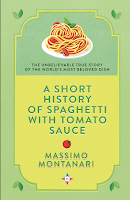
“Is it possible to sit down to a plate of spaghetti with tomato sauce and reflect on the meaning of roots, identities, and origins? That is what I have tried to do in these pages” (A Short History of Spaghetti with Tomato Sauce, p. 9)
Reading Massimo Montanari’s book
A Short History of Spaghetti with Tomato Sauce (first published in Italian in 2019, translation in 2021) I was delighted with his brief histories of all the key ingredients and how they came to Italy: pasta, tomatoes, cheese, olive oil, capsicum peppers, garlic, onions, basil leaves. Although I have read about these ingredients before, I enjoyed Montanari’s perspective on how the dish, which is seen as so quintessentially Italian, took a long time to become the iconic symbol of Italian food. He reminds the reader who thinks she knows it all: “in the history of cooking there is very little that is obvious, or maybe nothing.” (p. 35)
I enjoyed Montanri’s descriptions of the components of this dish to look for insights into culture and history, not only of food, but of the relationships among peoples and cultures over centuries and even millennia. Starting with a discussion of the long history of pasta, Montanari writes:
“The Italian pasta tradition has been influenced by other histories, other ‘roots,’ which evoke other cultures and other regions of the world. The search for ‘origins,’ in this case, takes us to the Fertile Crescent, the Middle Eastern regions to the east of the Mediterranean, where, ten to twelve thousand years ago, the agricultural revolution began, and with it, the culture of wheat and its derivatives—first among them, bread, which became the symbol of that revolution.” (p. 19)
Tomatoes, too have a long history:
“Original to the western coasts of South America, where it still grows wild, the tomato enjoyed an extraordinary success among the Maya and the Aztecs. It was in Mexico that it met up with the Spaniards of Hernán Cortés, when they occupied the country between 1519 and 1521. It was immediately taken to Spain and that’s how the tomato came to be grafted onto the gastronomic culture of Italy. Naturalists and botanists are the first to mention it, starting with Pietro Andrea Mattioli (1544) who cites it in his commentary on the pharmacological text of Pedacio Dioscoride. … In 1548, Cosimo de’ Medici received a basket of tomatoes from the Florentine gardens of Torre del Gallo, and this is the first evidence from the ‘field’ of an Italian interest for the new plant.” (pp. 55 & 57)
The Aztecs invented tomato sauce, among other things. A traveler to the New World was one Francisco Hernández, physician at the court of Philip II of Spain. During his travels from 1570-77, he wrote sixteen volumes concerning American plants and their uses. He wrote about a Mexican dish: “a delicious sauce or intinctus (dip) that ‘is prepared from sliced tomatoes and chili pepper, which enriches the flavor or almost all dishes and almost all foods, and reawakens the appetite.’” (p. 60)
However, tomato sauce took a long time to become the classic accompaniment to the highly traditional pastas of Italy. Author Ippolito Cavalcanti finally mentioned pasta with tomato sauce in the 1839 edition of his influential cookbook: a first! “The sauce is made from crushed ripe and deseeded tomatoes, placed to cook in a casserole together with their juice (acquiccia) and stirred continuously until, once cooked, they will be milled and cooked down ncoppa a lo fuoco (over the fire). At the end, salt and pepper are added and the sauce is ready, very simple and truly ‘popular.’” (p. 64)
Pellegrino Artusi, author of the most important 19th century Italian cookbook, provided a recipe for tomato sauce “seasoned with onion, garlic, celery, basil, parsley, olive oil, salt, and pepper.” He wrote that it would “lend itself ‘to innumerable uses’… It will be good with boiled meat,… but above all it will be ‘excellent when served with cheese and butter on pasta.’” Artusi’s recipe is also the first instance of using onion and garlic in the tomato sauce! (pp. 66 and 76)
Going onward to other ingredients, Montanari describes how peppers quickly became a staple ingredient of European food after their import from the New World. He explains that olive oil has been made since early antiquity, but its use in pasta is startlingly recent: “Dressing pasta or tomato sauce with olive oil became ‘normal’ only in the second half of the XX century.” (p. 75)
Similarly basil was long considered to be inedible; it became accepted as a culinary herb in the 16th or 17th century. Along with other herbs, it was included in the 19th century recipes cited above. “Over time, basil has become an inevitable ingredient of our dish, an identifying element, to the point of acquiring in the iconography of the media an immediately understandable symbolic value.” (p. 79)
In his conclusion, Montanari summarizes how the iconic plate of spaghetti that seems to represent Italy and the Italian identity actually has a variety of multi-cultural roots. “The history of our plate of spaghetti, the search for its origins and its roots—economic, social, political, cultural—has forced us to travel to multiple lands and to come to terms with eating habits, ways of production, and culinary procedures distant from each other in time and space. A long series of innovations, developed in different times and places, have contributed to creating this tradition so typically Italian.” (p. 82)
Our Pasta Dinner
Obviously reading about the history of spaghetti with tomato sauce made me wish to eat some. So I followed a recipe for a particular variety of pasta with tomato sauce: that is, Pasta Puttanesca, which includes the classic ingredients along with anchovies, olives, and capers. This dish does not include the cheese that’s a traditional part of the more usual version, probably because it’s not customary to include both fish and cheese at the same time. Note that the name Pasta Puttanesca means prostitutes’ pasta. There are many explanations for this interesting nomenclature.
 |
These are the basics for Puttanesca tomato sauce along with canned tomatoes as well as fresh.
Note that the wine is to be drunk with the meal, not used in the dish. |
 |
Pasta, garlic, tomatoes, anchovies, olive oil, pepper flakes, olives, capers, and basil for a garnish.
I mainly followed the New York Times recipe by Mark Bittman (link), adding the fresh tomatoes.
|
Review and photos © 2024 mae sander