Showing posts with label Native American History. Show all posts

Thursday, May 08, 2025

Books This Week


The Story of the Forest by Linda Grant doesn’t live up to its promise as a family saga. It tells the story of an immigrant Jewish family who come to Liverpool, England, just before the first World War, and despite their intentions of continuing onward to America, somehow never leave. It’s clear that this book is an effort to reconstruct the author’s own family history, based on rather sketchy information and a few often-retold stories. Indeed, it’s much too close to the way personal stories come off: a bit vague and tentative, somewhat pointless, lacking the power of a strong narrative voice or a really vivid central character. Wimpy. Sad. Not up to some of Linda Grant’s best fiction, of which my favorite is When I Lived in Modern Times, which won the Orange Prize in 2000.


Ursula Le Guin (1929-2018) was a fantastically imaginative writer, and I’ve read many of her books. This was her last book, published in 2008. It’s based on the Aeneid of Vergil, which I have never read, so it was entirely new to me, and I have no idea how Le Guin’s novel borrows from the original. I know only that Le Guin says that the title character, Lavinia, was only named, not developed by Vergil, and the detailed life of Lavinia was thus entirely her creation. Of course Le Guin brings the character to life in a wonderful and very readable way, and this book is genuinely a good read.

In the Afterword, Le Guin makes a point that I find especially important in thinking back on my experience reading this novel:

“From the Middle Ages on, the so-called dead language Latin was, through its literature, intensely alive, active, and influential. That’s no longer true. During the last century, the teaching and learning of Latin began to wither away into a scholarly specialty. So, with the true death of his language, Vergil’s voice will be silenced at last. This is an awful pity, because he is one of the great poets of the world.
“His poetry is so profoundly musical, its beauty is so intrinsic to the sound and order of the words, that it is essentially untranslatable. … More than anything else, my story is an act of gratitude to the poet, a love offering” (p. 359)


We never miss a new novel about the Navajo detectives Joe Leaphorn, Jim Chee, and Bernadette Manuelito. In this one, published quite recently, Chee and Manuelito — a husband and wife, both police officers — are subject to all kinds of terrible risks, and are both almost killed by the criminals they are investigating. Poor Bernie, she’s always a victim of some violence, but of course she outsmarts her opponents every time and quickly gets over whatever injuries she suffers. No surprises here. 

Shadow of the Solstice is interesting for the author’s focus on actual current issues for Southwest Indian tribes. There issues as a driving force in the two intertwined detective assignments of Chee and Manuelito. One issue is the continuing problems on the Navajo reservation caused by uranium mining in the past, and the necessity to block new efforts at destructive and damaging extraction of minerals from the territory. 

The other plot element is based on an actual series of fraudulent claims for social benefits in which criminal scammers tricked members of the tribe into cheating the government. These fraudsters exploited their Indian victims and left them in desperate straits, including homelessness, worse addiction, and even death. In the novel, the scammers are caught and the victims mainly rescued.

Joe Leaphorn, the original detective in the series, is mentioned but he never actually appears in this novel. After the original author of the series, Tony Hillerman, died in 2008, his daughter has continued to write a book just about every year, and though the detectives age slowly, it’s apparent that Joe must be well into his nineties and not really very active even as a retired mentor. Jim Chee first appeared in 1980 in the novel People of Darkness. But we won’t calculate how old he would be if he aged like real people.

There are now around 25 books in the series beginning with The Blessing Way in 1970. I’ve read them all, and reread some of them. I like that the detectives still enjoy a stop at a diner for coffee at a tense moment, or some fresh, home-made fry bread like this treat enjoyed by Jim Chee:

“An irresistible aroma had begun to fill his patrol unit. He could tell without opening the bag that Mrs. Yazzie had given him fry bread, freshly made in her own kitchen. He started to salivate. He reached in, grabbed the piece on top, as big as a dinner plate, pulled a bit free, and took a bite. He chewed slowly, savoring it as if it were his last meal.” (p. 174)

I wouldn’t say that Shadow of the Solstice is the best of the series, but it’s ok.

New Mexico landscape from our 2015 visit. The landscape is always a big part of the story in all the Navajo detective books.

Blog post © 2025 mae sander

Friday, March 01, 2024

Reading and Watching This Week

I reread There, There by Tommy Orange, which I originally reviewed in 2018 (link)
I am now reading the newly-published sequel. My recent visit to the Museum of the American Indian
included an exhibit about broken treaties between the US and the Native Americans. Totally relevant here!


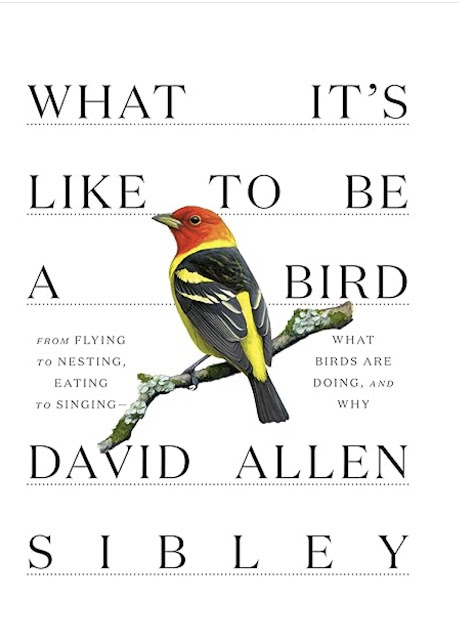
A Beautiful Bird Book


Thanks to Deb at Readerbuzz, who reviewed this last week, I bought a copy —
there was a great price on amazon.com.

I’m reading this wonderful book a little at a time. It’s very packed with information about birds.
The large format enables images of many birds at their full size.


The details of each bird’s capabilities illustrate the general way that birds are adapted to life on earth.

New on Streaming


I have only watched a few of the episodes from the first 12 seasons of Vera, but now started the new one.


Finally Read


Finished this book on my second attempt. 
Colson Whitehead is a brilliant writer. During the last few years, I’ve read four of his literary and historical novels which are fantastic. Zone One was published in 2011 — a very different type of book. It’s about an apocalyptic future where a plague is turning humans into living skeletons that eat not-yet-turned humans. “There were hours when every last person on Earth thought they were the last person on Earth.” (p. 108)

The book is centered around one character who goes by the name Mark Spitz (because he can’t swim). He is a very average American, but somehow a survivor. Whitehead  shows Mark Spitz’s consciousness of the apocalyptic scene that has replaced a recognizable America — especially New York. There are wonderful observations of middle-class people who had a comfortable life until faced with disaster. Food descriptions help to set the horrifying atmosphere in a nightmare world: Whitehead is a wizard with working food descriptions into the narrative to make it come alive. I marked many passages; here’s one about Mark Spitz:

“On impulse he purchased a deluxe combo juice at the cafĂ© on the way out and decided not to say anything when the pimply skel dropped a banana slice into the blender. He hated banana. He drank it anyway, blowing into the striped straw to dislodge a plug of pulp, and stepped out to the sidewalk into the rush-hour stream of the dead on their way home, the paralegals, mohels, resigned temps, bike messengers, and slump-shouldered massage therapists, the panoply of citizens in the throes of their slow decay. The plague was a meticulous craftsman, dabbing effects with deliberation.” (p. 133)

Mark Spitz works with others to try to restore humanity by destroying the living skeletons and disposing of the corpses — anyone can see that they are zombies, but Whitehead is such a clever writer that the word never appears in his text. A search of the Kindle edition turns up only one use of the word which is on the copyright page as a keyword for library searches!

I’m really happy that Whitehead turned his fantastic gifts to creating novels that I’m more enthusiastic about. I think he’s one of the best authors writing now.

Strange Weather We’re Having!

Tuesday, February 27: Record High. Detroit was 73°


Wednesday, February 28: More than 35 degrees colder!

Temperature dropped as low as 19° F by Thursday morning.


Blog post © 2024 mae sander


Thursday, February 22, 2024

Visiting Northern Virginia

Last week, we visited our daughter and son-in-law in Fairfax, Virginia, and then continued to Lancaster, Pennsylvania. I’ve written several posts about some of the highlights of the trip, but I wanted to add some photos from both places. Today: our visit to Virginia.

Sunday, February 11, we traveled the Ohio and PA turnpikes and continued
south to Fairfax.

We arrived just in time for the classic Superbowl refreshments: chili and guacamole.

We were also in time for Mardi Gras and Paczki.

Two Towns in Virginia: Occoquan and Alexandria.


When I was a child, there were several carriage stones in my neighborhood, but we called them 
“wishing stones” and thought if you sat on them and made a wish it might come true.

Near Alexandria, we enjoyed birding, especially the owl.

The Torpedo Factory, an art space in Alexandria.

The National Museum of the American Indian, Washington DC

I have written about the special chocolate festival at the museum
Evelyn, Tom, Len, and I also looked at a variety of other exhibits.

I enjoyed a case dedicated to children’s toys and dolls.

Symbolic gifts to the Europeans to cement a treaty.

“Nation to Nation: Treaties Between the United States and American Indian Nations” is a long-term exhibit at the museum (from 2014-2028). The exhibit documentation states:

“From a young age, most Americans learn about the Founding Fathers, but are told very little about equally important and influential Native diplomats and leaders of Indian Nations. Treaties lie at the heart of the relationship between Indian Nations and the United States.”

The first rooms were focused on several early examples of the very numerous treaties between Indian tribes and Europeans from early colonial times through the early 20th century. These pre-Revolutionary and early 19th century examples were often made in good faith, though later broken by the settlers and politicians eager to take over land and expand the European domination of the continent. As time went on, the treaties became more and more exploitative and cynical, and the national policy of  “removal,” which became law in 1830, replaced any good will towards the Native Americans. I was very interested in the artifacts, the facsimiles of treaties, and the historic information in this exhibit.


Visiting Evelyn and Tom


We took several walks around the neighborhood.
The weather was beautiful, with only a touch of snow.

Houseplants!

 A puppet from their collection.

Evelyn makes wonderful ceramic gnomes.

Tomorrow, I’ll continue with our visit to Arny and Tracy in Pennsylvania.
 
Blog post © 2024 mae sander

Sunday, February 18, 2024

Museum of the American Indian, Washington, DC

Heading into Washington, DC

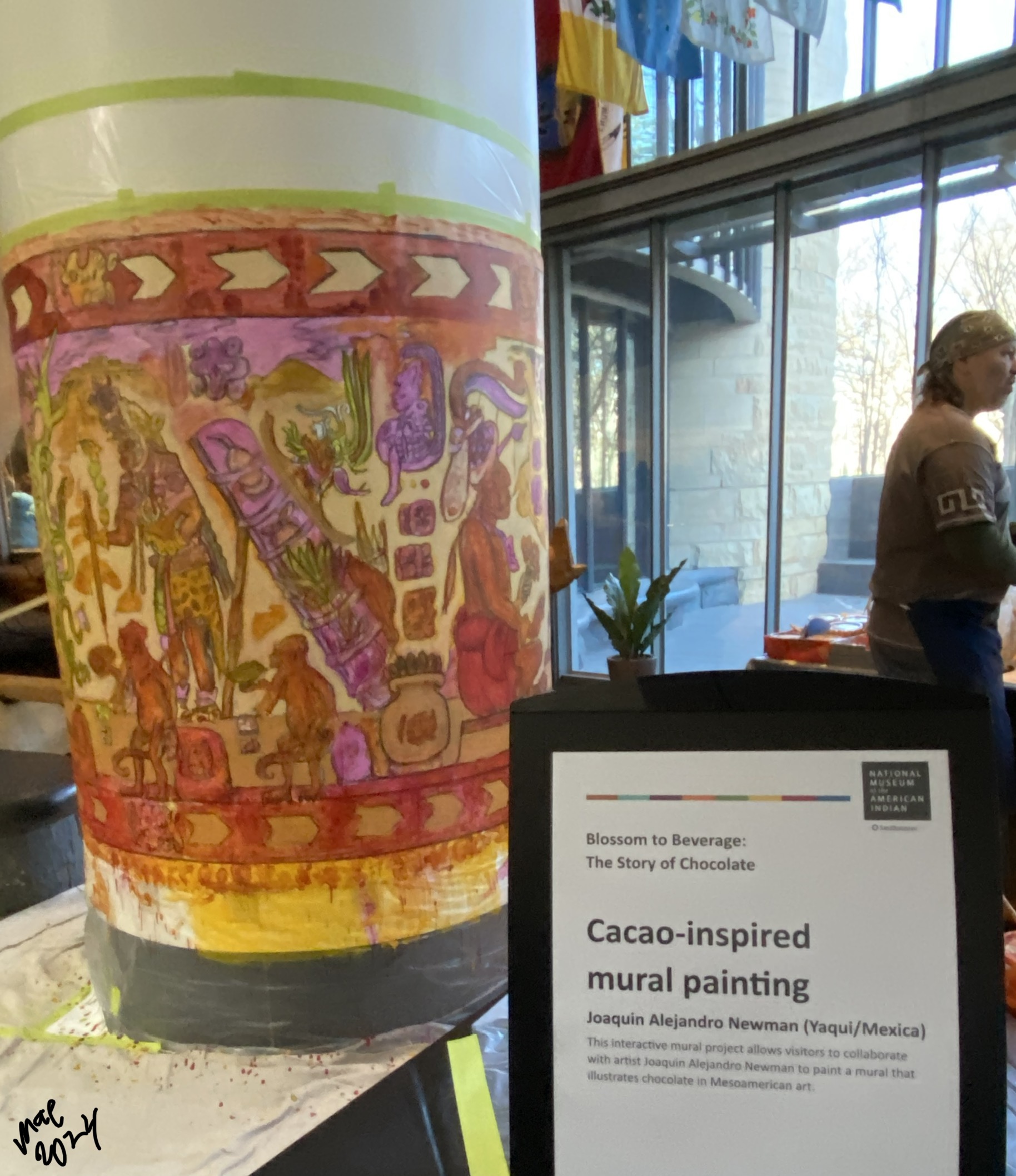
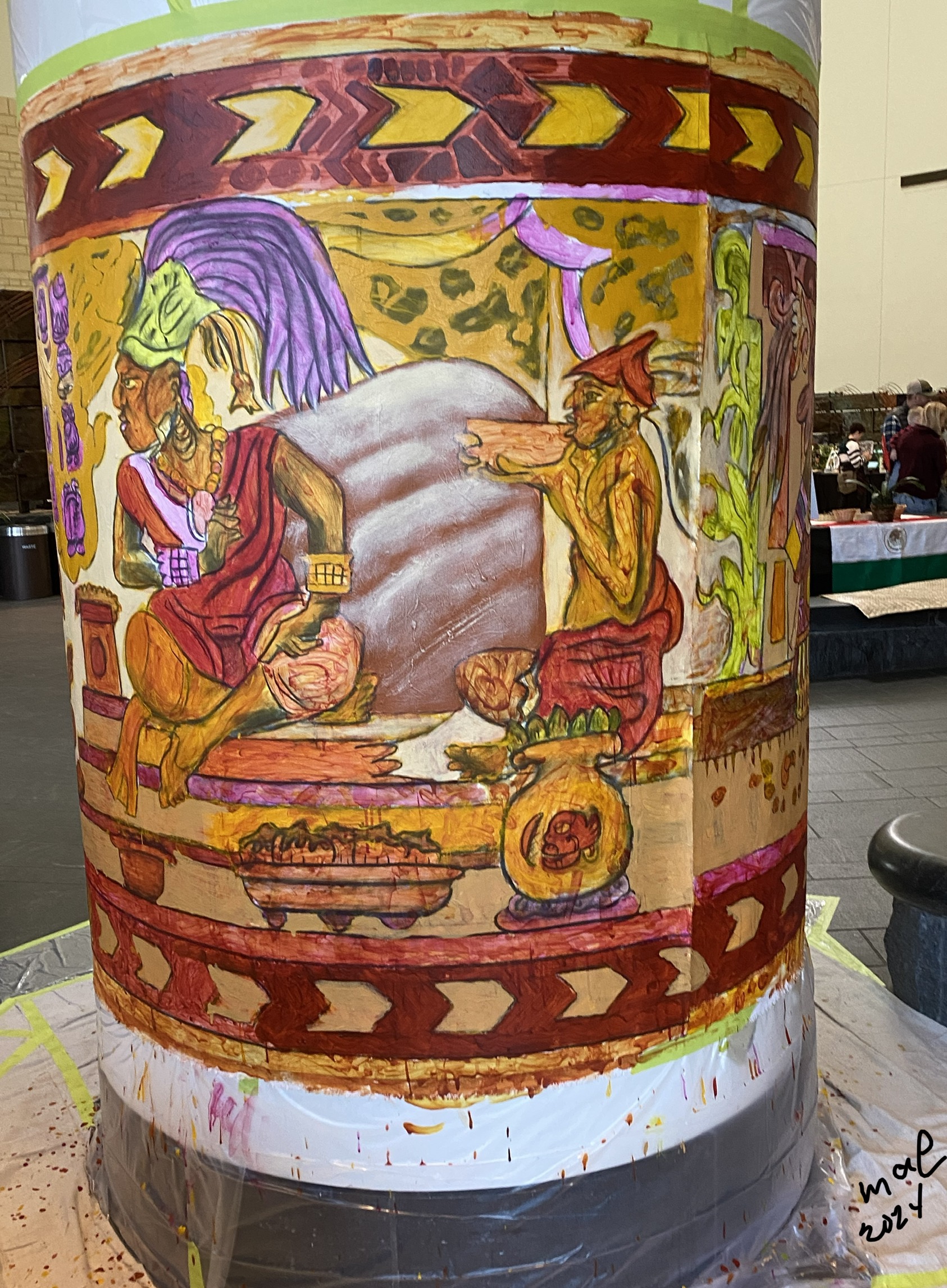
Blossom to Beverage: The Story of Chocolate

This weekend the museum had a special event with lectures and demos about the 
history and uses of cacao, including interactive mural painting. The aroma of chocolate was everywhere! 

The artist creating the murals is Joaquin Alejandro Newman, a Yaqui Indian from Mexico.

Kids could help paint the mural, which is deigned in Aztec style.


The display of chocolate-making, starting with the raw beans and processing them with traditional
equipment, was presented by Jose Reyes and his family, who are Mixtec.

Grinding cocoa beans and pressing cakes of chocolate in the traditional way.


Preparing a Mexican chocolate beverage.


The chocolate demos were on the main floor, while all the exhibits are upstairs.
After looking at the people preparing cocoa beans and mole, we spent quite a lot
of time in the main parts of the museum. From above, we could see the chocolate expo.

The American Indian Museum is one of the Smithsonian museums on the Mall in Washington,
so you can see the Capitol Building from the windows.

Blog post and all photos © 2024 mae sander
Shared with Sami’s Monday Murals and with Elizabeth’s celebration of drinks.

Tuesday, November 28, 2023

Endangered Eating

Endangered Eating: America’s Vanishing Foods by Sarah Lohman is a very readable account of the efforts to preserve several cultural culinary treasures. Inspired by the organization titled Slow Food International, and their endeavor called the Ark of Taste, Lohman selected a few very interesting American traditional foods, and described their current state, their cultural significance, and some recipes that use them. In addition, she presented the history of the owners of these foods. I really enjoyed reading this book.

Foods that are covered:

  • A few special varieties of dates from the Palm Springs, California, area
  • Native Hawaiian sugarcane now raised only by a few descendants of the original Polynesian inhabitants of the islands
  • Navajo sheep, a special breed that’s become quite rare
  • A specialized type of salmon fishing practiced by natives of the Puget Sound area in the Pacific Northwest and nearby Canadian islands
  • Wild rice from the Great Lakes region (now being replaced by cultivated forms of the native marsh crop)
  • Heirloom apple varieties once used for making cider, now almost lost
  • Louisiana FilĂ© Powder, traditionally gathered by native Americans and used for making gumbo
  • Carolina runner peanuts, a small and flavorful variety that was almost lost because they were not good for mechanized processing.
As I read many of the chapters, I thought about the way I had visited the locations that Lohman describes, and how I had heard about some of the rare and endangered foods she discusses. This made me especially enjoy reading these chapters. Here are a few of my memories.

Santa Barbara: Dates from a Farmers’ Market

At a California Farmers’ Market: empress dates and honey dates (source)

The first chapter of Endangered Eating is titled “Coachella Valley Dates.” As I read, I recalled the date vendors from the Coachella and Palm Springs area who came to the Santa Barbara Farmers’ Market where I shopped during several long visits there in the past. I particularly remember the incredible variety of dates, and the way the vendors offered samples so that one could decide which were the most delicious. 

Lohman writes:

“Although the Coachella Valley primarily grows commercial date varieties like Medjools and Deglet Noors, several small farmers still carry on the tradition of growing unique date varieties that were developed in the area a century ago. It’s these rare American dates, grown nowhere else on the planet, that have been onboarded to the Ark of Taste: Empress, Abada, Blonde Beauties, Brunette Beauties, Honey, McGill’s, Tarbazal, and Triumph.” (p. 2)

Although as Lohman points out, few trees with these special date varieties still are growing in California, it’s interesting that they can be tasted at least from a few sellers at the farmers’ markets of the area. I’m curious as well about the dates we tasted at a date farm in Israel, where we also encountered a number of different and interesting date flavors.

Santa Barbara Farmers' Market Date Vendor with his samples (2011)

Maui, Hawaii: Sugarcane and Native Agriculture

Early Hawaiian agriculture shown at Iao Valley State Park (2009)

Sugarcane first reached Hawaii with the original Polynesian colonists, centuries before the famous voyage by Captain Cook. This variety of cane was kupuna kĹŤ or Hawaiian legacy sugarcane. It was cultivated by the native people along with their traditional crops including coconut, taro, breadfruit, Hawaiian purple sweet potato, and Kalua pig, sometimes known as “canoe foods” because they were brought on the canoes of these early settlers. I wrote about this native agriculture here: Native Species and Canoe Foods.

Now, in the twenty-first century, Lohman visited a few farmers who are growing the native variety of sugarcane. She writes: “The Ark of Taste has five entries for Hawaiian sugarcane, chosen to represent the over forty varieties of legacy kĹŤ that have been identified as unique to the Hawaiian Islands.” (p. 38)

Native sugarcane is different from the variety imported by Europeans and cultivated in destructive, farming operations and refined in huge industrial refineries (which entirely ceased production in 2016). Her chapter on native Hawaiian sugarcane explores the current efforts and the history of sugar in the islands. One interesting fact is that sugarcane cultivation had two distinct histories: one with the Polynesian settlement of the islands in the Pacific, and the other with its spread to the west via Arab and European merchants and then to the New World, where it was cultivated in the Caribbean and the American South.

A sample of native foods that I tried at a festival on the Big Island in 2013. 

New Mexico: Navajo Sheep


Near Sandia, New Mexico (2015)

I’ve been on Navajo reservations more in Arizona than in New Mexico, the subject of Lohman’s chapter on the endangered species of sheep that are precious to the Navajo people for their wool and for meat. Thanks to the Tony Hillerman novels and their sequels by his daughter Anne Hillerman, I feel as if I am very very familiar with the people on the New Mexico part of the area!

Lohman describes the sheep and their special wool, which makes very beautiful weavings: 

“Navajo-Churro have an inner coat of lustrous wool and a shaggy outer coat that can reach up to 14 inches in length. The low lanolin content of the wool means that very little water is required to wash it, which is ideal in desert conditions. The wool is perfect for hand weaving because it is remarkably straight, strong, and durable. And it comes in over a dozen different natural colors, ranging from dark black to pure white as well as heather gray, tan, peach, and a light reddish-brown. Navajo-Churro wool is so recognizable and connected to DinĂ© weaving that in the Art of Native America gallery at the Metropolitan Museum of Art in New York City, a DinĂ© chief’s blanket dating to 1840 is labeled “handspun undyed and indigo-dyed Churro fleece.” The sheen of the wool in the blanket is unmistakable.”

I love learning about Navajo art and history, so this chapter was especially interesting to me.

A Navajo weaving — “Two Grey Hills” — in my home.

Traditional Salmon Fishing in the Pacific Northwest

Graffiti in Alert Bay, Canada (2018)

A few years ago, we traveled on a National Geographic cruise to see the Puget Sound and many islands and towns in Washington state and Canada. The cultural specialist onboard the ship introduced us to many historic facts about the Native Americans who lived in the area, and he especially talked about a tribal group called the Lummi, who employed a traditional type of salmon fishing with nets. He described. how this method had been lost but was being reintroduced. (My blog post about this is here.)

Lohman’s chapter called “Sxwo’le Straits Salish Reefnet Fishing” describes this exact restoration of a nearly forgotten fishing technique, and describes the struggles of Native Americans in both the US and Canada to recreate their traditional practice.

Reefnet fishing (Sxwo’le) is an ecologically responsible method of trapping the salmon on their run up one of the rivers where they go to spawn. It’s non-destructive of by-catch, and humane to the salmon. It uses a net called a reef. Lohman’s description:

“The reef is a web of rope which guides salmon both up from the ocean floor and in toward the net, like a funnel. The reef starts with two 200-foot rope lines that extend upstream from the platforms; the lines float with the help of buoys. The ends of these lines are about 80 feet apart at the upstream end, and narrow to the width of the net between the two floating platforms. Ropes are tied at intervals horizontally between these two main lines. At the upstream end, these horizontal ropes are anchored 80 feet below the surface of the water, nearly at the bay’s floor. Gradually, the ropes slope upward until their depth matches the opening of the net strung between the platforms. 
 
“Onto these horizontal ropes are tied blue or green plastic ribbons that shimmy in the tide and look like underwater plants. The ribbons trick the salmon into thinking that they are swimming safely on the ocean floor up a shoal, a natural shallowing of the bay.” (p. 111)

There are no illustrations in Endangered Eating, but I found this image helpful in trying to imagine the activity, involving several boats and a large system of nets:

Reef netting near Point Roberts, ca. 1940 (source)

Blog post © 2023 mae sander
Photos by mae sander or as credited