Showing posts with label Jewish history. Show all posts

Tuesday, June 09, 2026

The Silk Road


I have been reading this new book about travel in some very unusual places.
The recipes are fun to read, but I doubt that I’ll try them!
I wrote more about the silk road here: https://maefood.blogspot.com/2024/06/i-am-not-pilgrim.html
and here: https://maefood.blogspot.com/2020/03/what-did-marco-polo-eat.html

Images from Ansari’s Silk Roads

Fruit preserves in the style of the author’s family.


Reading Next: A different view of this history


A Long Time Ago

Many years ago, I read about medieval voyages in various contexts, and I wrote a book called Jewish Time Travel. Its pretty obscure though amazon.com still has a listing for it.


Blog post © 2026 mae sander

Wednesday, January 21, 2026

Identities

“After hundreds of years, if there were so many sinners left, what had the Inquisition accomplished? They might root out Jews and Muslims and Erasmists and alumbrados, but then what was left?” (p. 367)


“When Luzia had seen the burnt bread, she hadn’t thought much about passing her hand over it and singing the words her aunt had taught her, “Aboltar kazal, aboltar mazal.” A change of scene, a change of fortune. She sang them very softly. They were not quite Spanish, just as Luzia was not quite Spanish. But Doña Valentina would never have her in this house, even in the dark, hot, windowless kitchen, if she detected a whiff of Jew. Luzia knew that she should be careful, but it was difficult not to do something the easy way when everything else was so hard.” (p 6)

From the beginning, The Familiar is a book about secrecy and identity. Luzia, at the center of the novel,  has both an out-facing identity as a servant in an impoverished upper-class home in late-medieval Spain, and also a secret identity as a Jew who would like to flee to Salonika where she could practice her true religion openly. The novel adds an element of magical realism to this identity: Luzia can also do magic. 

Here is  Luzia’s view of the conversion which her ancestors had experienced a few generations earlier:

“Their great religion can make bread into flesh and wine into blood. But they don’t believe that any amount of holy water or prayer can truly make a Jew a Christian.” (p. 121)

“I have been baptized, she reminded herself. She went dutifully to mass. She knew her Pater Noster, the Ave Maria and Salve Regina, her psalms and commandments. She would happily eat ham and mend a dress after sundown on the Sabbath. And yet she felt her magic like a damning thread, binding her to the past, and to every Jew in every synagogue who still bent their head in prayer.” (p. 198)

The counter-theme of this book is a completely different identity: that of an immortal and magically created human-like being named Santángel who becomes Luzia’s friend and ally in struggling to survive and escape. He says: 

“In another life, in another world, I would be called a familiar. My gifts are not my own. They exist only to serve others. People fear me because I want them to, because their fear makes my life easier.” (p. 165)

The plot of this book is elaborate (maybe too much so). There are many twists as the stories of several characters are being told. That’s all I have to say about it. 

Blog post © 2026 mae sander

Thursday, May 08, 2025

Books This Week


The Story of the Forest by Linda Grant doesn’t live up to its promise as a family saga. It tells the story of an immigrant Jewish family who come to Liverpool, England, just before the first World War, and despite their intentions of continuing onward to America, somehow never leave. It’s clear that this book is an effort to reconstruct the author’s own family history, based on rather sketchy information and a few often-retold stories. Indeed, it’s much too close to the way personal stories come off: a bit vague and tentative, somewhat pointless, lacking the power of a strong narrative voice or a really vivid central character. Wimpy. Sad. Not up to some of Linda Grant’s best fiction, of which my favorite is When I Lived in Modern Times, which won the Orange Prize in 2000.


Ursula Le Guin (1929-2018) was a fantastically imaginative writer, and I’ve read many of her books. This was her last book, published in 2008. It’s based on the Aeneid of Vergil, which I have never read, so it was entirely new to me, and I have no idea how Le Guin’s novel borrows from the original. I know only that Le Guin says that the title character, Lavinia, was only named, not developed by Vergil, and the detailed life of Lavinia was thus entirely her creation. Of course Le Guin brings the character to life in a wonderful and very readable way, and this book is genuinely a good read.

In the Afterword, Le Guin makes a point that I find especially important in thinking back on my experience reading this novel:

“From the Middle Ages on, the so-called dead language Latin was, through its literature, intensely alive, active, and influential. That’s no longer true. During the last century, the teaching and learning of Latin began to wither away into a scholarly specialty. So, with the true death of his language, Vergil’s voice will be silenced at last. This is an awful pity, because he is one of the great poets of the world.
“His poetry is so profoundly musical, its beauty is so intrinsic to the sound and order of the words, that it is essentially untranslatable. … More than anything else, my story is an act of gratitude to the poet, a love offering” (p. 359)


We never miss a new novel about the Navajo detectives Joe Leaphorn, Jim Chee, and Bernadette Manuelito. In this one, published quite recently, Chee and Manuelito — a husband and wife, both police officers — are subject to all kinds of terrible risks, and are both almost killed by the criminals they are investigating. Poor Bernie, she’s always a victim of some violence, but of course she outsmarts her opponents every time and quickly gets over whatever injuries she suffers. No surprises here. 

Shadow of the Solstice is interesting for the author’s focus on actual current issues for Southwest Indian tribes. There issues as a driving force in the two intertwined detective assignments of Chee and Manuelito. One issue is the continuing problems on the Navajo reservation caused by uranium mining in the past, and the necessity to block new efforts at destructive and damaging extraction of minerals from the territory. 

The other plot element is based on an actual series of fraudulent claims for social benefits in which criminal scammers tricked members of the tribe into cheating the government. These fraudsters exploited their Indian victims and left them in desperate straits, including homelessness, worse addiction, and even death. In the novel, the scammers are caught and the victims mainly rescued.

Joe Leaphorn, the original detective in the series, is mentioned but he never actually appears in this novel. After the original author of the series, Tony Hillerman, died in 2008, his daughter has continued to write a book just about every year, and though the detectives age slowly, it’s apparent that Joe must be well into his nineties and not really very active even as a retired mentor. Jim Chee first appeared in 1980 in the novel People of Darkness. But we won’t calculate how old he would be if he aged like real people.

There are now around 25 books in the series beginning with The Blessing Way in 1970. I’ve read them all, and reread some of them. I like that the detectives still enjoy a stop at a diner for coffee at a tense moment, or some fresh, home-made fry bread like this treat enjoyed by Jim Chee:

“An irresistible aroma had begun to fill his patrol unit. He could tell without opening the bag that Mrs. Yazzie had given him fry bread, freshly made in her own kitchen. He started to salivate. He reached in, grabbed the piece on top, as big as a dinner plate, pulled a bit free, and took a bite. He chewed slowly, savoring it as if it were his last meal.” (p. 174)

I wouldn’t say that Shadow of the Solstice is the best of the series, but it’s ok.

New Mexico landscape from our 2015 visit. The landscape is always a big part of the story in all the Navajo detective books.

Blog post © 2025 mae sander

Monday, January 27, 2025

Thursday, January 23, 2025

Cruelty: A Story of Vietnam and Cambodia


Slow Noodles: A Cambodian Memoir of Love, Loss, and Family Recipes by Chantha Nguon (published 2024) is one of the most brutal stories I can remember reading. Born in Cambodia to a Vietnamese mother, she experienced the early days of the hideous events in Cambodia in the 1970s; she fled to Saigon where she suffered as the Vietnam War ended and dictatorship and poverty overtook the once-prosperous country. She lived perilously in Vietnam and then again in Cambodia and Thailand where she was in a wide variety of urban slums, refugee camps, and other places of suffering. As I read, I often had to stop and take a symbolic breath of air to clear my mind of the anguish, as well as to recollect the history of the Vietnam War and the Cambodian Genocide, which I haven’t thought about recently.

A quote that the author uses throughout the book: “Rice is what you eat when you have nothing and when you have everything.” (p. 16)  Remarkably, Nguon’s narrative of want and desperation is nevertheless filled with food descriptions. This may be the strangest embedding of food memories I’ve ever read! Each chapter has its own recipes, usually for the traditional foods of the countries where she lived, and usually of a fascinating exotic nature with many local and unfamilar-to-me ingredients. Some of the recipes, however, are written in irony with instructions like this: “Buy the least rotten fish you can find in the communal store or from your neighbor in the market.” (p. 109) or “Recipe: A Taste of Poverty: This dish is easy to prepare, but the regimen is very difficult to maintain—unless you must.” (this recipe is only rice, p. 226)

Life for Nguon until age nine was happy and prosperous; even after the early death of her father, her mother was able to provide a pretty good home and appealing food. Her mother’s many varieties of hand-made noodles are an especially vivid memory. She later contrasts these delicious creations to the packets of instant noodles that were available in some of the refugee camps where she was confined. The instant noodles that her mother disdained were a luxury in these later bad times.

The family escaped from Cambodia to Vietnam just before the situation in Cambodia became impossible: the Khmer Rouge dictators of Cambodia drove the educated urban population from their homes into the countryside where they had nothing and where one fourth of the people died of starvation or worse. (I have included a historic note about these events at the end of this blog post). 

Nguon describes this flight from the city: “You pack your things and walk out of the city with your family. You ask no questions. A sea of humanity is on the move: children, grandparents on cyclos, the sick and wounded in wheeled hospital beds.” (p. 71)

As the Vietnam war ended, Nguon experiences another era of losing everything, becoming a refugee in a camp. “We slept in two rows of thirty bamboo beds in a long, open-air bamboo hut with a thatched roof and earthen floor.” (p. 82) Still, she recalled dreaming of food at that time saying: “my fondest food memories are more of food-dreaming than of the actual meals we ate. It was the dreaming that sustained our minds, if not our bellies.” (p. 65)

Image of boat people fleeing Vietnam, 1975. (source)

After fleeing from Vietnam in a small dangerous boat (that is, becoming “boat people”) she and her husband spent a decade waiting in another refugee camp in Thailand, hoping to be accepted to go to Europe or the US. In the camp, they were given a few necessities:

“Again, a UNHCR official issued us two cookpots. This time we also got a small wood-burning cook stove, two blankets, a mosquito net, a spoon, and a plastic plate. Someone showed us to a long, narrow structure with concrete floors, tin roofs, and thin cement walls on three sides. ‘This is your house,’ the man said. The shelters were designed for forty people, so each person was allotted a rectangle of concrete about the size of a single bed.” (p. 190)

Eventually, they realized that they had no chance of escape from the refugee camp, and in desperation they returned to Cambodia, which was emerging from the genocide nightmare and becoming civilized again. After several years of various endeavors, they founded a women’s weaving studio where they helped to create a better life for other people, and where they raised their two children, though there’s only a fairly brief summary of this time of her life.

Refugee Camps Still Exist: Waiting at the US Border This Month

As I read the stories of the expulsions 50 years ago as people were forced from their homes and were walking long distances in search of a place of refuge, I thought with horror of the fact that the same thing is happening right now. Long lines of displaced people in Mexico are heading for the US border, and as of this week, their hopes of asylum have been destroyed. The camps where they wait are eerily like the ones the author experienced in Southeast Asia a generation ago.

Historic Note on Events in Nguon’s Memoir


In case the history is unfamiliar to you, here is a summary of the Cambodian Genocide: 

”Lasting for four years (between 1975 and 1979), the Cambodian Genocide was an explosion of mass violence that saw between 1.5 and 3 million people killed at the hands of the Khmer Rouge, a communist political group. The Khmer Rouge had taken power in the country following the Cambodian Civil War. During their brutal four-year rule, the Khmer Rouge was responsible for the deaths of nearly a quarter of Cambodians.

“The Cambodian Genocide was the result of a social engineering project by the Khmer Rouge, attempting to create a classless agrarian society. The regime would ultimately collapse when the neighboring Vietnam invaded, establishing an occupation that would last more than a decade.” (source)

Review © 2024 mae sander for maefood.blogspot.com

Monday, November 18, 2024

Orchids, Folktales, and a New-to-Me Painter

Orchid Show at Matthaei Botanical Garden


A number of orchid societies from nearby areas presented displays of orchids at this show, which we visited this weekend.
Below are photos of the orchids, as well as other plants on display in the greenhouses.


Two orchids and one cactus from the cactus room in the greenhouse.
I am very amused at finding a plaid plant!

From the Bonsai and Penjing display.

A stone plant: Lithops.

The orchid show.


All greenhouse and orchid photos © 2024 mae sander.

West African Folk Tales

An illustration from the tale “The Hunter and the Tortoise”
about a hunter who finds a miraculous singing tortoise, promises to keep it secret, but finally betrays it.

I’m reading a few folk tales from a collection titled West African Folk Tales by William Henry Barker (1882–1929) and illustrated by Cecilia Sinclair. This Project Gutenberg facsimile was made from the original text, published in 1917. I like reading these simple tales, about the tricky spider Anansi and his friends and family. Some are “just so” stories that explain the behavior of animals or birds; others are moral tales where characters are punished for not keeping secrets or the like; and some are just for fun.

It’s especially notable that so many of the tales involve hunger: the characters are constantly motivated by food shortages or the need to produce or set aside food, or their luck at finding a magical source for food. For example, 

“Anansi’s wives could not even get proper food; they had to live on unripe bananas with peppers.” (p. 26)

“Egya Anansi was a very skilful farmer. He, with his wife and son, set to work one year to prepare a farm, much larger than any they had previously worked. They planted in it yams, maize, and beans—and were rewarded by a very rich crop. Their harvest was quite ten times greater than any they had ever had before. Egya Anansi was very well pleased when he saw his wealth of corn and beans. He was, however, an exceedingly selfish and greedy man, who never liked to share anything—even with his own wife and son. When he saw that the crops were quite ripe, he thought of a plan whereby he alone would profit by them” (p. 47)   

“Once upon a time there was great scarcity of food in the land. Father Anansi and his son, Kweku Tsin, being very hungry, set out one morning to hunt in the forest.” (p. 66)

“There once lived upon the earth a poor man called Ohia … . Ohia thought of a plan which many of his neighbours had tried and found successful. He went to a wealthy farmer who lived near, and offered to hew down several of his palm-trees. He would then collect their sap to make palm wine. When this should be ready for the market, his wife would carry it there and sell it.” (p. 71)

Of course as in many folktales from many places, the magical or secret sources of food are often destroyed by the characters’ greed or selfishness. I have been curious about the Anansi tales because of the stories by Neil Gaiman that use them, and I’m finding these quite delightful.

Cutting down palm trees in order to make palm wine.

What I Hope to Read Tomorrow


Mayer Kirshenblatt: A Painter of Memories 

The Village Carp Pond

A Purim Play: children watch through the window.

Sabbath Candle-Lighting: wine, candles, challah.

Mayer Kirshenblatt (1916-2009) was born in Opatow, Poland. (The town was called Apt in Yiddish). In 1934, he emigrated to Toronto, where he worked in various jobs, married, and lived for the rest of his life. For his last 20 years, encouraged by his family, he began painting scenes from his youth in order to document his life in Apt, a shtetl whose Jewish population and culture had been destroyed by the Holocaust. Kirshenblatt's work is currently the subject of a special exhibit in the Polin Museum of Jewish History in Warsaw, Poland, and has been featured at several exhibits in the US as well. For more about Mayer Kirschenblatt, see "From Memory to Canvas, Lost Way of Life in Poland" (New York Times, May 7, 2009) 

NOTE: My father was born in a shtetl in what is now Belarus, about 500 km from Opatow, The life that these paintings depict was very very similar to the life my father described, so I’m happy to be introduced to this painter. Before the Holocaust, these and many other Jewish towns were ethnically unified in culture, language, and religious practice. The national borders that exist now were different before World War I, and have changed several times since then.

For Elizabeth’s tea party — two types of wine!


Tuesday, July 02, 2024

Antisemitism in France Then and Now

French Election, Summer 2024 

News of France this week is primarily the news of the election. If you have been following French current events, you will probably know what I’m about to say, but here is my summary of the situation. France has a multi-party political system, representing a spectrum of views from extreme right to extreme left. For several years, the centrist party of President Macron has dominated the government; however, his party was severely defeated in the election of representatives to the European Parliament last month, and he declared elections for a new French government. 

Sunday, June 30, the first round of voting was a major blow to Macron’s centrist coalition, which came in third behind the far right and the far left. In particular the far right National Rally party (the RN, formerly called the National Front) obtained the most votes, and has a good chance to win a majority in next Sunday’s second and final round of voting. As the Guardian says:

“A high turnout in Sunday’s first round saw RN comfortably win first place with 33.1% of the vote, almost two points up compared with three weeks ago. For context, this is the first time that the party founded by Jean-Marie Le Pen has broken through the 20% barrier in a legislative election.” (source)

This is concerning for many reasons; in this short summary I’m going to concentrate on the issues of antisemitism expressed by members of this party.

From French newspaper Libération: “Twelve million of our fellow citizens have voted for a far right party that is clearly racist and anti-Republican.” (source)

Despite pretense to the contrary, the “rebranded” party founded by self-proclaimed antisemite Jean-Marie LePen and currently run by his daughter Marine is a frightening specter in the French elections this week. A strong possibility of their winning a majority and thus taking over the government is very chilling.

After the first vote on June 30, the extreme right party in France is far ahead of the others.
This is the party of LePen, a dedicated antisemite, though they have stepped back the antisemite rhetoric.

During the electoral campaign in May, there were antisemitic statements from both far right and far left candidates, for example—

Racist and antisemitic rhetoric and conspiracy theories spread by National Rally candidates came under scrutiny during the campaign sprint — and amplified questions about whether the party’s rebranding was merely window dressing. Almost 1 in 5 of National Rally’s candidates for parliament have made “racist, antisemitic and homophobic remarks,” French Prime Minister Gabriel Attal said in a televised debate Thursday.” (source: https://www.washingtonpost.com/world/2024/06/30/france-elections-macron-le-pen-bardella/)

Further, antisemitic public actions in France (as in other European countries and in the US) has been ongoing since the Hamas attack on Israel and the ensuing war last October:

“There were more than 360 antisemitic episodes in France in the first three months of this year, or an average of four a day, an increase of 300 percent over the same period last year, the government said. In the most recent one that shocked the country, the three boys are said to have dragged the girl [age 12]  into an abandoned building where she was repeatedly raped and insulted.” (New York Times, June 20)

Here are few additional examples of antisemitism by National Rally candidates:

“Sophie Dumont, a National Rally candidate in northeastern France, was spotlighted by Libération for a post implying that Jewish financing was behind Reconquest, a rival far-right party led by Eric Zemmour, who is Jewish. Zemmour’s adviser had said that the ritual slaughter of animals to make kosher and halal meat should not be banned in France. “The small gesture that betrays the origin of the funds that fuel Reconquest,” Dumont wrote in a now deleted comment. 
 
“Agnès Pageard, a National Rally candidate in Paris, has advocated for abolishing a law that makes it illegal to question the Holocaust and another that bans ‘incitement to hatred’ against religious or racial groups. She responded to a social media post that alleged ‘collusion’ among prominent Jewish people in France by recommending ‘reread Coston and Ratier’ — two authors known for their antisemitic conspiracy theories.” (source: https://www.washingtonpost.com/world/2024/06/28/france-far-right-antisemitism-racism-le-pen/)


On the left, there are also a number of candidates who have made antisemitic statements, such as this example about a candidate of the party “La France Insoumise” —

“At least one member of La France Insoumise has made intolerable remarks. Reda Belkadi, a candidate in the Loir-et-Cher department south of Paris, published anti-Semitic messages in 2018 on social media. He had used the anti-Semitic slur ‘youpin.’” (Le Monde, June 29, 2024)


Looking Back: Paris Under the Nazi Regime

Les Parisiennes by Anna Sebba (published 2016)

As I read this book about life in Paris under the Nazis, I constantly thought about the current French election and its all-too-painful reminders of this part of the past. I read this observation about the current party, the National Rally:

“There was a reason a political barrier was long erected against the National Rally, with its quasi fascist history (now disavowed) and its enduring belief that immigrants dilute the essence of the French nation. The party provokes extreme reactions and troubled memories of the collaborationist wartime Vichy government.” (source
 
In Les Parisiennes, Anna Sebba depicts the lives of many women who lived through the Nazi occupation of Paris. Most of the author’s subjects had little or no contact with the Jewish residents of Paris, and little or no responsibility for the persecution and deportation of Jews to the Concentration Camps — but there are many stories of the fate of Jewish women, including, for example, the famous writer Irene Nemirovsky. I’m not going to review this book, but only use it to remind us of the past history that haunts many Parisians (and of course others) even today as antisemitism seems to return, along with attacks on many modern immigrant communities and naturalized French citiens.

For the Jews of Paris in 1942, the main event was the arrest of almost the entire Jewish population, which was done by French, not German, authorities. Here is Anna Sebba’s summary (in case you are not familiar with the history:

“On 16 and 17 July, the Vichy government, aiming to satisfy German demands to reduce the Jewish population, arrested some 13,152 Jews, including more than 4,000 children, mostly from Paris, in an operation which they were calling ‘Spring Wind’. René Bousquet, Secretary General of the French National Police, knew that using French police in the round-ups would be ‘embarrassing’ but hoped that this would be mitigated if those arrested were only so-called foreign Jews. However, as the historian Serge Klarsfeld has revealed (making use of telegrams René Bousquet sent to the prefects of departments in the occupied zone), the police were ordered to deport not only foreign Jewish adults but children, whose deportation had not even been requested, nor planned for, by the Nazis. Pierre Laval maintained that including children in the round-ups was a ‘humanitarian’ measure to keep families together, a clearly fallacious argument since many of the parents had already been deported.’ (p. 159)

Before they could be deported on trains to the East, these victims were held at a sports stadium:

“Everyone was taken on French buses to the Vélodrome d’Hiver, a bicycle stadium in the shadow of the Eiffel Tower, where most of the victims were temporarily confined for five days in extremely crowded conditions, almost without water as there was only one available tap, with little food and with inadequate sanitary facilities. They were then moved to Drancy, Pithiviers and Beaune-la-Rolande, internment camps managed by Vichy in collaboration with the Germans, before being sent on by train to Auschwitz for extermination. The round-up has been a source of enormous grief in France. It was not until 1995 that French President Jacques Chirac admitted French complicity as French policemen and civil servants had been used for the raid. He urged that 16 July be commemorated annually as a national day of remembrance. It was a ground-breaking moment in French history.” (p. 161) 

Sculpture commemorating the Jews of Paris deported in 1942 (Source: French Dept. of the Army)

The sculpture above shows the “Square de la Place-des-Martyrs-Juifs-du-Vélodrome-d’Hiver, where a sculpture by Walter Spitzer and Mario Azagury entitled ‘N’oublions jamais’ (Let us never forget) remembers the victims of the roundup of Jews on 16 and 17 July 1942, at 8, Boulevard de Grenelle, 15th arrondissement of Paris. © Département AERI

Paris in July

Along with many bloggers, I’m participating in “Paris in July,” a blog event hosted by Emma at the blog Words and Peace (link). My contribution today connects current events in Paris to the historic events of another July — July, 1942. 

Blog post © 2024 mae sander.
 

Tuesday, May 14, 2024

“Lublin”

Lublin by Manya Wilkinson is a tragedy with jokes. Old jokes: some good, some bad. All of them are Jewish jokes. Mostly adolescent jokes because they are told by an adolescent. The preoccupations of the novel’s three characters are adolescent preoccupations: sex, food, jokes, mothers, the future, sex, money, food, sex… 

It’s a road story. Some time in 1906, the three boys set out from their little shtetl town in Poland with the destination of the big city: Lublin. They have a map that someone gave them: hand-drawn showing important villages like Prune Town where they are promised prune pastry, and Lake Town where they will find water to refill their canteens. They each have a pack with a sleeping bag for camping by the roadside. One has a special silver coin that his mother gave him. One has a purse with money for emergencies. Their most important piece of baggage is a large suitcase full of brushes made by the rich uncle in his factory: they are expecting to sell these brushes and begin their lives as successful merchants. 

Nothing goes as planned. They are lost from the beginning, and they don’t realize that they have gone the wrong direction until they turn up at the Russian border. They don’t know Russian, In fact they don’t really know Polish: they really speak only Yiddish. And the novel is full of Yiddish of the cliche type, words that you probablaby know even if you don’t know the language. Although there are vivid observations about the lives and relationships of the three boys, the book includes too many cliches about life in the shtetls of pre-World War I Poland. For example, this passage with its list of tried and true Yiddish foods and predicable shtetl memories:

“They huddle together for warmth.‘We’re all going to die,’ Kiva sobs. Will he never smell pastry baking again, or hear his mother with a mortar and pestle crushing almonds and raisins? … 
Ziv’s affected too, imagining no more inky pamphlets, workers’ songs and slogans, or women tempting him to madness. He even recalls his poor home fondly, the remains of a herring on the table, lamps burning the cheapest kerosene and giving off the blackest smoke, his sisters bickering. 
‘Kreplach,’ cries Ziv, remembering his favourite small dumplings. 
‘Gudgeon in a blanket,’ cries Kiva, recalling the battered fish everyone loves to eat. 
‘Kishkas,’ cries Ziv. 
‘Gehakter herring on rye bread.’ 
‘Gefilte fish and chrain.’ 
‘Latkes.’ 
‘Kugel!’ They both look at Elya. 
‘Soup,’ he says. He could show more enthusiasm. He tries to conjure up a bowl filled with borscht, the ewe’s cheese he likes….” (Lublin, p. 164-165)

Lublin is an interesting attempt to recreate a lost past. The emotions and ambitions of the three boys on the road are often depicted vividly, including one who is religious, one who believes in a radical political future, and one who just wants to survive. As a reader, I’m not really convinced that it has new insights about that part of the lost world before the Holocaust. Maybe it’s supposed to be an allegory, but I don’t really find that it reads that way.

“Laughter through tears” is a traditional description of Yiddish literature. Lublin doesn’t qualify — this expression doesn’t mean just interspersing jokes. Frankly, I’d rather read a book by Sholem Aleichem or Isaac Bashevis Singer, who combine tragedy and comedy by using original humor, irony, human weaknesses, and especially their own lived experiences; Jews in these stories face a hostile world where they can be both victims and heroes. I’d even rather read the book Old Jews Telling Jokes by Sam Hoffman (where I first encountered many of the jokes from Lublin).

Wilkinson’s novel was just published in February, 2024, but it’s trying to sound old. Didn’t work.

Review © 2024 mae sander

Monday, April 22, 2024

Passover


Elijah the Prophet, from a 16th century Haggadah. The traditional belief is that Elijah will herald the coming of the Messiah.
To welcome Elijah a cup of wine is left on the Seder table -- "Elijah's cup" -- and near the end of the
ritual, someone opens the door, inviting him in, all hoping that his arrival will bring peace to mankind.
 
From the Haggadah: “This is the promise — not only once did they arise to destroy us, rather in every generation they rise to destroy us. But the Holy One Blessed Be He will save us from their hands.”

This evening, April 22, is the first Seder, the traditional meal that celebrates the beginning of Passover. The Passover holiday is celebrated mainly in people’s homes, though there are sometimes communal meals as well, especially for those who are separated from their families such as students who live away from home. The “Haggadah” is the book of rituals, readings, and prayers that is used for the service that accompanies the meal. I suspect that the above quotation is on a lot of people’s minds this year, along with the irony of a wish for a peaceful world.

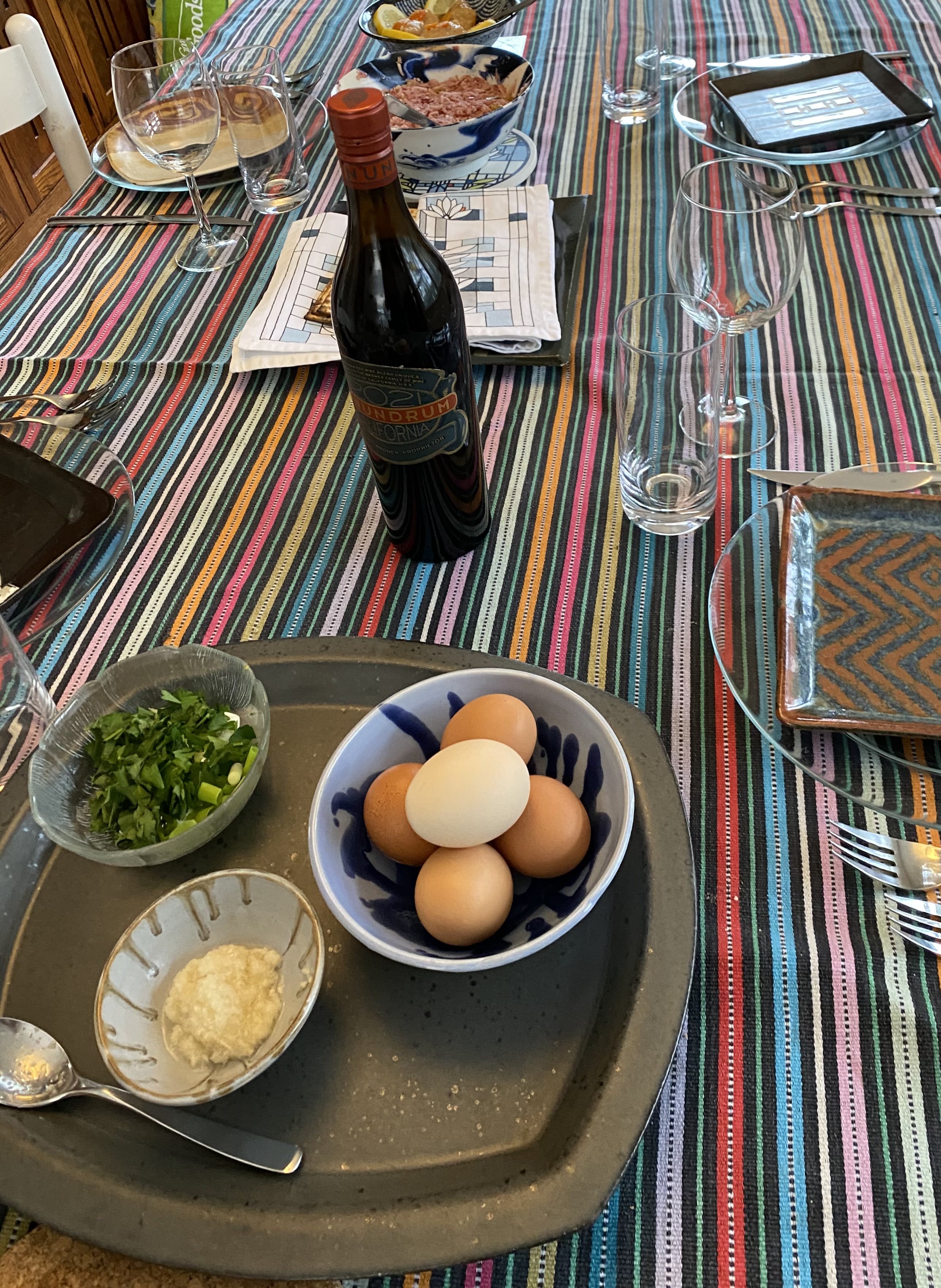
Although not religiously observant, we usually celebrate Passover in our home or with family or friends. I’ve written about it many times. Because we had a family visit last week, we ate Passover food early, so here are some pictures illustrating traditional foods that we enjoyed ahead of time.

“Conundrum” is a great name for a wine at Passover.

Wine is one of the traditional items on the Passover table. During the ceremony, all participants drink four glasses of wine at specific times as the Haggadah requires. The start of the ritual is the reading of The Four Questions, asking “Why is this night different from all other nights,” and beginning the explanation of the celebration of the Exodus from Egypt as presented in the Biblical book of Exodus. Since a conundrum is a puzzling question I thought the wine was very aptly named. (Note: for those who observe the kosher dietary laws, this is not kosher wine.)


Two foods that are part of the ritual: Matzo, the unleavened bread eaten as the Israelites fled Egypt,
and Charoset, a combination of grated apples and nuts, representing the mortar that the enslaved Israelites used to build the Pyramids.


Our table setting for our pre-Seder meal.

Symbolic foods: egg, parsley, horseradish, wine.

Another food that’s not required but is traditional: matzo ball soup.

Gefilte fish is not part of the Haggadah ritual, but it’s a key dish in many people’s Passover meal.

Recipes using dried fruit such as prunes are a Passover tradition.


Blog post and photos © 2024 mae sander

Saturday, January 27, 2024

A Book for International Holocaust Remembrance Day


W.G. Sebald (1944-2001) was a novelist and literary scholar at the University of East Anglia in Britain. He was born in Bavaria, and wrote in German. Austerlitz, his last book, is about the life of a man named Jacques Austerlitz, who was born in Prague in the 1930s. As the Nazis take over Czechoslovakia, his  Jewish mother in desperation sends him, at age four and a half, on a Kindertransport to England, He is taken in by a cold-hearted Welsh couple who never tell him his origin. As an adolescent, he finally learns his real name, but discovers that all paperwork about his family and where he came from had been lost in the bombings of London. 

The narrator of the novel is of an acquaintance of Austerlitz, who has occasional contact with him, and who relates a series of narratives that occur when he, the narrator, gets together with Austerlitz. The descriptions of his search for his birth parents and family are related with an overwhelming sense of alienation, which is in any case intrinsic to the existence of a man desperate to know who he really is. For years Austerlitz cannot even remember his own early life, and recovers a few faint memories through a series of coincidences and voyages to discover his identity.

Today is Holocaust Remembrance Day

From the United States Holocaust Museum in Washington, DC:

“The United Nations has designated January 27, the anniversary of the liberation of Auschwitz-Birkenau, as International Holocaust Remembrance Day—a time to remember the six million Jewish victims of the Holocaust and the millions of other victims of Nazi persecution. In 2024, the commemoration coincides with a surge in antisemitism worldwide.”

The background events of Sebald's novel are not as well known as the major events of the Holocaust. While millions of murdered victims died in Auschwitz, there were a number of other camps. Millions of Jews from Eastern Europe were shipped to these camps, but smaller numbers of victims came from other countries, where Jewish communities were also destroyed, Jewish property stolen, and synagogues, made unrecognizable, were converted to other uses. Very few efforts to save Jewish people occurred during this era. Here are a few of the facts and how Sebald's novel includes them.

An Early Effort to Save Jewish Children: The Kindertransport 

Children arriving in England brought by the Kindertransport (source)

The Kindertransport was an effort in 1938-1939 to rescue Jewish children from several countries in Nazi-occupied Europe. Ten thousand of these threatened children were taken from their parents and brought to England. Most of them were adopted or fostered by British families. Although the intent was that their rescue would be temporary until they could return to their homes, most could never be reunited with their families because the families had perished in the Holocaust. 

In the novel, Austerlitz for years is unable to recall his journey to England, but eventually he goes to Prague and finds an elderly woman named Vera, who had been a friend of his mother Agata Austerlitz. Finally in conversations with Vera, he learns about his early childhood. Vera explains that his mother, because she was Jewish, was banned from her profession as an opera singer and deprived of all the freedoms she had enjoyed. As the Nazis implemented their anti-Jewish policies, she slowly realized the danger to her life and that of her child:

"She finally decided, Vera told me, said Austerlitz, that she would send me at least to England, having succeeded through the good offices of one of her theatrical friends in getting my name put down for one of the few children’s transports leaving Prague for London during those months. Vera remembered, said Austerlitz, that the happy excitement Agáta felt at this first successful outcome of her efforts was overshadowed by her grief and anxiety as she imagined how I would feel, a boy not yet five years old who had always led a sheltered life, on my long railway journey and then among strangers in a foreign country. ...She was torn between wishful thinking and her fear that she was doing something irresponsible and unforgivable, and who knows, Vera said to me, whether she might not have kept you with her after all had there been just a few more days left before you were to set off from Prague." (p. 173)

Austerlitz himself has never had more than fleeting and unreliable memories of his journey, and almost no memory at all of his mother. Vera offers him his first real grasp of his childhood experience:

"I have only an indistinct, rather blurred picture of the moment of farewell at the Wilsonova Station, said Vera, adding, after a few moments’ reflection, that I had my things with me in a little leather suitcase, and food for the journey in a rucksack—un petit sac à dos avec quelques viatiques, said Austerlitz, those had been Vera’s exact words, summing up, as he now thought, the whole of his later life. Vera also remembered the twelve-year-old girl with the bandoneon to whose care they had entrusted me, a Charlie Chaplin comic bought at the last minute, the fluttering of white handkerchiefs like a flock of doves taking off into the air as the parents who were staying behind waved to their children, and her curious impression that the train, after moving off very slowly, had not really left at all, but in a kind of feint had rolled a little way out of the glazed hall before sinking into the ground." (pp. 173-174).  

One of Many Camps: Theresienstadt

Austerlitz continues with his efforts to discover his mother's fate, and learns that after he had been sent to England, she was deported from Prague to the Theresienstadt ghetto.

“Theresienstadt, established as a ghetto and transit camp in 1941, was presented as a model Jewish settlement for propaganda purposes. Despite congestion, hunger and forced labor, educational and cultural activities abounded. 35,440 Jews died in the ghetto and 88,000 were deported.” (From Yad Vashem Holocaust Museum)

A detailed history of Theresienstadt, as documented in a book that Austerlitz finds, makes up quite a long passage of the novel, but learning about this does nothing for his alienation and isolation. 

One of the somewhat mysterious illustrations from the novel (p. 244)

The Deportation from Paris

Austerlitz has much more difficulty discovering the eventual fate of his father, Maximilian Aychenwald, who had left Prague and had gone to Paris where he hoped to be safer from the Nazis. Living in Paris decades later, Austerlitz tries to find any documented record of his father. He studies the fate of the large Parisian Jewish community where his father presumably had lived. His efforts to imagine his father in Paris as the Nazis are destroying the Jewish community are poignant:

"I sat in this bar too for hours on end, trying to imagine him in his plum-colored double-breasted suit, perhaps a little threadbare now, bent over one of the café tables and writing those letters to his loved ones in Prague which never arrived. I kept wondering whether he had been interned in the half-built housing estate out at Drancy after the first police raid in Paris in August 1941, or not until July of the following year, when a whole army of French gendarmes took thirteen thousand of their Jewish fellow citizens from their homes, in what was called the grande rafle, during which over a hundred of their victims jumped out of the windows in desperation or found some other way of committing suicide. I sometimes thought I saw the windowless police cars racing through a city frozen with terror, the crowd of detainees camping out in the open in the Vélodrome d’Hiver, and the trains on which they were soon deported from Drancy and Bobigny; I pictured their journey through the Greater German Reich, I saw my father still in his good suit and his black velour hat, calm and upright among all those frightened people. Then again, I thought that Maximilian would surely have left Paris in time, had gone south on foot across the Pyrenees, and perished somewhere along his way." (p. 257).

In this blog in the past, I've written about the horrendous deportation from Paris, when the Jewish population was rounded up, held in appalling conditions at a bicycle-racing stadium called the Velodrome d'Hiver, and eventually deported to Auschwitz to die. I remember this because our apartment in Paris on one of our long stays was extremely close to this site, and I often walked past the commemorative marker on the street. My memories seem appropriate for this Holocaust Remembrance Day.

Memorial to the Parisian Jews who were deported to Auschwitz.

His Father’s Fate

Finally, almost at the end of the book, Austerlitz learns of his father's fate, which he relates to the narrator:

"When I met Austerlitz again for morning coffee on the boulevard Auguste Blanqui, shortly before I left Paris, he told me that the previous day he had heard, from one of the staff at the records center in the rue Geoffroy-l’Asnier, that Maximilian Aychenwald had been interned during the latter part of 1942 in the camp at Gurs, a place in the Pyrenean foothills which he, Austerlitz, must now seek out. Curiously enough, said Austerlitz, a few hours after our last meeting, when he had come back from the Bibliothèque Nationale and changed trains at the gare d’Austerlitz, he had felt a premonition that he was coming closer to his father." (pp. 290-291). 

 It's hard to describe how sad and desperate the character of Austerlitz is, and obviously the use of history -- including the reproduction of many photos -- makes the book a masterpiece of fictional use of historic facts. I can't tell you how sad the book made me, and I am not able to do justice to its literary accomplishment. Reading it seems very appropriate as a commemoration of Holocaust Remembrance Day, and also as a reminder of how Jews in our own time, right now, are struggling for their very existence. We are more and more being reviled and persecuted again by a new wave of antisemitism and antipathy to Israel, which was hoped to be a refuge from a future Holocaust.

Review © 2024 mae sander
Shared with Sunday Salon At Readerbuzz