Showing posts with label Wordy Wednesday. Show all posts

Wednesday, November 11, 2026

Wordy Wednesday: Chiron and Chyron

Chiron was a Centaur. A Chyron is on your TV.

What is a Centaur?

“A centaur is a mythological creature from ancient Greek folklore with the human head, arms, and torso (down to the waist) joined to the body and four legs of a horse.“ An important Greek myth tells the story of The Battle of the Lapiths and Centaurs (known in Greek mythology as the Centauromachy). This legendary conflict disrupted the wedding feast of Pirithous, King of the Lapiths, and the princess Hippodamia (also called Hippodaseia) in Thessaly. (source: Wikipedia)

A centaur in battle from the sculptures of the Parthenon, now in the British Museum in London.
Seeing these sculptures on a recent trip to London satisfied a dream that I’ve had for decades.

The Centaur Named Chiron

“In Greek mythology, the most famous centaur is Chiron. Unlike the rest of his wild and unruly brethren, Chiron was renowned for his exceptional wisdom, kindness, and mastery of medicine, music, and archery. He served as a revered mentor and tutor to some of ancient Greece’s greatest heroes, including Achilles, Jason, and Hercules.” (source: google search)

 Chiron, a legendary Centaur, on a Greek vase.

Chiron with animals he has hunted.

Definition of Chyron (not Chiron) — Webster’s Dictionary Says:

What's a chyron?

It's that thing at the bottom of your TV screen

Whether to promote other programs, give some backstory, or get viewers involved on social media, graphics and text show up more and more frequently on top of the shows on our TV screens. There’s a word for them: chyron. Although it's often used generically, it actually comes from the name of the company whose software allows television producers to add those crawling words, phrases, and images to their broadcasts. (Source: Webster’s Online Dictionary)

The Chyron Corporation is named for the famous Centaur of Greek myth. (source)

What made me think of this? At the fitness center while working out on a boring exercise machine, I was surrounded by TV screens playing the various news channels with their multiplicity of chyrons along with the subtitles for the speakers. I also see it on the screen in my living room. Chyrons are everywhere1

The Most Famous Modern Centaurs

The best-known centaurs in recent memory appear in the Harry Potter books, where they live in the Forbidden Forest. Their names are Firenze, Ronan, and Magorian (not Chiron). Their most famous action was seizing Delores Umbridge, the tyrannical and petty head of Hogwarts school.

Dolores Umbridge, who deserved to be abducted by Centaurs.
Delightfully portrayed by Imelda Staunton.


Blog post © mae sander 2026; photos as credited.

Wednesday, October 28, 2026

Much More Than I Want to Know About Fungi


When we were kids we thought it was funny to say “There’s a fungus among us.”

Robigus (from web search)
Merlin Sheldrake has definitely shown that we live in a vast web of mushrooms and spores and other creepy things. It’s worse than a Halloween nightmare. The author provides a huge number of weird examples like this: “Romans prayed to the god of mildew, Robigus.” (p.7)

The author offers a bewildering variety of theories about truffles and similar fungi, for example that “manna—the providential food that sustained the Israelites during their passage through the desert—was in fact the desert truffle,” (p. 43)

After the psychedelic chapter on the truffle (which seems almost like an acid trip) the author continues with the more prosaic lichen, which grows on a rock. His description of words for lichens is perfect for Wordy Wednesday — a celebration that I used to do but recently haven’t found such a perfect example:

“The names used to describe lichens sound like afflictions, words that get stuck in your teeth: crustose (crusty), foliose (leafy), squamulose (scaly), leprose (dusty), fruticose (branched).” (p. 74)

I haven’t decided whether to keep reading this book, as it’s actually pretty heavy with technical details.
blog post © mae sander 2026

Wednesday, March 29, 2023

Humanism: Reading Sarah Bakewell


What is a humanist? Sarah Bakewell’s introduction to her new book on this subject begins with this definition: A humanist is a person whose concern is “the human dimension of life … whereas scientists study the physical world, and theologians the divine one, humanities-humanists study the human world of art, history, and culture. Non-religious humanists make their moral choices based on human well-being, not divine instruction. Religious humanists focus on human well-being, too, but within the context of a faith. Philosophical and other kinds of humanists constantly measure their ideas against the experience of real living people.” (Humanly Possible, pp. 3-4)

In her introduction, Bakewell summarizes the long history of humanists: 

“Through the centuries, humanists have been scholarly exiles or wanderers, living on their wits and words. In the early modern era, several fell foul of the Inquisition or other sleuths of heresy. Others sought safety by concealing what they really thought, sometimes so effectively that we still haven’t a clue. Well into the nineteenth century, non-religious humanists (often called ‘freethinkers’) could be reviled, banned, imprisoned, and deprived of rights. In the twentieth century they were forbidden to speak openly, told they had no hope of running for public office; they were persecuted, prosecuted, and imprisoned. In the twenty-first century so far, humanists still suffer all these things.” (p. 7)

Humanly Possible: Seven Hundred Years of Humanist Freethinking, Inquiry, and Hope, which I have just begun reading, looks to be a fascinating book with interesting implications for the political events of the moment. More distantly, the development of humanist thought in Renaissance Italy has fascinated me for a long time, and I’m enjoying Bakewell’s account of the writers and philosophers of that era. 

The review of this book in The Guardian published last week suggests the way the term “humanist” has emerged, particularly how the usage of the term humanism is more recent than the way of thinking that’s at the center of the book:

“To date the rise of ‘humanism’ to the early Renaissance is, strictly speaking, anachronistic; there was no such term until the 19th century. But Humanly Possible traces a lineage, less of theories than of kindred spirits, over seven centuries in Europe. This runs from medieval umanisti (students of humanity), who remained Christian even while resurrecting ‘the flowering, perfumed, fruitful works of the pagan world spring’ (as John of Salisbury called them), to today’s (more secular) self-declared humanists.”


Who is Sarah Bakewell?

Here is Sarah Bakewell’s picture, drawn by Brad Craft, as posted on her web page:

From  https://sarahbakewell.com/about/ 

A few things she says about herself:

“After fitful attendance at various schools, I studied philosophy at the University of Essex. I became enthralled by the work of Martin Heidegger and embarked on a PhD, but some impulse led me to give this up and move to London, where I found work in a tea-bag factory.  My job was to catch boxes of tea-bags spat at me by a machine, flip them on their sides, and push them in groups of six to the next person on the line. It was only for the first two hours that the machine spat faster than I could flip, but those two hours were a formative influence.

“After this, I worked for several years in bookshops: Hatchards in Piccadilly, and Collet’s International in Charing Cross Road (the latter now long gone, alas).  I did a postgraduate degree in Artificial Intelligence, then landed a job at the Wellcome Library for the History of Medicine.  I spent ten fascinating years there as a cataloguer and curator of early printed books….

“Since 2002, my main job has been writing, although I also worked part-time for the National Trust from 2008-2010, cataloguing book collections in historic properties around England.  I taught Creative Writing at London’s City University and Oxford’s Kellogg College for some years.

“Otherwise I live mostly in London, and enjoy the usual glamorous writer’s life: putting a comma in, taking it out, putting it back in again, and eventually deleting the whole sentence.”

I may write more about Bakewell’s new book as I continue reading it. I’ve very much enjoyed two of her other books on the topics of the Existentialists and the philosopher Montaigne. She’s becoming a favorite author of mine.

Wednesday, September 21, 2022

Spatulas

Is this a lot of spatulas? Believe it or not, I have more than I showed here..

A spatula is an essential kitchen tool, as everyone knows. They come in a number of shapes and sizes, with variations in size, in the form of the handle, and in the design of the turning surface. Metal spatulas are best because the thin edge of the blade easily slips under whatever you are turning or lifting. They are perfect if your hamburger or your frying egg has slightly adhered to the cooking surface, or if your cookies have cooled a bit and are stuck to the cookie sheet. BUT if your frying pan or cookie sheet is treated with a no-stick surface, the metal will scratch, and you’ll regret it. Non-stick spatulas are often too thick to slide under a delicate egg with a still-soft yolk, or whatever.

I once had the perfect non-stick spatula but it wore out. I have bought many replacements, never perfect. My latest one was recommended in a spatula review. (There are MANY spatula reviews in places like Wirecutter from the New York Times, New York Magazine, or in The Spruce Eats, which recommended this one recently. And I bought it:


Why is it called a spatula?

Besides finding spatulas irresistible, I also love the word spatula. It’s such a weird-sounding word. In an article titled “5 Things You Didn’t Know About Spatulas” I learned that the derivation is from a Greek and Latin term for a long, broad sword. The word was “first used in the early 16th century to refer to a range of implements with broad, flat blades used not only in cooking, but also in medicine (i.e. a tool to spread ointments), and masonry (i.e. a tool to spread or mix solutions).” Though the word was invented then, similar tools had been made and used since the beginning of the iron age, when technology enabled their manufacture. Other words derived from the same Greek/Latin root are spade, spay, and the fencing term épée. (source)

Weird Al Yankovitch once created a fake ad for a warehouse outlet called “Spatula City” with thousands of types of spatulas. Too bad it’s fake, I could fill my whole kitchen! 

Blog post © 2022 mae sander.


Wednesday, June 22, 2022

"Gastronativisim"

Gastronativism: Food, Identity, Politics by Fabio Parasecoli is a new book: publication date July 5, 2022, but available already. Based on the title, I expected it to be an interesting and comprehensive study. Unfortunately, I found the book to be about what I would consider to be a rather old subject, for which the author has coined a new word -- the book's title, gastronativism. He also coined other words like gastronationalism and gastrodiplomacy. But that doesn't mean, in my opinion, that he actually has much new to say. 

Parasecoli's book is full of buzzwords like globalism, nationalism, colonialism neoliberalism, multiculturalism, elitism, patriarchy, hegemony, identity, tradition, cultural heritage, cultural capital, authenticity, appropriation, community, migrant culture, environmentalism, autonomy, national cuisines, ethnic cuisines, and many more. The author loves the word exclusionary. All this jargon makes for tedious reading.

Getting past the jargon, I found much of the book to describe the behavior of people who have the upper hand because of money or social privilege or political advantages, and who exploit others, have contempt for them, steal their land or livelihood, etc. In connection with such behavior, the word gastronativism refers to a sense of superiority among members of a such a group, a social class, or a national group and how they judge or put down the food ways and food choices of another group such as a racial or ethnic minority, an immigrant group, or a conquered people. 

"Gastronativism tends to be exclusionary when it is based on the tangible and emotionally charged defense of the status quo against internal and external forces, trying to limit access to the perceived privileges that come with belonging to a community. White supremacy in the U.S., anti-immigrant movements in Italy, conservative identity politics in Poland, and Hindu hegemonic efforts in India find enemies not only outside of the country but also inside." (p. 21).

Thus strong communities have frequently forced their food ways on the weak, one way or another for centuries. This is not news. It's been discussed over and over. Recently, globalization has been creating another go-round of this trend, as first-world food corporations force their manufactured products on third-world and underclasses, and force out the foods that are traditionally grown and processed by the unlucky members of other societies: "When it is the focus of exclusionary gastronativism, food can become a symbol of national sovereignty, cultural purity, or social unity, depending on the context." (p. 37) 

Parasecoli does make a good case for the cynicism of many politicians and other privileged people in exploiting food attitudes. Specifically,  these demagogues succeed in creating irrational support for political ventures through invoking food taboos, fears of multinational corporations, and fear of food insecurity. I would have appreciated it if he had made his examples more detailed, and curtailed some of the wordy generalizations.

Various examples of efforts to make native or traditional foods into tourist attractions provides another way to look at the relationship of privileged people (like tourists) to less privileged people (like natives) -- gastrotourism. It seems as if this would be the opposite of gastronativism, but the two abuses go hand in hand, in exploiting differences among cultures for the profit and even the amusement of the privileged.

Conversely, immigrant groups and colonial subjects have continually introduced new foods to societies and classes of people who were more powerful, while the underprivileged victims are often forced to give up their methods of cultivating food and the native foods of their culture. 

"What is at stake here are not only matters of international trade, comparative advantage, or even economic protectionism. The political debates that food-related incidents provoked in Japan, Taiwan, and Italy suggest that those concerns are accompanied and supported by deeper fears regarding the survival of one’s community. If the nation is the immediate horizon for the perceived threat, its ultimate cause lies in something broader, less easy to understand, and definitely tougher to keep at bay: the unregulated dynamics of globalization, which, on the one hand, facilitate exports and is supposed to endure food security but, on the other, force countries to partly give up their protections, their internal policies, and their autonomy." (pp. 146-147). 

Not really a new idea, but Parasecoli makes a big deal out of his observations of how this form of abuse has worked out in the past and how it goes along with other isms and class structures and modern efforts at food justice and respect for differences in food ways. Many of the specific examples are pretty well known, like the French contempt for people who eat couscous (even though the French eat it themselves) or the English people who hate curry (even though the English eat it themselves) and many other not very startling phenomena, including the UNESCO list of Intangible Cultural Heritage which "protects" such concepts as the Mediterranean diet. 

The biggest example of conquerers adopting the food of conquered people, appropriating foods from disadvantaged people, and simultaneously changing the food ways of the conquered is far from new. It began around 500 years ago. Parasecoli writes: "The isolation between the Old and the New World came to an end in the late fifteenth century with the Columbian exchange: corn, tomatoes, beans, and peppers were adopted from Spain to China, while olives, grapes, wheat, and onions were brought to the Americas." (p. 77) Not a new idea at all -- the historian Alfred Crosby began using the term "Columbian Exchange" and documenting this history in the 1970s. 
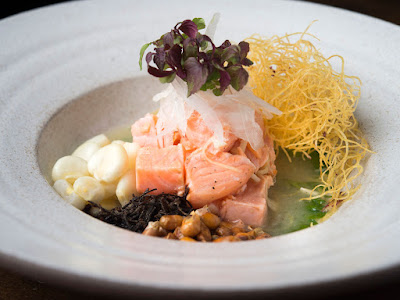
An example of Peruvian-Japanese fusion food (Food & Wine Magazine).
A google search provides pages of articles on this subject:
another example of his not having much new to say.

Here are some things I think the author missed or glossed over: he mentions fusion food, but doesn't say anything new about this much-discussed subject. He doesn't go into the way so-called traditional food is always changing, for example via the invention of new recipes that quickly seem to be a long-term part of traditional cuisine -- like tiramisu and ciabatta bread, both introduced in Italy in the second half of the 20th century. He is vague about the constant arguments about appropriation vs. honest adoption. He is also vague about trends of absorbing the food of the poor into the food of the rich (like polenta in American trendy restaurants). Feeding the victims of natural and human-caused disasters is currently a big endeavor in our global world. For example, José Andrés, whose efforts to provide sustenance that's culturally right are so effective in Haiti, Puerto Rico, and right now in Ukraine. But this isn't part of Parasecoli's story either. He loves to generalize vaguely, not to show how specifics support his ideas.

Mostly, I am very turned off by the pretentious jargon in which the book is written. Here's a passage from the book with my translation into normal English:

Quote from Gastronativism: "Culinary competence operates in four conceptually distinct but often overlapping dimensions: the personal, communal, collective, and institutional spheres of migrants’ social life. The personal dimension is the most immediate and idiosyncratic. Individuals find themselves at the juncture of necessity, external inputs, and their inner world of feelings, memories, desires, and instincts. Eating forces them to interact physically, emotionally, and cognitively with the new environment. Reactions may vary enormously in terms of involvement with foreign culinary practices, ranging from enthusiastic embrace and participative negotiation to active resistance—all the way to total refusal." (p. 164). 

My translation: "When people move to a new country, they react in various predictable ways to the food of the new place. Many but not all of them learn to eat new foods."

Marion Nestle, whom I respect, mentioned that she would be interviewing the author of Gastronativism, which I took for a recommendation, so I bought it. Sadly, I'm disappointed in this book despite her endorsement. I haven't found any professional reviews, I guess the book is too new.

UPDATE June 24. Marion Nestle's review: Weekend reading: Gastronativism

Review © 2022 mae sander for mae food dot blog spot dot com. 


Wednesday, March 30, 2022

What is Cuisine?


"Underlying the rich symbolic universe that food and eating always represent... there is the animal reality of our living existence. It is not separate from our humanity, but is an integral part of it. Only because most of us eat plentifully and frequently and have not known intense hunger may we sometimes too easily forget the astonishing, and at times even terrifying, importance of food and eating. ... A principal source of human suffering in the modern world is still – and has for so long been – hunger. ... Food is something we think about, talk about, conceptualize. But we more than abstract it and desire it – we really must consume it to stay alive." (Tasting Food, Tasting Freedom, p. 4-5)

Sidney W. Mintz (November 16, 1922 – December 27, 2015) wrote many books and articles on the anthropology of food and cooking. Tasting Food, Tasting Freedom: Excursions into Eating, Culture, and the Past is a collection of his essays published in 1996, and mainly written in the 1990s. These essays cover a number of subjects, but I want to look at just one: the attempt to explore the many meanings of the word cuisine and to ask the question: Is there such a thing as American Cuisine? Mintz’s answer is NO.

The word cuisine, Mintz points out, can be used many ways; one can talk about "national cuisines, regional cuisines, haute cuisine, and the possiblity of a society having no cuisine." He sees its use in the United States as mostly taking on "an ethnic or national character: French cuisine, Indian cuisine, Thai cuisine, Chinese cuisine." In fact, he says: "the only real cuisines are regional because of the enduring distinctiveness of local ingredients." Signature foods in various cuisines stand for something more than themselves, being related to "cooking methods and ingredients typical of certain locales, and perhaps only obtainable there. Such foods are intimately linked to the local economy." (p. 94-95)

Grande cuisine and haute cuisine are distinct from regional cuisines, but closely related. These extensions reflect the emergence of capital cities, courts, and the presence of powerful and privileged elites, and the chefs who served them, and of cookbooks that recorded them. "I mean to argue here," says Mintz, "that what makes a cuisine is not a set of recipes aggregated in a book, or a series of particular foods associated with a particular setting, but something more. I think a cuisine requires a population that eats that cuisine with sufficient frequency to consider themselves experts on it. They all believe... that they know what it consists of, how it is made, and how it should taste. In short, a genuine cuisine has common social roots; it is the food of a community – albeit often a very large community." (p. 96)

Things become more complicated the more Mintz looks at them. In some societies, the same foods are eaten by all economic and social levels, though of course at the level that each person or family can afford. In other societies, different social levels eat different things; this situation sometimes results in haute cuisine for the privileged, but the term haute cuisine, Mintz says, means more than just that. The high cost of haute cuisine results from the use of expensive ingredients and/or intense amounts of skilled labor in preparing them. Eventually, haute cuisine also becomes associated with restaurant food, but above all, it represents a social distinction among those who appreciate and value it.

To me, Mintz's many explanations of cuisine are very interesting, and offer useful insights. His chapter titled "Eating American" applies these ideas to American food. "When it comes to food, grasping our particularity as a nation requires us to get some sense of where our history differs from that of other countries, especially European countries," he points out, and cites the very large size of the US, and its recent domination by immigrants, especially from Europe, as well as the displacement of the native population. The mobility of Americans is another factor in his discussion. He seems to see this mobility as countering the fact that different regions of the country during its early history had widely varying foods available to the people's diet, as well as the differing customs of immigrants from many places.

As the immigrant groups arrived, he points out, they experienced a great deal of pressure to become like the already present populations, and this (I think he meant) prevented true cuisines from developing. The homogeneity of foods that became acceptable, he suggests, did not result in the development of an American cuisine. He lists a lot of American foods (like hot dogs, hamburgers, clam chowders, pizza, and desserts) but says they aren't a cuisine. Further, many regional ingredients, such as local fish, have become scarce or have disappeared. The integrity of fresh local and seasonal foods and of foods reflecting immigrant or introduced cuisines has also degraded, being replaced by "substitutes lacking any resemblance at all to the original." (p. 115)

In sum, Mintz does not see American food as adding up to a common cuisine -- he doesn't see "a community of people who eat it, cook it, have opinions about it, and engage in dialogue involving those opinions." (p. 117) He doesn't see people who take the time to contemplate food in the way he thinks a cuisine requires.

I have several problems with Mintz's dismissal of the idea of American cuisine. Although Mintz elsewhere has cited the major contribution of enslaved Africans to the food ways of the US (it's the substance of Chapter Three, "Tasting Food, Tasting Freedom") he seems to forget about this contribution when he talks about the possibility of American cuisine. I find this disturbing. I also find it disturbing that he dismisses so much of the history of American foods, and that he feels that the only unified sense of a meal is Thanksgiving Dinner when effectively the entire country eats the same menu. I thought about Mark Twain's list of American foods that he wrote in 1879. (For this, see Twain's Feast: Searching for America's Lost Foods in the Footsteps of Samuel Clemens by Andrew Beahrs). Despite these misgivings, I found the chapters on cuisine, and all the rest of the book very fascinating.

When I was new to reading about culinary subjects, I read Mintz’s most famous work, Sweetness and Power (published 1985). I vastly admired it and still do! He's widely recognized as one of the inventors of the anthropology of food.

Review by mae sander for mae food dot blog spot dot com. © 2022.

Wednesday, February 16, 2022

Excuse or Reason?

“LIMIT 1”

What is an excuse? Dictionary definitions: 

  • "a reason or explanation put forward to defend or justify a fault or offense." 
  • "a reason put forward to conceal the real reason for an action; a pretext."
  • "something offered as justification or as grounds for being excused."

What is a reason? Dictionary definitions: 
  • "a cause, explanation, or justification for an action or event." 
  • "a statement or fact that explains why something is the way it is, why someone does, thinks, or says something, or why someone behaves a certain way."
I thought about this distinction when I read a comment on my posts about high grocery prices: "Yada, yada – getting quite tired (as most of us are) about the excuses for consistently rising prices of everything." 

This comment implies that there might be a facile explanation for the high cost of goods today: it's somebody's fault and they are covering up with excuses. Is there an entity somewhere that has responsibility for prices? Is someone hiding why the authorities (whoever they are) don't just fix the situation? When something is called "an excuse" there's a suggestion that no real causes and effects are involved. I wonder, is there supposedly someone who could simply restore conditions at the grocery store to what they were two years ago? Who is responsible for empty shelves, higher prices, and difficulties all along the supply chain? Who is to blame for current inflation being at a 40 year high point? Why is there a high increase in the Consumer Price Index? Because commodities and finished products are produced and consumed globally, prices have global as well as national causes. Critical imports particularly come to the US from Mexico, Canada, and China. So inflation is not simply due to events or policies in the US.

I searched for explanations of rising prices other than simply inflation. For starters, sudden increase in demand as the pandemic started resulted in higher prices for some types of goods (and drove down other prices but nobody mentions this). This isn't an so much an excuse, it's more of an economic principle about supply and demand, as I understand it. 

Look at these details about a few specific commodities and what is driving their prices –
  • Toilet paper? Like almost all household paper products, it's made of wood pulp, which is scarce now, due to shipping and labor issues. So prices have gone up, and panic buying in April 2020 and in September 2021 also caused some retailers to limit purchases.
  • Lumber?  Along with many other building materials, big increases in demand were driven by home repair increases during the pandemic, resulting in big price increases. In addition, lumber prices rose because of forest fires, labor shortages due to covid, and overseas shipping issues. In the fall of 2021, prices dropped, but in December they again increased enormously. (Interesting article here)
  • Oranges? They are scarce now especially because groves in Florida are experiencing cold temperatures and diseases of the trees. Harvests are dramatically lower, so orange juice prices are going up.
  • Avocados? The price recently doubled. Right now, a threat to a US inspector of avocados in Mexico has caused cessation of all avocado imports from Mexico; that is, almost all the avocados we eat.  So without credible assurance that US inspectors are protected from Mexican organized crime, there will soon be no avocados available here at any price. It's a developing situation, changing even since I mentioned it a few days ago.
  • Cocoa, Coffee, Bananas, Vanilla, Tea? All are agricultural imports with various risks from shipping problems, plant diseases, climate change, labor issues including workers infected with covid, political unrest in producer countries, and more. 
  • Meat? Costs throughout the entire US meat industry have gone up. The price of chemical fertilizer to grow cattle feed is going up. The number of cattle available to be sold for slaughter is low; there are fewer animals now because of abrupt interruption of cattle ranching at the start of the pandemic. Availability of labor in meat processing plants has been reduced by employee illness during the pandemic (also employer cruelty). Costs of meat-packaging materials like styrofoam trays and wraps has increased. Transporting meat from the processor to the supermarket costs more. Supermarket costs and labor availability are also affected by covid and inflation.
  • Gasoline? The price of gas depends on global supplies (which might be hit by a war in Ukraine next week). The price is affected by oil pipeline capacity, by refinery capacity, by weather disruptions like hurricanes, and by local gas station conditions. Vastly decreased demand for gas during the coronavirus lockdowns caused price reductions; as lockdowns end, demand goes up so prices go up.
  • Cars, clothing, household utilities, houses for sale or rent, appliances, restaurant meals, snacks, furniture, electronics? Prices of these essentials are all driven upward by increased demand and reduced supplies. A few causes: shipping delays, shortages of electronic components, covid recovery problems in China where many key commodities are manufactured, and labor scarcity.
Maybe it's a mystery, whether price increases have identifiable causes or are created by some sort of conspiracy or ineptitude. When I look for solid evidence about prices rising, though, I feel as if I'm being provided with some solid causes, many resulting from the vast number of working people who had covid, others going back to climate change, still others from various specific events. 

Once I started down this rabbit hole, reading articles about shortages and inflation, I couldn't stop, so forgive me for my amateur wanderings in economic theory. I'm no good at this.

Economist Paul Krugman (a real expert with a Nobel Prize!) writes about economics in the New York Times. Recently, he discussed the way people get their news and form their economic beliefs. He pointed out that the right wing is being primed by sources like Fox News and worse, to believe that the economy is terrible and it's the government's fault. He says: "a substantial part of the electorate has economic perceptions quite far from reality; even if things improve, they probably won’t hear about the good news or will be regaled with other negative stories." (source)


Wednesday, January 05, 2022

Word of the day: Hikikomori.

The Cat Who Saved Books by Sosuke Natsukawa. Published 2021.

The Cat Who Saved Books is a fantasy about a boy in a bookstore. In reading this tale, I learned a new word: hikikomori. It means a person who wishes for  social isolation and who wants to spend their life alone. Evidently this Japanese word has been adopted into English. 

Rintaro, the boy in the book, repeatedly refers to himself as a hikikomori. For example:

"There was only so much a high school kid could do after all. He wasn’t a superhero—he was just some moody, gloomy bookworm who happened to make his way to Wonderland. Although this time he could take credit for navigating his way through a series of complicated discussions, he was and always would be a hopeless shut-in, a hikikomori." (p. 170). 

The plot of the tale is that Rintaro's grandfather dies, and leaves him as the proprietor of a small and excellent bookstore full of literary classics that are out of style. Rintaro, the extreme introvert, doesn't quite know how to cope. He stops going to school, and just sits in the bookstore. Then a mysterious cat appears and takes him on quests where he meets individuals who are misusing books. In various ways, Rintaro makes the book-abusers stop. He's a hero to the cat. A few other complications arise, including some bullying from other high-scool kids, and some reaching-out from nicer kids. It's slightly formulaic.

Can you tell that even though I actually enjoy this type of fantasy, where portals open to new worlds (say, Alice in Wonderland or the first volume of His Dark Materials) I didn't really relate to this one? I didn't think it was a very vivid or successful fantasy, and it was depressingly didactic about what's wrong with the way the modern world treats books. 

Like many reviewers, I appreciated the cover art, which is widely recognized for its quality.

Illustration by Yuko Shimizu for The Cat Who Saved Books

Really, there's not much more that I would like to say about this book.
Review © 2022 mae sander


Wednesday, August 25, 2021

"Nine Nasty Words" by John McWhorter


Nine Nasty Words
 by John McWhorter is "a linguist’s journey through profanity, rather than an anthropologist’s, psychologist’s, or historian’s. So many think that we are translators, or grammar scolds, or experts on how to teach kids to read, or dialect coaches. We are none of those things. Rather, we take in what looks like a mess and try to make out the sense in it." (p. 7)

McWhorter has a wicked sense of humor which I love. He's quickly becoming one of my favorite language writers, but I find it challenging to explain just how great he is! I've read quite a few articles and blog posts that he authored, but this is the first of his books I've read. One thing that I really appreciate is the incredible range of his sources, including old movies and stage plays, blues recordings, and historic documents of great diversity, as well as scholarly studies of language and its history. He fascinatingly describes how each of his chosen words became so unspeakable -- and how a few of them are now accepted, while just one of them is utterly taboo.

I especially like McWhorter's choice of three favorite sentences, which he mentions as he discusses the various profane and taboo words in the English language:
  • "The funniest sentence I have ever known, by a solid but non-native-English speaker who informs us that 'Like English, Chinese is a language without gender, i.e., apart from the natural sex of the nouns such as man, woman, boy, waitress, cock, bitch, etc.'” (pp. 147-148). 
  • "Or a sentence I love almost as much as the one about English lacking gender except for words like waitress, cock, and bitch: A wasp just stung me on some drive-by type shit, nigga just stung me and bounced. (p. 197).
  • "I may have found my third favorite English sentence... in something D. H. Lawrence grumbled in 1925 in reference to a cow: 'To me she is fractious, tiresome and a faggot.'” (pp. 214-215). 
If you want more review detail, it's easy to find. But I suggest that you'd be better off reading the book rather than reviews!

This blog post © 2021 mae sander.

Wednesday, March 10, 2021

Harbingers of Spring

Derivation of the word harbinger: "Middle English from Old French herbergere, from herbergier ‘provide lodging for’, from herberge ‘lodging’, from Old Saxon heriberga ‘shelter for an army, lodging’ (from heri ‘army’ + a Germanic base meaning ‘fortified place’), related to harbor. The term originally denoted a person who provided lodging, later one who went ahead to find lodgings for an army or for a nobleman and his retinue, hence, a herald (mid 16th century)." -- Oxford English Dictionary.

I've always liked the sound of the phrase harbinger of spring. It makes me think of birds singing to defend the territories where they soon will nest, and of tiny flowers pushing up through recently frozen earth. I vaguely wondered where harbinger, such an interesting word, came from, but this is the first time I've ever looked it up. 

Winter aconite: one of the first flowers to emerge each spring.

Hellebore, an early bloomer in a neighbor's garden

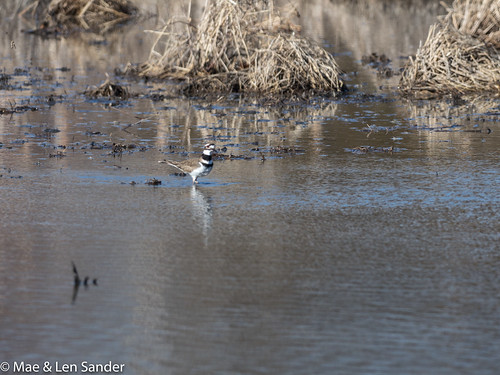
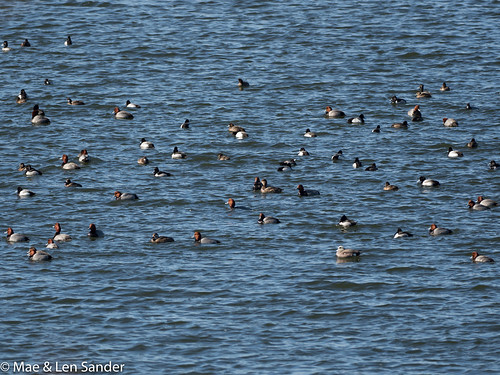
Happily, we have recently been seeing some avian harbingers of spring on our walks and at our bird feeders. The robins, year-round residents, have switched from their winter behavior of flying in large flocks. They are now pairing off and finding nesting places. Early migrants like red-winged blackbirds and killdeer have arrived in the marshy areas of local wetlands. Other birds are stopping here briefly on their way to breeding grounds farther north. Migration continues with a sequence of different species, and goes on for several months: this is just the beginning.

Washtenaw-3-5-3-8-3
Killdeer have returned to Michigan from Mexico. 

Washtenaw-3-5-3-8-4
Migrating waterfowl in breeding plumage:
 redheads, ring-necked ducks, lesser scaup, and widgeon.

We could still have another big snow storm (even a blizzard like the one that buried Michigan on Saint Patrick’s Day in 1973) but we hope this spring will not produce one of those occasional set-backs. 

A sign of hope: having been vaccinated, we can go to the supermarket.
A harbinger of spring -- Easter candy on display.

Blog post © 2021 mae sander.

Wednesday, April 22, 2020

Isolation

Taking a walk in my neighborhood, I noticed a hammock hanging high in a tree.
We're all in isolation these days, but if someone is sleeping up there, they have taken isolation to an extreme!
I've seen people using similar hammocks in parks and various remote places, but this seems to be a novel location.
I wonder how they get up to the hammock. Here's the other side of the tree.
No ladder here now. Maybe it's in the house.
Isolation has lots of meanings in this time of fear and avoidance. For me, it means a lot of reading and cooking and writing. My reading this week has been Tana French's book Broken Harbor, the fourth in the Dublin Murder Squad series, published in 2012. I found it a bit extreme, especially the way French explored (by coincidence) the theme of isolation. In Broken Harbor, isolation was the fate of a family victimized by the economic crash in Ireland a decade ago. Nevertheless, it speaks to our circumstances, perhaps too intensely.

Collectively, the motive to maintain our isolation is powerful. We talk to other people only at a distance. Many of us are wearing masks or bandanas over our faces. We are avoiding all public spaces, and most of them are closed down in any case. Here in a tree, I thought, is another way to be isolated.

Isolation -- my word of the day for Wordy Wednesday!

Blog post and photos © 2020 mae sander for mae food dot blog spot dot com.

Wednesday, April 15, 2020

Learning a New Word from John le Carré

Reading while locked down in anti-pandemic isolation, I decided to consume some escape fiction, specifically, Absolute Friends by John le Carré. Although it was published in 2003, and takes place up until maybe 2002, its time frame is mainly during the Cold War. I haven't read anything by le Carré in a long time, though I do remember some of his other books as well as the movies based on them.

Absolute Friends starts ponderously. The first third of the narrative is a complete biography of the protagonist, before he ever becomes any kind of spy or agent, and nearly a complete biography of the other main character. The two characters, who dominate the book, are very fully depicted, and I enjoyed reading about them despite the slow pace.

While I did enjoy le Carré's portrayal of the 1960s and 1970s from the point of view of a young person, I thought it was a little too detailed about things that don't really affect the plot -- and while reading, I couldn't see how these details could ALL become relevant. Maybe the narrative could have been a bit more disciplined.

Suspense? That's what to expect in a spy novel. This one really lays on the suspense -- in the last 100 pages out of 453. Even amidst the late-appearing suspense, though, the two main characters stop for long philosophical discussions. They debate which tactics are moral or right to use to change the world, violence or non-violence. There's a lot of navel-gazing. One spymaster also engages in some of this speculation. His words of wisdom:
"Lying for one’s country is a noble profession as long as one knows what the truth is, but alas I don’t anymore." (p. 422).
My memory of earlier books by John le Carré is that there are never good answers to the moral and philosophical questions that beset his spies, and that there's no such thing as pure idealism. That's the case in this book. Of course there's a surprise ending that I won't spoil.

Le Carré included lots of very clever and insightful passages. I chose just one, because it employed a word, chicanes, that I don't think I have ever seen before. When I looked it up, it seemed like an absolutely perfect word for a particular situation of Mundy, the main character. Immersed in his country, England, he feels himself to be an anxiety-ridden Englishman, Mundy One. Then he boards a plane to somewhere beyond the Berlin Wall:
"But once in the air, all that changes. The fears fall away and a sensation comes over him that is like a kind of grateful peace. Soon Mundy Two is replacing Mundy One. The England he is leaving behind becomes his enemy, and by the time he enters the grim chicanes of whichever East European airport is receiving him, he could almost hug the hard-faced frontier guards, so effectively has he persuaded himself that the pretending is over, he can breathe free air, he is among real friends at last."  (John le Carré. Absolute Friends, p. 249). 
Here's the dictionary definition of chicane:
chi·cane n. 1 an artificial narrowing or turn on a road or auto-racing course.
2 DATED (in card games) a hand without cards of one particular suit; a void.
3 ARCHAIC chicanery. ■ v. ARCHAIC employ trickery or chicanery.
[trans.] deceive or trick (someone).
late 17th cent. (in the senses 'chicanery' and 'use chicanery'): from French chicane (noun), chicaner (verb) 'quibble', of unknown origin. (The New Oxford American Dictionary)
Although the old sense of the word chicane -- deception -- is considered archaic, I suspect that the author knew his readers would think of it on reading this passage. Thus he packs in a multiplicity of meanings. Bravo!

More on Life in Isolation

Besides good reading and lots of cooking during our long coronavirus isolation, we've been watching recent movies that we had missed seeing in theaters. For different reasons, we liked both "Miss Fisher and the Crypt of Tears" and "Parasite." We have finished watching the new season of "Ugly Delicious" as well.

This review copyright © 2020 by mae sander for mae food dot blog spot dot com.


Wednesday, March 04, 2020

"The Curious Cook"

Harold McGee's book The Curious Cook was published in 1992. That didn't stop me from learning all kinds of interesting new things when I read it this week.

As in his earlier book, On Food and Cooking, McGee's main interest is the science of cooking. He looks at currently interesting issues like salmonella in eggs or how to keep lettuce leaves or guacamole from turning brown. He also explores older questions such as whether searing meat really keeps in "the juices" or whether ice cubes freeze faster if you start with boiling water instead of tap water.

The Curious Cook also has an interesting focus on unusual histories such as the history of persimmons or jerusalem artichokes. He offers summaries of earlier food science such as the work of Benjamin Thompson, Count Rumford (1753-1814), and on the history of food words such as the word mayonnaise.

Let me start by telling you a few things I learned from McGee about mayonnaise.
I am a lover of mayonnaise; these are the two I have on hand.
  • Purists insist that mayonnaise must be made from egg yolks, olive oil, and a hint of lemon juice or vinegar. McGee points out that the definition of this sauce was once much broader, including some very surprising ingredients, like mashed potato.
  • Mayonnaise was first mentioned in print near the beginning of the 19th century. An important early discussion of mayonnaise appeared in the work of the famous chef Antoine Carême (1784-1833). 
  • By the end of the 19th century, says McGee, mayonnaise was a very popular condiment in both Europe and America: an example of American use is Waldorf Salad, first offered in around 1895.
  • The chemistry of mayonnaise involves emulsifying oil and egg yolk. McGee did extensive research on how this process works, including exploring the limits of how much oil can be emulsified into a small amount of egg yolk. Techniques for salmonella-safe mayo using cooked egg are also provided in his hands-on report. As he does with many topics, he challenges conventional cooking wisdom and long-standing myths.
  • Where did the word mayonnaise originate? McGee cites a wide variety of theories. Some people, says McGee, think that it's named after the battle of Mahon, which the French won in 1756. Others believe that this is unlikely because the word wasn't used for around 50 years after the battle, and because the city of Mahon isn't known for its gastronomic successes. Another French word could be the root: moyeu, egg yolk; but that word obsolete by the 19th century. 
  • "The true root word according to Carême, is manier: to work to manipulate," because of the process of working the liquids together. And "The most recent educated guess ... derives mayonnaise from the old verb mailler, meaning to beat, crush, or grind." (p. 130) 
  • Modern bottled mayonnaise dates to near the beginning of the 20th century. This started when growing interest in photography caused a surplus of egg yolks -- albumen from large quantities of egg whites was essential in the booming photographic industry. To cope with the surplus, it was discovered that frozen egg yolks kept very well. Then it was discovered that the frozen yolks were a fine ingredient in long-lasting mayonnaise. Throughout the 20th century mayo became more and more widely used in American cuisine.
I pursued the topic of mayo history, and discovered that in 2013, the popular American brand Hellman's Mayonnaise celebrated 100 years of production. In honor of that anniversary, many writers discussed the same history that McGee had covered 20 years earlier, as well as topics like why some people love mayo and some hate it; why some think its blasphemy to use it on corned beef; or why others find it totally improper to put mayo on a BLT. Here are a few links to the articles I found useful: "On the Etymology of the Word Mayonnaise" from Bon Appétit, "A Brief History of Mayonnaise" from Slate, and a history of the word mayonnaise from the blog Word Histories.

You might be a curious cook yourself, so I'll tell you what McGee said about searing meat, freezing ice cubes, and keeping green stuff from turning brown. If you want to read about his very careful experiments and discoveries on these subjects, you need to get a copy of the book for yourself! His conclusions:
"Searing meat does not seal in juices. Nor does searing reduce the loss of juices. The juiciness of meat is determined by the doneness to which the meat is cooked: the rarer the juicier." (p. 21)
"Hot water can sometimes freeze faster than cold water. In my freezer, ice-cube trays filled with hot or cold water take about the same time to freeze." (p. 190)
"Blemished lettuce leaves darken more rapidly in a salad than leaves with intact surfaces.  ... As long as your knife is sharp, it doesn't matter whether you cut or tear the leaves ... Both vinegar and oil harm the appearance of lettuce, but oil acts more rapidly. ... Leaving the avocado pit in the bowl will keep green only the guacamole in direct contact with it." (p. 72) 
You may think you know how a lot of things work in the kitchen, but McGee doesn't let myths, traditional authorities, or old-wives' tales get in the way of his experiments. While TV food science programs and many others have redone some of the tests, especially about searing steaks to "keep the juices in," his ideas are still intriguing and many are not well-known. He may have made a few mistakes (especially about the physics of heat, according to my husband, a physicist), but his results are mostly still very useful.

The copy of The Curious Cook that I read came from the library -- I think I once owned a copy but I don't think I have it any more, and I have no idea why it took me so long to get around to reading such an interesting book!

This Wordy Wednesday blog post copyright © 2020 mae sander for maefood dot blogspot dot com.

Wednesday, February 12, 2020

Exigencies: A Poem


How happy is the little Stone 
That rambles in the Road alone, 
And doesn't care about Careers 
And Exigencies never fears— 
Whose Coat of elemental Brown 
A passing Universe put on, 
And independent as the Sun 
Associates or glows alone, 
Fulfilling absolute Decree 
In casual simplicity
— Emily Dickinson

I remember reading this untitled poem in high school. You probably remember it too, if you are old enough to have gone to high school before they modernized poetry classes. I don't know if Emily Dickinson is still in, or if she's out.

I believe the time I read this in high school was my first encounter with the word exigencies. A nice word, but it's a little obscure for every-day use. 

I have never memorized the poem, and when I looked it up, I realized that it was longer than I thought (though in fact it's pretty short). Like all poetry, this one makes me afraid that I'm missing the meanings or failing to grasp the depths. Despite my inadequacy, from time to time I like to think about the little rambling stone and the exigencies that don't frighten it. I'll skip the absolute Decree and the passing Universe, and just take the simplicity.

I hear this poem in my head when I walk on the beach and see the little stones, shells, and bits of seaweed tumbled by the water and scattered on the sand.

This blog post written for Wordy Wednesday at maefood dot blogspot dot com. 
© 2020 mae sander.