Showing posts with label tiramisu. Show all posts

Monday, May 19, 2025

Celebration Dinner and Saturday Night Party

 Dinner at Orzo Restaurant

The graduate, her parents, and her sister.

After attending three graduation ceremonies (the general one, the mathematics one, and the computer science one) we enjoyed a celebratory Saturday might dinner at a very nice restaurant called Orzo. 

We are now (Monday) spending a day in Fairfax on the way back home, but I have a couple more blog posts about the weekend that I’ll continue with for a while.

Appetizers

Grilled Asparagus.

Green Gazpacho.

Main Courses


Grilled Swordfish.

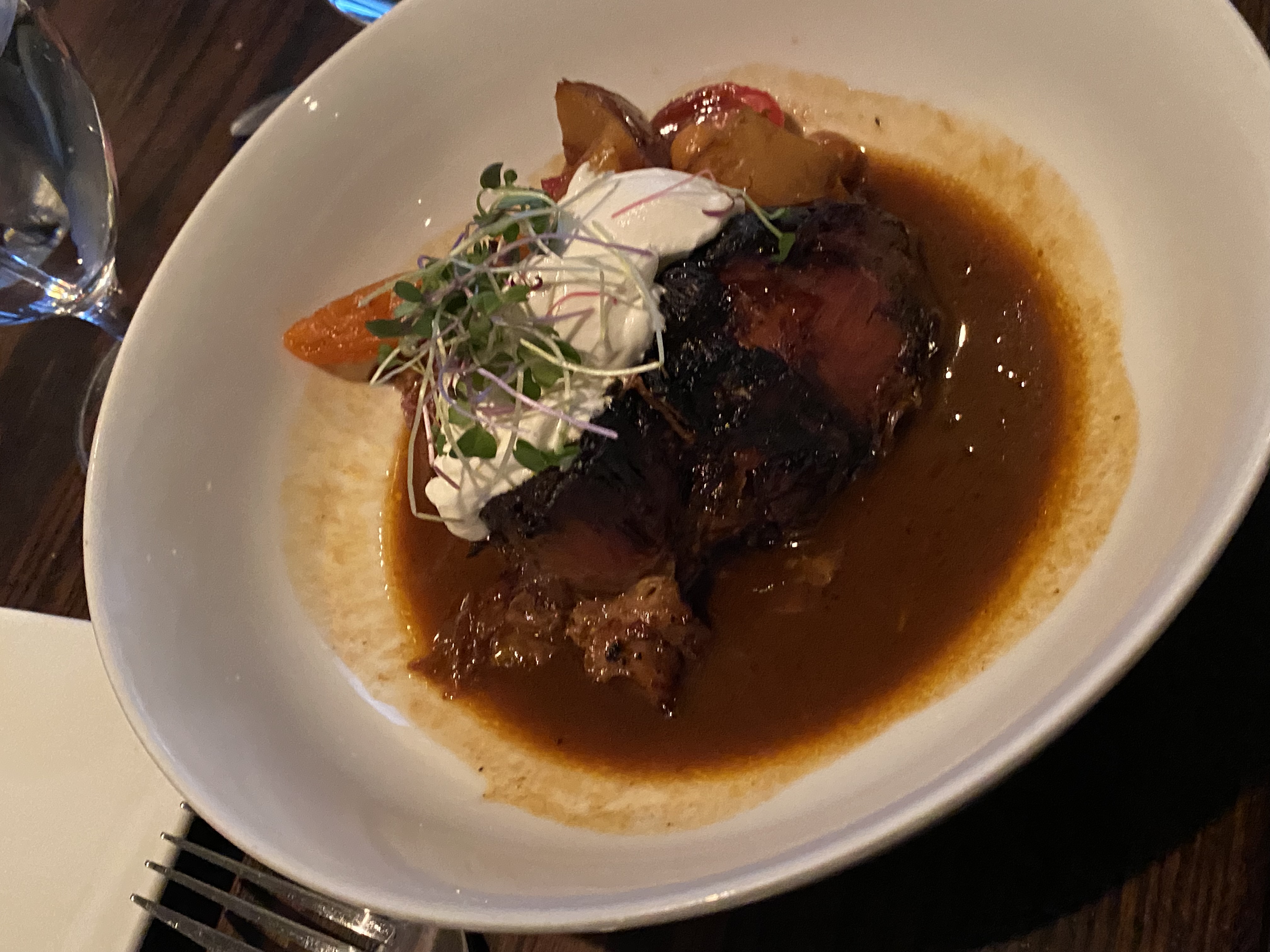
Coffee-braised Lamb Shank.

Grilled NY Sirloin.

This was my delicious steak.

Desserts

Olive Oil and Rosemary Cake.

Tiramisu.

Mango Sorbet.

In the Restaurant


The kitchen.

Graduation Party


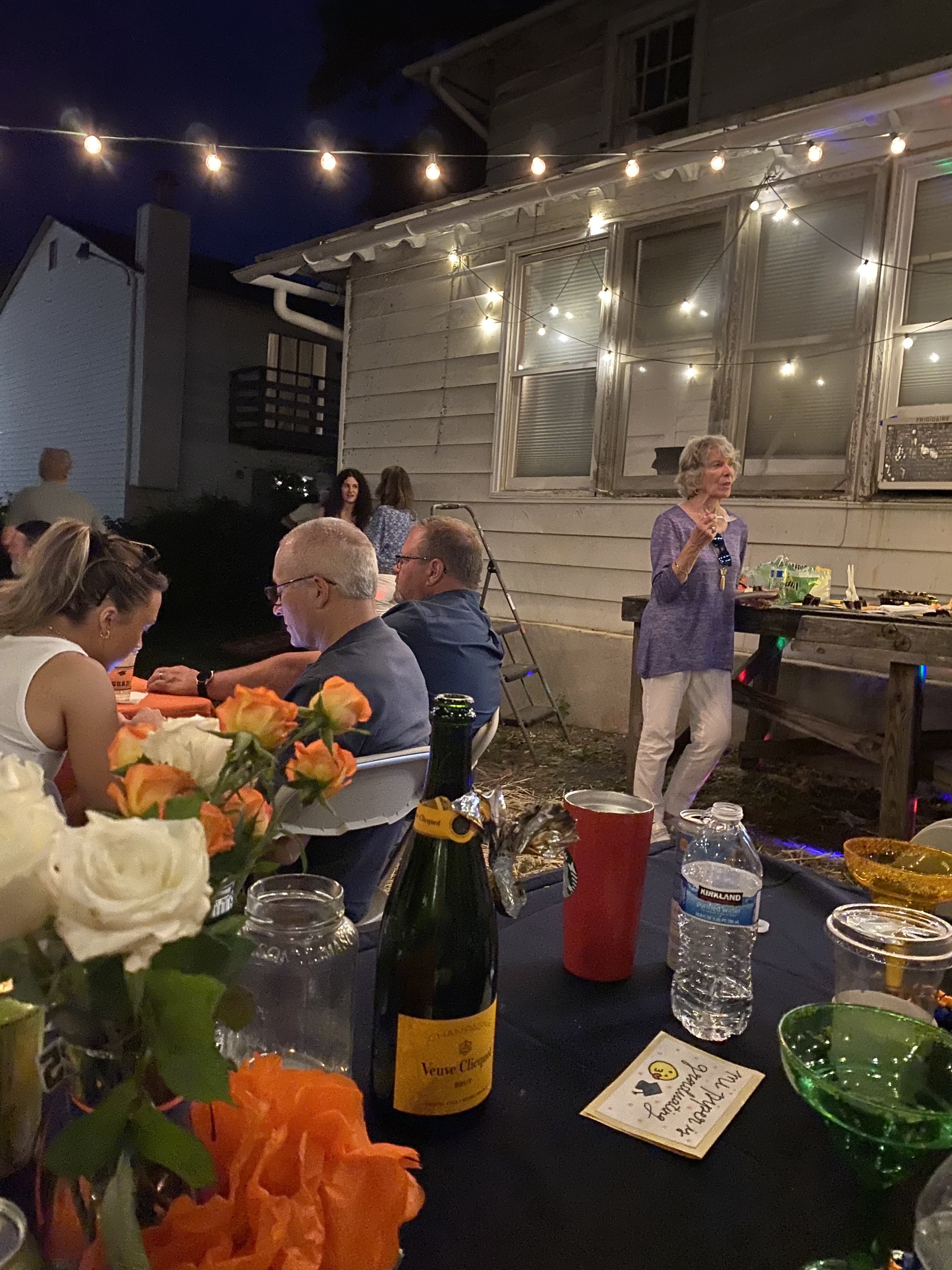
The party had begun with a taco truck, but we had been at Orzo during this time.

Thursday, April 20, 2023

Authentic Italian Food?

Pizza in our own kitchen.

"Of course, it goes without saying that many Italians and Italian-Americans alike have vested, entrenched opinions about their foods. So when Alberto Grandi — an Italian academic and a professor of history at an Italian university in Parma — made some especially controversial comments about the provenance of certain Italian dishes in a recent interview with the Financial Times, it's no surprise some feathers were ruffled."

This is the beginning of an article in Salon.com, "Pasta, pannetone, Parmegiano and pizza are obviously Italian . . . right? Some commonly accepted 'truths' about the origins of Italian food may actually be myths" by Michael La Corte, which analyses a recently-published interview in the Financial Times. The FT article was by food writer Marianna Giusti, who talked with an Italian expert named Alberto Grandi. Grandi is a "Marxist academic, reluctant podcast celebrity and judge at this year’s Tiramisu World Cup in Trevino.... Grandi has dedicated his career to debunking the myths around Italian food; this is the first time he’s spoken to the foreign press. When his 2018 book, Denominazione di origine inventata (Invented Designation of Origin), started racking up sales in Italy, his friend Daniele Soffiati suggested they record a spin-off podcast."

The complex questions of Italian food history have fascinated me because they are so often misrepresented, so I was delighted by both of these articles. My favorite example of counter-factual food history, in fact, is tiramisu, which historical novels often mention in settings very much earlier than it really should be. The FT article cites several examples of much more recent inventions of "classic" dishes than popular culture believes, continuing:

"Tiramisu is another example. Its recent origins are disguised by various fanciful histories. It first appeared in cookbooks in the 1980s. Its star ingredient, mascarpone, was rarely found outside Milan before the 1960s, and the coffee-infused biscuits that divide the layers are Pavesini, a supermarket snack launched in 1948. 'In a normal country,' Grandi says with a smile, 'nobody would care where [and when] a cake was invented.'” (Financial Times)

Grandi is quite a character! According to the FT article:

"Grandi has made himself unpopular in some quarters by criticising Italy’s mighty food and drink sector, which, by some estimates, accounts for a quarter of GDP. On the podcast, he jokes he should only leave his house 'with personal security guards, like Salman Rushdie.' In 2019, the Italian ambassador to Turkey reprimanded Grandi at a conference in Ankara after Grandi ridiculed Italy’s 800 protected designations, products whose quality is recognised by the EU as inextricably linked to their area. At Les Mots literary festival in Aosta in 2018, he was attacked by a Roman presenter who, offended by Grandi’s claims about carbonara, 'called [him] every name in the book' in front of a dumbfounded live audience." (Financial Times)

Also, the FT article discusses in detail the role of the Italian diaspora, especially in the US. There are several specific examples, about pizza, carbonara, and other Italian-American fascinations and fabrications. In addition to reporting on Grandi's ideas, the author did interviews of some older Italians, asking about their food memories in response to Grandi. For example, she writes:

"Mozzarella comes from the south of Italy .... To find out more, I call a friend’s Sicilian great-aunt. Ninety-five and a little deaf, Serafina Cerami answers the phone immediately. 'We ate a lot of mozzarella in Sicily before the war!' she shouts down the line. Like pizza, mozzarella was fast-tracked to global fame through the funnel of mass migration to America from the Italian south. Comparing her recollections with those of my grandmother, it’s clear that Sicily’s elevated 'Sunday' dishes (aubergine parmigiana, cannoli, pasta con le sarde) were the ones that went mainstream, thanks to the south’s contribution to the Little Italys of the US. My grandmother, on the other hand, grew up eating tordelli alla massese (large fresh tortelli with a meat filling, cooked in a ragĂș sauce) and cappelletti in brodo (fresh tortelli in chicken broth), dishes that are almost entirely unknown outside the region." (Financial Times)

The Salon.com article is intended to put the FT article in perspective. The author interviews an American food writer, Ian MacAllen, author of a book titled "Red Sauce: How Italian Food Became American." Here is an interesting excerpt from the interview:

Michael La Corte: "As far as you know, did carbonara, panettone or pizza actually originate in the US or by American chefs? Or were they authentically Italian creations?"

Ian MacAllen: "Carbonara has a lot of mythology behind it and much of it is just made up. The phrase is often credited to the black ration packs US Soldiers carried in World War II, but also attributed to a secret society known as the carbonari, who maybe served the dish at their secret meetings or maybe because of the charcoal workers who cooked it at their forest camps. Renato Gualandi, a chef who cooked a banquet for high ranking allied commanders in World War II is often credited with inventing the dish using ingredients in American soldiers' ration packs. For this reason Luca Cesari describes it as an 'American dish invented in Italy.' One of the earliest documented instances of a Spaghetti Carbonara recipe is in 'Vittles and Vice' by Patricia Bronte indicating the recipe originated in a Chicago restaurant. But it is also possible that Carbonara existed before the war under a different name."  (Salon)

Although it discusses both Italian and Italian-American foodways, the original story in the FT by Marianna Giusti was intended for a British audience. Therefore, expectations about Italian food are very different in the minds of her readers than they would be in an American audience. Her interview subject, Alberto Grandi, in fact, writes and podcasts for Italian readers/listeners, not for Americans OR Brits! To clarify this, the analysis in Salon points out:

"The United Kingdom has a very different relationship to Italian food than Americans have. The United States has literally millions of Italians come to the country between 1880 and 1940. It has become a huge part of American culture — but it's also tied to that time and place where and when these people came to the United States. Italians come to America today and if they end up working at an Italian American restaurant they are cooking dishes that have little connection to what they knew in Italy, but it is very American. In the United Kingdom, the relationship has been different. Italians had free movement to the island when it was a member of the EU. And this happened across all of Europe — Italians moved to those countries and brought with them contemporary Italian cuisine. That food is very different from Italian American cuisine or even contemporary American-Italian cuisine." (Salon)

Both articles are very clear on how extremely recent are many supposedly ancient Italian food traditions and the current insistence on correctness in recipes and ingredients. Giusti concludes:

"Indeed it’s hard to imagine that people who survived the second world war eating chestnuts, as my grandfather did, would be concerned about using pork jowl instead of pork belly in a pasta recipe. Or as Grandi puts it, 'Their "tradition" was trying not to starve.'  (Financial Times)

La Corte, Giusti, and their interview subjects offer lots of fun facts about Italian and Italian-American foods and about frequently repeated myths and fallacies on the subject of Italian cuisine. My summary only includes a very small number of the interesting details. The highly politicized atmosphere of Italy today also causes food to be a political issue, and the FT article has quite a bit on this subject, which I haven't touched. Whether you think you know about Italian food or not, if you are a fan of food history, you should  check out the two articles.

I love Italian food! Anywhere!

On a trip to Sicily in 2007, we were delighted by the food we ate, especially fresh fish.
Many Italian dishes can’t be duplicated because Mediterranean fish from day boats
are unavailable except at the docks and local markets.

SOURCE


At a restaurant where we ate in Sicily: presumably authentic.

Authentic Italian-American food from St. Louis, my native town: “Toasted Ravioli.”
Along with pizza, one of my first-ever Italian foods that I tried when I was in high school.
On a trip to St.Louis a few years ago, I ate this memory-jogging dish and took this photo.

Ottolenghi, a London restaurateur and cookbook author, invented this version of cacio e pepe.
 I’ve made it. It’s good! Photo from Ottolenghi’s website.

Trader Joe’s Ravioli. Product of Italy.
Made for dinner this week. I love it!

Tiramisu at a restaurant in Fairfax, VA, 2015.

Costco Tiramisu: totally American? No, made in Italy.
I love it too.
 

Blog post © 2023 mae sander.
 

Friday, October 21, 2022

History and how to disrespect it

The Four Winds by Kristin Hannah describes a noble cause: fair pay and working conditions for farm workers. The story embodies this noble cause in the lives of a few characters who learn from experience why humane treatment of workers is a cause worth living for. Specifically, this historical novel describes the hardships of the dust bowl era in the Texas Panhandle and the effort of one small family to find a better life in the cotton fields of California — where they instead discover how badly the migrants like themselves are treated, and how the cause of organizing for workers’ rights is crucial.

If a noble cause was all it took to make a great book, this would be a great book. Unfortunately, a few other things are lacking here. First, it’s a historical novel full of small details that the author didn’t bother to check. Second, the characters are presented as romantic and tragic and heroic but the actual portrayal is not very convincing, original, or well-written: there’s a lot of pathos, not much depth; further, there’s an overwhelming amount of repetition in the descriptions of features like the symptoms of starvation shown by the migrants. And third, the narrative is far too dependent on cliches and over-used language, especially in the dialog and the portrayal of the Italian family of the main character’s husband. I marked some specific examples, but they are really on almost every page, so I’m not going to quote them here.

However, I want to give a few examples of small but to me indicative points to illustrate the flawed historicity of the novel. These are clues about the author’s careless attitude, and maybe not important in themselves, except as indications of generally sloppy research.
  • During the family’s time in the Central Valley of California, a flood destroys the migrant workers’ campground, and the residents lose their scant and pathetic possessions. The Red Cross comes to the assistance of these victims. Sweet, isn’t it? Just what we expect to happen. But in reality, prejudice against the migrants was so severe that the local chapter of the Red Cross (at least, a chapter in the general area of the novel’s fictitious town) prohibited aid to migrants! My bullshit detector was triggered by the mention of the Red Cross, which doesn’t have a great reputation for this type of aid, so I looked it up. No help for Okies here! (source)
  • The novel is full of food descriptions, which I found very suspicious — too stereotyped, too much variety, too similar to American foods and Italian foods now. I won’t bother you with details, except to point to the fatal flaw in so many historic novels (often good, well-researched ones). Authors believe that tiramisu is an old traditional Italian dessert, but in fact the recipe was invented and NAMED in the 1970s. It doesn’t belong on an immigrant’s table in the 1930s! I have complained about anachronistic tiramisu in other historical novels, too (see this: https://maefood.blogspot.com/2021/11/tiramisu.html) Errors in food history, in my opinion, point to a sloppy attitude on the part of the author, who doesn’t care because she thinks her readers don’t care.
  • Throughout the novel, a lucky US penny is a key item in the life of the main character and her immigrant in-laws. It came into their possession as they were leaving Sicily: they found it on the street. The wheat sheaves on the obverse of the penny to them meant prosperity and promise from the new country they were heading for. What bothered me is that the design of the so-described penny came into circulation in 1909, and the details of the parents’ immigration would set their departure several years earlier. Not important, maybe, but it tells me that the author thought attention to historic detail was unimportant. 
  • Elsa, the main character, and later her daughter are great readers, and loved libraries. I was a bit suspicious of the breadth of Elsa’s reading — she lived in such a small town, but owned many books. Her daughter later asks a librarian for a recommendation for reading, and the librarian offers her the Nancy Drew mysteries. This really seems questionable, because at that time, librarians thought the very popular kids’ series books like Nancy Drew were not literary enough and they had higher goals for what they wanted kids to read. I verified this by finding an article on the topic: it wasn’t until the 1960s that librarians would have offered such books. This is in fact my own recollection from my own childhood in libraries! (The article, “Scorned Literature,” is fun to read for its own sake.)
The author vaguely addresses her inconsistencies in the end notes: “Primarily where I diverged from the historical record was in the timeline of events. There are instances in which I chose to manipulate dates to better fit my fictional narrative.” (p. 354)

This doesn’t really explain her lack of attention to detail, which I feel is important in a historical novel.

Frankly, it you want to read or hear about the dust bowl, the Okies, the migrant workers in California during the Depression, and the related political issues, I would recommend that you read Steinbeck’s Grapes of Wrath or watch the Ken Burns history series titled “The Dust Bowl.” You could even read some actual historical research, though most likely, it wouldn’t have seamy (though trite) sex scenes like the novel.

Looking Up Some Facts

You can see that I did have fun looking up some of the background about the Dust Bowl and the details of the lives of the characters in The Four Winds. I really wish the book had been better! 

I found a few sources that indicated that the book sometimes was a pretty good reflection of history. Dallhart, Texas, a town in Dallam County, was the birthplace of Elsa, the main character. For one thing, Elsa loves the library (though its founding date was one of the facts that the author shifted to make a better story).  I found some interesting material in the website of the Texas State Historical Association:

The Dallam County Public Library, the first county library in Texas, opened for circulation in January 1921. …

During the drought years of the 1930s Dalhart was notorious for its "black dusters" (see DUST BOWL). R. S. (Uncle Dick) Coon, a wealthy businessman who owned the DeSoto Hotel, became legendary for his generosity to depression-stricken farmers and cowboys. In August 1934 Dalhart became the site of one of the first three erosion-control demonstration projects in Texas, sponsored by the federal land bank, and the first to be devoted specifically to wind erosion.

What Reviewers Said

Some of the reviews of this best-seller seemed to have a reaction pretty much like mine. For example, the Washington Post review was titled "‘The Four Winds’ is Kristin Hannah’s next inevitable bestseller. Don’t forget the tissues." Its conclusion:


In fact, despite the strong echoes to “The Grapes of Wrath,” Hannah may be working closer to 19th-century melodrama. The heroines of “The Four Winds” are purely heroic; its villains wholly evil. Hannah never risks ambiguity; her pages are 100 percent irony-free. And she moves with a relentless pace. Her prose, so ordinary line by line, nevertheless accumulates into scenes that rush from one emergency to the next — starving! beating! flooding! — pausing only for respites of sentimentality. (There’s a little boy in these pages so sweet he could be ground up to flavor 8 million cupcakes.)


Despite Hannah’s extraordinary commercial success, the snob in me wonders what this indefatigable author could produce if she endured a little tougher editorial criticism and gave herself a little more time. (She’s published 24 novels in 30 years.) But that would mean fiddling with the well-oiled machine that reliably produces such marketable passion. I confess, I spent too long rolling my eyes at the flat style, the shiny characters and the clunky polemics of “The Four Winds” before finally giving in and snuffling, “I’m not crying — you’re crying!”

While she never overcomes her low self-esteem about her looks, Elsa displays an iron core of character and courage as she faces dust storms, floods, hunger riots, homelessness, poverty, the misery of migrant labor, bigotry, union busting, violent goons, and more. The pedantic aims of the novel are hard to ignore as Hannah embodies her history lesson in what feels like a series of sepia-toned postcards depicting melodramatic scenes and clichéd emotions. For devoted Hannah fans in search of a good cry.

As I’ve said, I wish this had been a better-written and better-researched novel, but at least it caused me to look up some interesting history articles!

Review by mae sander for mae food dot blogspot dot com. © 2022. 


Wednesday, June 22, 2022

"Gastronativisim"

Gastronativism: Food, Identity, Politics by Fabio Parasecoli is a new book: publication date July 5, 2022, but available already. Based on the title, I expected it to be an interesting and comprehensive study. Unfortunately, I found the book to be about what I would consider to be a rather old subject, for which the author has coined a new word -- the book's title, gastronativism. He also coined other words like gastronationalism and gastrodiplomacy. But that doesn't mean, in my opinion, that he actually has much new to say. 

Parasecoli's book is full of buzzwords like globalism, nationalism, colonialism neoliberalism, multiculturalism, elitism, patriarchy, hegemony, identity, tradition, cultural heritage, cultural capital, authenticity, appropriation, community, migrant culture, environmentalism, autonomy, national cuisines, ethnic cuisines, and many more. The author loves the word exclusionary. All this jargon makes for tedious reading.

Getting past the jargon, I found much of the book to describe the behavior of people who have the upper hand because of money or social privilege or political advantages, and who exploit others, have contempt for them, steal their land or livelihood, etc. In connection with such behavior, the word gastronativism refers to a sense of superiority among members of a such a group, a social class, or a national group and how they judge or put down the food ways and food choices of another group such as a racial or ethnic minority, an immigrant group, or a conquered people. 

"Gastronativism tends to be exclusionary when it is based on the tangible and emotionally charged defense of the status quo against internal and external forces, trying to limit access to the perceived privileges that come with belonging to a community. White supremacy in the U.S., anti-immigrant movements in Italy, conservative identity politics in Poland, and Hindu hegemonic efforts in India find enemies not only outside of the country but also inside." (p. 21).

Thus strong communities have frequently forced their food ways on the weak, one way or another for centuries. This is not news. It's been discussed over and over. Recently, globalization has been creating another go-round of this trend, as first-world food corporations force their manufactured products on third-world and underclasses, and force out the foods that are traditionally grown and processed by the unlucky members of other societies: "When it is the focus of exclusionary gastronativism, food can become a symbol of national sovereignty, cultural purity, or social unity, depending on the context." (p. 37) 

Parasecoli does make a good case for the cynicism of many politicians and other privileged people in exploiting food attitudes. Specifically,  these demagogues succeed in creating irrational support for political ventures through invoking food taboos, fears of multinational corporations, and fear of food insecurity. I would have appreciated it if he had made his examples more detailed, and curtailed some of the wordy generalizations.

Various examples of efforts to make native or traditional foods into tourist attractions provides another way to look at the relationship of privileged people (like tourists) to less privileged people (like natives) -- gastrotourism. It seems as if this would be the opposite of gastronativism, but the two abuses go hand in hand, in exploiting differences among cultures for the profit and even the amusement of the privileged.

Conversely, immigrant groups and colonial subjects have continually introduced new foods to societies and classes of people who were more powerful, while the underprivileged victims are often forced to give up their methods of cultivating food and the native foods of their culture. 

"What is at stake here are not only matters of international trade, comparative advantage, or even economic protectionism. The political debates that food-related incidents provoked in Japan, Taiwan, and Italy suggest that those concerns are accompanied and supported by deeper fears regarding the survival of one’s community. If the nation is the immediate horizon for the perceived threat, its ultimate cause lies in something broader, less easy to understand, and definitely tougher to keep at bay: the unregulated dynamics of globalization, which, on the one hand, facilitate exports and is supposed to endure food security but, on the other, force countries to partly give up their protections, their internal policies, and their autonomy." (pp. 146-147). 

Not really a new idea, but Parasecoli makes a big deal out of his observations of how this form of abuse has worked out in the past and how it goes along with other isms and class structures and modern efforts at food justice and respect for differences in food ways. Many of the specific examples are pretty well known, like the French contempt for people who eat couscous (even though the French eat it themselves) or the English people who hate curry (even though the English eat it themselves) and many other not very startling phenomena, including the UNESCO list of Intangible Cultural Heritage which "protects" such concepts as the Mediterranean diet. 

The biggest example of conquerers adopting the food of conquered people, appropriating foods from disadvantaged people, and simultaneously changing the food ways of the conquered is far from new. It began around 500 years ago. Parasecoli writes: "The isolation between the Old and the New World came to an end in the late fifteenth century with the Columbian exchange: corn, tomatoes, beans, and peppers were adopted from Spain to China, while olives, grapes, wheat, and onions were brought to the Americas." (p. 77) Not a new idea at all -- the historian Alfred Crosby began using the term "Columbian Exchange" and documenting this history in the 1970s. 
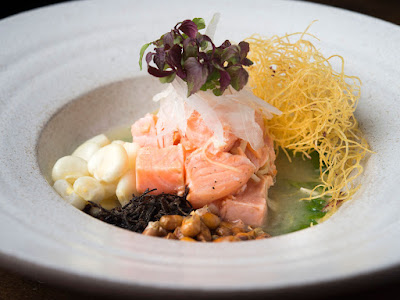
An example of Peruvian-Japanese fusion food (Food & Wine Magazine).
A google search provides pages of articles on this subject:
another example of his not having much new to say.

Here are some things I think the author missed or glossed over: he mentions fusion food, but doesn't say anything new about this much-discussed subject. He doesn't go into the way so-called traditional food is always changing, for example via the invention of new recipes that quickly seem to be a long-term part of traditional cuisine -- like tiramisu and ciabatta bread, both introduced in Italy in the second half of the 20th century. He is vague about the constant arguments about appropriation vs. honest adoption. He is also vague about trends of absorbing the food of the poor into the food of the rich (like polenta in American trendy restaurants). Feeding the victims of natural and human-caused disasters is currently a big endeavor in our global world. For example, José Andrés, whose efforts to provide sustenance that's culturally right are so effective in Haiti, Puerto Rico, and right now in Ukraine. But this isn't part of Parasecoli's story either. He loves to generalize vaguely, not to show how specifics support his ideas.

Mostly, I am very turned off by the pretentious jargon in which the book is written. Here's a passage from the book with my translation into normal English:

Quote from Gastronativism: "Culinary competence operates in four conceptually distinct but often overlapping dimensions: the personal, communal, collective, and institutional spheres of migrants’ social life. The personal dimension is the most immediate and idiosyncratic. Individuals find themselves at the juncture of necessity, external inputs, and their inner world of feelings, memories, desires, and instincts. Eating forces them to interact physically, emotionally, and cognitively with the new environment. Reactions may vary enormously in terms of involvement with foreign culinary practices, ranging from enthusiastic embrace and participative negotiation to active resistance—all the way to total refusal." (p. 164). 

My translation: "When people move to a new country, they react in various predictable ways to the food of the new place. Many but not all of them learn to eat new foods."

Marion Nestle, whom I respect, mentioned that she would be interviewing the author of Gastronativism, which I took for a recommendation, so I bought it. Sadly, I'm disappointed in this book despite her endorsement. I haven't found any professional reviews, I guess the book is too new.

UPDATE June 24. Marion Nestle's review: Weekend reading: Gastronativism

Review © 2022 mae sander for mae food dot blog spot dot com. 


Saturday, November 06, 2021

Tiramisu

Tiramisu that we enjoyed at Villa Mozart, Fairfax, VA, in 2015. Alas this restaurant is no longer in business.

My first introduction to tiramisu was some tine in the 1980s while Len was attending a meeting in Sicily. The Europeans with whom we were having dinner were familiar with this creamy dessert, which was new and very popular in restaurants where they had eaten. By the end of the 1980s, little cups of tiramisu were available in French supermarkets, as the dish had become very trendy. In the US, its popularity started a bit later, but now it's everywhere!

A recent Costco purchase: imported tiramisu from Italy.
It’s delicious! It’s eternally popular! But it’s not an old tradition!

Tiramisu in the Movies

Remember in "Sleepless in Seattle," the widowed hero Sam (played by Tom Hanks) is worrying about how to act on a date, and his friend brings up tiramisu, as something that’s been invented since Sam was in the dating pool. Sam responds: “Some woman is gonna want me to do it to her and I’m not gonna know what it is!” In fact, the 1993 film seems to have created a demand for the introduction of tiramisu to restaurants all across the US. More about this:

In the DVD commentary, director and screenwriter Nora Ephron says “It hardly seems possible there was a time when all of America didn’t know what tiramisu was.” But that was indeed the case. The food was so unknown in 1993 that TriStar Pictures, the distributor of Sleepless in Seattle, reportedly received 25-30 phone calls per day from moviegoers asking the meaning of the joke. (source)

Tiramisu in the News this Week 

This week’s tiramisu news offers some background about the originator of this now-popular dessert: from THE GUARDIAN October 31, 2021:

Italy’s father of tiramisu dies aged 93

Restaurateur Ado Campeol launched the coffee-flavoured dessert, whose name means ‘lift me up’, in 1972

An Italian restaurateur known as the “father of tiramisu” has died aged 93. Ado Campeol died at his home in Treviso, in the Veneto region, on Saturday.

Although the dessert’s origins are often disputed and the family never asserted copyright over the recipe, Campeol and his wife, Alba, the owners of the restaurant Alle Beccherie, are widely considered to be its inventor. 

According to historians, the dish – featuring egg yolks whipped with mascarpone cheese, layered over coffee-soaked biscuits and topped with bitter cocoa powder – was added to their restaurant’s menu in 1972.

Tiramisu in Literature 

Now I would like to do a moment’s trivia peeving with Amor Towles, a very popular and otherwise wonderful author. In his new novel, The Lincoln Highway,  Towles depicts a road trip that takes four characters across the USA in the summer of 1954. One character shares a vivid memory of a wonderful New York-Italian restaurant, including a long description of the way Leonello, the owner, works the room and tends to his customers:

After giving the ladies a few compliments, he’ll signal the bartender. Hey, Rocko. Another round over here for my friends. Then he’ll move on to the next table, where there’ll be more shoulder patting, more compliments for the ladies, and another round of drinks. Or maybe this time, it’s a plate of calamari, or some tiramisu. Either way, it’s on the house. And when Leonello’s finished making his rounds, everybody in the place—and I mean everybody from the mayor to Marilyn Monroe—will feel like tonight is something special. (Amor Towles, The Lincoln Highway, p. 163). 

The details about life in 1954 seem very well researched, and I've been enjoying everything about the characters and the setting of the book. But I wonder why Towles didn't seem to do his background checks about the food he names, and I wonder what else he didn't quite get right. He even repeats the mistake: Billy, a curious and very bright kid, asks these questions: "What’s a trattoria...? What’s a paisano? What’s an artichoke and pancetta and tiramisu?" (p. 435). 

I'm almost finished with The Lincoln Highway, and will probably write a glowing review of it soon. But I'm always disappointed when an author disrespects food history!

Wednesday, December 30, 2015

Memorable Meals of 2015

It's about time to celebrate the New Year, and to think about the old year. Here are some favorite meals I had in 2015, all documented in earlier blog posts --

January: Jack's 95th Birthday Dinner at an Italian restaurant in Boynton Beach, Fla.
January: Oysters at Aqua Grill, New York
February: Gatsby's Tavern, Alexandria, VA.
George Washington ate here -- see photo behind Len's head.
March: Tiramisu at Villa Mozart, Fairfax, VA, celebrating our anniversary.
April: Sparky's in Hatch NM for a Green Chili Cheeseburger.
May: Spike's Bar and Grill, Grayling, MI, with our friends Phyllis and Ed who joined us in the
search for the Kirtland's Warbler
June: reindeer barbecue on our cruise to Svalbart on the National Geographic Explorer
July: Miriam enjoying her sandwich at the Coffee Shack, Captain Cook, HI. And my Eggs Benedict with fresh tuna.
August: Delicious fish at Merriman's in Waimea, also on the Big Island of Hawaii.
September: Shrimp raised in an indoor shrimp farm in Indiana, and
cooked at Elaine and Larry's house in West Lafayette.
October: Cape May Scallops at Lobster House, Cape May, NJ
November: Thanksgiving Dinner in Fairfax, VA
December: Celebrating Chanukkah with Elaine and Larry in West Lafayette.
December: So many favorites! We had latkes in Ann Arbor and Indiana,
Bavarian sausage and potato salad for Christmas Eve, and
Polish Christmas Dinner. Here's the sausage!
It's been a wonderful year full of delightful meals with friends and family. We had lots of good meals alone at home, as well as many out. Thanks to everyone who shared with us! And Happy New Year to all.


Thursday, April 14, 2011

Sticky Toffee Pudding has a history

Today in the Guardian food section: an article about sticky toffee pudding. I ordered it on pub menus a few times in my one longish stay in Cambridge. It's very sweet and sticky indeed, and includes some of my favorite flavors. This cake-with-sauce (remember pudding just means dessert in British English) seemed to be part of the reintroduction of retro desserts into the new and much better English menus we experienced. But now I learn: "as every food nerd will tell you, it was invented in the 1970s by Francis Coulson of the Lake District's Sharrow Bay Hotel." Just like tiramisu, another dish that seemed to go into the eternal past but only goes back partway into the 20th century!

Monday, June 29, 2009

From ABBACCHIO to ZUPPA INGLESE

Zuppa Inglese is approximately equal to an English Trifle, according to the very last entry in the encyclopedic Oxford Companion to Italian Food by Gillian Riley. For several days, I've been browsing through this unusual work.

The book doesn't look unusual -- letter by letter, it goes through ingredients (like the first entry, abbacchio, which refers the reader to see LAMB), regions of Italy, classic dishes, food writers, famous Italians (if they had something to say about food), and concepts like SLOW FOOD and FAST FOOD. It has illustrations -- black and white, a bit grainy. It has consistent cross references. After Z there's a bibliography and an index; the front matter is also complete.

But the content reflects the author's ideas, which are interesting, and I would say, unusual.
  • First, it's fabulously historical -- for example, the entry on Sicily begins at the beginning of history, when Greeks and Phoenicians began to colonize the territory already inhabited by local people. In the Odyssey, the Cyclops adventure took place on Sicily -- and one thing the Cyclops did was to make cheese. Myth or reality? "By 400 BC, Sicilian salt pork and cheese were being exported to Greece," we learn. Also, "Mithaikos, the first celebrity chef, is said to have migrated ... from his native Syracuse [in Sicily] to Greece."
  • Second, the author makes such interesting connections. Zuppa Inglese, or trifle, for example, is linked to many other egg-custard-based desserts -- lighter versions, flummery, syllabub, dishes "where slices of bread are toasted or fried then allowed to absorb a liquid," bread-and-butter puddings, savory bread puddings, budins, other cake and custard dishes, tiramisu, and by implication related custards such as creme brulee.
  • And third, the work makes such wonderful use of Italian literary food references and even art references, such as the citrus fruits that appear in the works of Andrea Mantegna. I think I've in fact been introduced to a new mystery writer that uses food in his works -- I'll post more when I've followed it up.
In all -- I love browsing in this book. It's a really different experience from online browsing!