Showing posts with label Jose Andres. Show all posts

Friday, October 10, 2025

Civilization?

More and more Halloween displays in my neighborhood. Coming soon: another post dedicated to them.

Halloween critters for Eileen.


A Beautifully Illustrated Cookbook

José Andrés: Zaytinya.
I haven’t tried many recipes yet, but I hope I will do more.
I have enjoyed dining at the author’s restaurants in Washington, DC.

Fattoush salad from Zaytinya. Tomatoes, cucumbers, feta cheese, croutons, radishes, bell peppers,
red onions, and herbs from our garden. Olive oil, pomegranate, and lemon dressing. (I omitted sumac because I didn’t have any.)

In 2023: our family at one of the Andres restaurants in 
Washington DC.

Two Historical Novels

I originally reviewed this book by John Shen. Yen Nee and SJ Rozan last year:
https://maefood.blogspot.com/2024/07/two-exotic-mystery-tales.html
Reading next: a newly-published sequel about the same characters.

Next book: the sequel, also featuring Judge Dee.
The Railway Conspiracy by John Shen Yen Nee and S.J.Rozan.

A Challenging Theory of Prehistory and Civilization


Luke Kemp: The History and Future of Societal Collapse.
There are so many theories of prehistory! I haven’t finished this book yet.

The early chapters of this book summarize the emergence of violence and war in human societies, which in hunter-gatherer times had tended to be very egalitarian and peaceful. I found this fascinating. Here are a couple of passages that capture the author’s ideas about the disadvantages of civilization:

“In Europe, there are no signs of war during the Palaeolithic. Around 9500 BCE, after the entry into the Holocene, evidence of lethal violence begins to become more common. After around 5500 BCE, as agriculture agriculture spreads across Europe, people settle down, and inequality intensifies; clearer indications of warfare, including fortifications, towns surrounded by ditches, and evidence of massacres, all creep upwards. The Near East follows a similar trajectory. The Natufians killed each other at low rates and didn’t conduct war. For thousands of years we find just a few skeletons with fractured skulls and embedded projectiles. Then in the seventh century BCE, perhaps the first fortification in the world – Tell Maghzaliyah in northern Mesopotamia – was constructed near a node of long-distance obsidian trade.” (p. 68)

The author points out that the increasingly dense cities that emerged not only were more violent, but also began to suffer from contagious diseases. He writes:

“Many of the plagues of the world today, such as influenza, measles, mumps, cholera, smallpox, chicken pox, and, of course, Covid-19, are all recent developments from the past ten thousand years. Our hunter-gatherer ancestors never had to endure the throaty cough of influenza or the painful and disfiguring scabs of chicken pox or smallpox, which emerged only with the advent of urbanism and agriculture. These ‘density-dependent’ diseases require intense interaction between humans and animals, something many of the earliest cities provided in abundance. Such diseases also need a sufficiently large population so they don’t burn themselves out by killing all their hosts.” (p. 89)

This is a challengingly-written and rather long book, and I’m planning to continue reading it around 100 pages at a time.

Related book reviewed in 2017

James C. Scott , Against the Grain: A Deep History of the Earliest States.
Reviewed here: 
https://maefood.blogspot.com/2017/10/against-grain-contrary-book.html

Blog post © 2025 mae sander
Shared with Deb’s Sunday Salon at Readerbuzz

Monday, December 04, 2023

The Pisco Sour

A Pisco Sour: Pisco is a colorless grape brandy made in Peru.
(Random image from google)

On the Menu at China Chilcano in Washington, DC:


José Andrés
China Chilcano is the wonderful restaurant run by Chef José Andrés and his excellent staff, which opened in 2015. It's menu "honors Peru’s deeply rooted and diverse heritage, including its native Criollo, Chinese Chifa and Japanese Nikkei cuisines."
 
Looking at the drinks menu when we ate there recently, I recalled the Peruvian national drink: the Pisco Sour. Although I drank wine at the restaurant, I was amused to recall all the Pisco Sours we drank while on the Delfin II, a riverboat on the upper Amazon River in Peru.

José Andrés is not only a great chef, and the developer of a number of fabulous restaurants, but he's also the founder of World Central Kitchen, a remarkable organization for feeding victims of wars and natural disasters worldwide. Recent operations by WCK have taken place in response to the hurricane in Acapulco, the devastating fire in Maui, the wars in Ukraine and Gaza, and many other locations.

Super delicious Ceviche Nikkei that we tried at China Chilcano.

Pisco Sours in Peru


From the public relations for the Delfin Amazon cruises: the above photo features a bartender with the ingredients for a Pisco Sour, specifically giant limes from the local area. On our cruise (in 2017), Pisco Sours were available all day, included in the price of the voyage.

On the Delfin II in 2017: the bartender making Pisco Sours.


Blog post by mae sander © 2023


Saturday, November 25, 2023

Thanksgiving Vacation

Things we have done with the family this holiday —

Watching “Oppenheimer.”

Catching up on “The Great British Baking Show.”

We had a drink at the bar at China Chilcano in Washington, DC.

And we had a fabulous dinner at China Chilcano, a José Andrés restaurant with Peruvian/Japanese cuisine.
Andrés  is also the founder of a remarkable organization for providing food to victims of wars and natural disasters:
WORLD CENTRAL KITCHEN.

Dessert: a dulce de leche custard with passion fruit sorbet. Superb!

Going to the National Portrait Gallery to see the famous portrait of President Obama
by Kehinde Wiley. The Gallery has portraits of every President since Washington!

Bill Clinton by Chuck Close.

John F. Kennedy by Elaine de Kooning.

Abraham Lincoln by W.F.K.Travers (link)


Photos by mae sander © 2023
Shared with Deb at Readerbuzz.

Friday, September 15, 2023

Much More than Just a Cookbook!


This cookbook was published this week, and I just received my copy!


The World Central Kitchen Cookbook offers a wide variety of recipes, but also many stories about how the World Central Kitchen (WCK), in its 13 year history has helped the victims of fires, floods, earthquakes, hurricanes, and other disasters. This cookbook provides many really interesting recipes. Introductions to the chapters and to the recipes also tell the story of the organization and photos of the many workers, beneficiaries, and participants in its activities. 

I was interested in learning more about the WCK founder, chef José Andrés, a celebrity culinary personality whose restaurants have been widely recognized. Not content to feed the elite, he explains, he has tried to feed people who really need food. Because his approach is to find culturally appropriate foods for each new location, the recipes in this book are international, authentic, and very appealing. 

World Central Kitchen is a remarkable organization, mainly known for speedy response to natural and human-caused disasters that leave people without food, shelter, and family. WCK has fed people In Puerto Rico and Haiti after severe hurricanes left people homeless and hungry, in Beirut after a gigantic explosion destroyed much of the city, in refugee camps on the US-Mexican border, and in many other affected locations, most recently in Maui after the wildfire last month. WCK has developed the resources and equipment needed to come in quickly and prepare meals for the disaster victims, usually in cooperation with local restaurateurs, local organizations, and local volunteers.

Of many relief organizations, I believe that WCK has one of the most impressive philosophies of how to help. I’ve mentioned them often before. I’ll let you know more about the book when I have prepared some of the recipes!

In 2014, we had lunch at José Andrés’ Mexican restaurant Oyamel in Washington, D.C.
I enormously respect this chef for his culinary AND charitable accomplishments!
By the way, in the lower-right photo Miriam is trying a grasshopper taco.


Blog post © mae sander 2023

Wednesday, June 22, 2022

"Gastronativisim"

Gastronativism: Food, Identity, Politics by Fabio Parasecoli is a new book: publication date July 5, 2022, but available already. Based on the title, I expected it to be an interesting and comprehensive study. Unfortunately, I found the book to be about what I would consider to be a rather old subject, for which the author has coined a new word -- the book's title, gastronativism. He also coined other words like gastronationalism and gastrodiplomacy. But that doesn't mean, in my opinion, that he actually has much new to say. 

Parasecoli's book is full of buzzwords like globalism, nationalism, colonialism neoliberalism, multiculturalism, elitism, patriarchy, hegemony, identity, tradition, cultural heritage, cultural capital, authenticity, appropriation, community, migrant culture, environmentalism, autonomy, national cuisines, ethnic cuisines, and many more. The author loves the word exclusionary. All this jargon makes for tedious reading.

Getting past the jargon, I found much of the book to describe the behavior of people who have the upper hand because of money or social privilege or political advantages, and who exploit others, have contempt for them, steal their land or livelihood, etc. In connection with such behavior, the word gastronativism refers to a sense of superiority among members of a such a group, a social class, or a national group and how they judge or put down the food ways and food choices of another group such as a racial or ethnic minority, an immigrant group, or a conquered people. 

"Gastronativism tends to be exclusionary when it is based on the tangible and emotionally charged defense of the status quo against internal and external forces, trying to limit access to the perceived privileges that come with belonging to a community. White supremacy in the U.S., anti-immigrant movements in Italy, conservative identity politics in Poland, and Hindu hegemonic efforts in India find enemies not only outside of the country but also inside." (p. 21).

Thus strong communities have frequently forced their food ways on the weak, one way or another for centuries. This is not news. It's been discussed over and over. Recently, globalization has been creating another go-round of this trend, as first-world food corporations force their manufactured products on third-world and underclasses, and force out the foods that are traditionally grown and processed by the unlucky members of other societies: "When it is the focus of exclusionary gastronativism, food can become a symbol of national sovereignty, cultural purity, or social unity, depending on the context." (p. 37) 

Parasecoli does make a good case for the cynicism of many politicians and other privileged people in exploiting food attitudes. Specifically,  these demagogues succeed in creating irrational support for political ventures through invoking food taboos, fears of multinational corporations, and fear of food insecurity. I would have appreciated it if he had made his examples more detailed, and curtailed some of the wordy generalizations.

Various examples of efforts to make native or traditional foods into tourist attractions provides another way to look at the relationship of privileged people (like tourists) to less privileged people (like natives) -- gastrotourism. It seems as if this would be the opposite of gastronativism, but the two abuses go hand in hand, in exploiting differences among cultures for the profit and even the amusement of the privileged.

Conversely, immigrant groups and colonial subjects have continually introduced new foods to societies and classes of people who were more powerful, while the underprivileged victims are often forced to give up their methods of cultivating food and the native foods of their culture. 

"What is at stake here are not only matters of international trade, comparative advantage, or even economic protectionism. The political debates that food-related incidents provoked in Japan, Taiwan, and Italy suggest that those concerns are accompanied and supported by deeper fears regarding the survival of one’s community. If the nation is the immediate horizon for the perceived threat, its ultimate cause lies in something broader, less easy to understand, and definitely tougher to keep at bay: the unregulated dynamics of globalization, which, on the one hand, facilitate exports and is supposed to endure food security but, on the other, force countries to partly give up their protections, their internal policies, and their autonomy." (pp. 146-147). 

Not really a new idea, but Parasecoli makes a big deal out of his observations of how this form of abuse has worked out in the past and how it goes along with other isms and class structures and modern efforts at food justice and respect for differences in food ways. Many of the specific examples are pretty well known, like the French contempt for people who eat couscous (even though the French eat it themselves) or the English people who hate curry (even though the English eat it themselves) and many other not very startling phenomena, including the UNESCO list of Intangible Cultural Heritage which "protects" such concepts as the Mediterranean diet. 

The biggest example of conquerers adopting the food of conquered people, appropriating foods from disadvantaged people, and simultaneously changing the food ways of the conquered is far from new. It began around 500 years ago. Parasecoli writes: "The isolation between the Old and the New World came to an end in the late fifteenth century with the Columbian exchange: corn, tomatoes, beans, and peppers were adopted from Spain to China, while olives, grapes, wheat, and onions were brought to the Americas." (p. 77) Not a new idea at all -- the historian Alfred Crosby began using the term "Columbian Exchange" and documenting this history in the 1970s. 
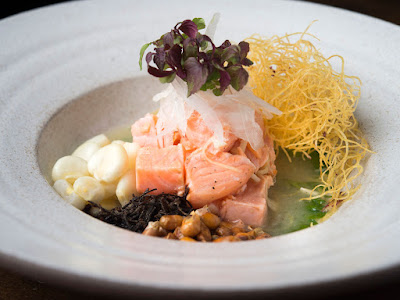
An example of Peruvian-Japanese fusion food (Food & Wine Magazine).
A google search provides pages of articles on this subject:
another example of his not having much new to say.

Here are some things I think the author missed or glossed over: he mentions fusion food, but doesn't say anything new about this much-discussed subject. He doesn't go into the way so-called traditional food is always changing, for example via the invention of new recipes that quickly seem to be a long-term part of traditional cuisine -- like tiramisu and ciabatta bread, both introduced in Italy in the second half of the 20th century. He is vague about the constant arguments about appropriation vs. honest adoption. He is also vague about trends of absorbing the food of the poor into the food of the rich (like polenta in American trendy restaurants). Feeding the victims of natural and human-caused disasters is currently a big endeavor in our global world. For example, José Andrés, whose efforts to provide sustenance that's culturally right are so effective in Haiti, Puerto Rico, and right now in Ukraine. But this isn't part of Parasecoli's story either. He loves to generalize vaguely, not to show how specifics support his ideas.

Mostly, I am very turned off by the pretentious jargon in which the book is written. Here's a passage from the book with my translation into normal English:

Quote from Gastronativism: "Culinary competence operates in four conceptually distinct but often overlapping dimensions: the personal, communal, collective, and institutional spheres of migrants’ social life. The personal dimension is the most immediate and idiosyncratic. Individuals find themselves at the juncture of necessity, external inputs, and their inner world of feelings, memories, desires, and instincts. Eating forces them to interact physically, emotionally, and cognitively with the new environment. Reactions may vary enormously in terms of involvement with foreign culinary practices, ranging from enthusiastic embrace and participative negotiation to active resistance—all the way to total refusal." (p. 164). 

My translation: "When people move to a new country, they react in various predictable ways to the food of the new place. Many but not all of them learn to eat new foods."

Marion Nestle, whom I respect, mentioned that she would be interviewing the author of Gastronativism, which I took for a recommendation, so I bought it. Sadly, I'm disappointed in this book despite her endorsement. I haven't found any professional reviews, I guess the book is too new.

UPDATE June 24. Marion Nestle's review: Weekend reading: Gastronativism

Review © 2022 mae sander for mae food dot blog spot dot com. 


Friday, June 03, 2022

"We Feed People" -- A Great Documentary


José Andrés is famous for his restaurants and for World Central Kitchen, an organization that has established emergency kitchens after natural disasters caused food emergencies. A recently released documentary, “We Feed People,” describes how Andrés and his dedicated coworkers created operations after the Puerto Rico hurricane, the Haiti earthquake, the Guatemala volcanic eruption, covid's effects on the Navaho Nation and on American cities, and other disasters. The scenes of total destruction and the sufferings of the victims are overpowering, but the ability of World Central Kitchen to offer humanitarian and empathetic help are inspiring.

The documentary offers an absolutely wonderful view of Andrés, a dedicated and successful chef. He could have simply enjoyed fame, success, and wealth from his restaurants. He could have stayed at home with his wife and children -- but the documentary shows how he constantly left them to help those in need. I've eaten in a few of his restaurants in Washington, DC, so I know what a talented restaurateur and chef he is. But he did so much more! 


I was already aware of World Central Kitchen and its unconventional way of creating feeding operations when much better-funded organizations like the Red Cross and FEMA allowed themselves to be enmired in bureaucratic nonsense. I was aware of the way that WCK always tried to create meals that satisfied the foodways of the local people, and I enjoyed the way the filmmakers stressed this commitment. The drama of overcoming the challenges of driving trucks and delivery vehicles into rushing water or just-erupted volcanic fields or desert roads to out-of-the way villages was exciting and fun to watch, but always with sadness for the victims. I enjoyed the visual detail and the emotional intensity shown in almost every scene.

I loved the cooking scenes!

The documentary was finished before World Central Kitchen's current efforts in the Ukrainian war areas and in the refugee camps just outside the Ukrainian borders. The fact that Russia is creating victims intentionally, and causing suffering like that from natural disasters must make these volunteers really mad. It makes me mad.


Official description: "WE FEED PEOPLE, from Oscar-winning director Ron Howard, spotlights renowned chef José Andrés and his nonprofit World Central Kitchen’s incredible mission and evolution over 12 years, from being a scrappy group of grassroots volunteers to becoming one of the most highly regarded humanitarian aid organizations in the disaster relief sector."

Review © 2022 mae sander. Images from the trailer.


Thursday, March 31, 2022

What’s cooking in my kitchen and happening in the world


In my kitchen in March, I tried quite a few new recipes for various vegetable dishes, and I want to share them with the other bloggers who participate in Sherry’s blog event called “In My Kitchen.” I’m always happy to see what others have written about their kitchens — but also saddened by a few spoilers who link posts that have no kitchen content, nothing but a recipe, an old blog post, or even just an ordinary post about some unrelated topic. It’s too bad when they do this at Sherry’s blog event or other blog events. Many of the committed participants -- whom I feel are my friends on almost every continent -- share new things they have acquired for their kitchens, which is always fun. So here is a wrap-up of what's been happening in my kitchen, and what I've been thinking about.

Trying New Recipes


Raw carrot salad with dates and almonds. (Recipe here)

Steamed Brussels sprouts: to be cooled & tossed with parmesan and pecorino cheese 
 and dried fruits and nuts. Recipe from combined sources online.

Aloo Gobi: the “dry” version without tomato sauce.
A classic made with cauliflower, potatoes, and Indian spices.

Squash made from a recipe in my Ethiopian cookbook.

Red beans to go with brown rice. A vegetarian version of the Louisiana dish.
I started with a recipe, but used canned beans and smoked paprika in place of
ingredients suggested (source).

Dressing: kefir, mayonnaise, chopped green onion, crushed garlic, dill, fines herbes, lemon juice, Dijon mustard, salt, black pepper
Veggies: fresh green bean, frozen peas, and to be added: leaf lettuce

Old Favorites


Shakshouka: the tomato sauce is simmering, the eggs ready to be poached.

Artichokes waiting to be steamed and eaten with melted butter.
Small Campari tomatoes are a winter treat!

Salmon patties, which I made from frozen salmon filets.
My mother's recipe, but she used canned salmon.


Len made a few batches of bread.

Outside my Kitchen


On my week of travel in March: I watched this vendor making tortillas on a tortilla press at the Charlottesville Art Park.

Food Thoughts about the War Zone

Everyone expected the war to end in March, but it goes on and on, increasing the suffering of the citizens of Mariupol, Kyiv, Kharkiv. Kherson, Chernihiv, Mykolaiv, and numerous other cities. Haunting images of bombed-out apartment towers, ruined cultural institutions, subway stations turned into bomb shelters, and makeshift graves appear in newspapers day after day, along with reports that supplies of food and safe drinking water are becoming scarce or nonexistent. 

Bread distribution in a subway station in Kharkiv. (source: UN)
One of many brutal Russian actions was killing people in a bread line.

Each day there is a new total for the number of Ukrainians displaced by the war. Endless streams of refugees are arriving in the surrounding countries with almost nothing of their former lives. The refugee total beyond the borders of Ukraine is now more than 4 million! People throughout the affected areas, aid organizations, and local and foreign governments are struggling to provide basic food and shelter to displaced residents, to people stranded in the devastated areas, and to those that have fled across the borders. 

World Central Kitchen, for example, was founded by the chef José Andrés, and is one of many organization providing meals to Ukrainian refugees. World Central Kitchen was recognized for success with previous disaster relief efforts; for example, they were among the most helpful after the hurricane in Puerto Rico a few years ago. They have set up a kitchen just over the Ukrainian border with Poland where large numbers of refugees are fleeing to try to find safety from the invasion.


World Central Kitchen operating in Poland in March.

Hunger and heroism are hand in hand throughout the devastated areas. Here is a description from mid-March of the efforts of one Ukrainian corporation, attempting to deal with the food shortages in cities that are being attacked:

"MHP, the sixth-largest poultry exporter in the world and said to be the biggest food company still operating in Ukraine, is giving away as many as 330 tons of chicken every day to feed thousands of civilians in Kyiv, Kharkiv and Mariupol under attack by Russian forces led by President Vladimir Putin. The courage comes in getting the food safely to destinations, bypassing blown-up bridges, maneuvering checkpoints, avoiding bombed-out terrain—and death. There’s no telling how many Ukrainians are living in desperate circumstances, without heat or sustenance, but reports of apartment buildings and hospitals ablaze in residential neighborhoods are frequent."  
 
“'It’s a humanitarian crisis,' said John Rich, chair of MHP, an Australian who’s running the company from safer ground in Slovenia. 'People in bombed-out areas have no access to anything.' 
 
"Thousands of drivers in Ukraine are embarking on what Rich called suicide missions to bring vans full of chicken to people who’ve gone days without food. Many of the drivers are new employees who turned to MHP after the closing of other companies, including MHP’s competitors.” (Source: Forbes)

This particular producer is currently struggling to maintain production in the agricultural areas of Ukraine, where the invasion has not destroyed the infrastructure. The spring planting season begins now, and they are trying to establish a way to keep going, and to continue exporting food, despite the war.  Details about their struggles give some insight into how the war is affecting the areas outside Ukrainian cities. (Source: Bloomberg)

The disruption of Ukrainian agriculture is a looming threat to global food supplies, as Ukraine is a major international agricultural supplier; however the immediate threat of hunger and even starvation is an unthinkable part of the life of large numbers of people in Ukraine right now, and my kitchen thoughts turn to them.

Ukrainian grain-processing plant as photographed last year. (source)

Blog post © 2022 mae sander.


Friday, March 19, 2021

“Waffles and Mochi”


Michelle Obama as the anchor! Samin Nosrat explaining about tomatoes and pasta! Jose Andres making gazpacho! How could one episode of this new Netflix show have three such famous people? And how could it be anything but stellar? 


Well, we watched it, and while I still love the three famous people, and I’m not really negative about the characters Waffles (born in a freezer somewhere with a frozen waffle for a mother) and Mochi (a little ball of, yes, mochi, the Japanese rice cake), I guess I’m basically disappointed in the dialog and the music. I was hoping for something faster and more exciting, like Sesame Street. And I know it’s for kids, but... just not thrilling enough for me. I’ll give one or two more episodes a try.