Showing posts with label cookbooks. Show all posts

Sunday, April 19, 2026

Women in the Kitchen


Women in the Kitchen  by Anne Willan, published 2020.

This book tells the story of twelve women who were famous for their cooking, with very enjoyable recipe sections for each of them. I hope to try some of these recipes. I liked reading about Hannah Glasse, Lydia Child, Fannie Farmer, Irma Rombauer, Julia Child, Edna Lewis, Marcella Hazan, Alice Waters, and the others. While some of the subjects of the book are new to me, I have used cookbooks by many of the other authors who appear in this book. 

Illustration from Women in the Kitchen. Note that there is a book open on her table while the woman works at the fire — no doubt a cookbook!

Women in the Kitchen includes many amusing and interesting little facts, such as that The Boston Cooking-School Cook Book by Fannie Farmer “outsold all other American cookbooks of the nineteenth century, its success only checked in 1914 by the outbreak of World War I.”  

I learned about several authors whose works I had only vaguely heard about. Sarah Rutledge (born 1782) for example, was the author of The Carolina Housewife. “By 1847, when Sarah Rutledge published The Carolina Housewife, her only book, she could look back on a lifetime as doyenne of Southern society, featuring rounds of spring presentation parties and languid summer suppers giving way to the festivities of Thanksgiving and the winter holiday season. When she set up house independently in Charleston, she would have been served by slaves.” So her advice on how to run a household is very different from later authors, who address women who had few or no servants!

Predictably, there’s a chapter on Irma Rombauer and her original and insanely successful way of writing a cookbook: The Joy of Cooking. Who doesn’t know this cookbook? By 1974: “No cookbook in American history had achieved such fame. Two decades later Joy of Cooking was chosen by the New York Public Library during their centennial celebration in 1995 as the only cookbook among its 150 most influential books of the century. More than a million copies had been sold by the time the seventh edition was published in 1997. After a series of revisions, a 75th anniversary edition was published in 2006. It contained 1,152 pages and more nearly echoed earlier editions. The urge to modernize was curbed and the teaching text was restored and expanded. As Julia Child put it when she heard about the upcoming anniversary edition: ‘Thanks for putting the joy back in JOY.’”

Women in the Kitchen is a quick and entertaining book to read. I found some of the material new to me, and some very familiar — which is a nice combination, I think. The author keeps her focus on food!

Cooking at our House

Cooking Sunday evening dinner: Alice made salmon with cherry tomatoes. I made au gratin potatoes.

Monday, June 16, 2025

A Beautiful Life in Food


— source
Joan Nathan’s cookbooks always offer lots of wonderful recipes, though I have followed only a few of them. One recipe that appears in her new memoir, My Life in Recipes, is especially tempting to me because it features a specialty of a long-closed Ann Arbor eating place. “Ann Arbor Schnecken” or Pecan Sticky Buns were a favorite of hers during her years as a student at the University of Michigan. I liked them too! In the photo you can see her working on a tray of these very very sweet treats!

I’ve been aware of the main details of Joan Nathan’s life for some time — I liked reading the book because I lived in some of the same places that she lived, and I share some of the memories from my own life. Raised in Jewish communities in the New York and East Coast area (unlike me, a midwesterner, though sharing the Jewish-American experiences), she came to Ann Arbor as a student a few years before we moved here. She also spent time in Paris, France at about the same time that we spent our first stay in Grenoble, and many of her memories remind me of things I enjoyed there as well. Obviously this makes it fun to read the early chapters of her book, especially as she provides connected recipes for each short chapter. 

As background for her childhood, she also described family memories of her parents’ origins in Europe. I especially liked her brief stories of Augsburg, Germany, and I would like to try her recipe for Augsburg’s special plum cake, Zwetschgenkuchen, when plums are in season. I’ve heard of it from my own family — my son-in-law is from Augsburg. He, my daughter, and my granddaughters have talked about this favorite, also called Zwetschgendatschi. They say it can’t really be made properly except with the special local Augsburg plums!

In her twenties, Joan Nathan had several very interesting jobs, especially working in Jerusalem as an aid to the mayor, and also worked in publishing in New York. She describes these years by alternating recipes with memories, which I enjoyed. My own visits to Israel were many years later, which contributed to how much I enjoyed this part of her story. And this is Joan Nathan, so I am sure that the recipes would come out just delicious if you cooked them!

After her marriage in the early 1970s, the author lived in Washington, DC, where she met many prominent members of political and social society, as well as many celebrities of cooking and culinary journalism. At this point, her book seems to do more name-dropping than really interesting narrative. I was dissatisfied with the way she presented these intriguing relationships, but felt that she never really provided a thorough portrayal of the many compelling figures who came in and out of her life. Sad to say, I really didn’t connect to these later chapters, and eventually scanned them rather than reading in detail.

Celebrities


Blog post © 2025 mae sander


Monday, January 20, 2025

Are Food Books Changing?

Complaint: I’m having difficulty finding recent food books that I want to read. Objectively, it’s hard to judge, but I have a feeling that the publishing industry has moved on from the type of book that I enjoyed very much 10 or 15 years ago or more. I’m not finding authors who write like M.F.K. Fisher, Elizabeth David, Mark Kurlansky (in his early books), Michael Pollan, Laura Shapiro, Édouard de Pomiane, Edda Servi Machlin, A.J. Leibling, Waverly Root, and  Calvin Trillin: to mention just a few. 

I’ve been searching New-Years lists of the 2024 best food books, and other lists of people’s favorites — but I’m just not finding what I’d like to read. Most of the books on these lists are cookbooks, which are not what I’m seeking — I want history books, food memoirs, and books about food and travel. (Note that what I really DON'T want is news of the world today, especially the world in Washington. Complaining about food books is a good diversion.)

I Found an Old Classic

As I searched, I did find a reference to an old classic from 1988, A Tuscan in the Kitchen by Pino Luongo. I read it this weekend, and it was pretty good, Although the book was mainly made up of recipes, the surprising thing was that it was fun to read them. That’s lucky because actually cooking from this book would be impossible: like most nostalgia books about living in small towns during an earlier and more innocent era, all the ingredients were procured from the cook’s own garden or from local hunters, small-scale farmers, fishermen, and so on. Everything was fresh except maybe home-canned tomatoes, which predictably were better than hothouse tomatoes out-of-season (I’ve heard this before). In other words, these recipes don’t exactly work in my world. I might be skeptical that the ideal world depicted in books like this ever did exist, but never mind that.

During 2024, I read a few older books, such as Vanilla: Travels in Search of the Ice Cream Orchid (from 2005) which I read last summer. A newly-published book that I read in September was Frostbite by Nicola Twilley; this book describes two centuries of development of refrigeration (review here). But there weren't many good finds.

In my search this week, I heard about a recent book called Slow Noodles: A Cambodian Memoir of Love, Loss and Family Recipes by Chantha Nguon, which I’ll be reading soon. I’m also aware of recently-published memoirs by Joan Nathan and Marion Nestle which I may read in the coming months. But in general, I’m not finding what I want — I guess maybe I need to go back and look for classics that I’ve missed. 

In the News

The obituary of food writer and editor Gillian Riley, who died in November, reminded me even more of how I can’t seem to find new food books that I would like to read. I reviewed her major work, The Oxford Companion to Italian Food, in 2009 (link). 

From the Guardian:

“In his review of The Oxford Companion to Italian Food for the Guardian in 2007, John Dickie advised that the author needed to be ‘brave, brilliant, learned and almost certainly a little unhinged.’ The food historian and typographer Gillian Riley, who has died aged 90, fulfilled all these requirements when composing that very book. That a single person was able to master the labyrinthine complexities of Italian food culture, embracing history, literature, the visual arts, politics and an infinite quantity of processes, ingredients and recipes is remarkable. That it was done with humour, humanity and lashings of erudition was the needful icing to make it digestible.” (Guardian Obituary)

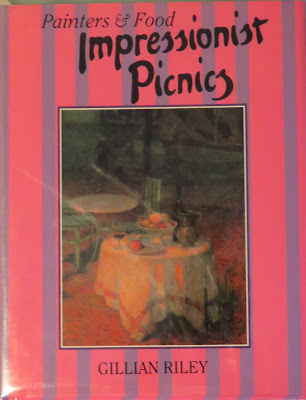
A book by Gillian Riley that I really enjoyed: Impressionist Picnics.
(Review Here)


The New Yorker still publishes a few food-themed cartoons.

Books I Love

A curiosity: the following list illustrates some of the books that I mentioned on my blog in 2008. These food books were on my shelves then, and they still are there.

  • Jennifer 8 Lee, The Fortune Cookie Chronicles
  • Tom Standage, A History of the World in Six Glasses
  • Gary Paul Nabhan, Why Some Like it Hot
  • Michael Pollan, In Defense of Food
  • Pollan, The Botany of Desire
  • Pollan, The Omnivore’s Dilemma
  • Jordan & Brady, eds, The World is a Kitchen
  • Julian Barnes, The Pedant in the Kitchen
  • Mary Taylor Simeti & Grammatico, Bitter Almonds
  • Elizabeth L. Ortiz, The Book of Latin American Cooking
  • Claudia Roden, A Book of Middle Eastern Food
  • Michelle Stacey, Consumed: Why Americans Love, Hate, and Fear Food
  • Henry Hobhouse, Seeds of Change
  • Julia Sahni, Moghul Microwave
  • Madhur Jaffrey, World Vegetarian
  • Harold McGee, On Food and Cooking
  • Ayla Algar, Classical Turkish Cooking
  • Gillian Riley, Painters & Food: Renaissance Recipes

Saturday, November 23, 2024

Food Reading, Shopping, and More

 
I’ve redone my refrigerator magnets: now it’s almost all birds. Plus the air plant that lives on the fridge.

These are just the owl magnets.

Downtown Ann Arbor

Downtown: a mural on the upper story of a building. Maybe a desert scene?


At Downtown Home and Garden


Ornaments that look like drinks.


Modeling the L.L.Bean clothes sold in the store. I wonder what his story is!

Painted on the shop window.

I always enjoy visiting Downtown Home and Garden, a store with many different sorts of merchandise and two cats. Besides household goods and L.L.Bean clothing, they have many dog and cat toys and pet supplies, garden tools and outdoor equipment, kitchen tools, and a large Christmas area.

Looking forward to Thanksgiving

Doris Lee: “Thanksgiving” (1935)

Recent Reading

I read this interesting book about the history of cookbooks and African-American
cooking in the 19th and 20th century: Recipes for Respect by Rafia Zafar.

Reading Next

Catching up on Jane Austen.

Blog post © 2024 mae sander
Shared with Saturday Critters, Sunday Salon, 
Monday Murals and Tea on Tuesday 

Friday, September 15, 2023

Much More than Just a Cookbook!


This cookbook was published this week, and I just received my copy!


The World Central Kitchen Cookbook offers a wide variety of recipes, but also many stories about how the World Central Kitchen (WCK), in its 13 year history has helped the victims of fires, floods, earthquakes, hurricanes, and other disasters. This cookbook provides many really interesting recipes. Introductions to the chapters and to the recipes also tell the story of the organization and photos of the many workers, beneficiaries, and participants in its activities. 

I was interested in learning more about the WCK founder, chef JosĂ© AndrĂ©s, a celebrity culinary personality whose restaurants have been widely recognized. Not content to feed the elite, he explains, he has tried to feed people who really need food. Because his approach is to find culturally appropriate foods for each new location, the recipes in this book are international, authentic, and very appealing. 

World Central Kitchen is a remarkable organization, mainly known for speedy response to natural and human-caused disasters that leave people without food, shelter, and family. WCK has fed people In Puerto Rico and Haiti after severe hurricanes left people homeless and hungry, in Beirut after a gigantic explosion destroyed much of the city, in refugee camps on the US-Mexican border, and in many other affected locations, most recently in Maui after the wildfire last month. WCK has developed the resources and equipment needed to come in quickly and prepare meals for the disaster victims, usually in cooperation with local restaurateurs, local organizations, and local volunteers.

Of many relief organizations, I believe that WCK has one of the most impressive philosophies of how to help. I’ve mentioned them often before. I’ll let you know more about the book when I have prepared some of the recipes!

In 2014, we had lunch at JosĂ© AndrĂ©s’ Mexican restaurant Oyamel in Washington, D.C.
I enormously respect this chef for his culinary AND charitable accomplishments!
By the way, in the lower-right photo Miriam is trying a grasshopper taco.


Blog post © mae sander 2023

Sunday, September 03, 2023

Bruno, Chief of Police, is Back!

Great book news. After years of waiting, the cookbook based on the mysteries by Martin Walker is finally coming to bookstores -- in English! The German edition has been available since 2014. If you are a fan of Walkers sixteen detective novels, you already know of the fantastic meals prepared by the policeman BenoĂ®t Courrèges, called Bruno by the people of the small (fictitious) town of Saint-Denis.

Bruno's Cookbook: Recipes and Traditions from a French Country Kitchen
by Martin Walker and Julia Watson. To be published in November, 2023.

A few days ago, the latest tale of Bruno, Chief of Police, detective novel -- A Chateau Under Siege: A Bruno, Chief of Police Novel -- was published. Of course I've already purchased and read it. As always, Bruno is resourceful, brave, loyal to France, clever about finding out what's really going on with a lot of very suspicious happenings, and basically smarter and more likable than the French international security team with whom he must cooperate to deter a dangerous gang of international assassins from their evil plans.

Bruno tirelessly performs heroic surveillance tasks to protect the local residents and to preserve the honor of France, though at times the plot was a bit exaggerated in the author's reliance on finding foreign agents plotting mayhem, and being thwarted. 


I'll skip any further plot summary or spoilers about this suspenseful novel full of dedicated men and women defending their country. In simple terms: while Bruno was dealing with the national security crisis, he had time to prepare several remarkable meals from the wonderful local produce of the region. Here are a couple of typical descriptions of Bruno in the kitchen and at the remarkable artisan food market in the town. First, he cooks for a few friends at the home of his friend the baron:

"To his surprise the kitchen was empty. Automatically he took a knife from the drawer, gutted and cleaned the fish, reached for the brush to spread on walnut oil, squeezed and sliced lemons, grated garlic, sprinkled salt and a little pepper. ... He put the dressed fish onto a platter, took it out and handed it to the silent baron." (A Chateau Under Siege, p. 183)

In St. Denis, Bruno goes to market: 

"The market was in full swing. The stalls were almost overflowing with strawberries, peaches, apricots, squash, cucumbers and different kinds of lettuce. StĂ©phane’s cheese stall could hardly be seen for the customers swarming around it, and the family from the Lac Noir farm was running back and forth to their refrigerated van to bring new supplies of duck breasts, legs, whole ducks and fresh foie gras. There were crowds around each of the stalls for wines—from the town vineyard, from the Montravel and Saussignac, the PĂ©charmant and Bordeaux. The children of the winemakers were kept busy rinsing out the glasses for free tastings, while the artisan brewers talked of their pride in their beers. 

"There were rivals for every trade, for the little round goat cheeses, fresh, demi-sec and aged; for the Basque sausage makers from the Pyrenees; for the stalls with fresh oysters and mussels, shipped from the coast at dawn that morning. They competed for space with live chickens and a host of breads—rye, black, with bits of bacon baked inside, sourdough and with olives. There were homemade butters, yogurts and every version of fruit jam under the sun. There were queues at the Vietnamese stall with its hot nem, at the Mauritian stall with its curries and an even longer line at the Guadeloupe stall with its empanadas and spices. A man with a huge vertical rotisserie was roasting chickens, quail and pigeons while great vats of pommes de terre sarladaises bubbling below sent wafts of garlic to blend tantalizingly with the scents of roasting fowls." (pp. 200-201). 

Bruno steps up to provide dinner for a group of very rich visitors in an unfamiliar kitchen because the cook has been injured:

"Bruno saw there was a bottle of very good cognac beside them. He grabbed it and went into the kitchen, took the chicken breasts and the crème fraĂ®che from the fridge and checked that there was Dijon mustard, chicken stock and sherry vinegar in the pantry. He took a basket, went back to the potager for artichokes, peaches and tarragon, took them into the kitchen, removed his jacket and washed his hands. There were a dozen chicken breasts in the large pack from Leclerc supermarket. He shrugged. It could have been worse. He found a decent knife, cut the breasts into three and then peeled and finely chopped three fat shallots. ... 

"Bruno rummaged in the cupboards for a large roasting pan and then for a large stainless-steel bowl. He melted a hundred grams of butter in a pan, stirred it into twice that amount of olive oil and poured the blend of fat over the chicken chunks that he’d placed in the large bowl. He stripped the leaves from half the tarragon and put them to one side. He washed his hands again and then manually massaged the oil and butter mixture thoroughly into all the chicken pieces. He put the well-greased chicken into the roasting pan, with the remaining tarragon twigs tucked in between and around them. He wiped his hands clean of the fat. 

"He put the chopped shallots into a large frying pan, added olive oil and sautéed them gently on low heat, stirring steadily until they were transparent. Then he added half a liter of chicken stock, a wineglass full of cognac and half a glass of sherry vinegar. He added salt and pepper, used a wooden spoon to blend it all together and then turned up the heat until the mixture began to simmer. He lowered the heat, let the ingredients simmer gently for about five minutes, and then put the pan to one side. Thirty minutes before serving the dish, he would add two-thirds of the liter pot of crème fraîche to this sauce, put it over the chicken, cover the pan and roast it for thirty minutes at 180 degrees centigrade." (pp. 226-228)

I'm looking forward to Martin Walker's cookbook, co-authored with his wife Julia Watson. I trust that it will provide detailed instructions for how to make the wonderful dishes from all sixteen Bruno novels. Obviously, I lack access to a market where I can find excellent duck breasts, freshly made foie gras, live oysters, newly-dug truffles, and all the other types of produce that play such a big role in Bruno's vast successes. I am sure that at least the cookbook will be fun to read and to enable me to imagine having such opportunities. 

Review © 2023 mae sander

Thursday, August 31, 2023

Will Artificial Intelligence Come to Our Kitchen?

63CA5FCD-0C2D-4AAB-A33C-9F2F1C7F2535
The best of August: ripe local apricots!

In my kitchen, as far as I know, no intelligent robots are likely to replace me and Len, the two cooks of the household. Could artificially intelligent (AI) robot workers eventually replace us humans in our own kitchens? Can artificial intelligence even come up with a decent recipe? One answer: "ChatGPT is smart enough to generate a recipe, but it’s not attuned to what actually tastes good." (source)

Very expensive robots in commercial settings do tasks like making rice balls for sushi or flipping burgers. Robots have done quality control for mass food production for a long time. But robots' capabilities limit each one to a narrow range of responsibilities. In laboratories, experimental robots recently have learned to taste whether an omelette has enough salt. But are practical robots ready to work in home kitchens, creating actual food, making the kind of varied menus we normally eat? Can they even do the dishes and put them away? Not yet, I think.

"Are Robots Really Destined to Take Over Restaurant Kitchens"
An insightful look at the current state of very expensive food prep robots from 2016.
"In 20 years, it will just be a commonplace fact that C3PO and his less humanoid brethren
are the ones making your lunchtime Chipotle burritos."

What robots are in kitchens now?

Rice cookers definitely can sense when the rice is done. Dishwashers -- which have always been kind of a kitchen robot -- definitely decide when the dishes are clean. Bread machines can sense when it's time to move on to the next step in bread-making, but their bread isn't as good as hand-made bread. Such devices, which have been around for years, do represent a kind of limited AI. One automated device we all would like is a robot that loads and unloads the dishwasher for us. Don't hold your breath. A self-cleaning stove top would also be nice.

What about the upcoming robot generation? So far, the currently newsworthy AI systems like the famous ChatGPT mainly function as text generators -- a limited capability in terms of usefulness in the kitchen. The only application seems to be finding or inventing recipes. 

Cookbooks and Recipes in Our Kitchen

Our recipe hunting endeavors currently consist of reading cookbooks and online recipe archives -- no AI involved. It's not apparent to me that a bot could replace what we do, since we know what we would like to eat, we know how we like our food seasoned, and we know what we have on hand and what we are willing or able to purchase. And we have different foods every day. Eventually, AI may help us, I guess. 

Let's see where we found the recipes that we cooked this month:
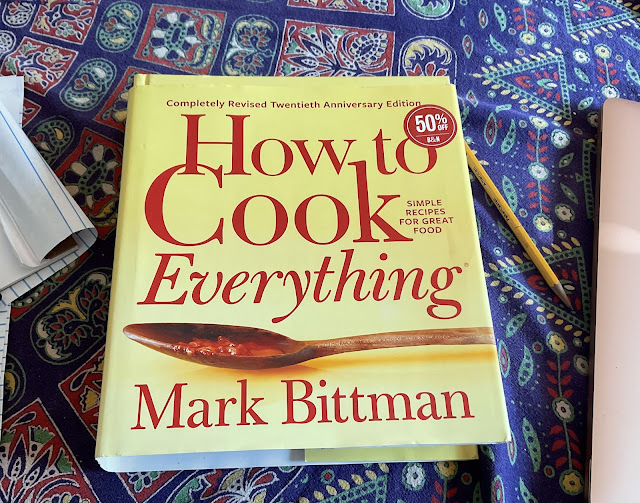

New this month: Mark Bittman’s revised edition of How to Cook Everything.
I gave it to Len for his birthday, because he’s becoming so interested in cooking.

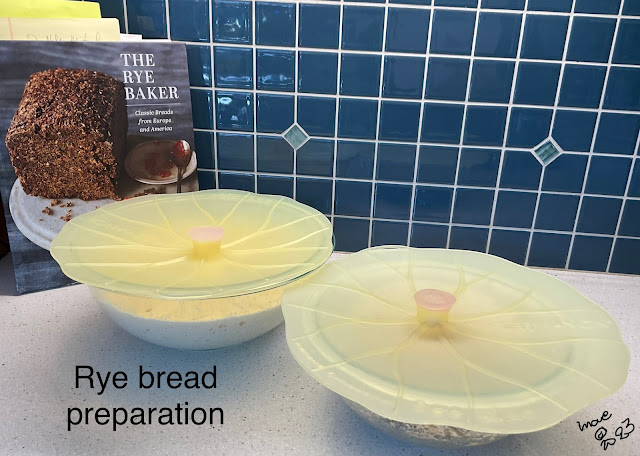
The Rye Baker is one of Len’s trusted baking books. One of our favorite breads requires two starters,
as shown here. The total time for preparing and baking this loaf is not extremely long, and the result is delicious!


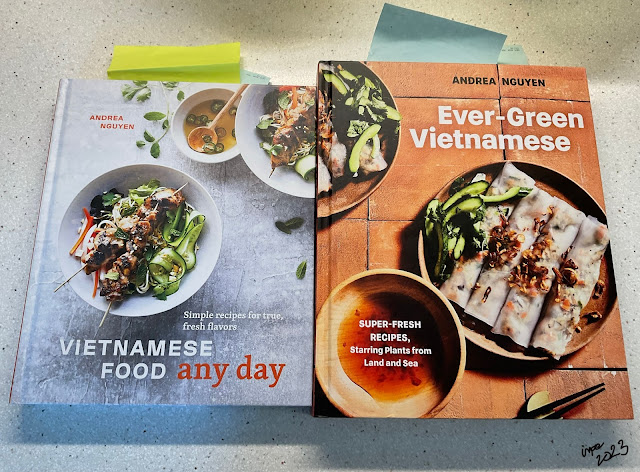
As I’ve said in previous posts, we are very satisfied when we cook from Andrea Nguyen’s recipes.

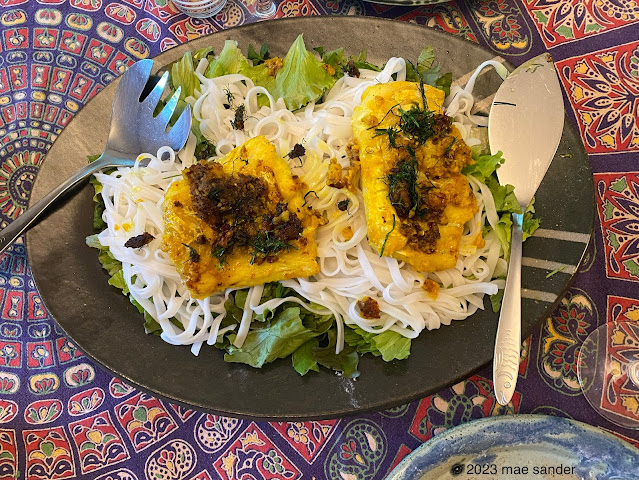
Andrea Nguyen’s fish with turmeric served on a bed of lettuce, herbs, and Chinese noodles.
The fish is topped with fried dill weed.

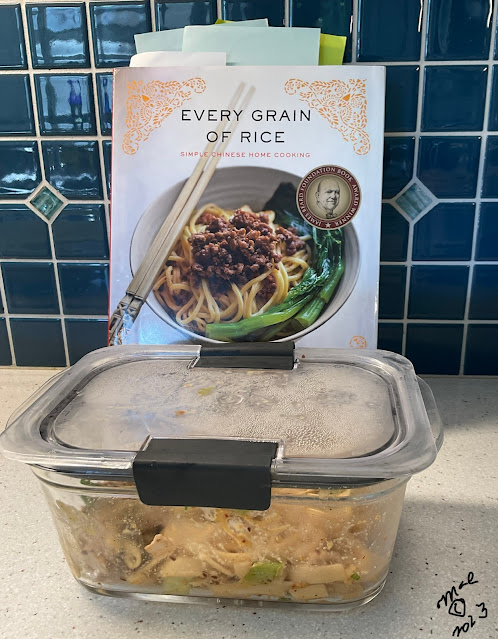
Fuchsia Dunlop’s cookbook, photographed with the leftovers from the salad we made.


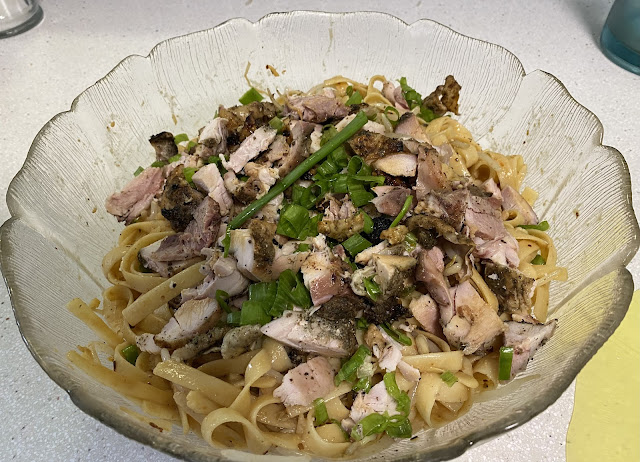
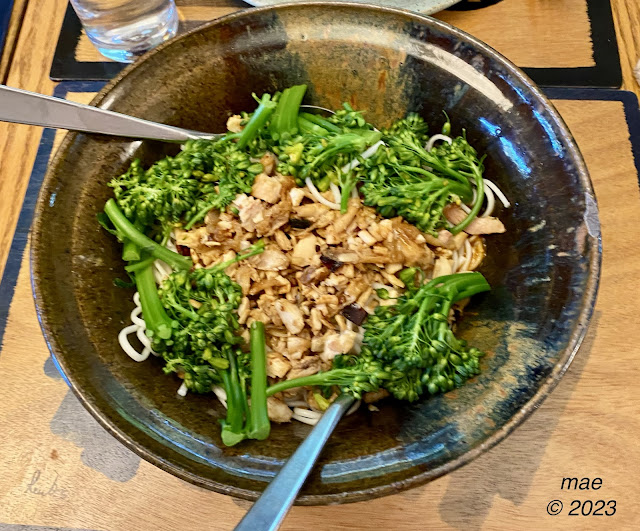
Fuchsia Dunlop’s Dan-Dan noodles made with leftover Costco chicken and broccolini. Very spicy!


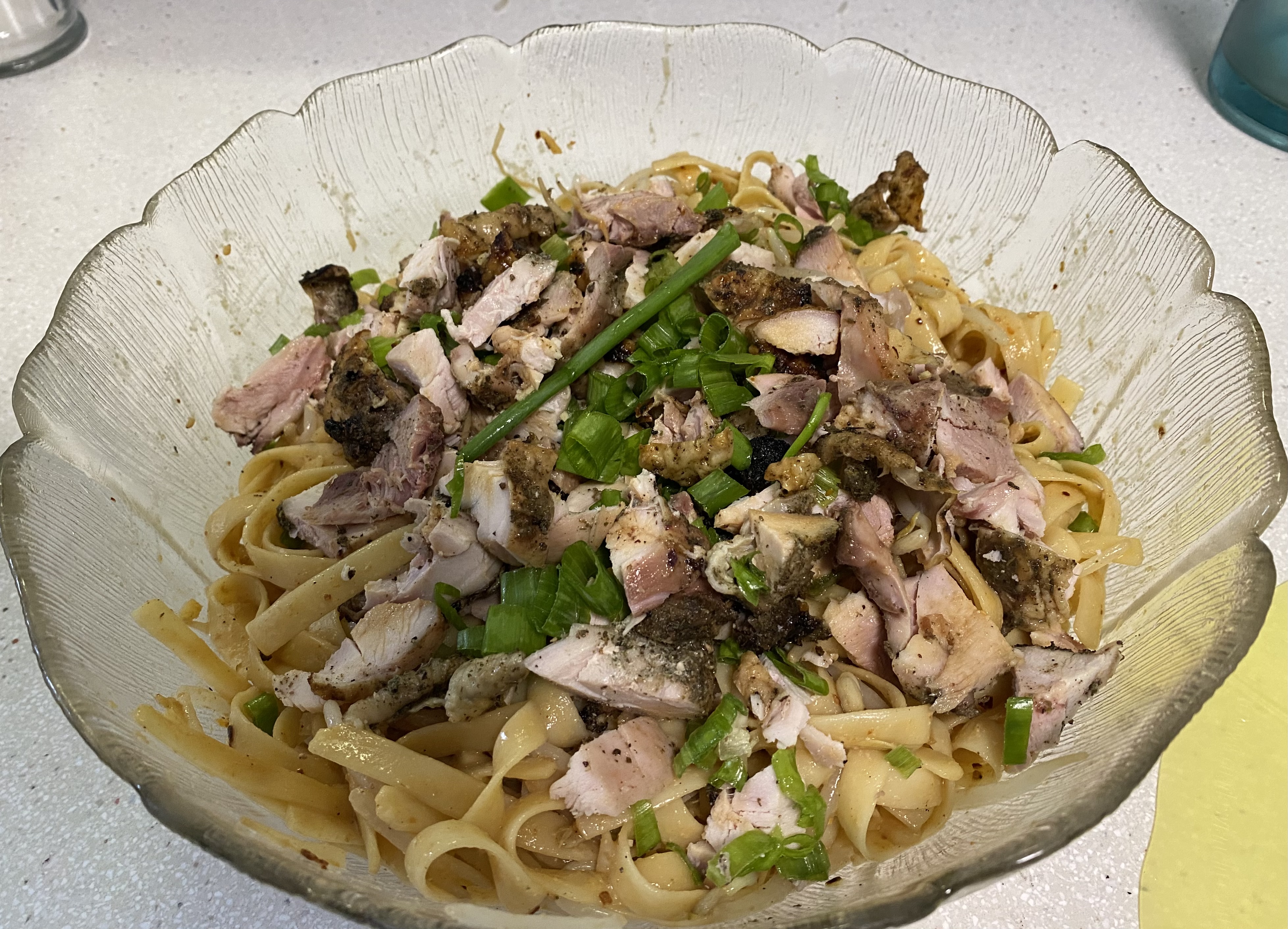
Bean sprouts, wheat pasta, many condiments, and chicken: a cold salad.
It’s a simple-sounding combination, but Fuchsia Dunlop's methods make it complicated -- and good.

Using the New York Times Cooking Archive
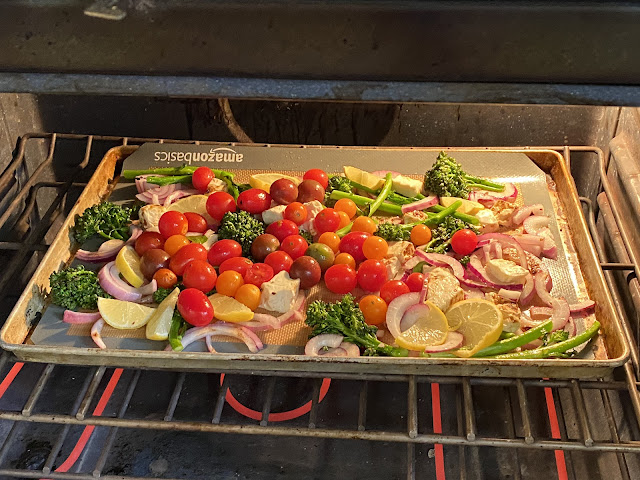

From the New York Times: sheet pan vegetable medley: broccolini, grape tomatoes, lemon, onion, feta cheese.

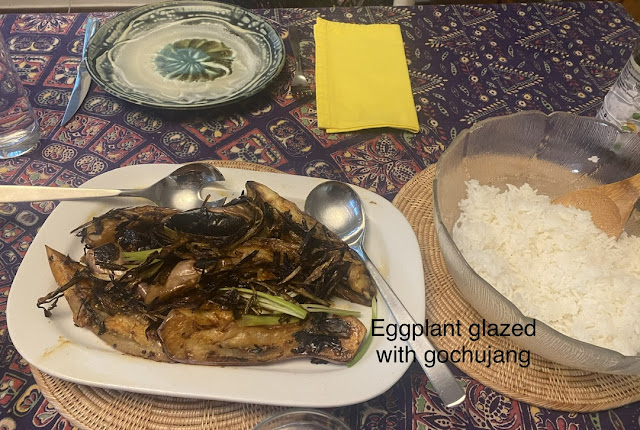
New York Times grilled eggplant served with rice.

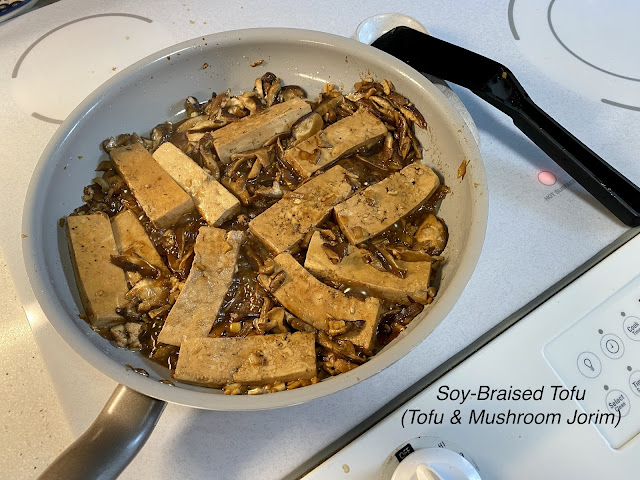
New York Times Soy-Braised Tofu with shiitake mushrooms. Recipe by Kay Chun.
I requested a recipe containing tofu and mushrooms, and this was the very satisfactory result!

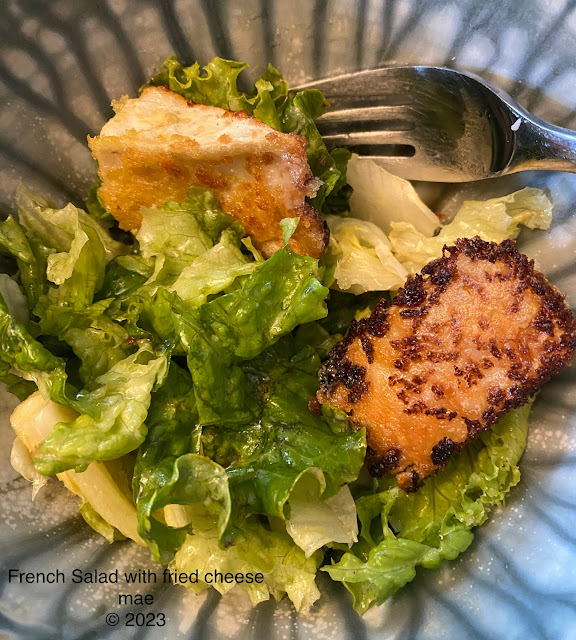
Salade de Chèvre Chaud (Warm goat cheese salad) from the New York Times


Grilling without a recipe

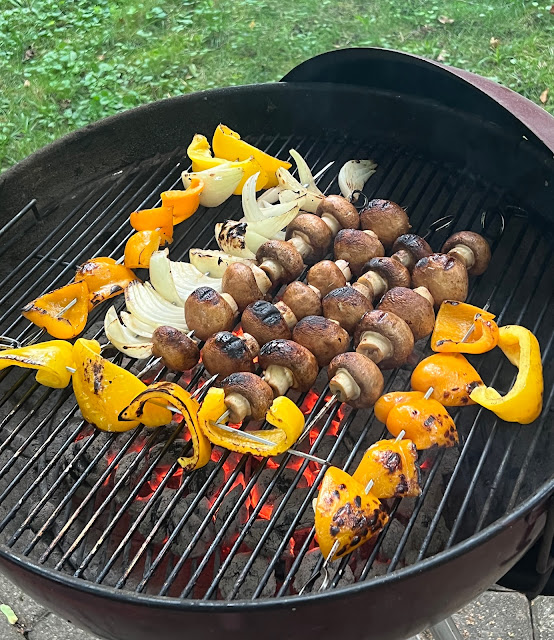
A vegetarian barbecue using a web-inspired soy butter for basting.

Can AI figure all this out?

A prematurely released AI recipe program received a lot of attention recently because of its nonchalant descriptions of inedible and even dangerous concoctions. Some of its suggestions, according to an article in the Guardian, included a “fresh breath” mocktail made with bleach; ant-poison and glue sandwiches; “bleach-infused rice surprise;” and “methanol bliss” – a kind of turpentine-flavored french toast. Admittedly, the users listed inappropriate ingredients in their queries, but the bot wasn't savvy enough to recognize them, and turned them into recipes like "mosquito repellant roast potatoes." OK, this one needs work!

Several experiments with ChatGPT and other bots did result in pretty good recipes being generated when the user entered reasonable lists of ingredients. For example, on Good Morning America, there was a report of a pretty good lentil and shrimp recipe that ChatGPT provided after several iterations, though it sounds like the user added quite a bit of human intelligence to the process! (source)

Many stories highlight inappropriate AI recommendations having to do with food. One such strange result from Microsoft that I found interesting was a travel guide to Ottawa that suggested a visit to the local food bank as the third activity on your city tour: you were to go there between a visit to the National War Memorial and attending an Ottawa Senators hockey game. Helpfully, the description suggested that you visit the food bank with an empty stomach! Obviously the AI generator was unaware that visiting a food bank isn't a tourist thing. Or maybe some very strange human produced this document; Microsoft was a bit evasive. No, I don't believe a human created such a bizarre list.

UPDATE ON AI FOODIE SCAMS: Mushroom hunting is a risky business, and some recent AI-generated guidebooks make it even more dangerous; for example they suggest that tasting wild mushrooms is a way to ID them. (Never taste an unidentified mushroom!!) Potential buyers of these phony books, sold on amazon.com, are warned that “the authors are invented, their credentials are invented, and their species ID will kill you.” (source)

Another report of an actual experiment using an AI recipe generator was ambiguous: “Recipe for disaster? I tried Botatouille, BuzzFeed’s AI kitchen helper”  The experimenter had a rather frustrating experience and ended up with nothing very good to eat. The interface by which the author asked for recipes was very poorly designed; for example, if she told the bot that she had no shallots, it would propose MORE recipes with shallots. The bot favored brand-name ready-made products; that is, it was already commercialized. None of the recipes were particularly good. 

An interview with a recipe and menu creator named Alex Hill, as reported in this article, made sense to me:

“While she sees how AI can be used to make things easier for busy, working parents, she said these programs couldn’t duplicate the cultural and personal history that informs what people cook. For Hill, this means the recipes she makes are connected to what her mother has cooked or meals she’s shared with loved ones while mourning a breakup or celebrating a new job.”

Of course the AI chatbots may learn more over time, but the more I read, the more I suspect that there’s no substitute for knowing how ingredients taste. The successful results seem to involve a lot of coaxing from the human user.

Futuristic Robot Helpers?

In "Sleeper" (1973) Woody Allen disguised himself as one of the
household robots in the future society to which he had been transported.
Are we any closer to having such devices in our daily lives?

Does AI have a future in our kitchens? Well, we know that a kitchen is a complicated place, and selecting recipes is only a tiny part of the game. “The end of work: which jobs will survive the AI revolution” (Guardian, August 19) offers some observations about a few areas that may profit from AI --but not kitchens. The author suggests that people who are resourceful will find ways to make a living no matter what the robots and chatbots and other AI gadgets do. I suspect that home kitchens will keep on producing hand-made meals, too.

AI for sorting trash?

Meanwhile, in our own kitchens today, we not only deal with food but also with trash — and that’s an area for bots to be useful. Right now, it's up to individuals in their own kitchens to determine how to discard the many containers that their food comes with. No matter how responsible you are, you can't get recycling choices all right every time, and the consequences are a lot of things end up in landfill or incinerators that could instead be recycled or composted.

Artificial intelligence has the potential to improve the efficiency of processing plants were we send our trash. Sorting bots that separate usable plastics, glass, cardboard, etc are already at work and in the future this can be improved. An article in the Atlantic, “The Future of Recycling Is Sorty McSortface,” describes the potential for sorting trash. 

“In a decade, recycling bots could be everywhere, helping facilities churn out perfectly sorted bales of junk that companies can turn into something new. But recycling, even souped up with AI and robotics, will always have limitations. Recycling tech can treat only the symptoms of unconstrained consumerism, not the disease of companies that are dumping far too many single-use products into the world.”

Do you think we will eventually have AI sorters installed on our kitchen garbage cans -- who knows? 

Blog post and food photos © 2023 mae sander

Saturday, June 10, 2023

Books and Movies: A Week Indoors

Avatar 2: A Lot of Blue People


I started watching this very predictable blockbuster with Len. I was so bored that I wasn't very focused on the first half, after which we stopped watching to eat dinner. Then we watched the rest: at least I tried to watch, but I fell asleep. Even the spectacular CGI effects get boring after a while. Nature’s sea creatures interest me much more than exaggerated artificial versions of them.

"Small Fires" -- Big Ego

Small Fires: An Epic in the Kitchen by Rebecca May Johnson is an appalling mash-up of bad jargon from academia, overdone feminism from the 1970s, and psychobabble. It's unbearably pretentious, and doesn't have anything new to offer anyone who has read feminist or academic or psycho stuff in the last 50 years or so. One of the two blurbs on the cover uses the word "witty." I can't think of any less applicable word for this author's prosaic and pedantic narrative.

What this book most definitely is not: EPIC! What this book is, mercifully, is short.

Here are a few quotes about the deep meaning of a recipe for tomato sauce:

“The recipe is a method for responding to things. Things have agency in many directions. Like words, they have histories and contexts, but when I perform the recipe, things become other things in a messier transformation than words in a sentence. They spatter my shirt red” (p. 51)

“When I cook the recipe, I experience the difference between the knowledge promised by language, and the unboundedness of embodiment, which is both richer and more dangerous that the text can convey.” (p. 73) 

“My ‘reception’ of the recipe – my intervention into the tradition of recipe reception – is to translate text into food. Each time I cook the recipe I produce a new translation of the text. I translate the recipe from the medium of language into the spattering physicality of the ingredients. Like different translations of the Odyssey, my translations of the recipe vary in accordance with the historical moment.” (p. 81)

“When people ask about my work an assumption hangs in the air that I am writing a lovely book of lovely recipes that will be beautifully photographed. … ‘Lovely’ is an acutely gendered adjective that brings my body into the discussion of my writing. It defines my writing through my body… ‘Lovely’ defines and excludes the non-lovely and works to legitimize violence against those who differ from the ideal of an obedient, quiet, thin, clean, happy, grateful, rich, white woman.” (p 98)

In Small Fires, Johnson may be the most extreme name-dropper whose works I’ve ever read. She really wants us to know what a great intellectual literary contemporary reader she is! She mentions writers and creators, briefly alludes to and quotes them, and then moves on to prove how much more she knows! A few of them include: Homer the ancient poet (she has a lot to say about the Odyssey), D.W. Winnicott, Rainer Maria Rilke, Mrs Beeton, Sam Sifton, Claudia Roden, Natalia Ginzburg, Sigmund Freud, Miles Davis, John Coltrane, Mingus, Sergei Eisenstein’s film Battleship Potemkin, Simone Weil, Jessye Norman, and many others. Aren’t we impressed? A typical sentence “I look up Jean Laplanche and read a little about his work – he is a psychoanalyst and winemaker who appears in Agnès Varda’s film Les Glaneurs et la glaneuse.” (p. 166)

The New York Times Review lured me into buying this newly-published book. It said:

"Small Fires: An Epic in the Kitchen ... aims to upend not only the way we cook but the way we think about cooking. The book regards recipes as sites of dynamic, creative engagement across generations — and notes that most bragging about not following a recipe is simply a defensive response to anxiety about originality. Small Fires, … is brave enough to hurt feelings, and delicious enough for no one to care."

I read all of this little book, and I mostly found it annoying. I will admit that there are a few good passages among all the posturing and long words and blustering and self-promotion, and I understand her point, that making a recipe for tomato sauce (particularly Marcella Hazan’s recipe) is a metaphor for life in general or for the plight of women in society. She isn’t the first one to discover this. I suspect that this book will be popular with other pseudo-intellectuals and aspirants to intellectual giganticness.

My Whole Week Felt Kind of Eerie


Although I read one very good book this week (The Great Influenza by John M. Barry) I was mostly feeling very claustrophobic because from Wednesday morning onward, the smoke from the Canadian fires means it has been too terrible to breathe much outdoors. I can’t take my usual walks, sit in the garden, or otherwise enjoy the cool summer weather. It's depressing and overwhelming, because we know what it means:

“Climate scientists have been saying for decades that global warming would lead to a proliferation of wildfires. Last year a U.N. report warned of a ‘global wildfire crisis’ as many forested areas become hotter and drier. The smoke-filled skies outside my window are, in effect, a validation of mainstream climate science: The experts didn’t predict this particular disaster for this particular week, but this is exactly the kind of thing they’ve been warning us would happen.” (Paul Krugman in the New York Times)


Shared with Sunday Salon at Readerbuzz.
Blog post © 2023 mae sander.

Sunday, April 30, 2023

In My Kitchen in April

Two new dragon eggs, just starting to hatch. Evelyn’s latest creations.
I’m starting my kitchen wrap-up with these great ceramics though they are actually in the living room!

What’s new in my kitchen in April?

Magnets from my visits to the African American History Museum and Mount Vernon: American Heroes.
George and Martha Washington, Frederick Douglass, Harriet Tubman, and Martin Luther King.
Also magnets from Lancaster and Longwood Gardens: everywhere we went in April.

One of two small bowls Evelyn made.

Inside our new kitchen cabinet.

A new rack for skillet  lids and a new insert that
makes our biggest pot into a steamer.

New ceramic-clad skillet (as Consumers’ Reports recommends).
In the skillet: salmon croquettes.

Ever-Green Vietnamese by Andrea Nguyen.
Newly published cookbook! We hope it re-energizes our
vegetable-focused cooking efforts.

New storage containers in place of the repurposed cookie
boxes I’ve been using. Recommended by the NYT (link)

From our kitchen: food and drinks

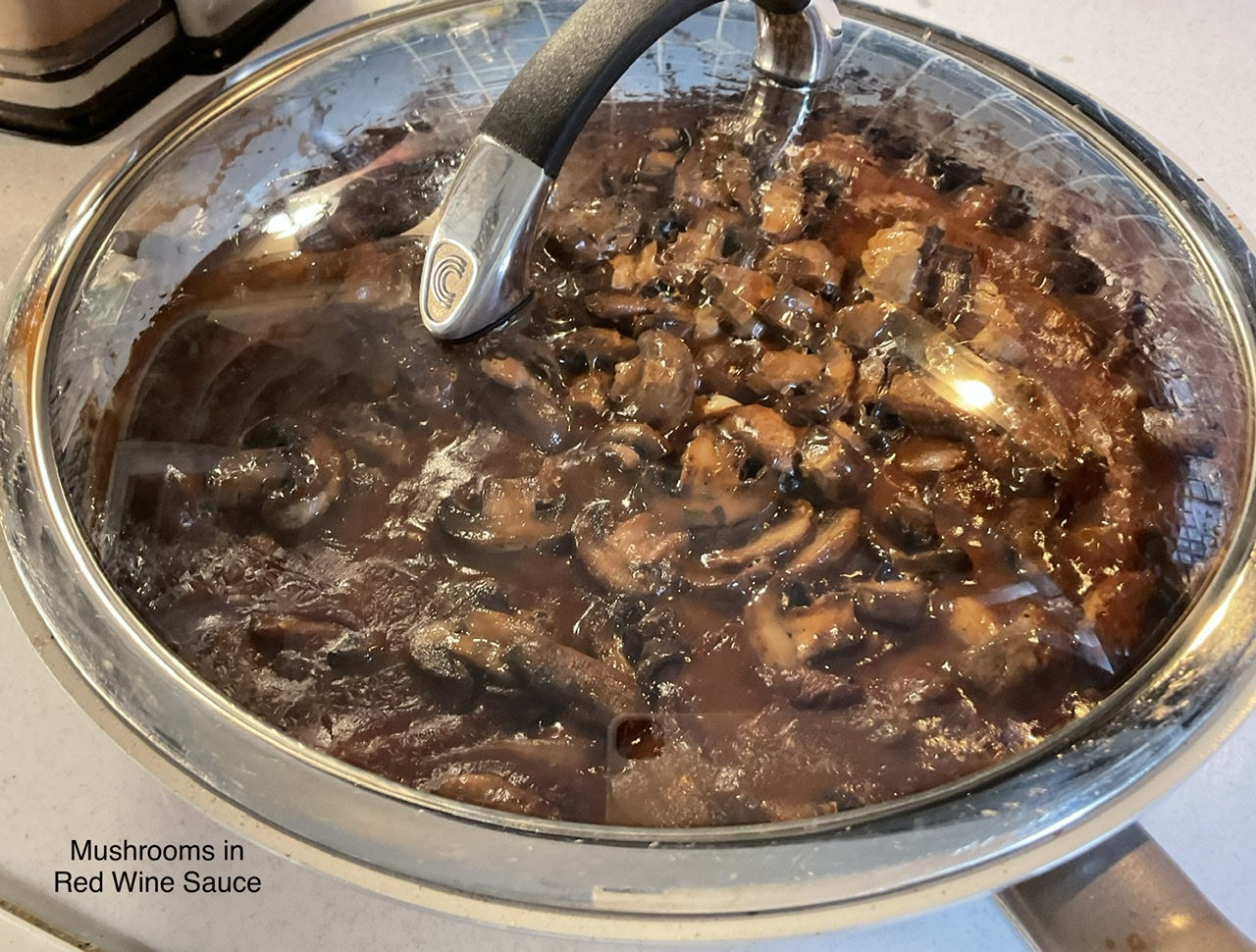
Mushrooms in red wine with new potatoes. A great non-meat dish!

Mushrooms cooking in our new ceramic-clad skillet.

Asian shrimp, bok choi, and rice. And some nice wine.

Kung-pao chicken. Another dish from Len’s Asian recipe adventures.

A leg of lamb ready for the oven, coated with mustard sauce and rosemary leaves. Our favorite roast!
This is Julia Child’s recipe from the original Mastering the Art of French Cooking.
The lamb and broccoli were served at our Passover dinner.

West-Indian lamb curry. Using lamb from the leg of lamb in the previous photo.

Steamed eggs made in the new steamer. The recipe comes from Fuchsia Dunlop’s cookbook.

Vegetarian baked spaghetti with cheese/crumb topping.


Drinking: LaCroix from Costco.

In Carol's Kitchen

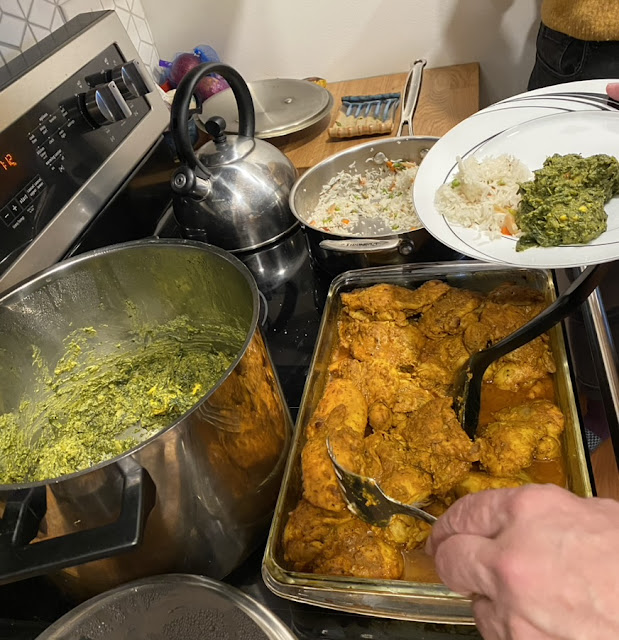
Carol's Indian chicken (from a Madhur Jaffrey cookbook), Jason's spinach paneer, and Carol's rice.
Good food for a family celebration of a cousin's graduation.

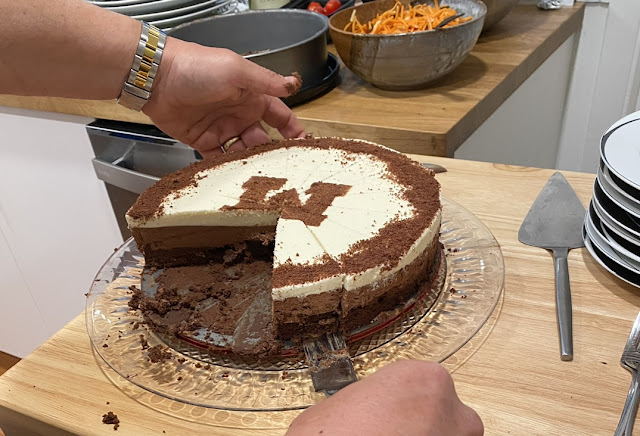
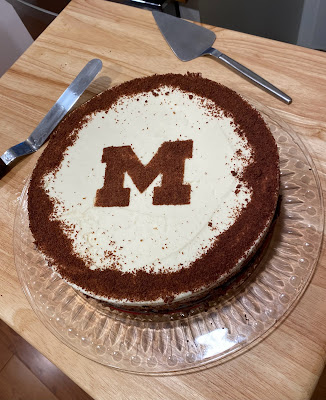
Celebrating a Michigan graduation: the father of the graduate made an unbelievable mousse cake
decorated with the Michigan "M."

Before the cake was cut.

Recycling and Composting in my Kitchen

Kitchen garbage such as fruit and vegetable parings, coffee grounds, and bones can be placed in
compostable bags (like the one in the photo) and collected with garden waste. Now that our weekly
compost collection has resumed this spring, we are trying to comply with local garbage rules..

MOTIVATION: “In the U.S., food waste is responsible for nearly 3 percent of the country’s emissions, according to the EPA—and that’s before considering the methane that leaks from landfills, where food waste is the single largest category of material that gets dumped. Diverting even some of that waste is a win for everyone involved, and more cities across the U.S. are at least trying to persuade people to separate their scraps from their trash.” (source)

We also respect the recycling rules!

Cans and bottles in Michigan have a deposit
of 10¢ — a very good law!

In my kitchen retrospective, which I publish on the last day of each month, I try to select an issue of importance to me and to society. April, is a celebration of the Earth, with Earth Day and all, so I’ve chosen to highlight my efforts to handle kitchen waste responsibly. Fortunately, Ann Arbor, where I live, has very enlightened trash disposal practices, and allows composting and recycling where possible.

Blog post & photos © 2023 mae sander
Shared with Sherry at her monthly blog party In My Kitchen.