Showing posts with label climate change. Show all posts

Wednesday, February 07, 2024

Reading and Watching


 A newspaper article, a novel, and a recent film: all very absorbing!

No more chocolate, coffee or wine? ‘Last supper’ shows stakes of climate crisis,” is an article that I read in the Guardian by Rachel Leingang. Endangered foods? It’s not just the ones that are always covered — quite a few favorites that we eat and drink every day have a worrying future. Above all: coffee! Chef and political worker Sam Kass invented a dinner menu that featured a number of dishes that we generally take for granted: “Courses included Norwegian salmon, oysters, lamb, fingerling potatoes, sticky toffee pudding.” Leingang explained how climate change is a threat to these favorite and not-at-all exotic foods and quite a few others.

UPDATE February 9: “Chocolate maker Hershey issues warning over record cocoa prices” another article in the Guardian notes that commodity price for cocoa has doubled in the last year.

Elizabeth Finch by Julian Barnes is a disappointing novel, because it’s hardly a novel at all. It’s more a collection of meditations on history and culture strung together as the thoughts and lectures of two characters: Finch, a freelance writer and teacher; and the narrator, once her student, later her sort-of friend, finally, the curator of her papers and books that she leaves when she dies. Very didactic and a little boring,

“The Holdovers,” a film about a prep school in 1970, which sometimes channels Catcher in the Rye (especially when there’s an outdoor skating rink scene), and sometimes “The Dead Poets Society,” and sometimes other similar tropes. It’s corny at times, as the two opposing forces, the pedantic teacher and the resentful student, are thrown together — abandoned when everyone else goes home for Christmas — with only one other person, Mary, the school cook and in my view the only fully sympathetic character. I found it watchable; you probably have watched it too as it’s very trendy right now, I think.

Reviews © 2024 mae sander

Saturday, December 23, 2023

A New Year is coming: let it be better than this one.

Birding allows me to enjoy the beauty of the natural world.
Yet anyone who appreciates the natural world has a lot to worry about.
This bird, the kingfisher, has long been a symbol of calm weather, peace, and love.

The Planet is in Trouble!

What is important to me this year? Global human and natural welfare are fragile. The future looks uncertain. My focus leans towards the US because that’s where I live, and I see many causes for concern, serious concern. Many of the issues that I worry about are closely linked to one another. And there are so many of them!

  • Climate change as an existential threat to humanity: arriving rapidly and causing a number of types of deprivation, desperation, natural disasters, and dysfunction in societies, especially causing food scarcity and famine or near-famine in the global south.
  • The war in Israel and the dreadful consequences if Hamas is not defeated.
  • Antisemitism in American life and on US university campuses — brought out by the war in Israel, but obviously evoked, not caused by the war.
  • Increasing inequality (both socio-economic and racial) throughout the US with a variety of bad consequences, combined with right wing repression of women’s rights and minority rights.
  • The war in Ukraine and the looming dominance of Russia as a consequence of a bad end to the war. 
  • Food shortages in many third world countries (much of it due to climate change) forcing large numbers of people to crowd into already overburdened cities and often to attempt migration to the global north.
  • Political success by the extreme right wing in many places. The large numbers of desperate people wanting to enter North American and European countries is one factor in growing right-wing strength in the global north.
  • Degradation of educational institutions in the US: a complex and multi-faceted issue.
  • The threat to world peace implicit in almost every one of the above issues.
  • In the US, we are also threatened with the end of democracy and the completion of a right-wing takeover of the executive, judicial, and legislative branches of the Federal government.
Notice that I don’t have any mention of AI or of any type of rampant and out-of-human-control technology on the list. I’m not very worked up about AI — maybe that will prove to be all wrong. And although I’m very interested in how our food choices and consumer choices collectively impact human life, my concerns for the future are expressed in a more general way. Similarly, fears that treasured creatures such as some species of birds, bats, frogs, polar bears, rhinos, fish, monarch butterflies, and many more may go extinct (or lose their natural habitat and exist only in captivity) is intrinsic in the concern about climate change. As the New Year approaches, all these thoughts perplex me.

Sunrise on one of the shortest days of the year. We hope things will start to look better.

I've also reread a mystical novel based on Jewish traditions and folklore:
The World to Come by Dara Horn. Reading good books: another cosolation.


Blog post © 2023 mae sander
Shared with Sunday Salon at Readerbuzz 
and with Eileen's Saturday Critters 

Friday, September 01, 2023

Destruction at the Arb

A huge fallen tree in the Arb, aftermath of last week’s storms.

The Nichols Arboretum is a beloved spot in central Ann Arbor, in walking distance of the campus and of many residential neighborhoods including ours. Familiarly known as “The Arb,” it has welcomed generations of students, families, and other visitors. The Arb’s peony garden has a remarkable variety of cultivated peonies, which bloom in May and June. There’s a beautiful wooded area, a large meadow, and a stretch of river front along the Huron River.

Last week, two violent thunderstorms raged through town, and the Arb lost nearly 100 trees, including some very old ones. When we walked through, nearly a week later, the destruction was easily seen, despite a vast amount of tree-cutting and hauling which has made the paths safely walkable again. 

Please note that this event is nothing compared to the devastation of several recent hurricanes and fires in other parts of the country, especially the Maui fire and Hurricane Idalia. We in Ann Arbor require no help or sympathy! Severe weather is increasing everywhere because of climate change.

Behind the peonies you can see several large pines that were snapped off by the wind.

 
The pines as they were before.


In this photo you can see the big trees behind the peony garden, several of which were lost last week.


The boardwalk with an upended tree.

Blog post © 2023 mae sander. Photos © 2022, 2023


Monday, August 28, 2023

Beautiful Hawaii

 Visiting Maui

Sunset in Maui, June 14, 2003.

Maui, ʻĪao Valley State Monument, 2003.

This beautiful monument, rich in cultural and spiritual values, marks the site of the battle of Kepaniwai where the forces of King Kamehameha I conquered the Maui army in 1790. In the valley behind me, you can see a demonstration of agriculture before the colonial era: cultivation of crops like taro, sweet potatoes, and yams. Like so many of the attractions of the island, the Iao monument was nearly empty when we visited, but is now so overburdened that non-residents are required to make reservations in order to visit when it's open. 

As tourists, we enjoyed many features of this beautiful island, and we mourn the loss of the historic town, Lahaina, and the suffering of the people there. We felt great awe for the natural wonders of sea, volcano, and stunning mountains, and we regret the ravages of human mishandling of the gifts of the Hawaiian gods. Today I'm thinking about all the people of Hawaii: those who suffered great losses from the fire in Lahaina, and all the others whose "Aloha" spirit has been so kind to us through the years.

WHY?

I have been reading some analysis of why this disaster happened. beyond the simple and obvious fact that climate change has caused a severe drop in rainfall in Hawaii, making fires much more likely. In the New York Times, "A Legacy of Colonialism Set the Stage for the Maui Wildfires" takes a penetrating look at the deeper reasons why Maui is so vulnerable, and how the human cost of the fires will fall very unequally on the remaining Native Hawaiians as well as on other poor residents, while the wealthy, the tourists, the landowners, and the heirs of the colonial past will survive and even come out ahead. The long-term results of colonialism and big agriculture are unfortunate:

"While Upcountry residents in Maui face water shortages, rationing and fines if they fail to conserve water, luxury resorts across the island are allowed to keep their taps running. The surge of tourism has caused housing costs to skyrocket and has given rise to a local economy focused on the needs of those just passing through. These imperial legacies combined to create a tinderbox, waiting to ignite."

Maui Sugar Mill, 2009. Closed 2016.

Maui's agricultural era is mainly over -- the big plantations of coffee, sugar, and pineapples are no longer producing, and the fields have been abandoned by the mainly absentee owners. Besides decreasing employment opportunities (forcing more and more unskilled workers into the tourist industry) this has caused the abandoned fields to become a fire hazard, and an ecological mess.

Colonialism has left a legacy that will badly affect the victims of the Lahaina fire:

"The State of Hawaii has said it will protect locals from land speculators. But if the bureaucracy of emergency management stalls out or fails, people who have temporary hotel vouchers or are overstaying their welcome on their cousins’ couches will be left with few options other than to sell. Opportunistic profiteering often follows an emergency, but it’s crucial to understand that those quick grabs of resources and power often depend on and exacerbate existing fault lines of imperial extraction."

Another recent article "How 19th-Century Pineapple Plantations Turned Maui into a Tinderbox" describes the slow process of change since European and American colonialism took over the island. Native agriculture was respectful of the land and its potential, while plantations were extractive. 

"To prevent more fires from engulfing communities ... it’s not enough to merely return water to streams. Maui needs to resurrect the wetlands and ecosystems that, for centuries, provided not only sustenance but also a natural buffer against disasters. Lahaina’s original name, Lahaina i ka malu ‘ulu o Lele, translates to 'Lahaina lies in the shade of the breadfruit trees of Lele' – a reference to the large breadfruit groves that once fed tens of thousands of people."

Swimming in Maui, 2009.

Kona Coffee

The Big Island has been another favorite of ours, and we have stayed in Kona a number of times over the years. Our favorite activities there have been in or near the water: scuba, snorkeling, beach-going, looking at the scenery.... On our many visits, we have also enjoyed seeing the native forests near the volcano, watching volcanic activity, dining in many excellent restaurants, cooking local food in condo kitchens, and visiting the coffee farms that face the ocean on the mountain slopes. 

At the Kona Farmers' Market, 2007.
Kona Lisa Coffee Mug
Of course I love anything Mona Lisa!

Unlike agriculture in Maui, Kona coffee farms are currently successful endeavors -- though here, too, unpredictable rainfall at the wrong time of year, insect infestations, and plant diseases have caused some crop failures. Last year saw extreme decrease in the coffee harvest, though this year the rainfall was adequate and the yield may be better. (source

Kona coffee is grown in a very small area, and thus more vulnerable to environmental damage than the huge farms in Central America and Africa. The cost of living for Hawaiian workers is high, and it's part of the USA so they have higher wages and a better standard of living than the workers in other sub-tropical coffee areas. Most of the farms are very small-scale and the owners do much of the labor, as we learned when we toured two farms on different visits. 

Kona coffee is considered a very high-end product, though in purchasing one has to be careful to obtain 100% Kona, not a blend with other coffee. We have been very fond of Kona coffee since purchasing some in 2007 at the Kona farmers' market from the then-owners of  Kona Lisa Coffee,. After a visit to the farm, we had it shipped to us in Michigan, but the constant price rises were too much and we haven't done so in quite a while. A pound of Kona Lisa Coffee beans is now $42, while single-origin beans from Central America cost $12-15 a pound at our local supplier. The local shop has 100% Kona for $49 a pound, alas.

Coffee beans, called "cherries" in a huge hopper ready to be hulled, dried, fermented, and roasted.
From a tour of Greenwell Farms, Kona, 2015.


Blog post © 2023 mae sander
Photos © 2003-2023

Wednesday, August 16, 2023

Climate Change Is Here

Maui in 2009: my memory is of a lush Garden of Eden. My thoughts are with the people of the island.
(Photo © 2009 mae sander)

Every day I read more stories of the consequences of a warming world, especially consequences to the more and more fragile global food supply. I read about much irresponsible neglect and bad choices by authorities and big agriculture, and about looming disasters. 

“A combination of calamities — extreme weather, Russia’s targeting of grain supplies in Ukraine and some countries’ growing willingness to erect protectionist barriers to food trade — has left food supplies more vulnerable and less prepared to absorb any one disruption, analysts say.”  (source)

Throughout the world, there are such disruptions. People in many countries are suffering from heat waves, and experiencing crop failures for lack of rain or for vastly too much rain. Large numbers of refugees, especially from third-world countries, are fleeing hunger-stricken areas. A variety of food scarcities make good nutrition unaffordable for many people, including the disruptions caused by the Russian war on Ukraine as well those caused by climate issues. According to Time Magazine

“The fingerprints of climate change are all over the intense heat waves gripping the globe this month, a new study finds. Researchers say the deadly hot spells in the American Southwest and Southern Europe could not have happened without the continuing buildup of warming gases in the air.”

Worst of all are the unprecedented disasters such as the fire in Maui, events that result from years of drought and heat waves. In Maui, specifically, after the long lack of rainfall and after the neglectful abandonment of former agricultural fields to noxious, fire-prone weeds, it seems in retrospect that such a conflagration was almost inevitable.  The Washington Post reports:

“Maui is facing a compound disaster, where many different agents acted together to make the fires so horrific. As human influences on the climate and environment grow, the risk of these disasters is escalating.”

Many more consequences of global warming — signaled by this, the hottest summer every recorded — appear to be inevitable as well. I try to picture the world as it is and as it will be, and the long term is very depressing. Some people, it's true, do prefer to focus on the short term, and on a few places where a hotter planet provides a few positive effects on agriculture; for example, 

Countries in the Northern Hemisphere, especially Scandinavian countries, are currently experiencing some positive effects from climate change in terms of crop yields. This is due partly to the COfertilisation effect where increased amounts of carbon dioxide in the atmosphere aid plant growth, but mostly because low levels of warming extend the growth duration of mainly perennial crops such as grass pastures, but reduce the duration of the staple annual crops, such as wheat, maize and rice. However, these effects are not permanent and will not balance the global negative effects of climate change. There is no doubt in the evidence and conclusions of more than 1,000 global and regional studies, that a temperature rise of 1 to 2 degrees Celsius will generally mean a loss in yield of a number of crop varieties, both in the tropical and the temperate regions. An increase of 3 to 4 degrees later on in this century will have very severe consequences for global food security and supply. However, it is remarkable to see that the rice plant is coping a lot better with the changes than other crops.” (source)

Concrete Examples 

Will things continue to deteriorate? Unfortunately, that seems to be the most probable future. It’s a gloomy endeavor, but here are some current facts about very specific results of a changing climate:

  • Oranges and other citrus crops are being devastated by weather-related disasters, for which a warming planet is a major contributor. Florida, which supplies 90% of orange juice to US consumers, is especially hard-hit: “Orange juice prices are expected to rise further in the US after a bacterial disease and extreme weather intensified by global heating ravaged this season’s crop of the citrus fruit.” Hurricanes, temperature extremes including freezing, and crop diseases resulting from the heat waves have reduced the size of the crop drastically. Brazil, California, and other citrus-growing regions have been similarly affected. (Source)
In the 1920s, oranges were a miracle, as shown by this orange crate label.
Maybe oranges will be a miracle again!

  • The problem is everywhere: “A healthy diet in the UK will be put at risk by climate breakdown as European droughts shrink fresh fruit and vegetable supplies, experts have said. Fresh produce from the Mediterranean, upon which the UK is reliant, will become more expensive and harder to obtain as extreme heat causes yields to reduce, putting a healthy diet out of reach of the poorest in society.” (source

  • Field crops are affected by heavy rainfall in many agricultural regions. This change in precipitation is one of the disruptions of normal weather from a changing climate. One consequence to agricultural areas is erosion and loss of topsoil. The washed-away soil is polluting lakes, rivers, and coastal waters. Pollution and loss of oxygen in bodies of water means a negative impact on fishing, another threatened food source for humankind.

  • Within a century, if unchecked, climate change will be devastating to wildlife as well as to agriculture. For example, a study by the Audubon Society predicts that two thirds (389 of 604) of North American bird species are threatened with extinction from climate change as it is currently predicted to proceed. In the Hawaiian Islands, several native species have already been almost driven to extinction as the warming climate has enabled mosquitos to live at higher altitudes, and thus transmit avian malaria to the small surviving native bird populations. Four species are particularly at risk. (source)

merritt_island_nwr 1
This Florida Scrub Jay is one of the US bird species considered to be most at risk.
Climate change and many other factors play a role in the endangerment of bird species.
We saw this bird at Merritt Island NWR, Florida, in 2015.

Conclusions? Actions?

Despair, I hope, is not an option here. Unfortunately, however, effective action is limited, and personal action without a collective will is virtually useless. Perhaps if governments and institutions reacted purposefully, some of the worst consequences of global warming could be mitigated. Perhaps at least people could be prepared for what's coming. I see little chance that our governments and institutions are in any way capable of leading collective action that would work. Democracies are in many cases dominated by people with short-term and probably selfish goals, who would sacrifice nothing for a future that they prefer to deny. I guess that it's no use expecting miracles -- not even from oranges.

As far as I am concerned, all we can do is try to help the victims as the consequences occur. In particular, I think there are some organizations that can be trusted to help the Maui victims. It's important to realize that most of the Hawaiian people displaced by the total destruction of Lahaina are workers, mainly in the tourist industry, and many didn't own the homes they lived in, or if they did, were uninsured against the loss. Even the local homeless shelter was destroyed in the Lahaina fire.

Residents of Lahaina were already struggling before the fire took everything they owned, and now they have the challenge of rebuilding their lives in an economy that caters more to millionaires and tourists than to hotel employees. So if you do decide to donate, please be sure you find an organization that can be trusted to support the victims in a way that is appropriate and won't end up further disadvantaging them. Also, beware of scams on the internet that claim they are collecting money for the victims, but might just be pocketing what you send them (or worse, misusing your financial information).

Here is an article from Food and Wine Magazine that suggests ways to donate if you choose to do so: "How to Help Hawaiian Islanders Affected by Maui's Wildfires: These charities are giving direct aid to locals. Here's how to donate."  I also recommend the organization World Central Kitchen which is working with local chefs to feed those displaced by the fire.

There's not much more I can say!

Blog post © 2023 mae sander

Monday, July 31, 2023

Kitchen Thoughts for July 2023

In My Kitchen This Month

Another quiet month with lots of home cooking but not much new in my home and kitchen. The only real cooking challenge was a multi-day power failure. Fortunately for us, we installed a natural-gas generator several years ago, because summer thunderstorms and winter ice emergencies routinely take out the electric lines. Only part of our house is powered by the generator, though: the electric stove is not generator-powered. Consequently, I had to make meals in the microwave, the toaster oven, or other small appliances Believe me, I am very aware at how lucky we are to have what we do have, in comparison to neighbors without power, and to many others throughout the world. NO complaints!

While my culinary month is quiet, food issues of national and international importance have been in the news in July. Various events and official actions will have a large impact on worldwide food policies and global hunger. So in this post, I’ll just describe my own food happenings a little bit and then proceed with a summary of several important current events.

Cooking


We enjoyed lots of fresh fruit.

Celebrating Paris in July, I made one French dish: classic ratatouille from the cookbook by
French chef Raymond Olivier. My usual recipe -- very similar -- is from Julia Child (blogged here).

Many more Asian dishes included these stir-fried snow peas.

Summer barbecue time: grilled chicken thighs, pineapple and red bell pepper — really delicious!

And once we made hamburgers with all the usual fixings.

Beautiful Serving Pieces (I wish they were mine)

I don’t have any new kitchen tools or serving pieces this month, so I thought I would
share some images from the 20th century collections of the Detroit Art Institute.
I love this silver tea service from 1938 by designer Harry Bertoia.

Also from the DIA: this Still Life by Jean Metzinger from 1925.
Coffee, liqueur, an apple, and (an item you’ll never get in my kitchen) cigars.


Finally, from the DIA, this Viennese liqueur set from 1909-1916.

Issues and Problems of our Threatened World

Food and Politics in the USA

Congress is working on a reauthorization or revision of the 2018 farm bill, which controls many aspects of agriculture and which provides US government assistance for food-insecure families. Federal programs such as SNAP (Supplemental Nutrition Assistance Program) and emergency food assistance programs that supply families and food banks are all on the line. The existing farm bill expires in September, so either a complete new farm bill or an extension of some sort must happen soon. Individuals and organizations that deal with hunger in our society are pressuring for improved government support for nutrition programs, and other interests, such as big agriculture, are competing for allocation of federal money.  Here is the previous allocation:


Ultra-Processed Food and More Politics

A controversy about ultra-pasteurized food has emerged from a report by the Food and Agriculture Organization of the United Nations. This report shows that global hunger is an extreme problem, but slight progress in decreasing food insecurity has been made this year. The study also suggests that a better diet for people around the globe would include less ultra-processed food. Food manufacturers are objecting to the critique of ultra-processed foods because they make lots of money by selling them — to say it in the most simple way.  The FAO report states:

“Healthy diets are essential for achieving food security goals and improving nutritional outcomes. A healthy diet…is based on a wide range of unprocessed or minimally processed foods, balanced across food groups, while it restricts the consumption of highly processed foods and drink products.” (source)

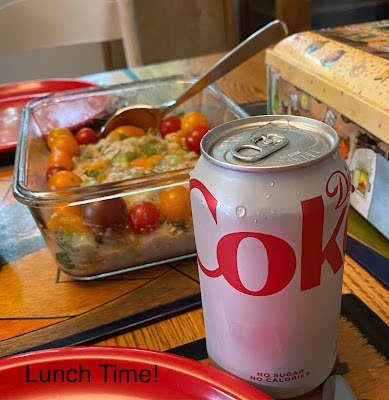
And another controversy, this one about artificial sweetener. As readers of this blog may know, I do love Diet Coke and drink a can of it for lunch often, which is moderate consumption. You probably are aware of  a pronouncement from yet another UN organization, this time the World Health Organization, which has called out Aspartame, the key to the flavor of Diet Coke. This report calls Aspartame a possible but not proved carcinogen. 


NOTE: I’M NOT LISTENING. I will continue to drink Diet Coke.

Drought and War: Bad News for Global Food Supplies 

A parched corn crop (source)

Michigan, where I live, is not experiencing a severe heat wave this month, but other parts of the country and much of the world are suffering from terribly hot weather, bad enough to threaten crops and jeopardize the world’s food supply:

"Successive heatwaves threaten nature’s ability to provide us with food, say researchers, as they warn of an 'unseen, silent dying' in our oceans amid record temperatures scorching the Earth. … The climate crisis doesn’t just increase atmospheric heatwaves but oceanic ones too, harming coastal communities and threatening another key food source for humans. Heat stress causes dramatic die-offs, such as the 2021 'heat dome' along Canada’s Pacific coast, which killed an estimated 1 billion marine animals." (source)

Besides natural disasters, the war in Ukraine has taken an ugly turn, with Russia withdrawing its promise to allow essential grain shipments to continue to supply food to a large number of dependent countries. This too threatens the world food supply:

"Russia unleashed drone and missile attacks on Ukraine’s export infrastructure [on July 17], including silos containing hundreds of tons of grain and vital port structures. … The effect of these Russian attacks is to make it harder for Ukraine to resume shipments if and when current or future diplomatic efforts to revive the agreement from which Moscow withdrew succeed. World grain prices rose 17 percent in eight days after Russia pulled out." (source)


Escape!

Neil Gaiman's Good Omens 2.
Great series, new this week, binged all 6 episodes already.


Blog post © 2023 mae sander

Thursday, June 29, 2023

Our World is Turning Black


As I write, the "PM2.5 concentration in Ann Arbor is currently 13.3 times the WHO annual air quality guideline value." Yesterday, Detroit's air quality was the worst in the entire world, and visibility was terrible. Today it's only second-worst in the world, with Chicago at number one.

Were the Rolling Stones predicting this in 1966 when they said:

"Maybe then, I'll fade away
And not have to face the facts
It's not easy facing up
When your whole world is black"


NOTE: I know they were not singing about air pollution. But I keep thinking about "the sun blotted out from the sky" when I look out my window today.

Saturday, June 10, 2023

Books and Movies: A Week Indoors

Avatar 2: A Lot of Blue People


I started watching this very predictable blockbuster with Len. I was so bored that I wasn't very focused on the first half, after which we stopped watching to eat dinner. Then we watched the rest: at least I tried to watch, but I fell asleep. Even the spectacular CGI effects get boring after a while. Nature’s sea creatures interest me much more than exaggerated artificial versions of them.

"Small Fires" -- Big Ego

Small Fires: An Epic in the Kitchen by Rebecca May Johnson is an appalling mash-up of bad jargon from academia, overdone feminism from the 1970s, and psychobabble. It's unbearably pretentious, and doesn't have anything new to offer anyone who has read feminist or academic or psycho stuff in the last 50 years or so. One of the two blurbs on the cover uses the word "witty." I can't think of any less applicable word for this author's prosaic and pedantic narrative.

What this book most definitely is not: EPIC! What this book is, mercifully, is short.

Here are a few quotes about the deep meaning of a recipe for tomato sauce:

“The recipe is a method for responding to things. Things have agency in many directions. Like words, they have histories and contexts, but when I perform the recipe, things become other things in a messier transformation than words in a sentence. They spatter my shirt red” (p. 51)

“When I cook the recipe, I experience the difference between the knowledge promised by language, and the unboundedness of embodiment, which is both richer and more dangerous that the text can convey.” (p. 73) 

“My ‘reception’ of the recipe – my intervention into the tradition of recipe reception – is to translate text into food. Each time I cook the recipe I produce a new translation of the text. I translate the recipe from the medium of language into the spattering physicality of the ingredients. Like different translations of the Odyssey, my translations of the recipe vary in accordance with the historical moment.” (p. 81)

“When people ask about my work an assumption hangs in the air that I am writing a lovely book of lovely recipes that will be beautifully photographed. … ‘Lovely’ is an acutely gendered adjective that brings my body into the discussion of my writing. It defines my writing through my body… ‘Lovely’ defines and excludes the non-lovely and works to legitimize violence against those who differ from the ideal of an obedient, quiet, thin, clean, happy, grateful, rich, white woman.” (p 98)

In Small Fires, Johnson may be the most extreme name-dropper whose works I’ve ever read. She really wants us to know what a great intellectual literary contemporary reader she is! She mentions writers and creators, briefly alludes to and quotes them, and then moves on to prove how much more she knows! A few of them include: Homer the ancient poet (she has a lot to say about the Odyssey), D.W. Winnicott, Rainer Maria Rilke, Mrs Beeton, Sam Sifton, Claudia Roden, Natalia Ginzburg, Sigmund Freud, Miles Davis, John Coltrane, Mingus, Sergei Eisenstein’s film Battleship Potemkin, Simone Weil, Jessye Norman, and many others. Aren’t we impressed? A typical sentence “I look up Jean Laplanche and read a little about his work – he is a psychoanalyst and winemaker who appears in Agnès Varda’s film Les Glaneurs et la glaneuse.” (p. 166)

The New York Times Review lured me into buying this newly-published book. It said:

"Small Fires: An Epic in the Kitchen ... aims to upend not only the way we cook but the way we think about cooking. The book regards recipes as sites of dynamic, creative engagement across generations — and notes that most bragging about not following a recipe is simply a defensive response to anxiety about originality. Small Fires, … is brave enough to hurt feelings, and delicious enough for no one to care."

I read all of this little book, and I mostly found it annoying. I will admit that there are a few good passages among all the posturing and long words and blustering and self-promotion, and I understand her point, that making a recipe for tomato sauce (particularly Marcella Hazan’s recipe) is a metaphor for life in general or for the plight of women in society. She isn’t the first one to discover this. I suspect that this book will be popular with other pseudo-intellectuals and aspirants to intellectual giganticness.

My Whole Week Felt Kind of Eerie


Although I read one very good book this week (The Great Influenza by John M. Barry) I was mostly feeling very claustrophobic because from Wednesday morning onward, the smoke from the Canadian fires means it has been too terrible to breathe much outdoors. I can’t take my usual walks, sit in the garden, or otherwise enjoy the cool summer weather. It's depressing and overwhelming, because we know what it means:

“Climate scientists have been saying for decades that global warming would lead to a proliferation of wildfires. Last year a U.N. report warned of a ‘global wildfire crisis’ as many forested areas become hotter and drier. The smoke-filled skies outside my window are, in effect, a validation of mainstream climate science: The experts didn’t predict this particular disaster for this particular week, but this is exactly the kind of thing they’ve been warning us would happen.” (Paul Krugman in the New York Times)


Shared with Sunday Salon at Readerbuzz.
Blog post © 2023 mae sander.

Friday, June 09, 2023

The Beginning of Summer


Chipmunks are all over our garden.

They also sit on our chairs.


Throughout the neighborhood, people are starting their vegetable gardens.
These raised beds are in a front yard around the block from us.

The University of Michigan Peony Garden was at its peak last Sunday.
Hundreds of people were enjoying the thousands of blossoms.


Neighbors are committed to encourage pollinators (but I'm not sure what that means here).

In another garden, less cultivated, is a clover, a recognized attraction for pollinators.

Roses are blooming in other people's gardens.


Spring flowers are just about finished blooming

The latest-blooming rhododendrons are just finishing their season.


Smoke from Canada has weirded out the sun.


Unfortunately this is climate change. Exceptional drought causes fires in Canada.

The Ann Arbor Potters' Guild held its June sale.


A ceramic dragon at the Potters' Guild.


Shared with Eileen's Critters.
Photos © 2023 mae sander