Showing posts with label French food. Show all posts

Tuesday, May 26, 2026

A Few Classic Foods

 Classic Cinnamon Rolls


Len made them on Saturday. We enjoyed them for afternoon tea and for breakfast.
I find it amusing that the spiral design on the plate looks like the spiral on the roll.

Classic Pommes à l’Huile

French-style oil and vinegar potato salad is another classic dish that we love.
I’ve blogged about this often — especially when I make Salade Niçoise in which it is a key feature.
Tonight we ate it as a side dish with shrimp.

Classic Shrimp Scampi


Recipe from New York Times Cooking

Ingredients ready to cook. Cooking only takes a few minutes.


Saturday Lunch at Everest Sherpa Restaurant

The owner of Everest Sherpa restaurant is from Nepal, and the decor includes photos
of the Himalayas and of famous mountain climbers. The restaurant serves Nepalese and Indian cuisine.
The founding owner of the restaurant was one of the first to climb Everest.

Crispy dumplings called MoMo.

Curried chicken served with rice. The restaurant offers a wide variety of dishes.


Photos © 2026 mae sander

Monday, July 01, 2024

Madame Bovary and Paris in July

What I think of when I think of Paris: fabulous pastry for breakfast!
This photo is from my interrupted trip to France at the end of May.

Paris in July is a big bloggers’ party that has been ongoing for a number of years; 2014 was the first year that I participated. I had been reading other bloggers’ posts for a few years before that. Now it’s time again, and this year the organizer is Emma at Words and Peace: her introductory organizing post will kick things off July 1. 


Although the event is called “Paris in July” any French topic is gladly accepted, including posts about books, food, films, travel, or any other topic about France, French literature, French cuisine, or whatever topic appeals to the writer. Many people plan what they will be reading and writing about, but that’s not my habit. Several book bloggers are reading Madame Bovary in French as part of this celebration of all things French. I didn’t have the courage to tackle this book in French, but last week I read it in translation.


The window of a wine shop. Paris, May, 2024.


Reading Madame Bovary

The number of covers for editions of Madame Bovary is amazing.


Since its publication in 1856, Madame Bovary must have been reviewed thousands of times. So why should I have the nerve to add anything? It’s been many years since I read it for the first time, and I remembered quite a few details as I just reread it. What impressed me is how Flaubert was so detailed in his observations of the life of this woman, who simultaneously ordinary and extraordinary. His tiny observations added up to her vanity, her shallowness, her desperation to be released from boredom, and her wish to feel passion and to be admired. Above all I was amazed at the level of detail with which he described her final agony and death, followed by her funeral. 

Blog post and photos © 2024 mae sander


Sunday, December 31, 2023

In My Oven and on the Stove in December

First, I wish everyone a very pleasant New Year’s Eve 
and a wonderful year in 2024.

Here are some photos of cooking in my kitchen this December, to be shared with Sherry’s In My Kitchen for the end of the year. Of note this month is the way I’ve been exploring so many books set in France: two mysteries set in Brittany, books about the Paris metro and the Seine River, and at last, Bruno’s Cookbook by Martin Walker. It’s been fun. I have no idea if this obsession will continue in the New Year.

Our kitchen photos show our lives up to December 27. On the 28th, we flew to Costa Rica where we are on a birding trip, but I scheduled this post to go live for the December 31 wrap up.


Inspired by Bruno’s Cookbook.


Also from Bruno's cookbook.


Assembling the chicken Marengo to take to a potluck. I adapted Julia Child’s recipe to work for a potluck.


A recipe from the New York Times.

Fried eggs for a sandwich.

Before serving, this tart is inverted on a plate, so that the onions are on top of the pastry.


A very refreshing salad: celery, green onion, capers, herbs, lemon zest & juice, olive oil.
Like many of the above preparations, this contains moderately-priced and easily available ingredients.


New in my kitchen in December

Oven-safe enameled pans -- the smaller one was used for the onion tart.

Fresh jars of spice blends to replace the ones in my pantry that have gone out-of-date.

Blog post © 2023 mae sander


Friday, December 22, 2023

Bruno’s Onion Tart


Continuing with our exploration of Bruno’s Cookbook by Martin Walker and Julia Watson, Len decided to make a rather complicated recipe: Red Onion Tarte Tatin. 

A classic French Tarte Tatin is a sweet pastry made with apples: a renowned dish where cooked apples are baked under a lid of flaky pastry and then flipped over for serving, so that the crust remains crisp. Walker explains that “it occurred to Bruno … that the method might be applied just as successfully to most vegetables.” Specifically, Bruno used this idea for baking with the abundant red onions that he grew in his garden. We were lucky to find beautiful red onions at Whole Foods, as we don’t have a garden — anyway, it’s fun to read fiction about one’s dinner. (p. 22)

Len has been wanting to try making simple flaky pastry (pate feuilletee facile) for quite a while. It uses flour, frozen butter, and ice water to make a flaky dough. Several other recipes in Walker’s book also use this preparation. If you watch the Great British Baking Show, the contestants constantly use this preparation for what they call “rough puff,” that is, a dough that is not repeatedly folded and layered, but that’s brought together quickly and only handled a little bit.


Grating butter for the pastry to make Bruno’s onion tart.


Roasting the onions — first on the stove-top, then in the oven.

Top the roasted onions with the pastry.


Beautifully brown, just out of the oven. The pastry is crisp and flaky.


Before serving, this tart is inverted on a plate, so that the onions are on top of the pastry,
and it’s garnished with goat cheese. The red onions become very dark, but are not charred.


Blog post and photos © 2023 mae sander

Thursday, December 21, 2023

Brittany in two Mystery Novels

“The simple question of who had a material benefit after a murder case – everyone always wanted to deflect it of course – might have seemed old-fashioned, but it was still elementary. Who got something out of the death? And what, exactly? ‘Traditional’ motives for murder still ruled the world: envy, humiliations and hurts, revenge, jealousy and greed dominated all statistics by a wide margin.” (Murder on Brittany Shores by Jean-Luc Bannalec, p. 148)


Jean-Luc Bannalec’s fictional detective, Commissaire Georges Dupin, wasn’t very careful to show respect for his superiors. In fact, he’s a bit contemptuous. This trait makes him a very good subject for a long series of novels — but isn’t very good for his career. Although he was Parisian through-and-through, he was banished from the Paris police force and sent to a small town in Brittany. At least he finds the food there good, especially at his favorite spot, the Amiral:

“It was true he loved Breton cuisine and the Amiral had all of the delicious Breton specialities, but nothing to Dupin’s mind, absolutely nothing, could beat entrecôte with chips (the real national dish of the Grande Nation – Dupin thought they should be very proud of it). There was nothing like it. Nothing even close after a day like that. And red wine to wash it down, a deep red Languedoc. Rich, velvety and smooth.” (Death in Brittany, p. 97)

He also finds good food in other restaurants as he investigates a series of crimes. Sometimes he enjoys these meals alone, sometimes with his fellow policemen:

“Madame Mendu had been looking after them, feeding them regional specialities: rillettes (scallop rillettes were Dupin’s favourite), paté, Breton goat’s cheese, various types of mustard, baguettes and a bottle of red Faugères. Dupin sat down and ate with them.” (Death in Brittany, p. 154)

I read these two books a couple of years ago, and decided to read them again. I must admit that I didn’t remember the details of either plot, so I enjoyed the suspense as Dupin questions the witnesses and suspects in the matter of multiple murders, while evading the demands of his more politically-oriented superiors. The atmosphere of the fishing villages and small-town life in both books is delightfully portrayed. I think I’ll read more of this series. 

One more unbearably delicious description of a dish you can eat only if you are on the Breton coast:

“The fish stew – you could never say fish soup – smelt indescribable. Dupin recognised all of his favourite fish: angler fish, sea bass, red mullet, gilt head, pollack, cod, hake and sole, his favourite shellfish: praires, scallops, blue mussels, palourdes grises and even better – palourdes roses – along with langoustines of various sizes and crab. It was in fact a huge, deep soup bowl with an impressive mountain towering upwards. More hurriedly than he’d intended, he poured the sauce over the fish and the potatoes. And ate. He tasted the whole sea. Incredible – the fish, but especially the broth, a concentrate that had been reduced for hours and hours.” (Murder on Brittany Shores, p. 316)

Blog post © 2023 mae sander


Tuesday, December 19, 2023

Bruno’s Cookbook at Last

Inspired by Bruno’s Cookbook: roasted vegetables with salmon and browned breadcrumbs.

For a long time, I’ve been waiting for the English edition of Bruno’s Cookbook by Martin Walker and Julia Watson, and at last, I have my copy. As you probably know, Bruno is a detective in the small, fictitious town of St. Denis in the Périgord region of France, and Martin Walker is the author of this series of delightful books. I’ve read them all.

Bruno is not only a model policeman, he’s also a fabulous cook, and he and the other characters in Walker’s series are attributed as the creators of many of the recipes: after all, it’s BRUNO’s cookbook. 

Reading the detailed introductions to the sections of the cookbook and to the recipes is a little like reading fiction. The vegetables and herbs are grown by the people of the village, including Bruno. If there’s something they don’t grow, they can get it at the amazing local market. Bruno knows everyone, and always gets the best of everything. And he always solves the crimes that occur in the little village, while helping all his fellow citizens in many ways.

Bruno and his friends forage the local mushrooms. (I suppose Walker does too, as he includes many recipes for a variety of wild mushrooms.) Bruno loves the region’s famous truffles, which somehow he always seems obtain as gifts, despite their astronomical market value. The characters in the book (and we are told, the real friends of the author) buy cheese that’s made by a local cheesemaker, who also has connections throughout France, so he can procure artisan cheeses from other regions and sell them at his market stall. The locals, including Bruno, hunt wild boar and game birds. Eggs for perfect omelets come from the chickens raised in their back yards. Bruno’s Cookbook even provides the recipe for dog biscuits that Bruno bakes for his intelligent and devoted dog Balzac.

I am totally enjoying my adventure with this nearly-imaginary food. And I think there are a few recipes that I can follow even with the dried herbs, winter vegetables, inauthentic cheeses, and supermarket meats in my pantry and refrigerator. For my first such dish, I adapted a recipe called “Herb-Roasted Halibut on a Bed of Summer Vegetables.” Since it’s winter, I used winter vegetables, and I used salmon, which is listed as an alternative to the halibut — that’s what I had on hand. But I followed the instructions for seasoning the dish, and for a topping of breadcrumbs browned in olive oil. And it was delicious!


Not exactly following the cookbook, but I was inspired by this recipe for a dish of roasted vegetables and fish.
Blog post © 2023 mae sander

Thursday, September 21, 2023

Very Very Noir: "Total Chaos"

Total Chaos by Jean-Claude Izzo (1945-2000)

You couldn't imagine a less cozy mystery than this graphically violent police story about Marseilles around 30 years ago. Jean-Claude Izzo's Total Chaos (written in 1995) is dark and often ugly with lots of underworld characters from all the ethnic and social strata of the Marseilles underground and police force. It's narrated by a policeman named Fabio Montale, a native of the city. Unlike him, his friends, both alive and dead, are mainly petty criminals and hookers. His enemies are gangsters and maybe some of his fellow policemen. The plot centers on the deaths of his two best friends and a young woman, and his efforts to discover who killed them, and maybe get some revenge. 

I didn't like the book at all: just not my kind of literature. However, one feature of this novel did appeal to me very much: between the scenes of unpleasant violence and the depiction of unsavory characters, Fabio's narrative is full of very savory food descriptions. Food here is totally central to the essence of the main character/narrator and his milieu. You could almost cook following his descriptions: in fact, if you were familiar with the local cuisine, you probably could use them as recipes.

Since I'm not fond of novels with this much graphic violence, I'll just quote a few of the amazing food descriptions. 

First, here is Fabio's childhood memory of his family dining table:

"The whole family used to come here on Saturdays. There’d be big plates of pasta in sauce, with headless larks and meatballs cooked in the same sauce. The smells of tomatoes, basil, thyme, and bay filled the rooms. Bottles of rosé wine did the rounds amid much laughter." (p. 38). 

Next, his friend Honorine makes Fabio some food to take on his boat:

"I made you some foccaccia, Honorine had written on a little piece of paper. Foccaccia is made with pizza dough, filled with whatever you like, and served hot. Tonight, the filling was cured ham and mozzarella." (p. 44).

And Honorine cooks another dish:

"Honorine made stuffed peppers like no one else could. Romanian style, she called it. She’d fill the peppers with a stuffing of rice, sausage meat and a little beef, well salted and peppered, then place them in an earthenware casserole and cover them with water, add tomato coulis, thyme, bay and saw-wort, and let them cook on a very low flame, without covering. They tasted wonderful, especially if you poured a spoonful of crème fraîche over them at the last moment." (p. 161).  

Another Marseilles specialty, by Céleste, another friend:

"Céleste made better aïoli than anyone I knew, except Honorine. The cod was desalted just right, which is rare. Most people leave it to soak for too long, and give it only two soakings. It was best to soak it several times. Eight hours the first time, then three times two hours. It was also a good idea to poach it in simmering water, with fennel and pepper grains. Céleste also used a particular olive oil to give the aïoli a ‘lift.’ .... Her salads always tasted different." (p. 194).  

Fabio's colleague Pérol supplies some provisions:

"Pérol had brought beer and sandwiches. Tomatoes, anchovies and tuna. Not so easy to eat, but better than the usual revolting ham sandwiches." (p. 139).  

Simple foods reflect the Marseilles atmosphere throughout the novel.A meal with a friend at a place called Chez Mario:. 

"Mozzarella and tomatoes, with capers, anchovies and black olives, for starters. Spaghetti with clams as a main dish. Tiramisu for dessert. To drink, a Bandol, from the Pibarnon vineyards." (p. 75).

Besides the tastes and preparations, there is also frequently a memory of aromas:

"On Rue Longue-des-Capucins, the market was in full swing. Smells of coriander, cumin, curry, mint. The East. I turned right, through the Halle Delacroix, went into a bistro and ordered a double espresso and a few slices of bread and butter." (p. 79). 

Sometimes Fabio himself prepares the meal:

"I’d started cooking early in the morning, listening to old blues songs by Lightnin’ Hopkins. After washing the bass, I’d filled it with fennel, then drizzled olive oil over it. Then I made the lasagne sauce. The rest of the fennel had simmered gently in salt water, with a touch of butter. In a well-oiled pan, I gently fried slivers of onion, garlic and finely chopped pepper. A spoonful of vinegar soup, then I added tomatoes that I’d cut into little cubes and plunged in boiling water. When the water evaporated, I added the fennel." (p. 100).  

To wrap up...

In contrast to Izzo's very hard-boiled crime stories is the genre of cozy mysteries. These were just becoming popular in the 1990s when Izzo's Marseilles novels were written. The cozy mystery genre in fact was initially developed as a reaction against noir tales like this. The main focus of cozy  novels is the food (cute little lady detectives in cozy mysteries are often owners of food establishments), but I think Izzo's food is much more fascinating and appealing. The meals served in a lot of cozy mysteries probably wouldn't be as delicious as Fabio's dishes. 

If you like your police tales noir and graphic, you should read this book. I prefer my crime fiction to be somewhere in the middle, not cutesy-cozy and not ultra-violent. I like quite a few authors of this in-between style. such as Donna Leon, Martin Walker, Tony or Anne Hillerman, Elly Griffiths, Sujata Massey, Robert Parker, and quite a few others. Total Chaos is the first volume of a trilogy, but I don't think I'll be reading the other two volumes.


Blog post © 2023 mae sander

Sunday, September 03, 2023

Bruno, Chief of Police, is Back!

Great book news. After years of waiting, the cookbook based on the mysteries by Martin Walker is finally coming to bookstores -- in English! The German edition has been available since 2014. If you are a fan of Walkers sixteen detective novels, you already know of the fantastic meals prepared by the policeman Benoît Courrèges, called Bruno by the people of the small (fictitious) town of Saint-Denis.

Bruno's Cookbook: Recipes and Traditions from a French Country Kitchen
by Martin Walker and Julia Watson. To be published in November, 2023.

A few days ago, the latest tale of Bruno, Chief of Police, detective novel -- A Chateau Under Siege: A Bruno, Chief of Police Novel -- was published. Of course I've already purchased and read it. As always, Bruno is resourceful, brave, loyal to France, clever about finding out what's really going on with a lot of very suspicious happenings, and basically smarter and more likable than the French international security team with whom he must cooperate to deter a dangerous gang of international assassins from their evil plans.

Bruno tirelessly performs heroic surveillance tasks to protect the local residents and to preserve the honor of France, though at times the plot was a bit exaggerated in the author's reliance on finding foreign agents plotting mayhem, and being thwarted. 


I'll skip any further plot summary or spoilers about this suspenseful novel full of dedicated men and women defending their country. In simple terms: while Bruno was dealing with the national security crisis, he had time to prepare several remarkable meals from the wonderful local produce of the region. Here are a couple of typical descriptions of Bruno in the kitchen and at the remarkable artisan food market in the town. First, he cooks for a few friends at the home of his friend the baron:

"To his surprise the kitchen was empty. Automatically he took a knife from the drawer, gutted and cleaned the fish, reached for the brush to spread on walnut oil, squeezed and sliced lemons, grated garlic, sprinkled salt and a little pepper. ... He put the dressed fish onto a platter, took it out and handed it to the silent baron." (A Chateau Under Siege, p. 183)

In St. Denis, Bruno goes to market: 

"The market was in full swing. The stalls were almost overflowing with strawberries, peaches, apricots, squash, cucumbers and different kinds of lettuce. Stéphane’s cheese stall could hardly be seen for the customers swarming around it, and the family from the Lac Noir farm was running back and forth to their refrigerated van to bring new supplies of duck breasts, legs, whole ducks and fresh foie gras. There were crowds around each of the stalls for wines—from the town vineyard, from the Montravel and Saussignac, the Pécharmant and Bordeaux. The children of the winemakers were kept busy rinsing out the glasses for free tastings, while the artisan brewers talked of their pride in their beers. 

"There were rivals for every trade, for the little round goat cheeses, fresh, demi-sec and aged; for the Basque sausage makers from the Pyrenees; for the stalls with fresh oysters and mussels, shipped from the coast at dawn that morning. They competed for space with live chickens and a host of breads—rye, black, with bits of bacon baked inside, sourdough and with olives. There were homemade butters, yogurts and every version of fruit jam under the sun. There were queues at the Vietnamese stall with its hot nem, at the Mauritian stall with its curries and an even longer line at the Guadeloupe stall with its empanadas and spices. A man with a huge vertical rotisserie was roasting chickens, quail and pigeons while great vats of pommes de terre sarladaises bubbling below sent wafts of garlic to blend tantalizingly with the scents of roasting fowls." (pp. 200-201). 

Bruno steps up to provide dinner for a group of very rich visitors in an unfamiliar kitchen because the cook has been injured:

"Bruno saw there was a bottle of very good cognac beside them. He grabbed it and went into the kitchen, took the chicken breasts and the crème fraîche from the fridge and checked that there was Dijon mustard, chicken stock and sherry vinegar in the pantry. He took a basket, went back to the potager for artichokes, peaches and tarragon, took them into the kitchen, removed his jacket and washed his hands. There were a dozen chicken breasts in the large pack from Leclerc supermarket. He shrugged. It could have been worse. He found a decent knife, cut the breasts into three and then peeled and finely chopped three fat shallots. ... 

"Bruno rummaged in the cupboards for a large roasting pan and then for a large stainless-steel bowl. He melted a hundred grams of butter in a pan, stirred it into twice that amount of olive oil and poured the blend of fat over the chicken chunks that he’d placed in the large bowl. He stripped the leaves from half the tarragon and put them to one side. He washed his hands again and then manually massaged the oil and butter mixture thoroughly into all the chicken pieces. He put the well-greased chicken into the roasting pan, with the remaining tarragon twigs tucked in between and around them. He wiped his hands clean of the fat. 

"He put the chopped shallots into a large frying pan, added olive oil and sautéed them gently on low heat, stirring steadily until they were transparent. Then he added half a liter of chicken stock, a wineglass full of cognac and half a glass of sherry vinegar. He added salt and pepper, used a wooden spoon to blend it all together and then turned up the heat until the mixture began to simmer. He lowered the heat, let the ingredients simmer gently for about five minutes, and then put the pan to one side. Thirty minutes before serving the dish, he would add two-thirds of the liter pot of crème fraîche to this sauce, put it over the chicken, cover the pan and roast it for thirty minutes at 180 degrees centigrade." (pp. 226-228)

I'm looking forward to Martin Walker's cookbook, co-authored with his wife Julia Watson. I trust that it will provide detailed instructions for how to make the wonderful dishes from all sixteen Bruno novels. Obviously, I lack access to a market where I can find excellent duck breasts, freshly made foie gras, live oysters, newly-dug truffles, and all the other types of produce that play such a big role in Bruno's vast successes. I am sure that at least the cookbook will be fun to read and to enable me to imagine having such opportunities. 

Review © 2023 mae sander

Monday, July 31, 2023

Kitchen Thoughts for July 2023

In My Kitchen This Month

Another quiet month with lots of home cooking but not much new in my home and kitchen. The only real cooking challenge was a multi-day power failure. Fortunately for us, we installed a natural-gas generator several years ago, because summer thunderstorms and winter ice emergencies routinely take out the electric lines. Only part of our house is powered by the generator, though: the electric stove is not generator-powered. Consequently, I had to make meals in the microwave, the toaster oven, or other small appliances Believe me, I am very aware at how lucky we are to have what we do have, in comparison to neighbors without power, and to many others throughout the world. NO complaints!

While my culinary month is quiet, food issues of national and international importance have been in the news in July. Various events and official actions will have a large impact on worldwide food policies and global hunger. So in this post, I’ll just describe my own food happenings a little bit and then proceed with a summary of several important current events.

Cooking


We enjoyed lots of fresh fruit.

Celebrating Paris in July, I made one French dish: classic ratatouille from the cookbook by
French chef Raymond Olivier. My usual recipe -- very similar -- is from Julia Child (blogged here).

Many more Asian dishes included these stir-fried snow peas.

Summer barbecue time: grilled chicken thighs, pineapple and red bell pepper — really delicious!

And once we made hamburgers with all the usual fixings.

Beautiful Serving Pieces (I wish they were mine)

I don’t have any new kitchen tools or serving pieces this month, so I thought I would
share some images from the 20th century collections of the Detroit Art Institute.
I love this silver tea service from 1938 by designer Harry Bertoia.

Also from the DIA: this Still Life by Jean Metzinger from 1925.
Coffee, liqueur, an apple, and (an item you’ll never get in my kitchen) cigars.


Finally, from the DIA, this Viennese liqueur set from 1909-1916.

Issues and Problems of our Threatened World

Food and Politics in the USA

Congress is working on a reauthorization or revision of the 2018 farm bill, which controls many aspects of agriculture and which provides US government assistance for food-insecure families. Federal programs such as SNAP (Supplemental Nutrition Assistance Program) and emergency food assistance programs that supply families and food banks are all on the line. The existing farm bill expires in September, so either a complete new farm bill or an extension of some sort must happen soon. Individuals and organizations that deal with hunger in our society are pressuring for improved government support for nutrition programs, and other interests, such as big agriculture, are competing for allocation of federal money.  Here is the previous allocation:


Ultra-Processed Food and More Politics

A controversy about ultra-pasteurized food has emerged from a report by the Food and Agriculture Organization of the United Nations. This report shows that global hunger is an extreme problem, but slight progress in decreasing food insecurity has been made this year. The study also suggests that a better diet for people around the globe would include less ultra-processed food. Food manufacturers are objecting to the critique of ultra-processed foods because they make lots of money by selling them — to say it in the most simple way.  The FAO report states:

“Healthy diets are essential for achieving food security goals and improving nutritional outcomes. A healthy diet…is based on a wide range of unprocessed or minimally processed foods, balanced across food groups, while it restricts the consumption of highly processed foods and drink products.” (source)

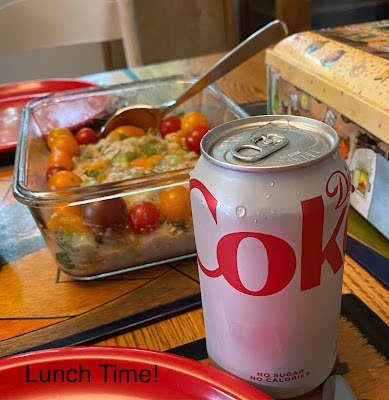
And another controversy, this one about artificial sweetener. As readers of this blog may know, I do love Diet Coke and drink a can of it for lunch often, which is moderate consumption. You probably are aware of  a pronouncement from yet another UN organization, this time the World Health Organization, which has called out Aspartame, the key to the flavor of Diet Coke. This report calls Aspartame a possible but not proved carcinogen. 


NOTE: I’M NOT LISTENING. I will continue to drink Diet Coke.

Drought and War: Bad News for Global Food Supplies 

A parched corn crop (source)

Michigan, where I live, is not experiencing a severe heat wave this month, but other parts of the country and much of the world are suffering from terribly hot weather, bad enough to threaten crops and jeopardize the world’s food supply:

"Successive heatwaves threaten nature’s ability to provide us with food, say researchers, as they warn of an 'unseen, silent dying' in our oceans amid record temperatures scorching the Earth. … The climate crisis doesn’t just increase atmospheric heatwaves but oceanic ones too, harming coastal communities and threatening another key food source for humans. Heat stress causes dramatic die-offs, such as the 2021 'heat dome' along Canada’s Pacific coast, which killed an estimated 1 billion marine animals." (source)

Besides natural disasters, the war in Ukraine has taken an ugly turn, with Russia withdrawing its promise to allow essential grain shipments to continue to supply food to a large number of dependent countries. This too threatens the world food supply:

"Russia unleashed drone and missile attacks on Ukraine’s export infrastructure [on July 17], including silos containing hundreds of tons of grain and vital port structures. … The effect of these Russian attacks is to make it harder for Ukraine to resume shipments if and when current or future diplomatic efforts to revive the agreement from which Moscow withdrew succeed. World grain prices rose 17 percent in eight days after Russia pulled out." (source)


Escape!

Neil Gaiman's Good Omens 2.
Great series, new this week, binged all 6 episodes already.


Blog post © 2023 mae sander