“As I would not be a slave, so I would not be a master. This expresses my idea of democracy. Whatever differs from this, to the extent of the difference, is no democracy.” — Abraham Lincoln, 1858. (source)
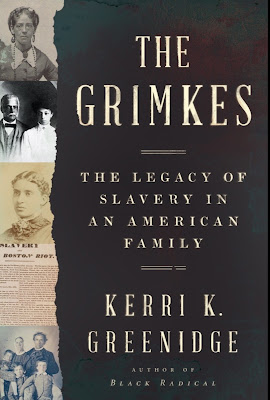 |
| The Grimkes: Published this month. |
The Grimkes: The Legacy of Slavery in an American Family by Kerri K Greenidge is making me think hard about Lincoln’s famous definition, though this quote doesn’t appear in the book. The profound depravity of many slave owners in this historic family, and the indifference and self-centeredness of many of the other White members of the famous abolitionist family is painful to learn about. In the preface, the author states an underlying observation: “The tragedy of the Grimke sisters’ lives was the fact that they never acknowledged their complicity in the slave system they so eloquently spoke against.” The self-awareness and suffering of the slaves, including the Black members of the Grimke family, is equally a torture to read.
At the very beginning of The Grimkes, we find a list of 17 central figures, mainly members of the Grimke family. By following this enormous number of historic figures, this book shows the development of consciousness of the White abolitionists before the Civil war. It also illustrates (with really impressive historic details) the numerous possibilities for inhumane treatment and vicious cruelty that slavery afforded many masters.
Further, the book describes in painful detail a number of violent attacks on free Black communities in Pennsylvania in the pre-war era. About one of these attacks and the way the sisters reacted:
"Angelina and Sarah Grimke undoubtedly heard the mob as it made its way down Lombard Street, through Sixth and Seventh and the narrow alleyways in between. And yet they never mentioned, either publicly or to each other, the actions of the city’s enraged white people, nor did they reflect in future writings on the lasting effects of such violence on the Black people they eventually claimed to serve." (pp. 10-11).
Obviously, this book is emotionally challenging to read, and further, it's challenging to follow the intense amount of historic detail that is presented.
I'm finding it even more challenging to review this profound social and political history, which looks at the American experience in ways I have never read before (though I haven't read that much). Besides the pain of reading about this era, our own era has plenty of pain; specifically, the shooting last Sunday night in Charlottesville, Virginia. Those who lost their lives are also at the forefront of my thoughts: another horrifying mass shooting, three promising young people dead, and an entire community terrorized as the shooter was at large for 12 hours. (My two granddaughters are both students at UVa, so it's personal.)
Who Were the Central Figures of The Grimkes?
Of the many individuals that played a role in Greenidge's history, here are the ones that are the best known, whose lives I followed the most closely as I read:
- Sarah Moore Grimke (1792–1873), White daughter of slave owners in South Carolina who became a major participant in the abolitionist movement in Philadelphia and the North.
- Angelina Grimke Weld (1805–1879), her sister, an orator and leader of the abolitionists.
- Archibald “Archie” Henry Grimke (1849–1930), son of their deeply evil and cruel brother and Nancy Weston, a woman who was his slave. With the help of his two aunts, he received a traditional education at several famous institutions, including Harvard, and became a highly educated and influential figure in the late 19th and early 20th century.
- Francis “Frank” James Grimke (1850–1937), his brother, equally educated and prominent.
- Angelina “Nana” Weld Grimke (1880–1958), Archie's daughter, a well-known poet and playwright of the early 20th century.
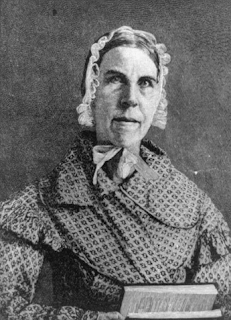 |
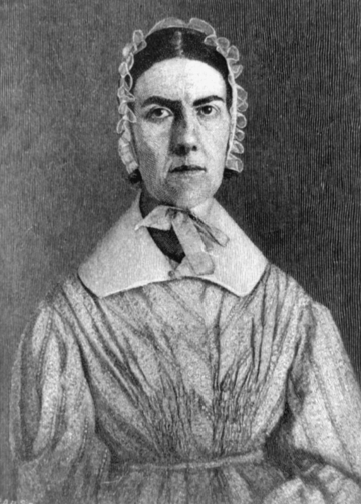
| Sarah Grimke, around 1850 |
The famous Grimke sisters, Sarah and Angelina, fled from their family of southern plantation owners in South Carolina, rejected the slave-owning ethics of their parents, and moved to Philadelphia where they participated in the anti-slavery movement leading up to the Civil War. Along with a number of other abolitionists, they were founders of important anti-slavery societies, and later promoted women's suffrage as well as rights for the Black community, and efforts at justice for the freed slaves of the South.
The author, while acknowledging their leadership, is very critical of their lack of respect for Black individuals and especially open about their blindness to the cruelty of their father and brother towards his own Black children, as well as to all enslaved people in his life.
The patriarchs of the Grimke family, like a shocking number of other slave owners in the pre-Civil-War South, virtually all had relationships with black women whom they owned and abused, and in general were unimaginably vile to their own children.
 |
Angelina Grimke, around 1850
(Images from the book) |
"From New Orleans to Charlotte, the slaveholding tradition of white men installing an enslaved Black woman in a slave cabin on his plantation so that she could be sexually available at all times was so common that writers, antislavery and proslavery alike, wrote countless parables about the practice." (p. 113).
Angelina and Sarah’s brother was the most horrifying of cruel slave owners; the enslaved woman, Nancy Weston, mother of his children, was a strong and brave woman who did the most she could to raise her sons as responsible and impressive citizens, and to procure their freedom and then their success in life. She succeeded. I feel that anyone reading this book would have to be overwhelmed by the thought of a man who enslaved and tortured his own children, whatever their race. But even the well-meaning helpers were deficient: "white reformers’ dedication to Black people as a moral obligation to be fulfilled did not always translate into a belief that Black people were intellectually and politically capable." (p. 168).
Nineteenth-Century Activism
Obviously the Grimke sisters' political abolitionism prior to the Civil War then led to the complex post-war process of changing American life from a slave society to a free society. Both Archie and Frank, highly educated with the help of their aunts, became leaders in the Black communities that emerged during the Reconstruction era. The Black free men in particular had to deal with the attitudes of Northerners, especially men, who looked down on them, or saw them as merely a means to achieve salvation in a religious sense:
"...most white abolitionists were as blinded by their own self-interests as the Grimke sisters nearly thirty years before had been blinded by their own sought-after redemption. Back then, Sarah and Angelina saw slavery as a sin for white people to vanquish from the land and white deliverance as a just consequence of slavery’s end. Now, in 1862, white men like abolitionist Samuel Gridley Howe and Union Army cotton agent Edward L. Pierce saw impending Black freedom as a force to be controlled and directed by white New Englanders.” (pp. 146-147).
As time went on after the war, the horrifying resurgence of racial discrimination and the slow erosion of the rights of the Black community in the final decades of the 19th century is of course well known. Greenidge's scholarly details about the members of the Grimke family bring this history to life. The details are both fascinating and truly depressing, as well as having all kinds of resonance in thinking of our own troubled times.
The unequal basis of Black and White lives in Philadelphia and other Northern cities throughout the 19th century is not surprising, but the details are enlightening. For example, Greenidge describes the lack of educational opportunities for Black children in the early years of the century:
"As Philadelphia’s rapidly industrializing economy led to low wages and underemployment that forced most Black children out of the classroom, poor white children were saved from ignorance and a lifetime of toil by publicly funded charity schools, designed to set the city’s 'destitute' on a path to productive republican citizenship. As one Philadelphia philanthropist informed Alexis de Tocqueville, who was then on his first tour of the nation, colored children were legally entitled to public education, but “the [white] people are imbued with the greatest prejudice against Negroes," (p. 47).
Even the reformers who were more open-minded than most White people did not recognize that Black people wanted the same type of education and opportunity that White people did. After the war, particularly, a system that fostered a supposedly practical education for Blacks appealed to the latent racism in many of the most supportive and committed people.
"At Howard University in Washington, Hampton University in Virginia, and others like them, Native Americans, recently denied citizenship under the Fourteenth Amendment; African Americans, recently emancipated in the South; and poor Southern white residents, exploited and degraded by the slaveholding plantocracy, would be trained in 'Christian morality and free labor' as a form of cultural and economic acclimation to a rapidly industrializing America." (p. 213)
This attitude greatly affected the support that the Grimke sisters offered to their nephews, whose education they took responsibility for, but whom they did not treat as real equals:
"It was in this vein that the well-meaning and sincere Grimke sisters ignored the type of education they had always valued for their own children and urged their Black nephews to consider a postsecondary education that emphasized labor as well as humanistic inquiry." (p. 213).
As time went on, the discrepancy grew between the aspirations of willing and able Black people to be educated in a traditional way, and the theory and practice of many educators. This included Booker T. Washington, who offered a different type of education for these "different" people. In reality, the former slaves were treated as unequal and less capable:
"... many members of the colored elite agreed with Washington’s prescription that 'harmony will come [between Black and white ] as soon as we forget the supposed injuries of the past.' The rising generation of negroes, Washington and his supporters believed, were best served by personal and community adherence to 'thrift, moral education, and the cultivation of our own businesses.'” (p. 271).
In The Grimkes, Greenidge offers the often-neglected alternative view held by people like Archie Grimke, that Black and White people both craved and deserved a full set of choices when it came to education and their life work.
There's Much More!
I've only described a few of the ideas and historic streams in this very interesting book. The lives of a number of other individuals are also presented, representing the author's amazing scholarship and painstaking interpretation of what is obviously many historic and primary sources of information. Besides their participation in the abolition movement, the Grimke sisters' role in the women suffrage movement is also explained in detail, including the fact that they were among the first women to cast ballots in an election in a symbolic protest in the 1870s -- though their votes weren't counted!
The life and accomplishments in the twentieth century of Angelina “Nana” Weld Grimke also made a big impression on me, but I am not going to try to summarize this. Throughout the book, I was fascinated by the number of very famous men and women who interacted with all of the members of the family.
It’s hard to explain how many really important facts and insights about American history that I learned while reading Greenidge's book. The struggle for justice was complex and fraught, and it isn’t over.
From The New York Times Review
“The Grimke sisters became celebrities, publishing essays that shaped abolitionist thinking and reluctantly stepping into a male-dominated public sphere where they were never completely welcome. Their fame derived from both their words and their deeds. They rejected their white inheritance by coming north and joining the movement, gaining moral credibility that few of their peers could match. But in her new book, ‘The Grimkes: The Legacy of Slavery in an American Family,’ the historian Kerri Greenidge challenges this narrative, showing that the sisters’ contributions to abolition and women’s rights were undergirded by the privileges they reaped from slavery. The lives they built, and their relationships with Black relatives, were poisoned by the profits, violence and shame of white supremacy. …
“Sarah and Angelina urged their Black nephews to forget about the past and focus on the future the sisters envisioned for them. Archie became a lawyer and diplomat in Boston, and, later, a national vice president of the N.A.A.C.P.; Frank became a pastor and leader of the Black church in Washington, D.C. Archie and Frank repressed their suffering and worked their way up the social hierarchy. But neither fully healed from the wounds of their enslavement and the denigration of their mother. The respectability they aspired to was saturated with sexist Victorian morality, colorism, and white ideals of intellect and propriety.” — “Slavery’s Indelible Stain on a White Abolitionist Legend,” October 29, 2022.
Review © 2022 mae sander