Showing posts with label human rights. Show all posts

Thursday, November 24, 2022

Thanksgiving Thoughts


As Americans celebrate Thanksgiving, many of us contemplate the blessings and the problems present in our society today. I feel that freedom is the greatest gift that Americans possess. In the State of the Union address in 1941, President Franklin D. Roosevelt defined four essential freedoms that needed protection in his day, and always. My Thanksgiving thoughts dwell on these freedoms and how they exist in our society now. 

Freedom of speech continues to have undisputed value, though recently has often been jeopardized. For example, the fight to keep books on library shelves, safe from self-righteous censors is a very active fight at the moment. In the campaign to destroy the freedom of reproductive choices, laws are also being proposed or enacted to muzzle speech by medical professionals or others helping women to exercise these rights. Freedom of speech is also much undermined by those who abuse it to spread false information: for example, over 300,000 covid victims have died because they were maliciously deterred from receiving immunizations (source). Our country needs to work on building trust, not destroying it. In my Thanksgiving thoughts are these ongoing struggles to protect freedom of speech and its benefits.

Freedom from want is an especially critical idea to think about on Thanksgiving, when many American families celebrate with a traditional meal. Unfortunately, many Americans are not free from want. For example, in my state, Michigan, 1.2 million people face hunger, including around 300,000 children (source). In some states, legislators are refusing Federal food benefits for citizens in need because these politicians view the hungry people as undeserving (source). Food banks and other social service organizations are stressed, as a large number of families are still suffering from the effects of the pandemic. The potential of global warming to destroy food security in coming times is another very complex issue, which I can't elaborate here. Whether we are among the fortunate or the needy, the freedom from hunger will continue to be essential to human well-being.

Freedom of worship and freedom from fear are the two other freedoms listed in Roosevelt’s speech. I am thankful that we enjoy them here in America. In Roosevelt's time, these freedoms were under unprecedented threat in Europe as the Holocaust was just beginning, ultimately resulting in the deaths of 10,000,000 human beings.

Today in America, while the situation is nowhere near as dire, both of these freedoms are jeopardized. We collectively experience the recurring nightmares of mass shootings in places of worship, in schools, and in many other gathering places. Freedom suffers because of hostility towards many minorities, including a return of the antisemitic conspiracy theories of the Nazi era and of the racist virulence of our own history. 

That said, Americans still are better off than minorities in many other countries, where worship isn't even officially protected at all, and where other personal freedoms are absent. So I am thankful for what we do have, and hopeful that we can, with a good will, improve the situation some day. I'm thankful for Roosevelt's leadership and many other people's efforts in the past. And I am thankful for the commitment to continued democratic voting that voters in several states established in the recent election. 

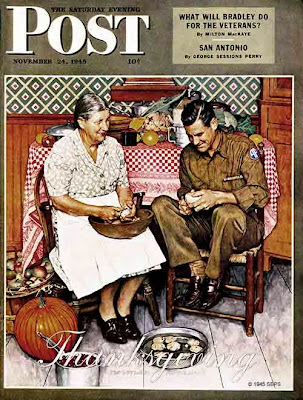
Norman Rockwell, "Home for Thanksgiving," 1945.

I think of the very dark days when Roosevelt gave his speech. The world was in the shadow of the coming war, facing Nazi Germany and Imperial Japan. There was a threat to all freedoms everywhere. He expressed a wish for a future where these freedoms would be protected, and he was aware that such protection would soon be very costly. He said: 

"That is no vision of a distant millennium. It is a definite basis for a kind of world attainable in our own time and generation. That kind of world is the very antithesis of the so-called 'new order' of tyranny which the dictators seek to create with the crash of a bomb. ...

"Freedom means the supremacy of human rights everywhere. Our support goes to those who struggle to gain those rights and keep them. Our strength is our unity of purpose."


Norman Rockwell: “The Four Freedoms”, 1943.

Thanksgiving thoughts inevitably turn to the history of the holiday, and the many fraught questions of the idealized story of friendship between “Pilgrims and Indians,” as opposed to the actual story. For an interesting viewpoint, see the op-ed  “It’s time to rethink” in the L.A. Times.

Blog post © 2022 mae sander. Images from Wikipedia.


Thursday, November 17, 2022

Slavery and its consequences

As I would not be a slave, so I would not be a master. This expresses my idea of democracy. Whatever differs from this, to the extent of the difference, is no democracy.” — Abraham Lincoln, 1858. (source)
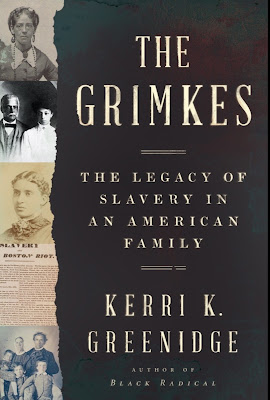
The Grimkes: Published this month.

The Grimkes: The Legacy of Slavery in an American Family by Kerri K Greenidge is making me think hard about Lincoln’s famous definition, though this quote doesn’t appear in the book. The profound depravity of many slave owners in this historic family, and the indifference and self-centeredness of many of the other White members of the famous abolitionist family is painful to learn about. In the preface, the author states an underlying observation: “The tragedy of the Grimke sisters’ lives was the fact that they never acknowledged their complicity in the slave system they so eloquently spoke against.” The self-awareness and suffering of the slaves, including the Black members of the Grimke family, is equally a torture to read.   

At the very beginning of The Grimkes, we find a list of 17 central figures, mainly members of the Grimke family. By following this enormous number of historic figures, this book shows the development of consciousness of the White abolitionists before the Civil war. It also illustrates (with really impressive historic details) the numerous possibilities for inhumane treatment and vicious cruelty that slavery afforded many masters. 

Further, the book describes in painful detail a number of violent attacks on free Black communities in Pennsylvania in the pre-war era. About one of these attacks and the way the sisters reacted:

"Angelina and Sarah Grimke undoubtedly heard the mob as it made its way down Lombard Street, through Sixth and Seventh and the narrow alleyways in between. And yet they never mentioned, either publicly or to each other, the actions of the city’s enraged white people, nor did they reflect in future writings on the lasting effects of such violence on the Black people they eventually claimed to serve." (pp. 10-11). 

Obviously, this book is emotionally challenging to read, and further, it's challenging to follow the intense amount of historic detail that is presented. 

I'm finding it even more challenging to review this profound social and political history, which looks at the American experience in ways I have never read before (though I haven't read that much). Besides the pain of reading about this era, our own era has plenty of  pain; specifically, the shooting last Sunday night in Charlottesville, Virginia. Those who lost their lives are also at the forefront of my thoughts: another horrifying mass shooting, three promising young people dead, and an entire community terrorized as the shooter was at large for 12 hours. (My two granddaughters are both students at UVa, so it's personal.)

Who Were the Central Figures of The Grimkes?

Of the many individuals that played a role in Greenidge's history, here are the ones that are the best known, whose lives I followed the most closely as I read:
  • Sarah Moore Grimke (1792–1873), White daughter of slave owners in South Carolina who became a major participant in the abolitionist movement in Philadelphia and the North.
  • Angelina Grimke Weld (1805–1879), her sister, an orator and leader of the abolitionists.
  • Archibald “Archie” Henry Grimke (1849–1930), son of their deeply evil and cruel brother and Nancy Weston, a woman who was his slave. With the help of his two aunts, he received a traditional education at several famous institutions, including Harvard, and became a highly educated and influential figure in the late 19th and early 20th century.
  • Francis “Frank” James Grimke (1850–1937), his brother, equally educated and prominent.
  • Angelina “Nana” Weld Grimke (1880–1958), Archie's daughter, a well-known poet and playwright of the early 20th century.
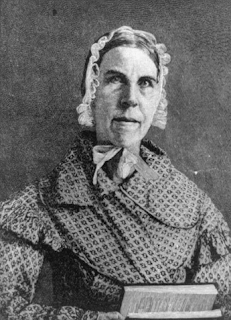
Sarah Grimke, around 1850
The famous Grimke sisters, Sarah and Angelina, fled from their family of southern plantation owners in South Carolina, rejected the slave-owning ethics of their parents, and moved to Philadelphia where they participated in the anti-slavery movement leading up to the Civil War. Along with a number of other abolitionists, they were founders of important anti-slavery societies, and later promoted women's suffrage as well as rights for the Black community, and efforts at justice for the freed slaves of the South. 

The author, while acknowledging their leadership, is very critical of their lack of respect for Black individuals and especially open about their blindness to the cruelty of their father and brother towards his own Black children, as well as to all enslaved people in his life.

The patriarchs of the Grimke family, like a shocking number of other slave owners in the pre-Civil-War South, virtually all had relationships with black women whom they owned and abused, and in general were unimaginably vile to their own children. 

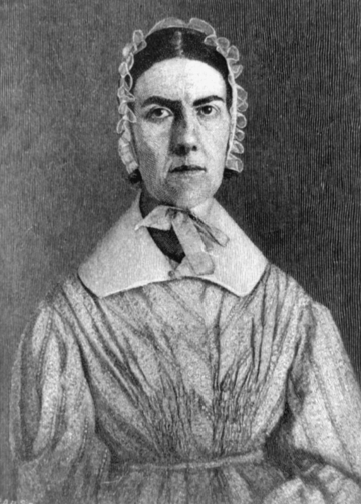
Angelina Grimke, around 1850
(Images from the book)
"From New Orleans to Charlotte, the slaveholding tradition of white men installing an enslaved Black woman in a slave cabin on his plantation so that she could be sexually available at all times was so common that writers, antislavery and proslavery alike, wrote countless parables about the practice." (p. 113).

Angelina and Sarah’s brother was the most horrifying of cruel slave owners; the enslaved woman, Nancy Weston, mother of his children, was a strong and brave woman who did the most she could to raise her sons as responsible and impressive citizens, and to procure their freedom and then their success in life. She succeeded. I feel that anyone reading this book would have to be overwhelmed by the thought of a man who enslaved and tortured his own children, whatever their race. But even the well-meaning helpers were deficient: "white reformers’ dedication to Black people as a moral obligation to be fulfilled did not always translate into a belief that Black people were intellectually and politically capable." (p. 168).  

Nineteenth-Century Activism

Obviously the Grimke sisters' political abolitionism prior to the Civil War then led to the complex post-war process of changing American life from a slave society to a free society. Both Archie and Frank, highly educated with the help of their aunts, became leaders in the Black communities that emerged during the Reconstruction era. The Black free men in particular had to deal with the attitudes of Northerners, especially men, who looked down on them, or saw them as merely a means to achieve salvation in a religious sense:
 
"...most white abolitionists were as blinded by their own self-interests as the Grimke sisters nearly thirty years before had been blinded by their own sought-after redemption. Back then, Sarah and Angelina saw slavery as a sin for white people to vanquish from the land and white deliverance as a just consequence of slavery’s end. Now, in 1862, white men like abolitionist Samuel Gridley Howe and Union Army cotton agent Edward L. Pierce saw impending Black freedom as a force to be controlled and directed by white New Englanders.” (pp. 146-147). 

As time went on after the war, the horrifying resurgence of racial discrimination and the slow erosion of the rights of the Black community in the final decades of the 19th century is of course well known. Greenidge's scholarly details about the members of the Grimke family bring this history to life. The details are both fascinating and truly depressing, as well as having all kinds of resonance in thinking of our own troubled times.

The unequal basis of Black and White lives in Philadelphia and other Northern cities throughout the 19th century is not surprising, but the details are enlightening. For example, Greenidge describes the lack of educational opportunities for Black children in the early years of the century:

"As Philadelphia’s rapidly industrializing economy led to low wages and underemployment that forced most Black children out of the classroom, poor white children were saved from ignorance and a lifetime of toil by publicly funded charity schools, designed to set the city’s 'destitute' on a path to productive republican citizenship. As one Philadelphia philanthropist informed Alexis de Tocqueville, who was then on his first tour of the nation, colored children were legally entitled to public education, but “the [white] people are imbued with the greatest prejudice against Negroes," (p. 47). 

Even the reformers who were more open-minded than most White people did not recognize that Black people wanted the same type of education and opportunity that White people did. After the war, particularly, a system that fostered a supposedly practical education for Blacks appealed to the latent racism in many of the most supportive and committed people. 

"At Howard University in Washington, Hampton University in Virginia, and others like them, Native Americans, recently denied citizenship under the Fourteenth Amendment; African Americans, recently emancipated in the South; and poor Southern white residents, exploited and degraded by the slaveholding plantocracy, would be trained in 'Christian morality and free labor' as a form of cultural and economic acclimation to a rapidly industrializing America." (p. 213)

This attitude greatly affected the support that the Grimke sisters offered to their nephews, whose education they took responsibility for, but whom they did not treat as real equals: 

"It was in this vein that the well-meaning and sincere Grimke sisters ignored the type of education they had always valued for their own children and urged their Black nephews to consider a postsecondary education that emphasized labor as well as humanistic inquiry." (p. 213). 

As time went on, the discrepancy grew between the aspirations of willing and able Black people to be educated in a traditional way, and the theory and practice of many educators. This included Booker T. Washington, who offered a different type of education for these "different" people. In reality, the former slaves were treated as unequal and less capable:

"... many members of the colored elite agreed with Washington’s prescription that 'harmony will come [between Black and white ] as soon as we forget the supposed injuries of the past.' The rising generation of negroes, Washington and his supporters believed, were best served by personal and community adherence to 'thrift, moral education, and the cultivation of our own businesses.'” (p. 271). 

In The Grimkes, Greenidge offers the often-neglected alternative view held by people like Archie Grimke, that Black and White people both craved and deserved a full set of choices when it came to education and their life work.

There's Much More!

I've only described a few of the ideas and historic streams in this very interesting book. The lives of a number of other individuals are also presented, representing the author's amazing scholarship and painstaking interpretation of what is obviously many historic and primary sources of information. Besides their participation in the abolition movement, the Grimke sisters' role in the women suffrage movement is also explained in detail, including the fact that they were among the first women to cast ballots in an election in a symbolic protest in the 1870s -- though their votes weren't counted!

The life and accomplishments in the twentieth century of Angelina “Nana” Weld Grimke also made a big impression on me, but I am not going to try to summarize this. Throughout the book, I was fascinated by the number of very famous men and women who interacted with all of the members of the family. 

It’s hard to explain how many really important facts and insights about American history that I learned while reading Greenidge's book. The struggle for justice was complex and fraught, and it isn’t over.

From The New York Times Review

“The Grimke sisters became celebrities, publishing essays that shaped abolitionist thinking and reluctantly stepping into a male-dominated public sphere where they were never completely welcome. Their fame derived from both their words and their deeds. They rejected their white inheritance by coming north and joining the movement, gaining moral credibility that few of their peers could match. But in her new book, ‘The Grimkes: The Legacy of Slavery in an American Family,’ the historian Kerri Greenidge challenges this narrative, showing that the sisters’ contributions to abolition and women’s rights were undergirded by the privileges they reaped from slavery. The lives they built, and their relationships with Black relatives, were poisoned by the profits, violence and shame of white supremacy. …

Sarah and Angelina urged their Black nephews to forget about the past and focus on the future the sisters envisioned for them. Archie became a lawyer and diplomat in Boston, and, later, a national vice president of the N.A.A.C.P.; Frank became a pastor and leader of the Black church in Washington, D.C. Archie and Frank repressed their suffering and worked their way up the social hierarchy. But neither fully healed from the wounds of their enslavement and the denigration of their mother. The respectability they aspired to was saturated with sexist Victorian morality, colorism, and white ideals of intellect and propriety.”  — “Slavery’s Indelible Stain on a White Abolitionist Legend,” October 29, 2022.

Review © 2022 mae sander

Sunday, October 23, 2022

Thoughts on the War and the Election

Victims of the war in Ukraine, October, 2022. (The Guardian)


"The operator of Kyiv’s energy grid has announced a series of 'stabilisation' power cuts following Russian strikes on key infrastructure on Saturday. More than a million households were left without electricity after strikes on energy facilities across Ukraine." (From The Guardian, this morning

Here I am in America. My life is fine and happy. Perhaps I allow myself to be protected by a bubble of American privilege and obliviousness to other people's problems, locally and globally. The suffering of the war victims in Ukraine increases every day as they are subjected to more and more attacks on civilian infrastructure and lives, but many other people around the globe are also experiencing worsening quality of life.

Although my life is ok, I have a continuing dread of current events and coming problems. Like many people, I often avoid thinking about the disasters that are looming before my country and the entire planet, some caused by climate change, some by human cruelty, greed, or carelessness. Droughts and floods and hurricanes have damaged or destroyed homes, farms, irrigation sources, and more. Crops have failed in some places, supply chain issues from a few years ago have not entirely been resolved, and the war in Ukraine has driven prices of wheat, fuel, and energy to new highs. Around the world, people are affected, with many populations facing severe hardships. 

Mostly in my blog, I don't mention these things, but today is different.

The War Continues: Brutality Never Stops

Reading about the brutal and intentional destruction of Ukrainian homes, schools, playgrounds, power stations, general infrastructure, and above all destruction of human lives has become too painful. I think many Americans and Europeans have become totally weary of learning of the evils being inflicted on innocent children and parents and civilians by Russian aggression and depravity. Unfortunately this weariness isn’t helpful to anyone and the savage attacks and threats of worse warfare methods, including nuclear weapons, is now unbearable. It’s tempting to just look away. The Europeans, perhaps more than Americans here, are showing signs of impatience and loss of sympathy for the Ukrainian victims because the war makes them fear for their own well-being.

Consider this prediction of suffering that looms in the lives of Ukrainians, even those far from the current battlegrounds:

“While Ukrainians have endured cuts to water and all manner of other services, fears about heat are now primary. The World Health Organization has warned of the potential for a spiraling humanitarian crisis in Ukraine, where lack of access to fuel or electricity ‘could become a matter of life or death.’” (NYT October 21)

Here are two murals from recent news sources, which illustrate the Russian aggressive spirit, and the Ukrainian determination to take back their country. Murals can be a window into how people are viewing their situation. First here: a Russian military mural. Then: two recent Ukrainian murals.


In Russia, they glorify their transgressions against humanity. This mural in Moscow honors soldiers.
But I think of those soldiers looting, raping, brutalizing children, and breaking international law. (source)

"A fresh painting photographed on October 18 on a battle-scarred wall in Kupyansk, a town in the northeast of Ukraine recently recaptured
by Ukrainian forces. The text reads 'We will multiply the love in the world, and for this we will win!'"
From "Paintings And Propaganda: The Art Motivated By War In Ukraine"

"The entrance to a coffee shop is decorated with posters depicting female Ukrainian warriors in Velyka Kostromka,
a village in eastern Ukraine on October 13." (Same source)


American Democracy May Fail

Like the war, the US November election is becoming too depressing to talk about, write about, read about, or even think about. Democracy is under threat, and the main issue people focus on is the price of gas — over which the elected officials have virtually no control. In Michigan, the issues are the same as everywhere: do we want to lose the power of the vote to candidates who have vowed to nullify any future election, keeping their party in power no matter what the people vote for. The Michigan ballot also contains a proposition to protect human rights — that is, to prevent legislation prohibiting abortion.

Ann Arbor’s iconic Rock, a kind of living mural, has multiple messages painted on it. It urges
a yes vote on Michigan Proposition 3 to protect women’s choices of their own medical care.

Well, that's my depressing set of thoughts for the day. Tomorrow will be better -- at least on the blog!
 
Blog post © 2022 mae sander


Monday, April 04, 2022

Water to Drink

Cezanne’s painting of a drinking water carafe.

Drinking water that’s safe and affordable is one of the basic human rights. Injustice and inequality deprive many humans on this planet of essential drinking water. Do we fortunate first-world inhabitants (with internet access right now, for example) think about the value of clean fresh water that comes from the tap in our homes? We may see water as a basic fact of life, not a luxury or something to struggle for -- aren't we lucky!

Facts and Observations about Water

  • 26% percent of the world population lacks a safe water supply. "In 2020, 74% of the global population (5.8 billion people) used a safely managed drinking-water service – that is, one located on premises, available when needed, and free from contamination." (source)
  • Polluted water causes many deaths from diseases like diarrhea cholera, dysentery, typhoid, hepatitis-A, and polio each year, mostly in Africa and India. “Unsafe water sources are responsible for 1.2 million deaths each year. … In low-income countries, unsafe water accounts for 6% of deaths.” (source
  • Cutting off supplies of drinking water is one of many atrocities of war — including the ongoing war in Ukraine, where new atrocities are being discovered constantly. Water rationing has been necessary in several nearly-destroyed cities that have been holding out against the Russian army invasion. “According to media reports, people in Mariupol were forced to melt snow for drinking water and cook on open fires with food, water and power supplies cut off.” (source)
  • In Biblical times, walled cities in dry areas developed ways to access their water supply during a military siege when lack of water would have been the quickest way to defeat. For example, the citadel of Megiddo had a secret tunnel that led to a spring with sweet water, making it much safer to defend. 
  • The water supply of Flint, Michigan, was polluted with lead in 2014 as a result of negligent and malicious behavior by Republican politicians. A criminal case against the governor of Michigan and other officials for their actions in causing the disaster is ongoing. (source)
  • Modern people who say they don’t drink water are expressing a preference: they are choosing other beverages, but these beverages supply them with ample water to sustain life. In the past, sometimes beer was preferred to water because beer is made from boiled water so it was safer from contamination — however, it did supply the necessary fluids to keep the drinkers alive. Ditto tea.
  • First world habits: consumption of bottled drinking water rather than soft drinks continues to grow in the US, despite the availability of safe tap water. For the VERY overprivileged, the purveyors of luxury goods have developed brands of bottled water that are very high-priced. In the collection of best American food writing that I read recently, a chapter describes a water “sommelier” who provides high-cost bottled water to restaurant goers and who hosts water-tasting events. In the light of the facts about deaths from polluted drinking water, this affectation seems beyond outrageous!

The End of the World?

The citadel at the ancient city of Megiddo was the origin of the word Armageddon, a Biblical term for the catastrophic end of the world, which would traditionally take place at this strategic site on the roads connecting major Middle Eastern cities. In the 15th century BCE and in 609 BCE important battles were fought there, and a critical battle of World War I took place there in September, 1918. Access to water through a secret stairway to a concealed spring helped the defenders of the ancient city. Archaeologists found the stairway, which is now part of the tourist route through the citadel. I was very impressed by it when I was visiting Israel.

The stairway to the spring below Meggido. (source)

A different prediction of the end of the world: "Climate change is disrupting weather patterns, leading to extreme weather events, unpredictable water availability, exacerbating water scarcity and contaminating water supplies. Such impacts can drastically affect the quantity and quality of water that children need to survive." (source)

The Value of Clean Water

The CDC reports: “Water, sanitation, and hygiene has the potential to prevent at least 9% of the global disease burden and 6% of global deaths. The impact of clean water technologies on public health in the U.S. is estimated to have had a rate of return of 23 to 1 for investments in water filtration and chlorination during the first half of the 20th century.” https://www.cdc.gov/healthywater/global/wash_statistics.html

The water treatment plant that supplies my drinking water,
Ann Arbor, Michigan.

Blog post shared with the bloggers celebrating drinks at Altered Book Lover.
Post © 2022 mae sander.