Showing posts with label Four Freedoms. Show all posts

Wednesday, November 06, 2024

The Four Freedoms


President Franklin D. Roosevelt defined “The Four Freedoms” in a speech in 1941. These images by Norman Rockwell were used in the War Bonds campaign in World War II, when the freedoms were jeopardized. We still have to fight for them.

Saturday, April 06, 2024

What I’m Thinking This Week

In Our Neighborhood

Our house shook slightly when this tree was cut down Wednesday morning.
The photo was taken from my front porch.

The Ann Arbor government does take care of things in our neighborhood! An old and probably dangerous tree across the street has been cut down, ground up in the wood chipper, and taken away by city workers. In the local park a few blocks away, we have been observing a building project which resulted in an impressive solar array. It will provide power for the nearby senior center, and also provide a charging station for electric cars. 

A total of three million dollars, partly from Federal Stimulus funds, was allocated to build solar generators in several city parks and at the Ann Arbor Farmers’ Market. This one has a nearly 30-kilowatt capacity. The allocated cost was $120,000, plus a 20-kilowatt backup battery for $56,000 and installation work for one EV charger for $8,000. (source)

Thinking About the Eclipse of the Sun

With any luck — and weather permitting — I will be. able to watch the eclipse of the sun next Monday afternoon at a location near Indianapolis. I’ll post photos if we get any! Meanwhile, I’m sharing my thoughts on several other subjects with the participants in Deb’s weekend blog event at Readerbuzz.

Thinking About American Freedom

Forces in our society oppose many freedoms that we once believed were secure. President Franklin D. Roosevelt outlined four freedoms in a famous speech in 1941, which I’ve talked about in several earlier blog posts. I think that all four of them are endangered:

  • Freedom of speech is endangered because instead of peaceful protests, many activists have begun disrupting and threatening those who disagree with them. This is especially notable in the behavior of those who oppose Israel and support Hamas. It’s particularly shocking on college campuses. See this article: “The Appalling Tactics of the ‘Free Palestine’ Movement” by Bret Stephens.
  • Freedom of worship is endangered by widely increasing coercion in public schools in many states to include Christian beliefs and prayers. Antisemitism, Islamophobia, and fear and hatred of non-believers also pressure Americans who do not satisfy some people’s wish for national religious conformity. “We must make America pray again,” former president Donald Trump said recently.
  • Freedom from want, another important Roosevelt guarantee, is being undermined by discontinuation  of many important financial benefits that were helping people to afford food and shelter. Increasingly many Americans are living in poverty.
  • Freedom from fear is denied to transgender and other non-conforming individuals by new discriminatory policies in schools and other public venues. Freedom from fear is also denied to many women whose reproductive choices are being narrowed by the anti-abortion and anti-family-planning forces. These tendencies are reinforced by the Supreme Court’s series of appalling decisions.
This rejection of historic American values takes many forms, and I’ve barely summarized how bad things are getting.

Thinking About the War in Ukraine

“Ukraine’s army of about one million soldiers is fighting the largest war in Europe since World War II, waged in muddy trenches or the ruins of cities in urban combat. Casualty rates are high” (source) 

The people of Ukraine are suffering just as much now as they were a few months ago — maybe more. However, other world events have distracted attention from this unjust war. I feel distracted. I don’t follow this news as much as before. But the independence of this determined country is just as important as ever.

Thinking About the War In Israel 

As the war goes on, I am becoming sadder and sadder at the brutality and inhumanity. The attack by Israeli forces that killed seven aid workers trying to feed the starving people of Gaza horrified me, because I have generally been in favor of Israel’s need to defend itself from perpetual attacks by Hamas and other forces.

These words from José Andrés, the famous chef and the founder and head of World Central Kitchen, whose workers were killed while attempting to deliver food to starving people in the war zone, impressed me with their wisdom and generosity:

”We know Israelis. Israelis, in their heart of hearts, know that food is not a weapon of war.

“Israel is better than the way this war is being waged. It is better than blocking food and medicine to civilians. It is better than killing aid workers who had coordinated their movements with the Israel Defense Forces.

“It is not a sign of weakness to feed strangers; it is a sign of strength. The people of Israel need to remember, at this darkest hour, what strength truly looks like” — José Andrés: Let People Eat, New York Times, April 3, 2024.

An article by Fred Kaplan writing in Slate summarizes the situation:

“Israel’s attack on three vehicles of the World Central Kitchen—which has fed thousands of war victims and refugees in Gaza, Israel, Ukraine, and other areas in crisis—was unpardonable, whatever the findings of an official investigation into how it took place. In any case, it has prompted WCK and other aid groups to suspend operations in Gaza—where, even with the relief efforts, hunger and sanitary conditions are nearing catastrophic levels. …
 
“Israel is not the only obstacle to aid getting through to Gazans. There have been reports that Hamas gunmen have intercepted food deliveries meant for Gazan civilians. Early on in the war, one Hamas leader said the terrorist organization, which has ruled Gaza since 2007, has no obligation to protect civilians in Gaza—that’s a matter, he said, for the U.N.”

Events in the last 24 hours have been rapid and possibly game-changing. Biden has made demands, and it’s a matter of time to see the response. I hope a real chance of peace and justice emerges, and that some progress can occur on hostage negotiations, so far refused by Hamas.

Blog post and original photos © 2024 mae sander

Shared with Sunday Salon at Readerbuzz.


Thursday, November 24, 2022

Thanksgiving Thoughts


As Americans celebrate Thanksgiving, many of us contemplate the blessings and the problems present in our society today. I feel that freedom is the greatest gift that Americans possess. In the State of the Union address in 1941, President Franklin D. Roosevelt defined four essential freedoms that needed protection in his day, and always. My Thanksgiving thoughts dwell on these freedoms and how they exist in our society now. 

Freedom of speech continues to have undisputed value, though recently has often been jeopardized. For example, the fight to keep books on library shelves, safe from self-righteous censors is a very active fight at the moment. In the campaign to destroy the freedom of reproductive choices, laws are also being proposed or enacted to muzzle speech by medical professionals or others helping women to exercise these rights. Freedom of speech is also much undermined by those who abuse it to spread false information: for example, over 300,000 covid victims have died because they were maliciously deterred from receiving immunizations (source). Our country needs to work on building trust, not destroying it. In my Thanksgiving thoughts are these ongoing struggles to protect freedom of speech and its benefits.

Freedom from want is an especially critical idea to think about on Thanksgiving, when many American families celebrate with a traditional meal. Unfortunately, many Americans are not free from want. For example, in my state, Michigan, 1.2 million people face hunger, including around 300,000 children (source). In some states, legislators are refusing Federal food benefits for citizens in need because these politicians view the hungry people as undeserving (source). Food banks and other social service organizations are stressed, as a large number of families are still suffering from the effects of the pandemic. The potential of global warming to destroy food security in coming times is another very complex issue, which I can't elaborate here. Whether we are among the fortunate or the needy, the freedom from hunger will continue to be essential to human well-being.

Freedom of worship and freedom from fear are the two other freedoms listed in Roosevelt’s speech. I am thankful that we enjoy them here in America. In Roosevelt's time, these freedoms were under unprecedented threat in Europe as the Holocaust was just beginning, ultimately resulting in the deaths of 10,000,000 human beings.

Today in America, while the situation is nowhere near as dire, both of these freedoms are jeopardized. We collectively experience the recurring nightmares of mass shootings in places of worship, in schools, and in many other gathering places. Freedom suffers because of hostility towards many minorities, including a return of the antisemitic conspiracy theories of the Nazi era and of the racist virulence of our own history. 

That said, Americans still are better off than minorities in many other countries, where worship isn't even officially protected at all, and where other personal freedoms are absent. So I am thankful for what we do have, and hopeful that we can, with a good will, improve the situation some day. I'm thankful for Roosevelt's leadership and many other people's efforts in the past. And I am thankful for the commitment to continued democratic voting that voters in several states established in the recent election. 
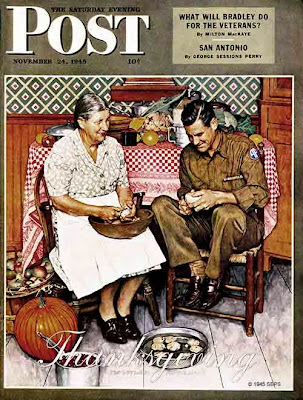
Norman Rockwell, "Home for Thanksgiving," 1945.

I think of the very dark days when Roosevelt gave his speech. The world was in the shadow of the coming war, facing Nazi Germany and Imperial Japan. There was a threat to all freedoms everywhere. He expressed a wish for a future where these freedoms would be protected, and he was aware that such protection would soon be very costly. He said: 

"That is no vision of a distant millennium. It is a definite basis for a kind of world attainable in our own time and generation. That kind of world is the very antithesis of the so-called 'new order' of tyranny which the dictators seek to create with the crash of a bomb. ...

"Freedom means the supremacy of human rights everywhere. Our support goes to those who struggle to gain those rights and keep them. Our strength is our unity of purpose."


Norman Rockwell: “The Four Freedoms”, 1943.

Thanksgiving thoughts inevitably turn to the history of the holiday, and the many fraught questions of the idealized story of friendship between “Pilgrims and Indians,” as opposed to the actual story. For an interesting viewpoint, see the op-ed  “It’s time to rethink” in the L.A. Times.

Blog post © 2022 mae sander. Images from Wikipedia.


Saturday, April 06, 2019

The Great Migration: Two Books

The New Negro: The Life of Alain Locke by Jeffrey C. Stewart and The Warmth of Other Suns: The Epic Story of America's Great Migration by Isabel Wilkerson have been my recent reading. Both books are very long, very dense, and very thought-provoking. I have not finished The Warmth of Other Suns, and I find it emotionally challenging to learn details of the depths of mistreatment, bigotry, and abuse that was the horror show of southern treatment of black people from the era after the Civil War until well into the twentieth century. The biography of Alain Locke was a fascinating companion to this book, because it showed one way that Black Americans were able to overcome the evils of white supremacy of that era.

Alain Locke (1885-1954) was a highly accomplished scholar and public intellectual who is very little known. This prize-winning book has probably introduced Locke to many other people besides me. Unfortunately it's extremely long -- I found it excessively long, though mainly fascinating.

One of the most amazing things about Locke is that he was incredibly flexible in his intellectual life, and was a leader in several areas of scholarship about Blacks in America and in creative support of several forms of emerging Black American culture. He wrote, among other things about the effects of the Great Migration, which began around the time of his birth, and continued throughout much of his life.

As a young man, prior to World War I, Locke attended Harvard and then was the first Black recipient of a Rhodes scholarship -- and it's interesting that he was the last one until around 50 years after his was awarded. Although his British hosts were reasonably welcoming, he had trouble finding a college where he would be accepted. Worse yet, he was very badly treated by the severely racist Southern Rhodes scholars (the scholarship is distributed evenly among the US States). For example, the Southerners forced the Rhodes social organization to exclude him from an invitation to the traditional Rhodes scholars' Thanksgiving dinner.

Despite the bigotry he experienced, Locke assimilated European culture, and came back to the US to finish a doctorate in philosophy at Harvard.  He then became a professor at Howard University in Washington, D.C. Soon after receiving his PhD, Locke became a leader and a creator of the Harlem Renaissance, and subsequently a driving force in other important intellectual and artistic Black cultural creations. The book title, "The New Negro," comes from a concept that Locke invented in the 1920s to encourage poetry, painting, sculpture, and fiction-writing that reflected the Black experience. As a member of a minority group, and also as a mainly closeted gay person, he was alienated from mainstream society in a number of ways. As author Jeffrey Stewart explains it:
"Locke did something remarkable with his alienation. He decided to use art, the beautiful and the sublime that nurtured his and his friends’ subjectivities in a world of hate, to subjectivize the Negro, to transform the image of the Negro from a poor relation of the American family to that of the premier creator of American culture." (p. 8)
Locke was an encourager and a colleague of a number of still-famous participants in the Harlem Renaissance; among those that are still famous are authors Zora Neal Hurston and Langston Hughes. Two of his collections of works, including his own essays are still in print today, particularly the volume titled The New Negro, published in 1925. 

During the 1930s and 1940s, Locke continued to be an innovator in encouraging Black culture. Stewart's book documents this at length, but I'm not going to try to summarize these activities. I would like to share something that I learned from this book, as well as from reading a biography of Paul Robeson (blog post here). These books forced me to think about Black Americans' response to the patriotism and idealism that predominated the nation during World War II. While Blacks were highly patriotic and willing to volunteer to work in the war effort, bigotry against them was rampant. Stewart writes of Roosevelt's famous "Four Freedoms":
"Almost as soon as the president laid out the Four Freedoms— Freedom of speech, Freedom of worship, Freedom from want, and Freedom from fear— for which the war would be fought, African Americans made it known that for them these rights were unattainable in America. A. Philip Randolph, having left the National Negro Congress, proposed in 1941 a march on Washington to demand desegregation of the armed forces, elimination of discrimination in hiring, and equal opportunity for Negroes in federal government contracts as the price of full-throated Black support for the war effort. FDR avoided that embarrassing protest in the nation’s capital by issuing Executive Order 8802 that banned discrimination in the hiring in wartime jobs, the awarding of contracts, and established the toothless but symbolically valuable Federal Employment Practices Commission (FEPC), but the Chicago Defender kept the pressure on by announcing a “Double V” campaign— victory in Europe and victory in America— to tie the loyalty of Negroes in war to an expected transformation of American race relations in peace." (pp. 821-822)
I'm ashamed that I had never thought this deeply about the Four Freedoms, which I've written about before (link). I learned a great deal in reading these two history books, but this is all I have to say right now.

Wednesday, October 24, 2018

Wordy Wednesday: Freedom

Freedom is a word that everyone knows. But advocates of freedom, while often striving for equivalent human goals, have expressed their commitment in many ways. In the last few days, I've read about two famous freedom fighters: Mahatma Gandhi and Harriet Tubman. I feel that by familiarizing myself with these two famous people from such very different backgrounds, I might better understand the richness of the idea of freedom. In this context, I've also been thinking of the famous "Four Freedoms" defined by President Roosevelt in 1941.

Harriet Tubman

Harriet Tubman was the best-known "conductor" on the Underground Railroad in the decade before the Civil War. She rescued several hundred slaves and escorted them to freedom in sympathetic northern states and Canada. During war, she continued by working with the Union Army to rescue hundreds more slaves that were being held by Confederate troops. Born into slavery, she escaped but returned to the South many times to rescue others.

To learn about her, I read the book Harriet Tubman: The Road to Freedom by Catherine Clinton (published 2004). Because Tubman's work by definition was highly secretive, and because little documentation of the birth and parentage of slaves was recorded, the book presents the scant details known about her life in the context of the fight against slavery in the 19th century. Some quotes from the book:
The states north of the Mason-Dixon Line that had passed emancipation statutes were revered as a kind of Canaan— a place where blacks could work and worship, marry and raise children, freely pursuing life and liberties. Once they crossed over, fugitives would be unfettered by bondage. Most southern bondspeople had little or no contact with this free northern black world, but idealized what might await them once they fled. (Kindle Locations 713-716).
Tubman’s growing realization that all people of color— slave, fugitive, or free, in both North and South— were imperiled by the very existence of racial bondage made 1850 a critical turning point in her life, as her own personal journey to freedom expanded to include the aspirations of all slaves. (Kindle Locations 1079-1081).
When she spoke out against slavery, she was not attacking it in the abstract but had personally known its evils. She risked the horror of reenslavement with every trip, repeatedly defying the slave power with her rescues and abductions. These risks elevated the significance of her contributions to the UGRR [Underground Railroad] movement. (Kindle Locations 1313-1315).

Mahatma Gandhi

Gandhi, from the New Yorker article.
Gandhi, of course, was the leader of the struggle to free India from British colonial rule. His method, non-violence, has been adopted by many subsequent freedom fighters. A current New Yorker article titled "Gandhi for the Post-Truth Age" by Pankaj Mishra explored the ways that Gandhi is relevant to our time. Two quotes:
People in the West, Gandhi argued, merely “imagine they have a voice in their own government”; instead, they were “being exploited by the ruling class or caste under the sacred name of democracy.” Moreover, a regime in which “the weakest go to the wall” and a “few capitalist owners” thrive “cannot be sustained except by violence, veiled if not open.” This is why, Gandhi predicted, even “the states that are today nominally democratic” are likely to “become frankly totalitarian.”
And this:
Satyagraha, literally translated as “holding fast to truth,” obliged protesters to “always keep an open mind and be ever ready to find that what we believed to be truth was, after all, untruth.” Gandhi recognized early on that societies with diverse populations inhabit a post-truth age. “We will never all think alike and we shall always see truth in fragments and from different angles of vision,” he wrote. And even Gandhi’s harshest detractors do not deny that he steadfastly defended, and eventually sacrificed his life for, many values under assault today—fellow-feeling for the weak, and solidarity and sympathy between people of different nations, religions, and races. 

Franklin D. Roosevelt 

In 1941, Roosevelt gave a speech in which he defined four freedoms relevant to the United States and the world, then threatened by German aggression.

Norman Rockwell's famous depiction of the Four Freedoms motivated the War Bond campaign in World War II. (Wikipedia)

Today, in 2018, these freedoms again are seriously threatened for at least some people who live in America, so I would like to leave you with the thought that one possible thing we can do to protect them is to vote next month!

Thursday, February 22, 2018

A World at War

The Taste of War: World War II and the Battle for Food by Lizzie Collingham contains the most horrifying collection of statistics and historical details that I can recall. In the following few paragraphs, I'm reviewing the most memorable facts about the global horror of nearly world-wide hunger and death from starvation that I read in her book. Understanding the vast range of disruptions and disasters of the war is complicated, but Collingham's presentation makes it almost comprehensible.

Year by year, country by country, Collingham documents mass starvation throughout Europe, China, Japan, the Indian subcontinent, South Asia, the Pacific Islands, the Middle East, and both North Africa and sub-Saharan Africa. She delves into the Nazi policies of intentional starvation of Russians, Slavs, Jews, and others, and the unintended consequences of acts of war and devastation in Poland and Russia. She shows how a motive of the Wansee Conference that ordered creation of Nazi Death Camps was to do away quickly with the Jews, labeled as "useless eaters" -- kill them immediately, don't just starve them to death. Starvation was the fate of many others that the Nazis deemed surplus human beings, especially Russians in the besieged cities and occupied territories during the Nazi invasion of their country.

Collingham explains how British policy protected the residents of Britain from starvation, but victimized their colonies. A major famine in Bengal was the most extreme. Before the war, people in Britain and British colonies, Germany, Japan, and many other countries had come to depend on foods imported to their countries. Prioritization of feeding large armies, consequences of blockades and attacks on commercial shipping and land transport, and other acts of war all disrupted supplies or cut them off entirely, leaving many people throughout the world without the foods they depended on.

Agriculture in countries at war was disrupted by direct battlefield activity or bombings, by transfer of needed labor away from farming to industry, and by wartime conscription. The military required heavy equipment of the same type as farm equipment, as well as drawing on the same fuel supplies used for tractors etc. Further, essential nitrates for fertilizer were required instead as components of explosives needed for war, thus reducing farm productivity. Coordination and well-planned policies were not always adequate.

During the early years of the war, the Nazis were able to improve German food production despite the multiple demands on labor and equipment. They also maintained a policy to loot the food from conquered lands. Decent nutrition was thus available for their own people. However, as the war turned in favor of the allies, these practices failed and starvation also affected the formerly privileged German people. The "hunger winter" at the end of the war resulted in yet more mass starvation, when a combination of bad harvests, cruel policies, and the aftermath of bombing and destruction occurred in Holland and other parts of Europe.

Much detail about the Japanese treatment of their own troops illustrates that even their soldiers often starved to death. Why? Because Japan's official policy was that troops should live off the land, but no actual study was done to see it this was possible -- the troops were just dropped off on one remote Pacific island or another with a few days' worth of rations. The Japanese didn't put supply lines into place the way that other military regimes did, it was every man for himself and blame the victims. Both intentional policies and also errors contributed to starvation of both their own troops, their own civilians, the people they conquered, and enemy troops. Japanese victims included people in China, the rest of Asia, and the South Pacific. Their prisoners of war also starved, including of course many American troops.

Long and detailed analyses and statistics about food supplies and production show just what happened. In many chapters, Collingham develops much more comprehensive information than the few sentences I have written. Most people who have read about the war at all are aware of some of the events and consequences Collingham describes, but I doubt if most people have squarely faced the incredible numbers of people who died of starvation: far more than on the battlefield. I doubt if most people ever think about the suffering of a human being starving to death -- even just one human being, much less millions. I found it really tough to read the many chapters in this book!

In contrast, Collingham also describes the impact of the war on agriculture and the food supply in the US. Once the US declared war, we were committed to try to feed the allies as well as to avoid hunger at home. We had to increase agricultural production and develop the means to deliver food to the allies, as well as to offer troops and military supplies. The US government quickly and effectively mobilized to do so. American manufacturing expanded to enable both military and agricultural equipment production. With new equipment and support for farmers, output of grain, meat, and other agricultural products increased and became more efficient. Despite rationing of some scarce resources, Americans were able to obtain an ample and fully nutritious diet, and American troops were fed vastly better and larger rations than any other armies. Among other things, Collingham describes the favored status of the Coca-Cola company, which received special sugar rations to supply Coke to all American troops. Statistics for all of this are included, along with some of the negative response that American superiority inspired.

The Taste of War is an amazing book; also overwhelming. The specter of millions of starving people, the memory of the millions who died from hunger, and the suffering that spread throughout so much of what was thought to be the civilized world is nearly unbearable. I've only presented the elements of the book that most stick in my mind.

One of the questions that the book suggests is this: What were Americans fighting for? I want to end this depressing summary of the impact of the war with the mention of Franklin Delano Roosevelt's January, 1941, State of the Union Address. His vision of a better world was often considered important in understanding the commitment of Americans during the war. He said:

"In the future days, which we seek to make secure, we look forward to a world founded upon four essential human freedoms."

Norman Rockwell's famous depiction of the Four Freedoms for the War Bond Campaign motivated Americans in World War II. (Wikipedia)
UPDATE: This book was the subject of a very interesting Culinary Reading Group discussion on September 19, 2018.