Showing posts with label recycling. Show all posts

Sunday, April 30, 2023

In My Kitchen in April

Two new dragon eggs, just starting to hatch. Evelyn’s latest creations.
I’m starting my kitchen wrap-up with these great ceramics though they are actually in the living room!

What’s new in my kitchen in April?

Magnets from my visits to the African American History Museum and Mount Vernon: American Heroes.
George and Martha Washington, Frederick Douglass, Harriet Tubman, and Martin Luther King.
Also magnets from Lancaster and Longwood Gardens: everywhere we went in April.

One of two small bowls Evelyn made.

Inside our new kitchen cabinet.

A new rack for skillet  lids and a new insert that
makes our biggest pot into a steamer.

New ceramic-clad skillet (as Consumers’ Reports recommends).
In the skillet: salmon croquettes.

Ever-Green Vietnamese by Andrea Nguyen.
Newly published cookbook! We hope it re-energizes our
vegetable-focused cooking efforts.

New storage containers in place of the repurposed cookie
boxes I’ve been using. Recommended by the NYT (link)

From our kitchen: food and drinks

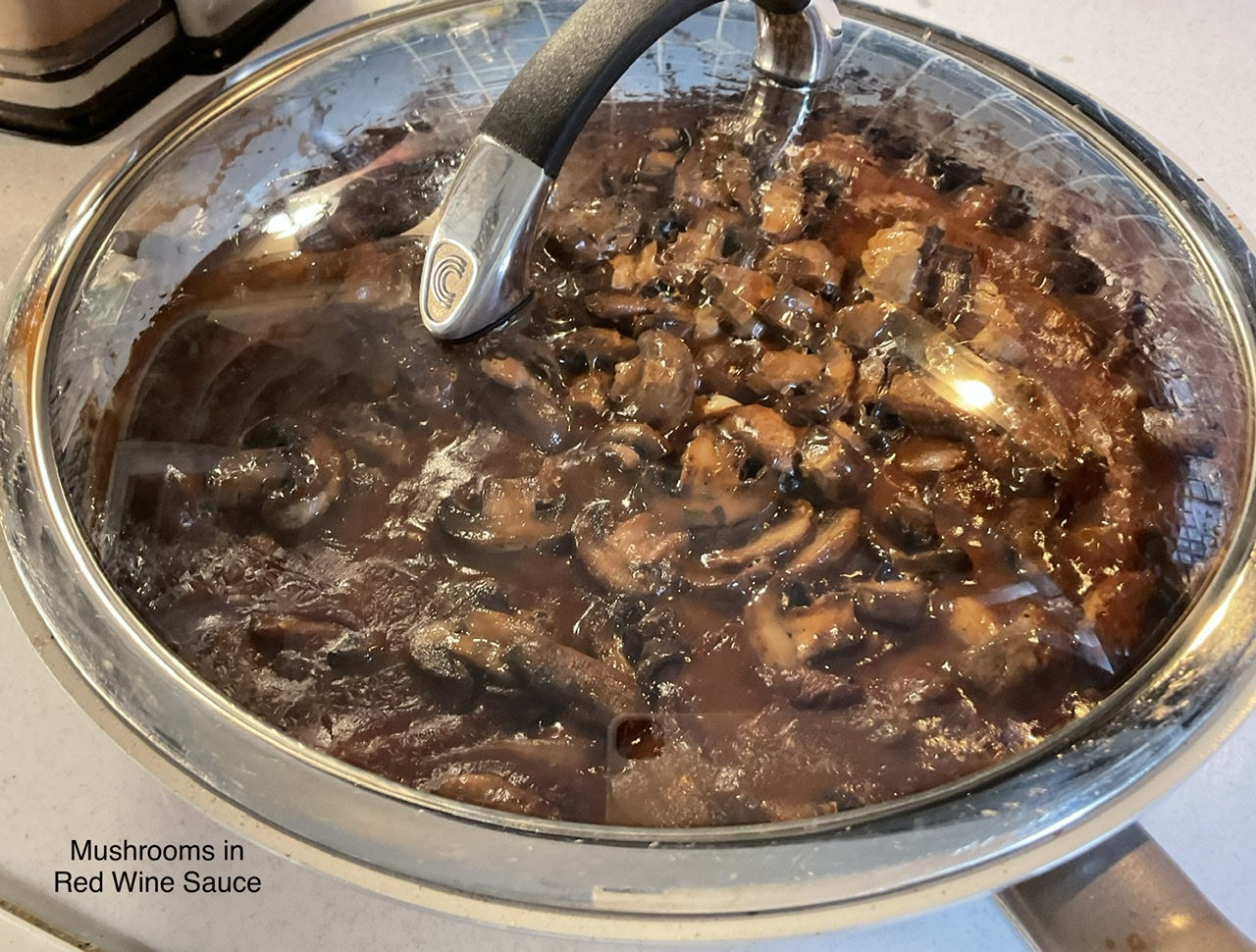
Mushrooms in red wine with new potatoes. A great non-meat dish!

Mushrooms cooking in our new ceramic-clad skillet.

Asian shrimp, bok choi, and rice. And some nice wine.

Kung-pao chicken. Another dish from Len’s Asian recipe adventures.

A leg of lamb ready for the oven, coated with mustard sauce and rosemary leaves. Our favorite roast!
This is Julia Child’s recipe from the original Mastering the Art of French Cooking.
The lamb and broccoli were served at our Passover dinner.

West-Indian lamb curry. Using lamb from the leg of lamb in the previous photo.

Steamed eggs made in the new steamer. The recipe comes from Fuchsia Dunlop’s cookbook.

Vegetarian baked spaghetti with cheese/crumb topping.


Drinking: LaCroix from Costco.

In Carol's Kitchen

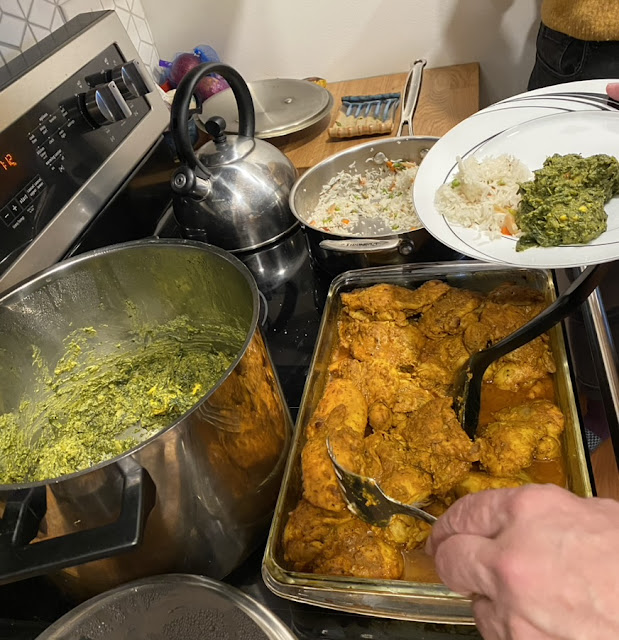
Carol's Indian chicken (from a Madhur Jaffrey cookbook), Jason's spinach paneer, and Carol's rice.
Good food for a family celebration of a cousin's graduation.

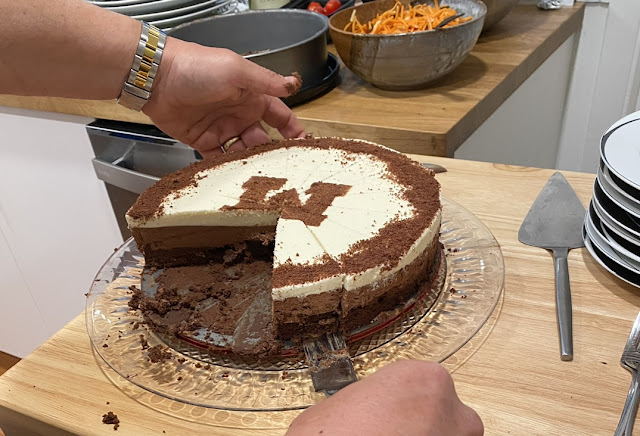
Celebrating a Michigan graduation: the father of the graduate made an unbelievable mousse cake
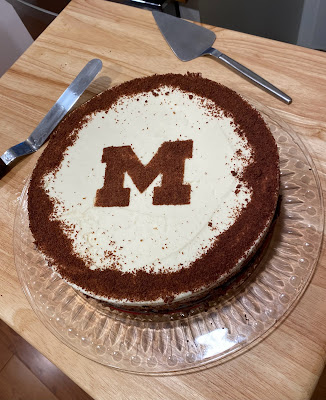
decorated with the Michigan "M."

Before the cake was cut.

Recycling and Composting in my Kitchen

Kitchen garbage such as fruit and vegetable parings, coffee grounds, and bones can be placed in
compostable bags (like the one in the photo) and collected with garden waste. Now that our weekly
compost collection has resumed this spring, we are trying to comply with local garbage rules..

MOTIVATION: “In the U.S., food waste is responsible for nearly 3 percent of the country’s emissions, according to the EPA—and that’s before considering the methane that leaks from landfills, where food waste is the single largest category of material that gets dumped. Diverting even some of that waste is a win for everyone involved, and more cities across the U.S. are at least trying to persuade people to separate their scraps from their trash.” (source)

We also respect the recycling rules!

Cans and bottles in Michigan have a deposit
of 10¢ — a very good law!

In my kitchen retrospective, which I publish on the last day of each month, I try to select an issue of importance to me and to society. April, is a celebration of the Earth, with Earth Day and all, so I’ve chosen to highlight my efforts to handle kitchen waste responsibly. Fortunately, Ann Arbor, where I live, has very enlightened trash disposal practices, and allows composting and recycling where possible.

Blog post & photos © 2023 mae sander
Shared with Sherry at her monthly blog party In My Kitchen.


Thursday, April 04, 2019

Update: Recycling in Ann Arbor Remains Effective

A few days ago, I wrote about recycling food waste and food packaging, and how it's not working as well as it did a few years ago. Our local recycling efforts here in Ann Arbor, it turns out, are doing better than the national efforts, according to an update to their web page. They write: "While we have felt the impact of China’s National Sword [the recent cessation of China's acceptance of US recyclables] through decreased commodity prices, we have continued to uphold our commitment to the community and the environment and can assure you that Ann Arbor’s recyclables are not being landfilled or incinerated." Source: Recycle Ann Arbor, "Recycle Ann Arbor's Mission Weathers the National Storm."

At the Ann Arbor recycling facility: here's the garbage truck that I recently photographed in front of my house.
From the Recycle Ann Arbor update page.


Ann Arbor's success at having their recyclables actually processed into new products is possible because of their relationship with Rumpke Recycling in Cincinnati, Ohio. Through local midwestern connections Rumpke recycles all the glass that they obtain. They make recycled plastics into "products such as bottles, drainage pipe, and paint cans through regional and national companies in a variety of industries."

The history of Rumpke Recycling is especially interesting, as documented on their website. The company began in the 1930s as a waste disposal company, and has been owned and operated by the same family ever since. During World War II, when recycling was a very important part of the war effort, "Workers sorted tin and aluminum, which was baled and sold for about $40 per ton, or rags and items that could be reused. The remaining material was food scraps for the animals." As you probably know, after the war Americans stopped recycling, as did Rumpke, which was in the landfill business. According to the web page: "Although Rumpke had a long history of recovering materials for recycling, Rumpke Recycling was officially developed in 1989 with the purchase of a large recycling operation in Circleville, Ohio."

Today, according to Recycle Ann Arbor, despite the setbacks in recycling and especially the drop in prices for recycled material, Rumpke continues to accept recycling from Ann Arbor and many many other places:  "Over 97% of the recyclables Rumpke collects and processes are shipped to domestic markets. Rumpke can accomplish this domestic rate through long-term relationships with many regional and Ohio-based outlets."

My recent posts on recycling are:

Sunday, March 31, 2019

Recycling in My Kitchen

"While there remains a viable market in the United States for scrap like soda bottles and cardboard, it is not large enough to soak up all of the plastics and paper that Americans try to recycle. The recycling companies say they cannot depend on selling used plastic and paper at prices that cover their processing costs, so they are asking municipalities to pay significantly more for their recycling services. Some companies are also charging customers additional 'contamination' fees for recycled material that is mixed in with trash." -- NY Times, "As Costs Skyrocket, More U.S. Cities Stop Recycling," March 16, 2019.
In my kitchen: lots of containers and packaging that need recycling. Or at least I think they do. The rules for recycling have been changing rapidly. A few years ago, most containers, clean cardboard, and lots of other things were welcomed into the recycling center where they were sorted and sent to manufacturers who paid at least some money. Our city, Ann Arbor, made money out of trash.

As I said in a recent blog post about the history of recycling, expecting too much from recycling was not a sustainable habit for Ann Arbor citizens or anyone throughout the country to have acquired, and many practical recycling problems now plague us. Like many people, I'm worried about the vast quantities of plastic polluting our waterways and endangering fish and wildlife, and about the vast quantities of all kinds of trash piling up in our landfills.

My pantry shelves are full of containers. My understanding: the metal and glass can all be recycled, though glass is
becoming less desirable. The soup packages are recyclable now, but may become more problematic.

Here's one of the mistakes I have learned: you can't recycle the plastic that
wraps the cardboard that contains the Coke cans. It's great that Michigan
requires a 10-cent deposit on cans, and so they are really recycled. But the
rest is up to us: the plastic is trash, not recycling!
How do we buy vegetables? Here's a recent picture of the offerings at Argus Farm Stop, a consignment store where local
farmers bring their produce. In March, there's not a lot of soft fruit, but I did find hoop-house lettuce, carrots and other
root vegetables that I think were saved from last season, and a few other things. You could use your own bags or use
paper or plastic bags that Argus provides. Sadly, plastic bags are one of the most serious problems for recycle centers.
Trader Joe's also offers lots of unpackaged fruit and vegetables, obviously
not local. Some like these are offered unwrapped, others in plastic boxes.
At Costco, there's a lot of packaging that has to be recycled. These light-
weight plastic boxes have a number 1 in the little triangle, so they are
recyclable in Ann Arbor. Maybe better than plastic bags?
Here in my kitchen: plastics marked with the little triangle with a "2" in it.
All bottles and tubs in this plastic are accepted for city recycling. No lids.
Also in my kitchen: plastics with the number 1. "The City of Ann Arbor accepts
all #1 bottle and tub-shaped containers in the curbside recycling program."
My worry: am I putting the wrong things in the bin? Juice cartons are still allowed. My junk mail is ok.
But the big question: can we keep on doing things the same way? Will a lot of this have to go to landfill?
It's hard to avoid what they call "aspirational recycling" -- that is, putting not-recyclable items in the bin with the good stuff. Greasy pizza boxes or take-out containers, any and all plastic bags, disposable beverage cups and their lids, K-cups from pod coffee makers, and the wrong kinds of plastic packaging are the worst offenders. A few mistakes by consumers, well-meaning or not,  can make large amounts of recycling unacceptable. Many cities are being priced out of the market for selling recyclables because of too many mistakes in people's kitchens as well as because as of last January, China has ceased to accept the shiploads of poorly sorted American recycling.
Am I irresponsible for buying these madeleines that are in a box and each
individually packaged? I like them this way because they don't get stale.
"About 25 percent of what ends up in the blue bins is contaminated, according to the National Waste & Recycling Association. For decades, we’ve been throwing just about whatever we wanted—wire hangers and pizza boxes and ketchup bottles and yogurt containers—into the bin and sending it to China, where low-paid workers sorted through it and cleaned it up. That’s no longer an option. And in the United States, at least, it rarely makes sense to employ people to sort through our recycling so that it can be made into new material, because virgin plastics and paper are still cheaper in comparison." -- The Atlantic, "Is This the End of Recycling?" March 5, 2019.
Winter tomatoes are tasteless, but  the best are Campari tomatoes grown in
hoop houses in Canada. The box definitely protects the fragile fruit.
It's a number 1, but what are the consequences for the environment?
Recyclable? Ann Arbor recycling says yes to numbers 4-7
tubs and containers. Other programs may not accept them.


Much of the US population drinks K-Cup coffee, and most K Cups aren't recyclable. At least I do right in this department.
These are locally roasted beans, packaged in a paper bag, and made into coffee without any filters or waste other
than the coffee grounds. Even K Cups that are said to be recyclable are often too small for the equipment and
cause problems at recycling plants. Something like 40% of coffee drinkers now use K-Cup machines.
Many other environmental issues have become pressing in recent years. Pollution comes from cars, planes, farm animals, careless trash disposal, factory effluent, smoke, and many other sources. I have tried to limit my discussion here to just one small corner of the problem, but a corner where I can actually do something no matter how small.

Every month, bloggers on several continents share what's in their kitchens by posting at Sherry's "In My Kitchen" (http://sherryspickings.blogspot.com/). I'm sharing this post with them, and I hope some of them will tell us about recycling issues in their environments.

Friday, March 29, 2019

Recycling Thoughts

The recycling truck still comes to our neighborhood, but the Ann Arbor government is challenged by recycling
problems that have emerged in the last few years. The cost for this service is becoming a real issue.

A Little History

Recycling began with earnest, responsible citizens who aspired to be good stewards of the environment. In Ann Arbor where I live a few dedicated people got a truck and began collecting recyclables in 1977. City dumps were just beginning to fill up and become a problem; some coastal cities still dumped garbage in the ocean, and recycling seemed a good start to making a cleaner world. The era of recycling began at this time.

Did recycling, which started so idealistically, become an enabler that allowed our society to become more and more dependent on excesses of packaging? During the era of recycling, our collective habits grew worse despite our personal efforts. China, which accepted much of this material for re-purposing, recently stopped processing our trash. Our own capacity to make new products from used plastics, paper and glass grew at first, but now has diminished. Landfills are at capacity. Plastics, especially, are a disastrous worldwide problem, polluting the oceans, poisoning fish, and killing wildlife in obscure parts of the planet. Just this month, a dead whale that washed up in the Philippines was found to have 88 pounds of plastic in its gut.

Ann Arbor allows individuals to bring in either trash or recycling that can't
be picked up by the neighborhood garbage trucks. Here's a photo from a
long-ago trip to the dump.
Going back 50 years: recycling, created by idealists, looked like an ideal solution. During the 1980s, towns and cities, including ours, developed municipal recycling centers. These accepted newspapers, which most people had delivered to their homes on a daily basis; glass bottles, and aluminum cans.  Manufacturers could buy this waste and turn trash into usable materials like paper products or roofing tiles. "Curbside pickup" became the norm. Plastics became acceptable as well as paper and glass. Recycling became part of virtually all municipal trash collection, whether done by public or private trash services.

In 1987 people throughout the USA had a garbage awakening when a barge loaded with New York City trash was denied access to garbage plants all along the East Coast. It went as as far as Mexico and Belize, but finally had to bring the garbage back to its starting point for incineration. The cost of dumping garbage was accelerating, while people became increasingly consciousness of resulting air and water pollution from mountains of rotting garbage and never-rotting plastic.

During the 1990s, recycling became a habit of virtually everyone in the US. Bottles, cans, yogurt tubs, cardboard boxes, juice cartons, more kinds of paper -- there were constantly new items that could be put in recycling. I think this made us all complacent. Fruit and vegetable packing plants, electronics manufacturers, and many others didn't have to worry that people would criticize them for using more and more plastic containers.

Economists refer to "externalities," that is, costs that society -- not manufacturers -- would be responsible for. Specifically, producers that wrapped every product with plastic packaging didn't have the least responsibility for disposing of the packaging. It wasn't their problem; it was an externality. Garbage disposal seemed kind of magical: both producers and consumers assumed that recycling took care of it. The foreign and domestic markets where we could sell the recyclable materials seemed able to expand indefinitely. Especially: exports of plastics between 1988 and 2016 amounted to 26.7 million tons. (source) It was too good to be true.

By the end of 2017, the destination for large quantities of collected recycling was China. Ships brought giant containers of manufactured goods to America from China; instead of returning empty the ships returned to China filled with recycling. Cheap Chinese labor could deal with it.

"Single stream recycling" allowed us to throw all our household recyclables together for someone else to deal with. Everyone assumed that ubiquitous recycle bins demonstrated that garbage problems were under control. No more idealism -- not even a bit of responsibility for our kitchen waste.

A problem for our time

Protecting soft fruit with plastic packaging is the norm now.
However, disposal of the packaging is a major issue.
Vast quantities of plastic and cardboard are used at Costco.
The corporate policy is to recycle unsaleable food and also
packaging. (Costco Policy Statement Here.)
At the beginning of 2018, China stopped accepting our undisciplined trash. China is a more prosperous country now -- and we are slobs who contaminate our recyclables with food waste, scraps of the wrong materials, and so on, making it hard to deal with. Without China, the consequences of our irresponsibility are painfully obvious. Municipalities that could get at least a little money for the trash in their single stream of recyclables are now beginning to pay more and more to get rid of it. A lot of recycling has nowhere to go but landfills, which are overfilled anyway.

According to NPR: "Recycling experts say it's a time of reckoning for their industry and that wealthy countries need to stop exporting to countries that can't handle it."

According to an article in Wired: "This new reality risks an increase of plumes of toxic pollution that threaten the largely black and Latino communities who live near heavy industry and dumping sites in the US."

Somehow the good intentions our society acted on in the 1980s have reached a limit. Allowing more and more products to be over-packaged and taking less individual responsibility for our trash was not sustainable. We're clearly in need of a new solution, both collective and personal. We need to exert the self-discipline and restraint that we lost when recycling became too easy.

Plastic boxes of mandarin oranges at Trader Joe's. Is this reasonable and necessary packaging? I don't know.

Reading About Recycling

A number of recent articles discuss the emerging crisis in recycling.
Coming next: for my once-a-month report titled "In My Kitchen," a more personal post about recycling.