Showing posts with label Joan Nathan. Show all posts

Monday, June 16, 2025

A Beautiful Life in Food


— source
Joan Nathan’s cookbooks always offer lots of wonderful recipes, though I have followed only a few of them. One recipe that appears in her new memoir, My Life in Recipes, is especially tempting to me because it features a specialty of a long-closed Ann Arbor eating place. “Ann Arbor Schnecken” or Pecan Sticky Buns were a favorite of hers during her years as a student at the University of Michigan. I liked them too! In the photo you can see her working on a tray of these very very sweet treats!

I’ve been aware of the main details of Joan Nathan’s life for some time — I liked reading the book because I lived in some of the same places that she lived, and I share some of the memories from my own life. Raised in Jewish communities in the New York and East Coast area (unlike me, a midwesterner, though sharing the Jewish-American experiences), she came to Ann Arbor as a student a few years before we moved here. She also spent time in Paris, France at about the same time that we spent our first stay in Grenoble, and many of her memories remind me of things I enjoyed there as well. Obviously this makes it fun to read the early chapters of her book, especially as she provides connected recipes for each short chapter. 

As background for her childhood, she also described family memories of her parents’ origins in Europe. I especially liked her brief stories of Augsburg, Germany, and I would like to try her recipe for Augsburg’s special plum cake, Zwetschgenkuchen, when plums are in season. I’ve heard of it from my own family — my son-in-law is from Augsburg. He, my daughter, and my granddaughters have talked about this favorite, also called Zwetschgendatschi. They say it can’t really be made properly except with the special local Augsburg plums!

In her twenties, Joan Nathan had several very interesting jobs, especially working in Jerusalem as an aid to the mayor, and also worked in publishing in New York. She describes these years by alternating recipes with memories, which I enjoyed. My own visits to Israel were many years later, which contributed to how much I enjoyed this part of her story. And this is Joan Nathan, so I am sure that the recipes would come out just delicious if you cooked them!

After her marriage in the early 1970s, the author lived in Washington, DC, where she met many prominent members of political and social society, as well as many celebrities of cooking and culinary journalism. At this point, her book seems to do more name-dropping than really interesting narrative. I was dissatisfied with the way she presented these intriguing relationships, but felt that she never really provided a thorough portrayal of the many compelling figures who came in and out of her life. Sad to say, I really didn’t connect to these later chapters, and eventually scanned them rather than reading in detail.

Celebrities


Blog post © 2025 mae sander


Monday, January 20, 2025

Are Food Books Changing?

Complaint: I’m having difficulty finding recent food books that I want to read. Objectively, it’s hard to judge, but I have a feeling that the publishing industry has moved on from the type of book that I enjoyed very much 10 or 15 years ago or more. I’m not finding authors who write like M.F.K. Fisher, Elizabeth David, Mark Kurlansky (in his early books), Michael Pollan, Laura Shapiro, Édouard de Pomiane, Edda Servi Machlin, A.J. Leibling, Waverly Root, and  Calvin Trillin: to mention just a few. 

I’ve been searching New-Years lists of the 2024 best food books, and other lists of people’s favorites — but I’m just not finding what I’d like to read. Most of the books on these lists are cookbooks, which are not what I’m seeking — I want history books, food memoirs, and books about food and travel. (Note that what I really DON'T want is news of the world today, especially the world in Washington. Complaining about food books is a good diversion.)

I Found an Old Classic

As I searched, I did find a reference to an old classic from 1988, A Tuscan in the Kitchen by Pino Luongo. I read it this weekend, and it was pretty good, Although the book was mainly made up of recipes, the surprising thing was that it was fun to read them. That’s lucky because actually cooking from this book would be impossible: like most nostalgia books about living in small towns during an earlier and more innocent era, all the ingredients were procured from the cook’s own garden or from local hunters, small-scale farmers, fishermen, and so on. Everything was fresh except maybe home-canned tomatoes, which predictably were better than hothouse tomatoes out-of-season (I’ve heard this before). In other words, these recipes don’t exactly work in my world. I might be skeptical that the ideal world depicted in books like this ever did exist, but never mind that.

During 2024, I read a few older books, such as Vanilla: Travels in Search of the Ice Cream Orchid (from 2005) which I read last summer. A newly-published book that I read in September was Frostbite by Nicola Twilley; this book describes two centuries of development of refrigeration (review here). But there weren't many good finds.

In my search this week, I heard about a recent book called Slow Noodles: A Cambodian Memoir of Love, Loss and Family Recipes by Chantha Nguon, which I’ll be reading soon. I’m also aware of recently-published memoirs by Joan Nathan and Marion Nestle which I may read in the coming months. But in general, I’m not finding what I want — I guess maybe I need to go back and look for classics that I’ve missed. 

In the News

The obituary of food writer and editor Gillian Riley, who died in November, reminded me even more of how I can’t seem to find new food books that I would like to read. I reviewed her major work, The Oxford Companion to Italian Food, in 2009 (link). 

From the Guardian:

“In his review of The Oxford Companion to Italian Food for the Guardian in 2007, John Dickie advised that the author needed to be ‘brave, brilliant, learned and almost certainly a little unhinged.’ The food historian and typographer Gillian Riley, who has died aged 90, fulfilled all these requirements when composing that very book. That a single person was able to master the labyrinthine complexities of Italian food culture, embracing history, literature, the visual arts, politics and an infinite quantity of processes, ingredients and recipes is remarkable. That it was done with humour, humanity and lashings of erudition was the needful icing to make it digestible.” (Guardian Obituary)

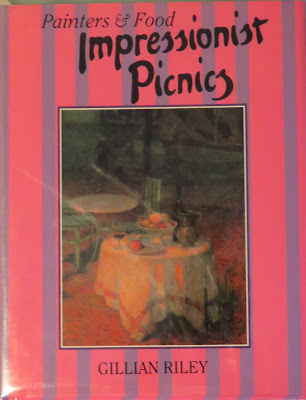
A book by Gillian Riley that I really enjoyed: Impressionist Picnics.
(Review Here)


The New Yorker still publishes a few food-themed cartoons.

Books I Love

A curiosity: the following list illustrates some of the books that I mentioned on my blog in 2008. These food books were on my shelves then, and they still are there.

  • Jennifer 8 Lee, The Fortune Cookie Chronicles
  • Tom Standage, A History of the World in Six Glasses
  • Gary Paul Nabhan, Why Some Like it Hot
  • Michael Pollan, In Defense of Food
  • Pollan, The Botany of Desire
  • Pollan, The Omnivore’s Dilemma
  • Jordan & Brady, eds, The World is a Kitchen
  • Julian Barnes, The Pedant in the Kitchen
  • Mary Taylor Simeti & Grammatico, Bitter Almonds
  • Elizabeth L. Ortiz, The Book of Latin American Cooking
  • Claudia Roden, A Book of Middle Eastern Food
  • Michelle Stacey, Consumed: Why Americans Love, Hate, and Fear Food
  • Henry Hobhouse, Seeds of Change
  • Julia Sahni, Moghul Microwave
  • Madhur Jaffrey, World Vegetarian
  • Harold McGee, On Food and Cooking
  • Ayla Algar, Classical Turkish Cooking
  • Gillian Riley, Painters & Food: Renaissance Recipes

Thursday, June 06, 2024

I am not a pilgrim.

My next book: I have just begun reading it.
A Travel Guide to the Middle Ages by Anthony Bale (published April 2024)
It’s full of interesting tales, descriptions of early maps, and many amazing details.

Why go on a pilgrimage? Where to go?

“Reasons and motives for pilgrimage were various – sometimes pilgrimage was voluntary, sometimes it was medical, sometimes it was imposed as a punishment, sometimes one undertook a pilgrimage on behalf of one’s community – but a pilgrimage was always a journey to a special destination. Such destinations included Walsingham, Canterbury, Aachen, Wilsnack, Cologne, Santiago de Compostela, Rome, Bari, Jerusalem. These locations, and many more, were all imbued with a charismatic holiness and were key shrines for Christian pilgrims.” (Bale, p. 11)

Why I want to read about Medieval travel…

While sitting in the airport waiting for our unexpectedly early flight from Paris back home, I overheard an unexpected conversation. A security agent with a clipboard was interviewing the waiting passengers. He asked if they had packed all their own bags, had been approached to carry something by a stranger, and those usual questions — no longer part of the universal security, presumably because it slows things down too much. 

A couple sitting across from us were of course asked the same questions — what is the purpose of your trip? The man answered: “We were on a pilgrimage.” At that point I noticed that he was wearing a clerical collar, though I don’t think his clothes were all black, I think they were brown. The agent seemed disconcerted, and he asked what that meant. 

“We went to all your holy sites,” answered the pilgrim. I think this ended the interview, and the agent ticked them off and headed for us with his list of passengers on the flight. I wonder if they visited any places connected with Joan of Arc, whose statue stood quite near to the hotel where our brief trip took place. I wonder if they saw the holy relics or remains of saints that Medieval pilgrims reverently viewed. 

Our departure was painful, so I didn’t take any photos during our ride to the airport, our transport through the airport, or our time in the boarding area. But I did notice this startling interchange that made me think about past trips and experiences with the once-holy travel sites in France — in a way, modern tourism has some of its roots in this type of tourism from the past. Just thinking about it is interesting.

Visiting Notre Dame de Paris during a service in 2018 (before it burned).
Of course I know it’s a holy site… but it doesn’t occupy that niche in my mind.

I have never thought of France as a country of holy sites, though of course I’m aware that there are many cathedrals and churches, as well as the famous grotto of Lourdes (where I’ve never visited). I know about the pilgrimages of the Middle Ages — for example how Rue Saint Jacques in Paris, leading from Notre Dame Cathedral, was the start of the most famous route, which led to the Santiago de Compostela site in Spain. I know about the major cathedrals of Chartres, Rouen, Rheims, Amiens, and also of Mont Saint Michel — in fact, over the years, I’ve visited them all. I’ve been to Vézelay, where there is a basilica and a Benedictine and Cluniac monastery — a key site where pilgrims started for Santiago as well as where Saint Bernard called on French people to join the Second Crusade.

I’m sure these churches all have reliquaries with holy objects — in fact, these boxes are often on display, made of precious metals, stones, and enamel work. Stained glass images of Bible stories, mosaics or paintings of holy scenes, and similar images are often part of the appeal, along with the impressive architecture. So I wonder why the words of the pilgrim about to board our plane were so startling to me. I guess I think of all that as being in the distant past. Because my specific example was a Christian pilgrim in France, my thoughts only turned to Christian sites and motives, though of course people of other religions and in other places have also made pilgrimages to holy sites connected to their own faith.

This devil on the ruins of the church at St. Gilles in Provence is waiting to tempt Adam and Eve.
In the Middle Ages this church was also a starting points for the Santiago pilgrimage.
I wonder if our fellow passengers went there, or if they only went to currently active holy sites. 

Medieval Travel

Reading Anthony Bale’s book about long-ago travelers and pilgrims is an interesting contrast to my own experiences throughout my life. Medieval travelers had to think ahead and purchase supplies of food, wine, and clean water for their voyages. They were sure to be in danger from a variety of criminals — their possessions could be stolen during the night in an inn or hostel if their rooms were not securely locked. (Well, this may not be completely changed). Often, they were robbed by the officials of a country or by gate keepers along the way. Even in the best of situations, they could be required to pay extortionate amounts of money or goods for safe passage.

Accommodations were substandard at best. Hostels were proud of themselves if they made a practice of washing the bedding once a month — and it would be nice if they even offered a bed rather than just a space on the floor. Don’t even ask about privacy or sanitation! Fleas, ticks, maggots, gnats, lice, worms, mice, rats, and other vermin were inevitable in even the best hostels or onboard ships, and bathing to get rid of pests wasn’t always an option. The accommodations on ships were even worse than the travelers’ inns along the routes where pilgrims and tourists walked. Moreover, storms and rough seas could cause terrible seasickness, or extreme calm could prolong voyages to the point where the passengers and crew might starve or die of thirst.

“The Florentine Simone Sigoli, reflecting on his journey to Jerusalem in 1384, seemed to summarize the medieval attitude to sea travel: ‘No one should travel who does not desire hardship, trouble, tribulation and the risk of death.’” (p. 85)

What a luxurious life we live in today’s world! 

Imaginary Places

A particular feature of many Medieval travel accounts, especially those of the Silk Roads into the unknown areas of Asia, were accounts of various mythical lands and peoples, such as The Old Man of the Mountain; the Land of Gog and Magog; or the fountain of youth. I have always enjoyed the stories of the land of plenty called Cocayne, which author Anthony Bale describes in some detail:

“From the thirteenth century, the land of Cockayne (Cockaigne, Cuccagna) was the false paradise most widely represented. Cockayne was on a distant shore, somewhere. Work was forbidden, free sex with willing partners was available to all and sinuous brooks ran with youth-giving liquors. The sun never set and one’s clothes were even free from lice. Pigs voluntarily roasted themselves as tasty pies flew through the air. The shingles on Cockayne’s pretty church were made of wheaten cakes, and one could tug away the sweet masonry and eat and eat and eat. It was a dreamland of plenty.” (p. 212)

Some of the real cities and royal courts in China and India were described just as fancifully as the imaginary places, as the returning adventurers told the remarkable stories of the places they visited. The great wealth of the Indian princes, for example, must have seemed mythical to the Europeans who stayed home and only read the travelers’ tales. Bale summarizes these tales for the modern reader — to me some still seem more imagined than real. 

Tales of Food

Of course the travelers brought back news about exotic and unfamiliar foods — sometimes accurate, sometimes exaggerated. Marco Polo’s supposed introduction of pasta from China is a twentieth century fairy tale — pasta had long been eaten in Italy. I wrote about Marco Polo and food a few years ago (in this post). Here is Bale’s summary of his contribution:

“Marco Polo is often credited with bringing a range of foods from China to Italy, but there is no evidence he brought recipes back with him. He did note many peculiarities of diet and rituals around food: for example, he described excellent spiced date wine in Hormuz, the exclusive diet of meat and rice in Kashmir, the Tatar habit of eating horse, dog and mongoose, the central Asian offerings of fat and broth to the gods, the rice and millet noodles of China and the wonderful pears and peaches at the Hangzhou market.” (p. 266)

I’ve read other books about Medieval travel, such as Gary Paul Nabhan’s Cumin, Camels and Caravans Mary Taylor Simeti’s Travels with a Medieval Queen, and Giles Milton’s Nathaniel’s Nutmeg. I’ve also enjoyed the Travels of Benjamin of Tudela, who wrote about his twelfth-century voyages. Travel stories are always an intriguing bit of history! 


Post and photos © 2016, 2018, 2024 mae sander

Monday, December 24, 2018

French Regional Cooking

Recently, a friend asked me to recommend some regional French cookbooks. I found quite a few books about the cuisine of Provence and southern France, but quite a few regions are missing from my collection. To be thorough I would need to find cookbooks that featured the Basque region, Normandy, Brittany (especially for crepes!), Lyons, Alsace (especially recipes for the famous choucroute), and several other regions. My favorite regional French recipes are for Gratin Dauphinois (blogged here) and Salade Niçoise (blogged here), but these are now so popular that you can find recipes in a variety of cookbooks and online sources, and you can order them at many American restaurants as well.

As I looked through my shelves I did find quite a few relevant cookbooks. I've written about many of them before, over my years of blogging. Here's a list of my books that emphasize French regional cooking, with links to previous posts. This list reflects only books that I own, so it's not meant to be comprehensive or systematic in any way.
  • French Provincial Cooking by Elizabeth David (editions in 1960, 1977, and 1983) includes an overview of the cuisine of a number of regions, and then provides recipes and techniques for French cooking.
  • The Cooking of South-West France by Paula Wolfert (1983) describes the agricultural products of this region, along with many recipes.
  • The Cuisine of the Sun: Classical French cooking from Nice and Provence by Mireille Johnston (1976) offers many good recipes, which I've been trying -- most recently a daube, the famous Provençal stew (blogged here).
  • Cézanne and the Provençal Table by Jean-Bernard Naudin and others (1995) is an amusing discussion of the environment in which the artist lived and worked -- with recipes and many illustrations (blogged here).
  • La Cuisine Corse by Christiane Schapira (1979) is unfortunately in French, but I find it intriguing to learn about Corsica, a somewhat exotic region of France; I'm including it because it's my most obscure French regional cookbook!


  • The Auberge of the Flowering Hearth by Roy Andries De Groot (1973) documents his stay in an auberge in the Dauphiné region, with descriptions of the meals served to guests there, accounts of the way the owners shopped and cooked, and also recipes (blogged here).


  • Madeleine Kamman's Savoie: The Land, People, and Food of the French Alps (1989) presents the cuisine of the next region over from De Groot's book.
  • Simca's Cuisine by Simone Beck (1972) is a general French cookbook with many regional recipes; it's often overlooked in preference to her collaborative work with Julia Child.
  • Madame Maigret's Recipes by Robert J. Courtine (1975) includes some of the cuisine of Alsace, home of the wife of the famous detective. If you've read the many police procedurals by Georges Simenon (who of course invented Inspector Maigret, his wife, and her cooking) you'll appreciate this cookbook (blogged here).
  • Quiches, Kugels, and Couscous: My Search for Jewish Cooking in France by Joan Nathan (2010) is not about a region, but about the multi-ethnic Jewish cuisine of France (blogged here).


... of course, if you want to know everything, you can always consult the Larousse Gastronomique!

French food has always been Americans' model of quality and excellence starting when Benjamin Franklin and Thomas Jefferson described it to their fellow citizens. French cooking, both in restaurants and homes, has reflected an identity of its own in the US. In particular, we have not been as conscious of French regional differences as French people are. In the late 20th century, Julia Child made a big difference both to Americans' cooking and awareness of French food; since her peak of influence, many English-language works have appeared in books, magazine articles, TV programs, and online, and I would say that French regional cuisine is of increasing interest.


Wednesday, June 08, 2016

Israeli Food and Cookbooks

Shakshouka: eggs cooked in tomato sauce, here garnished with fried eggplant,
cheese, and grilled peppers. It's usually prepared and served in individual casseroles.
Now that I'm back from Israel, I'm thinking about how to make some of the Israeli favorite foods that I ate while I was there. I've already mentioned several of them: hummus, falafel, grilled fish and meat, and salads, and I also had a few others. I'm checking my cookbooks for recipes for some of the favorites --

Joan Nathan -- The Foods of Israel Today
Sherry Ansky -- The Food of Israel
Ottolenghi and Tamimi -- Jerusalem: A Cookbook
Lilian Cornfeld -- Israeli Cookery
Claudia Roden: The Book of Jewish Food
Chopped salad served with the shakshouka at a cafe in Kiryat Ono where we stayed.
From Sherry Ansky's excellent cookbook: a recipe for Shakshouka. I've made it before.
Salads, I would say, are among the most varied and popular items in Israeli restaurants. They vary from raw vegetable salads, cooked vegetable salads, fish salads, grains. Salads both warm and cold also are components of the popular pre-dinner mezze appetizers. Every one of my cookbooks suggests numerous and tempting recipes for many Israeli salads.
Quinoa and other grains in an Israeli salad at the restaurant in Caesarea.
Quinoa has become quite popular in Israeli cooking, along with rice.
Claudia Roden traces the appetizers to Sephardic customs by Jews in Arab countries.
Arab-Israeli restaurants also serve their own versions of these popular dishes.
This was called "Jerusalem Shuk Salad" -- a version of the popular Israeli chopped salad with added egg and chick peas.
From Lilian Cornfeld's historic book (written 1962) -- the classic chopped salad.

Len's Caesar salad at Caesarea -- of course there's no connection as Caesar
Salad is named for a chef in Tijuana, Mexico, who invented the recipe in 1924.
And Caesarea, Israel, was named by its founder Herod for Augustus Caesar.
Despite its North American origin, Caesar Salad often appears on Israeli menus.
Original Caesar Salad was prepared -- with flair -- by the waiter, but as in the US,
the Israelis bring it to the table already plated.
The appetizer of many Israeli vegetable dishes, sometimes called Mezze.
Here our selection at the Lebanon Restaurant in Abu Ghosh, an Arab village.
Most of the cookbooks provide recipes for fattoush, falafel, hummus, etc.
Sabich, an Israeli vegetable and hard-cooked egg sandwich I ate in Tel Aviv.
Ottolenghi's book Jerusalem has a very elaborate recipe for this.
I'm sharing this post with Louise's Cookbook Wednesday.

Wednesday, March 25, 2015

"Quiches, Kugels, and Couscous" by Joan Nathan

Quiches, Kugels, and Couscous, Published 2010.
The title refers to three major types of Jewish cooking in France:
Quiche for traditional French food, Kugel for Eastern European
Jewish food, and Couscous for the cuisine of North African Jews.
When Joan Nathan's book on the food of the Jews of France was published, I was especially interested in her history of diverse Jewish communities in Paris, Alsace, and the South of France and how they got there. Their sufferings during World War II, as she related their stories, seemed very far away.

Very sadly, now when I think of Jewish food in France I think not only of the cuisines described in Joan Nathan's book, but also of the kosher supermarket in Paris where Jews were murdered in January, 2015 -- merely for being Jewish. Though the nightmare destructiveness of the Holocaust is not being repeated, I fear that the tragedy of European Jews is far from finished.

History can make me so sad. Nothing can make up for mass murders and other injustices that have occurred in the past. Nevertheless, I love Joan Nathan's culinary history of the many French-Jewish communities, which include:
  • European-French Jews who lived there as early as Roman times, especially those who lived in Alsace and Provence;
  • Sephardic Jews who came from Spain during centuries of persecution;
  • Eastern European Jews who came to Paris from Poland and other places in response to many persecutions in the late 19th and early 20th century, as well as seeking a more prosperous life; and
  • North African Jews who were forced out of their long-term homelands by events in the 1950s and 1960s and have settled in many French cities.
Each group possessed distinctive cuisines. While preserving their traditions and religious laws regarding kosher foods, they often adopted French recipes and local ingredients as well. They also introduced some of their own recipes and preparations into French cuisine. Joan Nathan brings all these food ways to life with a variety of interviews, historic background, vivid photographs and art reproductions, and above all descriptions of French-Jewish bakeries, spice shops, groceries, butcher shops, wineries, farms, restaurants, and home kitchens.

Although I have owned this book for several years, I just finally decided to try some of the recipes, starting with this one: 

Cassolita: a Moroccan squash dish with caramelized onions -- trying it is an extension of my
current interest in Moroccan foods and spices.
My Cassolita in progress.
On the table, garnished with almonds and flat-leaf parsley and ready to eat with couscous (in covered dish).
Cookbook Wednesday, sponsored by Louise at Months of Edible Celebrations, is an inspiration for this post.

Thursday, March 05, 2015

Crock Pots, Bagels, and Bundt Pans

Jewish food inventions, you would think, must have their source in New York. At least New York's promoters give themselves a lot of credit for the strength of their cultural influence. Some Jewish food contributions to mainstream American life, however, originated in the midwest: the slow cooker, the bundt pan, and the Americanized bagel.

I started thinking about these yesterday, when a question about my slow cooker post led me to look up a bit of history. The Rival brand Crock Pot, first of its type, became widely popular in the early 1970s, but its earlier history, I learned, links it to a very traditional Jewish Sabbath practice and a Chicago inventor. I had already read about the Bundt Pan, created for a Jewish women's group in Minneapolis. The bagel, once an obscure ethnic item, became a mainstream nosh in the Midwest.

As I thought about these innovations it hit me: New York isn't the only source of Jewish food trends!

The Invention of the Slow Cooker

Screen shot of google images of Rival Crock Pots
Chicago, 1936. Self-educated inventor Irving Naxon patented a slow-cooking, energy efficient appliance he called the "Naxon Beanery."

Naxon's daughter provided the background of the device:
"My Dad, Irving Naxon, invented the crock pot, then-called Naxon Beanery. He retired in 1971 and sold his business to Rival Manufacturing. They streamlined the design, renamed it the crock pot, and the rest is American culinary history. But what was his inspiration for its creation in the first place, you might ask?
"My grandmother Tamara Kaslovski Nachumsohn, grew up in a small 'shtetl' in Lithuania. She told my dad, when he was a young child, that when she was growing up back in the old country, each Friday afternoon her mother would send her to the local bakery with their pot of prepared but yet uncooked  'cholent.' There it would be put into the oven for a full day, while the family observed the Sabbath and the hot oven cooled to warm while not in use for that same period. At sundown she would go to the bakery and bring the family their delicious pot of steamy stew. 
"Dad remembered the story and was inspired to find a way to create a heating element that surrounded the pot in the same way that an oven would have. He wanted to find a low cost, low electricity use solution."

The Origin of the Bundt Pan 

Minneapolis, 1950. A chapter of Hadassah, a Jewish women's charitable organization, approached the head of a company, Nordic Ware, that manufactured metal cookware. They needed special fluted pans, which they called bund pans, to make traditional cakes for bake sales. The company owner, H. David Dalquist, developed a version of a ceramic cake pan that one of the members had inherited from her grandmother:
"Dalquist, whose motto was 'If you can sell it, you can usually make it,' produced the pan in cast aluminum for the Hadassah members. He also made some to sell in department stores and called this early model a bund pan, borrowing a German word that means an alliance or bond. Later, in order to trademark it and perhaps avoid association with the German-American Bund, a pro-Nazi organization active in the 1930s and 1940s, he added a T."  
In 1966, the Pillsbury Bake-Off Contest winner was a chocolate cake named "Tunnel of Fudge" which was baked in one of Dalquist's bundt pans. The immense popularity of the recipe led to very widespread use of these pans, especially for Pillsbury recipes. Bundt cakes became totally American mainstream. Over time, Dalquist donated pans to be sold by the chapter of Hadassah that had inspired him, allowing them to make money for the support of hospitals in Israel.

This information comes from Dalquist's obituary in the L.A.Times. Other sources have alternate explanations for the spelling of bundt.

The Americanization of Bagels

Troy, New York, 1983. Nord Brue and Mike Dressell founded Bruegger's Bagels, a specialty shop which baked fresh bagels for everyone -- not only for Jewish customers. Bruegger's, which soon became a nation-wide chain, and other bagel shops turned the formerly Jewish bagel into an all-American favorite, not just an ethnic curiosity that some people bought frozen in plastic bags. Yes, Lender's bagels came from New York, and they were moderately popular before the spread of bagel shops, but they were not really what you could call mainstream.

"Until the 1960s," said a New York Times article, "bagels were little known outside large Jewish communities in major cities. In 1951, The New York Times, in an article about a bagel bakers’ strike, thought it necessary to provide a pronunciation guide ('baygle') and define it as a 'glazed surfaced roll with the firm white dough.'"

During the 1980s, bagel shops spread to cities and towns all over America. By 1999, Americans ate more bagels than donuts -- though that may no longer be the case. As bagels became more popular, you could even buy them at Dunkin' Donuts. You could get green bagels for St.Patrick's day. Ham and cheese on a bagel lost its irony, even for Jews who had grown up eating bagels with lox and cream cheese for Sunday brunch. McDonald's Steak, Egg & Cheese Bagel Sandwich and other bagel items date from 1999 or earlier.  Over time, bagels became more user-friendly: softer and easier to bite, larger, slower to get stale, and easier to slice without losing a finger. (Some people bemoan the changes: I'll refrain from commenting on them.)

Most of my adult life I've lived in Ann Arbor, MI, home of Zingerman's Deli and Bakery, where bagels have been fetishized into a gourmet treat. However, I grew up in a predominantly Jewish suburb of St. Louis, MO, that just happens to be the home of Panera Bread, originally called the St. Louis Bread Company. Panera's now-mainstream bagels, though gigantic compared to the ones we ate when I was a kid, might just be related to the ones I ate back then. That was when ONLY Jewish people knew what they were and ONLY the few Jewish bakeries baked them. In fact, cookbook author Joan Nathan wrote that her father tested new neighbors to see if they were Jewish by offering them bagels and checking their reaction: puzzlement or recognition.

In sum, the general view of bagels has changed so much that buying bagels from a Panera at a rest-stop on the Ohio turnpike or from a Korean franchise owner in San Diego now seems natural to me.

Most bagel histories concentrate on the bagel's early existence in Poland in the Middle Ages, and on New York immigrant history, when the bagel bakers' union was powerful. I think the bagel's metamorphosis into a food that most Americans don't even recognize as ethnic is as interesting as the earlier history.

For more on bagel history, see Joan Nathan's article A Short History of the Bagel.

Wednesday, December 10, 2014

Israeli Cookbooks: Hummus and Falafel

Today's cookbooks from my collection all feature the foods of Israel. I've copied images from each one to illustrate the various ways that the authors deal with two typical Israeli dishes: Hummus and Falafel. These are both favorites with both Jews and non-Jews in Israel, as well as in many other countries. I love them too. Israelis enjoy complete connoisseurship of hummus -- we were once sent to the famous Diana restaurant in Nazereth because the hummus was "poetic."

The earliest Israeli cookbook in my collection is called Israeli Cookery, by Lilian Cornfeld, and dates from 1962. It's organized around the many Jewish communities that had already settled in Israel at that time, not long after Israeli independence. The book is also very concerned with nutrition, and classifies Falafel and Hummus as "Sabra Cereal and Legume Foods."

Falafel and Hummus as packaged 50 years ago

The Food of Israel: Authentic Recipes from the Land of Milk and Honey by Sherry Ansky was published in 2000. Every recipe is accompanied by beautiful photos. The book begins with a history and general discussion of Israeli foods, including a discussion of the Biblical "seven species" that still play a fundamental role today: olives, figs, dates, pomegranates, wheat, barley, and grapes.

Hummus, depicted in Ansky's book.
Ansky's Hummus recipe

Ottolenghi and Tamimi's Jerusalem: A Cookbook has been very popular since its publication in 2012. I cooked several recipes from  it, and wrote about it here: Jerusalem: A Cookbook. The book has beautiful images of the authors' native city, Jerusalem, and the discussion of hummus is illustrated with several photos and recipes; the image below suggests the wide selection of hummus in an Israeli market:


Joan Nathan's The Foods of Israel Today (2001) presents many recipes. She also reviews a variety of restaurants and small eating places throughout Israel. Some of her suggestions are probably obsolete, as the situation in the Middle East, as always, is complicated. (I'll stay off the topic of politics!)

I've reproduced, below, a page of general information on hummus and where to buy it. Again, this reflects the overall love of hummus throughout Israel.

A page from The Foods of Israel Today by Joan Nathan

The Book of Jewish Food; An Odyssey from Samarkand to New York by Claudia Roden (1996) is a survey of Jewish foodways from around the world, including Israel of course. Roden grew up in the Jewish community of Alexandria, Egypt, and began her career writing about general Middle Eastern food. The breadth of the recipes and stories collected in The Book of Jewish Food amazes me!
A story about Falafel from The Book of Jewish Food by Claudia Roden

Recently, I wrote about another book on Israeli food titled Breaking Bread in Galilee: A Culinary Journey into the Promised Land by Abbie Rosner.

"I have chosen to approach food as a means of bringing people together instead of keeping them apart," Rosner wrote in her introduction. "If using food as a bridge between individuals from either side of the conflict can help overcome suspicion and promote mutual understanding, even on the most modest scale, then something very significant can be achieved."


Cookbook Wednesday is inspired by
Louise at Months of Edible Celebrations.

Wednesday, November 26, 2014

American cookbooks and what they say about Thanksgiving

In celebration of Thanksgiving, my favorite national holiday, I've looked through a number of my American cookbooks for ways that diverse people in many regions of the country enjoy the holiday. Here are a few examples of Thanksgiving celebrations from these books, illustrating the many ways that Americans vary the traditional menu.

As you can see, this  was a remaindered book. I have to admit,
I haven't really read it much or tried any of the recipes.
American Food: The Gastronomic Story by Evan Jones was first published in the 1970s with a revised edition in 1990. It was ambitious and in fact ponderous to read -- but I'm afraid it never made much of an impression in the cookbook literature. It does have an amusing little bit on Thanksgiving, though, explaining that in the past, a turkey recipe would start with instructions on how to fatten your bird. He quotes an 1881 book titled Los Angeles Cookery:
"The cook was advised to 'Get your turkey six weeks before you need it: put him in a coop just large enough to let him walk ... give him walnuts -- one the first day, and increase every day one until he has nine; then go back to one and up to nine until you kill him, stuffing him twice with corn meal  each day, in which you put a little chopped onion and celery, if you have it.'" (p. 324)
I guess that the cornmeal stuffing was administered to the bird along with the walnuts, not meant as a recipe for post-slaughter turkey stuffing. Jones gives a recipe for a Tennessee sausage stuffing made with chestnuts.

This totally American book on grilling has several pages devoted to
cooking a whole turkey on your outdoor grill. I think this
Thanksgiving tradition is limited to the warmer regions of the US!
Rachel Laudan's book on Hawaiian foods describes many ethnic groups
that have contributed to the complex Hawaiian cuisines.
In The Food of Paradise, Lauden includes this description of one family's merging of several Hawaiian food traditions -- "One Miss Hawaii described her Thanksgiving dinner for me: turkey, dressing, rice, sashimi, sushi, macaroni salad, jello salad, namasu (cucumber salad), mashed potatoes, and kim chee." (p. 23)

Another item from my collection is a completely classic cookbook -- the original New York Times Cookbook edited by Craig Claiborn (1961).

Claiborn featured several ways to cook turkey, along with this two-page spread on how to carve the turkey.

Joan Nathan's Jewish Cooking in America identified several recipes from various Jewish cooks that could feature at Thanksgiving tables. "A Jewish-Cuban Thanksgiving meal is American in the real melting-pot sense," she wrote. "It includes a roasted turkey as the centerpiece surrounded by cranberry sauce, plantains, rice, black beans, and stuffed derma [i.e. kishka, casing made from beef intestine], with pumpkin pie for dessert." (p. 125)

Moroccan-Jewish pumpkin soup with chick-peas is another specialty Nathan suggests for Thanksgiving dinner. (p. 128) Also, she tells a story of a charitable Thanksgiving in 19th century Providence, and offers two recipes associated with this story, one for chestnut stuffing, the other for Virginia corn-bread stuffing. (p. 210-211)

Lewis Lewisson's Thanksgiving story and the stuffing recipe.

Marcie Cohen Ferris documented the foodways of the Jews of Atlanta, New Orleans, the Mississippi Delta and other locations in the South. We read her book Matzoh Ball Gumbo: Culinary Tales of the Jewish South last week in my culinary book club. Some of the details about the extreme efforts of Jews to fit into Southern life made us uncomfortable -- such as the Jewish embrace of slavery before the Civil War and of employing black kitchen servants ever since. However, we agreed that the author had collected a vast quantity of interesting material -- maybe too much. We wished she had shortened some of the repetitive lists and other repetitions and given more historical context for the trends she described. 

Among the many Jewish-Southern fusion dishes Ferris describes is Thanksgiving Cornbread Oyster Dressing. "This is a true southern and Jewish combination, schmaltz (chicken fat) and oysters (nonkosher shellfish)," she wrote.

Of course if you want a vast choice of Thanksgiving recipes, you can always find them online. (Though it's a bit late now, since tomorrow is IT!) Dozens of bloggers for the last few weeks have been offering their best recipes for turkey, dressing/stuffing, pie, and sides. The archive of the late Gourmet magazine has a page of links to Thanksgiving recipes published there in the past. The LA Times suggests "A most excellent Thanksgiving." Food and Wine provides recipes for a vegetarian or even vegan Thanksgiving.  And the New York Times has a fascinating list of most-googled recipes state by state.

I hope you have a wonderful holiday!

My blog post today celebrates both Thanksgiving and Cookbook Wednesday, for which I join Louise and other bloggers. On my cookbook post last Wednesday I discussed Sunset cookbooks. In response, several people told me that their favorite Thanksgiving recipes were originally from Sunset. Indeed, Sunset cookbooks are a treasure of American cooking literature. I've also already written a about the most classic of American cookbooks, The Joy of Cooking.