Showing posts with label Paula Wolfert. Show all posts

Monday, December 24, 2018

French Regional Cooking

Recently, a friend asked me to recommend some regional French cookbooks. I found quite a few books about the cuisine of Provence and southern France, but quite a few regions are missing from my collection. To be thorough I would need to find cookbooks that featured the Basque region, Normandy, Brittany (especially for crepes!), Lyons, Alsace (especially recipes for the famous choucroute), and several other regions. My favorite regional French recipes are for Gratin Dauphinois (blogged here) and Salade Niçoise (blogged here), but these are now so popular that you can find recipes in a variety of cookbooks and online sources, and you can order them at many American restaurants as well.

As I looked through my shelves I did find quite a few relevant cookbooks. I've written about many of them before, over my years of blogging. Here's a list of my books that emphasize French regional cooking, with links to previous posts. This list reflects only books that I own, so it's not meant to be comprehensive or systematic in any way.
  • French Provincial Cooking by Elizabeth David (editions in 1960, 1977, and 1983) includes an overview of the cuisine of a number of regions, and then provides recipes and techniques for French cooking.
  • The Cooking of South-West France by Paula Wolfert (1983) describes the agricultural products of this region, along with many recipes.
  • The Cuisine of the Sun: Classical French cooking from Nice and Provence by Mireille Johnston (1976) offers many good recipes, which I've been trying -- most recently a daube, the famous Provençal stew (blogged here).
  • Cézanne and the Provençal Table by Jean-Bernard Naudin and others (1995) is an amusing discussion of the environment in which the artist lived and worked -- with recipes and many illustrations (blogged here).
  • La Cuisine Corse by Christiane Schapira (1979) is unfortunately in French, but I find it intriguing to learn about Corsica, a somewhat exotic region of France; I'm including it because it's my most obscure French regional cookbook!


  • The Auberge of the Flowering Hearth by Roy Andries De Groot (1973) documents his stay in an auberge in the Dauphiné region, with descriptions of the meals served to guests there, accounts of the way the owners shopped and cooked, and also recipes (blogged here).


  • Madeleine Kamman's Savoie: The Land, People, and Food of the French Alps (1989) presents the cuisine of the next region over from De Groot's book.
  • Simca's Cuisine by Simone Beck (1972) is a general French cookbook with many regional recipes; it's often overlooked in preference to her collaborative work with Julia Child.
  • Madame Maigret's Recipes by Robert J. Courtine (1975) includes some of the cuisine of Alsace, home of the wife of the famous detective. If you've read the many police procedurals by Georges Simenon (who of course invented Inspector Maigret, his wife, and her cooking) you'll appreciate this cookbook (blogged here).
  • Quiches, Kugels, and Couscous: My Search for Jewish Cooking in France by Joan Nathan (2010) is not about a region, but about the multi-ethnic Jewish cuisine of France (blogged here).


... of course, if you want to know everything, you can always consult the Larousse Gastronomique!

French food has always been Americans' model of quality and excellence starting when Benjamin Franklin and Thomas Jefferson described it to their fellow citizens. French cooking, both in restaurants and homes, has reflected an identity of its own in the US. In particular, we have not been as conscious of French regional differences as French people are. In the late 20th century, Julia Child made a big difference both to Americans' cooking and awareness of French food; since her peak of influence, many English-language works have appeared in books, magazine articles, TV programs, and online, and I would say that French regional cuisine is of increasing interest.


Saturday, March 25, 2017

Tagine of Lamb with Dates: a Recipe by Paula Wolfert

After slowly simmering lamb with spices. butter, and onions, you transfer the nearly-finished tagine to a serving dish,
surround it with dates, and sprinkle them with cinnamon. You finish it in a very hot oven, which slightly crisps the dates.
The photo shows the result, as I served it for our dinner this evening.


My copy of Paula Wolfert's Couscous.

Paula Wolfert has been in the news this week, including an interview in the New York Times (link), and a review of a new book about her in Food 52 (link).

I read both articles with pleasure, and decided it was time to try another recipe from Wolfert's book Couscous and other Good Food from Morocco. I chose Tagine of Lamb with Dates. The combination of onions, garlic, saffron, cilantro, pepper, and ginger really appealed to me, and for once, I followed the recipe pretty faithfully, except for scaling down the quantity to make it appropriate for only two of us.

Both of the inspiring articles were frank and detailed about the fact that Wolfert is suffering from Altzheimer's, and no longer can write or cook in the way she was famous for. Mayukh Sen his Food 52 article "Who is Paula Wolfert? A New Biography Gives an Answer," was also interested in introducing Wolfert to his readers, whom he feels might not be familiar with her work. While I had heard of her long ago, I admit that I only recently began experimenting with her recipes, such as the one I did tonight.

Before I cut up the lamb, I assembled all the ingredients.
Accompanying our tagine: salad of small tomatoes, cucumber, chopped preserved lemon, lemon juice, cilantro, and olive oil.


"Wolfert, author of nine cookbooks, was an early champion of Mediterranean foods in a time when their ingredients went unnoticed in American kitchens, beginning with 1973’s Couscous and Other Good Food from Morocco," wrote Sen. His article interestingly describes how Emily Kaiser Thelin worked on the new biography, titled Unforgettable: The Bold Flavors of Paula Wolfert's Renegade Life (cover at right).

Sen describes Wolfert's reputation thus:
"Though many American home cooks have been singing Wolfert’s gospel for decades, she isn’t discussed nearly enough as she should be. She's existed in the shadow of men like Yottam Ottolenghi, her spiritual successor, even though she tilled the ground he now walks on. Her lack of name recognition is incommensurate with her legacy, and with time and distance, it’s become easier to see how this happened. When Wolfert’s The Cooking of the Mediterranean came out in 1994, Wolfert toured the country, shoving hulking jars of Marash chile flakes under chef’s noses, going to bat for meze and pomegranate molasses. 'She was like a community organizer, lobbying for the region...,' Thelin claims. This was her modus operandi: She’d get these foods on your plate no matter what, cheerleading for them as loudly as she could."
And from the New York Times article "Her Memory Fading, Paula Wolfert Fights Back With Food" by Kim Severson --
"It would be hard to overstate the importance of Ms. Wolfert’s work, which introduced couscous and other classic Mediterranean dishes to generations of cooks. The New York Times food writer Craig Claiborne called her 'one of the leading lights in contemporary gastronomy.' She made Alice Waters fall in love with chicken cooked with preserved lemons and olives in a tagine, and primed America for the Middle Eastern flavors of Yotam Ottolenghi, who remains a fan. The British chef Fergus Henderson chose her cassoulet as his favorite recipe of all time.

"A whole murderers’ row of great American chefs — Thomas Keller, David Kinch, Judy Rodgers — has said how much her work mattered. 'I have always treasured and loved the vigor of her passionate and intellectual approach to authenticity,' Mario Batali said."

Sunday, July 17, 2016

Celebrating Marcella Hazan and Paula Wolfert: CHAA Dinner

This afternoon was the summer dinner for the Culinary Historians of Ann Arbor (CHAA). Everyone was asked to
bring a dish from a cookbook by Marcella Hazan or Paula Wolfert. Above: my two contributions --
orange salad flavored with cinnamon and rosewater (Paula Wolfert Moroccan recipe) and
peaches, blueberries, and raspberries in Prosecco (Marcella Hazan).
Preparing the dessert table. Some dishes were from other Mediterranean cookbooks.
Turkish pumpkin and walnut dessert: Kabak tatlısı.
Vitello Tonnato (Marcella Hazan)
Baked Pasta with Sardines (Marcella Hazan)
Pita bread with zatar. 
Early view of main-dish table.
More dishes: a cauliflower salad (Marcella Hazan), tagine of chicken smothered in olives (Paula Wolfert),
stuffed grape leaves, and mushroom tart (from other sources).
We enjoyed the potluck very much, both the food and the people. The presentations about each dish were short and very interesting. The flavors were super!

Saturday, July 02, 2016

"Marcella Cucina" -- A Great Book

Lunch today: Marcella Hazan's Amalfi-style potato salad with capers, olives, and anchovies. On the side: a few vegetables.
"Marcella Cucina" in Italian means "Marcella cooks" -- such a great name for the book I'm using.
I had all the ingredients on hand for this simple recipe except fresh parsley, so I used dried parsley. My bad.
The Culinary Historians of Ann Arbor have set up their summer dinner in honor of two authors: Marcella Hazan and Paula Wolfert, and everyone is supposed to bring a dish made from a recipe by one of the two. Though I had read Marcella's autobiography, I have never before this week owned one of her cookbooks, and I'm really pleased with Marcella Cucina. It's truly meant for home cooks, and the recipes seem to be the kind I can really follow. I need a bit more practice before I feel confident, but I think I'll enjoy it!


The title page of my new book:
I don't know who Nancy is, but she
obviously owned this otherwise
pristine copy before I
bought it from amazon this week!

Sunday, June 19, 2016

Preserved Lemons from the Middle Ages to the Present

My preserved lemons some time last
year before I used most of them.
In the book Hesperides by Samuel Tolkowsky, published in 1938, there are virtually no recipes, just a thorough history of citrons, oranges, lemons, and other citrus fruit  (my review here). One exception is a recipe for preserved lemons from the author Ibn Jamiya, "which has been widely used throughout the Middle Ages and right up to modern times" --
"take lemons that are fully ripe and of bright yellow color; cut them open without severing the two halves and introduce plenty of fine salt into the split; place the fruits thus prepared in a glass vessel having  a wide opening and pour over them more lemon juice until they are completely submerged; now close the vessel and seal it with wax and let it stand for a fortnight in the sun, after which store it away in a cool place for at least forty days; but if you wait still longer than this before eating them, their taste and fragrance will be still more delicious and their action in stimulating the appetite will be stronger."
Indeed, this recipe is nearly identical to many recipes for preserved lemons that one finds by searching the Web -- except of course that modern canning jars have lids so we don't need wax!

Paula Wolfert, expert in Moroccan cooking, gives almost the same directions in recipes quoted at Epicurious and by Julia Moskin in the New York Times. Author Julia Moskin says: "The brightness of this pickle has lately elbowed its way out of Morocco’s tagines. New York chefs add the minced peel to salads and garnish fried seafood with it; the cured-lemon flavor is particularly friendly to salmon, carrots, olives, parsley and potatoes. The lemony brine is great in a bloody mary."

When I made preserved lemons last year, I followed Paula Wolfert's directions; I've enjoyed them in small quantities for a number of different recipes including salads and tagines.

Ibn Jamiya's best-known work was titled "Treatise of the Lemon." Written in the twelfth century, it was eventually published in a Latin translation in the sixteenth century. The author's full name was Abu'l Asher Khibat-Allah ben Zeyn-ed-Din Muwaffeq ed-Din, a Jewish physician from Cairo "who was personal physician to the sultan Salah ed-Din (A.D. 1171-1193) -- the Saladin of the Crusaders and Richard Lionhearted's opponent in Palestine." His book also contains many recipes for drinks and syrups made from lemons and other fruits. "There is a ring of modernity in Ibn Jamiya's dissertations on the lemon, and he might aptly be called the theorist of the art of the preparation and use of lemonades."

All quotes in this post are from S. Tolkowsky, Hesperides, pages 132-134.

Saturday, May 02, 2015

Moroccan Cooking

On the menu last night: Moroccan tagine with beef, prunes, onions, and apples (upper row).
Tomato and bell pepper salad; roasted cauliflower salad; cake topped with fruit (lower row left to right).
Some of the pre-dinner drinks and snacks (actually, everybody
opted for Dubonnet, which was in the fridge when I took the photo.
Ready to serve.

Two of our guests: Linda and Peter.
Cookbooks I used.
The Tagine of Beef with Prunes and Apples was a recipe from Paula Wolfert's Couscous and Other Good Food from Morocco. The roast cauliflower recipe was an interpretation of one from Ottolenghi's Jerusalem: I used roast cauliflower, celery, walnuts, and sections of clementines. La Cuisine Juive Maroccaine described a tomato and pepper salad like the one I made. My friend Abby baked the cake -- unfortunately I didn't get her photo this time.

Wednesday, January 28, 2015

Around the World for Cookbook Wednesday


As you know if you've been following my posts for Cookbook Wednesday, I love international cookbooks. Today is the last episode of this blogging adventure, sponsored by Louise at Months of Edible Celebrations. As a finale, I decided to make a quick cookbook tour of the world, at least the parts I haven't covered in my posts so far -- I've already written Cookbook Wednesday posts on Australia, Eastern Europe, the Caribbean, Israel, and several regions of the US. I tried to pick cookbooks that really were written and published in the country they were about, or written by people who had lived there.

Starting with Europe and Africa:

Classic European Cookbooks:
Anne Volokh, The Art of Russian Cuisine. Bayerishes Kochbuch (belongs to my daughter & Bavarian son-in-law).
Sicilian cuisine: Mary Taylor Simeti, Pomp and Sustenance; tourist pamphlet, "Palermo Cooking."
France: Ginette Mathiot, La Cuisine Pour Tous; Raymond Oliver: La Cuisine.
I have many other European cookbooks, especially French and Italian cookbooks!
Specialities of Turkish Cuisine,
purchased in Istanbul, 1990.
One of my newest books: Couscous by Paula Wolfert -- I hope to experiment with North African dishes soon.
And Anetta Miller, African Flavors: Recipes with Proverbs, a most intriguing book.
I have tried various Asian cookbooks. Here are two that really came from there:

A Chinese cookbook published many years ago
by the Chinese government. Sort of propaganda.
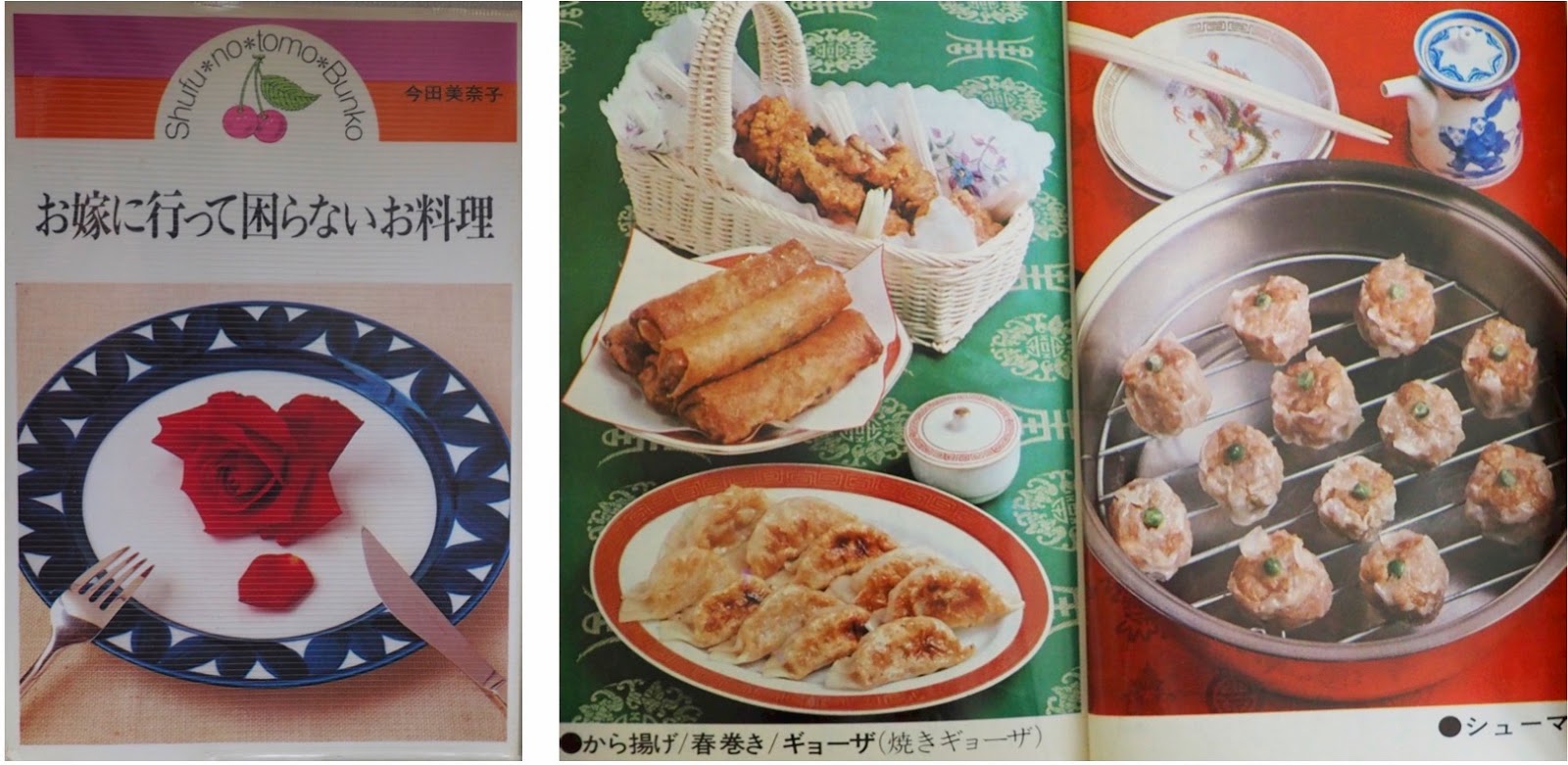
A cookbook in Japanese. Cover, left; sample 2-page spread, right.
brought to us by our international exchange student. (No, I have no idea what it says.)
And now a few from the Americas -- remember I've already written about California, Louisiana, the Southwest, and a few other places:
Favorite recipes from Miss Hullings Cafeteria, the popular, long-gone
St.Louis downtown eatery: a no-longer-existing type of restaurant!
Very early American cookbook by Sarah Josepha Hale
who worked to establish the Thanksgiving holiday.
This is a Canadian cookbook, a gift from my friend Kappu
who has lived in Toronto for many years.
I see Toronto as an incredibly international city!
Latin America: Elizabeth Lambert Ortiz, Latin American Cooking;
Cocina Judia a recipe collection from a synagogue in Buenos Aires;
and the classic Diana Kennedy, The Cuisines of Mexico.
Have I tried recipes from all of these books? Well, not quite, but I've tried a lot, and I really love them. I'll miss the fun of Cookbook Wednesday, and hope Louise comes up with a new challenge for her dedicated readers and blogging family.


Saturday, December 20, 2014

More Moroccan Cooking

 As I've written (Tagine, Tagine) my first experiment with cooking in a tagine was a disaster from the point of view of the cookware -- but the food was delicious. And I can see that any recipe can be made with the cooking equipment that I already own.

Thus I decided to continue with my plan to buy one or more Moroccan cookbooks. My favorite book dealer (Motte and Bailey) had this wonderful French-language book on the cuisine of the Jews of Morocco by Viviane and Nina Moryoussef. My next possible purchase will be one by Paula Wolfert.

I'm not sure when I'll be trying new recipes, but I'm already really enjoying reading them and looking at the gorgeous illustrations.
Preserved lemons and other condiments as shown in my new cookbook.
"Boulettes de Poisson Sauce Tomate" --
definitely a recipe I hope to try.

Sunday, March 23, 2014

"Cumin, Camels, and Caravans": A Review

Gary Paul Nabhan writes very complex books. His latest, Cumin, Camels, and Caravans: A Spice Odyssey, may be even more complex than the earlier ones I've read. However, I'm finding it very much worth the effort.

Family, identity, travel, political history, cuisine, sensory experience of spices, roles of many ethnic groups, and globalization -- Nabhan covers all these topics in every chapter.

Each chapter begins with a narrative about travel, history, and spice trade. By visiting many locations where ancient spice routes once existed and meeting local contacts, Naban pursued a search for his own identity. His family descended from the ancient Nabateans, a clan that originated in Yemen and now has members worldwide. In each chapter, he searches out other members of his clan when he can, in souks, in run-down neighborhoods, or wherever his guides would take him.

When he finds distant cousins, his interactions are interesting. When he can't find any distant relatives, it's often for a good reason. For example, the possible Nabhan kin he had identified in Tajikistan turned out to be arms dealers working on the Afghan border: not very safe for an American like Nabhan to meet (Kindle location 2929). Despite his affinity for his clan, he's actually a second or third-generation Lebanese American professor, agriculture researcher, and conservationist, and his identity very much reflects these activities and his life in the American Southwest.

As Nabhan visits and follows the spice routes, he presents their history in chronological order. Each chapter advances the historic record of trade and interaction of various ethnic people. Fascinating: as early as ancient Egyptian times, groups who engaged in long-distance trade transformed from rooted agriculturalists to long-distance travelers. Their religions changed, maybe, from beliefs rooted in a locale to belief in more universal deities; especially those of Jews and later Arabs. And skillful spice dealers over time learned to tell tales to make their products more appealing. Nabhan explores many obscure locations in China, Central Asia, the Middle East, and elsewhere.

Nabhan's consciousness of Jewish role in spice trade especially interested me, for example his references to early Jewish caravan traders in the Middle East, Europe, and China; to medieval travelers like Benjamin of Tudela at the end of the twelfth century; and to the secret Jews after 1492, especially enormously wealthy business woman Dona Gracia Nasi during the sixteenth century. A search for secret Jews descended from Spanish colonialists in the Southwestern US is another line of inquiry in the book.

Following the historic and travel narratives, every chapter includes one or more information boxes about a single spice. Nabhan includes a description of how the spice looks, how it tastes, where it originated, how it spread to various parts of the world, how it grows, and its uses. And spices have so many uses including, obviously, to flavor foods, but also to cure or prevent illness, to add to incense, and to be used in perfume, hair products, or body oil. To illustrate the level of detail: at the end of Chapter 8, "The Crumbling of Convivencia and the Rise of Transnational Guilds," there's a box titled "Coriander - Cilantro" which describes the flavor of coriander leaves as having:
"a citruslike aroma complemented by notes of sage and freshly cut grass. Their pyrazine-rich flavors are warm and somewhat nutty, with floral undertones that have been likened to lemon or orange blossoms. Although the flat parsleylike leaves of the coriander plant are known as cilantro in much of the world today, they have an entirely different flavor, which some people, perhaps by genetic disposition, find agreeable and others repugnant." 
Nabhan continues with the history of coriander, which was first mentioned as "a medical plant in an Egyptian papyrus dating from 2500 to 1550 BCE." He discusses the words used for coriander in various language, and what these words tell us. And concludes by mentioning that "Today, coriander seeds are essential ingredients in Indian curries and garma masala, Yemeni zhoug, Ethiopian berbere, Moroccan ras el hanout, and baharat mixes throughout the Arab world." So much information about just one of the 25 spices he describes in these text boxes! (Kindle location 4076 to 4106)

After the spice descriptions, at the end of every chapter is a recipe chosen for its relation to the themes of history and globalized spice in cuisine. The recipe at the end of the first chapter is particularly a tour de force. This lamb and garbanzo bean stew, he says, "may have emerged at different times in multiple places, but it clearly spread with Arab and Persian influence as far east as Mongolia, and with Jewish and Arab-Berber influence as far west as the Hispanic communities of Mexico."  Nabhan found nearly identical versions of this recipe in two incredibly separated places. The first version he cites was collected in 1939 in Arroyo Hondo, New Mexico, and elaborated by Paula Wolfert in connection with Moroccan cuisine. The second version he cites was included in a set of medical dietary recipes written down in China by Hu Szu-hui in the early 1300s. Nabhan's introductory chapter presents a number of reasons why the same recipe in two seemingly unrelated times/places was not a coincidence, but a result of the worldwide spice trade that he's exploring. (Kindle location 473)

To summarize my experience: I had to read Nabhan's book Why Some Like it Hot twice to figure out what it was about as I wrote here. I did that with this book too.

Saturday, November 01, 2008

"Artichoke to Za'atar"

Artichoke to Za'atar. Such a promising name for a book on Middle Eastern food. This work by Greg Malouf and Lucy Malouf has been on my amazon wish-list for quite a while, and so I've chosen it as the second of my current reading project.

For starters, check out the table of contents (left). The book is organized by basic ingredients, except the section on "Pastry." The first sections are "Almonds" and "Apricots." Third, not first, is "Artichokes." Look down towards the end of this list: the authors never actually get to "Za'atar" at all. OK, the publisher probably picked the title to make it catchier, never mind consistency.

Actually, inconsistency would be my word of choice for this book. Za'atar isn't omitted entirely, for example. The section titled "Thyme" claims that za'atar is simply a blend of thyme, sesame seeds, and sumac -- which isn't exactly right. Like many of the sections of this erratic book, this information is not very reliable. Even in Wikipedia's entry on Za'atar, there's a much more nuanced description, including a reference to hyssop, the unique ingredient in this somewhat obscure Middle Eastern spice blend (a fact I learned some time ago by reading the back of the Za'atar box -- see Muhamarra.)

Some sections offer interesting tidbits of information in the overview of the individual ingredient. Cardamom is a member of the ginger family. Quinces grow sweeter in hot climates, and can be used in both sweet and savory dishes. Apricots originated in China. But I'm sorry to say I think you could easily find out this much by a little simple web browsing. And cliches abound: "Garlic shouldn't overpower every other flavor in a dish..." (p. 135); "Parsley can be added to and will improve just about every dish imaginable." (p. 208) For the most part, these introductions just aren't adequately focused on the detailed uses of the subject ingredient. The list sounds delicious: lemons, dates, orange blossom water (no oranges), rose water, saffron, pomegranates, sesame seeds: mostly pretty Middle Eastern. But the treatments are too trivial.

And there are real gaps. In a book like this, I'd expect to learn about the Moroccan spice blend ras al hanout. In the section on ginger, the reader learns that ginger is one of the primary ingredients in the blend, but the ras al hanout recipe on p. 80 doesn't call for ginger in its long list of spices. And to my disappointment, I didn't find a single recipe that called for this blend. Tagines, the book says, often use it, but among the indexed tagine recipes, not one calls for it. (The index is incomplete -- another annoying inconsistency.)

Some of the recipes sound good -- though I think if I wanted to make the more elaborate dishes, I'd go for a more trusted source, such as one of Paula Wolfert or Claudia Roden's books. The elaborate recipes in fact aren't even always possible. I'd like to make a tagine, for example, but it's not helpful to have a recipe that calls for a pigeon. I don't have a BB gun so where would I get one? Some of the simple recipes appear interesting, such as the tahini and yogurt dressing with garlic, lots of lemon juice, salt and pepper. I might try that soon.

I enjoyed reading through the narrative portions of this too-ambitious book and seeing the variety of recipes, but I'm glad I only got it out of the library. It just wouldn't be worth the shelf space for the shallow coverage it gives its subject.