Emily Wilde’s Encyclopaedia
| Emily Wilde’s Encyclopedia of Faeries by Heather Fawcett (published 2023) |
| Emily Wilde’s Encyclopedia of Faeries by Heather Fawcett (published 2023) |
|
|
A Studebaker sedan, similar to the one in the novel. These were very funny-looking cars, even for the 1950s. |
|
|
“We were sitting in a booth at the HoJo’s waiting for our breakfast. In front of each of us was a paper place mat that was also a simplified map of the state of Illinois showing major roads and towns along with some out-of-scale illustrations of regional landmarks. In addition, there were sixteen Howard Johnson’s, each with its little orange roof and little blue steeple.” (p. 179)
|
|
A roadside Howard Johnson’s: recognizable because of its blue
steeple. Its familiar orange booths are a comfort to Woolly, a troubled character. |
Details about the road trip, like the distinction between a simple map and a gas station map, make for fun reading:
“When a gas station map is handed to you, it’s almost the perfect size—like a playbill at the theater. But in order to read a gas station map, you have to unfold and unfold and unfold it until the Pacific Ocean is up against the gear shift and the Atlantic Ocean is lapping at the passenger-side door. Once a gas station map is open all the way, just the sight of it is likely to make you woozy, because it is positutely crisscrossed from top to bottom and side to side by highways and byways and a thousand little roads, each of which is marked with a tiny little name or tiny little number.” (p. 186)
|
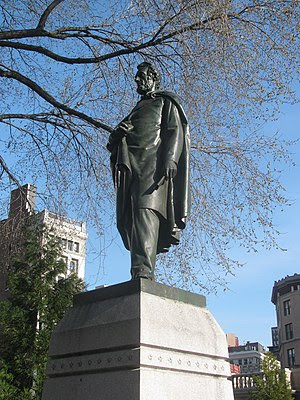
| "When I asked Woolly where we should meet, naturally he suggested the statue of Abraham Lincoln in Union Square." (p. 366). |
“Wasn’t it hard enough in the course of life to distinguish between fact and fancy, between what one witnessed and what one wanted? Wasn’t it the challenge of making this very distinction that had left their father, after twenty years of toil, bankrupt and bereft?” (p. 240)
![]() |
| Tiramisu that we enjoyed at Villa Mozart, Fairfax, VA, in 2015. Alas this restaurant is no longer in business. |
My first introduction to tiramisu was some tine in the 1980s while Len was attending a meeting in Sicily. The Europeans with whom we were having dinner were familiar with this creamy dessert, which was new and very popular in restaurants where they had eaten. By the end of the 1980s, little cups of tiramisu were available in French supermarkets, as the dish had become very trendy. In the US, its popularity started a bit later, but now it's everywhere!
![]() |
| A recent Costco purchase: imported tiramisu from Italy. It’s delicious! It’s eternally popular! But it’s not an old tradition! |
Remember in "Sleepless in Seattle," the widowed hero Sam (played by Tom Hanks) is worrying about how to act on a date, and his friend brings up tiramisu, as something that’s been invented since Sam was in the dating pool. Sam responds: “Some woman is gonna want me to do it to her and I’m not gonna know what it is!” In fact, the 1993 film seems to have created a demand for the introduction of tiramisu to restaurants all across the US. More about this:
In the DVD commentary, director and screenwriter Nora Ephron says “It hardly seems possible there was a time when all of America didn’t know what tiramisu was.” But that was indeed the case. The food was so unknown in 1993 that TriStar Pictures, the distributor of Sleepless in Seattle, reportedly received 25-30 phone calls per day from moviegoers asking the meaning of the joke. (source)
Italy’s father of tiramisu dies aged 93
Restaurateur Ado Campeol launched the coffee-flavoured dessert, whose name means ‘lift me up’, in 1972
An Italian restaurateur known as the “father of tiramisu” has died aged 93. Ado Campeol died at his home in Treviso, in the Veneto region, on Saturday.
Although the dessert’s origins are often disputed and the family never asserted copyright over the recipe, Campeol and his wife, Alba, the owners of the restaurant Alle Beccherie, are widely considered to be its inventor.
According to historians, the dish – featuring egg yolks whipped with mascarpone cheese, layered over coffee-soaked biscuits and topped with bitter cocoa powder – was added to their restaurant’s menu in 1972.
Now I would like to do a moment’s trivia peeving with Amor Towles, a very popular and otherwise wonderful author. In his new novel, The Lincoln Highway, Towles depicts a road trip that takes four characters across the USA in the summer of 1954. One character shares a vivid memory of a wonderful New York-Italian restaurant, including a long description of the way Leonello, the owner, works the room and tends to his customers:
After giving the ladies a few compliments, he’ll signal the bartender. Hey, Rocko. Another round over here for my friends. Then he’ll move on to the next table, where there’ll be more shoulder patting, more compliments for the ladies, and another round of drinks. Or maybe this time, it’s a plate of calamari, or some tiramisu. Either way, it’s on the house. And when Leonello’s finished making his rounds, everybody in the place—and I mean everybody from the mayor to Marilyn Monroe—will feel like tonight is something special. (Amor Towles, The Lincoln Highway, p. 163).
The details about life in 1954 seem very well researched, and I've been enjoying everything about the characters and the setting of the book. But I wonder why Towles didn't seem to do his background checks about the food he names, and I wonder what else he didn't quite get right. He even repeats the mistake: Billy, a curious and very bright kid, asks these questions: "What’s a trattoria...? What’s a paisano? What’s an artichoke and pancetta and tiramisu?" (p. 435).
I'm almost finished with The Lincoln Highway, and will probably write a glowing review of it soon. But I'm always disappointed when an author disrespects food history!
"At 5:45, with his five waiters standing at their stations, the Count made his nightly rounds of the Boyarsky. Beginning in the northwest corner, he circulated through the twenty tables to ensure that every setting, every saltcellar, every vase of flowers was in its proper place.
"At table four a knife was realigned to be parallel with its fork. At table five a water glass was moved from midnight to one o’clock. At table six a wine glass that had a remnant of lipstick was whisked away, while at table seven the soap spots on a spoon were polished until the inverted image of the room could be clearly seen on the surface of the silver.
"This, one might be inclined to observe, is exactly how Napoleon must have appeared when in the hour before dawn he walked among his ranks, reviewing everything from the stores of munitions to the dress of the infantry— having learned from experience that victory on the field of battle begins with the shine on a boot." (p. 203)The count is not the only fascinating character in the book: there are many, both men and women. I wondered about both the characters and the hotel itself and especially about its kitchens and head chef Emile Zhukovsky:
"Along the wooden tables the junior chefs are chopping carrots and onions as Stanislav, the sous-chef, delicately debones pigeons with a whistle on his lips. On the great stoves, eight burners have been lit to simmer sauces, soups, and stews. The pastry chef, who seems as dusted with flour as one of his rolls, opens an oven door to withdraw two trays of brioches. And in the center of all this activity, with an eye on every assistant and a finger in every pot, stands Emile Zhukovsky, his chopping knife in hand.
"If the kitchen of the Boyarsky is an orchestra and Emile its conductor, then his chopping knife is the baton. With a blade two inches wide at the base and ten inches long to the tip, it is rarely out of his hand and never far from reach. Though the kitchen is outfitted with paring knives, boning knives, carving knives, and cleavers, Emile can complete any of the various tasks for which those knives were designed with his ten-inch chopper. With it he can skin a rabbit. He can zest a lemon. He can peel and quarter a grape. He can use it to flip a pancake or stir a soup, and with the stabbing end he can measure out a teaspoon of sugar or a dash of salt. But most of all, he uses it for pointing." (p. 175).
![]() |
| The dining room of the hotel from Amor Towles' website |
"Because the Metropol was one of the few fine hotels in Moscow at the time, almost anyone famous who visited the city either drank at, dined at, or slept at the Metropol. As a result, we have an array of firsthand accounts of life in the hotel from prominent Americans including John Steinbeck, e. e. cummings, and Lillian Hellman." (Amor Towles Q & A)