

Wednesday, June 13, 2018

Sunday, June 10, 2018
"The Tuscan Child" by Rhys Bowen

The novel is suspenseful and enjoyable, and the food descriptions are indeed mouth-watering. The naive Joanna, first-person narrator of the 1973 chapters, is constantly impressed by the cuisine of her peasant hosts in the fictional village, and fascinated by their great cooking skills as she watches their preparations. She contrasts the delicious Tuscan food with the limited British food of her childhood and her life as a single woman in London. It's a fun read for a foodie.
Unfortunately I think the author's food research was a bit sketchy, and that many of the specific dishes that feature in Joanna's narrative have more to do with high-end 21st century restaurants and food writers than with accurate portrayal of Tuscan peasant cooking in 1973. (The food of 1944 was extremely scarce and doesn't figure in my critique.) Joanna's enthusiastic descriptions don't, in my opinion, seem convincing as a naive reaction, but use too much now-popular food jargon and too many cliches about both English and Italian cuisine. Her quotes from her the Italian hostess seem a bit too predictable and sophisticated as well.
Here, to explain my reactions, are specific examples of the indisputably delightful descriptions of the food served to Joanna on her visit in June, 1973, and an explanation of why I'm not convinced that they represent the reality of peasant life in rural Tuscany of that era. My impressions are based on the overall way that the book echoes current food writing, and on specific mistakes about regional food that are present in these passages.
"'Asparagus from the garden,' she said. 'It is asparagus season. Such a short time that we make the most of it and eat asparagus at almost every meal.'
"She placed a dish of white stalks in front of me, then drizzled them with olive oil and grated Parmesan cheese over them from a big block." (The Tuscan Child, p. 133, emphasis mine)The problem here: white asparagus is a specialty of a region near Venice, and doesn't grow in simple gardens like those in the description. Joanna's hostess in the village gathers the asparagus from "a feathery plant." (p. 152). White asparagus grows under a mound of sand to prevent it from being green, not as described. Maybe this is trivial, but it's part of a pattern of ignoring the regional differences in Italian foods.
The descriptions of food preparation and attitudes of Joanna's hostess also frequently sound more like high-end food writing than like the spontaneous conversation of a relatively uneducated woman. For example:
"'How do you make this soup?' I asked.
"She laughed. 'So simple. It is what we call part of our cucina povera— simple food for the peasants. And a good way to use up yesterday’s stale bread. It is simply stale bread soaked in broth, and then we cook the garlic, tomatoes, some carrot, and celery and add these to it, then serve with olive oil. That’s all.'" (p. 99).Cucina povera is a term you expect from culinary writers -- not so much from peasants describing their own food. It's a bit unconvincing.
I have similar doubts about the foods mentioned in the following meal:
"'We will have a good meal tonight if it is to be your last,' she said. 'A mushroom risotto, perhaps, before the aubergine Parmesan and panna cotta, definitely.'" (p. 278).Risotto, the rice dish, is characteristic of northern Italy around Milan, not Tuscany. Aubergine (eggplant) Parmesan is a classic dish from around Naples, Calabria, and Sicily, not Tuscany. And panna cotta is a specialty of the Piedmont and is known in Sicily. These dishes are also very popular outside Italy. Panna cotta and risottos appear on trendy menus at prestigious restaurants. The author pretends that Joanna is experiencing the authentic deep Tuscan cuisine, unspoiled and naive.
Finally, this last meal ends with a famous liqueur:
"We finished the meal with the little dishes of panna cotta— smooth and white and slipping easily down the throat, and to accompany it a glass of limoncello, the local liqueur." (p. 288).Limoncello became highly popular outside Italy long after 1973, which supports my theory that the author used modern sources about Italian food, not historic ones. More importantly, limoncello is not at all a specialty of Tuscany: rather, it is "mainly produced in Southern Italy, especially in the region around the Gulf of Naples, the Sorrentine Peninsula and the coast of Amalfi, and islands of Procida, Ischia, and Capri." (Wikipedia, "Limoncello," retrieved June 10, 2018)
All in all, The Tuscan Child is a readable book. The plot is a little exaggerated, but that's ok. The characters are portrayed effectively, and in general I liked the settings. In the Afterword, the author mentions doing real research about World War II airplanes -- I have no knowledge of this aspect of the book, so I take her word that she made it accurate. I wish she had done the same with her descriptions of Tuscan peasant food.
*I'm grateful to blogger Tina at the blog Novel Meals for the review that got me to read the book. Check it out at Tina's blog HERE.
Friday, June 08, 2018
Auguste Escoffier: "Memories of My Life"

The endless inventions of the famous French chef Auguste Escoffier (1846-1935) include many iconic dishes such as peach Melba and several duck recipes. Escoffier is recognized as the inventor of new restaurant concepts in collaboration with César Ritz (1850-1918), the hotel impressario. In particular, Escoffier was responsible for firmly establishing the custom of à la carte dining where restaurant diners ordered from a menu rather than being served a set meal. His restaurants in several cities were popular with the highest of high society, with European royalty and with other celebrities, notably the Prince of Wales (later King of England); the Kaiser of Germany; author Emile Zola; opera diva Nellie Melba; and actor Sarah Bernhardt. Steamship lines, American hotels, and many restaurants requested the services of Escoffier as a consultant, which he gladly accepted because he wanted to promote fine French food throughout the world.
After Escoffier's death, his grandson created the book Memories of My Life from a number of documents found among his papers. The English translation, published in 1997, contains additional material. Besides all of the well-known accomplishments, Memories documents Escoffier's military service in the Franco-Prussian War (1870-1871), when he cooked for the troops and was taken as a German prisoner of war. He reveals himself to have been a generous person. For example, he arranged to have properly conserved leftover food from a restaurant regularly donated to a charity home where it enabled residents to enjoy an excellent meal. He requested that a tribute fund meant to purchase a gift for him, in honor of his retirement, be donated instead to an old-age home for destitute chefs.
I regret to say that I don't think the recipes in the book are achievable now, at least not as written. Too many truffles, for one thing. Consider the recipe for Mousse de Merlan aux Ecrevisses (fish mousse with shrimp, subtitled "Le Réve de Katinka" in honor of a famous dancer). Besides fish and shrimp, it calls for "a few" sliced truffles to line a mould for the mousse, and then another 125 grams of raw truffles to flavor the sauce -- up to $1000 worth of truffles at current prices.
Besides the cost of truffles, making a mousse by Escoffier's method is very demanding. It requires pressing a mixture of fish and other ingredients through a fine sieve, chilling it on ice, and working in heavy cream. Too much work for me. However, I love the following instructions from the recipe, especially the part about using one's sense of smell:
"While the mousse is cooking, boil 36 large shrimp in a white wine court bouillon. Remove their shells and place the tails in a sauce pan with 2 teaspoons of butter and 125 grams of raw truffles, peeled and sliced, and a little salt and pepper. Cover the saucepan and heat the shrimp for several minutes, until the aroma of the truffles is perfect." (p. 80)
 Escoffier's most famous dish is surely Peach Melba, named for the famous soprano Nellie Melba (1861-1931). Escoffier invented it, he wrote, "for the opening of the Carleton Hotel," which was in 1899. He continued:
"I presented her with a dessert of peaches on a bed of vanilla ice cream, covered with a lace of spun sugar, and placed in a silver bowl nestled between the wings of a beautiful swan sculpted out of a large block of ice. The effect was stunning." (p. 115)It's essential to use "tender and very ripe peaches... and a purée of sugared raspberry." Warnings against substitutions are emphatic:
"Any variation on the recipe ruins the delicate balance of its tastes. ... Some take the liberty of replacing the raspberry purée with strawberry jam or red currant jelly... Others suggest decorating the peach with whipped cream. The results obtained have absolutely nothing to do with the original recipe and could hardly satisfy the palate of a real connoisseur." (p. 116)In other words, if you want to follow Escoffier, you better get it right! If you see Peach Melba on a menu today, it's probably a peach half (maybe from a can) with red fruit sauce, ice cream, and whipped cream. Escoffier would not approve! A google search for "peach melba" suggests that there's a whole lot of desecration going on.
Escoffier's Memories include only a few of the most notable recipes. A huge number of Escoffier's recipes and techniques, along with many traditional French culinary skills, appeared in 1903 in his immediately classic book: Le Guide culinaire, aide-mémoire de cuisine pratique, translated as The complete guide to the art of modern cookery. Escoffier clearly intended the book as a guide for chefs in fine restaurants, but also he says:
"It is absolutely necessary that waiters be able to answer the questions of any customer wanting to know the content of any dish, without having to ask somebody in the kitchen. Therefore, they need precise information put forth concisely." (p. 172)Although I've always had the impression that Escoffier was very old-school, and had been superseded by various subsequent styles of French cuisine, I was surprised at how many of his essential ideas still seem relevant at the current times. Wouldn't it be nice if waiters were truly well informed? And if restaurateurs had a social conscience?
Wednesday, June 06, 2018
Over the top: more food shows from Netflix

Netflix watchers, ourselves included, seem to be insatiable when it comes to food shows. We are alternating among a few newish ones: Mega Food (dated 2013, released on Netflix early this year); Nailed It (March); and Ugly Delicious, which we've been watching since it came out in February.
The first episode of Mega Food is about a gigantic restaurant/pub in Queensland, Australia. The food there looks fabulous -- watching it made us ravenous, which I can't say any of the other food shows have done. The owners and managers seem incredibly amiable and disciplined, and the atmosphere portrayed in their kitchens is really impressive. They buy local greens and berries from farmers, butcher their own meat, make bread and pasta, and established good supplier relationships. The plates being sent out of the kitchen all look delicious. They even buy beautiful old lumber and serve as their own contractors for building and remodeling their quite large establishment.
 |
| A chef making pasta and talking about his family background. |
 |
| An in-house butcher, cutting up steaks. I noticed that many of the food workers wore gloves while handling food. |
The second episode of Mega Food was set in Florence, Italy. It followed a caterer who was setting up temporary kitchens and huge cocktail parties and buffets for a major fashion event, including dozens of waiters and service workers. I found it much less interesting than the first episode. We will probably only watch one or two more in this series, which was made in England (I think).
 |
| I noticed that the Italian caterers never wore gloves, even when working with food that was not going to be cooked later. Somehow I seemed to notice a lot of things there that would be health-code violations here! OOPS. |
The third Netflix series is Nailed It. It's not actually labeled a food show but a "reality" show, and it's closely copied from The Great British Baking Show. The judges include highly professional bakers, but the contestants are rank amateurs who are given impossible tasks to perform. At least the contestant who produces the least abject failure is awarded $10,000.
Although the participants seem amused by their inevitable failures, not humiliated, this show just doesn't do much for me. I was enticed to watch by an enthusiastic review in the New Yorker titled "The Joys of Netflix’s 'Nailed It!,' the Baking Competition That Celebrates Kitchen Disaster" by Helen Rosner. Too bad I don't share her enthusiasm.
 |
| Judging pathetic wedding cakes which contestants had only 2 hours to make. At left: the judges. The leftmost one reminds me of Mary Berry of GBBS; next: Nicole Byer, the comedian/MC; and judge Jacques Torres, famous chocolate maker. At right: the contestants with their wobbly cakes. Farthest back: a beautiful model cake that nobody duplicated. |
This week, we watched the Ugly Delicious episode on barbecue -- which Chang defines as anything cooked with lots and lots of flames, including a variety of Asian foods. Here, with friends, including famous food writer Fuchsia Dunlop, he's eating Peking Duck in China:


All images are screen shots from the Netflix shows we watched this week.


All images are screen shots from the Netflix shows we watched this week.
Tuesday, June 05, 2018
The Little Free Library
 |
| My neighbor Anne received this Little Free Library as a gift over a year ago. People have been putting books in it, and recently at least one person among them seems to share my reading tastes. Thank you, Anne! Thank you, person! |

The psychological twists and turns of the story are very gripping. First-person internal narratives, which alternate among several of the characters, work amazingly effectively, creating immense suspense.
But I'm pretty late to the party -- everyone who had something to say about this book probably said it a couple of years ago.

Several other Little Free Libraries are scattered around my neighborhood. As I walked past another of them the other day I saw one of the delightful children's books by Russell and Lillian Hoban, but I didn't take it since I don't have any children around to read to. Such a great idea for recycling books! I'll have to choose a few good titles from my massive book stacks to contribute to Anne's library.
Thursday, May 31, 2018
The New and the Old in my Kitchen in May
 |
| New in May: our second Dutch oven for baking bread. Now two round loaves can bake at the same time. The cast iron frying pan on the lower oven rack helps to keep the oven temperature even when the door is opened. |
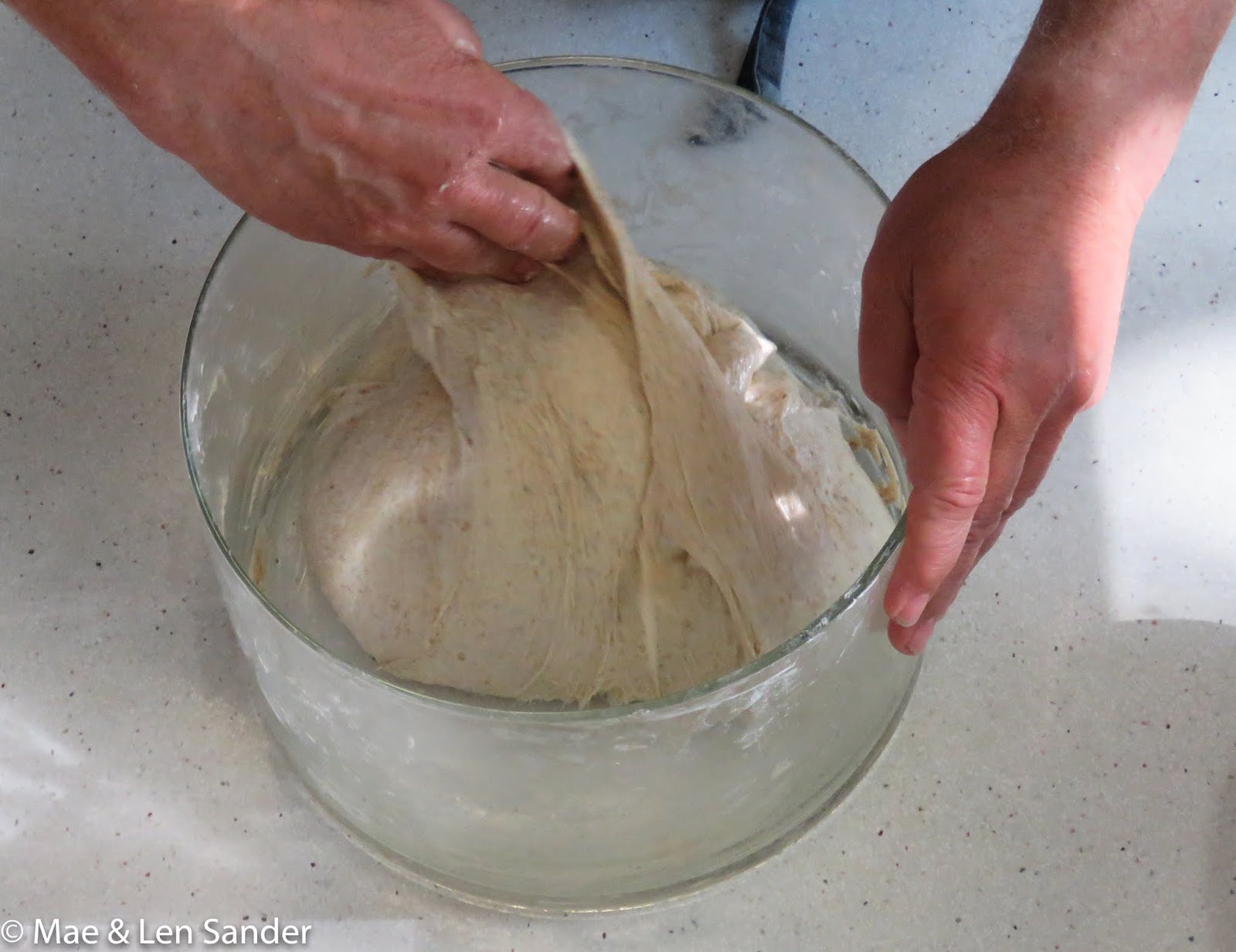 |
| Old and new: a large glass bowl in use for folding bread dough. |


 |
| Two newly-purchased baking books: Flour Water Salt Yeast by Ken Forkish and The Bread Baker's Apprentice by Peter Reinhart. |
 |
| The internet is another source of recipes. However, Len's most successful breads so far have come from recipes in Flour Water Salt Yeast. Also repurposed: plastic flour storage box originally from Costco biscotti. |
 |
| A small rye loaf was the first attempt, but the rise was not satisfactory. |
 |
| Len's successful rye loaves, baked in the new and old Dutch ovens, were delicious, with a perfect crumb and crust. |
 |
| Another success: overnight wheat bread, same source. |
Also in the Kitchen in May: A Low-key Celebration of the Royal Wedding

We didn't eat much while watching the wedding since it started at breakfast time. But the day before the wedding, I tried an appropriate recipe for lunch: Coronation Chicken. This dish was served at the coronation of Elizabeth II. Basically it's chicken with fruit, usually mango and apricots, in a curry mayonnaise. Shown here: the fruit mixture and the sautéed and spiced chicken breast cubes, ready to be tossed together.
OK, a wedding is not a coronation, but I thought it was in the spirit of the celebration. I know some people baked elderflower-flavored cake to be like the royal wedding cake, but that's not my kind of thing.
 |
| Coronation chicken, garnished with parsley. |
 |
| On the plate with plum chutney and mango chutney. |
 |
| Wrong wedding! I didn't have any souvenirs of the current one. This tea cannister was a gift from Evelyn. |
 |
| Among my many British tea towels, I thought this was a very appropriate one. I don't iron my tea towels. Sorry. Please don't judge me. |
 |
| The Royal Yacht Britannia on another tea towel, also a gift from my wonderful friend Sheila. The yacht was in service from 1954-1997, and was used for four royal honeymoons including Charles' and Diana's. |

One more royal souvenir: a Wedgwood sugar bowl commemorating a 1939 visit to Canada of King George and Queen Mary, the great-grandparents of the current royal bridegroom. This was originally a wedding gift to Elaine's mother-in-law. Elaine gave it to me a few years ago because I have a tea pot in the deep-blue Wedgwood pattern, though not a commemorative item.
"In My Kitchen" is brought to the blogging community by Sherry, who blogs from Australia at Sherry's Pickings. WHY "SHERRY'S PICKINGS"? she asks. Her reason: "I am Picking out all the best things in life." To see the best things that Sherry and other bloggers throughout the world have in their kitchens this month, link here: http://sherryspickings.blogspot.com/
Wednesday, May 30, 2018
Zora Neale Hurston's "Barracoon"

Zora Neale Hurston (1891-1960) was an anthropologist and novelist, writer of several successful and still-classic books. Unfortunately, publishers rejected this work, and it's just been released for the first time this month.
The first thing I learned while reading Barracoon was the definition of the word in the title. This word, barracoon, very poignantly embodies the cruelty that slavery implies. Here is the definition given at the beginning of the book:
"Barracoon: The Spanish word barracoon translates as 'barracks' and is derived from barraca, which means 'hut.' The term 'barracoon' describes the structures used to detain Africans who would be sold and exported to Europe or the Americas. These structures, sometimes also referred to as factories, stockades, corrals, and holding pens, were built near the coast. They could be as insubstantial as a 'slave shed' or as fortified as a 'slave house' or 'slave castle,' wherein Africans were forced into the cells of dungeons beneath the upper quarters of European administrators. Africans held in these structures had been kidnapped, captured in local wars and raids, or were trekked in from the hinterlands or interior regions across the continent. Many died in the barracoons as a consequence of their physical condition upon arrival at the coast or the length of time it took for the arrival of a ship. Some died while waiting for a ship to fill, which could take three to six months. This phase of the traffic was called the 'coasting' period. During the years of suppression of the traffic, captives could be confined for several months." (Kindle Locations 14-22).Kossola, or Cudjo, told Hurston his story of his life as a boy in an African village, his subsequent capture by men from Dahomey, the trek through the jungle, his confinement in the barracoon, how he was shipped across the ocean, his life as a slave in America, and the challenges of life as a free man after the Civil War. She transcribed his accented English phonetically, and followed his wishes to tell the story in the order that he chose, beginning with the life of his grandfather.
I find his narrative of imprisonment in the barracoon and then crossing the ocean so moving and vivid that I'm just going to quote a long passage of excerpts without trying to comment:
“When we git in de place dey put us in a barracoon behind a big white house and dey feed us some rice.
“We stay dere in de barracoon three weeks. We see many ships in de sea, but we cain see so good ’cause de white house, it ’tween us and de sea.
“But Cudjo see de white men, and dass somethin’ he ain’ never seen befo’. In de Takkoi we hear de talk about de white man, but he doan come dere.
“De barracoon we in ain’ de only slave pen at the place. Dey got plenty of dem but we doan know who de people in de other pens. Sometime we holler back and forth and find out where each other come from. But each nation in a barracoon by itself. ...
“Dey takee de chain off us and placee us in de boats. Cudjo doan know how many boats take us out on de water to de ship. I in de last boat go out. Dey almost leavee me on de shore. But when I see my friend Keebie in de boat I want go wid him. So I holler and dey turn round and takee me.
“When we ready to leave de Kroo boat and go in de ship, de Many-costs snatch our country cloth off us. We try save our clothes, we ain’ used to be without no clothes on. But dey snatch all off us. Dey say, ‘You get plenty clothes where you goin’.’ Oh Lor’, I so shame! We come in de ’Merica soil naked and de people say we naked savage. Dey say we doan wear no clothes. Dey doan know de Many-costs snatch our clothes ’way from us. ...
“Our grief so heavy look lak we cain stand it. I think maybe I die in my sleep when I dream about my mama. Oh Lor’!” (Kindle Locations 815-867).
 | |
| Illustration from Barracoon titled: "The 'Door of No Return' at La Maison des Esclaves (House of Slaves) at Gorée Island in Senegal, West Africa. Above the entryway: 'Lord, give my people, who have suffered so much, the strength to be great' (Joseph Ndiaye)." (Kindle Location 261) |
Monday, May 28, 2018
Memorial Day
 |
| Our host Nat with BBQ ribs for a quiet Memorial Day. We also had corn, potato salad, and ice cream with strawberries. |

 |
| Len's bread was my contribution, although he's away and wasn't at the picnic. |
 |
| The lake was tranquil as usual, although unusually many people were boating today, as is always true for Memorial Day. |
Sunday, May 27, 2018
"Gourmet Rhapsody" by Muriel Barbery
A childhood memory of a meal in Morocco:

As a radical and influential food critic, this character had spent his life expressing thoughts about what he ate. On his deathbed, thoughts of many things that he had enjoyed eating rushed through his head as he tried to imagine one special taste from his past. Each chapter of the book represents one stream of consciousness from his mind or from the mind of another character that is somehow connected to him and to his immanent death; no character is aware of the inner thoughts of any other. What a strange premise for a novel!
The dying food critic also recalls many tastes and food experiences from his life in France and his adventures as a professional eater. Another of this character's memories:
Muriel Barbery became famous around a decade ago for her novel, The Elegance of the Hedgehog, which takes place in a Paris apartment building. This apartment building on rue de Grenelle in Paris is also the site of Gourmet Rhapsody. As I've been reading this earlier novel I've enjoyed Barbery's perspective on many things and her skillful and terse way of portraying characters from their inner thoughts. She's an interesting author, whose work obviously appeals to readers in many countries.

"I will, at least, have had the opportunity to recall this: the grilled meat, the mechouia salad, the mint tea and the cornes de gazelle. I was Ali Baba. The cave of treasures: this was it, the perfect rhythm, the shimmering harmony between portions, each one exquisite unto itself, but verging on the sublime by virtue of the strict, ritual succession. The meatballs, grilled with the utmost respect for their firmness, had lost none of their succulence during their passage through fire, and filled my professionally carnivorous mouth with a thick, warm, spicy, juicy wave of masticatory pleasure. The sweet bell peppers, unctuous and fresh, softened my taste buds already subjugated by the virile rigor of the meat, and prepared them for the next powerful assault. Everything was there in abundance. ... When at last we were sated and somewhat dazed, we would shove our plates away and look in vain for a back to the bench so that we might relax; the waiter brought the tea, poured it according to the established ritual, and on the table, which had been only haphazardly wiped clean, he set down a plate of sugar-covered crescents, the cornes de gazelle. No one was the least bit hungry anymore, but that is precisely what is so good about the moment devoted to pastries: they can only be appreciated to the full extent of their subtlety when they are not eaten to assuage our hunger, when the orgy of their sugary sweetness is not destined to fill some primary need but to coat our palate with all the benevolence of the world." (Gourmet Rhapsody, Kindle Locations 160-172).Vivid food descriptions like the one quoted above are the center of interest in Muriel Barbery's novel Gourmet Rhapsody. These passages represent the inner thoughts of a dying man; the specific memory above concerned his childhood meals while visiting relatives in his mother's native country, Morocco, which is also the birthplace of the author.
As a radical and influential food critic, this character had spent his life expressing thoughts about what he ate. On his deathbed, thoughts of many things that he had enjoyed eating rushed through his head as he tried to imagine one special taste from his past. Each chapter of the book represents one stream of consciousness from his mind or from the mind of another character that is somehow connected to him and to his immanent death; no character is aware of the inner thoughts of any other. What a strange premise for a novel!
The dying food critic also recalls many tastes and food experiences from his life in France and his adventures as a professional eater. Another of this character's memories:
"I bit into the fruit, I bit into the tomato. In salads, baked, in ratatouille, in preserves, grilled, stuffed, cherry, candied, big and soft, green and acidic, honored with olive oil or coarse salt or wine or sugar or hot pepper, crushed, peeled, in a sauce, in a stew, in a foam, even in a sorbet: I thought I had thoroughly covered the matter and on more than one occasion I wrote pieces inspired by the greatest chefs’ menus claiming that I had penetrated its secret. ...
"Sugar, water, fruit, pulp, liquid or solid? The raw tomato, devoured in the garden when freshly picked, is a horn of abundance of simple sensations, a radiating rush in one’s mouth that brings with it every pleasure. The resistance of the skin— slightly taut, just enough; the luscious yield of the tissues, their seed-filled liqueur oozing to the corners of one’s lips, and that one wipes away without any fear of staining one’s fingers; this plump little globe unleashing a flood of nature inside us: a tomato, an adventure." (Kindle Locations 440-452).Could this only be written by a French person? Impossible to say, but stereotyping of French attitudes would lead to this idea. In fact, I came across this novel when pursuing my current project of finding out what French people read and write when they read and write about food. I'm looking at it as a source of insights into a perhaps different mindset than that of Americans who write lovingly about Paris restaurants and Provencal romantic getaways.
Muriel Barbery became famous around a decade ago for her novel, The Elegance of the Hedgehog, which takes place in a Paris apartment building. This apartment building on rue de Grenelle in Paris is also the site of Gourmet Rhapsody. As I've been reading this earlier novel I've enjoyed Barbery's perspective on many things and her skillful and terse way of portraying characters from their inner thoughts. She's an interesting author, whose work obviously appeals to readers in many countries.
Friday, May 25, 2018
French Food Books

Cookbooks, history books, and memoirs about French cuisine are popular and fascinating, and I've read and cooked from quite a few of them. The majority of these works, however, were not written in French or written by French people. I've challenged myself to find books on the history and culture of food written in French by and for French readers -- and thus to learn what French people read when they want to read about food. I hope to find some books that will be appropriate for future reading in my culinary history reading group, to whom I've suggested that we try to read some actual French sources rather than just Americans.
Using google.com, google.fr, amazon.com, amazon.fr, and the bibliographies of books I've read, I have identified some such books, though I've mainly located academic sources rather than books written for a general reading public. Quite a few of these are very general histories of food in human history or of French food throughout all of French history, while I would like to find more specific histories comparable to those popular in the US. Also, I haven't yet found many very recent ones, although I've searched the best-sellers in amazon.fr -- a few sound interesting but do not seem to have appeared in English translation.
The photo above shows some of the French food books, other than cookbooks, that I own. I have read several of them, and have already written about a few on this blog. This is a preliminary list of French food books translated into English.
- Jean Anthelme Brillat-Savarin, The Physiology of Taste: or Meditations on Transcendental Gastronomy.
- Alexander Dumas, Le Grand Dictionnaire de Cuisine, translated into English under various names, usually abridged.
- Madeleine Ferrières, Sacred Cow, Mad Cow: A History of Food Fears.
- Jean-Louis Flandrin, Arranging the Meal: A History of Table Service in France.
- Jean-Louis Flandrin and Massimo Montanari, Food: A Culinary History, collection of essays.
- Prosper Montagne, Larousse Gastronomique: The Encyclopedia of Food, Wine & Cookery. (Obviously not a book to be read for a single discussion!)
- Anka Muhlstein, Balzac's Omelette.
- Jean-Robert Pitte, French Gastronomy.
- Edouard de Pomiane, Cooking with Pomiane. (I did a big project on Pomiane a few years ago.)
- Jean-François Revel, Culture And Cuisine: A Journey Through The History Of Food.
- Herve This, Molecular Gastronomy: Exploring the Science of Flavor and other books on molecular gastronomy.
- Maguelonne Toussaint-Samat, A History of Food.
There will be more ... I hope!
All photos and text copyright 2018 by Mae E. Sander. Published at maefood dot blogspot dot com. If you read this elsewhere, it has been stolen.
All photos and text copyright 2018 by Mae E. Sander. Published at maefood dot blogspot dot com. If you read this elsewhere, it has been stolen.
Wednesday, May 23, 2018
What did Balzac eat?

Balzac's Omelette is a delightful study of the food that nineteenth-century French author Honoré de Balzac (1799-1850) described in his many novels and stories, as well as his own rather eccentric eating habits. Author Anka Muhlstein, a native of Paris, provides just the right amount of background, as well as additional information about food as depicted by later French authors such as Flaubert and Zola. I really enjoyed reading it, and I suspect that the quality of this book is also due to the translator, Adriana Hunter. I'm only writing a very brief review here.
The following passage about a dishonest landlady in one of Balzac's novels illustrates Muhlstein's approach:
"Sadly, Cousin Pons and his friend Schmucke lack this attention to detail and knowledge of current prices when they try to keep an eye on their conceirge, Madame Cibot, who cooks their meals and, in so doing, leads them to ruin. She boasts to her husband that she has amassed two thousand francs in eight years thanks to her cunning and talent. In fact, rather than going to a butcher, she rummages through the stalls at a regrattier, who buys leftovers from nearby restaurants. With a fiercely discerning eye, she choose the best-looking debris of chicken or game, fish fillets, or even boiled beef, which she dresses up with finely sliced onion. Using this technique, she cooks such strong-smelling sauces that her lodgers never complain, and she makes them pay three francs 'without wine' for these dinners, a sizable sum if we consider that, in a modest but acceptable restaurant, a meal with a small carafe of wine cost a maximum of two francs." (p. 111)You can see how Muhlstein selects food details to show a great deal about the landlady/concierge who serves repurposed food as if it were fresh. The entire book is full of captivating retellings of just the foodie parts of Balzac's great novels, offering lots of insight into how he used food to make his characters vivid.
One thing about this passage is the wonderful word regrattier: a dealer in leftover food from restaurants or from receptions or dinner parties in wealthy or aristocratic homes. This is strictly a French word, but I think we need to borrow it in English. I'm including it for Wordy Wednesday because it's such a great word.
Unlike in 17th and 18th century Paris, today's redistribution of previously offered foods is usually the work of organizations for feeding the needy. For example, Ann Arbor's Food Gatherers began in 1988 when volunteers "borrowed a van and collected 50 pounds of vegetables, bread, milk, and eggs from half a dozen grocery stores and restaurants. The food was quickly re-distributed to hot meal programs in Ann Arbor and Ypsilanti." (link) Today Food Gatherers still collects unused or nearly-out-of-date food, though it has many more sources including people's gardens and nationwide warehouses of food for this purpose.
Balzac's Omelette, which was published in 2011, includes some delightful illustrations. Here are two of them in color (though in the book the reproductions were in sepia tones).
 |
| Les Halles, 1893, by Leon Lhermitte. Shopping in Paris markets, especially Les Halles, was a topic of quite a few of the authors mentioned in the book. |
 |
| The Oyster Eaters, 1825, by Louis-Léopold Boilly. |
Tuesday, May 22, 2018
May Flowers
 |
| In the Nichols Arboretum, Ann Arbor. |

 |
| Spring violets -- a favorite. |
 |
| Many types of wild flowers bloom in the wooded area of the Arb. |
 |
| At Matthaei Botanical Gardens Bonsai display: a flowering fruit tree in bloom. Both the Arb and the Botanical Garden belong to the University of Michigan. |
 |
| Flowering tree in my backyard. |
 |
| Lilly of the Valley: another backyard favorite, though some think they are weeds. |


 |
| Dandelions growing in the ponds at Howard Marsh Metropark near Toledo, Ohio. Everyone thinks they are weeds! |
 |
| It's hard to stop looking at flowers. Now the irises are just beginning to bloom, but I've used Van Gough's for variety. |
Subscribe to:
Posts (Atom)