Showing posts with label William Butler Yeats. Show all posts

Friday, March 17, 2023

Happy Saint Patrick's Day!

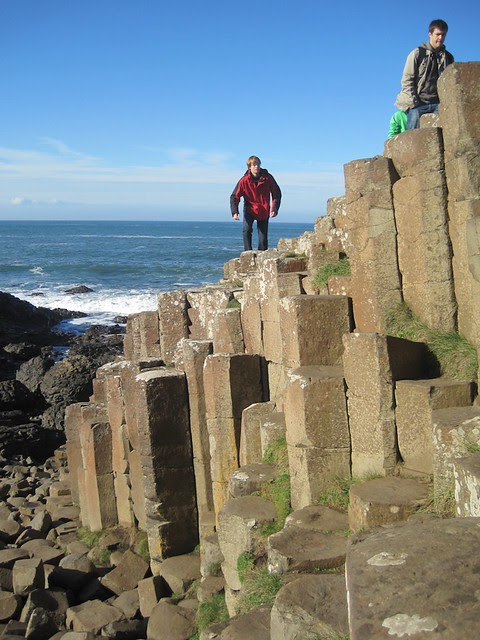
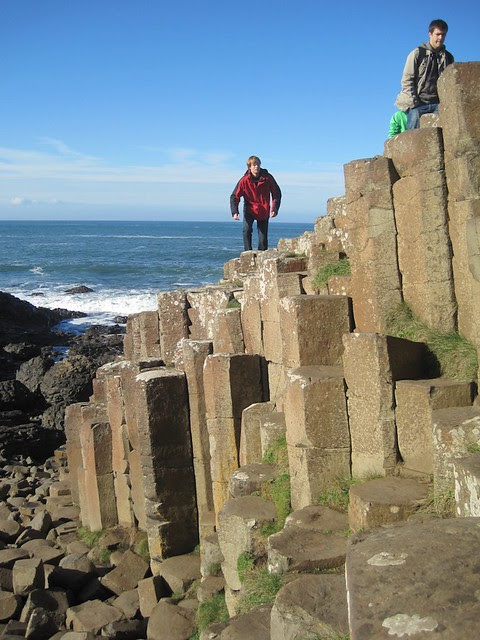
At the Giants Causeway, March 2011. This mysterious rock formation was made by the
giant Finn McCool of Ireland. (Or if you prefer, by volcanic activity)
One of many places we have visited with Arny and Tracy on our visits with them in Ireland.

On several trips to Ireland, I've come to love the green beauty of the Irish landscape and also to appreciate the cuisine, which is not in the least dominated by corned beef and cabbage or by potatoes. These are the American cliches about Irish food! Here are some photos that I have posted before, to celebrate Ireland.

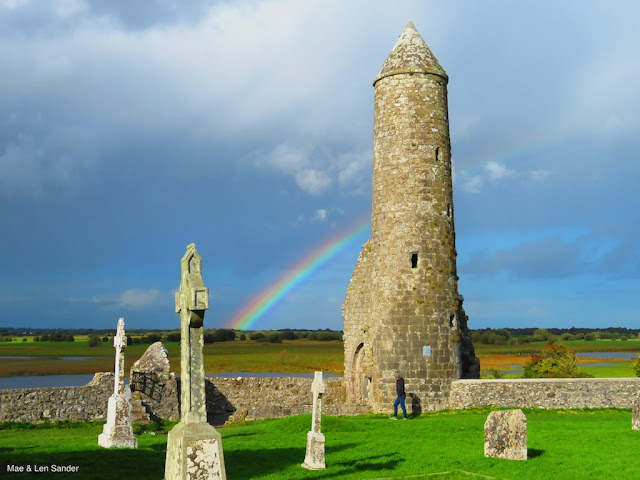
Clonmacnoise National Historic Site, County Offaly, Ireland.

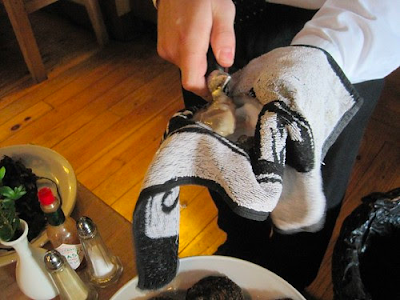
Opening an oyster at Moran's Oyster Cottage at Coole near the estate made famous
by William Butler Yeats. We've been there several times.

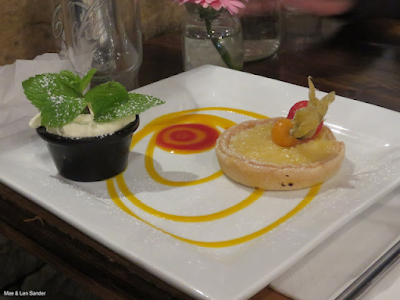
Lemon tart at a restaurant in Galway.

Swans near Moran’s Oyster House, reminding me of the Yeats poem “The Wild Swans at Coole.”
”But now they drift on the still water,
Mysterious, beautiful”

Irish sheep in 2016.


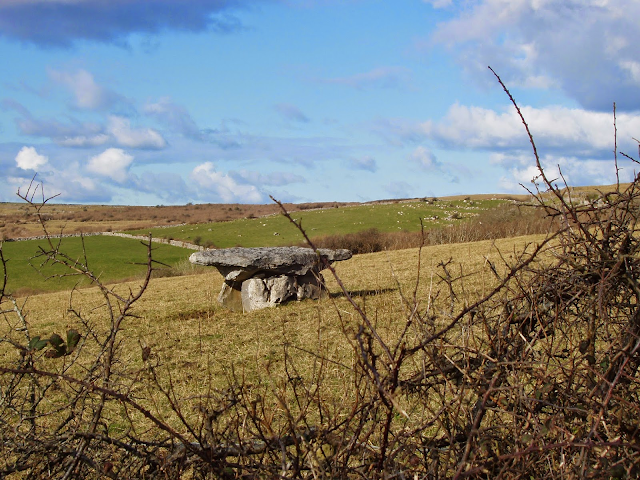
Ancient Dolmen at the Burren near Galway, 2005

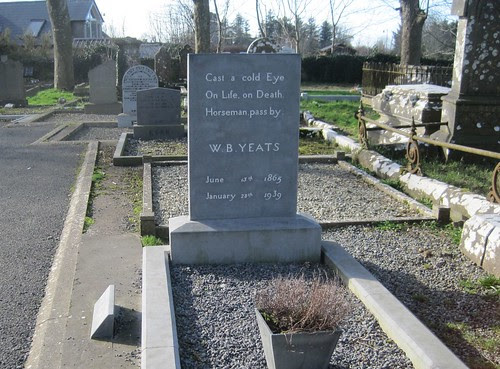
"Under bare Ben Bulben's head
In Drumcliff churchyard Yeats is laid.
An ancestor was rector there
Long years ago, a church stands near,
By the road an ancient cross." -- W.B.Yeats

Photos © 2005-2023 mae sander

Tuesday, March 17, 2020

Happy St. Patrick's Day

St. Patrick's Day 2009 in a Mexican restaurant in San Diego.
We were surprised to find an Irish celebration in front of a Mexican mural!
The traditional American celebrations of St.Patrick's Day involve parades and big parties at bars with green beer. This year, the coronavirus has cancelled most of that. I don't normally go to bars anyway, but I love Ireland, where I've visited several times. To celebrate St. Patrick's Day in my own way, I decided to re-publish a blog post about Ireland that I wrote in 2011.

giants5237
At the Giants Causeway, March 2011. This mysterious rock formation was made by the
giant Finn McCool of Ireland. (Or if you prefer, by volcanic activity)

Where Do Irish Fairies Live? 

Originally posted on my travel blog in March, 2011

The landscape in Ireland is full of ancient stones. Old towers and seaside fortifications from the Middle Ages. Early Christian churches, holy wells, and abbeys with a few standing arches from once-secluded cloisters. Stone walls from all eras dividing the land into sheep pens. Ruined castles from many different centuries. The giant Finn McCool's causeway. And neolithic tombs, forts, and other constructions.

My perspective in seeing all these bare stones on my three trips to Ireland has always been historical: I try to learn about the eras when many races and tribes came to Ireland and built new lives and new stone structures. I envisioned how these peoples cut down the ancient forests and turned them into bogs and stony fields. I read about centuries of fighting, famine, colonization, and other events affected the landscape.

But how did the Irish farmers two centuries ago view all this evidence showing centuries of human occupation? They had little historic information, and less understanding of how ancient the neolithic tombs and forts were created. The mysteries of their surroundings created a sense of enchantment. Irish folk tales invented Finn McCool to create the giant's causeway, and imagined races of fairies, wee people, leprechauns (who are originally shoe makers), banshees, and many others to populate these very scary ruins. In their stories, doors would open amidst the stones, old tombs would light up and songs would sound into nighttime darkness, and the old castles would come to life with ethereal people who couldn't be seen in daylight.

neolith2005c
Neolithic stones, photo from our 2005 trip.

In reading William Butler Yeats's Irish Fairy and Folk Tales, I'm getting a much more vivid picture of how the fairies live. In one story, a man named Lusmore was walking slowly home one night, when "he came to the old moat of Knockgrafton, which stood on the right-hand side of his road." A moat is a neolithic tomb, such as I saw on my trip.
"Tired and weary was he, and noways comfortable in his own mind at thinking how much farther he had to travel, and that he should be walking all the night; so he sat down under the moat to rest himself, ... Presently there rose a wild strain of unearthly melody upon the ear of little Lusmore; he listened, and he thought that he had never heard such ravishing music before. It was like the sound of many voices, each mingling and blending with the other so strangely that they seemed to be one, though all singing different strains, and the words of the song were these--
"Da Luan, Da Mort, Da Luan, Da Mort, Da Luan, Da Mort;
"when there would be a moment's pause, and then the round of melody went on again. ... The fairies within Knockgrafton, for the song was a fairy melody ... " -- The Legend of Knockgrafton

neolith2005b
Another neolithic tomb in The Burren, from our 2005 trip

neolith5497
Poulnabroe, a well-preserved neolithic portal tomb

neolith5152


neolith5147

neolith5153
One more portal tomb, north of Sligo, 2011
Castles such as the ones we saw were also homes for fairies; from the tale of a young man:
"An old ruined castle, about a quarter of a mile from his cabin, was said to be the abode of the 'wee folk.' Every Halloween were the ancient windows lighted up, and passers-by saw little figures flitting to and fro inside the building, while they heard the music of pipes and flutes. It was well known that fairy revels took place; but nobody had the courage to intrude on them." -- Jamie Freel and the Young Lady

castle2-1

If fairies or pookas come here now, they disturb the residents of the just-visible adjacent housing development!

Saturday, October 08, 2016

In My Kitchen: October, 2016

My Kitchen Door
While we were in Ireland and London, we had a new kitchen door installed. The old one was ruined by a painter who painted the gasket which therefore rotted the door inside. The new one also has a new doorstep and better weatherstripping.


The only other new items in my kitchen are three Irish magnets and one English magnet. The Irish ones depict writers James Joyce and William Butler Yeats as well as a 3-D "Irish Pub." The British Museum magnet is a cast of one of the famous medieval chess pieces (which I showed in an earlier post).

My bare refrigerator shelves after 2 weeks away: I need to go to the market!

The Kitchen In Ireland.

We stayed with Arny and Tracy for almost a week, so their Irish kitchen was sort of "my" kitchen for that time; at least, it's where we ate breakfast every day and fixed other meals. Here's Tracy -- the main cook -- as she was finishing several dishes for the 4 of us and 4 guests:


While we were visiting, their new refrigerator was delivered.
It's very small by US standards, but the landlords like it that way.
The dining room table, ready for the guests. The first course, Caprese salad, was made with
delicious ripe tomatoes, fresh basil, and Irish-made mozarella, all, I believe, from Aldi.
Tracy made chicken piccata and roasted vegetables for the main course, and one of the guests
brought a pear crumble made with pears from her own tree.
"In My Kitchen" is hosted by Lizzy of Bizzy Lizzy's Good ThingsYou can find links to many other blogger kitchens there.

Tuesday, March 17, 2015

Happy Saint Patrick's Day

Ancient Dolmen at the Burren near Galway, 2005
Thinking of Ireland and food, I can't help remembering the terrible Irish crop failure and famine in the 19th century that drove more than half the population to emigrate, mainly coming here to the US. Consequently, I'm remembering the important contributions of Irish-Americans like President Kennedy.

More cheerfully, for this holiday I've chosen a few photos of Ireland, mainly food, from our visits to Arny and Tracy when they lived there. There's much more good food in Ireland than we know about over here.

ArnyKitchen0404
Cooking in Arny and Tracy's kitchen, Galway, Ireland, 2011

monks3
Lunch at Monk's Pub, Ballyvaughn Ireland  
morans0-1
Opening an oyster at Moran's Oyster Cottage at Coole near the estate made famous
by William Butler Yeats
moycullen1
Open-air market at Moycullen, a small town near Galway

At a restaurant near Galway, 2005 

Hearth inside Yeats's tower at Gort, from our visit in 2000.

Cooking hearth at the Rock of Cashel, from our visit in 2000.
The Rock of Cashel is also known as Saint Patrick's Rock.
Happy Saint Patrick's Day!

Thursday, February 26, 2015

"The Longshoremen's Noon" and Other Paintings

A workingman's lunch pail from John George Brown (1831-1913):
"The Longshoremen's Noon," 1879
Corcoran Collection now at the National Gallery of Art, Washington, DC
These workingmen eating lunch and socializing reminded me strongly of
the books I've been reading about food in America 100 years ago or so.
"The Longshoremen's Noon"
John Sloan, "Yeats at Petitpas'," 1910-1914
Another painting showing diners during the era I've been reading about.
Corcoran Collection, now at the National Gallery. 
The story of John Sloan's painting surprised me: "In 1909 Sloan became close friends with John Butler Yeats, father of the poet. The following year Sloan painted Yeats (second from left) and a group of others around the table in the backyard at Petitpas's, the boarding house where Yeats lived. The French flag above Yeats's head marks the nationality of the three Petitpas sisters who ran the boarding house at 317 West Twenty-ninth Street." -- from "Seeing the City: Sloan's New York."

Picasso: "Le Gourmet," 1901.
National Gallery of Art.
Cezanne: "The Peppermint Bottle," 1893/1895.
National Gallery of Art.
I enjoyed a beautiful visit to the National Gallery of Art yesterday, and as always searched for paintings that go along with my interests in food. The Corcoran Gallery has recently closed and turned its collections over to the National Gallery.

Wednesday, December 11, 2013

Great Events of 1913

It's almost the end of 2013. Time for an illustrated but not totally reverent retrospective of events of 1913, events whose 100th anniversary was in the past year. Especially, I want to celebrate one anniversary that takes place today.

First let's commemorate the most significant food anniversary that took place around a month ago:
Mallomars were introduced November 13, 1913.
But is this as significant as the year 1912, when Oreos were introduced?
A BIG event took place 100 years ago today:
After the theft of Mona Lisa from the Louvre, August 21, 1911,
commemorated in these antique postcards in my collection,
she was returned on December 11, 1913.
The thief, as depicted on one of my postcards.
Other centenaries:
New York, February 17 - March 15, 1913
Infamous Armory Show presents Duchamp’s 
“Nude Descending a Staircase"
(here shown for a change with Nancy's head)
Paris, May 29, 1913 -- Premiere of Stravinsky's "Le Sacre du Printemps."
Paris, November 14, 1913 --
Publication of first volume of Proust's 
Remembrance of Things Past.

AND one poem:
"Romantic Ireland's dead and gone,
"It's with O'Leary in the grave." -- W.B.Yeats, "September, 1913"

Wednesday, March 02, 2011

Coole Oysters

morans0

Moran's Oyster Cottage was a splendid place to eat lunch after a walk in Coole Park. Lady Gregory, owner of Coole 100 years ago, was often host to William Butler Yeats and his circle, and he wrote a book of poems called "The Wild Swans at Coole." (More about Coole elsewhere, later).

morans00

The peat fire was warm, and the oysters so fresh that the Moran family member who opened ours showed us a little sea worm still alive inside one. (I shuddered. A lot.) Other family members have won national and international competitions to see who can open 30 oysters the fastest without damaging them.

morans0-1

morans1

They were DELICIOUS!

After lunch, we watched the swans on the water in front of the restaurant. Yeats saw nine and fifty on Coole Lake, where we saw none at all, so they must have come down here for the day.

morans4

Saturday, January 23, 2010

Edible Colors

I was wondering how I developed the images of colors that are most vivid in my mind. I'm sure that like every toddler learning to talk and name colors, I learned to identify apples and tomatoes with the color red, bananas and lemons with yellow, and oranges and carrots with orange. Green beans, peas, celery, and spinach, though familiar on my plate, were probably not mentioned in my color-teaching baby books.

The radio sang to me about J-E-L-L-O which spelled Jello and came in Raspberry, Strawberry, Cherry, Orange, Lemon, and Lime. Our family mainly stuck to raspberry and lemon. Lifesavers came in a 5-flavor pack: red, orange, lemon, green, and grape. Wint-o-green Lifesavers -- in a roll colored dark green -- were themselves white. Another roll offered pale colors like pink grapefruit or apple. Other hard candy and lollipops created other color-flavor associations. But when we ate grapes, they were light green, not deep purple like a Lifesaver or Welsch's Grape Jelly. The dull color of the half of a lime in the limeade at the Kresge lunch counter didn't look or taste like green Jello or a green Lifesaver.*

Crayola crayons were my major source of color knowledge. First were the eight basic crayola colors in one row in a box. They included the rainbow list that I had memorized: red, orange, yellow, green, blue as well as black, white, brown, but they always used the name violet where I had learned to call it purple. Though there was once a plum crayola, there was never a purple crayola, if the website doesn't lie. (But there was a book about Harold and his purple crayon.)

The 48 crayola box became available when I was in early elementary school. (I know this because I'm looking at the history of crayola colors here.) Apricot, salmon, melon, lemon yellow, olive green, and orange crayola colors connected directly with foods. I must have tasted crayons, at least once, but they did not taste like their names at all. Other foods on our table every day didn't appear in the crayon box at all, though their names are also colors -- coffee, cream, eggshell, cocoa. Not to mention one that I saw at school not at home: bubblegum.

Soft drink colors and flavors were even more unlike their food namesakes -- Orange, Grape, Black Cherry, and Cream Soda (which was vivid red). Our family had a color we called "borscht pink" which was not the color of beets, but the color of beet borscht that had been mixed with egg white while hot and then with sour cream while cold -- and thus turned a much pinker, lighter color. My mother once caught sight of a dish of strangely artificial-looking pickle relish at an amusement park food seller's counter; she said one should never eat anything that was that shade of green. She turned out to be right -- a dangerous dye had once been found in similar foods. Eggplant, papaya, mango, watermelon, pineapple, and many other colors named for foods also came into my visual and gustatory vocabulary over time.

I'd be willing to swear that there was a Chartreuse crayola color, but I can't find anything but yellow-green and green-yellow until the 1970 box of seventy colors. I never connected any taste to that color until I visited the Alps and learned about the sharp, medicinal liqueur made at the monastery of the Chartreuse fathers. Obviously also I was an adult when the color words claret, burgundy, chablis, wine, and champagne became meaningful to me.

Many crayola colors connected to other natural objects, plants, or flowers -- lavender, rose, goldenrod, mulberry (we had them on a tree but didn't eat them), sky blue, mahogany, flesh (changed to peach years later for political reasons), brick red, silver, copper, pine green, aquamarine, and so on. Along with magenta, maize, fuchsia, burnt sienna, raw umber, and many other crayola colors, all assumed a firm place in my mental color spectrum. It was years before I learned that maize meant corn, that Sienna and Umbria were regions of Italy with vividly colored dirt, that there were flowers called fuchsias or that turquoise was a stone. I still don't know what magenta comes from -- ok, I googled it, it doesn't refer to anything in my experience to date, it's just a chemical dye. Like mauve.

More color imagery outside of food or crayolas includes stones that give names to colors: amber, jade, ruby, emerald, topaz, lapis lazuli. Lapis is used in Chinese carving, as I learned about in a poem by William Butler Yeats -- in his imagined scene carved in lapis "Every discoloration of the stone,/Every accidental crack or dent,/Seems a water-course or an avalanche/Or lofty slope where it still snows."

I wasn't that old when I learned the lyrics to the Gilbert and Sullivan Mikado's song about letting the punishment fit the crime, condemning "The lady who dyes a chemical yellow. Or stains her gray hair puce, Or pinches her figure, Is painted with vigor. And permanent walnut juice." If there had been a Crayola named "puce" then I might be able to conjure a vivid mental image of the purplish-brown that the lady dyed her hair.

*Here's another strange fact from the web: the list of Jello flavors has grown a great deal since my childhood, while Lifesavers seem to have fewer choices. Jello now includes Berry Blue, Apricot, Strawberry-Banana, Pineapple, and Pina Colada, and many others, but not back then. And Lifesavers have only a few of the choices I recall.