
Sunday, January 16, 2022


Saturday, January 15, 2022
Spice!
 |
| New from the wonderful Penzey’s spice company, thanks to my brother and sister-in-law who gave me a gift certificate! Berbere spice blend and fenugreek are new to me, but I have plans. |
 |
| My spice shelf is now reorganized, and I have disposed of old, empty, and duplicate containers. There are approximately 75 spices in my pantry (you can’t see them all here). |
Friday, January 14, 2022
Dining In Not Out

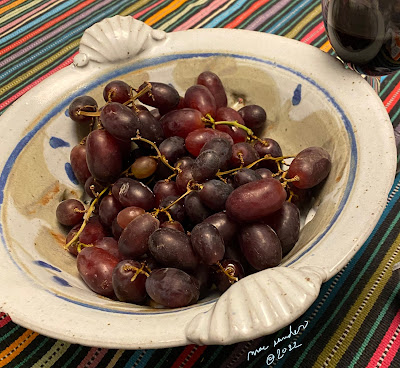 |
| Grapes from Bush’s produce department. |
 |
| A rolled omelet filled with pepper jam for breakfast one day. |
 |
| Best breakfast I know of: Len’s cinnamon rolls made from a King Arthur recipe. |
 |
| Childhood breakfast favorite— now a guilty treat. I’m glad that they still make it! |
 |
| New recipe this week: roasted sweet potatoes in spicy tomato sauce. Another from Ottolenghi’s Jerusalem cookbook. The leftovers made good tacos. |
 |
| I tried making my own black bean burgers. Bigger than the bun! Not bad either. I did not buy any meat on my shopping trip. |
 |
| Cauliflower soup with goldfish. No recipe but all fresh ingredients. |
 |
| Another childhood treat, still as good as ever. |
 |
| Many websites say that Jello. Butterscotch Pudding Mix is no longer available. NOT TRUE! |
Wednesday, January 12, 2022
"Black Smoke: African Americans and the United States of Barbecue"

|
| Adrian Miller, Black Smoke, published 2021. |
 |
| Argia B. Collins, (p. 181). |
Barbecue competitions are a major element of the current life of barbecue in the US, and Miller has a lot to say about the way that Black barbecue experts are unable to compete effectively -- mainly because they lack the large amounts of money that it takes to enter a competition, where White contestants often find sponsors or donors to fund the entry fees, travel, hotel accommodations, large quantities of meat and other ingredients, elaborate equipment, and other expenses. The economic issues are important, but another major problem is a frequently hostile environment during the competitions: the most egregious example being White competitors who fly Confederate flags.
"Ill will . . . is the culmination of tangible and intangible race-based factors that give African American barbecue entrepreneurs businesses a competitive disadvantage. The main ingredients of ill will that I focus on are the racial attitudes of whites toward Blacks, government regulation, a lack of access to capital, and the theft of intellectual property." (p. 127).

"Shall I count the ways that my love for barbecue is the real, true thing? Whether it’s 'pork shoulder with outside brown' from the Carolinas, rib tips, hot links, and fries from the South Side of Chicago, 'burnt ends' and pork spareribs from Kansas City, pork steaks in Kentucky, coleslaw-topped pork sandwiches and barbecue spaghetti in Memphis, snoots (pig snouts) and turkey ribs in St. Louis, or brisket, boudain (a variant spelling of boudin, a Louisiana meat and rice sausage), chopped beef, and hot links in Texas, I’d eat some version of barbecue every day if weren’t for some predictable health consequences." (pp. 2-3).
Tuesday, January 11, 2022
Winter Art and Poetry
It's winter now. Where I live it's cold, with a little bit of snow on lawns and roofs. Much of the country is in considerably worse shape -- the worst being the Colorado town that burned to cinders just before the snow fell. We have to stay in, like a large number of people, but our house is warm, our food supplies are fine, and we have nothing to complain about. We are the fortunate ones in this dreary time.
I was thinking about how poets and artists have given us such enjoyable creations that express something akin to what I'm experiencing. First, a few of my favorite winter-theme art works:

|
| Pieter Bruegel the Elder, "Hunters in the Snow (Winter)," 1567. |
 |
| Hiroshige, "Mt. Fuji and Mt. Ashigara in Snow from Numazu in Clear Weather after a Snowfall," 1855 |
 |
| August Rodin, "The Burghers of Calais," 1884-1895. |
 |
| Renee Magritte, "Golconde," 1953 |
 |
| Marcel Duchamp "In Advance of the Broken Arm." |
The last piece of art above is a "Ready Made" by that joker Marcel Duchamp, from the collection of the Museum of Modern Art in New York, dated 1964. Duchamp "produced" quite a few of these, so I've seen them in several museums (also on my back porch, but unsigned). From the MOMA website: "Duchamp purchased the first version of this work in a hardware store in 1915, signed and dated the shovel, and hung it on display from his studio ceiling." (source) I'm a big fan of Duchamp and his DaDa style.
Finally, I found a poem that I had never read before that seems very apt for this season:
Lines for Winter
for Ros Krauss
Monday, January 10, 2022
The Fish Girl and The Four Dutchmen
 |
| The Fish Girl, published 2017. (This review contains spoilers) |
The epigraph at the beginning of The Fish Girl, a novella by Mirandi Riwoe, comes from the short story "The Four Dutchmen" by W. Somerset Maugham. It reads:
"One of these days he would buy himself a house on the hills in Java and marry a pretty little Javanese. They were so small and so gentle and they made no noise, and he would dress her in silk sarongs and give her gold chains to wear round her neck and gold bangles to put on her arms." (The Fish Girl, p. 4).
Riwoe's story begins in a fishing village in Indonesia. It tells in simple language of the life of Mina, a very young daughter who works in her mother's kitchen, mostly preparing the fish her father catches. The first chapter tells how her father sells her to be a servant in a larger town, where she learns to wait on the master and work for the cook, making a variety of local dishes. After I read Riwoe's story, I read the Maugham story. In it, we can recognize Riwoe's girl, but Maugham presents her without any distictive characteristics at all. She's just a toy for men.
The master in Riwoe's story expects the arrival of group of visitors. A servant boy tells Mina: "These men are great friends, but no-one can tell them apart. We just call them 'the four Dutchmen.',... Tonight they are bringing a friend. I heard Master say he’s famous. A famous storyteller. From far away." (The Fish Girl, p. 20). So we can recognize the appearance in Riwoe's story of the humanized characters in the Maugham story -- the white men.
 |
| I chose this book cover because I appreciate the connection to Gauguin's exotic women, maybe a little more human but still problematic. (I read the Project Gutenberg version.) |
I fear that if I read "The Four Dutchmen" without the context of Riwoe's story, I might not come around to fully grasping the cold way that the girl was only a thing: not human, not feeling, not suffering, not even having a name or origin. How could literature -- highly respected literature like Maugham's -- have been so careless with humans as long as they were exotic alien female creatures with dark skin? (He does mention the color of skin.)
I admire Riwoe's creation of a flesh-and-blood character who has her own village, her own parents, her position in as a servant, her relationships with other servants, deep emotions, and a tragic fate, as well as a name. A much more profoundly depicted character. Maugham's creature is so indistinct that her death isn't even the least tragic, not even sad.
Here is the end of Maugham's story. The girl, having been taken on the tramp ship to be used by the captain, having been raped by one of the men, and then causing a murder and a suicide, becomes nothing but a bulky package as the sailors, who have fought over her, dispose of her, and blame her for her own fate. The narrator searching to know the end of the story reveals:
"But one of the sailors on the watch, just before dawn, had seen the supercargo and the chief engineer carry something up on deck, a bulky package, about the size of a native woman, look about them to see that they were unobserved, and drop it overboard; and it was said all over the ship that these two to avenge their friends had sought the girl out in her cabin and strangled her and flung her body into the sea." (W. Somerset Maugham, "The Four Dutchmen")
In The Fish Girl, we care about this "package," as the innocent girl, whom we've come to know, meets a tragic fate, thrown alive into the sea:
"The first shock of the cold ocean smites the fury from her. She falls through the water, as swiftly as a coin. Blackness smothers her, surrounds her in tiny bubbles. The blurred lights of the tramp waver and dim as she sinks. She panics, inhales salty water through her nostrils. A blank pressure builds inside her head. She feels she might burst. . . . Her descent slows. Specks of seaweed and silt swirl around her head, punctuate the murky depths. . . . The Ocean Queen whispers to her, wraps her warm arms around Mina’s constricted body. Loosens the folds. Nyai Loro Kidul promises her much, buoys her descent. Mina’s head relaxes back and the tramp is nothing but a glowing spot in the distance. The silken water draws Mina further down into nothingness. Until she is finally back in the sunlight, scaling fish with her mother." (Mirandi Riwoe, The Fish Girl, p. 48)
Review © 2022 mae sander.
Sunday, January 09, 2022
Sake

Sujata Massey's series about Japan keeps tempting me to read one more. The latest is The Samurai's Daughter. Like her other novels, this one has held my attention with its amazing variety of Japanese history and culture, as well as several suspenseful plot elements. Food in all of these novels is described in mouth-watering detail, but right now, I want to concentrate on sake, the Japanese fermented rice wine. Sake has quite a history: its roots link to the Shinto celebrations of old times, and it has continuing significance in modern holidays like New Year's, cherry blossom festivals, autumn "moon viewing," and wedding celebrations.

"Norie wanted to immediately open the fine bottle of Fukushima sake that I’d brought to toast the holiday. As my aunt offered the carefully warmed spirits in tiny, dark blue lacquered glasses, everyone said Kampai except for Chika, who had a big glass of water next to her untouched cup of green tea...." (p. 130)
Sake was also used in cooking some of the traditional foods for the dinner, which Rei introduces to her Scottish boyfriend Hugh, also a guest at the party:
"Below the din of voices, I encouraged him to try the safe bets: sweet, sake-simmered root vegetables, the fancy hard boiled eggs, the grilled salmon, and the daikon root and carrot that had been knotted together to look like a New Year’s rope. Everything Norie had prepared was symbolic of different elements of nature, which in turn were symbolic of the New Year and good wishes for the future. This was the kind of Japanese cooking that I admired most and had already spent many pages chronicling for my family history." (p. 130).
The many types and qualities of sake lend themselves to luxury consumption as well as ritual significance. Rei goes to a high-end very trendy Tokyo restaurant:
"Sake was the specialty beverage of the restaurant, with over a hundred varieties available from different regions in Japan. After some deliberation, I ordered a crisp sake from my favorite province, Fukushima, which came to me in a small glass filled with ice. It was the perfect partner to the otoshi, the small, predinner nibble they served alongside it—a spicy, tangy mix of mackerel and trout chunks. I couldn’t have eaten fish this strong-tasting when I was in high school, but the longer I’d lived in Japan, the more I had become able to appreciate savory and strong flavors, especially if they were spiked with things like chilies and horseradish." (p. 176).
There's also a Buddhist view of sake and its role in Japanese tradition, expressed by Rei's father: “Well, a person may take sake, but not in an amount to cause intoxication. My grandfather drank sake at supper, but only a single glass.”(p. 2).
Both sake and food, along with many other details, create the atmosphere in which Rei is faced with her own family background and the weight of Japanese history left over from World War II. It's well-written and enjoyable to read, with a few plot twists that kept me interested to the end. I'm really intrigued by the food descriptions and the many varieties of sake. I'd love to know the quality of the sake that's in my refrigerator, for example. I'm sure it's pathetic -- I bought it to make yakitori sauce.
As I was reading, I looked up a few facts about sake. A very interesting summary is found at the website Eat-Japan.
"When first produced over two thousand years ago, sake was revered and cherished and made as an offering to the various gods and deities of Japan’s indigenous Shinto religion. Indeed, for many years sake production in Japan was carried out for the most part within the Imperial Court, and the drink itself was only enjoyed on celebratory or festival days." (link)
The multi step process of making rice into sake is very exacting, employing two types of microorganisms, one to convert the starch in polished rice to sugar, and another to ferment the sugar into alcohol. The production process is just as complex as the process of making fine wine from grapes. In fact, maybe even moreso.
 |
| My sake set has 5 cups: odd numbers are lucky in Japanese culture. The number 4 is especially unlucky. |
Serving sake in a traditional way involves special serving vessels and special cups. Sometimes it's served warm, sometimes not. I have no idea of all of the possibilities, but I've seen the many styles and designs of these beautiful serving sets. I’ve never used my sake set (shown above), but I think it’s very attractive.
Blog post and photos © 2022 mae sander.
Saturday, January 08, 2022
More of the Thursday Murder Club
 |
| The Man Who Died Twice by Richard Osman. Published 2021, |
The sequel centers around two cases: one being investigated by two police detectives named Chris and Donna, and the other involving "spies" -- that is, members of MI5 and MI6, the British secret services that we all know from watching James Bond and other relevant movies. Both cases proceed with help from the members of the Club.
I'll skip directly to the perceptive way that the author uses food to define his characters. For example, one of the spies was described as "a small woman with a nose ring and an Ottolenghi cookbook." (p. 95).
Joyce, one of the retirees, is important in both novels. Passages from her diary, interspersed with the novel's third-person narrative, give a lot of clues about the action. Sometimes she doesn't quite know what is going on, but sometimes her observations are critical to the plot. Joyce provides constant cups of tea to herself and others. One time, as she is getting ready to entertain a woman whom she hasn't met before, she writes: "I have no idea what she likes, and I couldn’t find a place in our conversation to ask her. So I’m playing it very safe with a Victoria sponge, some brownies with no nuts, and a coconut and raspberry slice in case she’s adventurous." (p. 102).
 |
| A Victoria Sponge by Paul Hollywood of the Great British Baking Show. This is one of many TV programs mentioned in the novel (source). |
Chocolate comes up a lot. Joyce buys chocolate to bring to her friend Ibrahim but something always goes wrong. Joyce was bringing him a candy bar, but she fails: "I can’t tell you how tempted I am to have some of this Dairy Milk. I know Ibrahim will let me have some as soon as I hand it over, but you know what it’s like when’s it’s just staring you straight in the face? I should have bought him grapes, then I wouldn’t have been tempted. I will have a bit of the chocolate now. Don’t you think? I’ll just nip up to the shop and buy him a new one before the taxi arrives. Then everyone’s happy, aren’t they?" (p. 50).
And there's Joyce's trip on the Eurostar to Belgium: "We had to head back to the station but, on the way, I bought some chocolate for Ibrahim and some beer for Ron. The shop even wrapped them nicely. ... It was quite a long journey back, so somewhere in northern France I unwrapped Ibrahim’s chocolates and we ate them, and then I unwrapped Ron’s beers and we drank them." (p. 274).
The policeman Chris works with his colleague Donna, whose health-conscious mother he has just started seeing romantically: "Stakeouts with Chris Hudson used to be more fun. There would be crisps, there would be quizzes, there would be gossip about the new DS who’d just started at Fairhaven and had accidentally sent a picture of his penis to a local shopkeeper who was asking for advice on security grilles. They’d laugh, they’d eat, they’d put the world to rights. But now? Sitting in Chris’s Ford Focus on a late-autumn evening, keeping a watchful eye on Connie Johnson’s lockup? Now Chris has a Tupperware container filled with olives, carrot batons, and hummus. The Tupperware container bought by her mum, the hummus made by her mum, and the carrot batons sliced by her mum." (pp. 12-13).
This continues as Chris sees more of Donna's mother: "He is pretending to eat healthily, which, after a couple of days, he realizes is the same as actually eating healthily. An apple is an apple whether you are eating it because you like to take care of yourself or you are eating it to impress a new girlfriend. The nutrients are the same. Chris hasn’t had a Snickers since Monday." (p. 127).
And much later: "Chris Hudson munches on a carrot baton. When you got used to them they actually weren’t so bad. Well, they were, but it seemed to matter less. ... A man voluntarily eating carrot batons. That really was someone to be." (p. 323-324)).
The two Murder Club novels are very fun to read! I suspect that there will be more of them in the future.
Review © 2022 mae sander.
Friday, January 07, 2022
What’s Cooking?
 |
| Home made granola. |
 |
| Roasted eggplant with lemon and browned onions. Recipe from Ottolenghi’s book Jerusalem. |
 |
| Slicing vegetables for the eggplant garnish. |
 |
| Prep for another Ottolenghi recipe for squash with oranges. I used delicata squash and satsuma mandarins. |
 |
| The finished dish. Recipe from the Guardian (link). |
 |
| Len cooked a red snapper using a recipe from the very old Time-Life Fish Cookbook. |
 |
| The origin of the recipe: The Complete Book of Caribbean Cooking by Elizabeth Lambert Ortiz. |
 |
| The delicious result: whole fish garnished with parsley and bell pepper. On the side we had a garlic sauce called Salsa Esmeralda. |
 |
| Simple lunch: avocado and tomato sandwich with green bean salad. |
“The growing toll of sick workers — Capital Economics says more than 5 million Americans are in quarantine — is hammering employers that already were struggling to secure enough labor. Yet even as pandemic fatigue deepens, there are hopes that omicron will prove to be a punishing but short-lived squall.”
Wednesday, January 05, 2022
Word of the day: Hikikomori.
 |
| The Cat Who Saved Books by Sosuke Natsukawa. Published 2021. |
The Cat Who Saved Books is a fantasy about a boy in a bookstore. In reading this tale, I learned a new word: hikikomori. It means a person who wishes for social isolation and who wants to spend their life alone. Evidently this Japanese word has been adopted into English.
Rintaro, the boy in the book, repeatedly refers to himself as a hikikomori. For example:
"There was only so much a high school kid could do after all. He wasn’t a superhero—he was just some moody, gloomy bookworm who happened to make his way to Wonderland. Although this time he could take credit for navigating his way through a series of complicated discussions, he was and always would be a hopeless shut-in, a hikikomori." (p. 170).
The plot of the tale is that Rintaro's grandfather dies, and leaves him as the proprietor of a small and excellent bookstore full of literary classics that are out of style. Rintaro, the extreme introvert, doesn't quite know how to cope. He stops going to school, and just sits in the bookstore. Then a mysterious cat appears and takes him on quests where he meets individuals who are misusing books. In various ways, Rintaro makes the book-abusers stop. He's a hero to the cat. A few other complications arise, including some bullying from other high-scool kids, and some reaching-out from nicer kids. It's slightly formulaic.
Can you tell that even though I actually enjoy this type of fantasy, where portals open to new worlds (say, Alice in Wonderland or the first volume of His Dark Materials) I didn't really relate to this one? I didn't think it was a very vivid or successful fantasy, and it was depressingly didactic about what's wrong with the way the modern world treats books.
Like many reviewers, I appreciated the cover art, which is widely recognized for its quality.
 | |
|
Tuesday, January 04, 2022
The Wide-Ranging Value of Cloth
“From the moment we’re wrapped in a blanket at birth, we are surrounded by textiles. They cover our bodies, bedeck our beds, and carpet our floors. Textiles give us seat belts and sofa cushions, tents and bath towels, medical masks and duct tape. They are everywhere.” (The Fabric of Civilization, p. 3)

The history and science of textiles are amazing. At the beginning: early agriculture not only altered food crops, but also created new and better strains of fabric-producing plants. And early herdsmen selectively bred sheep to produce individuals that yielded better wool and improved the process of obtaining fleece.
Weaving these fibers depends on the understanding of numbers — fundamental mathematics is a key to threading a loom, whether the weaver is conscious of it or not. And the earliest use of programming using punch cards was in weaving: “at the turn of the nineteenth century Joseph-Marie Jacquard used punch cards to select warp threads and …his invention inspired Charles Babbage’s Analytical Engine, the digital precursor to the computer.”
Spinning fiber into thread was a key skill for virtually all women prior to the Industrial Revolution, when the new invention of the spinning jenny multiplied efficiency in a staggering way. Later, synthetic fabric dyes involved a variety of new chemistry concepts. Natural dyes had historically been derived from invertebrates such as the snail called the murex, which contributed the reds and purples of highly symbolic royal clothing in antiquity. Certain tiny beetles were also a key dye source for European textiles, but better ones had been cultivated by the Aztecs, changing the European expectation of colors for clothing. More biology: a precursor of the French researcher Pasteur discovered the role of micro-organisms in pathology by diagnosing the cause of a particular disease of silkworms.
The interconnections of science with textile invention and production go on and on. From very early times, the complex processing of indigo from plant to color-fast dye had required a variety of experiments in practical chemistry. In the 20th century, polymer chemistry was developed at least in part to assist the invention of synthetic fibers. Ongoing research now seems to be leading to the invention of clothing with artificial intelligence built in.
The importance of cloth in international trade in the early modern era inspired many economic advances, such as the development of letters of credit, an early form of banking. Indeed, textiles have played a significant role in commerce and trade throughout human history. At times they have even served as a fundamental medium of exchange, where bolts of cloth, with a standardized value, could be exchanged for other commodities.
Textiles are beautiful. For centuries, the extraordinary silks made in China used techniques that were unequalled elsewhere. Similarly, the cotton fabrics made in India were more comfortable and colorful than European goods. The cultural role of certain textile patterns is a key to identity in sub-Saharan Africa — though the patters originated in Indonesia and elsewhere. The right to wear particular fabrics or styles was often part of the social stratification of European and other societies.
The Fabric of Civilization: How Textiles Made the World — where I learned all these diverse facts which I just dumped out of my head — is an overwhelming book! Author Virginia Postrel explored the scientific, mathematical, economic, and social impact of the constant demand for fabric not only for clothing, but also for transportation (critically important parts of ships like sails!) for households (like rugs and draperies), for shelter (like tents) and many other key features of human life from prehistory through the current era of high tech.
“Throughout history the desire for more and better cloth has driven technological innovation, from hybrid silkworms to digital knitting, from belt drives to bills of exchange. The sheer ubiquity of textiles—and the money to be made in producing and selling them—amplifies their influence. They spark the imagination of scientists and inventors, investors and entrepreneurs, mercenaries and idealists. Change textiles and you change the world.” (p. 218)
 |
| There are a number of illustrations in the book, though I wished for more diagrams about the way a loom works. Here: From the scroll Pictures of Tilling and Weaving after Lou Shu, attributed to Cheng Qi, active mid- to late thirteenth century (Freer Gallery of Art, Smithsonian Institution, Washington, DC: Purchase—Charles Lang Freer Endowment, F1954.20) |
Monday, January 03, 2022
“Fortune Favours the Dead”
 |
| Fortune Favours the Dead by Stephen Spotswood Published 2020. A much-appreciated Christmas gift from my sister. |
Sunday, January 02, 2022
What was in your “cup of kindness” on New Year’s Eve?
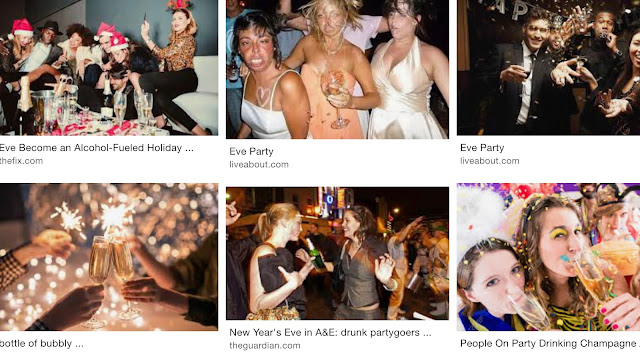
If you check google, what people want is champagne — and they want to be in a crowd. The photos above are google’s top selections for people drinking, and probably getting drunk, on New Year’s Eve. It’s funny that they sing such a gentle song about memory and friendship, but don’t know what the words mean.
As we settle into 2022, champagne will give way to a variety of drinks. Personally, I prefer wine and Diet Coke to cocktails, which I almost never drink. In fact, during the last 2 years, I've had exactly one mixed drink from a bartender. However, I'm sort of fascinated by all the wonderful names and exotic ingredients that are mentioned by writers predicting what restaurant and bar patrons will be ordering. For example, the New York Times projects that vintage cocktails will be back in style:
"Even in the age of no-alcohol cocktails, all those 1980s drinks you can barely remember (for obvious reasons) are coming back. Look for Blue Lagoons, Tequila Sunrises, Long Island iced tea and amaretto sours re-engineered with fresh juices, less sugar and better spirits." (source)
 |
| A Golden Cadillac (source) |
A Denver publication called "5280" is a bit more amusing, predicting cocktails with big flavors:
"The spicy margarita will hold its popular cocktail crown and more variations of it will emerge in this agave-loving city, predicts Drew Stephens, bar manager at Green Russell near Union Station. He also expects dirty martinis with various brines and washes and infusions will gain some momentum. The espresso martini could continue to go strong as its one that can be made with liquors other than vodka (think: tequila or amaro) to contrast the robust coffee and chocolate notes." (source)
The National Restaurant Association also expects to see increased demand for strong flavors. They interviewed 350 chefs, who predict that the following will be the most popular:
• Cashew and pistachio nut milks
• Flavored sparkling waters
• Hard seltzers
• Spicy-rimmed cocktails
• At-home cocktail kits
• CBD-infused beverages (source)
Well, that’s my reflection on the holiday and what really sophisticated and impressive people, not me, will be drinking when the go to fancy bars and fine dining places. If the pandemic doesn't subside soon, I'll probably be going through another year without much eating out. I'm even less likely to go to a bar, unless I manage to go on another ship this year: also unlikely. (My one and only cocktail was on the National Geographic Quest.)
This theoretical drinking research will be shared with the beverage lovers at Elizabeth's blog this week.
Blog post © 2022 mae sander for maefood dot blogspot dot com.
Saturday, January 01, 2022
Dara Horn: "People Love Dead Jews"
First, I wish everyone a happy and healthy and better year in 2022. For my first blog post of the New Year, I am writing about a new book that's a bit depressing, but profound in many ways. Dara Horn has written several novels and many op-eds and other types of essays for various publications. I've enjoyed reading two of her novels, A Guide for the Perplexed (2013) and The World to Come (2006). I did not enjoy Horn's newest book People Love Dead Jews: Reports from a Haunted Present, a collection of her recent essays. It's a masterful work of genius, full of insights that I would rather not have.
 |
| People Love Dead Jews (published 2021) |
What is it that I dislike about "feel good" novels about the Holocaust? Horn explains exactly what has bothered me more and more as the Holocaust gets further in the past and as rather shallow writers create their own imaginary Holocaust world that teaches the lessons they want to learn. Horn summarizes:
"We expect the good guys to be 'saved.' If that doesn’t happen, we at least expect the main character to have an 'epiphany.' And if that doesn’t happen, then at least the author ought to give us a 'moment of grace.' All three are Christian terms. So many of our expectations of literature are based on Christianity—and not just Christianity, but the precise points at which Christianity and Judaism diverge. And then I noticed something else: the canonical works by authors in Jewish languages almost never give their readers any of those things. (pp. 75-76).
"Dead Jews are supposed to teach us about the beauty of the world and the wonders of redemption—otherwise, what was the point of killing them in the first place? That’s what dead Jews are for! ... This is far from a fringe attitude among contemporary readers, as just about every bestselling Holocaust novel of our current century makes fantastically clear. Holocaust novels that have sold millions of copies both in the United States and overseas in recent years are all 'uplifting,' even when they include the odd dead kid. The Tattooist of Auschwitz, a recent international mega-bestseller touted for its 'true story,' manages to present an Auschwitz that involves a heartwarming romance. Sarah’s Key, The Book Thief, The Boy in Striped Pajamas, and many other bestsellers, some of which have even become required reading in schools, all involve non-Jewish rescuers who risk or sacrifice their own lives to save hapless Jews, thus inspiring us all.... In addition to their wonderful non-Jewish characters, these books are almost invariably populated by the sort of relatable dead Jews whom readers can really get behind: the mostly non-religious, mostly non-Yiddish-speaking ones whom noble people tried to save, and whose deaths therefore teach us something beautiful about our shared and universal humanity, replete with epiphanies and moments of grace. Statistically speaking, this was not the experience of almost any Jews who endured the Holocaust. But for literature in non-Jewish languages, that grim reality is both inconvenient and irrelevant." (p. 80).
Horn discusses the content of Holocaust literature written in Jewish languages by survivors and also the contemporary accounts by Jews who managed to write something before they didn't survive. She finds that these are not in the least uplifting or beautiful. Some of the elements of such work are "confusion, starvation, denial, and sheer sadistic horror." (p. 83).
The same problem, Horn explains, occurs in even the most well-meaning and carefully researched exhibits about the Holocaust and its survivors. One illustration was a lavish commercially produced and very accurate show, which required several hours to walk through:
"At the end of the show, on-screen survivors talk in a loop about how people need to love one another. While listening to this, it occurs to me that I have never read survivor literature in Yiddish—the language spoken by 80 percent of victims—suggesting this idea. In Yiddish, speaking only to other Jews, survivors talk about their murdered families, about their destroyed centuries-old communities, about Jewish national independence, about Jewish history, about self-defense, and on rare occasions, about vengeance. Love rarely comes up; why would it? But it comes up here, in this for-profit exhibition. Here it is the ultimate message, the final solution.
"That the Holocaust drives home the importance of love is an idea, like the idea that Holocaust education prevents antisemitism, that seems entirely unobjectionable. It is entirely objectionable. The Holocaust didn’t happen because of a lack of love. It happened because entire societies abdicated responsibility for their own problems, and instead blamed them on the people who represented—have always represented, since they first introduced the idea of commandedness to the world—the thing they were most afraid of: responsibility." (pp. 190-191).
In other chapters of People Love Dead Jews, Horn explores different themes and events, including the rise of antisemitism in our society, and her view of the numerous recent murderous attacks on synagogues and other Jewish places. She includes a very insightful essay about Shakespeare's Merchant of Venice, contradicting conventional views of the play and whether it is antisemitic. It's a fascinating and horrifying essay collection. I wish that some of my fellow bloggers who are so enamored of feel-good Holocaust fiction would read what Horn has to say and try to follow her insights, but I don't think it will happen.
Review © 2022 mae sander