Showing posts with label Poets. Show all posts

Monday, June 09, 2025

Weekend at Home

 The Potters’ Guild Sale


Saturday morning: the June sale of the Ann Arbor Potters’ Guild.


Our favorite artist: Maki Lin.

We bought two new plates (similar to ones we have already).


Along the Huron River

We don’t understand this “sculpture” — here’s another one in a different park.
Anyone know its real purpose?

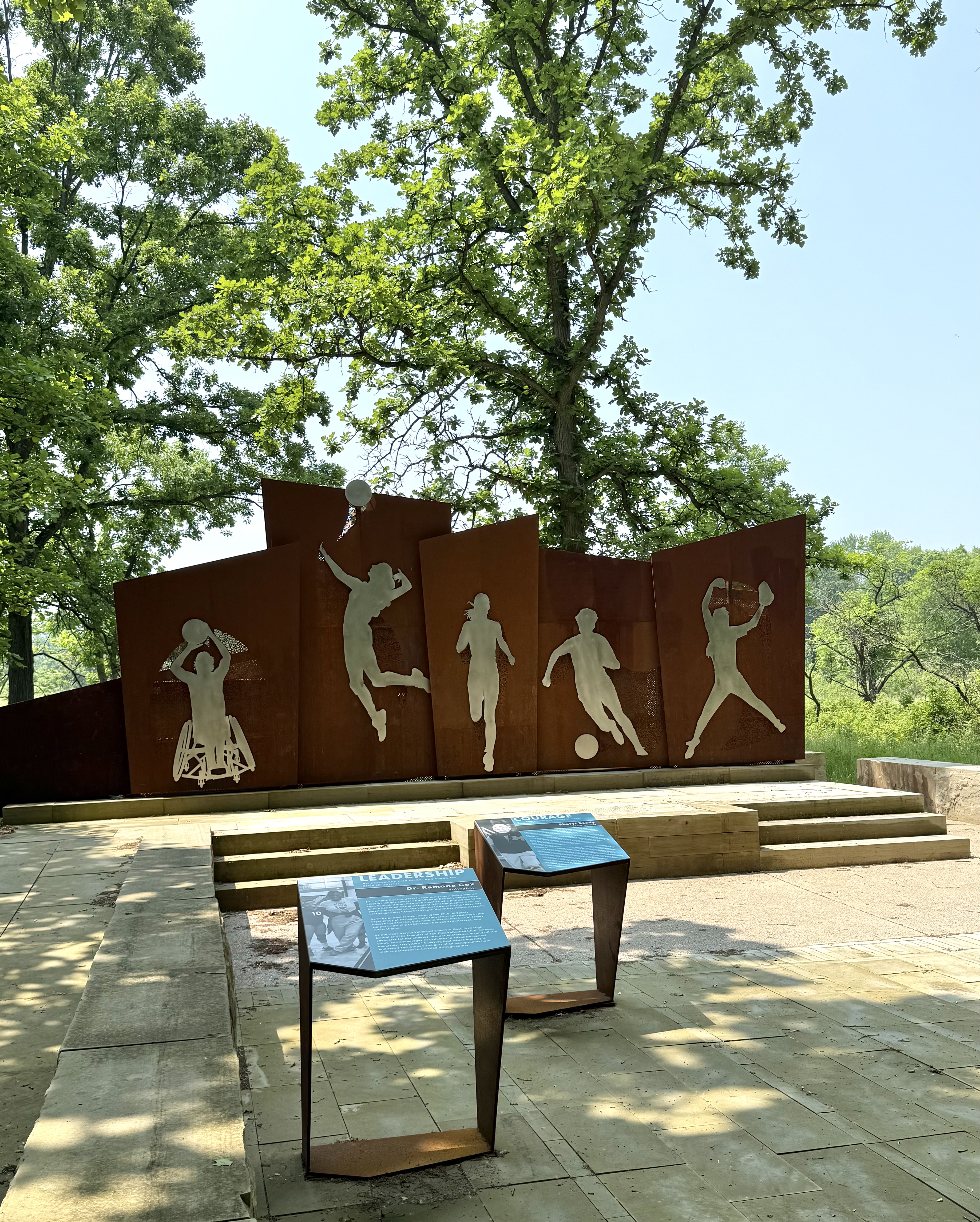
Along the path is a plaza celebrating the history of local women in sports for the past 50 years.

We always enjoy watching the canoes and kayaks making their way down the Huron River.


Beautiful Weather But with Some Smoke

In spite of poor air quality, we have been eating in our garden.

Contemplation: “A Child’s Garden of Verses”


The Swing

HOW do you like to go up in a swing,
Up in the air so blue?
Oh, I do think it the pleasantest thing
Ever a child can do!

Up in the air and over the wall,
Till I can see so wide,
Rivers and trees and cattle and all
Over the countryside—

Till I look down on the garden green,
Down on the roof so brown—
Up in the air I go flying again,
Up in the air and down!”


Blog post © 2025 mae sander


Friday, April 04, 2025

April Is Here!

Flowers Around Me


Spring thoughts shared with Deb’s Sunday Salon at Readerbuzz.
All spring photos were taken this week, © 2025 mae sander.

Baby Owls

Can you see two owlets peeking out from their hollow tree? We visited them on Monday.
Shared with Eileen’s critters.

 An Excellent Novel

Dream Count by Chimamanda Ngozi Adichie

I think many people are recalling the start of the pandemic five years ago, and probably share my feeling that it seems very long ago and at the same time seems like just yesterday. The pandemic is at the center of the lives of the characters in this newly published novel, which makes it perfect reading for right now! Ultimately, the narrator says: “The ending of lockdown trailed off like a forgotten song. If only life could immediately return to what it used to be. Some bars and restaurants had opened, all hesitantly, the rules changing day by day.” Things return to normal — but not really.

Dream Count is about four characters, all women from Africa who immigrate or simply visit the United States. Chiamaka, Zikora, Kadiatou, and Omelogor all know one another in various ways. Each belongs to different ethnic and status groups. They have different economic opportunities: one comes from a quite rich family, one makes money on her own, and one is quite poor. I was fascinated by the vivid portrayals of the women, their relationships with men, their views of both American and African social norms, their attitudes towards having children, their jobs or careers, and many other features of their lives. The author has a fabulous way of creating stories and showing the inner and the outer realities of the characters.

The poorest woman in the story, Kadiatou, works as a hotel maid in New York, and her high-profile experience is based on the much-publicized rape of a hotel maid by the famous French banker Daniel Strauss-Kahn, in 2011. However, the author created an entirely different background for the character and her reaction to the events and the cancellation of the prosecution of the perpetrator, imagining an original persona into existence

What is the “Dream Count” of the title? It’s the way that Chiamaka, the pivotal character, during lockdown, reviews her many failed relationships with a series of lovers, both serious and casual. At the end, her friend remarks that “normal people spent lockdown suffering anxiety while you were busy looking up your exes and reviewing your body count.” Chiamaka (who is narrating the novel, corrects her:

“My dream count,” I said. 
“So how many dreams have you been with?” 
“The world has changed and you look back to take stock of how you’ve lived. And you have so much regret,” I said. I wished I had not used that word, “regret.”

In my opinion, Dream Count is one of the best novels I’ve read recently because of the penetrating portraits of the characters and the fascinating insights into both African and American lives.

A Poem For Changing Seasons

With all the big wind storms that have swept across the country lately, I thought a symbolic wind poem would be good for this week —

[what if a much of a which of a wind]

what if a much of a which of a wind
gives truth to the summer's lie;
bloodies with dizzying leaves the sun
and yanks immortal stars awry?
Blow king to beggar and queen to seem
(blow friend to fiend:blow space to time)
—when skies are hanged and oceans drowned,
the single secret will still be man

what if a keen of a lean wind flays
screaming hills with sleet and snow:
strangles valleys by ropes of thing
and stifles forests in white ago?
Blow hope to terror;blow seeing to blind
(blow pity to envy and soul to mind)
—whose hearts are mountains, roots are trees,
it's they shall cry hello to the spring

what if a dawn of a doom of a dream
bites this universe in two, 
peels forever out of his grave
and sprinkles nowhere with me and you?
Blow soon to never and never to twice
(blow life to isn't: blow death to was)
—all nothing's only our hugest home;
the most who die, the more we live

Caused by the wind in April, 2025.


Sunday, December 01, 2024

Graffiti Poem

“The Rock” is constantly repainted with new graffiti. Here it is this morning. It’s probably different by now.

A look into Graffiti Alley in Ann Arbor from 2022.

My search continues for poetry that works into my life. Thinking of the two places in our town that encourage graffiti artists to express themselves — “The Rock” and Graffiti Alley — I looked for a poem about graffiti, and found a poem titled “Graffiti.”  I’m sharing this post with other lovers of street art who post at Sami’s Monday Murals.

I like its description of “looping black script that no one can read.”

In Ann Arbor a few years ago: “looping black script.”

Here are a few lines from “Graffiti,” and a link so that you can read the entire work if you like:

Graffiti

Kitty Goes Kommando and the Goldman Rats — Phooey!
That blue scaffolding holds up the sky. Who did we think
we were padlocking in, or out? Give me that huge
looping black script no one can read, a secret glyph,
and just where someone has smashed the window, Jesus
the Way the Truth the Life and a dented aluminum frame.
…
Hole in the wall, rose sound-hole,
ribbed sounding board — always from fissures and gaps
melody strains as trains thunderclank across
the girdered overpass, a siren keens, and a solitary man
ambles past amputated acacias fisting out with leaves.

Source: Poetry (July/August 2014)


https://www.poetryfoundation.org/poetrymagazine/poems/57057/graffiti

Saturday, September 02, 2023

Food Poems

I never read poetry. But the other night, I decided to look on the site of the Poetry Foundation for poems from the magazine Poetry. I found two enjoyable poems about food. I’ll tell  you about one of them now, and maybe about the other one another time.

I was amused by some of the stanzas in a very long poem titled “Grapes,” which was published in April of 1927. The author is Ellen Glines, who published a number of poems there between 1924 and 1930, and that’s all I know about her — one or two mentions in an internet search yield very little other information. Here are a few lines from the poem.

Strange, the things that folks will eat,
Costly, exotic, piquant, sweet:
Truffles, snails, and nectarines,
Cashews, palm-hearts, madelines;
Pies of squash, mince, custard, apple;
Haggis; Philadelphia scrapple;
Syrupy kumquats stewed in crocks;
Bonbons from a tinselled box-
Sugared violets, nougat, divinity,
Hand-dipped chocolates to infinity!
Ripe olives, blutwurst, marzipan,
Sweet potatoes out of a can;
Anchovies, reed-birds, Camembert,
Stuffed celery, alligator-pear,
Rainbow ices in fancy shapes!
Nobody seems to care for grapes.


As I said, these are only a few of the lines from the poem, in which the author expresses her regret that “grapes” she had grown are not wanted by anyone. I take these grapes to be a metaphor for her poetry, which was evidently not particularly popular. The poem ends by saying that some day she thinks there will be a demand, but by then, she won’t want to sell grapes any more. As always when I interpret a poem I doubt my own ability to read poetry. Maybe the poem means something entirely different. The author is so incredibly obscure that no one seems ever to have published any other opinion, though.

I looked at a few of the other poems that Ellen Grimes published in Poetry Magazine. They didn’t seem to share the humor and light touch of the list of world foods that I quoted. In fact, they seemed a bit melodramatic and heavy to me. Maybe that’s why she’s so thoroughly forgotten.

Saint Paul, Minnesota: Poetry on the Sidewalk

Sidewalk poem that I photographed in Saint Paul in October, 2012. (Photo © 2023)

As I thought about my own encounters with poetry, I remembered a great poetry place: St. Paul, Minnesota, where I visited family (who were there temporarily) in 2012. A very special contest has been held in St. Paul every year since 2008: the Sidewalk Poetry Contest. Every year the winners' poems are embossed in the sidewalk blocks as they are repaired by the city. By now, around 1200 poems have appeared on the sidewalks of St. Paul.

A St. Paul sidewalk poem, embossed in concrete. (source)

"The submissions featured from this year’s [2023] contest encompass the diversity of St. Paul,
with poems in English, Hmong, Somali and Dakota." (source)


Review © 2023 mae sander
Magazine cover and verse from the Poetry Foundation website.