Sunday, November 24, 2019

Along the Mississippi: The Culinary Historians' Dinner


The Culinary Historians of Ann Arbor (CHAA) held their winter theme meal on November 24. The theme was foods from states along the Mississippi River. As we have done many times before, members contribute one or more dishes that follow the theme. We present our dishes and a bit of history or background about what we cooked and how we made our choices and then we eat! 

Here are pictures of a number of the very interesting selections of dishes that came from the whole length of the river from Minneapolis to New Orleans --

Wild rice with several types of mushrooms from the cookbook of the Sioux Chef.
The Native Americans of Minnesota gather wild rice from canoes in the north of the state.
Wild rice with hazel nuts -- another of the several wild rice
dishes on the menu.
Wild Rice and chicken salad.
Our contribution: sauerbraten. It was tasty but not very photogenic.
Where along the Mississippi does it originate? It's from the German
community of St. Louis, via the one great culinary contribution of
our native city, namely, the book The Joy of Cooking, which was
written in St. Louis by Irma Rombauer in 1931.
Iowa ham balls.


My friend Sherry with a Mississippi cookbook, one of several that she consulted. And my friend Randy,
editor of the CHAA newsletter, taking notes on what everyone said. He will correct me if I got any of this wrong!
Southern-style greenbeans.
Louisiana beef stew.
Jambalaya
Kentucky corn pudding.
Cajun cornbread with ham, cheese, scallions and jalapeno.
Bread pudding -- whiskey sauce was in a separate dish. 
Minnesota Best Bars: the classic, made with sweetened condensed milk!
Pecan Pie. The baker told us that pecans were used by native Americans
for thousands of years. French settlers in New Orleans began to make pecan pies
soon after arrival, but the most-used current recipe comes from the makers of
Karo Syrup, who published it in the 1920s.

Here is a list of most of the contributions in geographic order. Sherry said "It's a long river," and I think we showed that she was right!


From Minnesota:
  • Favorite Tuna Hot Dish
  • Hazelnut Wild Rice & Passion Fruit Foam Salad
  • Wild Rice Pilaf with Wild Mushrooms, etc.
  • Wild Rice and Chicken Salad
  • Amaranth Bites from the Sioux Chef
  • Very Good Bars
More from the Midwest:
  • Karl Ratzsch’s Burgundy Red Cabbage from Wisconsin
  • Ham Balls appetizer, Iowa
  • Blue Cheese Spaghetti, Illinois
  • Sauerbraten from The Joy of Cooking, St. Louis, Mo.
Going South:
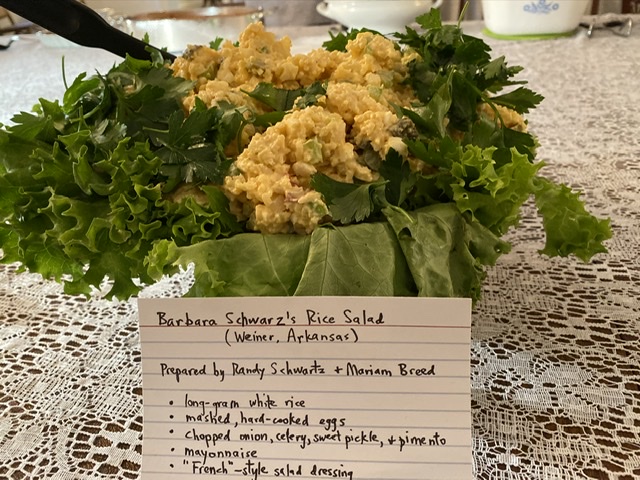
  • Rice Salad, Arkansas
  • Corn Pudding, Kentucky
  • Southern Style Green Beans
  • Cajun Cornbread, Louisiana
  • Jambalaya with Sausage, Shrimp, & Ham, Louisiana
  • Louisiana Beef Stew
  • Shrimp Dip with Crackers & Chips, Louisiana
  • Roselawn Plantation Punch, Louisiana
  • Bread Pudding with whiskey sauce, Louisiana
  • Pecan Pie
This post and photos © 2019 by mae sander.

Friday, November 22, 2019

Thanksgiving in Our Neighborhood

Thanksgiving decorations are rare in our neighborhood, though Halloween decor was everywhere!
Displays of pumpkins very well might have a Thanksgiving theme, but mostly they are a feast for the squirrels,
like these well-chewed specimens on one front porch.


One of our recent Japanese visitors (in all innocence) asked me if the "thanks" in Thanksgiving were directed at the Indians who gave us this country. This gave me quite a jolt, because it so clearly highlighted the discrepancy between the celebration and the historical reality. For this and other reasons, besides enjoying the cooking and consuming of a traditional turkey dinner with family next week, I will think about the real history of the "Pilgrims" and their relationship to the natives of Massachusetts.

The book 1491: New Revelations of the Americas Before Columbus by Charles C. Mann, which I read a few years ago opened my eyes to some of the actual history of the original inhabitants of New England -- especially the fact that the area had been heavily populated with farming villages, but that European contagious disease had wiped out most of the population before the settlers arrived -- a fact that was only recognized very recently.

This week, The New Yorker published an article by Philip Deloria titled "The Invention of Thanksgiving." The article offers some very stark information about the relationship of the white settlers and the native people. Even the motives of the Indians and the content of the feast isn't really what we learned in school:
"The Indians were Wampanoags, led by Ousamequin (often called Massasoit, which was a leadership title rather than a name). An experienced diplomat, he was engaged in a challenging game of regional geopolitics, of which the Pilgrims were only a part. While the celebrants might well have feasted on wild turkey, the local diet also included fish, eels, shellfish, and a Wampanoag dish called nasaump, which the Pilgrims had adopted: boiled cornmeal mixed with vegetables and meats. There were no potatoes (an indigenous South American food not yet introduced into the global food system) and no pies (because there was no butter, wheat flour, or sugar).
"Nor did the Pilgrims extend a warm invitation to their Indian neighbors. Rather, the Wampanoags showed up unbidden. And it was not simply four or five of them at the table, as we often imagine. Ousamequin, the Massasoit, arrived with perhaps ninety men—more than the entire population of Plymouth. Wampanoag tradition suggests that the group was in fact an army, honoring a mutual-defense pact negotiated the previous spring. They came not to enjoy a multicultural feast but to aid the Pilgrims: hearing repeated gunfire, they assumed that the settlers were under attack. After a long moment of suspicion (the Pilgrims misread almost everything that Indians did as potential aggression), the two peoples recognized one another, in some uneasy way, and spent the next three days together."
After this more-or-less peaceful event in 1621, the story becomes sadder and sadder, as the Pilgrim settlers repeatedly fought with the Indians. Ousamequin’s son was killed in one of these wars, in 1676. The Pilgrims mounted his head "above their town on a pike, where it remained for two decades, while his dismembered and unburied body decomposed." They also gave thanks for the victory.

By the time Abraham Lincoln declared Thanksgiving a national holiday in 1863, the real history had been successfully unlearned, and the modern myths that we commemorated in school pageants had been invented. A few years ago, also, I wrote about Sarah Josepha Hale, the proponent of Thanksgiving who influenced Lincoln, and her 1828 novel where there's a Thanksgiving feast with turkey, cranberry sauce, and pie -- see this blog post: Northwood by Sarah Josepha Hale.

As we cook our turkey I'll try to keep both the ideal and the real stories in mind.

This post and photos © 2019 by mae sander for maefood dot blogspot dot com. 
If you read it elsewhere, it's been pirated.

Wednesday, November 20, 2019

Thai Potato Curry


“Hotbox” by Matt Lee & Ted Lee


New York food ways are not the food ways of the rest of the country. Not enough billionaires. Matt Lee and Ted Lee have written a very revealing book about how New York billionaires' catered party food (and that of a few slightly less wealthy New Yorkers) is created or designed, presented to party planners and party givers, and then cooked, delivered, and served. Because the emphasis is on the workers in the catering industry, the billionaires don't spoil the story -- they really don't talk to the help anyway.

What do billionaires eat? Here are a few examples:

  • Hors d'oeuvres: "Tuna Tartare with Dijon and Diced Celery on Round Potato Crisp; Curried Chicken with Black Currant and Toasted Coconut of Bite-Size Papadum; Peking Duck Roll with Cucumber, Scallion,  and Hoisin; Mission Fig Puree with Candied Walnut and Whipped Boursin on Brioche." (p. 79-80)
  • A dinner menu for 14 billionaires: "Frisée Salad, Pecorino, Cipollini Onion with Bacon Marmalade; Braised Lamb Shank with Winter Greens and Huckleberry Jus, Vanilla Bean Pot de Crème." (p. 121)
  • Standard canapés "like pigs in blankets, the little triangular phyllo-dough pies called beggars' purses, and Chinese-style spring rolls" or high cost items like "Sunny-side Quail Egg with Tomato and Asparagus on Brioche." (p. 188)

The hotbox is the appliance that makes it possible to serve such food in venues where there's no kitchen at all. The hotbox, effectively unique to the catering industry is "an upright aluminum cabinet on wheels ... that conveys the partially cooked food from the refrigerator at the caterer's prep kitchen to the site of the party.... Once on-sight the hotboxes are emptied and transformed into working ovens."  (p. 4)

The heat source for a hot box is cans of Sterno in startlingly large numbers: enough to finish cooking partially cooked food and heat it to serving temperatures. Or these boxes can keep food cold with the use of dry ice.

Most fascinating: the techniques for making them work include a vast number of ingenious tricks and strategies. And the workers who understand this are wizards! Without the hotbox, the entire method of delivering food to exotic party venues would be impossible.

Hotbox: Inside Catering, the Food World's Richest Business by brothers Matt Lee and Ted Lee is enjoyable, informative, well-researched, and well-written. The illustrations are entertaining too: I've included a couple of scans at right. The two authors researched the subject by working for catering companies over a period of years. They really worked! And the work ranges from hard to grueling.

These authors weren't just journalists who embedded themselves for a few days. The Lees really got to know and respect the people who did the labor, as well as understanding the relationships among the various businesses that allow million-dollar (or more) fund-raising dinners, weddings, political dinners, bar mitzvahs, and other events to be held at kitchenless venues such as the Metropolitan Museum of Art or big meeting places without food facilities. They wore the "polyester black pants, black clogs, and untailored white chef's jackets," (p. 79) and received the same salary as the other workers.

The best feature of the book, in my opinion, is the numerous interviews. These reveal the skills and responsibilities of the workers who staff the temporary kitchens, where the authors were working alongside them. They explain the rationale and challenges of chef-owners of catering companies who hire these workers. They delve into history through interviews about the origin of modern kitchenless catering in 1970s New York. They reveal the statistics of vast quantities of rental items -- obvious like cutlery, dishes, glassware, and tablecloths, less obvious like special wooden tables to give a party a rustic look, or special covers for fancy hors d'oeuvres.

I was never bored or impatient with anything in this book, though I didn't know I would be interested in the subject. I think that's the mark of really skilled and thoughtful authors. It's also really fun to read!

This review © 2019 by mae sander for maefood dot blogspot dot com

Tuesday, November 19, 2019

The History of Nonfiction November

Yesterday I wrote about my thoughts on Nonfiction November, where a lot of bloggers have chosen to read nonfiction books and share their thoughts. For example, a blog I follow called Based on a True Story has been reviewing a number of nonfiction books throughout the month, and has encouraged quite a few other bloggers to share nonfiction they have read, including food writing.

In response to my post, a FB friend asked if Nonfiction November was a reaction to NaNoWriMo -- National November Writing Month -- in which participants write a work of fiction (another collective activity that I haven't signed up for). I did a brief search and it looks to me as if a couple of bloggers invented Nonfiction November in 2013. They had been creating theme months, where a number of bloggers read and posted on a single type of book. For November that year, they described specified variations on nonfiction books: some of the bloggers this year are still using similar weekly themes. They did not mention NaNo in their posts at that time, though NaNo was invented in 1999 and had a very large following by 2013.

Evidently, the idea spread, and Goodreads seems to have first published a list of books recommended specifically for Nonfiction November in 2017, and has done so every year The two blogs that started this are now inactive. These blogs were: Sophisticated Dorkiness and Regular Rumination.

It's all become a very big deal, I guess. Here's the Goodreads banner for this year:


Does anyone have more information about how and when Nonfiction November got started? As far as I can see it doesn't even have a Wikipedia page yet: though I bet someone makes one soon!

This post written by Mae Sander, © 2019 for maefood dot blogspot dot com. 
If you are reading this at a different location, you are reading a pirate version.

Monday, November 18, 2019

Nonfiction November

Slate Magazine: "The 50 Best Nonfiction Books of the Past 25 Years" 
by Dan Kois and Laura Miller (link).
November weather is usually depressing, following the bright blue skies of October. The brightly colored leaves fall, then the dull brown ones. Snow happens -- this year earlier, colder, heavier than usual. This year the news is full of political malfeasance, sadness, violence, and pessimism. My reaction is to want to read more fiction, not to read books that may ultimately be uplifting but that are full of sad details.

Consequence: I'm not participating in any of the blog happenings or other online stuff for Nonfiction November, which is a kind of online event cooked up by who knows what web intelligence!

Today, Slate magazine came to my rescue, giving me lots of food for thought about nonfiction in this very nice list of 50 nonfiction books with a thoughtful summary of each one. I've read -- or at least tried to read -- a few of them, including :

  • The World Without Us by Alan Weisman.
  • The Warmth of Other Suns: The Epic Story of America’s Great Migration by Isabel Wilkerson (it was too depressing so I didn't finish it).
  • Behind the Beautiful Forevers: Life, Death, and Hope in a Mumbai Undercity by Katherine Boo (read with a book club that I used to belong to).
  • The Sixth Extinction: An Unnatural History by Elizabeth Kolbert -- so good I have read it twice.

The list includes many more books that I have been meaning to read, as well as many that don't interest me very much. I find it interesting that there are virtually no food books on the list, and I hope there will be a parallel list of good food books somewhere -- and not just memoirs which seemed to be excluded from this list. This is my contribution to Nonfiction November. I'm writing this for my blog maefood dot blogspot dot com -- I hope you are reading it at my blog and not at a pirated site! This post © 2019 by mae sander.

Saturday, November 16, 2019

Margaret Atwood is a Marvelous Writer

The Tempest, a profound and very popular Shakespeare play, is embedded in a fascinating way in Margaret Atwood's novel Hag-Seed. The protagonist of the novel is a formerly successful theater director living under the name "Mr. Duke," in order to conceal his former prominent identity. As Mr. Duke, he has found a part-time job teaching literacy in a prison, where he inspires the inmates to rethink Shakespeare plays and perform them in their own way.

Atwood's development of this cast of colorful characters is magnificent, and she manages to create an amazing plot for the novel, as well as wonderful re-imaginings of some of the dialog in modern jargon. Also included: a bit of fantasy.

I'll just talk about one feature of the novel: the way that Atwood uses language, specifically, curse words! As the convict group begins their study and performance of The Tempest, they are aware that they will receive points for successful participation in the class, which are used in the prison system of rewards and punishments. Mr. Duke tells them this:
"I want you to go through the text very carefully and make a list of all the curse words in the play. Those are the only curse words we'll be using in this room. Anyone caught using those other words, the F-bomb and so on loses a point of their total. ... Once you have your list, pick ten of those curse words and memorize them, and then learn how to spell them. Those will be your special swear words. You can apply them in this class to anyone and anything. If you don't know what they mean I'll be happy to tell you." (p. 90) 
Of course this sets up the situation where Atwood can play with the Shakespearean curses in her invented dialogues and quotes from the prisoners! Here's just one example, in a discussion of Prospero. Mr. Duke begins by pointing out that Prospero is the "the top jailer in the play," having locked up the three inhabitants who were on the island first: Sycorax, Ariel, and Caliban, as well as the shipwreck victims. The convicts continue this conversation:
"Plus he's a slave-driver," says Red Coyote.
...
"Plus he's a land stealer," adds Red Coyote. "Suckin' old white guy. He should be called Prospero Corp. Next thing he'll discover oil on it, develop it, machine-gun everyone to keep them off it."
"You're such a poxy communist," says SnakeEye.
"Shove it, freckled whelp," says Red Coyote.
"No whoreson dissin', we're a team," says Leggs. (p. 131)

Hag-Seed was commissioned for the Hogarth Press Shakespeare series, and published in 2016. When I read Atwood's most recent novel, The Testaments, I realized that this was the only one of her novels that I did not own and had not read. Now I have read them all. Margaret Atwood is a marvelous author whose word play and word sense I have always enjoyed.

This review copyright © 2019 by mae sander for maefood dot blogspot dot com. 
If you are reading it elsewhere you are reading the work of a poisonous poxy plaguey thief.


Friday, November 15, 2019

Thoughts on Climate Change

Venice, November, 2019. Throughout the city waters rose six feet above normal. Tourists in what appear to be disposable over-the-knee boots took selfies in deep water around St. Marks Square, while the basilica, a masterpiece of Byzantine art, received just a little more damage in what might build up to a catastrophe. Local residents in their permanent boots despair.

Winter floods in Venice, once unusual occurrences, are now a predictable occurrence whenever storms coincide with high tides. The city, which is below sea level, has been sinking for centuries. Protective barriers, which may or may not solve the problem, are under construction but delayed by government corruption. Climate change amplifies the results of human actions. 


-- from the Washington Post (source)

Update Nov. 17: Bansky's mural as the waters continued to rise --
"Banksy's Venice artwork of a refugee in a lifejacket is now under floodwater"

A quote that captures the Venetians' reaction: "Flooded Venice had tourists taking selfies and residents in tears" --
“The reaction is to cry,” said Flavia Feletti, 77, who has lived in Venice for six decades. “I am afraid there is no solution. When I went out the day after the flooding, I met a kind of funeral in the city.”
You already know all this. I already know all this.

Midwest US, November, 2019. Winter has arrived, either one or two months early depending which statistics you read. According to the Weather Channel: "over 400 daily mid-November cold records, including record lows and record-cold high temperatures, were tied or set across the nation from Veterans Day through Thursday, Nov. 14." (source) People respond to a slightly frivolous online challenge: list cities in central and southern US that have temperatures lower than that of Anchorage, Alaska. But this is not a a game.

Here in Ann Arbor we had 11 inches of snow and record low temperatures:

In my back yard this week: piles of snow.
You already know all this. I already know all this.

October and November, 2019. California and Australia both have had especially dry and hot weather, with dangerous winds creating conditions for horrific fires. In California, the fires have been worse than those that destroyed whole towns and killed many people last year. In Australia this week, several people and hundreds of koalas died in forest fires in sanctuaries where the habitat of these rare animals was being protected. (link).

An injured koala being treated after the forest fires. (Washington Post)
You already know all this. I already know all this.

Climate and weather are different things: hot dry weather, extreme cold weather, storms in the Mediterranean -- these are weather events. However, more and more extreme weather events indicate that we have gone beyond random happenings. Though I'm not a scientist, I've been reading the results of climate research, and it's clear that we are already experiencing rising sea levels, extreme heat, unusual patterns of warm and cold air like the ones that have warmed the tundra and frozen American cities, and much more.

Does this seem inconclusive, like I don't know what to do? That's what it feels like to me. Our own government seems to be taking more and more measures to make it worse, backing out earlier efforts to reverse or retard actions that increase climate change. Iconic event yesterday: "Just moments after council members rejected measures to tackle climate change, the Veneto regional council — located on Venice's Grand Canal — was flooded for the first time ever." (source)

You already know all this. I already know all this. What do we do?

This post written by Mae Sander for maefood dot blogspot dot com. 
If you read it elsewhere it's been pirated.

Wednesday, November 13, 2019

"The Starless Sea" by Erin Morgenstern

"Virtual reality isn't all that real if it doesn't smell like anything." (The Starless Sea, p. 304)
"Inside the tent is a table set with a modest feast. A bowl stacked with fruit: apples and grapes and figs and pomegranates. A round crusty loaf of bread. A roasted Cornish game hen. There are bottles of wine and bottles of mystery. Tarnished silver cups waiting to be filled. Jars of marmalade and honeycomb. A small object carefully wrapped in paper that turns out to be a dead mouse [and turns out to be a treat for an owl]." (p. 388)
"... the Kitchen has taken his request for 'all the dumplings' literally but the assortment proves as delicious as it is intimidatingly vast. Single dumplings in countless varieties are presented on individual covered dishes, some accompanied by dipping sauces. Each ceramic cover has a painted scene: a figure going on a journey..." (p. 227-228) 
"Zachary picks up the glass. Again, a single word is carved underneath.
"Drink 
"The glass contains a small measure of honey-colored liquid, not much more than a sip. Zachary removes the lid from the glass and sets it down next to the carved instruction. He sniffs the liquid. It has a honey sweetness but it also smells of orange blossom and vanilla and spice. ... He downs the drink in a single shot and replaces the empty glass on the stone. It tastes of everything he smelled in it and more -- apricot and clove and cream -- and it has a very, very strong kick of alcohol." (p. 119)
As I read Erin Morgenstern's new book, I loved the very numerous and vivid sensory descriptions of aromas and tastes.

The book has many brief vignettes, little tales that constantly reminded me of other authors: Lewis Carroll, Neil Gaiman, Robin Sloan, the Grimm brothers, and lots more. Sometimes there are direct echoes of other fantasy tales in these short fairy stories and fables that are embedded in the rambling narrative. At times I felt as if I was reading 500 pages of flash fiction, except that these little stories and briefly depicted characters might come back later, sometimes quite significantly, so you better remember all of them. (It's hard.) There are also many reminders that this book is like a fantasy game, and maybe as bewildering.

This book asks a lot of the reader. Concentration is needed. Continuity isn't guaranteed. There's repetition and imitation and flashes of imagination. Repetition of things like doors that lead one place or another, similar to the doors in Wonderland. A character named Dorian has a name that may or may not be a significant echo of the word door. Books, libraries, bookstores, and the like come up all the time.  Also bees, owls, and burned out buildings; fortune-telling and time-shifting; and much more. The foods and aromas and cocktails (especially the sidecar, somehow) are all delightful.

It's a very challenging book. Or maybe I'm just not capable of reading something this amorphous. While I loved, The Night Circus, Morgenstern's earlier novel, I can't say I loved The Starless Sea. Too exhausting.

After writing this, I looked for other reviews, and especially liked the one at the Guardian by Natasha Pulley, which said:
"Although the core of the novel is a simple story about a young man who wants to know his fate, these other strands make such a complex tapestry that the images blur and warp....The Starless Sea rejects older stories: it makes its own. ... Rather than a traditional fantasy novel, this is an artificial myth in its own right, soldered together from the girders of skyscrapers – a myth from and for the US, rather than inherited from older nations. Like any myth, it refuses to decode its own symbols. A reader might find this deliberate vagueness either uplifting or maddening, but the novel’s scope and ambition are undeniable." (source)
This review is written by Mae Sander, © 2019. If you read it at another site than maefood dot blogspot dot com, you are reading a pirated edition. Yes there are pirates mentioned in The Starless Sea but not that kind.

Tuesday, November 12, 2019

A Retro Mexican Dinner


Dinner tonight: an enchilada casserole with green salsa, chicken, and sour cream.
And a bowl of papaya and mandarin oranges.
My inspiration: this very old cookbook from Sunset.
The original recipe, which I changed a bit to suit my taste.
This is a dish I remember making many years ago when we first moved from California to Michigan. At that time, this Sunset book, published in 1970, seemed to offer the closest approximation to the food we had enjoyed in cheap little Mexican restaurants on Telegraph Avenue in Berkeley.

To make this dish as shown here, I used around a cup of salsa verde from a jar and six Trader Joe's corn tortillas. I added some onion, garlic, cumin and oregano to the chicken while I was cooking it. After slightly cooling the chicken, I mixed in sour cream -- rather than whipping cream as the recipe specifies. I used the green salsa to dip the tortillas, and to surround the enchiladas. So the dish was sort of inside-out. I baked the casserole for around 30 minutes. and served it with fresh jalapeño peppers and tomatoes as a garnish.

Of course this dish would be great for leftover chicken or turkey, so I recommend it for post-Thanksgiving consideration.


This blog post © 2019 by mae sander for mae food dot blog spot dot com.
If you read it at another site, it's been pirated.

Sunday, November 10, 2019

Murals vs. Advertising Signs

A mural based on a 1940s tourist map of Michigan and an advertising sign at Townies Brewery.

What's the difference between a mural and an advertising sign? Ann Arbor city law says that a sign, which can be regulated, promotes a business. It must follow that a mural is not regulated and does not promote a business. Last year, the brewery wall in that photo had a picture of "a giant image of a glass of beer." Obviously, the glass of beer promoted the brewery's business, but it turned out to exceed the size-limit stated in the city's sign ordinance. A competitor complained, and the brewery had to replace the old sign with this one.  (I never saw or photographed the previous sign, and have not been able to find a photo of it online.)

Meanwhile, the city's sign ordinance is being revised to be more up-to-date. I read through the version that's currently under consideration, but it's too full of legal jargon for me. Basically the elements that are regulated include the size of the sign, whether it moves, whether its lighting is too bright, whether it obscures identifying information needed by first responders or law enforcement, whether there are too many signs cluttering up the area, and things like that. "Historic" signs will be accepted.

Another view of the mural, which doesn't violate the sign ordinance.
Photos are mine. Information on the brewery sign comes from the column "Table Talk" on p. 41 of the November, 2019, issue of the Ann Arbor Observer; information on the sign ordinance comes from the city website (link). This blog post copyright © 2019 mae sander for maefood dot blogspot dot com.

Friday, November 08, 2019

What did T.S.Eliot Eat?

I am definitely no expert on the poet T. S. Eliot, but I did invite a real Eliot scholar to dinner recently, and discussions with her have propelled me to try to find out what he liked to eat. Though an expert on Eliot, she didn't provide me with any clues. Naturally, I started with google. Actually that's all I did: just google.

Eliot, if my search is any indication, wasn't much of a foodie. His most famous reference to food was "Do I dare to eat a peach?" from The Love Song of J. Alfred Prufrock, which also refers in a rather superior way to other foods (like oysters or "tea and cakes and ices") and of course "I have measured out my life with coffee spoons."

I dare to eat peaches all the time!
Like almost every word Eliot ever wrote, interpretations of what the peach means are numerous, including quite a few rather abstract ones, such as a reference to Adam and Eve's fruit or fear of aging or fear of sexuality (source). My favorite interpretation seems to view the peach rather literally: from a review of the book titled The Duchess of Malfi's Apricots and Other Literary Fruits by Robert Palter:
"But why does T.S. Eliot's Prufrock wonder if he dares to eat a peach and not, say, an apple or plum? Palter's answer displays poetic and pragmatic insight: because 'on the one hand, the sensuous experience might be too unsettling for him, and, on the other hand, he might make a spectacle of himself because of the messiness involved in biting and masticating something so juicy.' Still, he adds, another 'possible explanation for Prufrock's hesitation about eating a peach might be the rarity and high cost of the fruit in the England of 1911.' Even after World War II, he continues, peaches were scarce in England: Ted Hughes claims that he first tasted one in 1955, the year that Sylvia Plath arrived in England as a Fulbright Scholar." (Review by Michael Dirda, 2003)
If the peach is the most famous food quote in Eliot's poetry, maybe his second-most-famous one is from The Wasteland:
"The typist home at teatime, clears her breakfast, lights
Her stove, and lays out food in tins." 
But what did the poet actually eat? From later in his life, Eliot's pocket calendar (also called a diary) offers a few clues about his food recommendations or preferences:
"Like many of us, Eliot made odd notes in the back of his diaries, in particular, recommendations – of books, places to eat, food and drink. In 1936, Eliot noted ‘Rakørret with Swedish brandy’ – Rakørret is a Norwegian dish of salt-cured trout which is left to ferment for several months. Eliot was not shy of trying less-palatable dishes – he recommended a Norwegian cheese, Gammel Ost, ‘made of reindeer milk and then stored for years under the beds of Norwegian farm folk’ to his friend J. D. Aylward. Leaping forward to 1960, he has made a note of two cheese recommendations (here for more on Eliot’s love of cheese)– a Portuguese number ‘Caixa d’Estrella’ and ‘Boursault (?)’, a French cheese recommended by D. Herbert ‘who recommends also "Make me an offer' by Wolf Mankovitz" (a story set among the Jewish community of London’s East End of the 1930s)." (From "A first look at Eliot’s pocket diaries")
Eliot also wrote an article (mentioned in the quote above) praising Stilton cheese, and promoted the idea of a "Society for the Preservation of Ancient Cheeses." (Link "For the Love of Cheese.")

My hands, carving a duck à l'orange that I cooked in 2008.
Duck à l'orange is the specific food most often mentioned when Eliot's dining preferences are mentioned, especially a version of this dish that he enjoyed at a dinner given by the right-wing antisemite organization L'Action Française.
“A private room in one of the best restaurants – fifteen people – and the most exquisite dinner I have ever tasted...I remember the canard aux oranges with permanent pleasure."
From the same source, I learned that he and his wife entertained at home rather than at restaurants, mainly at lunch to save money because they didn't have to serve meat to guests at lunch. The following paragraph adds what seem to be few food memories:
"T.S. Eliot once asked his messenger boy what he would do with £5,000. “I’d have a good dinner,” the boy said. 'Duckling and green peas, gooseberry tart and cream.' Having just moved to London, Eliot was impressed by the boy’s expensive taste. 'Such is the society I move in in the city,' he wrote, where even 11-year-olds know their food." (source)
Maybe food was really more of an abstraction and a spiritual rather than a physical symbol for Eliot, at least as far as writing was concerned. I find the following paragraph from a biography of Eliot rather interesting:
"One of his last essays, a British Council pamphlet on George Herbert (1962), explores a belated turn to natural happiness, much like his own, and it concludes movingly with Herbert’s poem, ‘Love: III’ with its blessed sense of forgiveness: ‘Love bade me welcome: yet my soul drew back, / Guiltie of dust and sinne. / … You must sit down, sayes Love, and taste my meat: / So I did sit and eat.’" (source)
NOTES:
  • Full disclosure: I mainly didn't read any poems, but I once read them in high school.
  • I have obtained a copy of The Duchess of Malfi's Apricots and plan to read it soon.
  • This blog post written and copyright © 2019 by Mae Sander for mae's food blog. If you are reading other than at maefood dot blogspot dot com you are reading a pirated edition.

Thursday, November 07, 2019

Margaret Atwood is a Linguist


On Tuesday I reread The Handmaid's Tale. Yesterday and today, I have been reading the sequel: The Testaments, Margaret Atwood's newest novel. I loved it very much. I would summarize the two books thus: The Handmaid's Tale is about being powerless. The Testaments is all about power. But I'm not going to discuss these ideas; rather, some ideas about Atwood's uses of language.

In rethinking The Handmaid's Tale, I explored the idea that Atwood uses language in innovative and very poetic ways. This quality is even more sparkling in the new book, as well as another of the author's great skills: observing how individuals use language, each in their own way.

When I say that Atwood is a linguist, I mean she has a wonderful power to hear the way people talk and how they use words. Specifically, the characters' use of language is magnificently differentiated, and these language choices are perfect for the speaker. She portrays adolescents convincingly -- and in a very amusing way -- through their ways of speaking. And in The Testaments, she particularly portrays one older woman who has a mordant or sardonic witty way of answering people who might be opposing her. This use of language as part of character development is something I also loved in several of Atwood's earlier books, especially The Robber Bride.

The Testaments is a very new book, and lots of my readers are planning to read it soon, so I'm not going to have any spoilers. I hope you read it and it makes you happy. Instead of quoting from the new book, I'm going to quote a poem from the book The Animals in That Country, which was published in 1968. It cost $1.95, just to let you see how long ago that was.

Here are a few lines from the poem "Progressive insanities of a pioneer" --

I
He stood, a point
on a sheet of green paper
proclaiming himself the centre,
with no walls, no borders
anywhere; the sky no height
above him, totally un-
enclosed
and shouted:
Let me out!
II 
He dug the soil in rows,
...
The ground replied with aphorisms:
a tree sprout, a nameless
weed, words
he couldn't understand.
...  
VII 
Things
refused to name themselves; refused
to let him name them.
...
the green
vision, the unnamed
whale invaded.
                                          -- Margaret Atwood, The Animals in That Country, pp. 36-39

Some of Margaret Atwood's poetry books that I bought years ago.

NOTES:
  • For my thoughts on The Handmaid's Tale, see my post from Wednesday, "Margaret Atwood is a Poet" at maefood dot blogspot dot com. 
  • This post is the work of Mae Sander; © 2019 for maefood dot blogspot dot com. If you read this elsewhere, it's been pirated.

Wednesday, November 06, 2019

Margaret Atwood is a Poet

First editions of two Margaret Atwood books.
"I sit in the chair and think about the word chair. It can also mean the leader of a meeting. It can also mean a mode of execution. It is the first syllable in charity. It is the French word for flesh. None of these facts has any connection with the others." (The Handmaid's Tale, p. 110)
Words clearly fascinate Margaret Atwood! She began her writing career as a poet, and went on to write her many very successful novels. A few pages into the newest one: The Testaments, I realized that I didn’t remember enough of The Handmaid’s Tale to read the sequel, so yesterday with great enjoyment and admiration, I reread the earlier book. It's a masterpiece.

I quoted the above passage, this brief reverie on a word, as an example of Atwood's special powers of looking at words. The narrator of the book refers to it as one of her "litanies." I can't help feeling that in The Handmaid's Tale, while I'm obviously reading a kind of cautionary tale where women have become a totally downtrodden class in a highly abusive and authoritarian society, I'm also reading a kind of poem to everyday feelings, objects, and experiences. Atwood always does that to me. In fact, I think that the amazing dystopian society that Atwood invented captivates readers so much that they don't necessarily dwell on the amazingly imaginative language of the narrative.

Food, aromas, pain, hunger, desire, outrage, fear, resentment, humiliation, hope and despair -- so many internal sensations and emotions come out in the experience of the narrator, whose name isn't really her name: she's called Offred, meaning she's the "handmaid" of a man named Fred. She's his sexual slave whose only purpose is to bear a child for Fred and his wife Serena Joy, who is too old for childbearing. Dystopian through and through! But such a thoroughly imagined dystopia!

I don't want to go on and on about the book, I want to start reading the sequel. But here's another passage that captured my admiration: 
"The room smells of lemon oil, heavy cloth, fading daffodils, the leftover smells of cooking that have made their way from the kitchen or the dining room, and of Serena Joy's perfume: Lily of the Valley. Perfume is a luxury, she must have some private source. I breathe it in, thinking  I should appreciate it. It's the scent of pre-pubescent girls, of the gifts young children used to give their mothers, for Mother's Day: the smell of white cotton socks and white cotton petticoats, of dusting powder, of the innocence of female flesh not yet given over to hairiness and blood. It makes me feel slightly ill, as if I'm in a closed car on a hot muggy day with an older woman wearing too much face powder. This is what the sitting room is like, despite its elegance." (p. 80)

Margaret Atwood has been one of my favorite authors since I read The Edible Woman, her first novel, which was then pretty obscure. It was published in 1969, and I read it soon after that, along with a few slim poetry collections. I have bought and read all but one of her subsequent novels when they were published, and I have liked them (with one or two exceptions).  Somehow I have never seen the movie or the TV series based on The Handmaid's Tale, so I enjoyed rereading it very much without having to think about how it was interpreted and dramatized by others. Now I'm ready to read The Testaments!

This review © 2019 by mae sander for maefood dot blogspot dot com

Monday, November 04, 2019

"From Hardtack to Home Fries"

Why did I decide to read From Hardtack to Home Fries by Barbara Haber? I have no idea where I heard of it, and I think it's deservedly been forgotten since it was published in 2002. I found a few of the chapters mildly interesting, but I wouldn't recommend this book.

The title refers to two foods -- hardtack and home fries -- that play a negligible role in the actual book. Someone (probably the publisher) must have felt that a catchy title would make up for the deficiencies in the book. And the subtitle, "An Uncommon History of American Cooks & Meals" could be about almost any food history. This misdirection seems to be a good indication that the book isn't very insightful.

Well, what's the book about? Not much. Most of the chapters seem to be summaries of just a few books on the chosen topic. For example, the chapter on Black American cooks simply summarizes several cookbooks by well-known authors like Leah Chase and Edna Lewis. There are a few remarks about how black women weren't given credit by many white authors who stole their recipes and didn't acknowledge them, but not much serious exploration of historic trends or attitudes.

The chapter on the Fred Harvey company and the Harvey Girls who went out west with the railroads is similarly devoid of what I would see as helpful insights or background. It didn't even mention the most famous thing about them: the movie with Judy Garland and several other famous stars. I've read much better treatments of the history of the Harvey company, its founder, and its innovations.

The chapter on Sylvester Graham and 19th century vegetarianism was also devoid of much insight into social history. It tried to cover far too much ground about two centuries of food fads and diets. Ultimately, it was pretty plodding, and disconcertingly ended up with a discussion of celebrity food memoirs, one by actress Elizabeth Taylor. Again, I've read much better books about this part of history.

An obscure topic was a chapter on the history of a shop and bakery in Cambridge, Massachusetts, where refugees from Nazi Germany and later from Eastern Europe were given jobs to help them adapt to American life. There's a lot of effusive praise for the women who worked there, and not much substance about refugees or historic issues. The treatment of this shop doesn't really provide the reader with much substance about American social history, and in the end is quite disappointing.

The last chapter, which is sort of about Gourmet magazine, is probably the worst, but I don't want to keep repeating myself. In sum, I didn't like the book. I don't recommend wasting any time reading it. And I wonder what caused me to buy it!

This review © 2019 by mae sander for maefood dot blogspot dot com

Saturday, November 02, 2019

A Visit from our Friends from Japan

The Matthaei Botanical Garden Bonsai Collection is closing for the season this week,
but we managed to enjoy the beautifully trained little trees despite the rain.
Ann Arbor was damp and cold this week, but we found quite a few activities for our guests from Japan: Mariko, who was our exchange student and lived with us for a year when she was in high school, and her daughter who is now a graduate student at Tokyo University. We had a lot of fun showing them around town and nearby attractions. I've picked out a few photos to show some of the highlights of our tour. We also did quite a few other things, amazing for such a short time.

We took lots of photos.

Halloween

Halloween was especially intriguing to our guests. Here they are with our neighbors' giant pumpkins.
We all especially enjoyed the Halloween parade at the elementary school
near our house.


For the trick-or-treaters, Mariko and Moeha brought Japanese sweets in small packages, which we gave away with our American treats. Unfortunately around half-way through the evening, the rain became really bad and very few kids showed up for the second hour of fun. We did give away all the Japanese sweets, but not all the M&Ms, Peanut Butter Cups, etc.

The Henry Ford Museum, Dearborn, Michigan.

The Henry Ford museum has huge collections of old and antique cars, and everything to do
with the American culture of the road. Here are the 4 of us in front of the mid-century
McDonald's sign and an old chevy.
We enjoyed a recently installed exhibit entitled
"Mathematica," which is all about math.

We also enjoyed the Museum's exhibit of full-sized kitchens from various eras, and doll houses with miniature kitchens.
This little glass delicatessen is in a fascinating
exhibit about the modern art of glass blowing.
The modern studio glass exhibit displays works that combine "art, science, and technological innovation... the notion of glass as a medium for creative expression, in contrast to its use in industrial production." I especially enjoyed seeing this historical arrangement of studio glass from the 1960s through the present.

We had lunch in the authentic diner in the 20th century exhibit.

Meatloaf, mashed potatoes, mixed vegetables, lemonade!

American Food

We tried to offer as many different current American foods as we could. Mariko especially remembered eating roast beef
when she stayed with us many years ago. So we made a roast beef dinner for their arrival day.
Len's pizza was another dinner choice. We also went out for hamburgers
at Shake Shack, for a Mexican lunch, and for American-Japanese noodle bowls.
Mariko made us traditional tea-ceremony tea and brought very special
tea-ceremony sweets for us to try. Another highlight of the visit.

Goodbye!

We dropped Mariko and Moeha at the airport this morning to continue
their trip. They are visiting Evelyn and her family in Virginia now.
UPDATE: Here is a photo of Moeha and Mariko visiting
Evelyn, Tom, Miriam, and Alice in Washington, D.C.
where the baseball players and fans were enjoying the parade.
Photos and text copyright © 2019 by mae sander for maefood dot blogspot dot com