Showing posts with label Shakespeare. Show all posts

Monday, October 24, 2022

What's On Streaming?

Iceland in the Age of Magic

After two visits to Iceland, we are very intrigued by TV shows that are set there. Some of the naturalists on our trip there last summer were enthusiastic about the very recent film, "The Northman." We watched it last week.

A drama full of violence and pathos. The similarity to Shakespeare’s Hamlet
becomes less and less important as the film goes on. Plot summary:
Prince Amleth is the son of the king. His mother and uncle conspire to kill
the king, marry each other, and take over. Rest of story: REVENGE.

Much of the action is set in 9th century Iceland. There’s lots of black magic, witches, and the like.

I think the costumes, sod houses, boats, and armor are pretty accurate.

Iceland is a ravishingly beautiful location, and the film captured lots of great vistas.

“Trapped”

We found ourselves literally trapped by the Icelandic police procedural titled "Trapped." The first season dates from a few years ago. We binged all 10 of the episodes in around two days. Insane!

Andri, Chief of Police in an Icelandic fishing village, is challenged by numerous murders. 
He has lots of quirks — the best-known being that he drinks milk.

The burly and brooding Andri is played by actor Ólafur Darri Ólafsson.

Hinrika, Andri's brave & competent partner in the
investigation, is played by Ilmur Kristjánsdóttir. 


The fishing village where Andri is Chief of Police. Who would  think it would be a hotbed of crime!

Map showing the location of the real village where the filming was done.

Most of all in “Trapped” I loved the Icelandic scenery and the long shots of the fishing village. The series was filmed mainly in the fishing village of Siglufjörður, North Iceland, which is very picturesque. Since it takes place in mid-February, the characters experience the worst of winter: specifically, a blizzard is blocking all the roads during the first several episodes. Numerous murders and other crimes create an absorbing plot, though there's sometimes an overdose of cruelty, including several violent deaths (I sort of lost count).

Classified as “Icelandic Noir” this crime drama is both very Icelandic and very very Noir. In fact, the shortness of days in the far north mean that there are a lot of night scenes, and if it wasn’t already dark enough, an avalanche takes out the village's power plant, so there are a number of interior scenes lit only by candles and flashlights. Now that’s noir!

The Great British Baking Show: Wrong Again

Ridiculously unAmerican s'mores from the Great British Baking Show.

As you see: we've been watching a lot of TV. Every Friday morning for 10 weeks we are watching a newly-released episode of the Great British Baking Show. This series isn't as good as it used to be, but still is nice mindless fun. The latest episode included an American "pastry" — s'mores. I would never have considered this childhood campfire treat as "pastry," but the judges made the contestants bake their own graham crackers: in Britspeak that would be "Digestive Biscuits." I've never heard of a normal American who has baked graham crackers from scratch for other than religious reasons. Nabisco Honey Grahams are the prescribed choice for s'mores.

Still more ridiculous: the bakers had to make their own marshmallows and some kind of fancy chocolate confection to substitute for the customary Hershey Bar. And the judges’ method won’t work. They required the bakers to make marshmallows that were equal in size to around 4 commercial American marshmallows, which meant that the contestants couldn't possible toast them correctly so they were gooey, as you should for s'mores. Of course they also required using a kitchen torch, not a campfire, but that’s a detail.

In case you don’t know it: this is a real s'more with a gooey toasted marshmallow melting the chocolate. (source)

One contestant did torch his marshmallows long enough to make them gooey, and Prue’s reaction was to make one of her dismissive sniffy noises and say that his marshmallows shouldn’t be so soft, and the chocolate isn't supposed to drip down.

Dear Prue and Paul: Drippy chocolate and very soft hot toasted marshmallows are authentic features of s'mores. The word “gooey” even appears in the first published s’mores recipe in the1927 Girl Scout Handbook (see it here). If America were a third-world country, you'd be guilty of cultural appropriation and ethnic insensitivity like what you did on Mexican Week recently. I'm sorry you have run out of variations on Victoria Sponge and are resorting to all kinds of foods that you don’t know much about.


Miss Marple.

Marple

More British than the Great British Baking show is “Marple” one of many interpretations of the work of Agatha Christie over the 100+ years since she began writing mysteries. "Marple" originally ran from 2004-2014, and is currently available for streaming. We are watching this slowly. I especially like Geraldine McEwan, one of the two actresses who plays Miss Marple in this series. Of course there are many cups of tea!

Blog post © 2022 mae sander. 
Shared with Elizabeth’s blog party celebrating drinks like Andri’s milk.


Monday, June 06, 2022

A Midsummer Night’s Dream


Since 2001, "Shakespeare in the Arb" has presented outdoor performances of a chosen Shakespeare play each June, except during the pandemic. This year's play is "A Midsummer Night's Dream." The first scene was presented in the peony garden, which is a very popular site in the Nichols Arboretum -- "The Arb." Here you can see the introductory musicians. Behind the performers, you can see many people (the ones without costumes) visiting the peony beds which are at their peak this weekend.

The audience and players move from one location in the Arb to another. This performance had four or five such changes. It was a beautiful evening and very pleasant to walk in the woods and open spaces.

The "rude mechanicals" rehearse their play-in-a-play.


Bottom the Weaver.

The character Puck was played by three actors.
I would prefer the traditional choice: just one Puck!

Queen Titania about to go to sleep,
with her four fairies chanting a lullaby.

Queen Titania, bewitched by Oberon, falls in love with Bottom.
He now has the head of an ass, thanks to a mischievous magic spell.

Bottom with the fairies.

Final applause for the players. Some cast members are students, and some are from the local community.

2007: "The Tempest"

In 2007, the play was "The Tempest." The photo is from that performance.
We have attended several other presentations of "Shakespeare in the Arb."
The Arboretum and the presentation are sponsored by the University of Michigan.

We took some sandwiches for a pre-performance supper.
Our beverage: sparkling water (to share with Elizabeth).
NOTE: This is not an ad!

Blog post and photos © 2007, 2022, mae sander.


Wednesday, July 15, 2020

Looking for a good book to read.

I'm having a run of bad luck choosing books to read. In the past, I've enjoyed the mindless comedies of Christopher Moore, such as Coyote Blue (published in 2009). So I thought I would be cheered by his latest, Shakespeare for Squirrels. It's a send-up or mash-up or screw-up based on the Shakespeare play A Midsummer Night's Dream, narrated by a character not in the Shakespeare play. It features all the characters from the original -- especially Puck, the fairies Peaseblossom, Cobweb, Moth, and Mustardseed, and the fairy king and queen Oberon and Titania.

Let me mention that I have a great fondness for the fairies in this play, and I don't mind if they are borrowed by another writer. The very first Shakespeare re-write I encountered (well, the first one after Lamb's Tales) was written by my 9th grad Latin teacher Miss Gorse for our graduation from junior high school. She assigned me the role of Moth, and all of us had to memorize the Shakespeare scene where the fairies dance, which was fun to rehearse and not too bad to perform. However, you can imagine how the other kids reacted in relation to the four of us who were assigned to be "fairies." Never mind. Sorry for the digression.

My problem is that Shakespeare for Squirrels didn't do anything for me. The humor is crude -- no Shakespearean light touches. And the plot is forced. I didn't find it very amusing or at all enlightening as a reading of the play. I didn't even like the few food scenes, such as when Pocket helps himself from the dining table where Oberon is eating:
"I tore a leg from the roasted bird, a duck methinks, and had a taste of the greasy flesh, sans plate, settings, or goblet.
“'Oh, scrumptious. Well done,' said I. 'Do you have any wine?'” (Kindle Locations 2461-2462). 
Moore's efforts at humor just seemed to fall flat in this novel. Oddly enough, in his Afterword, Moore completely summarized my reaction (except that somehow throughout the years I've actually read virtually all of Shakespeare's plays and enjoyed most of them) --
"I know what you’re thinking. You’re thinking, 'A Midsummer Night’s Dream is my favorite Shakespeare play— it’s the only one I’ve ever made it all the way through without thinking about things I’m going to eat— and you, sir, have besmirched this delightful, spirited sex comedy with murder, goblins, and gratuitous squirrel shagging. You, sir, you cad, you dilettante, you scrofulous scribbler of unscrupulous satire, have made a sow’s ear from a perfectly lovely silk purse. Why? Why, why, why?'
"Okay, harsh, but fair." (Kindle Locations 3799-3803).

A Food Novel that Missed

Another failure in my efforts to find a book that I would enjoy reading: High Bonnet: A Novel of Epicurean Adventures by Idwal Jones, originally published in 1945. Considered a very obscure classic, it was republished in the Modern Library series selected by Ruth Reichl in 2009. While I'm very fond of most of the books in this series, I just couldn't get into this one -- in fact, I didn't even finish it.

High Bonnet is in the picaresque tradition -- that is, adventures of single character who is typical of something. In this case, the adventurer is a chef, and his adventures are mostly about cooking and relating to other chefs and chef mischief.

Despite how much I like food and food books, the combination of food and personalities here didn't click for me. For one thing, the cheffy descriptions in the narrative seemed to interrupt it awkwardly rather than to advance the novel. Too many different things were going on at the same time.

Here's an example of a description that goes too far for a novel:
"We sent up the consommé. Then a baked pike à la Genoise. After that a pair of langoustes from some Devonshire cove. Jules had boiled them; he cut up the meat, stirred it into thick velouté sauce with the pounded coral, a spoonful of meat extract, seasonings, chives, sherry, a half cupful of grated Parmesan, some sherry, and sliced truffle. It was the veritable black truffle with veinings of white. With this mixture he filled the shells, baked them a while in the oven, then coated them with buttered crumbs which he browned with a red-hot salamander. Finally a Grand Marnier soufflé was put into the oven." (p. 23).
Or another one:
"Connoisseurship exacts too often its penalty. Savors pall, the taste buds dull, the palate grows as indurated as the sole of an old boot or the conscience of a judge. Guido feared it. He judged the perfection of his soups by the twitch of his nose in the steam. He was protected also by a childlike gift of wonder. This drew him nearly every night into some remote quarter, in quest of surprises. He knew all the bistros at Clichy where red-sashed navvies engulfed their ragouts. For months he made a pilgrimage to the Annamese colony in Grenelle, where he had surrendered himself to a beef-and-veal soup. It was tinctured with a few drops of nuoc-man, a briny exudation of decaying fish, mellowed for years in a jar." (p. 32).  
At the risk of too much punning, I'll say this book is neither fish nor fowl -- neither a real novel nor a real work about cuisine. Too bad.

Finally, a Rather Sensationalistic Novel 

I read this a few weeks ago. I can't remember where I heard of it. I finished it, but did not enjoy it:


Wish me luck finding something better!

Blog post © 2020 mae sander. 

Saturday, November 16, 2019

Margaret Atwood is a Marvelous Writer

The Tempest, a profound and very popular Shakespeare play, is embedded in a fascinating way in Margaret Atwood's novel Hag-Seed. The protagonist of the novel is a formerly successful theater director living under the name "Mr. Duke," in order to conceal his former prominent identity. As Mr. Duke, he has found a part-time job teaching literacy in a prison, where he inspires the inmates to rethink Shakespeare plays and perform them in their own way.

Atwood's development of this cast of colorful characters is magnificent, and she manages to create an amazing plot for the novel, as well as wonderful re-imaginings of some of the dialog in modern jargon. Also included: a bit of fantasy.

I'll just talk about one feature of the novel: the way that Atwood uses language, specifically, curse words! As the convict group begins their study and performance of The Tempest, they are aware that they will receive points for successful participation in the class, which are used in the prison system of rewards and punishments. Mr. Duke tells them this:
"I want you to go through the text very carefully and make a list of all the curse words in the play. Those are the only curse words we'll be using in this room. Anyone caught using those other words, the F-bomb and so on loses a point of their total. ... Once you have your list, pick ten of those curse words and memorize them, and then learn how to spell them. Those will be your special swear words. You can apply them in this class to anyone and anything. If you don't know what they mean I'll be happy to tell you." (p. 90) 
Of course this sets up the situation where Atwood can play with the Shakespearean curses in her invented dialogues and quotes from the prisoners! Here's just one example, in a discussion of Prospero. Mr. Duke begins by pointing out that Prospero is the "the top jailer in the play," having locked up the three inhabitants who were on the island first: Sycorax, Ariel, and Caliban, as well as the shipwreck victims. The convicts continue this conversation:
"Plus he's a slave-driver," says Red Coyote.
...
"Plus he's a land stealer," adds Red Coyote. "Suckin' old white guy. He should be called Prospero Corp. Next thing he'll discover oil on it, develop it, machine-gun everyone to keep them off it."
"You're such a poxy communist," says SnakeEye.
"Shove it, freckled whelp," says Red Coyote.
"No whoreson dissin', we're a team," says Leggs. (p. 131)

Hag-Seed was commissioned for the Hogarth Press Shakespeare series, and published in 2016. When I read Atwood's most recent novel, The Testaments, I realized that this was the only one of her novels that I did not own and had not read. Now I have read them all. Margaret Atwood is a marvelous author whose word play and word sense I have always enjoyed.

This review copyright © 2019 by mae sander for maefood dot blogspot dot com. 
If you are reading it elsewhere you are reading the work of a poisonous poxy plaguey thief.


Saturday, March 16, 2019

"Gingerbread" by Helen Oyeyemi


A very puzzling book, Gingerbread. I'm totally confused by it, but don't feel like rereading it to see if it makes more sense the second time through. I'm not sure I can write a coherent review, but here's a try at it. (If you don't like mine, there was a very coherent one in the New York Times last week.)

Is it fantasy? I suppose so. But it's also a kind of psychological mystery. Who are all the people in the seemingly real and fantasy places? What is their mysterious country of origin -- or maybe alternate reality -- named Druhástrana?

During the course of the book, which is sometimes narrated by one or another character, but sometimes more omniscient, we meet a rather large family with three main characters, Margot, the mother; Harriet, her daughter, and Perdita, Harriet's daughter. They tell each other maybe-real stories, interacting with Perdita's four dolls named Bonnie, Sago, Lollipop, and Prim, who seem to be alive and rather perceptive. We hear a long story about Margot and Harriet's early lives in Druhástrana and the unreal way they arrived in England. We hear a lot about how they make gingerbread from a maybe-magical formula, how they give it to various people. Are we supposed to know that the name Perdita means lost? Are we supposed to think of Shakespeare's character named Perdita in The Winter's Tale, who was rejected, lost, then found? I don't know.

Is gingerbread a real food or some type of magical substance? Right at the beginning, we learn about life in a rural part of Druhástrana, where the peasants are badly mistreated by landlords, and where gingerbread seems to sustain them:
"The gingerbread recipe is one of the lean-year recipes,... lean-year recipes are all about minimizing waste and making that which is indigestible just about edible. None of it tastes good save the gingerbread, which is exactly as delicious as it has to be. Blighted rye was the family’s food of last resort, and the jeopardy in using it was so great that it made Great-Great-Great-Grandma really think about how to take the edge off. Out came the precious ingredients, the warmth of cinnamon, nutmeg, cloves, and ginger, the best saved for last. After this gingerbread you might sweat, swell, and suffer, shed limbs. Often that didn’t happen— often the strenuous sifting of the grain expelled just enough ergot to make this an ordinary meal as opposed to a last meal. But just in case, just in case, gingerbread made the difference between choking down risk and swallowing it gladly." (pp. 8-9). 
Eventually, there's even "a gingerbread house, a classic gingerbread house at that, straight out of a story he’d been told as a child." (p. 259).

The time frame of Gingerbread seems to be mainly something like the present -- a time with cell phones, social media, and all the other modern conveniences -- the women of the story still make gingerbread, and it still potentially causes a variety of harm as well as delight. Characters make mysterious trips to Druhástrana, maybe out-of-body trips, maybe some other kind. A mysterious character named Gretel (who eventually seems to have a partner named Hansel)  appears and disappears in the lives of the characters. Gretel has strange eyes: "Gretel’s double pupils were evenly spaced, so it was possible to be disturbed by them without knowing quite what you were getting disturbed by." (p. 97).

Gretel articulates her philosophy: "All that happens when you grow up is that your ethics get completely compromised and you do extremely dodgy things you never imagined doing, apparently for the sake of others. Plus, growing up isn’t in my job description." Asked what her job is, she says: "Changeling." Is that "Changeling as in nonhuman replacement for a human child?" Gretel says: "Changeling as in changeling. We’ve had bad press." (p. 140).

Does this paragraph explain it?
"'Oh,' Harriet says aloud to Perdita, 'what am I thinking? That you went to Druhástrana, that you went there somehow without leaving this bed . . . even though you would have had to leave this bed to get there, Perdita, because as I have been saying all your life, Wikipedia doesn’t get to decide which places have actual geographic existence and which don’t. But OK, playing along for now, I seem to be thinking that you made it across and that Gretel was there. My Gretel. She saw you. She knew who you were, helped you, maybe. She gave you her ring. And she said— now let me see, what is it I’m wishing she’d said: Tell Harriet Lee I am still her friend . . . something like that . . .'" (p. 53). 
There's a lot of mystery in the book, especially around Gretel. She's maybe appearing and disappearing more than one thinks throughout the novel I just don't really get it, but I think that's how it's intended. I guess it's not one of my favorite recent reads. Maybe I'm just distracted by the terrible news of the massacre in Christchurch, New Zealand, today -- so horrifying.

Wednesday, March 06, 2019

"Blackface"

Sadly, the mistakes our society has made in the past remain with us seemingly forever. One cruel and despicable mistake that's been in the news recently is the practice of Blackface. I doubt if anyone needs a description, but here's a particularly insightful one from an op-ed in the New York Times yesterday:
"Blackface is a performance historically grounded in white supremacy and as such, an act of epistemological and ontological terror. In other words, blackface is a form of 'white knowing' (in reality, of white unknowing), of white projection, and of stipulating through performance of what it means to be black by way of lies about what it means to be white. Hence, to understand blackface, we must return to the white face that refuses to see itself in its own monstrous creations."
The article was titled: "Why White People Need Blackface: To understand this degrading practice, we must examine the white face that refuses to see itself in its own monstrous creations" It was written by George Yancy, professor of philosophy at Emory University. Yancy treats the practice of blackface as a way of making fun of blacks and alienating them from consideration as full human beings:
"Within the white American antebellum context and after, anti-blackness was at the very heart of white blackface minstrelsy. The black body functioned as the repulsive and revolting object of white disgust, with whites 'throwing forth' their hatred and lies onto what they themselves had created. White American blackface performers engaged in exaggerated and distorted gestures, warped dialect and racist clowning, all creations of the white American imaginary. As white performers blackened their faces with burnt cork, re-presented the black body in caricatured, silly, ersatz, inferior, horrible, and damnable ways, they were able to mark black bodies publicly as appallingly stupid and subhuman."
Recently, I've been reading  Martin Duberman's Paul Robeson: A Biography about the great singer, actor, and political activist Paul Robeson (1898-1976). Blackface was very much an issue during Robeson's debut as an actor in 1924 in two plays, The Emperor Jones and All God’s Chillun Got Wings  by Eugene O'Neill. In both plays, Robeson acted the role of a black protagonist: roles that had previously been played by white actors in blackface. The discussion of his being chosen for these serious roles provides interesting insight beyond the use of blackface as burlesque, illustrating what happened when a serious black character role was assigned to black actors:
"In March [1924], shortly before rehearsals for Chillun were to begin, Paul acquired additional experience by acting in a revival of Roseanne, by the white playwright Nan Bagby Stevens. The play, about a transgressing black preacher in the South saved from his 'avenging congregation' by Roseanne, had first been produced in 1923 with a 'burn-corked' all-white cast (despite the acclaim Charles Gilpin had received in 1920 in O’Neill’s The Emperor Jones, the long-standing practice of whites playing black roles in blackface remained widespread). But the revival at the Lafayette in Harlem in 1924 had an all-black cast, headed by Robeson as the preacher and Rose McClendon in the title role." (Kindle Locations 1320-1324).
The casting of Robeson in these three roles, was not only controversial (despite his distinct abilities), but resulted in near-riots and terrible harassment via letters and other comments from a widely racist public. Although a few years later, he was widely popular in London and New York as star of two hits -- Porgy and Bess and Showboat -- these early experiences are significant.

Later in his career, Robeson was passed over for roles where producers preferred to cast a white man playing in blackface. They refused to cast Robeson, an extraordinarily talented black actor, in serious roles. In 1928, the Metropolitan Opera chose to feature a white singer in blackface for a role as a black jazz musician in the opera Johnny Strikes Up the Band by Ernst Křenek. In 1933, an opera based on The Emperor Jones gave the title role to a white man in blackface in preference to Robeson, though a few minor black characters were played by black singers. While the Met may have evolved since that time, our society still has many perplexed issues with this fraught subject.

Another highlight of Robeson's career was his performance in the 1940s as Othello, which he achieved with great success. For at least a century before this production, most American versions of the great Shakespeare play had de-emphasized Othello's blackness, employing white actors in the role with at most a hint of dark makeup. These versions avoided the play's obvious racial issues. Robeson completely changed this; he expressed the "view that Othello was a great— and persecuted—'Negro warrior,' and that his own responsibility was to convey the tale of a man who had managed to rise to a position of leadership in an alien culture— only to be destroyed by it." (Kindle Locations 6264-6266). 

Paul Robeson was a complex, multi-talented man of great genius. He was mistreated in many ways, and eventually became more and more dissatisfied with American society and racial attitudes.  I'm a life-long admirer of Paul Robeson. My father had huge respect for him, loved listening to recordings of Robeson singing spirituals, and was dismayed at the terrible treatment Robeson received at the hands of certain fanatics after World War II.


Sunday, July 22, 2018

"French Rhapsody" by Antoine Laurain

French people care about politics -- French politics! They know a great deal about the lives and histories of recent candidates for president of France. They care about literature, mostly French literature, though they are aware of writers from elsewhere: Shakespeare, for example. They care about a variety of genres of popular music. They have their own stars in music, literature, art, film... as well as sharing the love of many stars from England and the US.

Paris is the center of French life for politics, literature, music, education, and most other cultural activities. To live and work outside Paris can result in others viewing you as a failure or at least can result is others seeing you as giving up your ambitions.

All these basic facts are in play in the novel French Rhapsody by Antoine Laurain (published 2016). Several fifty-something men and one women in roughly the present moment (maybe 2015) reconnect many years after their one shared moment from their past. For a brief time, they had tried to form an innovative popular band -- "The Holograms, that was my group, my rock group. Well, it wasn’t rock, it was new wave; cold wave to be exact," the central character explains. (Kindle Locations 127-128).

A strange coincidence brings the members of the long-dissolved group back into contact through a rather wacky and revealing set of events. The man who engineers the reconnection has become a rather dull doctor who has followed his father's footsteps treating very ordinary people's ordinary illnesses. Two of the other men who shared the brief dream are now powerful political leaders in opposing political parties. One politician was "To the Right of the Right" (Kindle Location 1119) and the other was a very rich businessman whose political position would only be understandable if you were French.

Another man from the group had become a kind of conceptual artist, moderately successful. He desperately craved recognition and adoration for his works. The last man in the band had been a very eccentric antique dealer, but had committed suicide in a rather bizarre way around a year earlier. The only woman, the group's highly talented singer, had lived in Paris only briefly, and long since returned to the provinces to run her family's hotel.

Each one who had shared in the band's brief existence also had a few significant close relationships with a spouse, a girlfriend, or children. The author provides a vivid look at the facts of their current existence and their current frustrations. At the same time, the author is surprisingly terse, portraying each character with just a few details, and telling the story of their reconnection in a suspenseful way so that the end is actually a surprise (but no spoilers). He refers to many French cultural icons such as the book Le Grand Meaulnes by Alain-Fournier (Kindle Location 1449), the restaurant in the Gare de Lyon called Le Train Bleu, or "an arthouse cinema on Boulevard Saint-Michel." (Kindle Location 1382).

Could this group really be a kind of "everyman" and "everywoman" who reveal a key cross-section of French life? And at the same time, satirize life in France in quite a funny way? That was how it seemed to me. Each character occupied a different social position in a typical neighborhood of Paris (or in the case of the woman, outside Paris). Each man had his own frustrations with his life and his own regrets about his past (maybe the woman didn't have as many regrets). As the story unfolds, each one is forced to think about how much life has changed since they were young, which could be pretty ordinary, but this is no ordinary tale.

Here's just one example. A publicist is attempting to create a new image for JBM, the not-right-wing very rich businessman character with political ambitions. So she makes him cook (how French is that?) --
"For half an hour, JBM had been stirring a now-overcooked pot-au-feu under the spotlights set up in the kitchen, to the constant flash of the camera. The domestic staff – the cook who had actually made the pot-au-feu, the butler and the housekeeper – had withdrawn discreetly to the doorway, where they stood watching Monsieur pretend to be an enthusiastic weekend cook, while doing their best not to smirk or nudge each other. Monsieur, who couldn’t boil an egg and was barely capable of pouring himself a Nespresso from the machine.  
"‘Who do you think I am, Alain Ducasse?’ JBM said with irritation in his voice." (Kindle Locations 1221-1225). 

In an article about the book, author Antoine Laurain wrote: "I called the book Rhapsody because nothing is certain in a rhapsody. It’s a very particular musical form, free, full of movements, and most of all, as unpredictable as the times we live in." ("Antoine Laurain: My country is the same as yours. Politicians have never been so unpopular" The Guardian, November, 2016)

My friend the blogger Jeanie at the Marmelade Gypsy recommended this author, for which I thank her enormously! She wrote about his other book, The Red Notebook, and said "It's all so simple. Yet so wonderful." Yes.

Wednesday, January 17, 2018

Eponymous Characters in Literature

It's Wordy Wednesday again. Last week one of the words I mentioned was Panglossian, which comes from Pangloss, a character in Voltaire's Candide, and defined, in the words of Pangloss himself: "marked by the view that all is for the best in this best of possible worlds." (source)

I was trying to think of more words from memorable characters in literature -- so memorable that their name became a word and they became eponymous. I digress to call out that wonderful word eponymous, meaning a person that gave his or her name to a word or a concept or even to a physical thing, like (shudder) Trump Tower. Or the derived concept.

You probably know quite a few such words yourself. I thought of these:
  • The term Uncle Tom often appears in discussions of current events. You probably know that its origin is a character in Harriet Beecher Stowe's novel Uncle Tom's Cabin. The dictionary offers two meanings:
    -- "a black who is overeager to win the approval of whites (as by obsequious behavior or uncritical acceptance of white values and goals), and also
    -- "a member of a low-status group who is overly subservient to or cooperative with authority."

  • Uncle Tom's Cabin also includes the character Simon Legree, a name that has become synonymous with a cruel slave driver.

  • Nabokov's book Lolita is the source of the word lolita -- "a precociously seductive girl."

  • From Shakespeare: a Romeo is, of course, a handsome lover.

  • Caliban by Rackham
    Also from Shakespeare: a caliban, from the character in the Tempest, is a degraded or bestial man.

  • Yet another Shakespearean word -- sometimes the name Dogberry, a self-satisfied policeman in Much Ado About Nothing, is applied to similar officers of the law outside of the play. This one is a bit obscure, I think.

  • Many other Shakespeare characters' names are also used to indicate similar individuals of the same type -- Macbeth, Lady Macbeth, Macduff, Othello, Iago, Hamlet, Portia.

To return to panglossian -- it's one of several words that Merriam-Webster online includes in "A Who's Who of Literary Allusions: Words that Come from Characters in Books." Examples from this list:
  • W.C.Fields as Mr. Macawber.
    (All images from Wikipedia.)
    From David Copperfield by Charles Dickens: micawber -- "an improvident person who lives in expectation of an upturn in his fortunes."

  • From The Three Princes of Serendip by Horace Walpole: serendipity -- "an assumed gift for finding valuable or agreeable things not sought for."

  • From Gulliver's Travels by Swift: three words -- yahoo, lilliputian, and brobdingnagian -- which apply to three types of characters: boorish, very tiny, and gigantic.

  • My biggest surprise was finding that the name of the disease, syphilis, originated as the name of a character in a literary work!  "Syphilis was the name of the ostensible first sufferer of the disease, a shepherd and hero (if such a word can be used here) of the 1530 poem written by the Italian physician Girolamo Fracastoro, Syphilis sive Morbus Gallicus."

Other eponymous literary words on the dictionary list: pollyanna, pander, malapropism, milquetoast, gargantuan, pooh-bah, and quixotic. There must be many more such words, based on the enormous number of memorable characters in literature throughout the ages!

Monday, September 18, 2017

"In Patagonia"

I've been reading In Patagonia by Bruce Chatwin (published 1977). We have signed up for a trip to Patagonia next month, but I doubt that this book will really be much preparation for our trip.

I hope we will see some of the birds he mentions, like "yellow-fronted ibises, big birds with bright pink feet that made a melancholy honking sound;" "a flock of flamingos [that] took off, flashing orange and black and striping the blue water white as their legs lifted clear;" "black petrels ... slicing the swells;" or "Two condors had dived on me. I saw the red of their eyes as they swept past, banking below the col and showing the grey of their backs. They glided in an arc to the head of the valley and rose again, circling in the upthrust, where the wind pushed against the cliffs, till they were two specks in a milky sky." And many penguins -- "Albatrosses and penguins are the last birds I’d want to murder." (p. 31, 53, 199, 140, 87).

The introduction to In Patagonia by Nicholas Shakespeare offers this: "Birds are wonderful. Condors in the cordillera, a black and white vulture, a beautiful grey harrier (also amazingly tame), and the black necked swan which has my prize for the best bird in the world. On the mud flats are flamingoes— these are a kind of orange colour— the Patagonian goose inappropriately called an abutarda, and every kind of duck."

On our upcoming trip, we might hear a little about the early explorers, adventurers, and settlers, or about the original natives, who all figure with importance in Chatwin's travels. For example, Butch Cassidy, famous outlaw, escaped to Patagonia where he was well-known and gave rise to various legends. I bet we'll hear about this!

Mythical birds and animals, as well as prehistoric creatures whose bones are found there, play an outsize role in Chatwin's sketches. As a child, he was fascinated by a souvenir of Patagonia owned by his grandparents: "a piece of skin. It was a small piece only, but thick and leathery, with strands of coarse, reddish hair."  (p. 1). The skin was instrumental in influencing Chatwin to explore modern-day Patagonia.

As a child, Chatwin thought it was from a Brontosaurus, but in fact it was a mylodon, or Giant Sloth. Chatwin traces the identity and history of the man who gave the bit of mylodon skin to his grandparents -- an adventurer with a complicated story. He finally writes a whole chapter on the natural history and discovery of this animal that roamed Patagonia thousands of years ago. I wonder what we'll learn about prehistoric creatures on our much tamer and accompanied tour!

The book includes many flashbacks to the early explorations, misfortunes, and theories about Patagonia. For example: "Until in 1619 the Dutch fleet of Schouten and LeMaire rounded the Horn— and named it, not for its shape, but after Hoorn on the Zuyder Zee, cartographers drew Tierra del Fuego as the northern cape of the Antichthon and filled it with suitable monstrosities: gorgons, mermaids and the Roc, that outsize condor which carried elephants." (p. 111).

As always, I was interested in what Chatwin ate on his trip, often walking long distances and staying with random country people. I'm sure our meals, provided by the tour company and on the large ship (the National Geographic Explorer) will be very different. Chatwin makes food details tell a great deal about the people as he meets them -- here are a few such passages:
"At dinner the waiter wore white gloves and served a lump of burnt lamb that bounced on the plate. Spread over the restaurant wall was an immense canvas of gauchos herding cattle into an orange sunset. An old-fashioned blonde gave up on the lamb and sat painting her nails. An Indian came in drunk and drank through three jugs of wine. His eyes were glittering slits in the red leather shield of his face. The jugs were of green plastic in the shape of penguins." (p. 22). 
"The day was hot. Mrs Powell said: ‘It’s better to talk than work. Let’s have an asado.’ She went to the barn and set a table with a red and white check cloth. Eddy lit the fire and his father went to an underground larder. He cut a side of mutton from a hanging carcass, stripped off the fat and gave it to the dog. He fixed the meat to an asador, which is an iron spit in the shape of a cross, and stuck it in the ground slanting over the fire. Later we ate the asado with a sauce called salmuera, made of vinegar, garlic, chillies and oregano. ‘It takes the fattiness off the meat,’ Mrs Powell said. We drank thin vino rosado and Alun Powell talked about the herbs that grew in the desert." (p. 24).
"As we drove into Esquel, a bush fire was burning on one of the tight brown hills that hemmed in the town. I ate at a green restaurant on the main street. A zinc counter ran the length of the room. At one end a glass vitrine displayed steaks and kidneys and racks of lamb and sausages. The wine was acid and came in pottery penguins." (p. 31).   
"She had been making pastry and the grey dough clung to her hands. Her blood-red nails were cracked and chipped. ‘J’aime bien la cuisine,’ she said. ‘C’est une des seules choses que je peux faire maintenant.’" (pp. 61-62).
"The restaurant was owned by an Arab, who served lentils and radishes and kept a sprig of mint on the bar to remind him of a home he had not seen." (p. 75).  
I think my experiences on a tour and on a boat with 160 passengers will be very different from the independent travels that Chatwin describes.

Monday, July 17, 2017

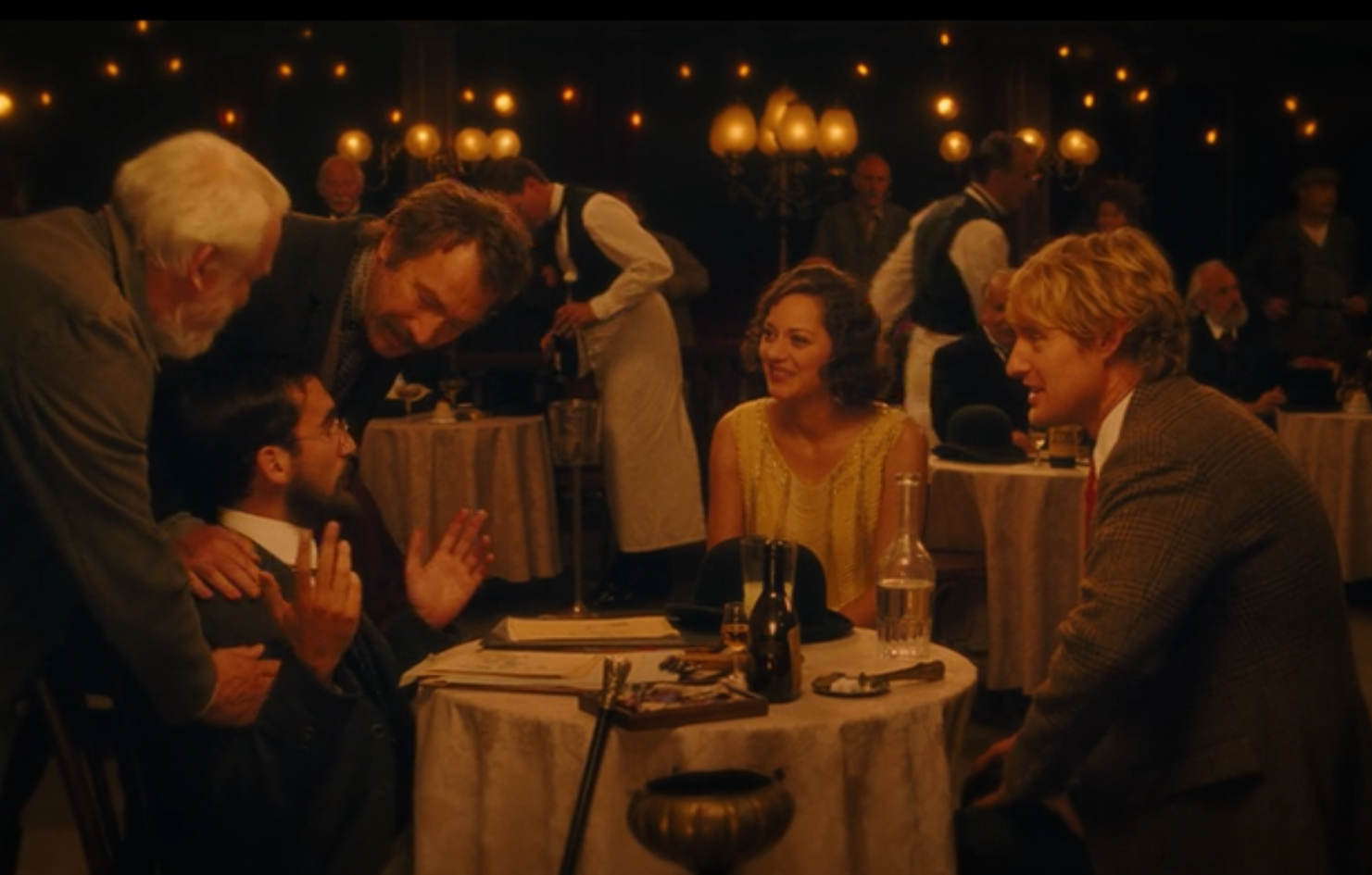
Restaurants, Bars, Dives, and Cafes in "Midnight in Paris"

Almost at the beginning, Gil, the central character and his unlikeable fiancee dine in a fancy Paris restaurant in 2010.
His dream is of the 1920s, and mysteriously, he's quickly whisked off to the nightclub scene back then.
He meets Zelda & Scott Fitzgerald, Hemmingway, Picasso, Gertrude Stein, and many more.
He takes up with an obscure girlfriend of Picasso. Here they are in a nightclub.
Gil's trips to the past are always at night, often in clubs and bars. Lots of alcohol, not much to eat.
At a wine tasting in 2010. Gil's fiancee's friends are wine snobs and every other kind of snob.
Meeting Toulouse Lautrec in Montmartre, time travel to the Belle Epoque. Another era traveled to.
Gil thinks the 20s is the Golden Age, but the girl from the 20s thinks she's missed the best time. So on they go!
Maxim's famous restaurant in La Belle Epoque. 
Back to Paris, 2010. Everyone goes to Shakespeare and Company, now and ever since the 20s.
It's not what it used to be in the 20s, 60s, or 80s -- another age was always the Golden Age.
"Midnight in Paris" is a wonderful movie, full of the most iconic Paris scenes from several eras.

Wednesday, October 12, 2016

Iain Pears: "Arcadia" -- A Mash-Up

"'Of course I can cook,' she said crossly. 'I used to enjoy it. I can do fresh perch in a cream and sorrel sauce. Calf’s head in honey and vinegar. Jams and preserves of all sorts. What do we have?' 
"'Bread, cheese, beer, some pickled meats as a treat and porridge for breakfast,' Callan said with an amused snort. 
"'What about tomorrow?' 
"'Bread, cheese, beer, some pickled meats as a treat and porridge for breakfast,' Callan said again. 'That’s easy enough, then.' 
She could drink as well, and felt she deserved to, as she had been the one who had carried the two heavy jars of strong beer. Once the food was ready, Callan made the blessing over it and poured the beer into three earthenware pots. 
"'It may be against the rules,” he said, “but in my village, servants eat with the family. So sit you down, servant Kate, and join our meal.'" -- Arcadia: A novel (p. 275)
Arcadia by Iain Pears is full of delightful passages like this one between a master (fake) and a servant (also fake) living somewhat roughly in a wooded Arcadian environment. The book is a mash-up of genres and settings linked by a couple of time-travel machines invented by a "psychomathematician" named Angela Meerson. Her title doesn't mean she's psycho, but that she has some kind of sort of psychic power that lets her do mathematics sort of kind of magically -- don't ask. Unfortunately, in reading the book's 500 plus pages I wasn't happy with the quantity of effort that it took to get through it compared to the rewards of doing so.

As for the genres: there's the Arcadia part set in an imaginary Shakespearean or Renaissance-Fair ideal time/place with a lot of references to "As You Like It." There's the dystopian future part set around 200 years from now where despotically-managed technology oppresses the enormous population of the planet. And there's the 1960 part set in Oxford where literary scholars are creating fantasies (like Tolkien and C.S.Lewis) and where they can also be former spies: in other words, a literary fiction genre mixed with a cold-war-spy genre. 

"As You Like It" performed in the Ann Arbor Arboretum. June, 2014.
A mash-up of twentieth century and Shakespeare the way Pears seems to envision it.
Each of these sub-plots is populated by a large number of characters. The reader is required to keep track of them as the narrative jumps around without what I would view as helpful reminders. A few of the central characters are transported in Angela Meerson's time machines and appear in more than one setting. Sometimes they aren't clearly identified, though maybe you are supposed to recognize them. I didn't always manage this trick.

Really, I don't want to go into more about this book, though I am proud that I pursued reading it to the very end. In its favor, I can say that Pears did a remarkable job of pulling all the story threads together in the concluding chapter.

If you want a thorough critical discussion of Arcadia, including identification of its numerous literary references, I suggest that you read the reviews in the New York Times by Scott Bradfield (March, 2016) and in Strange Horizons by Paul Kincaid (November, 2015). The book also has an app if you want to read it in a different order or something; I didn't have anything to do with the app.

If you want to read a book by Iain Pears I strongly recommend An Instance of the Finger Post (which I reviewed here) or one of his art-history mysteries, not Arcadia.

Friday, August 24, 2012

What did Shakespeare eat?


What did Shakespeare eat?

Definitive answers here: The Shakespeare Cookbook by Andrew Dalby and Maureen Dalby, published by the British Museum Press this year. Andrew Dalby is a culinary historian, so this is a work of scholarship, using contemporary cookbooks and dietary advice books that were in print during Shakespeare's lifetime. I had no idea how many such works existed!

Another surprise: many recipes are simple and close to modern cooking. For example, chicken fricassee described on page 54 is almost exactly the way I sometimes use up leftover chicken, though the modern version often includes pimentos (a variety of capsicum peppers, which Dalby says hadn't reached England from the New World yet) and the Shakespeare-era version uses the spice mace, which isn't on my spice shelf.

A variety of pies of all sizes combine meat, fruit, suet, and spice into a preparation that predates our mince pies. The small ones are called "chewets" and contain saffron and ground ginger along with cooked meat. If I could find suet, I would be interested to try pies or chewets, as I have always liked that funny packaged mincemeat that is featured at Christmas and Thanksgiving, and I would like to meet its ancestor. (If I could find a swan, there's another recipe in the book I might try too.)

Similarly there are recipes for a sort of meatball including meat-egg-dried fruit and flavored with mace. Large ones were called Farts, small ones were called Fysts. I definitely plan to try these, as the modernized recipe doesn't require suet at all. And the name is so amusing! Dalby doesn't offer any word history on this. Although there are many references on the Web to the original recipe, a quick look didn't offer me any insight into why this word meant little meatballs in Elizabethan times.

The explanation of what the word "cake" meant to Shakespeare is very interesting. "A cake, to Shakespeare, was a concept that overlapped with the modern English cake but didn't coincide with it." (page 70)

So, the authors point out, cakes could sweet or savory in the famous line
"Dost thou think, because thou art virtuous, that there shall be no more cakes and ale?" 
The word cake could refer to a loaf cake, a tea-cake, or a waffle. It could mean a biscuit. (I think this is the British biscuit, which in America we call a cookie -- the problem of terminology didn't stop in Shakespeare's time.) The book's cake recipe is for Barm Brak, made from white-bread dough, sugar, lard, eggs, raisins, and sweet spices.

Every section of the book has a discussion of a food reference in a particular Shakespeare play, with elaborations from the literature of Shakespeare's contemporaries as well as contemporary food sources. Almost every page includes an illustration, also contemporary to Shakespeare. And every section offers a wide range of interesting references and information, as well as at least one recipe quoted directly from the sources and then a modernized version. A fantastic book, for which I'm grateful to my friend Sheila!