Tuesday, August 21, 2018

American Home Life, 1880-1930

American Home Life, 1880-1930: A Social History of Spaces and Services (published 1992) explores the development of American houses and how each room or space took on its modern meaning during the specified time period. Each chapter is the work of a specialist in a particular area of material culture and history.

Chapters cover the design and layout of the rooms in middle class houses, the expectations of what types of activities would take place inside the home or elsewhere, and quite a few other social and economic features of life in one's home. The sense of what parts of family life took place in the "public" or the "private" spaces of the home changed during this era, with one result being that the room known as the parlor more or less disappeared, replaced by a somewhat different functional space known as the living room.

Changing attitudes affected the floor plan and arrangement of rooms in family homes. For example, the way people viewed children affected architecture of houses. At the beginning of this time period, children usually shared an adult's bedroom, but by the end of the era, children were given special nurseries, play rooms, and personal spaces. The book is full of interesting examples of changing attitudes.

Illustration and its caption from Chapter Three: "Children in the House, 1890-1930," by Karin Calvert. (p. 88)
Household technology above all changed dramatically during this era:
"In the forty years between 1890 and 1930, the equipment with which housework was done underwent a veritable industrial revolution. The phrase 'Industrial Revolution' rarely conjures up images of domestic appliances.... Nonetheless, the washing machine and the bathroom are as much products of industrialization as the railroad and the factory -- and they are just as full of social portents." -- From Chapter Nine: "Coal Stoves and Clean Sinks: Housework between 1890 and 1930" by Ruth Schwartz Cowan (p. 211)
Electricity for light and home appliances, gas heat instead of coal or wood stoves, modern cooking ranges, refrigeration, indoor plumbing, and changes in other building products all were important innovations. Building methods had to change to accommodate electric wiring for appliances, electric lighting fixtures, central furnaces with duct work or radiators to deliver heat to each room, and water and sewage pipes. Houses, which formerly had been essentially stand-along buildings, thus developed connections to centralized utilities such as electric plants, water works, and sewage treatment plants.

Color version of an advertisement used to illustrate Chapter One:
"The Modern Look of the Early Twentieth-Century House"
by Candace M. Volz. (p. 29)
Labor-saving devices became more and more common during this time. For example, the vacuum cleaner made it much easier to clean floors. Flush toilets meant no more cleaning of chamber pots. Central heating and the replacement of gas or kerosene lamps with electric lighting removed a terrible source of dirt and grime in homes, and thus meant less time needed for house cleaning. Modern cooking equipment required much less constant attention than tending a coal stove. Electric sewing machines made mending and sewing less time-consuming (though other trends were also at work in respect to clothing and household textiles). 

Household servants were almost an automatic part of middle-class home life at the beginning of this time period, and were becoming less and less common by the end of the era. The slow reduction in immigration during the era meant that immigrant girls were no longer available as servants -- and in 1924, the near-total cessation of immigration put an end to this frequently-used source of domestic workers. Further, factory jobs and retail jobs for women (whether native or immigrants) paid more and offered better working conditions than domestic service. The authors of these studies do not say definitively whether the reduced labor market inspired invention of more labor-saving devices or whether the new ease of housekeeping provided an incentive to households to stop employing as many domestic workers. The two trends seem to have reinforced one another.

The chapters of American Home Life document amazingly many changes in domestic arrangements and in the design and building of houses that still remain in our lives today. Radios and Victrolas (early record players) changed the way that people amused themselves, and thus the way they used spaces in their homes. Even the telephone affected home design. Before the telephone, there was an expectation that people would make a personal call at one's house. This changed to the expectation that prospective visitors would make a telephone call instead. This seems to have ultimately changed the way that the front door and reception area of a home might be designed, since you didn't have to be prepared for frequent unexpected visitors at your door.

Some of the life-cycle events that formerly took place in a private home were appropriated by public institutions during this time. For example, one life event that was usually held in the very formal and rarely-used parlor of a Victorian home was the funeral of a family member. Though we no longer have parlors in our homes, the term "funeral parlor" retains the memory of the former custom.

Jessica H. Foy and Thomas J. Schlereth, the editors of this volume assembled a wonderful selection of articles on a subject that really interests me. Many of the house styles that are illustrated in the book are still visible as I walk around my neighborhood, which was mainly built in the 1920s, and in nearby neighborhoods that are somewhat older. Reading this book gives me some new insights into what I'm seeing and how people are still experiencing home life.

Frank Lloyd Wright (1867-1959) was an influential architect of this era. Here: a household library of his design.
Color version of an illustration in Chapter Four: "Home Libraries: Special Spaces, Reading Places"
by Linda M. Kruger. (p. 110)

Sunday, August 19, 2018

Cocoa: Who cultivates it? Who processes it? Where does it come from?

"Five companies – Mars, Mondelēz, Ferrero, Nestlé, and Hershey – sell more than half the world’s branded chocolate by value... Just three – Barry Callebaut, Cargill, and Olam – grind nearly two-thirds of the world’s beans." Kristy Leissle, Cocoa (p. 25). 
Above: cocoa pods on a tree in the greenhouse of the botanical garden in Ann Arbor.

Chocolate, as most of us know, comes from cocoa beans that develop in the pod of a tropical tree. Few of us know about the farm workers who tend the trees and harvest the beans. Fewer still know about the economics and trade issues for this luxury food.

Cocoa and chocolate are major commodities. The view of food as a resource or as a commodity is different from viewing its culinary qualities. Kristy Leissle's book Cocoa (published 2018) treats the subject of cocoa as a resource and a commodity, and it explores the conditions in which African, South American, and Asian farmers work to produce this valuable product.

Chocolate is unlike foods that we might see in our own or a neighbor's garden or in a corn field beside an interstate highway. "Nothing about the tree suggests a relationship with industrial chocolate," Leissle writes. Fresh from the pod, cocoa beans "can be bitter and nauseating to eat, even in small quantities." (p. 60 & 63).

Chocolate, obviously, is highly processed. Steps from harvested beans to a candy bar from Hershey, Cadbury, or a boutique brand include removing the beans from the very tough pod, fermenting and drying them, shipping them to a processor, grinding, cooking, and tempering the chocolate, adding ingredients such as sugar and milk, and forming the chocolate mass into familiar shapes. These processing steps almost always take place in several places in the world: fermentation and drying sometimes are done on the farm or in the country of origin of the beans. Grinding, cooking, and tempering are usually done in factories of the major processors, listed in the quote at the beginning of this post. The final steps of making confections are sometimes done by the major industrial processors, sometimes by small-scale artisans.

Cocoa as a commodity has the potential to yield a lot of profit at each step of production. Thus:
"From the earliest records of its uses among the Olmec, Maya, and Aztec civilizations, cocoa has always been politicized. In comparison with other food commodities, cocoa has a wide range of values – social, cultural, economic, psychological, physiological, emotional, and so forth – and this book explores many of them. But no matter how else it is valued, cocoa is always a political tool." (p. 37).
The politics of cocoa as a commodity are rooted in the fact that it grows only in the tropics, and is thus a crop from some of the most disadvantaged areas of the world, as illustrated in the graph in the illustration (from Cocoa, page 25).

Chocolate is a luxury product consumed by inhabitants of the industrial regions of the world, the author points out, while its production can only be accomplished by these poor, rural, tropical farmers. Ghana's farmers for example, experience "unreliable electricity, insufficient sanitation facilities, poor schools, and inadequate housing." The cause of these problems is not "that farmers weren’t producing enough cocoa to fund improvement of all those things – it was that the government was not reinvesting cocoa taxes in farming communities." (p. 210).

Cocoa farmers are not privileged to consume chocolate: many have  never even tasted it, and most have not developed a taste for it, except perhaps a thin beverage made from less-processed beans. The author writes:
"While growers in Ghana may not want to eat chocolate regularly, many expressed the desire for chocolate to be available, as a sign of Ghana’s participation in value addition. Chocolate’s inaccessibility was a reminder that, though they fed the industry with its most necessary input, farmers remain marginalized from the realm of the finished product." (p. 86).
I was fascinated by the author's discussions of the lives and challenges of cocoa farmers, especially in the two highly productive African countries of Ivory Coast and Ghana. The political side of this history is that these governments tax and often exploit the cocoa growers, who receive such a small share of the world price for their highly-desirable commodity.

The poverty of the farmers, the fact that women and children on the farms are in an even worse situation than the men, the predatory practices of the governments, and many other aspects of third-world politics are all presented in interesting detail. The author makes every effort to demonstrate that child labor and other things that westerners criticize may be different for people in vastly different environments, and especially that improvements in their lives require very complex thought and appropriate solutions. She writes:
"Singling out cocoa as a sector that uniquely endangers children exposes the cognitive dissonance that results from wanting to eat chocolate – a luxury associated with romance, holidays, and happiness – while not wanting to harm children. Because consumers in the Global North do not benefit from child labor in, say, domestic service in Ghana, chances are they do not experience the same personal conflict upon learning that such exploitation is happening. But were an initiative to make it impossible for children to grow cocoa, there is every chance they would be absorbed into other industries where conditions are as likely to be harmful." (p. 228). 
Finally, Leissle says: "We are used to paying only a little for chocolate and balk at higher prices for what has long been an affordable luxury. This is not to say that shoppers are consciously acting unethically when buying low-priced chocolate. Rather, that low price is part of what sustains an unjust system in which consumers play a role." (p. 228).

I read about this book in the blog "Food Politics," written by Marion Nestle, who says: "If you wonder why food is worth talking about, Cocoa is an excellent illustration of how even something used to make candy connects to many of the most important social, economic, and political issues faced by today’s world." (source)

Friday, August 17, 2018

“White Fragility”


White Fragility: Why it’s so hard for white people to talk about racism by Robin Diangelo is a challenging book full of thought-provoking anecdotes and discussions. It’s currently a best-seller, and I hope that means people will be influenced by the difficult ideas and concepts that the author presents, and will seriously think about the implications of her definition of racism as a feature of society rather than a feature of an individual. Her starting point:

  • “Let me be clear. If your definition of a racist is someone who holds conscious dislike of people because of race, then I agree that it is offensive for me to suggest that you are racist when I don’t know you. I also agree that if this is your definition of racism, and you are against racism, then you are not racist. Now breathe. I am not using this definition of racism, and I am not saying that you are immoral. If you can remain open as I lay out my argument, it should soon begin to make sense.” (p. 13-14)
I hope many people will not only buy, but also read this book with an open mind and willingness to consider the author’s way of seeing our society.

Wednesday, August 15, 2018

Wordy Wednesday: What is authentic? What is mahoosive?

For the next meeting of my culinary book club, I'm rereading Haiming Liu's book From Canton Restaurant to Panda Express: A History of Chinese Food in the United States. On second reading, I am again finding many insights into American history, Chinese history, and more. See this earlier blog post for my review.

One idea that comes up often in Liu's book is authenticity. You'll hear people say often that one or another version of Chinese food is more authentic than another. Above all is the question whether chop suey was even a Chinese dish at all. Liu discusses these questions in a very interesting way.

Liu begins his discussion of authenticity with the earliest Chinese restaurants. These were founded during the Gold Rush and era of the forty-niners in San Francisco, and for the early years had mostly a Chinese audience. Chinese cooks also made Western meals for miners and city people, who didn't seem to want to eat Chinese food. Prejudice against Asians forced many Chinese immigrants to establish either laundries or restaurants because they were excluded from most other trades or professions.

The rising popularity of Chinese food, especially chop suey, dates to the visit of diplomat Li Hongzhang to the US in 1896. In response to the publicity he generated: "The Chinese restaurant businesses made a rebound in the form of chop suey houses. ... Chop suey became an imagined authentic Chinese dish. Chinese immigrants quickly capitalized on the legend. They changed chop suey’s ingredients, flavor, and method of preparation to fit the palate of Americans." (p. 2-3).

Chop suey, the imagined authentic Chinese dish, contrasts to Liu's definition of authentic Chinese food: "In Chinese culinary culture, authentic food means regional cuisines." However, complex issues with authenticity remain: "food authenticity is a fluid and flexible concept. This is especially true considering how Chinese cuisine has become a global phenomenon." (p. 4-6).

Although Americans continued to enjoy chop suey, and were rarely aware of other Chinese foods, by the 1920s they became more aware that chop suey was "only an imagined authentic Chinese food." Specifically, "In 1924, the Los Angeles Times carried an article entitled 'China Has Most of the Things Chinese, But Chop Suey Isn’t to Be Found There.'" The article explained, "China has played a little joke on the world. Its citizens in America have popularized chop suey as if that dish were characteristically Chinese. It is not. It is unknown in China." The New York Times, in 1928, "also noted that the dish was virtually unknown in China." (p. 66).

American consumers continued to view chop suey as the only Chinese food until the 1970s. At this point, interest in actual regional Chinese dishes awakened, especially in New York and Los Angeles. Cooks who had immigrated from Mainland China to Taiwan and then to the US were opening more ambitious restaurants, and the new tastes caught on. Before they came to the US, these refugees fled from the Communist regime in mainland China to Taiwan, bringing with them authentic regional foods: "Customers could find Sichuan spicy beef noodles, Hunan stir-fried chicken, Shandong steamed buns, Shanxi’s hand-sliced noodles, Beijing boiled dumplings or hotpot, Shanghai steamed dumplings, Mongolian roasted mutton, or Yunnan’s rice noodles soaked in burning hot chicken soup, called 'bridge-crossing.' The rapidly growing translocal restaurant business quickly made Taipei a famous tourist destination." (p. 95).

At Peng Garden Restaurant in New York, Chef Peng, one of the Taiwanese/refugee chefs, began to serve Hunan cuisine, especially a dish of his own invention, General Tso's Chicken, which he had invented in Taiwan. Over time, this dish was adapted to American taste, with a sweeter sauce and with broccoli, a vegetable unknown in China. "This contradictory character of General Tso’s chicken or other Hunan dishes made in Taiwan helps us understand the nature of Diaspora Chineseness. Chinese food does not exist in a social vacuum. Authenticity in food culture is often a flexible concept." (p. 101).

Other regional Chinese cuisines, introduced via Taiwanese/refugee chefs of the time, also achieved recognition among Americans. "However, few American customers knew that those Hunan, Sichuan, Mandarin, or Shanghai restaurants were operated by immigrants from Taiwan rather than from mainland China, which did not have diplomatic relations with the United States and could not send immigrants until after 1979." (p. 86).

In 1960s Los Angeles, according to Liu, Chinese immigrants created another new type of Chinese restaurant, with both food and atmosphere designed to attract Chinese customers rather than Westerners. For example, "At the Golden Palace, non-Chinese were ushered to one side of the restaurant, decorated with plush black banquettes and dim lights, and Chinese to the other side, which has a more authentic décor, full lighting, and simple square tables and chairs."  (p. 111).

Trader Joe's soup dumplings. Liu has a long description of the transfer of
this dish from its Shanghai origin to the transplanted community in Taiwan.
Very recently, these dumplings became a fad in the US. Obviously they've
made it all the way to Trader Joe's and my freezer. What's authentic?
At about the same time, "Cecelia Chiang was probably the first restaurateur in San Francisco who wanted to introduce authentic Chinese cuisine with a variety of regional flavors. She opened her first Mandarin Restaurant on Polk Street in San Francisco’s Chinatown in 1962." The Chiang family ran the restaurant for many years, and eventually her son became a partner in the successful and widespread chain P.F. Chang's. He struggled to convince American consumers to accept his more authentic menu, but Liu says his determination succeeded in selling "authentic Chinese food rather than the old-fashioned chop suey type of meals....The inspired concept of this place is to fuse authentic Chinese cooking with the amenities of a fine Western restaurant.” (p. 129-131).

Another example of serving authentic (or almost authentic) Chinese regional dishes to Americans is the fast-food chain Panda Express. Liu points out that their adaptation of Asian flavors is meant to please Americans in shopping malls, university food courts, airports, and other places where the chain competes for customers. He admires their success! But he adds, "It is difficult to say if Panda Express serves authentic or somewhat Americanized Chinese food." (p. 138).

I was very interested the exploration of the questions about authenticity throughout this thought-provoking book. Authenticity can be a perplexed question. Food writers and critics in general talk not only about "authentic" Chinese food but also about "authentic" pizza, "authentic" tacos, "authentic" bagels, "authentic" sushi, and lots of other foods. Usually, they are complaining because the recipe for these items varies from one city or country to another -- or from artisanal to industrial -- and they have a favorite, which they consider to be the real thing. Like Chinese food, these items have often migrated from one culture to another with various ethnic or refugee groups, and comparisons often ignore the natural changes that happen, for better or worse, when people adapt to new circumstances.

According to Jonathan Gold: the world's best pizza. (source)
The late, great Jonathan Gold, for example, was a skeptic on "authentic" pizza, which in some views has authentic versions in Naples, Chicago, New York, Los Angeles, Buenos Aires (link), and lots of other places -- even Tokyo (link). He wrote: "The words 'authentic,' 'New York' and' pizza' in conjunction mean nothing but trouble... If you ask me, the best New York pizza is made 90 miles north at Pepe's in New Haven, but as a Californian I don't have a vote." (source) Anyway, that didn't mean Gold had no opinion on the world's best pizza. He said "the modernized Margherita made famous by Franco Pepe, whose pizzeria in Caiazzo, north of Naples, is considered by some people (including me) to be the best in the world." (source)

There's really a lot to say about this one word: authentic. And since it's Wordy Wednesday I will share another random word that's entirely new to my vocabulary:

MAHOOSIVE

It means very huge. Maybe it applies to authenticity. A mahoosive issue?

Friday, August 10, 2018

What’s for lunch?


Where can you buy fresh local food for lunch? At the Ann Arbor Farmers Market! We went early and were rewarded with
a very close parking space -- parking is scarce. The market is on Wednesday and Saturday -- we chose the less-busy Wednesday.
Corn cooking for lunch just a few hours after we bought it from one of the farmers at the market.

Lunch: corn with salad and Michigan peaches.

Earlier in the week: a tortilla Espagnol (Spanish potato omelet).
Made with local new potatoes and local eggs.
Farmers' Market eggs are remarkably colorful.
Another day: the simplest lunch is cottage cheese with vegetables.
And a bit of home-baked bread.
Muffins with Michigan blueberries. Made in silicone baking cups.
Only muffins for lunch? Decadent!

Monday, August 06, 2018

What I read today: Philip K. Dick


This 1962 work by Philip K. Dick is quite a good book — I like counter factual history. Specifically, as you probably know, the action of The Man in the High Castle takes place in a world where Japan and Germany won World War II and have split up the United States between their two authoritarian regimes.

The book is full of action and intrigue: very suspenseful. But I was interested in one particular conversation between two of the characters. They are discussing the genre of counter factual history, because they are all reading a counter factual book within the book — specifically, a work where the allies actually HAVE won World War II. Their conversation:
“I see you’re reading The Grasshopper Lies Heavy,” he said... “A mystery? Excuse my abysmal ignorance.” He turned the pages. 
“Not a mystery,” Paul said. “On contrary interesting form of fiction possibly with genre of science fiction.” 
“Oh no,” Betty disagreed. “No science in it. Nor set in future. Science fiction deals with future, in particular future where science has advanced over now. Book fits neither premise.”  
“But,” Paul said, “it deals with alternate present. Many well-known science fiction novels of that sort.” (p. 113-114)

 As you see, there’s a lot of meta stuff in this book! Next step: I want to watch the recent TV version of The Man in the High Castle.

UPDATE, August 28, 2018. I watched the first episode of Man in the High Castle, and didn't feel inclined to continue watching. I also read two more novels by Philip K. Dick, which I found pretty interesting. I particularly liked Blade Runner (originally titled Do Androids Dream of Electric Sheep?, which was the basis for the film.

Freshwater by Awaeke Emezi


After Paris in July -- a month of reading and writing about Paris -- I picked a novel that's as far from Paris as I can imagine. Freshwater by Akwaeke Emezi is a story of gods and humans (published in February, 2018). The gods, who are the narrators of most of the novel, are gods from the African/Igbo tradition.

"How do you survive when they place a god inside your body?" (Kindle Locations 2395-2396) one of these gods asks. This question is central to the sad and tormented life of Ada, a young human woman, whose psyche and all her actions are inhabited and dominated by these gods. Ada's father is African and her mother is South Asian. In the course of the novel, Ada lives in her father's native African towns; in Virginia, where she goes to college; and in other US locations. Her mother sometimes lives in Saudi Arabia. She had other relatives in England. But the gods in this world of magical realism go with her everywhere and slowly control her life more and more.

The gods, who sometimes speak as a group, other times individually, are totally amoral and antithetical to human morals or decency in human relationships. They explain themselves:
"Everyone knows the stories of hungry gods, ignored gods, bitter, scorned, and vengeful gods. First duty, feed your gods. If they live (like we do) inside your body, find a way, get creative, show them the red of your faith, of your flesh; quiet the voices with the lullaby of the altar. It’s not as if you can escape us— where would you run to?" (Kindle Locations 508-510).  
The gods revel in taking over Ada's body, causing her many types of intense suffering and self-destructive behavior. Often, she isn't even aware of what she seems to have done in her interactions with other humans when a god was in control. Each of the gods has a name and an identity, and together, they belong to a particular tradition of African/Igbo gods --the novel explains everything you need to know about them. One god, for example, is a python -- an inhuman snake god. Another god says: "I was unforgiving and petty and vindictive. Don’t expect anything else from an ọgbanje."(Kindle Location 1359). Another one describes itself and its fellows as tricksters: "They didn’t give a shit about humans, they enjoyed causing pain— they were me and I was them." (Kindle Locations 1499-1500).

You could interpret this as the story of a young woman with multiple personalities, but the author's powerful portrayal of each of the gods and its forces made me believe that these gods were truly present, somehow. The gods refer to her not as "Ada" but as "the Ada" -- that is, an entity that they are controlling, and that gives them a human body. One of the gods touches on this question: is she really a mentally troubled person or is she driven by forces that are real but not really part of her? The god says:
"Sectioning the Ada gave her isolated pockets of memory, each containing a different version of her. There were versions to whom bad things had happened and, therefore, there were also versions of her to whom these things had not happened. The Ada could look back on her life and see, like clones, several of her standing there in a line. This terrified her, because if there were so many of her, then which one was she? Were they false and her current self real, or was her current self false and it was one of the others, lost in the line, who was the real Ada? We could not alleviate her terror because we would not allow a bridge between her and the past sections of her. We had separated them for a reason. Many things are better than a complete remembering; many things we do are a mercy."  (Kindle Locations 2416-2421). 
I'm sure you could look up the African myths that are embodied in this story, and that this would provide a lot of additional richness to the reading experience, but I enjoyed it without any extra work doing so. The reviewer in the New Yorker puts it this way: "The book would have made grim sense through a mental-health lens; instead, it is an indigenous fairy tale." (link)

Freshwater is a powerful novel. Several reviews compare this fiction to the actual life of the author, but I prefer to let the novel stand alone, without the author's complex personal story. As the reviewer in the L.A. Times says: "Emezi’s lyrical writing, her alliterative and symmetrical prose, explores the deep questions of otherness, of a single heart and soul hovering between, the gates open, fighting for peace." (link)

Sunday, August 05, 2018

How We Cook

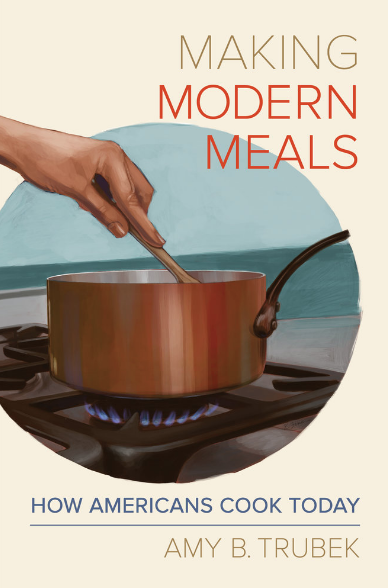
"The female head of household needs to be recategorized from 'born to cook' to 'born to figure out how to feed people.' The domestic obligation really revolves around problem-solving: the fact that there are always hungry mouths to feed is the weary load of all humans, but especially all women. Having a single member of the household cook all the food for a single meal or many meals using what we now label 'fresh,' 'raw,' or 'whole' ingredients is but one choice." (Making Modern Meals, p. 110)
Making Modern Meals by Amy B. Trubek (published 2017) is a scholarly study of how Americans get their dinner, and sometimes lunch and breakfast. In other words, it's not just about how people cook, but an attempt to see how they put food on the table, whether it's prepared at home, at a supermarket, at a take-out restaurant, or from a fast-food place.

Trubek points out that cooking now more than ever is a paid occupation, and that insight into "social changes in many aspects of meal preparation" can be understood by examining what paid cooks do. We are looking at "a changed reality in Americans' relationship to where certain meals are consumed and what is considered a culturally appropriate meal structure." (p. 104-106)

The author is aware of history, though the current state of cooking in America is the principal focus of the book. Her clearest summary of the past is this:
"As the activity of feeding a household became connected to women's roles as primary nurturers, the category of the 'good cook' became something to fight for. Women needed to enhance the social value of cooking -- they needed to show it to be more than mere tedium or necessity." (p. 45)
Although looking beyond just the question of twenty-first century home cooks and the kitchen skills they have -- or maybe don't have -- seems obvious, there's also something original in Trubek's anthropological approach. She didn't just interview people, but her research involved filming a number of meals being prepared in homes, and interviewing the women and men who did the preparation to learn about about their choices and their goals.

The organization of the book is itself enlightening. The chapters cover cooking as people see it:
  • As a chore, including plenty of historic examples of the view of cooking as an obligation and a duty that might or might not be highly satisfying or an end in itself.
  • As an occupation, including the idea that modern meals come from a continuum of sources -- often from a variety of them, and that the profession of food preparer has been growing over time.
  • As art, including the role of food TV in creating rather inflated self-images among some of the subjects of her book. I was especially amused by the man who compared himself to Picasso without seeming aware of the extraordinary skill that Picasso brought to his disruption of modern art. The high self esteem of this character was incredible considering his lack of skill and knowledge!
  • As a craft, including some quite interesting examples of current views of home baking: always optional, she reminds readers. She points out that it's difficult even to create "an accurate definition of baking 'from scratch.'"  To underscore this, she describes an artisan baker who starts each loaf by milling his own flour from wheat berries! (p. 174 & 179)
  • And cooking for health, another fraught topic.
People are eating, obviously -- mainly at home. Pundits are always bemoaning the loss of cooking skills among Americans (especially housewives), and are constantly worrying about issues of nutrition, quality, how children are trained to eat and eventually feed themselves, and many other things. Trubek steps back from the usual approach and asks more general questions about where home meals come from. The result: a readable book, though sometimes more academic than many snappy popular treatments of these issues.

Thursday, August 02, 2018

What I dream of when I dream of Paris...

All of July, I have been reading books about Paris, checking recipes on the website of Cuisine et Vins de France, looking for unknown books by French authors, and reading posts that my fellow bloggers wrote about their own views of Paris. All this for the annual event Paris in July, hosted by Tamara at the blog Thyme for Tea. I thought about writing a wrap-up of what I've learned by my reading of books, magazines, and other bloggers' work this month, but I'm leaving that to someone else and trying to remember what I've always loved about Paris, which I last visited in 2016.

Behind Notre Dame, 2016.
Paris has been my dream city for many years, since the first time that I saw it. I was on the back of the Lambretta motor scooter on which we were wandering around Europe in the 1960s. The scooter wasn't safe on big roads (I have no idea if the REALLY big autoroutes had even been constructed back that far in time). So we came in through a series of rather run-down neighborhoods full of not very interesting post-war buildings. Until suddenly we were scooting alongside the river and coming right up to the back of Notre Dame de Paris. I was breathless! (Breathless: a perfectly-named movie about Paris from a few years earlier, 1960.)

From our favorite, the Musée du Cluny, our most recent visit.
We found a very cheap hotel on the Quai de la Tournelle which directly faced Notre Dame. One of the first museums we went to was the Cluny Museum, to see the Unicorn Tapestries, which I'd been reading about for years. Breathless! We've gone back to Cluny on every Paris trip, except when it was under construction.

We mostly ate meals in student restaurants because Len had been enrolled in the  University of Grenoble, and we had special cards that entitled us to this privilege. But we had received a wedding gift of a 100 franc note, which we used for one real high-end meal at a serious restaurant. I wish I recalled what we ate, but all I remember was that it was amazingly delicious, and we were surprised that the waiters and so on treated us as honored guests, not as the poorly dressed student wanderers that we were.

In 1976, we spent most of a year in Paris, living in a very small apartment on Boulevard de Grenelle. Our balcony looked out at the elevated metro train -- noisy! especially when a terrible heat wave hit the city in late May.  The famous Poilâne bakery was across the street.

The sidewalk in front of the bakery could be seen from our balcony, though the facade was mostly hidden behind the metro. Sometimes we could see a long line of people waiting to buy the famous bread. And early in the morning, we could watch the deliveries of cords of wood to the cellar door that gaped in the middle of the sidewalk. Poilâne was famous for its wood-baked bread, and the ovens were in the cellars where the wood was being delivered. In the photo from inside the bakery, taken in 1976, you can see the elevated metro and dimly make out our building across the street.

We ate Poilâne's bread often, as well as the fantastic croissants, apple turnovers, rolls, and other Poilâne products that can be seen in the photo. Len is trying to recapture some of that taste with his current baking adventures.

Under the elevated tracks facing our building, city workers constructed the temporary stalls for an open-air market on Sunday and another day, maybe Tuesday: a good place to buy produce to prepare in our tiny kitchen. Right around the corner from us was a wonderful shopping street: Rue de Lourmel. I remember specialists in fresh fish who would tell me how to cook what I bought, specialists in exotic fruit and vegetables, and especially an amazing cheese shop called Cantin. This original Cantin shop doesn't seem to be on Rue de Lourmel any more, though there's another Cantin owned by the daughter of the original owner.

The memorial at the Vélodrome d'Hiver (Wikipedia).
Sadly, there is another landmark on Boulevard de Grenelle in the other direction, beyond the huge concrete building where we lived that year. This is the site of the Vélodrome d'Hiver, or indoor bicycle racing arena, which was torn down in approximately 1959, and replaced by other huge middle-class apartment buildings in solid concrete. The Vel d'Hiv is mainly remembered in history as the site of a huge round-up of the Jews of Paris in July of 1942. Something like 13,000 people, including 4000 children, were herded into the arena without food, water, or sanitation, and held for days before being shipped off to Auschwitz. I often walked past the monument and thought about this collective horror. Depressingly, the signs commemorating the past were often defaced by right-wing fanatics, but at the time I thought they were special to France. Now I'm thinking again of those families torn apart forever in 1942, and putting it together with what's happening to many innocent immigrant families in our own country -- in 2018. This is not a dream of Paris, but a nightmare.

Place Dauphine in 1615. A very historic location! (Wikipedia).
We've also made many shorter visits to Paris. I recall a specific day when I was alone because Len had to fly back on a different plane. I had lunch alone at a restaurant near the historic center of Paris on the Ile de la Cité in Place Dauphine. This is quite near the office of Inspector Maigret, where he sometimes has his lunch. Yes, I know he was fictitious, but for me he's a real Parisian. I was seated at a table with another tourist, a German woman, and had a very interesting conversation in French, our mutual language, about what we liked about Paris. I don't know why it was memorable! But it was.

On both long trips and many short ones, I searched for hours in a quest to collect Mona Lisa parodies, which I've posted on this and other blogs many times. I looked in antique shops, bouquinistes (that is, those book stalls along the Seine), specialists in old paper, and modern card shops. Sometimes I found a few wonderful items, sometimes not. But it's always good to have an obscure goal that takes one out of the tourist routine!

In 1976, I also followed the guidance of a book that a friend gave me. Its title was Paris Inconnu, and it described the history of very old and deteriorating buildings throughout Paris. This book is now very obsolete because most of these buildings have since then been restored and serve as museums or high-end office space or apartments worth millions of euros. The Picasso museum and the Jewish museum of Paris are both in such restored buildings. I'm amused to recall how I peeked into slummy courtyards to look for Renaissance archways and stone carvings visible behind rows of garbage cans and parked bicycles.

Another friend that year introduced me to a book titled Paris pas Cher, which explained how to find bargains. She was especially fond of one recommended store that had mid-level designer clothing and other not-quite-high-end clothing in rejected lots from the manufacturers -- who still made clothing in Paris then. Dresses, blouses, and kids' clothing, particularly by design house Cacharel, were often sold with the center of the label cut out (or in French, dégriffé) so that a person who knew labels could recognize it, but so it was clearly designated second-quality. We found quite a few nice things shopping there. (The edition that I still have is from the next long stay in Paris, as shown.)

Paris, Len's campus workplace at Place Jussieu (Wikipedia).
I'll just mention that in 1989, we spent a full year living not far from the same place, in a relatively unpleasant apartment on the ground floor of an otherwise nice building. As in 1976, Len was visiting at the University of Paris in the ugliest complex of buildings we've ever seen. But it was a wonderful year with more visits to great restaurants and fabulous museums, discoveries of food, wine bars, art, books, and a growing familiarity with subway stations and obscure neighborhoods. Above all, during each stay in Paris we enjoyed the company of many Parisian friends and many visitors who also appreciated Paris.

Well, that's my wrap-up of memories of Paris, particularly the small things rather than the ones that get on everyone's list. You know the list. You can find it in any guidebook: the Louvre and the Mona Lisa, the Eiffel Tower, Impressionist museums, a walk on the Champs Élysée, a dinner cruise on the Seine in one of the famous bâteaux-mouches. In fact, we've never done a dinner cruise on the Seine, just watched the brightly lit boats go by as darkness fell and the lights of Paris came on. In that first hotel when we stayed on the quai, spotlights from the passing boats would shine into our eyes when we were trying to sleep.

I'm sure I've written down some of these thoughts before, though not recently. Paris in July is a great idea!