Showing posts with label Paris Metro. Show all posts

Tuesday, July 14, 2026

Happy Bastille Day


Patriotic flyover with French tri-color smoke for Bastille Day.

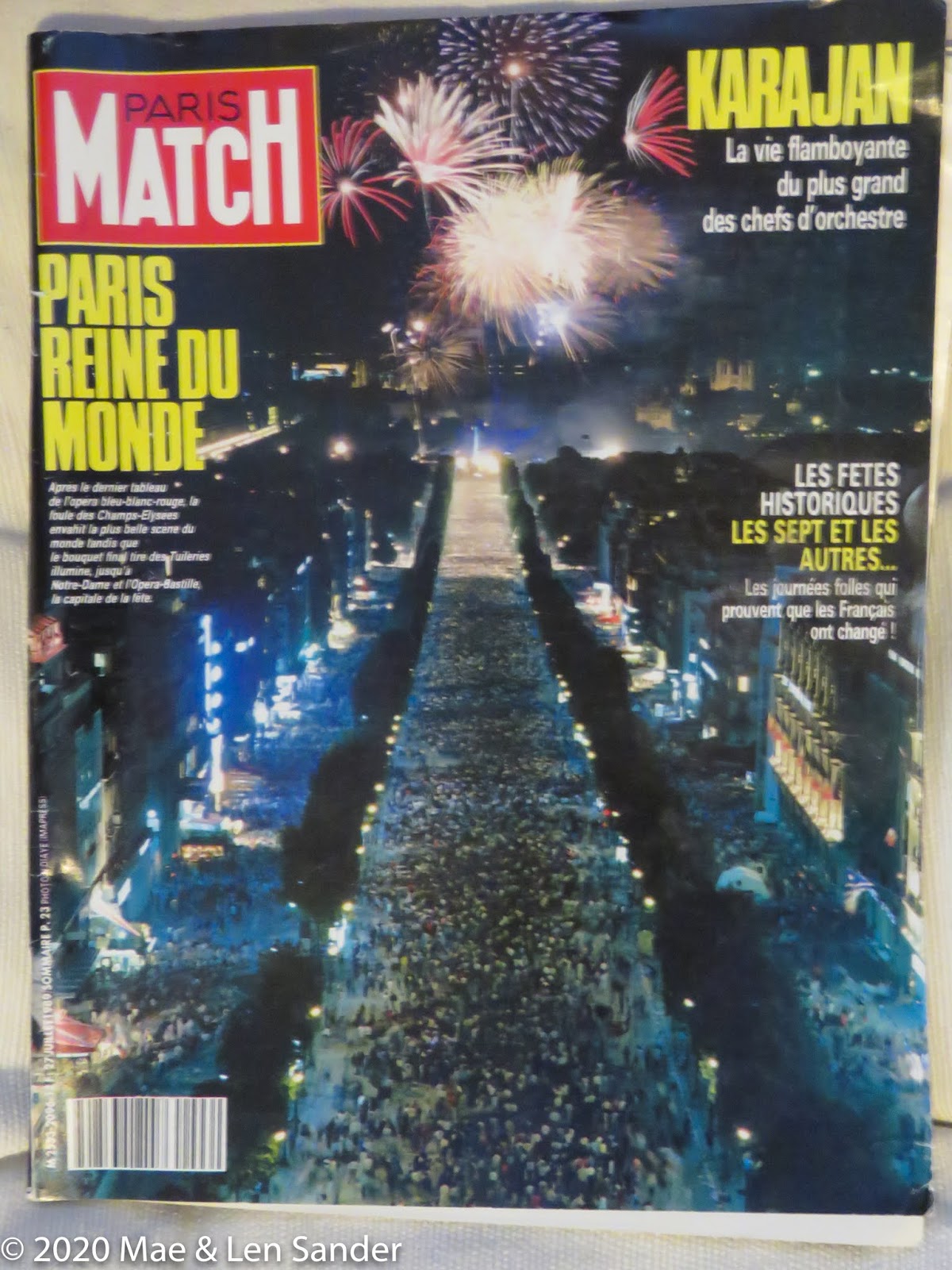
Paris Match, July, 1989.

Celebrating Bastille Day!

Reposted from past years…

Fireworks seem like the natural way for a nation to celebrate. On July 13, 1989, we arrived in Paris for a planned 1-year stay; of course we chose that date to be sure we would be present for the biggest Bastille day of the century, and we weren’t disappointed! That night, we watched the incredible show at the Eiffel Tower, which was very close to the apartment where we were spending our first night of our year there. The next evening, we joined the millions of people trying to get a glimpse of the parades and fireworks along the Champs Elysée.

I didn't take photos, but I did save a copy of Paris Match published just after the event. Our viewpoint was much less dramatic than the ones in the magazine!


The parade moving toward the Arc de Triomphe.

Also in honor of the 200th anniversary of the French Republic, the newly built Pyramid of the Louvre was dedicated.

Besides parades and fireworks and building dedications, the unexpected way that Bastille day is celebrated every year is with bals des pompiers, that is, firemen’s balls. For at least a century, these dance parties have been organized by the firemen at the fire houses in each arrondissement of Paris as well as in many other locations in the suburbs and other French cities. Sadly, the extreme heatwave this year (2026) has forced the cancellation of the parties scheduled at the firehouses. (link)

Our only other Bastille Day in Paris was in 1975. Our good friends Michelle and Jean (then a couple, later not) took us around Paris on the eve of the holiday to see the celebrations. We spent a long night of roaming around Paris. Not only at fire stations, but everywhere in the streets and squares of the city, we saw people dancing to live music by a variety of bands and small ensembles. I think we just went into the fire station and watched the dancing without having to wait in line.

At the time, Michelle and Jean had a minuscule apartment in central Paris, as well as a large house far out in the suburbs; they loaned us the apartment for our week in Paris. After our long walk around the city, we went to bed very late. A few hours later, around 6 AM, a lone trumpet player -- no doubt coming from a gig at a fire station -- strolled down the now-empty street outside our window, playing cool jazz on his trumpet: our wake up call for Bastille Day. I know we saw a parade go by but I'm not sure where or what time. I think it was near the apartment, which was on the Left Bank, not near the Champs Elysée.

For the 1989 celebration, many people wore "Revolutionary"
hats and clothing. A bit later in July, 1989, we attended
another celebration at our friend Jean's country house, where we
met these costumed children.

A celebration of the Bastille depicted on the tile wall of the Paris Metro Station named Bastille.


Sunday, July 14, 2024

July 14, 1789 and Afterwards

 July 14, the French National Holiday

Place de la Bastille (Wikipedia).
I have recently seen this memorial from a moving taxi!

The storming of the Bastille, July 14, 1789 (Wikipedia)

Today marks the anniversary of the fall of the Bastille, a huge prison and armory in Paris. The Bastille represented the worst of the repression of the common people by the French kings. On July 14, 1789, after four hours of fighting and 94 deaths, revolutionary fighters finally took over this highly fortified structure. It was razed to the ground, and now is memorialized at Place de la Bastille where a large commemorative sculpture stands in the place of the destroyed prison. 

To celebrate Bastille Day, I've looked up some photos of Paris that connect to the holiday -- these are not my own photos!

Celebrating the result of last week’s election at Place de la Bastille. (I wasn't there.)

The Revolution in Murals at Bastille Metro Station


Photos from metro websites. I have not been to this station except on a moving train.

Blog post by mae sander 2024

Thursday, December 14, 2023

Aromas of the Paris Metro and Other Metro Facts

Metropolitan: An Ode to the Paris Metro, published July, 2023

Andrew Martin’s ode to the Paris metro ranges over a huge variety of topics, many of which I found quite interesting, though not all of them. Martin is somewhat obsessed with comparing the history, purpose, architecture, engineering feats, sociology, and much else about the metro to the same features of the London underground, which I found a little tedious as I tend to value the Paris metro for itself alone.

I remember the metro for the many experiences and observations I’ve made during many visits to Paris over a number of decades. It’s always been my main transportation other than walking in Paris. Like Martin, I love to think about the names of the stations, which seem sometimes so exotic. I love the conventions of the standard metro map and enjoy trying to connect the underground map with the above ground map. I appreciated Martin’s summaries of how the metro stations, ticket sellers, gate controllers (human and automated), and other mechanics of riding have changed over the years. 

One topic that Martin covered only slightly is the buskers whose music can sometimes be heard echoing through the long connecting corridors, and how they have to audition to play legally. He mentioned only slightly (if at all the stations) where there's art in the metro, like the Louvre station, or murals of relevance to the station, like Bastille. He didn't mention the occasional vendors with permitted stalls selling mainly flowers and foods, and the many vending machines. 

Some of his material recalled things I’d long forgotten. For example, he described the mechanical route maps where you pushed a button for your destination and the map lit up a series of tiny incandescent light bulbs to show you which train lines to take and where to change lines. I can't find a single photo of such a map.

One feature of the metro that stays with me is the smell, which always strikes me as I descend the stairs into the underground tunnels. I am often amused to sniff the metro aroma that wafts up from grates in the sidewalk, a combination of odors which announce that you are above the ventilation system. I’ve never really figured out what components create this recognizable smell, but I’ve never encountered it anywhere else.

Martin has a few things to say about the metro smell — he’s much more analytical than my observations.

“‘It’s the smell of Paris,’ says my Parisian friend Julian Pepinster: ‘all the packed-in people and all the good and all the bad.’ When the first generation of all-steel Metro trains were stood down in the early 1980s, one ingredient of the Metro’s mysterious smell was lost: that of the hot oil on their wooden brake blocks. In Footprints in Paris: A Few Streets, a Few Lives, Gillian Tindall describes the smell as ‘garlic, dust and tobacco’. Cigarettes were an ingredient until 1991, when smoking on Metro platforms and corridors was banned. … I once described the odour as ‘lemongrass’; it’s possible I was detecting a perfume called Eau de Madeleine, which since 1998 has been added to the wax applied to the bitumen on Metro platforms during nightly cleaning. (The wax is to make the platforms shine, and you can see your blurry reflection in them, as in turbid water.) On 20 April 2001, ABC News described this scent as ‘a floral bouquet of rose and jasmine combined with citrus top notes, giving way to strong woody accents and a hint of sweetness in the base’. It might be that people are interested in the Metro aroma because Paris in general is such an odoriferous place, with all its concentrated perfumery, traffic, and outdoor dining.” (Metropolitan p. 112-113)

“From ‘Death of a Nobody’, a short story collected in Maigret’s Christmas: ‘the Metro, which smelled of bleach and where Maigret had to put out his pipe’.” (p. 10) 

On one long stay in Paris, we lived opposite the elevated metro line on Boulevard de Grenelle in the 15th arrondissement. So I enjoyed what he said about living next to these tracks (which could be very noisy, but we got used to it). He writes;

“I once discussed this part of town with a woman in her sixties whose mother lived in a third-floor flat on boulevard de Grenelle, directly overlooking the Line 6 viaduct. She insisted that such flats are no cheaper than any others in the desirable 15th Arrondissement, and that her mother enjoyed being near the trains, but did admit that her mother might have been prejudiced, since her (the mother’s) father had been one of the first drivers on the Metro. The boulevards and Line 6 do seem to have reached an accommodation, like two grand, venerable families; once, perhaps, wary of one another, but with more and more in common as time goes by.” (p. 153)

In his “ode to the Paris Metro” Martin refers to many other documentary books about the metro, as well as songs, films, novels, and popular culture from Parisians and tourists. For example, I remember seeing the film “Last Tango In Paris” where Marlon Brando’s apartment faces the Metro line that crosses the Seine near the Eiffel Tower — the elevated line near where we lived was only one Metro stop from this location, so we knew it well. In fact, I saw this film in a theater in Paris with French subtitles for the English and no subtitles for the occasional dialog in French.

Of course I know well the novel and film “Zazie dans le Metro” (Zazie in the Metro) by author Raymond Queneau; it’s about a foul-mouth little girl who visits Paris with the goal of riding the metro, but never has a chance because it’s on strike the entire time. Obviously another favorite of Martin! 

Here’s another cultural fact that I learned:

“Serge Gainsbourg had his first hit, in 1958, with a song called ‘Le Poinçonneur des Lilas’, whose bustling chorus – suggestive of a fast Metro train – repeatedly mentions the word trou, meaning a hole.” (p. 107)

Added note: in this video, available on Youtube, there's one extremely brief and a bit blurry view of one of the lit-up maps, with the words "connection lights."  

More Metro Books

Being a fan of the metro and loving to learn about it, I’ve read several other books on the topic — 


I’ve also read Martin’s book titled Sleeper Trains, reviewed it in 2018 (link). I haven’t read any of the dozens of other fiction and nonfiction books he has written!

The Famous Metro Entrances: Photos from the Web

As I read I couldn't help wishing for images of the topics in Martin's book because the Kindle edition has no illustrations. Searching the web produces a vast selection of images covering the last 120 years since the first metro lines came into service. I’ve just selected a few of them that I particularly like, particularly the Art Nouveau designs created in the very early days by Hector Guimard. 


Metro Platforms

Martin also referred to a work by the conceptual artist Daniel Buren, a collection of 100 images of the interior of a number of metro stations photographed in 1970. If you love the metro, as I do, check this out:

Cent Stations du métro parisien


Metro Decor

A few metro stations are decorated with murals such as this one at Bastille, installed in 1989. (source)

If I don't publish this RIGHT NOW I will probably spend the day finding more images and metro stories connecting to my metro memories!

Added Note: An earlier post with my own photos: "The Paris Metro"

Review © 2023 mae sander; images as credited.


Saturday, July 02, 2022

"Paris Metro Tales"

My Favorite Metro Photo: Faded but not Forgotten

It’s Paris in July in the world of bloggers, and I’m writing about books set in Paris! My favorite photo, showing me in front of one of the most famous metro entrances, has appeared in my blog posts before. I've included it again today. 

The Metro is one of my favorite Paris institutions. In July 2020, I wrote about it here:

The Paris Metro


Pursuing my reading theme of Paris-based fiction, I have chosen a collection titled Paris Metro Tales. Many of the stories take place near or in a particular Metro station; a few even take place on the train between stations. Because each Metro stop is named for a street or square near to the entrance, a habitual rider gets to know these place names even if one never gets out and looks around the neighborhood. The above-ground places that are never seen sometimes seem to be a mystery. 

I thought the stories in the collection would provide some insight about these unseen places, but most in fact do not. Only a few really focus on the Metro and its stations. In fact, they are more about the area or its history. Several of the stories were actually written prior to the design of the Metro system and construction of the tunnels and the famous entrances. Quite a few of these stories describe Paris streets and street life, or other features of life in the city, but aren’t really strictly about the Metro.

A Few Stories Are Really about the Metro

A few stories really have a focus on the Metro, with very specific details about characters riding on the trains or events within the stations. The most interesting to me was a story titled "Rue des Larmes" by Frédéric Fajardie (1947-2008). The central character of this story is very disoriented from the start, and it’s quickly clear that he has sustained a beating of some kind, with severe head wounds. He’s evidently been participating in some sort of violent street demonstrations. 

The story, told as a stream of consciousness, is fiction, though based in real events; in particular, one of the character’s fleeting memories is about a police massacre in 1962, which took place in a Metro Station — a horrifying event!  The disjointed memory as he struggles in the street: 

“On his right he saw the Philippe Auguste passage, at the far end of which he thought he could make out a small factory. Unless it was a large shed. Militant! Of course! How could he have forgotten such an important thing! He had just taken part in a demonstration. A demonstration intended to honour the memory of the eight people murdered at the Charonne metro on 8 February 1962: small chance of him forgetting the date because he was at that demonstration as well, when he was only a little boy, holding his father’s hand. He wondered at being able to recall all that in such detail.” (p. 106)

And the editor’s note on the  Charonne Metro Station: 

“On 8 February 1962, at the end of the war of Algerian Independence, eight people suffocated at this metro station while taking refuge from the police who, led by their chief, Maurice Papon [convicted, in 1998 for ‘crimes against humanity’ during World War II], were putting down a left-wing demonstration against the far-right nationalist OAS (Organisation de l’Armée Secrète). Fajardie recalls the violence at the metro in his story ‘Rue des Larmes’ (‘Street of Tears’).” (p. 297)

For a very interesting and detailed description of the 1962 massacre see: “A Massacre in the Metro.

***

“Confronting the Present" by Andrée Chedid (1920-2011)  is a story that's really about the Metro. It describes a man who loses his sense of time when he is riding the train -- 

"It was the rush hour. It was extremely crowded in the metro. The seats were folded up to allow the stream of passengers to invade the whole compartment. For a moment Wallace doubted their existence—and then doubted his own."

And then: "At the exit, a young man with a lot of hair and a leather jacket held the door open for him. He hurried through, thanked him; at the same time sorry to leave behind that very special smell of the Paris metro. A sharp-sweet odour which he sometimes caught a whiff of back home in his house in the woods." (p. 199 & 201). 

Oh, yes! I know the smell of the Metro. Sometimes when you walk over a street grid in certain neighborhoods, where the trains are not far beneath the street, you can smell that odor wafting upwards. 

***

Another story really about the Metro:  “Romance in the Metro” by Claude Dufresne (1920-2005). The central character is a punctilious man with no imagination. The story begins:

“Leaving home at 8.03, Hilaire Robichon reached the Porte de Vincennes metro at 8.12 precisely. Every morning for the last twenty-three years, Saturdays and Sundays excepted, he arrived there at the same time, at the same metro station. Time to buy his paper, get his weekly pass punched and reach the platform, and catch the 8.14 every morning, which set him down at Concorde exactly thirty-one minutes later.” (p. 252)

The remainder of the story seems like an imagined fantasy, but there’s a surprise ending! 

Paris Metro Tales: My Impressions

In my opinion, this story collection as a whole is not successful. The stories just don't have enough in common with one another. The fact that they take place in Paris doesn't give them enough connection. I expected to read tightly related tales centered on the Paris Metro. That was not the case, and it took me a while to adapt as I read. First, as I said, the link of many of the stories to the metro is tenuous -- sometimes there's just a mention or it's in the neighborhood. 

Another weakness of the collection is the editor's failure to give enough background information. Because these stories are set in many different eras, in fact different centuries, it would be nice if the date of composition had been given. You have to figure it out as you read, based on the biographical dates for the authors given in a list at the end of the book. Eventually I got used to this as well.

Reading stories with so many different themes and approaches made it hard for me to concentrate. I found myself forgetting what had happened in some of the stories, as I continued with something completely different. Or maybe some of the stories were just plain forgettable. All in all, I was disappointed in this book.

For more bloggers’ Paris posts,
see Thyme For Tea!

Blog post © 2022 mae sander.

Wednesday, June 29, 2022

Paris in July Reading Goals

Paris in July is now getting started at the blogs Thyme for Tea and Readerbuzz. I'm definitely planning to participate as much as I can! I'm looking forward to seeing what Paris themes other bloggers share as they read, cook, watch, dream about, or show Paris in writings, in images, and in photos. Thinking about Paris is such a wonderful distraction from our troubled world (blogged here: What's wrong with the world?) that I have decided to share my very enjoyable plans now, not wait until we really get to July!

My goal this year, as I have said in a previous post, is to read books by French-language writers who lived in Paris, and try to get a French point of view, rather than the view of a tourist or an ex-pat. It's hard to do; so many Americans and other non-French writers have loved Paris and still do, and so many people love to read these authors' books. 

I've given my plan more thought now than I had done in my earlier post. Realistically, I can't possibly read all the books that meet my ambitious goals. However, here are some areas that I hope to explore, with links to some articles about the authors I would like to read:
  • Oulipo, a literary association of experimental writers and mathematicians, founded in 1960, offers all sorts of possible reading projects! I have read a few works from the early days of Oulipo, and I wrote about Raymond Queneau's book and film Zazie dans le Metro (here). On the blog to date I have only mentioned the works of Oulipo writer Georges Perec, whom I hope to go back to. I would also like to learn more of what has been done by Oulipo writers recently. Michele Audin, a current Oulipo member, is one example. 
    https://www.newyorker.com/books/page-turner/the-absolute-originality-of-georges-perec
Georges Perec
Simone de Beauvoir
  • Mystery novels written in French are intriguing. Currently, author Fred Vargas writes police procedurals about Commissaire Adamsberg. I have read three of them. 
    https://www.bookseriesinorder.com/fred-vargas/ 
    Also, I would like to read more of the Inspector Maigret books by Georges Simenon, written between 1931 and 1973. Almost all of them at least begin in Paris at the central police station.
  • French cuisine is always my favorite. French home cooking has evolved over the years I've been cooking and eating French food. To see what's new, I might read some current French food magazines like Marie Claire/ Cuisine et Vins de France.  https://www.marieclaire.fr/cuisine/
  • Foreign immigrants to Paris have their own special experiences -- as I have mentioned, I would like to read novels about them. In my search, I especially learned about Faïza Guène, author of six novels about immigrant life in the Paris banlieus. The latest one was just published, and I have now read it and will post a review. A 1950s immigrant writer was  Driss Chraïbi. He wrote Les boucs (1955), but I don't think I would like it.
  • Hip adolescents have had their own French literature. Beloved books now and in the past fascinate me. I would like to find out what books French students are passionate about now. For this project -- I don't know how to begin! Two examples that were popular for a long time (which I've read before) are: Le Grand Meaulnes byAlain-Fournier, published shortly before the author was killed in the first month of World War I, and L'Écume des jours by Boris Vian (1947), which was highly popular for at least two generations. 
    https://www.newyorker.com/books/page-turner/whimsy-war-boris-vian-two-minds https://www.theguardian.com/books/booksblog/2007/dec/10/borisvianstillspittingfrom https://www.linternaute.fr/biographie/litterature/1775154-boris-vian-biographie-courte-dates-citations/

  • Two recent novels in French that look interesting: The Art of Losing by Alice Zeniter (2021) and  The Anomaly by Hervé le Tellier (a best-seller in 2021). 
  • Paris Metro Tales, translated by Helen Constantine (2011) is a collection of French stories linked to various Metro stops, which I've started to read.

Blog post © 2022 mae sander
Photos from web.

Saturday, April 02, 2022

Michel Bussi: "After the Crash"

"Lots of initial promise, but the plot proves improbable and the execution melodramatic." -- Kirkus Reviews

"The mystery kept me reading, but only because it employed some not-too-believable plot lines to keep readers in suspense." -- Rhaposdy in Books

"...an intriguing if formulaic thriller, featuring skeletons in every closet, secret love, murder and even an occasional nod to James Bond" -- Boston Globe


Why is Michel Bussi's After the Crash such a best seller? I don't quite get it, and neither did several of the reviewers a few years ago when the English translation was published.

The frame story, which happens in just two days, is fast-paced; in fact, the author insists on showing you how fast paced it is by date-and-time stamping each chapter with a particular date in 1998. The main character, Marc, rushes from place, all over France by train, by Paris Metro, sometimes running on foot, and sometimes driving an ancient and rickety van, and also frantically trying by phone to reach Lylie, the other main character. He also has to defend himself against a couple of murderous opponents. And as he rushes around, at the same he is reading an account of the past, beginning in 1980 and continuing through he 90s, written by a private detective named Crédule Grand Duc. Bussi also provides flashbacks to the past that illuminate the central mystery.

The central mystery is the identity of Lylie. As a baby, she was found on a mountainside near Switzerland after a horrendous airplane crash. Miraculously, while the other passengers died in the explosion that followed the crash, she had been thrown from the wreckage and survived on the ground until the firemen arrived. The mystery at the center of the novel is her identity: two babies were on board with their now-deceased parents, and there's no way to discover which of the two is the survivor. DNA analysis became available only a decade or so later, and while one wonders why it wasn't tried as soon as possible, that also becomes one of the implausible elements of the plot.

Implausible is the word for much of this novel, but it's the plot that really seems unlikely, including many loose ends. For example, the sometimes-bizarre violence described would surely have brought in police action. The characters and details of their lives are more believable than the plot, which I think explains why the book is popular -- and why I kept reading. The families that claim the baby are exaggeratedly different in social standing: one insanely rich, one insanely poor. Further, most of the characters are either at the extreme of rotten human degradation or at the extreme of kind, sweet, human loveableness.

A few food mentions helped to portray the social standing of the characters: these are a bit off-beat. Marc's grandparents made a marginal living by running a food truck, which they would take to the beach on summer Sundays and to local events like a kite-flying fair. They sell cider, fries, sausages, crêpes, waffles, and other snacks to beach-goers and tourists.

And: "A Salammbô was Marc’s favorite cake. Or, at least, it had been when he was ten years old."  (p. 252) This green-frosted eclair was popular with kids, but his grandmother keeps buying it as a treat for him: "Marc had stopped liking the weird green cakes when he was eleven, but had never dared tell his grandmother. It was the cheapest item in the bakery." (p. 295). 

On the other hand, Crédule Grand Duc, the detective who worked on the mystery of Lylie's identity for 18 years, embodies a love of very luxurious food. In particular, when he visits the region where the crash took place, he always drinks the very rare and special Vin Jaune of the Jura Mountains: "Apparently I needed to drink an entire bottle of Vin Jaune before my imagination started working properly."  (p. 288) In addition to loving food, while investigating in Turkey, the place where the fatal plane originated, he becomes fond of the Turkish smoking custom: "The hookah, raki, and the inevitable keyif; afternoon tea served on a silver platter, in carved glass beakers, so hot it burns your lips as you refresh yourself between increasingly insane questions." (p. 143)

Despite all the flaws, I kept reading, because the suspense builds up despite all the implausible details. In fact, I suspect that the unbelievable nature of Bussi's plot makes the whole novel more, not less, fun to read.

Blog post © 2022 mae sander. 

Wednesday, June 30, 2021

Paris Kitchens

A tiny Paris kitchen. (source)

This is kitchen day. At the end of each month, I write about what's happening in my kitchen and share it with like-minded bloggers who link up at Sherry's blog, Sherry's Pickings. This week is also the start of another fun blog link-up called Paris in July, hosted by Tamara at Thyme for Tea. I've decided therefore to write a post about French kitchens I've experienced: the dream and the reality. The ongoing dream is the part that makes this ok (I hope) for Sherry's kitchen event, which is supposed to be about the present not the past.

I've lived in Paris for a few long stays, when I cooked in an apartment kitchen. These were anything but dream kitchens. They were really small. The appliances were touchy: ovens without a good thermostat, extremely small refrigerators, tiny countertops, wobbly cabinets (once a shelf fell and all the lovely platters and baking dishes that I had bought were broken). Despite the limitations, I not only made most meals for two or three of us, I also thoroughly enjoyed shopping in the nearby open-air markets and small specialty shops in the neighborhood. I even invited French friends for dinner parties where I cooked American foods to amuse them.

While we were living in Paris, we also had quite a few visitors from home who stayed with us for a weekend or even for several days. I have a cousin who still remembers that she and her friend, who were bumming around Europe between college semesters, slept in the kitchen in one of the apartments, which now in retrospect seems impossible. Why in the kitchen? Because our then-young daughter slept in the bedroom and we slept in the living room which was also the dining room. So Jacki and her friend squeezed their sleeping-bags into the narrow kitchen. Mostly, though, we didn't have overnight guests in that location.

Our building from street level. Our apartment faced the
elevated metro, so it was also very noisy as well as small.

We invited more visitors during a later stay in Paris, when we had a very small second bedroom, which was also the laundry room. My then-3-year-old nephew, who was visiting us with his parents and brother, remarked "Aunt Mae's kitchen is smaller than her bathroom." You get the idea!

During our stays in France, we also were invited to the apartments of many friends, so all in all, we've seen a number of Paris kitchens. These were typically crowded and small, but usually had newer cabinets and equipment than ours -- sometimes even a compact dishwasher, an almost-normal refrigerator, and a tiny washing machine. Real estate in Paris is very very expensive, so small kitchens are just a normal part of life there, at least among our middle-class friends. Whenever we go to Paris, we still frequently have dinner at their homes, so some of our experiences are also more recent.

A "solution" for a kitchen that can be hidden
from guests: put it in a closet! (source)

I don't have any photos of the kitchens I've seen in Paris apartments -- not even from recent trips. Before the year 2000, the old limitation of 36-exposure rolls of film meant that I saved the shots for the beautiful tourist sights. Besides, most of the Parisians we know have always tried not to let anyone see their kitchens during a dinner party -- you have to sneak a peek between courses if you can, and bringing your iPhone for a photo op would be horrendously gauche!

Typical Paris kitchen: the refrigerator is below the counter.
Next to it is a tiny washing machine.

Dream Kitchens

Let's turn our attention to another Paris kitchen experience -- dreaming of ideal kitchens in Paris, which is what I'm doing this month. I love to take long walks through the many types of neighborhood in Paris. I enjoy looking into the display windows of a variety of businesses, including kitchen remodeling shops. These are amazingly frequent, unlike here in the US. You would never know how small the typical kitchen is when you look into these spacious sample installations. 

Knowing that kitchen remodeling is so popular in France, I searched out some web-sourced photos of Paris dream kitchens. These unattainable remodeling proposals, like the windows of the kitchen remodeling shops, reflect the fact that Paris is full of rich people -- really, really rich!

My entire Paris apartment would have fit in this kitchen. (source)

At the time we lived in Paris, there was another major difference between French and American kitchen practice. Cabinets, stoves, and refrigerators were not usually provided when people bought an apartment. Instead, the kitchen would be empty, except for maybe a porcelain sink on spindly metal legs and some appliance hook-ups. If the buyers already owned cabinets and so on, they would move them in along with their furniture. Otherwise they had to buy them. We had a friend who did that when she moved from a house in the suburbs. I have no clue if that's still the French custom. Our short-term rentals were all fully furnished, so this didn't apply to us.

Smaller, but elegant, this image is made with CGI. (source)

A kitchen in a former maid's room under the roof. (source)
Do you dream of living in Paris? Do you imagine going to a bakery for croissants every morning and for fresh bread every evening? Do you picture yourself picking out beautiful produce in the markets, buying meat from a custom butcher shop, choosing a whole cake from a patisserie, or enjoying cheese shops with dozens of types of French cheese? Do you dream of giving dinner parties in an elegant apartment with a beautiful view of the Eiffel Tower from the balcony? I hope you have good luck finding your dream place! 

Despite the limitations of my past French living quarters (which by the way were not in the least inexpensive!) I really had a wonderful time there on my past trips, and would love to do it again some time.

A French cheese shop. (source)
Blog post © 2021 mae sander; photos as credited.


Monday, September 07, 2020

“A broth of pure meat essences”


In Paris in the eighteenth century you could find lots of types of food for sale. A variety of culinary trades specialized in various dishes and preparations. Cuisineurs (cooks), rôtisseurs (roasters), patisseurs (pastry cooks) and several other food professionals had legal rights allowing them, exclusively, to sell specific foods for dine-in or takeaway. In addition, a contemporary source in 1773 wrote:
“Restaurateurs are those who have the skill of making true consommés, called restaurants or the prince’s boullions, and who have the right to sell all sorts of creams, rice and vermicelli soups, fresh eggs, macaroni, stewed capons, confitures, compotes and other delicate and salutary dishes.” (Mathurin Roze de Chantoiseau, cited in Rebecca Spang, The Invention of the Restaurant, p. ix)
Mid 18th century bouillon pot from France.
Recently sold at Christies for 50,000 pounds.
Broth bowl with cover and stand, 1752-1753,
Metropolitan Museum. (source)
The pure essence extracted by slowly cooking meat, with or without the addition of water and vegetables, was considered a healthful restorative beverage, or "restaurant," that brought invalids back to health, particularly individuals with weak chests or digestive problems. Consuming this liquid instead of eating a heavy evening meal was especially seen as healthful. Everyone who drank this beverage could be "improved and benefited, restored and delighted, by means of a small cup of bouillon." (Spang, p. 25)

To drink these “restaurants” Parisians went to the specialty shops — which were also called restaurants — as described in the quote above from Roze de Chantoiseau. These shops became popular and important in 18th century Paris before the French Revolution, and slowly introduced other light and restoring foods and beverages, as well as guaranteeing especially clean and careful preparation. These food shops became the precursors of the modern restaurant.

During and after the French Revolution and the Napoleonic era (1789-1815), restrictions eased up on who could sell each type of food. By the early 19th century, when the above image of a kitchen was published, Paris restaurants were serving full meals to diners of all sorts — not just to invalids.

Restaurant offerings in the 19th century weren't limited to health foods: many new dishes were added to the menu. Over time, restaurant dining became more and more similar to the experience of current French restaurants, with a varied menu served in courses and cooked to order by trained chefs and their staffs. Rather than regular clients who ate their meals in the establishment every day at a set time as in the 18th century, emerging restaurants served meals either to regulars or to occasional customers at whatever time they chose to dine.

Thus the original meaning of "restaurant," a health-inducing beverage, was lost. Extracted essences of chicken, veal, or beef are now called consommés, bouillon, stock, or broth, and the word "restaurant" refers only to a dining establishment. A complete history of the creation of the French restaurant appears in The Invention of the Restaurant: Paris and Modern Gastronomic Culture, by Rebecca Spang, a fascinating history book published in 2000.

The Return of a Classic

From the website of Bouillon Julien, Paris. (link)
The Michelin Guide online site reported last year: "Recently, a crop of restaurants labeled bouillon has resurfaced in Paris, including Bouillon Chartier, Bouillon Julien (formerly just Julien), Le Bar du Bouillon and a new kid on the block, Bouillon Pigalle." (link)

While these historic re-introductions have roots in the establishments run by the original 18th century "restaurateurs," they were all founded in the mid-19th century. They serve traditional French "comfort food" at affordable prices. Despite their later foundation, they claim a connection to the earlier 18th century models.

The Michelin article describes one of these in particular detail:
"At the Bouillon Julien, the founder's promise of "beau, bon et pas cher" ("beautiful, delicious and affordable") has been reinstated by new owner Jean-Noël Dron. After a delicate renovation of its fabulous floral and sculpted wood decor by Majorelle and other art nouveau artisans, it reopened in the fall of 2018. The new menu, crafted by a head chef lured away from a starred hotel restaurant, includes a terrine de volaille et legumes (€5.20), a foie gras de canard (€9.20) and the Bouillon Julien (beef bouillon with tender morsels of beef, ginger and citronella, for €9.90)—a perfect example of the original vocation of these restaurants."
An article in the New York Times last year, "Three Courses, 20 Euros: The Affordable Dining Renaissance in Paris,"  emphasized that these restaurants, mostly located far from the tourist areas of the city, follow the 19th century tradition of working-class restaurants called "bouillons," which give great value for a low price.

The Bouillon Cube 

The "restaurateurs" of the 1760s not only produced bouillon to serve in their restaurants, they also created a safe and healthy portable product -- an early version of the bouillon cube for travelers. (Spang, p. 29)

Various experimenters improved the technology of concentrating meat flavors and making the result shelf-stable. By the end of the 19th century, bouillon cubes were being mass produced, and industrial food manufacturers like Knorr, Oxo, and Maggi made and distributed them widely. For more of this history, see "How Bouillon Cubes Became an International Pantry Staple" by Mari Uyehara, published in Serious Eats last July.

Today bouillon remains an important culinary ingredient and sometimes a beverage for invalids and others. Most cooks worldwide today make it not by slowly cooking meat and extracting the flavor, but by dissolving a cube or a spoonful of concentrate in a cup of water. The industrial production and wide sale of this highly concentrated essence of meat led to another type of change in cooking, not just in France, but on almost every continent: you could add meat flavor and its umami quality to any dish by just unwrapping the small cube.

Every Tuesday, many bloggers share a beverage: a photo, memory, or reference to a drink. These circulate via a like-minded group hosted each week at the Altered Book Lover blog. Today my beverage is the 18th century health drink known then as a“restaurant.

 Blog post © 2020 mae sander.

Friday, August 14, 2020

Three Girl Detectives

Vintage Nancy Drew
My first detective was —naturally — Nancy Drew.  The everlasting girl sleuth made her first appearance in 1930. Nancy Drew books kept being updated for generation after generation of readers, and eventually for film and TV watchers. At age 10 or 11, on summer days, I could walk to the nearby library, check out my max of three Nancy Drew mysteries (disapproved by the librarians), read them in a day or so, and go back for more.

Over the years, I’ve read lots of  mysteries of various kinds that featured both men and women detectives. Or sleuths, as Carolyn Keene, fictitious author of Nancy Drew would have it. So much has been written about Nancy Drew and her influence that I have nothing to add here, except that I've been thinking about girl detectives because my current reading has featured a couple of 1990s female detectives, Aimee Leduc and Lydia Chin.

The novels I read are the creations of authors Cara Black and S.J. Rozen. Black's Aimee is a private investigator in Paris. Rozan's Lydia investigates in New York, with a focus on Chinatown. Both of these characters are highly intelligent, strong, young, good looking, brave, and resourceful. I have a feeling that their invincible and unflappable personalities are particularly representative of the ideals of the 1990s, though both authors have continued to write many more novels featuring these detectives. Their abilities defy the imagination: they are just too perfect!

Murder in the Marais by
Cara Black (published 1997,
set in 1993.
While I've read several of the Lydia Chin novels in the past, and posted reviews of several of them, Aimee Leduc is new to me: she's a favorite of my friend Mary, who recommended them and loaned them to me. In the first novel of the series, Murder in the Marais, Aimee is depicted as a real superwoman, able to cope with events that would presumably defeat anyone else, and able to cope with the threats that occur in this suspenseful tale.

Aimee uses ingenious and convincing disguises for every occasion. She has a huge wardrobe of remarkable haute couture clothing, as well as special-purpose clothes for slumming and other situations. Mostly these come from thrift shops where she makes incredible finds from famous Paris designers. However, on one occasion she simply stole an entire outfit from a factory. It's ok: she had to get new clothes in order to escape a pursuer.

Aimee's brilliance includes a range of computer skills appropriate for the novel's 1993 setting. Using equipment that's now long obsolete, she can hack into any government or industry computer and find out what she needs to know: often while fighting off bad guys. Her various confrontations with dangerous violent men show her to be intrepid -- including shooting the worst of them off a roof when he was shooting at her with a night-vision weapon.

Witnessing deaths or finding bodies doesn't cause her to lose her calm demeanor. She effortlessly navigates the streets, metro, and sewers of Paris. Above all, Aimee knows where to find the most delicious onion soup, hot apple tart, and good coffee in Paris. What a remarkable woman!

Mandarin Plaid by
S.J. Rozan (1997)
S.J. Rozan's Lydia Chin is a Chinese American, a child of immigrants. She lives with her mother -- who would prefer a more submissive and conventional behavior of her daughter. In Mandarin Plaid, the second in the series, Lydia uses her knowledge of Chinese language, immigrants, and diverse customs in her work as a private eye, partnering with a conventional detective named Bill Smith. Like Aimee, Lydia has remarkable computer skills (appropriate for her time). She also has an uncanny ability to judge character and guess people's motives or weaknesses. She's also similarly capable of staying cool while threats and dangers lurk all over New York.

Although Lydia's wardrobe isn't as versatile or stylish as that of Aimee in Paris, she thinks hard about dressing to fit into a variety of low-life bars, trendy restaurants, and other settings where her detective duties take her. She uses Asian martial arts in hand-to-hand fighting with the bad guys -- her gun comes in handy as well. She works out at a dojo to keep in shape mentally and physically:

"Practicing form, repeating the traditional moves in their prescribed combinations, again, again, again, with no involvement with anyone else, nothing but the relentless, exhausting effort to perfect yourself: that helped." (p. 173).
Food, especially the most appealing foods of Chinatown, is often on Lydia's mind. She stops for tea often, and enjoys several specific types. She's also a helpful shopper for her mother: before going out detecting one morning, she has to do some marketing:
"Water spinach, in Chinatown on a bright weekday morning, is not hard to find. Fruit and vegetable sellers weight their sidewalk stands down with shiny oranges and ugly misshapen jackfruit, crowded beside bundles of foot-long beans as thin as a shoelace and surrounded by bunches of deep green leaves, some rounded, some serrated, all glistening with water sprinkled enthusiastically over them by the sharp-eyed merchants and their fresh-off-the-boat assistants." (p. 84).
At an up and coming trendy Chinese restaurant (remember, this is the early 1990s!), she ordered "a platter of sizzling oysters in a garlic and scallion sauce. ... I tasted them. They were wonderful, something bitter in the sauce setting off the richness of the oysters perfectly." For her second course: "a whole perch, steamed and glistening in a ginger-scallion sauce, topped with delicate strands of carrot, red pepper, and bean thread. With it came a platter of watercress sauteed with garlic, and a large covered bowl of fragrant rice." (p. 141-143).

These days, the library isn't a place I'm going (in fact, I don't think it's open, only delivering books for pre-arranged pick-up). Borrowing books from a friend like Mary is exceptional. E-books are my mainstay! But lazy reading about girl sleuths is still a great way to spend a hot summer afternoon.

This review post © 2020 by mae sander for mae food dot blog spot dot com. 
If you see this at another blog, it's been pirated!