Showing posts with label Georges Perec. Show all posts

Saturday, July 16, 2022

Two books by Georges Perec


Continuing with my brief exploration of the life and work of French author Georges Perec (1936-1982), I have been reading Tentative d'épuisement d'un lieu parisien (An Attempt at Exhausting a Place in Paris) and W ou Le souvenir d'enfance (W, or the Memory of Childhood).

The first book reports on Perec's observations during three consecutive days in 1974 when he sat in Place Saint-Sulpice in Paris. (It was easier to obtain the translation, so I read it in English.) The second book is a dual narrative, partly of his childhood, published in 1975; I read it in French with help from only translation programs. From the biography that I read recently (blogged here), I am aware that the mid-seventies were a highly productive time in Perec's life as a writer, and so I decided to read (or, for W, reread) these two books.

Exhausting a Place in Paris

An Attempt at Exhausting a Place in Paris is even more unusual than most of Perec’s eccentric output. From a café or a park bench in Place Saint-Sulpice he took notes on everything he saw -- or at least everything that interested him. And it's surprisingly interesting and readable because... well, because Perec. For example, he noted the numbers of the city buses that drove past or stopped, and where they were going, as well as noting tourist buses. He described the passers-by and their clothing and what they seemed to be carrying. He described cars and motor scooters. Occasionally he saw someone he recognized. It's all documented.

Palmiers (source)

There is obviously no plot or much to summarize here. But one thing struck me: there's a cliché that claims that the French do not eat while they walk on the street. Unlike Americans. This is evidently not true. Perec sighted many such people. 

"A young girl is eating half a palmier." (p. 14) 

"A man goes by, eating a cake." (p. 37) 

"A woman goes by; she is eating a slice of tart. A couple approaches their Autobianchi Abarth parked along the sidewalk. The woman bites into a tartlet." (p. 34) 

"A girl with short braids wolfing down a baba (is it a baba? it looks like a baba.) A woman with a baguette. Another one." (p. 21)

Perec also eats and drinks in the cafés, while watching -- sausages, a Camembert sandwich, coffee, Vittel water, and so on. But this is ordinary while sitting in cafés. I think it turns out that eating while walking on the street in Paris is also ordinary. Or, to use Perec's own term infra-ordinary.

A Memory of Childhood

W ou Le souvenir d’enfance contrasts the very few memories Perec had from his early childhood to an increasingly violent and horrifying vision of an exotic society on the island of W somewhere beyond the Strait of Magellan. His loss of his childhood — especially his lack of any traces of his mother — disturbs him deeply, and he attributes this gap in his otherwise very excellent memory to the horror of being taken from his mother: he just barely remembered her turning him over to the Red Cross to be evacuated from Paris. He remembered even less of his father, who had volunteered for military service and died in one of the only battles in which France tried to defend itself from the Nazi invasion.

Perec the writer, as an adult, could muster only the vaguest memories, augmented by a few documents and relatives’ accounts, of being hidden first in the countryside, then in a boarding school for children including refugees, and then again in the countryside — but never seeing his mother again. He eventually learned that she was unable to escape Paris and was rounded up and sent to the camps; she eventually disappeared at Auschwitz, along with most of the Jews of Europe. But he didn’t know this as a child, when he knew only that he must never reveal anything about who he really was. His struggle to conjure vivid memories is painful to read.

Between the chapters about his experiences before the age of 9, when he returned to Paris and life with an aunt and uncle, Perec included a very complete description of the Fascist life of the inhabitants of W, where all the male inhabitants were athletes engaged in formal and very violent games, and the female inhabitants were imprisoned in barracks that “protected” them from the men. While my summary makes this sound obvious and clumsy, the contrast between the two parts of the book is subtle and powerful.

Besides the constant contests among the athletes of W, there were occasional races where the women would be forced to run away from the men, and when they were inevitably caught, the men would rape them, while the crowds of spectators watched. The society of W is described in excruciating and vicious detail: a much worse fantasy than even the worst Nazi society that Perec was coming to grips with in his early autobiography. Even the non-rape contests included rules that allowed the athletes to attack one another, disrupt the flow of races, use unfair holds in games like wrestling, and wear pointed toe shoes to kick and maim their opponents. 

It’s not hard to figure out what Perec means by the two opposing parts of this book. The cascading nightmare created by the Nazi occupation and imposed on a small child and the helpless adults around him — and the cascading nightmare of W, an imagined dystopia with the worst human conditions possible. In the last few paragraphs, Perec brings these two seemingly separate worlds together. What a horrifying book!

The cover of the English edition
of W, or the Memory of Childhood.
I read it in French because there's
no Kindle version in English.
Blogpost © 2022 mae sander
Shared with Paris in July.


Thursday, July 14, 2022

Perec and Paris

My reading project this week is the works and life of the French writer Georges Perec (1936-1982). Reading about him is fun for me because I was in Paris a number of times in his lifetime and shortly thereafter. On these visits, I frequently visited the streets and neighborhoods that are mentioned in Georges Perec: A Life in Words by David Bellos, which I wrote about yesterday. Although I never met any of the quite famous people that played a role in his life, I'm reminded of some things I saw and did in Paris. Here are some of the special ways that I connect when reading about Perec:

  • Perec in his early years lived for a time near Place Jussieu, location of the science faculty of the University of Paris, and much later at another nearby location on Rue Linné in the same neighborhood. Len worked at the university during both of our long stays in Paris. And we once borrowed an apartment on Rue Linné or an adjacent street. Our brief stay there was actually at the same time Perec lived there, though of course we never saw him nor would we have known who he was at that time. 


  • In a café near the university, where Len and his colleagues used to eat lunch, a mirror on the wall had signatures of the Oulipo members who used to meet there a decade earlier. So I've seen the signature of Perec. The café was familiarly known as Chez Dédé. (This small detail was not in Belloc's book, and I can't find it on the internet either. However, I think this might be how I heard of Perec and Oulipo.)
  • Perec also lived for a time next to the elevated Metro Line 6, from Nation to Etoile. Our apartment in Paris in 1976 faced another section of the elevated track, so we experienced the noise levels that are described in the biography.

    The elevated metro line outside our apartment window, 1976)

  • Perec loved the restaurant Balzar in the Latin Quarter. Our friend Michelle also loved Balzar, and took us there on a number of occasions. Evidently it was popular with professors and researchers because it was close to many labs and academic buildings.

    source -- Wikipedia

  • NOTE: French Wikipedia provides some insight into the customers of the Balzar restaurant. It lists as regulars: writers Albert Camus, Simone de Beauvoir, and André Malraux; the historian Jean Tulard; the politicians Jacques Toubon, Václav Havel and Mário Soares; the movie figures Louis Malle and Johnny Depp; the physicist Walter Kohn; and philosophers Hélène Cixous and Jacques Derrida.
  • Perec worked in a research laboratory located in the Sainte-Anne Hospital Center in the 14th arrondissement. During our long stay in Paris in 1976, the owner of our apartment lived on the hospital grounds where her husband, a doctor, was a department head. Therefore, I had to go there to pay the rent each month as she wanted payment in cash.
  • Perec was very fond of films, and often saw the new films being made in France and Hollywood throughout his lifetime. He also worked on scripts, he made an entire film, and he contributed to other aspects of cinema. When I read the names of the films he appreciated, I have lots of memories of them, though of course I was at a great distance and he was often up close.

    "Un Homme Qui Dort" or "A Man Asleep"
    is a film made in 1974, directed by Bernard Queysanne
    and written by Perec. (I haven't seen it.)

Other Things About Perec

In addition to the facts of Perec's life in Paris in the 1970s and 1980s, some other topics described in his biography make me feel connected to him:

    • During World War II, as an endangered Jewish child, Perec was hidden in a village and in a school near Grenoble. On more than one occasion, I have visited that area of the mountains of the Grenoble area. In fact, a colleague of Len's once took us on a long walk in the mountains there and got us quite lost.
    • Perec’s job for nearly 20 years was working as a cataloguer in a medical research laboratory where the research topic was the neuroscience of sleep. This field of study was in its infancy in the 1970s when he worked there, and so was the work he did: making an information retrieval system using index cards to help the researchers find relevant publications on their chosen topics. Both of these fields (sleep and information retrieval) have interested me at various times in my life, and I once had a job in a company that was developing computerized information retrieval tools. So again, I feel vaguely connected.
    • On a completely different subject: Perec's parents, grandparents, aunts, uncles, etc. fled from their native Jewish cities and shtetls in Poland and other parts of Eastern Europe in the early part of the 20th century -- as did my ancestors.
    • Perec was proud to be a collateral relative of I.L.Peretz, the Yiddish writer, and especially was interested in the story "Bontsha the Silent." The name Perec is a spelling variant of Peretz. The stories of I.L.Peretz are of great interest to me, including the famous "Bontsha," though I have no personal connection to the author.
    • Perec was Jewish by ethnicity and self-identification, but did not practice the Jewish religion or any religion. This of course is characteristic of many modern Jews in both France and the US -- including me.
    I also feel connected to Perec because I am very fond of word play, crossword puzzles, and books that experiment playfully with a variety of forms — though I’ve never created any works of this type. Perec was a great writer of inventive literature. He contributed clever inventions to the meetings of Oulipo, the society of writers and mathematicians in which he was active. I've been enjoying Perec's works for a long time. I admire him greatly!

    I’m sharing this with my blog friends who are participating in Paris in July at Tamara’s blog… and I wish everyone an enjoyable Fourteenth of July, celebrating liberty in whatever way feels good. I’ve enjoyed several Paris celebrations of the day, and especially remember the fireworks and the parade that we saw in 1989 to celebrate the bicentennial (blogged here).

    Blog post © 2022 mae sander.

    Wednesday, July 13, 2022

    Georges Perec

    Who was Georges Perec? He was a very talented and accomplished French writer, born in 1936. He published many books between 1965 and his death in 1982. As a member of Oulipo. a French literary society, he  was involved with a variety of formal and unusual writing techniques. In particular, he wrote an entire novel without the letter e and then wrote a short story with no vowels other than the letter e.

    Perec was very fond of word play and complicated plots and twists in his works of fiction. He was concerned with what he called the “infra-ordinary” side of daily life, and his many books explored it in a number of forms, including prose, poetry, and even the composition of crossword puzzles. He liked jokes too; he wrote erudite spoofs, poems full of tricks and more, and his work is extraordinarily full of allusions to other works of literature.

    The biography of Perec reveals a very complicated person. He was orphaned during World War II, when his father died in battle and his mother died in Auschwitz. Once the war ended, he lived with his aunt and uncle, received an entirely French education, worked at a job in a research lab, and published highly acclaimed fiction and other writing. In the course of his life, he associated with many of the most famous thinkers and writers of his era. Perec’s life, in my view, mirrors much about the life of intellectuals in Paris in his time.

    Reading a Biography of Georges Perec

    Georges Perec: A Life in Words by David Bellos begins with a history of the author's name: Perec. While it seems to be a Breton name, it's actually a phonetic transcription of Peretz, the original name of Perec's father, who was a Jewish immigrant with a traditional Jewish name. Bellos gives a detailed history of the origins of the Peretz-Perec family's immigration from Eastern European shtetls to Paris France in the decades before Georges' birth in 1936.

    Bellos's biography is highly detailed in every way, beginning with the family’s assimilation to life in Paris, the business dealings of several family members, and eventually the way they survived (or didn't survive) during the Nazi occupation and the deportation of Jews to the concentration camps. The survivors spent the war in the Grenoble area; when the war was over they moved back to Paris and more or less resumed their pre-war life. It’s a painful story, especially the death of. Perec’s parents and his time being hidden when he was a small child.

    The years just after the allied victory in France brought the family another type of nightmare, one that's not covered in many histories. For the surviving Jews there was an agonizing wait to know what had happened to their deported relatives: a brief period that is rarely covered by history books. After the 1944 Allied victory in France, the government was unable to provide information about these victims. Finally, in June 1945, a huge exhibition at the Grand-Palais was entitled “Hitler’s Crimes." It revealed, for the first time, the fate of the French Jews. It's unimaginable to think of the way this news must have affected the surviving Jewish people of France, including Perec's family. 

    About the exhibition:

    "It presented a chronology of the internment of Jews in the French camps of Pithiviers, Beaune-la-Rolande, and Drancy, in the occupied zone, and at Gurs, near Navarrenx, in southwestern France, under the rule of Vichy. It also gave a tally of deportations from Drancy to Germany: 62,608. ... The exhibition itself was dominated by two wall-size enlargements of photographs of Belsen-Bergen, on loan from the British embassy; there were other images as well of Buchenwald, Nordhausen, Mittelgladbach, and Maidanek. Though there were no pictures yet available of Auschwitz, it must have been obvious what fate had befallen the French Jews deported there from Drancy."

    Perec was a small child at this time. From age 5 to 9 he had been required to keep his identity and Jewishness a secret, and forget everything including his lost mother. When his Aunt and Uncle took him into their family, they were required to do excruciatingly painful paper work to prove Perec’s mother Cécile’s “disappearance.” After she had been taken to Auschwitz there was no proof of her fate. They obtained only “a missing person’s certificate for Cécile. It was not a death certificate. It was called an acte de disparition.” Perec thus grew up without clear knowledge of his mother’s end -- but in fact he had too much knowledge.

    The future writer had a fairly conventional school career. He recieved a typical French Lycee education until the bacchalaureate, and then spent some time preparing for admission to further education. Having attended prep classes for the Grandes Ecoles examinations, Perec decided (unlike almost all French intellectuals) to drop out, and simply try to be a writer. In fact, he had decided on this ambition at the end of Lycee. For the rest of his life, his principal identification of himself was as a writer. 

    Once he abandoned the standard educational path, Perec struggled to establish a life in Paris, and he had various part-time jobs while enjoying life with friends and pursuing intellectual interests. During his early 20s he was required to do a term of military service. After training as a paratrooper, his military service included a term as an office worker in Paris, where he returned to life with his friends. His Paris life:

    “The moment his duties were done each day, he could step out of the ministry building, dressed in his embarrassing uniform and red beret, walk down Rue Saint-Dominique, go over the Solférino Bridge into the Tuileries gardens and saunter past the statue of Eblé, the least famous of Napoleon’s generals, or alternatively, using the Point-Royal, pass through the Place du Carrousel, then cross Rue de Rivoli, and reach his perch in ten minutes at the most. He would reemerge metamorphosed, wearing (perhaps) a broad-striped red and green pullover, tight trousers, and shoes as unlike military boots as could be managed; and in such or similar informal evening attire, he would head for one or another of his regular haunts to drink with his friends and discuss the major issues of the day, from food to philosophy to film.”

    To me, this describes the ideal life of a young person in Paris in the late 1950s! Perec was also trying to write and publish his first novel. His early efforts were not particularly successful, and he drifted around for a while, acquiring an apartment (with money from German reparations) and a wife. He lived briefly in Tunisia, where his wife had a temporary teaching position. 

    After a long time living on the margins, Perec took a salaried (though low-paying) and stable job as an archivist at a neuroscience laboratory. He was given the job because he had experience creating a file-card system for information retrieval. Though not mathematical, he worked out a way to apply mathematical graph theory to the task of finding articles on neuroscience for the researchers in the lab, and his invention was a remarkable success, while his job left him time to keep on writing. As it happened, a mathematician whom he consulted on graph theory for his job was also a member of the literary group Oulipo, to which he introduced Perec. 

    In 1965, after ten years of reworking his first novel, Perec published Les Choses — Things. It achieved a slow success, as each small edition sold out with more and more of the young people around Perec’s age, mid-twenties, talked about the way this unusual and very short novel captured the spirit of the 1960s. And: “On 21 November 1965, the Renaudot Prize put Things in the limelight and made Georges Perec a national celebrity if not quite a household name.”
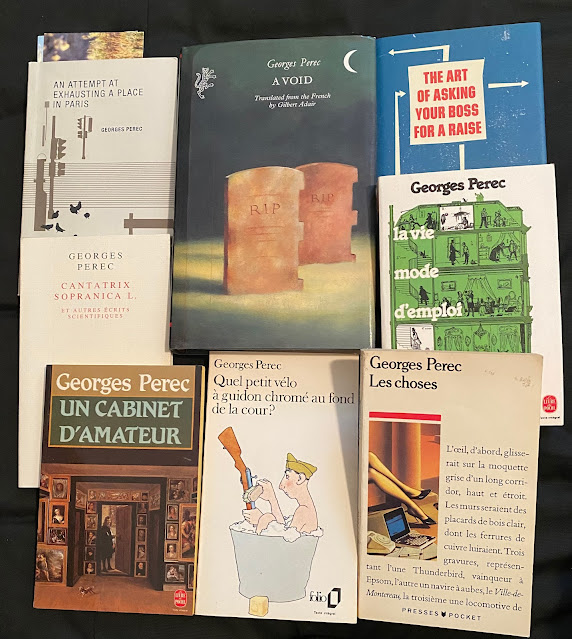
    Perec wrote many books in the following years.
    These are the ones I found in my attic from my past Perec reading projects.
    He also worked in film, radio productions, opera, magazines, and other media.

    Perec and Oulipo

    Oulipo was a formal group of literary and mathematical creators, who had regular meetings (dinner meetings at restaurants) and discussed a variety of literary forms. One such form was the lipogram, which is a text that is missing one of the letters of the alphabet. Many others, based on mathematical ideas, were also discussed, and some of the members wrote poetry or short works that followed the invented constraints.

    Perec took the inventions of Oulipo more seriously than the others -- in 1969 he published a full-length novel called La Disparition, which is a lipogram in e -- that is, it is written entirely without the most common letter in the French language. The plot of the novel centers around disappearance and loss: the characters know something is missing but they can't quite grasp what it is. Remember the "acte de disparition" that proved that the French government did not know what had happened to Perec's mother at Auschwitz? Perec connected the disappearance of the letter to the disappearance of the mother. 

    Throughout his life, Perec was often treated by psychoanalysts and other analysts, and he was enormously introspective. This seems to have contributed to his genius as an author of unusual and very original writings.

    Perec's Writing and Publishing Continues

    In the 1970s, Perec continued writing and publishing a variety of things, both directly influenced by Oulipo and not-so-directly. He traveled, including visits to the US and Germany. His personal life was complicated by separation from his wife, and relationships with several other women. In Georges Perec: A Life in Words, Bellos details all of his writing and personal life in great detail, but my summary is already much too long!

    An important publication, W or The Memory of Childhood was an autobiographical novel that Perec worked on for years, but completed only in 1974. Alternating with a fictitious story, he tells how his memory of his parents, their disappearance, and his time hiding from the Nazis were unretrievable no matter how hard he tried to remember. 
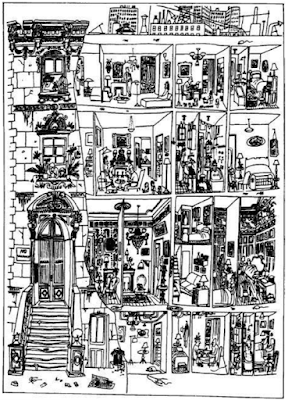
    Saul Steinberg: "The Art of Living." 1949.
    One of Perec's inspirations for Life: A User's Manual.
    Perec began working on a long and elaborate book called La Vie: Mode d'Employ or Life: A User's Manual in around 1972, intensely in 1974. Like the Steinberg cartoon, which he cited as an inspiration, he pictured the rooms of an apartment building, the people living in them, and what they were doing. The various chapters of the book, as he presented it to Oulipo, fit together in a way that Perec imagined was like chess puzzle called a knight's tour. He also described it as "a jigsaw-novel that describes a block of flats in Paris with its façade removed." The book was eventually completed and published in 1978. Essentially, the book defies any simple description of its style. "Perec’s masterpiece is an Oulipian work, but one that is based on the “bending” of all of its constraints."

    The book won the Médicis Prize for 1978 -- an important accomplishment in France. He also appeared on the insanely influential French TV program Apostrophes, hosted by Bernard Pivot. And thus became famous and acclaimed as a writer.

    Perec's creative life continued with a book he wrote while on a visit to Australia, and with many of the other creative endeavors he had pursued in his life. However, when he returned from Australia, he was diagnosed with cancer, and he died in 1983.


    Wrapping up this very long blog post

    Georges Perec: A Life in Words is a painfully and painstakingly complete biography, based on numerous interviews with Perec's family, friends, and colleagues as well as on published and unpublished materials. The hardcover edition has 832 pages; this blog post is based on my reading of the book.

    The Kindle edition of Georges Perec: A Life in Words is very bad. It is missing the photos and illustrations that are called out in the text; it has no page numbers but it gives cross-references by page number; and it has many transcription errors. My quotes here have no page numbers because they are missing from the Kindle edition. 

    In conclusion, I'll just ask -- do you think I am totally mad to have patiently read this enormous book? Whatever the answer, I now hope to read and reread some of the actual works by Perec. I'm sharing all of this with the bloggers at Paris in July.

    The google doodle for March 7, 2016, which would have been Georges Perec's 80th birthday.
    I like the subtle erasing of the e -- referring to the book for which Perec is best known.

    Blog post © 2022 mae sander.

    Wednesday, July 06, 2022

    A Novel of Paris in the 20th Century

    “As one of its characters rightly says, this book is a novel, a work of fiction. Its characters are imaginary. Any resemblance to real persons, living or dead, is purely coincidental or due to the permanence of human behavior. The names of some of these characters have been taken from (or inspired by) various books, including THE LILY OF THE VALLEY (Honoré de Balzac), A GALLERY PORTRAIT and W OR THE MEMORY OF CHILDHOOD (Georges Perec), THE COUNT OF MONTE CRISTO (Alexandre Dumas), and THE MASTER AND MARGARITA (Mikhail Bulgakov).” 

    As I read the book One Hundred Twenty-One Days by Michele Audin, I sometimes tried to look up the characters as if they were real. The style of the book made me think it was historical rather than a novel. The narrator, who identifies as a researcher, constantly explains where the quoted manuscripts and letters came from, and claims to have received permission to publish them — but after a while the reader is supposed to figure out that it’s all made up. As you see in this nearly-final paragraph, the book is very literary in its approach to the past.

    The novel focuses on several intertwined  “lives,” especially of mathematicians and other academic figures, beginning in around 1900. The concern: what the twentieth century — especially the two World Wars — did to the characters in the novel, concentrating on lives led in Paris and the hardships and destruction, both physical and social, that befell them. One character had been a soldier in the trenches in World War I, and came out with a “broken face,” so that for the rest of  his life, he wore a mask to hide his deformity. Shortly after the war, another character went mad and shot his family, though he continued to do mathematical research for the rest of his life in an insane asylum. His psychiatrist was sent to Auschwitz, but died on the way home. There are many vignettes, presented in a variety of ways, supposedly from diaries and letters and other fictional first-person accounts of life at the time.

    The reader must face the worst agony of the century as the characters experience the horrors of war, the mutilation of the soldiers in World War I, the persecution of Jews in World War II, deportation and the degradation of  concentration camps, the chilling decisions of collaborate with the occupiers of Paris, and — always — many of these characters’ efforts to pursue mathematical research under horrific conditions.

    Here, to illustrate what I see as the nature of this novel,  is just one excerpt from the diary of a German occupier of Paris:

    “May 31, 1942 Sunday morning. Thought of Otto Zach again. Where is he exactly, and in what condition? This is a time when many brave men will go through the gates of hell—and many will have seen it even before their own deaths. Walked across Paris to the Abwehr headquarters at the Hotel Lutetia, where Blank, one of my friends from Gymnasium, is assigned, and where they even work on Sundays. Had a drink with him. Then, on Boulevard Saint-Michel, I contemplated the fountain’s archangel while thinking of it as a symbol of our victory and the peace that will follow.”

    The author’s own biography seems more than usually relevant to understanding the novel:

    “MICHÈLE AUDIN is a mathematician and a professor at l’Institut de recherche mathématique avancée (IRMA) in Strasbourg, where she does research notably in the area of symplectic geometry. Audin is a member of the Oulipo, and is the author of many works of mathematics and the history of mathematics, She has also published a work of creative nonfiction on the disappearance of her father, Une vie brève (Gallimard, 2013)—Audin is the daughter of mathematician Maurice Audin, who died under torture in 1957 in Algeria, after having been arrested by parachutists of General Jacques Massu.” (Introduction to One Hundred Twenty-One Days)

    It's very hard to write a conventional review of this novel and its protean excursions into many types of writing. The principles of Oulipo aren't enough to explain it. Oulipo is an abbreviation for the French "Ouvroir de littérature potentielle"  which means "workshop of potential literature." Founded in 1960, most of the writers and mathematicians who were its original members are no longer alive. However, the  group continues to bring in new members such as Audin, who was born in 1954. I find the experimental and unusual works of these writers to be fascinating, but I'm challenged when I try to explain it.

    This post is being shared with the ongoing blog party called "Paris in July." I will return to the interesting yet challenging topic of Oulipo when I write about Georges Perec, one of the founding members, later this month.


    Blog post © 2022 mae sander.

    Wednesday, June 29, 2022

    Paris in July Reading Goals

    Paris in July is now getting started at the blogs Thyme for Tea and Readerbuzz. I'm definitely planning to participate as much as I can! I'm looking forward to seeing what Paris themes other bloggers share as they read, cook, watch, dream about, or show Paris in writings, in images, and in photos. Thinking about Paris is such a wonderful distraction from our troubled world (blogged here: What's wrong with the world?) that I have decided to share my very enjoyable plans now, not wait until we really get to July!

    My goal this year, as I have said in a previous post, is to read books by French-language writers who lived in Paris, and try to get a French point of view, rather than the view of a tourist or an ex-pat. It's hard to do; so many Americans and other non-French writers have loved Paris and still do, and so many people love to read these authors' books. 

    I've given my plan more thought now than I had done in my earlier post. Realistically, I can't possibly read all the books that meet my ambitious goals. However, here are some areas that I hope to explore, with links to some articles about the authors I would like to read:
    • Oulipo, a literary association of experimental writers and mathematicians, founded in 1960, offers all sorts of possible reading projects! I have read a few works from the early days of Oulipo, and I wrote about Raymond Queneau's book and film Zazie dans le Metro (here). On the blog to date I have only mentioned the works of Oulipo writer Georges Perec, whom I hope to go back to. I would also like to learn more of what has been done by Oulipo writers recently. Michele Audin, a current Oulipo member, is one example. 
      https://www.newyorker.com/books/page-turner/the-absolute-originality-of-georges-perec
    Georges Perec
    Simone de Beauvoir
    • Mystery novels written in French are intriguing. Currently, author Fred Vargas writes police procedurals about Commissaire Adamsberg. I have read three of them. 
      https://www.bookseriesinorder.com/fred-vargas/ 
      Also, I would like to read more of the Inspector Maigret books by Georges Simenon, written between 1931 and 1973. Almost all of them at least begin in Paris at the central police station.
    • French cuisine is always my favorite. French home cooking has evolved over the years I've been cooking and eating French food. To see what's new, I might read some current French food magazines like Marie Claire/ Cuisine et Vins de France.  https://www.marieclaire.fr/cuisine/
    • Foreign immigrants to Paris have their own special experiences -- as I have mentioned, I would like to read novels about them. In my search, I especially learned about Faïza Guène, author of six novels about immigrant life in the Paris banlieus. The latest one was just published, and I have now read it and will post a review. A 1950s immigrant writer was  Driss Chraïbi. He wrote Les boucs (1955), but I don't think I would like it.
    • Hip adolescents have had their own French literature. Beloved books now and in the past fascinate me. I would like to find out what books French students are passionate about now. For this project -- I don't know how to begin! Two examples that were popular for a long time (which I've read before) are: Le Grand Meaulnes byAlain-Fournier, published shortly before the author was killed in the first month of World War I, and L'Écume des jours by Boris Vian (1947), which was highly popular for at least two generations. 
      https://www.newyorker.com/books/page-turner/whimsy-war-boris-vian-two-minds https://www.theguardian.com/books/booksblog/2007/dec/10/borisvianstillspittingfrom https://www.linternaute.fr/biographie/litterature/1775154-boris-vian-biographie-courte-dates-citations/

    • Two recent novels in French that look interesting: The Art of Losing by Alice Zeniter (2021) and  The Anomaly by Hervé le Tellier (a best-seller in 2021). 
    • Paris Metro Tales, translated by Helen Constantine (2011) is a collection of French stories linked to various Metro stops, which I've started to read.

    Blog post © 2022 mae sander
    Photos from web.

    Friday, June 17, 2022

    Paris in July 2022


    Coming soon: the ultimate blogger party of the year, an entire month of "Paris in July." Paris is surely my favorite tourist destination, and I've been lucky to visit there and even live there a number of times. This year the blog sponsors are Tamara at Thyme for Tea and Deb at Readerbuzz. Participants can write about any Paris topic — food, travel experiences, travel wish lists, books, films, TV shows, magazines, personal experiences or whatever their imagination comes  up with. Each week, Tamara and Deb will write a summary of the week’s activities. If you are a lover of Paris, with or without experience, you can be part of the fun — see “It's coming - Paris in July 2022.”

    My Reading Plans

    This year, I hope to read some books in French, and some books translated from French — and of course, write about them. Above all, I want to read books that have a French point of view, especially about Paris, and to read some of them in the original language. I have been looking at a number of lists of books that fit my goals. Here are a few that I hope to read and to write about:

    Kiffe Kiffe demain by Faïza Guène, published 2010
    So far I have read 2/3 of it in French.

    Marie by Madeleine Bourdouxhe, published 1943.
    I have ordered a copy of this obscure classic,
    which was translated in 1997.


    Le Larousse du Pain by Eric Kayser, published 2019.
    Len has begun baking bread from the many recipes here:
    so far so good, in fact delicious!

    Possibilities -- If I'm Ambitious!

    Georges Perec. A book written in 1975 about watching the
    Place de Saint Sulpice in Paris. I'm not sure whether I will
    try to read this in French or in translation. Or if I even have the
    courage to try it! Perec’s books are challenging in any language.

    One Hundred Twenty-One Days by Michèle Audin,
    published in French in 2014.

    Hunting and Gathering by Anna Gavalda,
    published in French in 2004.

    Tuesday, September 05, 2017

    Three Views of Paris, Especially Walking in Paris

    "Paris was a place where one wanted to walk, where to walk— flâner, as the French said— was practically a way of life. ('Ah! To wander over Paris!' wrote Honoré de Balzac. 'What an adorable and delectable existence is that! Flânerie is a form of science, it is the gastronomy of the eye.')" -- The Greater Journey: Americans in Paris (p. 31). 

    The Greater Journey: Americans in Paris by David McCullough


    Recently, I've read three books about Paris. All three are especially interested in the topic of walking around Paris, for which the French have a special word: flâner.

    David McCullough's The Greater Journey: Americans in Paris (published 2011) describes the experiences of a number of Americans there during the 19th century. Writers, painters, sculptors, musicians, medical students, and others all found enormous advantages in the cultural and scientific atmosphere of Paris; many remain famous for their accomplishments. One way or another, each one experienced Paris by a version of flânerie.

    In the area of the arts, McCullough  especially describes the life of Augustus Saint-Gaudens, creator of many famous monuments that still stand in American cities. Saint-Gaudens found skilled helpers who could make cast bronze statues and perform other tasks that even in New York in the 19th century were unavailable.

    There were many cultures in Paris. For example, medical Paris, writes McCullough, was "unmistakably different from fashionable Paris, or political Paris, intellectual Paris, financial Paris, or the visitor’s Paris, not to say the Paris pictured in the minds of so many who had never been there, or the Paris of the desperately poor." (p. 103). Over 700 medical students came to Paris from America before the Civil War to learn in the medical schools, advanced hospitals, and laboratories there. Paris offered far better educational facilities than the US, where most doctors learned from apprenticeships. As these now-professional doctors returned to the US, they improved medical practice at home and contributed to the development of American medical schools.

    Interesting photo selections appear in several sections in the book. These include portraits of many of the American visitors (famous and less famous), as well as images of the Paris they experienced; for example the image of American minister to France Elihu Washburne included below.

    McCullough often quotes the appreciative response of Americans to the fine dining available in Paris as well as to the fascination of the old and historic elements of the city and how the Americans reacted to history as it was being made. One historic occurrence covered in detail is the famous siege of Paris in 1870-1871.

    Elihu Washburne was especially noted for staying throughout the ordeal and helping other Americans to escape. Here's an account of his Christmas dinner in December 1870 and why Americans were able to experience the siege in a different way than their fellow victims:
    "For his part, determined not to let Christmas go by unrecognized, he sacrificed two laying hens for a Christmas dinner at home for Wickham Hoffman, Dr. Johnston, Nathan Sheppard, and a few other American friends, in addition to Gratiot. The bill-of-fare included oyster soup, followed by sardines, roast chicken, corned beef and potatoes, tomatoes, cranberries, green corn, and green peas— all but the chicken from Washburne’s supply of canned goods.   
    "As Hoffman was to explain, the French were accustomed to shopping for fresh food day-to-day, not only because of their love of fresh food, but because so many lived in apartments with little if any room for stores. Americans liked being well stocked with canned goods, and consequently many Paris grocers had obligingly imported large quantities for the colonie américaine. With the greater part of the colonie having departed by the time the siege began, a quantity of canned fruits, vegetables, oysters, even lobsters, had remained on the market. 'The French knew nothing of these eatables till late in the siege, when they discovered their merits,' Hoffman wrote. 'In the meantime the Americans bought up nearly all there was at hand.' 
    "For dessert Washburne offered a selection of canned fruits, in addition to chocolates, of which there was still no shortage in Paris. Indeed, supplies of French chocolate, mustard, and wine appeared to be inexhaustible." (pp. 294-295). 
    McCullough described the continually worsening starvation faced by those who were isolated by the siege, including the consumption of dogs, cats (tastier than dogs!), zoo animals, and rats -- "Rat pâté was considered a delicacy," he wrote (p. 296).

    I've enjoyed at least one other book by McCullough, and would recommend this to anyone with an interest in Paris, in American history, and in other related topics.

    Flâneuse: Women Walk the City... by Lauren Elkin


    Several themes of McCullough's book are treated in a different way in Lauren Elkin's book Flâneuse: Women Walk the City in Paris, New York, Tokyo, Venice, and London (published 2016). The familiar topic of walking in a city is central to this book -- especially the famous topic of flânerie. 
    "From the French verb flâner, the flâneur, or ‘one who wanders aimlessly’, was born in the first half of the nineteenth century, in the glass-and-steel-covered passages of Paris. When Haussmann started slicing his bright boulevards through the dark uneven crusts of houses like knives through a city of cindered chèvre, the flâneur wandered those too, taking in the urban spectacle. A figure of masculine privilege and leisure, with time and money and no immediate responsibilities to claim his attention, the flâneur understands the city as few of its inhabitants do, for he has memorised it with his feet. ... 
    "The flâneur, attuned to the chords that vibrate throughout his city, knows without knowing." (pp. 3-4).
    Flâneuse: Women Walk the City sometimes seems disorganized, as it shifts among several cities and moves around in the author's own experiences, her sense of place, and her idiosyncratic memories. She mentions many people I've read about -- Gertrude Stein, George Sand, Georges Perec, Alexandra David-Neel, Martha Gellhorn (for whom there's a whole chapter) -- all connected in somewhat unpredictable ways. For example, she says: "I seem to recall Georges Perec writing of one of his walks around the city that he can sense the moment when one neighbourhood gives way to the next without consulting the blue-plated street signs, and that this sets apart the Parisian from the visitor." (p. 222).

    Another example of the jumpy and maybe messy organization of the book: there's a long chapter on the film maker Agnes Varda and how Elkin feels about her. I was especially interested in her description of Varda's interest in postcards: "We believe in the connection of postcard to place so deeply that the postcard becomes proof that we have been there." (p. 214).

    It's a somewhat difficult book to follow, but with lots of nice detail!

    The Other Paris by Luc Sante


    The Other Paris (published 2015) is a beautiful book: its topic is the Paris of the desperately poor, as mentioned in McCullough's list of multiple Paris cultures. Sante describes laborers, homeless people, sex workers and street walkers, people with unusual occupations, and a wide variety of eccentrics. He celebrates the many low-life areas that have been cleaned up, torn down, or totally erased in a long sequence of urban remodeling. Often lost, he shows, are the remnants of separate villages that eventually merged into the big urban space.

    Like McCullough and Elkin, Sante is very interested in the special meaning of walking all over Paris -- he too finds the term flâneur very special. He writes:
    "Paris is sufficiently compact that you can cross it with ease, in a few hours, and it has no grid, forestalling monotony. It virtually demands that you walk its length and breadth; once you get started, it's hard to stop." (p. 19)
    One central Parisian focal point was Les Halles, the great food market that stood in central Paris until the late 1970s. I found the following description of specialized jobs there particularly amusing:
    "Les Halles employed many hundreds, from the famous forts (strongmen...) to people with very specific occupations: egg candlers, builders of vegetable pyramids, fatteners of pigeons, fish stall display artists, breakers of mutton heads to extract the brains and the tongue (whose workplace was called a massacre), people who flattened ducks' breastbones with a rod to make them look plumper. There were many whose jobs involved some sort of counterfeiting: people who collected ham bones and jammed them into sundry cuts of meat, people who sprayed mouthfuls of fish oil on the surface of a bouillon to make it look fattier, people who painted turkey feet with varnish to disguise the progressive lightening in color that marks the days elapsed since death, and the confectioners of cocks' combs (which were used in ragouts or as trimming) from beef, mutton, or veal palates." (p. 101-102)
    No doubt, Sante is somewhat eccentric in selecting his examples!

    The book design of The Other Paris is quite interesting, with many illustrations. Sample pages:


    Monday, August 01, 2016

    Life in an Apartment Building: "The Flea Palace"

    "Though Cairo hums, Istanbul smells. Strangers are aware of its smell before they even approach the city. We can’t smell it, of course. They say a snake likes milk a lot and finds milk through its sense of smell, but could it detect the smell of milk if it swam in the milk cauldron? Probably the Cairene wouldn’t hear the hum and the Istanbulite couldn’t spot the smell of his or her own cities – and these are such old cities. When I was young, I didn’t know Istanbul was so old. Naturally, as it ages, the garbage increases. I no longer get angry." -- Elif Shafak, The Flea Palace (p. 133).
    These are the words of Madame Auntie, a character who lives in one of the apartments in a formerly fine but the now crumbling building, called "The Bonbon Palace" for its former pretension, though it's now more appropriately "The Flea Palace." Though Madame Auntie feels that all Istanbul smells like garbage, the smell actually just pervades the apartment building whose residents are the focus of this novel. Garbage, in fact, is such a strong presence in the story that the word "garbage" itself appears 100 times in the novel, according to the count on my Kindle app!

    For most of the inhabitants of the Bonbon Palace, a few other aromas compete with the smell of garbage, but garbage always wins:
    "If exposed to this malodour on the street, one walks faster, if in the car, one rolls the windows up. However, if the house you live in, the morning you wake up into, the night you sleep through, the walls, the windows, the doors and every direction you turn to stinks, then you are trapped. There is no way of stepping outside the yoke of smell. ... Every night a brand new garbage mound awaits me comprising of stuffed plastic bags of all sizes marked with the emblems of the grocers and markets in the neighbourhood, bags with their tops tied but for some reason always with a hole or slit at the bottom, cardboard boxes tossed here and there, items that once belonged to godknowswhom, and black clouds of buzzing flies landing on and taking-off from the leaking watermelon juices and scattered scraps. Cats too… dozens of cats loom hither and thither… some skinny, some chubby, all indifferent to passers-by, bedridden in their foul-smelling kingdom, basking all day long over, inside and under the garbage bags, as their number increases incessantly, alarmingly." (pp. 273-274)
    Because The Flea Palace takes place in a distinctly domestic setting, there's a lot in it about the food that the residents of the building cook and eat -- even a bit about a very hungry dog that likes pastry. At the same time, we learn of relationships. Fathers, mothers, grandparents, children, lovers, mistresses, in-laws, spouses, hairdressers and patrons of a beauty shop, weak people and strong people, and above all, neighbors are all constantly in action. And though the setting is mainly very modern Istanbul, the residents reflect a combination of modern and more exotic Turkish life, including some amazing summaries of their every-day superstitions, their Istanbul saints, and their consumption of alcohol despite its forbidden status for Moslems.

    Food and cooking descriptions are quite revealing about the characters and their values. I loved especially the vast number of Turkish dishes that were named and sometimes described, like walnut chicken, halvah, the popular pastry called a simit, and the pudding called ashure that was a key theme in Shafak's other (and I would say better) novel that I've read, The Bastard of Istanbul (2006).

    About ashure we learn:
    "Just like in the Tower of Babel, in the pudding cauldron too, miscellaneous types that would otherwise never come together managed to mingle without fusing into one another. Just as the workers at the Tower had failed to comprehend each other’s language, so too did each ingredient in the cauldron retain its distinctiveness within that common zest. The fig in the ashure, for instance, though subjected to so many processes and boiled for so long, still preserved its own flavour. As they boiled there on the stove, all the ingredients prattled on in unison but each in its own language." (pp. 199-200)
    At times in the narrative, although excellent food is being cooked and consumed by the Bonbon Palace residents, there's a problem, like this:
    "On that day, all their relatives gathered together, sacrificed a bulky ram early in the morning, then spent the entire day gulping down tea, almond paste, roasted meat, yogurt soup, wheat boiled with meat, yogurt drink, rice and meat sausage, apricot compote, meat pilaf, tea again, baklava with pistachios, semolina dessert for the spirits of the dead, grapes, watermelon, again baklava with pistachios and coffee; only to end up suffering from severe indigestion at night." (p. 292)
    The Flea Palace shares its apartment-building theme with several other modern novels. This choice allows authors to explore the life within each private space and the interactions and conflicts among the residents, the things they keep, and the things they don't. Though this limited focus doesn't require or even permit a conventional plot, it allows for a lot of leisurely descriptive writing and artistic sketches, which Shafak does rather pleasingly.

    Similar novels seem to have some of the same strengths and weaknesses. Other apartment-building novels that I know include Manil Suri's The Death of Vishnu, published in 2001, and Georges Perec's Life a User's Manual, published in 1978 (English translation, 1987). The Flea Palace was published in 2002, and The Yacoubian Building, about the residents of a building in Cairo by Alaa Al Aswany (which I've never read but maybe should) was published the same year. From the nineteenth century, Pot-Luck by Emile Zola is about the residents of a boarding house, a slightly different setting, since they live at even closer quarters than apartment dwellers. For a discussion of such books, I was interested in the following article: "Tall stories: the appeal of apartment block fiction" by Chris Power, which begins with a summary of The Yacoubian Building. I bet there are more such novels!

    For more Turkish-centered reading and my 2006 visit to Istanbul, see the posts HERE.

    Google images for the Turkish pastry called a simit. I love imagining all the foods in The Flea Palace.
    Our visits to Istanbul convinced us that Turkish cuisine is one of the world's best!