Showing posts with label Oulipo. Show all posts

Thursday, July 21, 2022

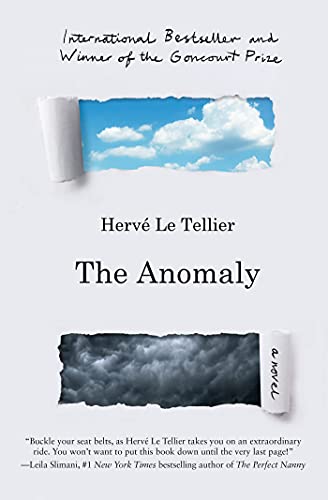
The Anomaly

"For a statistician, he's a dreamer. He has green eyes that make him look like a number theorist, even though he has long hair like a game theorist, and wears the Trotskytizing small steel-rimmed glasses of a logician and the holey old T-shirts of an algebraist -- the one he's wearing at the moment is especially shapeless and ridiculous." (Hervé Le Tellier, The Anomaly, p. 108-109)


How could I resist these clever mathematician stereotypes? They come from The Anomaly -- the best-selling novel by Hervé Le Tellier, whom I found to be a highly inventive and readable writer. I especially enjoyed Adrian, the mathematician in this description, who was one of ten (or so) delightfully sketched individuals in the early chapters of the novel -- residents of many places from New York to Paris to Africa, or in Adrian's case, a former resident of Princeton, NJ. Slowly, it becomes apparent that the only connection between these individuals is that they were all on a particular Air France flight from Paris to New York on a particular date in March, 2020.

Le Tellier's approach to narrative writing reminded me of the earlier French writer, Georges Perec, in the way he chose to show a huge number of characters in a kind of a frame; however, at times he outdoes Perec's off-beat approach to multi-faceted forms of writing. In fact, Le Tellier (born 1957 in Paris) is identified as an author and a linguist and a mathematician -- so of course he is a very long-term member of Oulipo, as was Perec. He has even been its president.

Besides portraying so many characters who have so little in common with one another, the book is insanely allusive. It mentions many types of popular culture like the book A Hitchhiker's Guide to the Galaxy or the film Close Encounters of the Third Kind. It has allusions to classic literature. I probably didn't get all of them. There's a reference to If on a winter night a traveler by Italo Calvino, another Oulipo member. There are scenes with appearances by the President of the United States (unnamed), the President of France, Stephen Colbert, and other celebrities. There's an Afro-pop musician who inspires lots of references to popular music genres including Elton John. There's a deep discussion involving a meeting of religious leaders of various sects of Islam, Christianity, Judaism, and Buddhism. When you read it you are supposed to be impressed by the breadth of the author's knowledge.

The ten main characters presented in the initial vignettes aren't hard to follow, but I found myself wishing for more about some of them (like Adrian) and less about others (like an American lawyer who has ethical conflicts). Minor characters also abound! A memorable character with many aliases is a contract killer, and the first vignette of the novel is a description of his debut as an assassin -- violent! Another character, named Victor Miesel, is himself an author, who writes a book named The Anomaly. Deep.

Miesel consciously considers his similarity to Perec: "He jots down: An attempt at exhausting an improbable place. Wait, no. Why walk in Perec's shadow?" (p. 200) Then he starts to record his observations of the airplane hangar where he and all the other passengers have been detained after the flight. Just like Perec's Attempt at Exhausting a Place in Paris which I read a few days ago. I see layers of irony.

The Anomaly was published in French in August, 2020, and appeared in English translation in November, 2021. The events in the book, which take place from the time of the Air France flight in March 2020 until the following summer are very strange events; in fact, they are surreal or science fiction or paranormal type events. I think the book accidentally became even more surreal because -- having no doubt been completed months before the original French publication -- it assumed a continuing normal world in 2020. This fictional world was suddenly rendered abnormal by the surprising fate of the airplane in the novel. However, our real world, as we all know, went crazy in its own way at exactly the moment when the surreal plane landed: mid March of 2020. Just deal with it!

Too complicated for me. I tried not to overthink all this, as I read and enjoyed the book, or at least most of it. I would say that having built up a surreal set of very dramatic events and a vast cast of characters dealing with the events, Le Tellier wasn't as good at unraveling his story as he was at introducing it. The last 100 pages or so really weren't as much fun to read as the first 300 pages. But no more spoilers!

A review in the New York Times: "‘The Anomaly,’ Part Airplane Thriller and Part Exploration of Reality, Fate and Free Will" by Sarah Lyall from December 3, 2021, begins thus:

"As you read 'The Anomaly,' by the French author Hervé Le Tellier, you might find yourself wondering what sort of book it is, exactly. Is it science fiction dressed up as philosophy? Metaphysics disguised as high-concept thriller? Neither, both, all. 'The Anomaly,' a runaway best seller in France, where it won the Prix Goncourt last year, lies in that exciting Venn diagram where high entertainment meets serious literature. Its plot might have been borrowed from 'The Twilight Zone' or 'Black Mirror,' but it movingly explores urgent questions about reality, fate and free will. If our lives might not be our own and we end up dying either way, how should we live?"

Philosophy? Well, maybe. The metaphysics (or maybe pataphysics) in this book makes for a very French feel, as I read it. French writers seem to always out-intellectual everyone else, even in thrillers. I'm just not sure when it comes to the urgent question about whether everything we know is just a simulation and whether we really exist. Too facile. I say it's a thriller with a bunch of amusing, self-satirizing, self-referential pretensions, but what do I know? Not as much as Sarah Lyall! My reading plan for this month was to read books about Paris and France that were written by French authors -- to look for a different point of view from the one I'm most accustomed to reading. This definitely satisfied my plan.

Review © 2022 mae sander
Shared with Paris in July. 


Saturday, July 16, 2022

Two books by Georges Perec


Continuing with my brief exploration of the life and work of French author Georges Perec (1936-1982), I have been reading Tentative d'épuisement d'un lieu parisien (An Attempt at Exhausting a Place in Paris) and W ou Le souvenir d'enfance (W, or the Memory of Childhood).

The first book reports on Perec's observations during three consecutive days in 1974 when he sat in Place Saint-Sulpice in Paris. (It was easier to obtain the translation, so I read it in English.) The second book is a dual narrative, partly of his childhood, published in 1975; I read it in French with help from only translation programs. From the biography that I read recently (blogged here), I am aware that the mid-seventies were a highly productive time in Perec's life as a writer, and so I decided to read (or, for W, reread) these two books.

Exhausting a Place in Paris

An Attempt at Exhausting a Place in Paris is even more unusual than most of Perec’s eccentric output. From a café or a park bench in Place Saint-Sulpice he took notes on everything he saw -- or at least everything that interested him. And it's surprisingly interesting and readable because... well, because Perec. For example, he noted the numbers of the city buses that drove past or stopped, and where they were going, as well as noting tourist buses. He described the passers-by and their clothing and what they seemed to be carrying. He described cars and motor scooters. Occasionally he saw someone he recognized. It's all documented.

Palmiers (source)

There is obviously no plot or much to summarize here. But one thing struck me: there's a cliché that claims that the French do not eat while they walk on the street. Unlike Americans. This is evidently not true. Perec sighted many such people. 

"A young girl is eating half a palmier." (p. 14) 

"A man goes by, eating a cake." (p. 37) 

"A woman goes by; she is eating a slice of tart. A couple approaches their Autobianchi Abarth parked along the sidewalk. The woman bites into a tartlet." (p. 34) 

"A girl with short braids wolfing down a baba (is it a baba? it looks like a baba.) A woman with a baguette. Another one." (p. 21)

Perec also eats and drinks in the cafés, while watching -- sausages, a Camembert sandwich, coffee, Vittel water, and so on. But this is ordinary while sitting in cafés. I think it turns out that eating while walking on the street in Paris is also ordinary. Or, to use Perec's own term infra-ordinary.

A Memory of Childhood

W ou Le souvenir d’enfance contrasts the very few memories Perec had from his early childhood to an increasingly violent and horrifying vision of an exotic society on the island of W somewhere beyond the Strait of Magellan. His loss of his childhood — especially his lack of any traces of his mother — disturbs him deeply, and he attributes this gap in his otherwise very excellent memory to the horror of being taken from his mother: he just barely remembered her turning him over to the Red Cross to be evacuated from Paris. He remembered even less of his father, who had volunteered for military service and died in one of the only battles in which France tried to defend itself from the Nazi invasion.

Perec the writer, as an adult, could muster only the vaguest memories, augmented by a few documents and relatives’ accounts, of being hidden first in the countryside, then in a boarding school for children including refugees, and then again in the countryside — but never seeing his mother again. He eventually learned that she was unable to escape Paris and was rounded up and sent to the camps; she eventually disappeared at Auschwitz, along with most of the Jews of Europe. But he didn’t know this as a child, when he knew only that he must never reveal anything about who he really was. His struggle to conjure vivid memories is painful to read.

Between the chapters about his experiences before the age of 9, when he returned to Paris and life with an aunt and uncle, Perec included a very complete description of the Fascist life of the inhabitants of W, where all the male inhabitants were athletes engaged in formal and very violent games, and the female inhabitants were imprisoned in barracks that “protected” them from the men. While my summary makes this sound obvious and clumsy, the contrast between the two parts of the book is subtle and powerful.

Besides the constant contests among the athletes of W, there were occasional races where the women would be forced to run away from the men, and when they were inevitably caught, the men would rape them, while the crowds of spectators watched. The society of W is described in excruciating and vicious detail: a much worse fantasy than even the worst Nazi society that Perec was coming to grips with in his early autobiography. Even the non-rape contests included rules that allowed the athletes to attack one another, disrupt the flow of races, use unfair holds in games like wrestling, and wear pointed toe shoes to kick and maim their opponents. 

It’s not hard to figure out what Perec means by the two opposing parts of this book. The cascading nightmare created by the Nazi occupation and imposed on a small child and the helpless adults around him — and the cascading nightmare of W, an imagined dystopia with the worst human conditions possible. In the last few paragraphs, Perec brings these two seemingly separate worlds together. What a horrifying book!

The cover of the English edition
of W, or the Memory of Childhood.
I read it in French because there's
no Kindle version in English.
Blogpost © 2022 mae sander
Shared with Paris in July.


Thursday, July 14, 2022

Perec and Paris

My reading project this week is the works and life of the French writer Georges Perec (1936-1982). Reading about him is fun for me because I was in Paris a number of times in his lifetime and shortly thereafter. On these visits, I frequently visited the streets and neighborhoods that are mentioned in Georges Perec: A Life in Words by David Bellos, which I wrote about yesterday. Although I never met any of the quite famous people that played a role in his life, I'm reminded of some things I saw and did in Paris. Here are some of the special ways that I connect when reading about Perec:

  • Perec in his early years lived for a time near Place Jussieu, location of the science faculty of the University of Paris, and much later at another nearby location on Rue Linné in the same neighborhood. Len worked at the university during both of our long stays in Paris. And we once borrowed an apartment on Rue Linné or an adjacent street. Our brief stay there was actually at the same time Perec lived there, though of course we never saw him nor would we have known who he was at that time. 


  • In a café near the university, where Len and his colleagues used to eat lunch, a mirror on the wall had signatures of the Oulipo members who used to meet there a decade earlier. So I've seen the signature of Perec. The café was familiarly known as Chez Dédé. (This small detail was not in Belloc's book, and I can't find it on the internet either. However, I think this might be how I heard of Perec and Oulipo.)
  • Perec also lived for a time next to the elevated Metro Line 6, from Nation to Etoile. Our apartment in Paris in 1976 faced another section of the elevated track, so we experienced the noise levels that are described in the biography.

    The elevated metro line outside our apartment window, 1976)

  • Perec loved the restaurant Balzar in the Latin Quarter. Our friend Michelle also loved Balzar, and took us there on a number of occasions. Evidently it was popular with professors and researchers because it was close to many labs and academic buildings.

    source -- Wikipedia

  • NOTE: French Wikipedia provides some insight into the customers of the Balzar restaurant. It lists as regulars: writers Albert Camus, Simone de Beauvoir, and André Malraux; the historian Jean Tulard; the politicians Jacques Toubon, Václav Havel and Mário Soares; the movie figures Louis Malle and Johnny Depp; the physicist Walter Kohn; and philosophers Hélène Cixous and Jacques Derrida.
  • Perec worked in a research laboratory located in the Sainte-Anne Hospital Center in the 14th arrondissement. During our long stay in Paris in 1976, the owner of our apartment lived on the hospital grounds where her husband, a doctor, was a department head. Therefore, I had to go there to pay the rent each month as she wanted payment in cash.
  • Perec was very fond of films, and often saw the new films being made in France and Hollywood throughout his lifetime. He also worked on scripts, he made an entire film, and he contributed to other aspects of cinema. When I read the names of the films he appreciated, I have lots of memories of them, though of course I was at a great distance and he was often up close.

    "Un Homme Qui Dort" or "A Man Asleep"
    is a film made in 1974, directed by Bernard Queysanne
    and written by Perec. (I haven't seen it.)

Other Things About Perec

In addition to the facts of Perec's life in Paris in the 1970s and 1980s, some other topics described in his biography make me feel connected to him:

    • During World War II, as an endangered Jewish child, Perec was hidden in a village and in a school near Grenoble. On more than one occasion, I have visited that area of the mountains of the Grenoble area. In fact, a colleague of Len's once took us on a long walk in the mountains there and got us quite lost.
    • Perec’s job for nearly 20 years was working as a cataloguer in a medical research laboratory where the research topic was the neuroscience of sleep. This field of study was in its infancy in the 1970s when he worked there, and so was the work he did: making an information retrieval system using index cards to help the researchers find relevant publications on their chosen topics. Both of these fields (sleep and information retrieval) have interested me at various times in my life, and I once had a job in a company that was developing computerized information retrieval tools. So again, I feel vaguely connected.
    • On a completely different subject: Perec's parents, grandparents, aunts, uncles, etc. fled from their native Jewish cities and shtetls in Poland and other parts of Eastern Europe in the early part of the 20th century -- as did my ancestors.
    • Perec was proud to be a collateral relative of I.L.Peretz, the Yiddish writer, and especially was interested in the story "Bontsha the Silent." The name Perec is a spelling variant of Peretz. The stories of I.L.Peretz are of great interest to me, including the famous "Bontsha," though I have no personal connection to the author.
    • Perec was Jewish by ethnicity and self-identification, but did not practice the Jewish religion or any religion. This of course is characteristic of many modern Jews in both France and the US -- including me.
    I also feel connected to Perec because I am very fond of word play, crossword puzzles, and books that experiment playfully with a variety of forms — though I’ve never created any works of this type. Perec was a great writer of inventive literature. He contributed clever inventions to the meetings of Oulipo, the society of writers and mathematicians in which he was active. I've been enjoying Perec's works for a long time. I admire him greatly!

    I’m sharing this with my blog friends who are participating in Paris in July at Tamara’s blog… and I wish everyone an enjoyable Fourteenth of July, celebrating liberty in whatever way feels good. I’ve enjoyed several Paris celebrations of the day, and especially remember the fireworks and the parade that we saw in 1989 to celebrate the bicentennial (blogged here).

    Blog post © 2022 mae sander.

    Wednesday, July 13, 2022

    Georges Perec

    Who was Georges Perec? He was a very talented and accomplished French writer, born in 1936. He published many books between 1965 and his death in 1982. As a member of Oulipo. a French literary society, he  was involved with a variety of formal and unusual writing techniques. In particular, he wrote an entire novel without the letter e and then wrote a short story with no vowels other than the letter e.

    Perec was very fond of word play and complicated plots and twists in his works of fiction. He was concerned with what he called the “infra-ordinary” side of daily life, and his many books explored it in a number of forms, including prose, poetry, and even the composition of crossword puzzles. He liked jokes too; he wrote erudite spoofs, poems full of tricks and more, and his work is extraordinarily full of allusions to other works of literature.

    The biography of Perec reveals a very complicated person. He was orphaned during World War II, when his father died in battle and his mother died in Auschwitz. Once the war ended, he lived with his aunt and uncle, received an entirely French education, worked at a job in a research lab, and published highly acclaimed fiction and other writing. In the course of his life, he associated with many of the most famous thinkers and writers of his era. Perec’s life, in my view, mirrors much about the life of intellectuals in Paris in his time.

    Reading a Biography of Georges Perec

    Georges Perec: A Life in Words by David Bellos begins with a history of the author's name: Perec. While it seems to be a Breton name, it's actually a phonetic transcription of Peretz, the original name of Perec's father, who was a Jewish immigrant with a traditional Jewish name. Bellos gives a detailed history of the origins of the Peretz-Perec family's immigration from Eastern European shtetls to Paris France in the decades before Georges' birth in 1936.

    Bellos's biography is highly detailed in every way, beginning with the family’s assimilation to life in Paris, the business dealings of several family members, and eventually the way they survived (or didn't survive) during the Nazi occupation and the deportation of Jews to the concentration camps. The survivors spent the war in the Grenoble area; when the war was over they moved back to Paris and more or less resumed their pre-war life. It’s a painful story, especially the death of. Perec’s parents and his time being hidden when he was a small child.

    The years just after the allied victory in France brought the family another type of nightmare, one that's not covered in many histories. For the surviving Jews there was an agonizing wait to know what had happened to their deported relatives: a brief period that is rarely covered by history books. After the 1944 Allied victory in France, the government was unable to provide information about these victims. Finally, in June 1945, a huge exhibition at the Grand-Palais was entitled “Hitler’s Crimes." It revealed, for the first time, the fate of the French Jews. It's unimaginable to think of the way this news must have affected the surviving Jewish people of France, including Perec's family. 

    About the exhibition:

    "It presented a chronology of the internment of Jews in the French camps of Pithiviers, Beaune-la-Rolande, and Drancy, in the occupied zone, and at Gurs, near Navarrenx, in southwestern France, under the rule of Vichy. It also gave a tally of deportations from Drancy to Germany: 62,608. ... The exhibition itself was dominated by two wall-size enlargements of photographs of Belsen-Bergen, on loan from the British embassy; there were other images as well of Buchenwald, Nordhausen, Mittelgladbach, and Maidanek. Though there were no pictures yet available of Auschwitz, it must have been obvious what fate had befallen the French Jews deported there from Drancy."

    Perec was a small child at this time. From age 5 to 9 he had been required to keep his identity and Jewishness a secret, and forget everything including his lost mother. When his Aunt and Uncle took him into their family, they were required to do excruciatingly painful paper work to prove Perec’s mother Cécile’s “disappearance.” After she had been taken to Auschwitz there was no proof of her fate. They obtained only “a missing person’s certificate for Cécile. It was not a death certificate. It was called an acte de disparition.” Perec thus grew up without clear knowledge of his mother’s end -- but in fact he had too much knowledge.

    The future writer had a fairly conventional school career. He recieved a typical French Lycee education until the bacchalaureate, and then spent some time preparing for admission to further education. Having attended prep classes for the Grandes Ecoles examinations, Perec decided (unlike almost all French intellectuals) to drop out, and simply try to be a writer. In fact, he had decided on this ambition at the end of Lycee. For the rest of his life, his principal identification of himself was as a writer. 

    Once he abandoned the standard educational path, Perec struggled to establish a life in Paris, and he had various part-time jobs while enjoying life with friends and pursuing intellectual interests. During his early 20s he was required to do a term of military service. After training as a paratrooper, his military service included a term as an office worker in Paris, where he returned to life with his friends. His Paris life:

    “The moment his duties were done each day, he could step out of the ministry building, dressed in his embarrassing uniform and red beret, walk down Rue Saint-Dominique, go over the Solférino Bridge into the Tuileries gardens and saunter past the statue of Eblé, the least famous of Napoleon’s generals, or alternatively, using the Point-Royal, pass through the Place du Carrousel, then cross Rue de Rivoli, and reach his perch in ten minutes at the most. He would reemerge metamorphosed, wearing (perhaps) a broad-striped red and green pullover, tight trousers, and shoes as unlike military boots as could be managed; and in such or similar informal evening attire, he would head for one or another of his regular haunts to drink with his friends and discuss the major issues of the day, from food to philosophy to film.”

    To me, this describes the ideal life of a young person in Paris in the late 1950s! Perec was also trying to write and publish his first novel. His early efforts were not particularly successful, and he drifted around for a while, acquiring an apartment (with money from German reparations) and a wife. He lived briefly in Tunisia, where his wife had a temporary teaching position. 

    After a long time living on the margins, Perec took a salaried (though low-paying) and stable job as an archivist at a neuroscience laboratory. He was given the job because he had experience creating a file-card system for information retrieval. Though not mathematical, he worked out a way to apply mathematical graph theory to the task of finding articles on neuroscience for the researchers in the lab, and his invention was a remarkable success, while his job left him time to keep on writing. As it happened, a mathematician whom he consulted on graph theory for his job was also a member of the literary group Oulipo, to which he introduced Perec. 

    In 1965, after ten years of reworking his first novel, Perec published Les Choses — Things. It achieved a slow success, as each small edition sold out with more and more of the young people around Perec’s age, mid-twenties, talked about the way this unusual and very short novel captured the spirit of the 1960s. And: “On 21 November 1965, the Renaudot Prize put Things in the limelight and made Georges Perec a national celebrity if not quite a household name.”
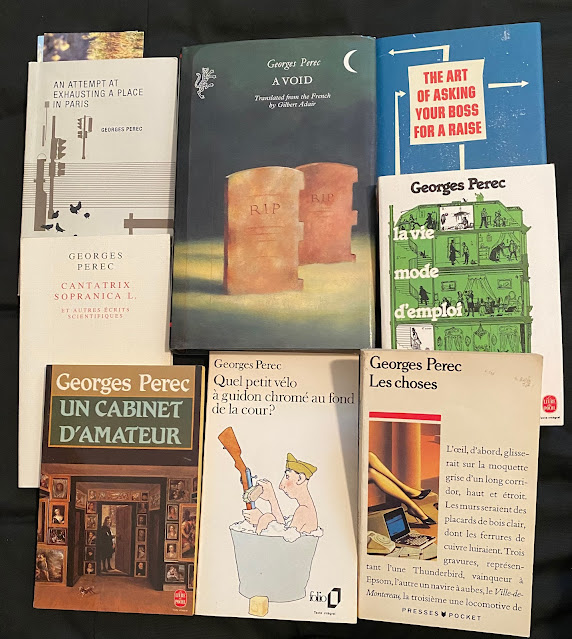
    Perec wrote many books in the following years.
    These are the ones I found in my attic from my past Perec reading projects.
    He also worked in film, radio productions, opera, magazines, and other media.

    Perec and Oulipo

    Oulipo was a formal group of literary and mathematical creators, who had regular meetings (dinner meetings at restaurants) and discussed a variety of literary forms. One such form was the lipogram, which is a text that is missing one of the letters of the alphabet. Many others, based on mathematical ideas, were also discussed, and some of the members wrote poetry or short works that followed the invented constraints.

    Perec took the inventions of Oulipo more seriously than the others -- in 1969 he published a full-length novel called La Disparition, which is a lipogram in e -- that is, it is written entirely without the most common letter in the French language. The plot of the novel centers around disappearance and loss: the characters know something is missing but they can't quite grasp what it is. Remember the "acte de disparition" that proved that the French government did not know what had happened to Perec's mother at Auschwitz? Perec connected the disappearance of the letter to the disappearance of the mother. 

    Throughout his life, Perec was often treated by psychoanalysts and other analysts, and he was enormously introspective. This seems to have contributed to his genius as an author of unusual and very original writings.

    Perec's Writing and Publishing Continues

    In the 1970s, Perec continued writing and publishing a variety of things, both directly influenced by Oulipo and not-so-directly. He traveled, including visits to the US and Germany. His personal life was complicated by separation from his wife, and relationships with several other women. In Georges Perec: A Life in Words, Bellos details all of his writing and personal life in great detail, but my summary is already much too long!

    An important publication, W or The Memory of Childhood was an autobiographical novel that Perec worked on for years, but completed only in 1974. Alternating with a fictitious story, he tells how his memory of his parents, their disappearance, and his time hiding from the Nazis were unretrievable no matter how hard he tried to remember. 
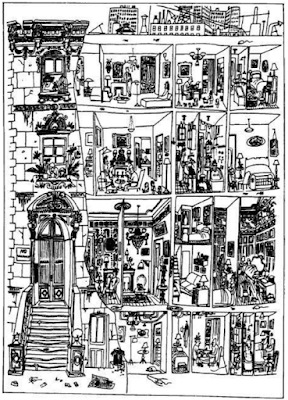
    Saul Steinberg: "The Art of Living." 1949.
    One of Perec's inspirations for Life: A User's Manual.
    Perec began working on a long and elaborate book called La Vie: Mode d'Employ or Life: A User's Manual in around 1972, intensely in 1974. Like the Steinberg cartoon, which he cited as an inspiration, he pictured the rooms of an apartment building, the people living in them, and what they were doing. The various chapters of the book, as he presented it to Oulipo, fit together in a way that Perec imagined was like chess puzzle called a knight's tour. He also described it as "a jigsaw-novel that describes a block of flats in Paris with its façade removed." The book was eventually completed and published in 1978. Essentially, the book defies any simple description of its style. "Perec’s masterpiece is an Oulipian work, but one that is based on the “bending” of all of its constraints."

    The book won the Médicis Prize for 1978 -- an important accomplishment in France. He also appeared on the insanely influential French TV program Apostrophes, hosted by Bernard Pivot. And thus became famous and acclaimed as a writer.

    Perec's creative life continued with a book he wrote while on a visit to Australia, and with many of the other creative endeavors he had pursued in his life. However, when he returned from Australia, he was diagnosed with cancer, and he died in 1983.


    Wrapping up this very long blog post

    Georges Perec: A Life in Words is a painfully and painstakingly complete biography, based on numerous interviews with Perec's family, friends, and colleagues as well as on published and unpublished materials. The hardcover edition has 832 pages; this blog post is based on my reading of the book.

    The Kindle edition of Georges Perec: A Life in Words is very bad. It is missing the photos and illustrations that are called out in the text; it has no page numbers but it gives cross-references by page number; and it has many transcription errors. My quotes here have no page numbers because they are missing from the Kindle edition. 

    In conclusion, I'll just ask -- do you think I am totally mad to have patiently read this enormous book? Whatever the answer, I now hope to read and reread some of the actual works by Perec. I'm sharing all of this with the bloggers at Paris in July.

    The google doodle for March 7, 2016, which would have been Georges Perec's 80th birthday.
    I like the subtle erasing of the e -- referring to the book for which Perec is best known.

    Blog post © 2022 mae sander.

    Wednesday, July 06, 2022

    A Novel of Paris in the 20th Century

    “As one of its characters rightly says, this book is a novel, a work of fiction. Its characters are imaginary. Any resemblance to real persons, living or dead, is purely coincidental or due to the permanence of human behavior. The names of some of these characters have been taken from (or inspired by) various books, including THE LILY OF THE VALLEY (Honoré de Balzac), A GALLERY PORTRAIT and W OR THE MEMORY OF CHILDHOOD (Georges Perec), THE COUNT OF MONTE CRISTO (Alexandre Dumas), and THE MASTER AND MARGARITA (Mikhail Bulgakov).” 

    As I read the book One Hundred Twenty-One Days by Michele Audin, I sometimes tried to look up the characters as if they were real. The style of the book made me think it was historical rather than a novel. The narrator, who identifies as a researcher, constantly explains where the quoted manuscripts and letters came from, and claims to have received permission to publish them — but after a while the reader is supposed to figure out that it’s all made up. As you see in this nearly-final paragraph, the book is very literary in its approach to the past.

    The novel focuses on several intertwined  “lives,” especially of mathematicians and other academic figures, beginning in around 1900. The concern: what the twentieth century — especially the two World Wars — did to the characters in the novel, concentrating on lives led in Paris and the hardships and destruction, both physical and social, that befell them. One character had been a soldier in the trenches in World War I, and came out with a “broken face,” so that for the rest of  his life, he wore a mask to hide his deformity. Shortly after the war, another character went mad and shot his family, though he continued to do mathematical research for the rest of his life in an insane asylum. His psychiatrist was sent to Auschwitz, but died on the way home. There are many vignettes, presented in a variety of ways, supposedly from diaries and letters and other fictional first-person accounts of life at the time.

    The reader must face the worst agony of the century as the characters experience the horrors of war, the mutilation of the soldiers in World War I, the persecution of Jews in World War II, deportation and the degradation of  concentration camps, the chilling decisions of collaborate with the occupiers of Paris, and — always — many of these characters’ efforts to pursue mathematical research under horrific conditions.

    Here, to illustrate what I see as the nature of this novel,  is just one excerpt from the diary of a German occupier of Paris:

    May 31, 1942 Sunday morning. Thought of Otto Zach again. Where is he exactly, and in what condition? This is a time when many brave men will go through the gates of hell—and many will have seen it even before their own deaths. Walked across Paris to the Abwehr headquarters at the Hotel Lutetia, where Blank, one of my friends from Gymnasium, is assigned, and where they even work on Sundays. Had a drink with him. Then, on Boulevard Saint-Michel, I contemplated the fountain’s archangel while thinking of it as a symbol of our victory and the peace that will follow.”

    The author’s own biography seems more than usually relevant to understanding the novel:

    “MICHÈLE AUDIN is a mathematician and a professor at l’Institut de recherche mathématique avancée (IRMA) in Strasbourg, where she does research notably in the area of symplectic geometry. Audin is a member of the Oulipo, and is the author of many works of mathematics and the history of mathematics, She has also published a work of creative nonfiction on the disappearance of her father, Une vie brève (Gallimard, 2013)—Audin is the daughter of mathematician Maurice Audin, who died under torture in 1957 in Algeria, after having been arrested by parachutists of General Jacques Massu.” (Introduction to One Hundred Twenty-One Days)

    It's very hard to write a conventional review of this novel and its protean excursions into many types of writing. The principles of Oulipo aren't enough to explain it. Oulipo is an abbreviation for the French "Ouvroir de littérature potentielle"  which means "workshop of potential literature." Founded in 1960, most of the writers and mathematicians who were its original members are no longer alive. However, the  group continues to bring in new members such as Audin, who was born in 1954. I find the experimental and unusual works of these writers to be fascinating, but I'm challenged when I try to explain it.

    This post is being shared with the ongoing blog party called "Paris in July." I will return to the interesting yet challenging topic of Oulipo when I write about Georges Perec, one of the founding members, later this month.


    Blog post © 2022 mae sander.

    Wednesday, June 29, 2022

    Paris in July Reading Goals

    Paris in July is now getting started at the blogs Thyme for Tea and Readerbuzz. I'm definitely planning to participate as much as I can! I'm looking forward to seeing what Paris themes other bloggers share as they read, cook, watch, dream about, or show Paris in writings, in images, and in photos. Thinking about Paris is such a wonderful distraction from our troubled world (blogged here: What's wrong with the world?) that I have decided to share my very enjoyable plans now, not wait until we really get to July!

    My goal this year, as I have said in a previous post, is to read books by French-language writers who lived in Paris, and try to get a French point of view, rather than the view of a tourist or an ex-pat. It's hard to do; so many Americans and other non-French writers have loved Paris and still do, and so many people love to read these authors' books. 

    I've given my plan more thought now than I had done in my earlier post. Realistically, I can't possibly read all the books that meet my ambitious goals. However, here are some areas that I hope to explore, with links to some articles about the authors I would like to read:
    • Oulipo, a literary association of experimental writers and mathematicians, founded in 1960, offers all sorts of possible reading projects! I have read a few works from the early days of Oulipo, and I wrote about Raymond Queneau's book and film Zazie dans le Metro (here). On the blog to date I have only mentioned the works of Oulipo writer Georges Perec, whom I hope to go back to. I would also like to learn more of what has been done by Oulipo writers recently. Michele Audin, a current Oulipo member, is one example. 
      https://www.newyorker.com/books/page-turner/the-absolute-originality-of-georges-perec
    Georges Perec
    Simone de Beauvoir
    • Mystery novels written in French are intriguing. Currently, author Fred Vargas writes police procedurals about Commissaire Adamsberg. I have read three of them. 
      https://www.bookseriesinorder.com/fred-vargas/ 
      Also, I would like to read more of the Inspector Maigret books by Georges Simenon, written between 1931 and 1973. Almost all of them at least begin in Paris at the central police station.
    • French cuisine is always my favorite. French home cooking has evolved over the years I've been cooking and eating French food. To see what's new, I might read some current French food magazines like Marie Claire/ Cuisine et Vins de France.  https://www.marieclaire.fr/cuisine/
    • Foreign immigrants to Paris have their own special experiences -- as I have mentioned, I would like to read novels about them. In my search, I especially learned about Faïza Guène, author of six novels about immigrant life in the Paris banlieus. The latest one was just published, and I have now read it and will post a review. A 1950s immigrant writer was  Driss Chraïbi. He wrote Les boucs (1955), but I don't think I would like it.
    • Hip adolescents have had their own French literature. Beloved books now and in the past fascinate me. I would like to find out what books French students are passionate about now. For this project -- I don't know how to begin! Two examples that were popular for a long time (which I've read before) are: Le Grand Meaulnes byAlain-Fournier, published shortly before the author was killed in the first month of World War I, and L'Écume des jours by Boris Vian (1947), which was highly popular for at least two generations. 
      https://www.newyorker.com/books/page-turner/whimsy-war-boris-vian-two-minds https://www.theguardian.com/books/booksblog/2007/dec/10/borisvianstillspittingfrom https://www.linternaute.fr/biographie/litterature/1775154-boris-vian-biographie-courte-dates-citations/

    • Two recent novels in French that look interesting: The Art of Losing by Alice Zeniter (2021) and  The Anomaly by Hervé le Tellier (a best-seller in 2021). 
    • Paris Metro Tales, translated by Helen Constantine (2011) is a collection of French stories linked to various Metro stops, which I've started to read.

    Blog post © 2022 mae sander
    Photos from web.

    Monday, May 11, 2020

    Strange Memories from a Strange Book

    "I wonder where memories go. In fact a memory really can’t be lost. All it can do is wilt, gently wither, go bad, fade in tender agony, but never be lost. There is no land of lost memories. There is no cemetery of banished memories, not a single one, not even for the most porous, the most debilitated. There is no ossuary, no funeral home where their remains can be laid. Maybe because deep down a memory can never die. Not really." --Chloé Delaume. Not a Clue: A Novel, Kindle Locations 1108-1110).
    "That’s all memory is, a row of awful cesspools, sluggish places of death, a picture tacked up behind every door, a door for every period, one picture per calendar, and memories in the middle, memories are dead moments..."  (Kindle Locations 914-916). 

    Not a Clue by Chloé Delaume, which was published in 2004, is a very unusual work of fiction, very challenging to read. The chapters consist of a succession of monologues from mad people in the Hopital Sainte-Anne in Paris with occasional interleaved text by a self-identified "omnicient narratrix" and other odd bits.

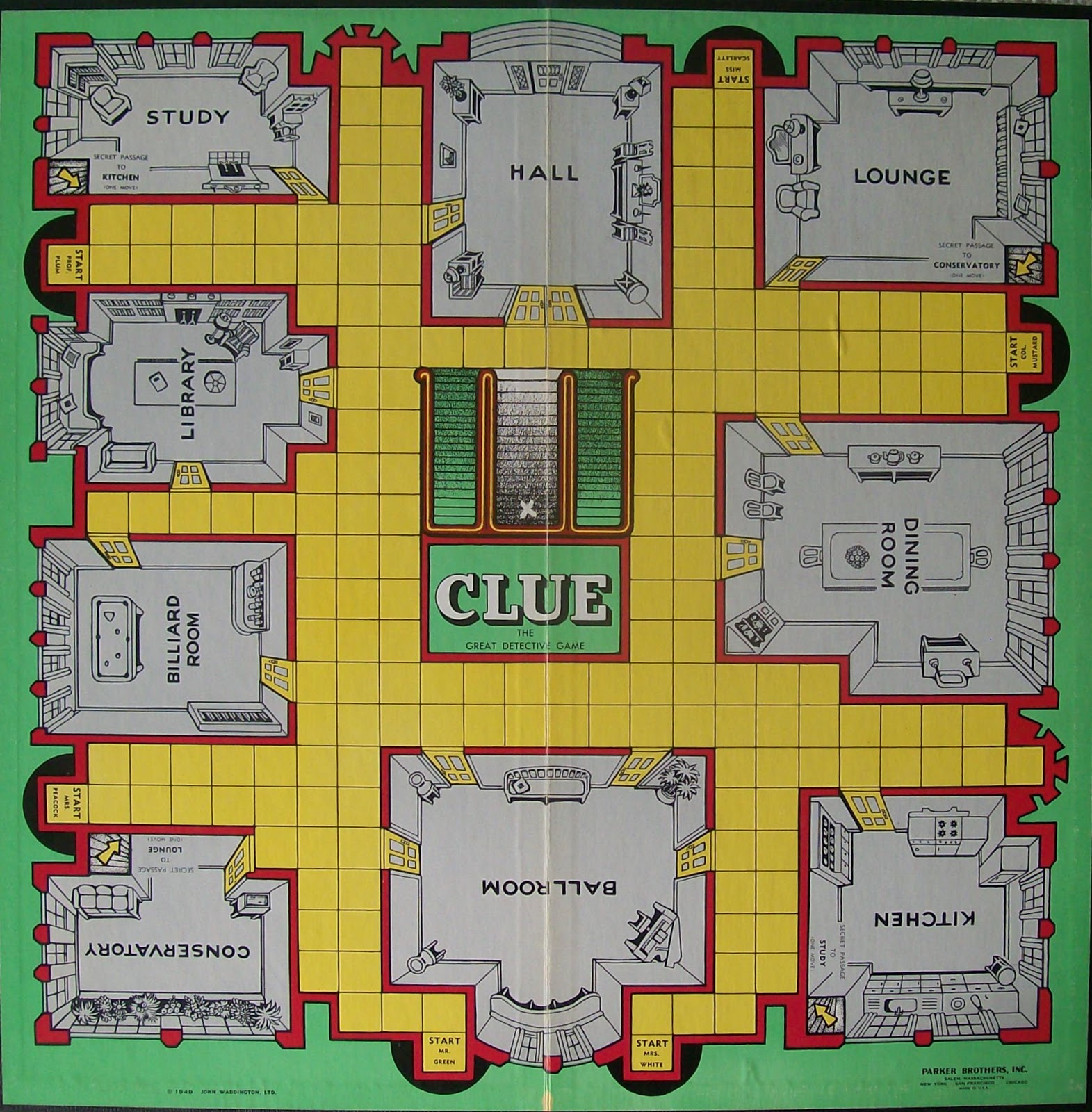
    If you have ever played the board game "Clue" you will recognize the playing pieces on the book cover: the six tokens that represent the players and the six weapons: rope, knife, gun, wrench, candlestick, and lead pipe. The rooms of the hospital, where the patients tell their stories, correspond to rooms on the Clue game board, though the connections, I find, are a little baffling.

    When I read about the author's unconventional approach to mystery writing, I thought it would be fun to read. When I learned that the author's literary predecessors were the group Oulipo I was even more interested, though I realized that it would undoubtedly be very difficult to read this book! Never would I dare to try reading it in French! I was challenged enough by translated works of "potential literature," overwhelmed by Life: A User's Manual, charmed by Zazie in the Métro, and so on with the works of the Oulipo writers, what would happen with this one?


    Not a Clue -- a book about memory and its unreliable of ephemeral nature -- created all kinds of memories as I read. First, my childhood memories of playing games of Clue with the kids in my neighborhood. Memories of a variety of French experimental literary creations, read over the years. Memories of experiences described in the book, like changing from one Paris Metro line to another. Memories of my happen-stance visits to the Hôpital Sainte-Anne in Paris where the action takes place. At this moment in time, in the year 2020, memories of exotic locations or social interactions are all I or anyone else can have, being deprived by the coronavirus of direct experiences outside a very limited sphere. Weird, no?


    The gate of the Saint Anne mental hospital in Paris. (Wikipedia) 
    It's pretty funny that this book should be so full of memories for me, since so many of the characters who write little self-portraits are in the mental hospital because they have amnesia of some sort. During one of our long stays in Paris I had to go through the hospital gate shown in the photo once per month to pay our rent. The woman who owned our rental apartment required payment in cash to facilitate her tax evasion, but we never acknowledged this directly. She herself lived in a lovely apartment inside the hospital compound, where her husband worked as a psychiatrist and administrator.

    Glacèire, the metro stop for the hospital
    Whenever I entered the hospital grounds, I felt very uneasy because my French wasn't very good. I was frightened that my presence would be questioned by some authority, that I would answer inappropriately, and thus I would be taken for a mad person who belonged there.  Could I explain myself convincingly? My real purpose was making a business call, but I had to pretend it was a social call. Having our whole month's rent in cash in my pocket also made me edgy, especially during my trip on the metro. When I arrived, my landlady would put the cash in a sugar bowl and then offer me a cup of tea.

    My own memory makes me feel kinship to the memory-monologues of the many mad people in the book -- "The post-withdrawal alcoholics living in the 14th arrondissement of Paris who’ve been in my presence in the smoking lounge of the Piera Aulagnier Wing at Sainte-Anne’s for the last eight and a half months," or "Amnesiacs, schizophrenics, psychotics, neurotics, manic-depressives, and so many more," says one character  (Kindle Location 1085-1099).

    The mad people in the novel were identified with the six personages of the Clue game, and relevant chapters are labeled with the guesses that Clue players make about the murder that's being solved by playing. The Clue game cards for these personages appeared in an ad I found on e-Bay, offering a vintage Clue set like the one I remember playing. In Not a Clue, the author probably had in mind some later version of the game, but I’m making this review also about my own memories.

    You can probably guess the problem with this book. Such an artificial structure in the end makes it seem incoherent — all these different mad people with oddball efforts to forget and to remember. The interspersed observations by their doctors, the digressions by the "narratrix," comments the characters make about being in a book and other "meta" things, and so on follow the lines of certain 20th century literary forms. "I have other plans than being part of this pathetic book, you know." says one character. (Kindle Location 3665).

    In my judgement, the book is a curiosity, but not very readable. Liking it would require some real mental gymnastics, as far as I’m concerned.

    Blog post copyright © 2020 mae sander for mae food dot blog spot dot com.


    Friday, January 05, 2018

    "Sourdough" -- Food and Robots

    Robin Sloan's recent novel Sourdough explores a number of links between food and technology -- especially robotics and artificial intelligence. Sourdough takes place in San Francisco and Berkeley in the near future: or maybe even now, in an imagined present. More or less by happenstance, a character named Lois, who's a programmer of robots, becomes a sourdough baker. Lois's sourdough starter has remarkable qualities; in fact, it has a pretty fully developed personality and unusual abilities, such as a love of certain types of music, a propensity to luminesce, occasional formation of pseudopods that reach out, and "Scents, various: still banana, always, along with smoky smells, like far-off fires, and occasionally the scent of gasoline." (Sourdough, Kindle Locations 1640-1641).

    After a few successful bakes with the starter, which produces loaves inscribed somehow with a face, Lois unsurprisingly realizes that she'd rather bake than program. After a while she doesn't even mind the vastly lower pay scale for baking. She tries out for a place in one of San Francisco's extremely exclusive farmers' markets, competing mainly with pickle makers but others as well. This is where it gets to be a foodie book: all the trendy food games people play are brought into focus. Lois describes her try-out for the market:
    "That was the absurdity of this: I was standing in line with people who were masters of their craft. People who pickled plums, pressed olives, raised chickens, kept bees. I was just lucky: gifted with good raw materials and, perhaps, charitably, a sense for how to use them." (Kindle Locations 1051-1052). 
    Lois's robot-programming background serves her in her new occupation: she obtains a used robot (actually a robotic arm: this isn't one of those books that maintains the silly fiction that robots are going to look like C-3PO in Star Wars or like the humanoid robots in Woody Allen's Sleeper).  She programs the robot to help in her baking, and also solves the classic problem of teaching a robot to break eggs. In the market, though, there's another type of technology at work: using fermentation to create artificial food. Fermenting cultures play a huge role as the plot unfolds in Sourdough. So do these artificial foods, starting with the favorite of the programmers at Lois's former job: "Slurry was a nutritive gel manufactured by an eponymous company even newer than General Dexterity. Dispensed in waxy green Tetra Paks, it had the consistency of a thick milkshake. It was nutritionally complete and rich with probiotics. It was fully dystopian." (Kindle Locations 212-214). Later Lois encounters a more artisanal version made by one of the market vendors.

    The market where Lois is selected to sell her sourdough loaves includes many strange and sometimes dystopian offerings of her fellow-vendors. Its existence is a deep secret: it's housed in a former military bunker, and populated by vendors of quite unusual merchandise. Besides the woman who made the artificial food product:
    "There was Gracie with her Chernobyl honey; the cave-dwelling mushroom monger; a man and a woman decanting smoothies that appeared to have … things swimming inside them. Orli, the elf, presided over a table piled with cheeses, some ghostly pale, some brown like leather, and some veined not only with blue but also bright green and hot pink. The larger wheels she had carved into pieces at irregular angles, so the resulting hunks looked like soft, fat jewels. There was a workstation selling algorithmically optimized bagels, their outsides perfectly smooth like computer renderings. A printed banner said NEWBAGEL; it was surprisingly well designed." (Kindle Locations 1499-1504). 
    Sourdough is full of colorful characters, starting with two mysterious brothers, members of a tribe called the Mazg, who first sold Lois spicy soup and sandwiches on sourdough, and then entrusted Lois with their sourdough starter as they left the country. There are many others, such as Charlotte Clingstone, the owner of a famous gourmet Berkeley restaurant named Candide (after the French tale by Voltaire) that might or might not resemble Alice Waters and her restaurant named Chez Panisse (another French literary illusion). The book is full of references to cultural stuff. Really fun cultural stuff! Like "All the restaurants with Michelin stars, where you can eat salted moss and turnip foam." (Kindle Location 1157). Like "rejected applicants to the Oulipo." (Kindle Locations 1719-1720). Like "if anybody wanted to ask a lady out, he could do it via text message like a normal person." (Kindle Location 2384). Like "salt of every kind and color, black and pink and blue. Each variety sat shimmering in a glass canister, priced by the ounce..." (Kindle Location 1661).

    Lots of mysteries drive the plot of Sourdough, which is in fact quite fast-paced, and has a rather delightful ending that I'd love to discuss but I don't do spoilers.

    It's much more fun to read Robin Sloan's speculation on the potential benefits and risks of artificial intelligence and robotics than to read the rather tedious and self-promoting non-fiction book titled Life 3.0: Being Human in the Age of Artificial Intelligence by Max Tegmark. I bring up Tegmark's book quite mindfully. It's a very gloomy effort to predict how terrible it would be if AI of some sort gained control of the human world, and where owners of this technology suck up all the wealth. This is a future which the author claims is all too possible.

    Tegmark's vision of what could happen uses examples from real AI  research. Unfortunately his approach to convincing the reader is to provide imaginary scenarios of how AI could take over, and to bring this home by citing all the successful tech entrepreneurs, superstars, and researchers who agree with him and how much money he and his cohort have been given to warn humanity of the dangers of technology. I'm not sold.

    Tegmark also augments his vision with lots of references to science fiction and dystopian literature. But a real fiction writer like Sloan (and of course many others) is much better at making such speculation come alive.  I do give Tegmark credit for occasional jokes about a future when there are no jobs and maybe all-powerful computers take over -- "A friend of mine recently joked with me that perhaps the very last profession will be the very first profession: prostitution. But then he mentioned this to a Japanese roboticist, who protested: 'No, robots are very good at those things!'" (Life 3.0, Kindle Locations 2287-2289).