Sunday, June 14, 2015

Where we've been

Runde, Norway, from a boat trip we took yesterday.
Runde Lighthouse from the boat. We also saw colonies of nesting gannets and puffins.
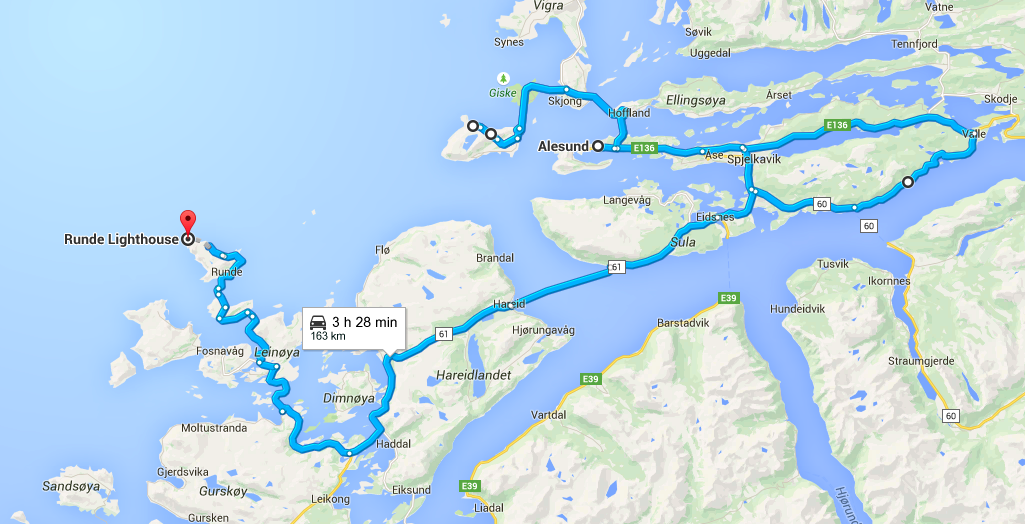
Where we drove today: from Runde Island
to the city of Alesund with detours around several other islands.

The Nature Center where we stayed was not quite all the way to the lighthouse, which is not on a road.
What I ate for dinner: salmon and vegetables in cream sauce.
I think of this as very Norwegian.
Where we ate: Søstrene Fryd Cafe and Restaurant near our hotel in Alesund. 
We've been very busy looking at the magnificent scenery, driving through tunnels, over bridges, and beside the fjords, and enjoying 20 hours of full daylight and no darkness at all. Well, sometimes it keeps us up during the night. At the Nature Center, we cooked in our kitchen using food from a grocery store quite a distance away, but we've also enjoyed several restaurant meals.  Too busy seeing things, not much time to blog!

Want more photos? We are continuously adding to Flickr:


Wednesday, June 10, 2015

"Feed Me" ... Birding in Oslo

Gyrfalcon chick on its nest
Moorhen chicks
After feeding the babies, mother bird leaves nesting box to get more food.
Swans with chicks
Wednesday our bird guide Simon took us around Oslo to wonderful fresh-water lakes where ducks, geese, and swans are breeding, and to open fields and wooded areas. He told us how he'd been watching an owl's nest (the owlets were all fledged and gone so we didn't visit). He showed us a beaver dam and a gyrfalcon chick waiting in its huge nest for its parents to feed it, and a woodpecker hole from which the chick was incessantly chirping to remind its parents to bring food, and several active nesting boxes of other birds. He was really excited to see a colorful butterfly that normally doesn't migrate up here from Africa until much later in the season. He found a wren's nest on the side of a bluff, almost invisible to the numerous passers-by.

Simon showing Len a bird
Simon is English, and reminded me sometimes of Shakespeare's character Puck, immersed in nature and creatures.
Black-faced gull with chicks almost as large as it is.
Grebe chick taking a ride on parent's back.

Sunday, June 07, 2015

Utopia in a Dystopia

In The Subprimes, a very recent satiric novel by Karl Taro Greenfeld, the setting is not far in a future in which all our worst fears have been realized. American life has become an orgy of rampant greed untempered by government regulation, including cancellation of all government-provided benefits: schools, health care, road maintenance (except for exclusive roads for rich people), police protection, civil rights, basic freedoms. Renewable energy is illegal, as are hybrid cars; the energy industry owns everything.

Climate change has resulted in punishing heat waves, packs of coyotes preying on humans and housecats, and distressed whales washing up on the beaches. In California, the view from the once-beautiful shoreline is mainly of large numbers of oil rigs. Food is scarce, and many types of food are simply not available any longer. Brutality of the rich against the poor includes debtors prison or worse for the "subprimes," that is, citizens with a bad credit score.

The subprimes have lost their jobs and have been routed out of their former middle-class neighborhoods. Large numbers of them roam in disintegrating SUVs and old cars from one "Ryanville" to another -- most of them underneath derelict freeway overpasses. In case you have forgotten this: in the Great Depression similar encampments where homeless people congregated were called "Hoovervilles." Yes, it's a very political satire!

The novel includes several vividly drawn individuals and families from each of the new classes of society including of course the subprimes. Sometimes the story is told by an omniscient narrator, sometimes by a writer who is still almost managing what's left of a middle-class lifestyle. As the novel progresses, these compelling characters all gather in a utopian communal experiment located in an abandoned subdivision in the desert near Las Vegas. With a mysterious woman leading them, they create a utopian living space where they raise vegetables, rehabilitate the decaying housing, cooperate to provide health care and nutrition, establish ways to educate their children, and above all, reclaim their dignity.

Communal meals particularly serve to unite them -- as individuals most of the subprimes have had to live on canned beans (heated when they were lucky) and tortillas as they fled from one Ryanville to another. In the small emerging settlement, they pool their resources and cook together. When the writer first arrives at the settlement, the residents feed him from their stew pot. It's a major contrast to the food in fast-food outlets, and a major contrast in attitude:
"Gemma and I both sit down on a log bench and spoon the stew into our mouths. The food is earthy and smoky, and while the first bite seems bland, the flavors grow on me, some kind of meat, seasoned with cilantro, onions, chipotle, garlic, and salt, so that after a few mouthfuls, I can’t imagine anything I would rather be eating. We wash it down with cups of water. 
"'What’s the meat?' I ask Sargam. 
"'Rabbit, goat, maybe snake,' she says. 'Definitely some lobster. Cans of the stuff have been donated— by the pallet.'" (Kindle Locations 3889-3894).
In the end, as one would expect, a violent clash pits the residents of this utopia against the goonish security guards hired by the representatives of the greedy society which has oppressed them. The leaders of the oppression are a pair of twins -- the Pepper sisters -- who own the biggest energy corporation in America and their ally, a smarmy evangelistic preacher who assures the public that all misfortunes, from those of beached whales to those of deprived subprimes, are the will of God. These representatives of the greedy rich plutocrats seem to me to be the most amusing of the novel's broad satiric streak.

I'm not going to tell you who prevails, but the end is dramatic if a little exaggerated. The whole book, especially the ending, is fun to read.

Friday, June 05, 2015

"The American Way of Eating"

“What’s a foodie?” was the start of a conversation related to Tracie McMillan by one of her neighbors, Martina, one of many examples of acquaintances whose ways of eating she profiles in her book The American Way of Eating.

“It’s someone who’s really, really into food, and grows their own, and then does things like make preserves and pickles and cans their food,” was the answer from the man Martina was describing. She answered him: “'Oh, like my mom, she does that,' but now she’s old. But, when I was a kid, she used to grow all these herbs and tomatoes and chiles and everything, just like back on the rancho in Mexico."

"That used to be all food. And it was a pain, man, to help with that. But it was real good, too. ... Right. That’s totally the same thing! Right! ...

"And so this guy, he says, 'Oh no, not like that.' and I can’t get him to tell me what the difference is, he just keeps saying, 'It’s just, like, you really, really like your food,' and I keep saying 'Like. My. Mom.' And we go back and forth like this, and finally I just told him, straight up, 'That’s classist, you just don’t get it.' And all he could say was, 'Foodies really care about what they eat.'" (p. 141)

It's kind of a cliche that many Americans have little choice in what they eat even though they in fact might prefer to eat more fresh produce and fewer meals of soft drinks or beer and a bag of chips -- and elitists don't get it. Many working people lack the time, access, and money to choose what they most wish for. This is the American way of eating that Tracie McMillan explores.

Though much of the statistical and general social information in the book has often appeared elsewhere, the development of relationships with fellow workers, landladies, or roommates, even in the short spans of time she worked each job, was one of the most interesting elements of the book -- like her relationship with Martina, whose mother loved food but didn't qualify for an elite definition of "foodie."

In order to learn about American food, McMillan decided that picking peaches and digging up garlic in the California fields, stocking the produce counters or the baking-supply aisles at Walmart, and working in the kitchen at Applebee's would help her to understand how poor and lower-middle-class Americans eat. While doing so, she had few financial or other resources to distinguish her from her fellow workers. They accepted her as a peer and a friend, and she also felt the same way about them.

McMillan herself grew up in a family that didn't always cook, though her grandmother taught her a bit. Both her background and her education led her to expect poorer people not to value cooking, good food, and fresh produce as much as wealthier Americans do. She clearly shows how very much these peers did love fresh food and home cooking.

One of McMillan's Walmart jobs was in Detroit, where she described her fellow workers and some of their food habits thus:
"Patti and Marvin reminded me how much people care about their meals. There were signs of it all around me in Detroit. There was Chris and her ceviche, for instance. The woman largely subsisted, so far as I could tell, on high-fiber breakfast bars, quesadillas, and Michelob Ultras, but she would also spend an hour cutting through five pounds of raw fish so that we could eat it all week. ...  
"Really, though, all I would have needed to do was look out my bedroom window. In the balm of springtime evenings, I’d watch my neighbors work in the community garden, crouching low to yank out weeds or ambling up the sidewalk behind a creaking wheelbarrow in the long shadows of twilight. Our garden wasn’t that big, maybe half a lot, but there were hundreds of them throughout the city .... Since the early 2000s, Detroit’s limited supermarkets and an overabundance of vacant land have inspired city residents to start growing their own food, in gardens ranging from tiny corner lots with collards and tomatoes to a four-acre expanse complete with a mushroom patch. They’ve churned out such an abundance of greens, herbs, and tomatoes that the most prodigious among them have formed a cooperative, Grown in Detroit, to sell their excess at farmers’ markets and restaurants around town. (p. 171)
Where does your food come from? Not a simple question. The process of bringing fresh vegetables and fruits from the fields in California or Mexico to the produce department at Walmart or to the kitchen of a fast-casual restaurant is complicated and adds most of the cost of these products. The author's experiences at Walmart were especially discouraging, as the produce there was very badly managed and poorly conserved, and she points out that Walmart supplies far more people with produce than any other source.

In today's New York Times a very closely related article, "Closing the Broccoli Gap" by Tina Rosenberg discusses the exact problems that are laid out in McMillan's book. It describes a program called Health Bucks, which enables people using food stamps (the SNAP program) to purchase considerably more produce for the same amount of money and credits. The program attempts to overcome two problems: poor people's access to markets where good produce is sold, and their inability to afford it.

The emphasis in the article is on an advocacy organization titled Fair Food, headquartered in Ann Arbor and their efforts in southeastern Michigan, right where I live:
"In 2013, the group worked with three independent grocery stores in Detroit to run a Double Up Food Bucks program from July through October. A SNAP customer who spent $10 on fruit and vegetables received a $10 gift card to spend on Michigan-grown produce. The next year, four new Detroit stores started the program, along with two groceries in Western Michigan."
McMillan makes a highly political point about social responsibility in her book. Perhaps the efforts described in today's article are making a tiny bit of headway in dealing with the issues of better and more nutritious food for all socio-economic classes in our society.

Monday, June 01, 2015

"Twain's Feast" by Andrew Beahrs

John James Audubon's painting of the Greater Prairie Chicken.
Author Beahrs watched the mating dance of the once-plentiful birds in one of their
last nesting places in Illinois, and described the factors that have nearly extinguished them.

A homesick Mark Twain, bored with a European cuisine he found tasteless, once wrote a wish list of the American foods he longed for.

Food writer Andrew Beahrs used Twain's list as the jumping-off place, a combination of research on historic recipes, on 19th century agriculture and transportation, on the natural history of the game birds and animals Twain enjoyed eating, on the role of some of the foods in Twain's literary works, on menus from banquets Twain attended, and even on the way ice was used in 19th century America. Beahrs described a number of his own experiences seeking to eat the foods or to see the now-rare species in the wild. I loved this well-written book for its variety!

Beahrs' description of his visit to the rare nesting site of a few surviving prairie chickens fascinated me, as I love to see wild birds; he explains how the taming of the prairies and the conversion of grassland to farmland gradually destroyed the vast habitat of the bird. Once killed by the hundreds and shipped in barrels to American cities, the prairie chicken is now mostly protected from any hunting at all -- so of course he never tasted any.

Other now-rarely-eaten game included raccoon, possum, and terrapin, all enjoyed by Twain. Beahrs did manage to taste raccoon, but doesn't recommend it, while the traditional way to boil a live terrapin made Beahrs decide not to follow Twain's example. Oysters on the East coast, the West coast, and the Gulf coast were all popular in Twain's day, and Beahrs documents their history and how few of them remain as they were then. On an early trip west, Twain loved the now probably extinct species of trout from Lake Tahoe, whose natural history appears in the book.

In contrast to the fraught history of fish and game in early American life, maple syrup and cranberries, which Twain loved, are still quite available and not at all obscure. Two fabulous flavors, in my opinion! Beahrs presented both the history and the current methods for preparing these two favorites.

Beahrs researched the methods that Native Americans used to gather maple sap, with its 2% sugar, and concentrate it into a much more intense sweetener. Lacking iron kettles, they hollowed-out felled tree trunks, poured sap into them, and then dropped hot rocks into the sap to bring it to a nearly-explosive boil and turn it to syrup. An interesting bit of historical background: abolitionist Benjamin Rush, at the time of the American Revolution, encouraged the substitution of maple sugar for cane sugar -- because it would help defeat the slave-intensive production of refined cane sugar.

I was delighted and fascinated by the wide variety of past and present food information that's assembled in this book. I loved the way he tried to find both the similarities and the differences between how things probably tasted to Mark Twain and how they taste now.

Saturday, May 30, 2015

Dining out in Grayling

Breakfast at Borcher's Canoe Livery and B&B where we stayed Thursday
and Friday nights.
Breakfast Saturday monring: really delicious baked omelet
We would have loved to go canoeing, but it was too rainy.
We were lucky to have had good weather for our main
goal: seeing the Kirtland's Warbler.
Dinner our first night: at Spike's Keg O'Nails, a bar & grill.
Phyllis and Ed, our traveling companions at Spike's
Food and beer at Spike's ... very good!
After dinner...
we weren't the only ones enjoying our DQ!
Lunch Friday...
Deep-fried smelt.
Most of the time, we were out walking on beaches, in wildlife refuges and in parks. But we did enjoy our meals. Friday evening we went to a pizza place, but it wasn't very photogenic!

Friday, May 29, 2015

The Logger's Breakfast


At Hartwick Pines State Park we met the Audubon Society tour to visit the Kirkland's warbler nesting areas. That's why we are in Grayling.

We also stopped briefly at the logger museum in the park, where they have a facsimile of the logger's kitchen, showing what they ate and how they cooked. Unfortunately the museum is more or less in open air which in this case means open to huge clouds of hungry mosquitos, so we gave up learning about the loggers' meals because we didn't want to be the mosquitos' meals.

The museum reminded us of the song "The Frozen Logger," which you can hear on Youtube -- or here are some of the lyrics:

I see you that you are a logger
and not just a common bum
'Cause nobody but a logger
stirs his coffee with his thumb.

My lover he was a logger,
there's none like him today
Well if you'd pour whiskey on it
well he'd eat a bale of hay.

He never used a razor
to shave his horny hide
He'd just drive them in with a hammer
then he'd bite them off inside.
...

Sunday, May 24, 2015

Life under Stalin: "The Zelmenyaners" by Moyshe Kulbak

"You can be a Bolshevik, march with the flag, say what you’re expected to, and still help a fellow Jew here and there. ... You know, sometimes I look at a light bulb and I think: the only God left in this world is electricity. You tell me, though: can a light bulb be God?" 
So worries a Jew in Stalin's Russia in around 1930 -- a character in The Zelmenyaners, a comic novel by Moyshe Kulbak. The work -- which deals with the adjustments to Communism, modernity, and attendant dislocations of a Jewish family in Minsk -- was published in Yiddish in serial form from 1929 until 1935. It was recently translated into English, and I read it to my great amusement, as I've always wondered about how the Jews of the Shtetls and the cities of Eastern Europe managed to adapt to the major upheavals of the era.

The book is episodic, covering the lives of the descendants of one Reb Zelmele. In a kind of apartment building that Reb Zelmele built for his sons we meet a large number of his descendants, and their spouses or lovers, and a few others too, simple people: "a Zelmenyaner is no more complicated than a slice of bread." (p. 4)

Sometimes the author looks back to the history of family members, for example, how one of them had survived the Great War and the Revolution because he had a wooden spoon:
"Although he had more than once lost his rifle, he was never without the wooden spoon that he kept tucked into his boot leg, his most precious weapon of the war....By the time it was old and black and broken at the handle, no bigger or cleaner than the palm of his hand and hardly still a spoon at all, it had done more for him than any spoon in the world had ever done for anyone. He had raked potatoes from campfires with it. He had eaten snow with it. ... He had spooned castor oil, vodka, and plain water down his throat with it. He had dug trenches with it. Once he had even rented it out for a single meal in exchange for a thick slice of bread." (p. 128)
During the main narrative, in the early years of the Communist regime, Jews in the apartment building ate traditional foods: potato puddings, boiled potatoes, cold potatoes, bread, herring, hard-boiled eggs, bagels, jam. Jam, it seemed had miraculous properties for comforting the eater, curing the sick and other purposes. The Zelmanyaners loved to eat, especially children: "Given a slice of bread with a pickle, or a radish and a bowl of sorrel soup, they gulped it down and cried: 'More!'" (p. 31)

And times change as on this occasion towards the end:
"The food was served. Uncle Itshe had a sharp eye. He saw at once that it wasn’t the usual Zelmenyaner fare. It started with little tidbits served from tins, each barely enough for a lick and a bite. What else was to be seen on the table? Gorgeous yellow apples on a white platter. Round little tortes in cobbler dishes. Canned delicacies on white trays. A suckling pig, its lewd little head at one end of a trencher with its feet tucked beneath it and its tail curled like a cord at the other end. Tall, thin wineglasses with napkins folded inside them." (p. 213)
I'd love to also tell you about the huge and varied smells that the author describes like this one about the apartment building -- "A smell of fresh pine boards mingled with the odor of the long-gone geese that had once laid their eggs in the vestibule" --  but I'm out of time. (p. 23)

The Zelmanyaners are doomed by modern life and by the outlawing of their ways of making a living, as summarized in this passage:
"The last tailor is gone— the old Jewish tailor with the little beard, the thin, amused brows, and the dry-as-dust fingers. 
"Gone is the barefoot potato wolfer and fecund progenitor who reproduced like grass, doubling and redoubling himself.  
"Gone is the merry Jew who needed only a bowl of sorrel soup to make him sing the world’s wonders." (p. 173)
The end of the story is the end of the Zelmanyaners' apartment building:
"Reb Zelmele’s kingdom, which had endured for seventy years and several generations, had come to an end. Not only would it never see the fulfillment of its founder’s dream, the well from which it could drink its own water, it was doomed to be wiped from the earth with its little houses, fences, sheds, and even its brick building that had been the incomparable pride of so many Zelmenyaners." (p. 263)

Saturday, May 23, 2015

More about peanut butter than you want to know: "Creamy & Crunchy"


When I was around ten years old, I ate a Peter Pan peanut butter sandwich, no jelly, for lunch every day -- on Wonder Bread. Peanut butter came in a reusable drinking glass with a lid that had to be pried up, and that summer every lid had a different image of a character from Walt Disney's movie Peter Pan. I collected something like 13 of 14 lids -- my favorite was Tinker Bell. Of course I don't have the lids any more, but I found one picture (above) of a few of my least-favored lids that were once sold on E-Bay.

When I started reading Creamy & Crunchy: An Informal History of Peanut Butter, the All-American Food by Jon Krampner, I expected to learn more about this and other popular jingles and advertising campaigns for various brands of the incredibly popular spread. But instead of a review of what I think of as popular culture, I found a pretty plodding history of the agricultural and industrial processes used to make peanut butter. Krampner never mentions the Disney promotions at all -- just a bit about advertising Skippy and Jif. He documents various salmonella contamination scandals and regulatory issues at length, which is reasonable, but doesn't really convey what makes peanut butter so popular that people keep eating it anyway.

The plodding wouldn't be so bad, but the book is incredibly repetitive. For example, the author must have mentioned 10 times that the boll weevil's destruction of the cotton industry around the turn of the 20th century was a cause of the increase in peanut farming in the South. The explanations of the various chemical processes that have been devised to make peanut butter taste creamier are repeated again and again -- maybe there are a few details different, but only a food chemist could care. He constantly re-hashes the history of the early families whose plants made peanut butter. Sometimes I had the feeling I was reading the same sentence over and over again.

I got through the whole book, always hoping it would be more like three books Krampner mentioned as his models: Mark Kurlansky's Cod, John McPhee's Oranges, and Steve Almond's Candyfreak. Those are really good books. I wish this one had come up to the standard they set.

Thursday, May 21, 2015

"On Persephone's Island"

In the 1960s, when Mary Taylor Simeti began her life in Sicily, peasants still
used the traditional painted carts to at least occasionally, she wrote. By the time
we were there, only vendors to tourists used them. (Photo from our trip in 2002)
Last night my culinary book club discussed the book On Persephone's Island by Mary Taylor Simeti, which was published in 1986, and describes her life in Sicily from 1964 until the 1980s. Simeti's year abroad after her graduation from college became a lifetime commitment when she married a Sicilian. She tells of her adjustment to his family, how she was raising her children to have both a Sicilian and American identity, and how she had adapted to the rhythm of life in the countryside in summer and in Palermo in winter. Her husband is a teacher and also manages the family farm, and her children were in school in the city.

Last night everyone seemed to have found the book as charming as I do. Most of the books we read take a scholarly or other systematic approach to food. In Simeti's book, food is an important part of family life and community life, but she doesn't look deeply into its history or systematically examine foodways. I at least found this a welcome variation on our usual reading. For example, I loved her description of the tradition for some holidays of grilling artichokes with garlic.

The Martorana Church in Palermo where a wedding was taking place.
Simeti mentions this as a popular choice for weddings.
We agreed that we were surprised by her descriptions of the major impact that the Mafia had on the ordinary people in the book. Huge sums of money were expected: if not paid, the Mafia would blow up homes or businesses. And the Mafia murdered a number of government officials who tried to establish the rule of law.

Though we enjoyed the book, much of our discussion ended up being our own travelers' tales -- of the eight people present, four had been to Sicily. In response, I looked up these photos from one of our trips.

Simeti's book explores her sense of connection to the ancient Greeks who settled many parts of the island, and to the
many Greek myths that take place in Sicily -- such as the abduction of Persephone. Above: one of the temples of
Agrigento, a beautiful and major Greek city.
All of us had very strong memories of the mosaic floors at the villa at Piazza Armerena.
That's me holding a green Michelin guide.
One memorable experience shared by a member of our group was about stopping to talk to a man who was working in his vineyard. He asked about the wine, and the man invited the traveler and his wife (both present last night) to come home with him to taste his wine. The guests were seated in the parlor, which was obviously saved for special events, while the host and hostess prepared food. Several other people from the village joined them, and entertained them for around 2 hours. The people of Sicily, our friend concluded, were among the warmest and most welcoming in Europe.

Monday, May 18, 2015

Magee Marsh

A crowd of birdwatchers looking for one little Connecticut Warbler, May 16, 2015
Magee Marsh is a beautiful preserve in Ohio, where large numbers of migratory birds stop briefly as they migrate from their wintering locations in the south to summer breeding grounds in Canada. They wait in the marsh until just the right moment to fly across Lake Erie.

Connecticut Warbler by
John James Audubon
This weekend was particularly crowded with birders who come especially to see the many species of warblers passing through, as well as those that stop here to nest.

We joined the huge crowd depicted above, all hoping to catch at least a fleeting glimpse of a shy Connecticut warbler that was in the woods. Since we didn't succeed in photographing the poor bird, I included the John James Audubon picture.

Sadly, the crowds of birders appear to be putting enormous pressure on the birds along the boardwalk that allows access to the marsh. We read that a prothonotary warbler and a woodcock that were nesting near the boardwalk have abandoned their nests because of all the people nearby.

Environmental pressure from groups often occurs slowly, so that no single individual realizes that his innocent actions have tiny but real consequences. I've seen the term "future eaters" applied to this situation, where environmental damage accumulated slowly but inevitably. Birdwatching seems to be about as non-destructive as any activity could be. Is it?

A prothonotary warbler (photo from last year at Magee Marsh).
A woodcock we saw from the boardwalk a few weeks ago.
Birders like these who were there on Saturday love Magee Marsh and who can blame them?


Wednesday, May 13, 2015

Hunger and Justice

From Mark Bittman's column today in the New York Times, a penetrating suggestion: "Without economic justice there is no nutritional literacy, there is no good eating, there is no health. And there’s increasing concern on the part of many Americans that too many of us lead diminished lives — and in some cases, dramatically shortened lives as well."

Bittman's discussion centers on the many current issues of unjust treatment of minorities and the poor, pointing out how nearly impossible it is for children in impoverished neighborhoods with inadequate schools to attain the skills needed to make a better living than their parents. Food insecurity is only one of the many injustices they suffer.

In reading this column, I found myself wondering about food insecurity in America, a topic that I often return to. National Geographic last fall offered several fascinating studies of food topics, particularly an article titled "The New Face of Hunger" by Tracie McMillan. She writes:
"To witness hunger in America today is to enter a twilight zone where refrigerators are so frequently bare of all but mustard and ketchup that it provokes no remark, inspires no embarrassment. Here dinners are cooked using macaroni-and-cheese mixes and other processed ingredients from food pantries, and fresh fruits and vegetables are eaten only in the first days after the SNAP payment arrives. Here you’ll meet hungry farmhands and retired schoolteachers, hungry families who are in the U.S. without papers and hungry families whose histories stretch back to the Mayflower. Here pocketing food from work and skipping meals to make food stretch are so common that such practices barely register as a way of coping with hunger and are simply a way of life."
Through several photo essays, this article described the efforts of several families in different parts of the country to avoid hunger. While Bittman stressed the injustice of a system that has plenty of food and plenty of everything else, yet allows such wide discrepancies in family well-being, this article just documents the struggles, the dependence on food pantries, the unavailability of fruit and vegetables (which are definitely wanted), the sadness of parents whose children are underfed. And she provides charts and maps showing where families are most dependent on food aid, where hunger is the worst, and how farm subsidies fail to create general nutritional benefits.

Three images from the detailed slide shows in National Geographic:


One sixth of Americans don't have enough to eat. This is the basic and cruel fact about our society. I wish I shared the optimism of Bittman who thinks we can solve this problem. Here's his conclusion:
"This is unjust and intolerable. The bad news is that we should be ashamed of ourselves: As long as these things are true, this is not the country we say it is or the country we want it to be. The good news is that it’s fixable, not by 'market forces' but by policies that fund equal education, good-paying jobs, and a good food, health and well-being program for all Americans."

Saturday, May 09, 2015

"Brown Dog Novellas"

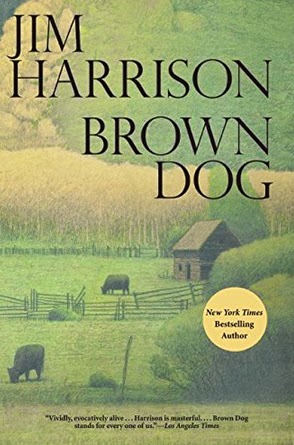
BD, short for Brown Dog, is the hero of the numerous novellas in this large (and somewhat repetitive) volume; most of the stories were published previously over a number of decades.

Author Jim Harrison, I learned by looking him up, has written a number of better-known fictions and at least one food book titled The Raw and the Cooked.  His Brown Dog is my book group's selection this month which is the first I heard of him. These novellas did not make me wish to read more of his work.

As a part-Indian inhabitant of the Michigan Upper Peninsula, BD is a friend of many Indian people and UP locals. He's also an enemy in most cases of the hyper-intellectuals who come up there from Ann Arbor from time to time for one reason or another. So maybe, as a long-term Ann Arborite, I'm not really supposed to like him or the book. I don't.

"The natural man lives for himself; he is the unit, the whole, dependent only on himself and on his like," wrote Jean-Jacques Rousseau. BD tries to live in a state of nature like this, and I think Harrison wants to be seen as an heir of Jean-Jacques, presenting a man in a state of nature, sort of.

There's a lot about food in the stories, which should make me like it. BD for a while adopts two children and cares for them by cooking from a book titled Dad's Own Cookbook, from which he made recipes like Mexican Chicken Stew and Dad's Own Chili. He loves the nurturing aspects of this cooking, and especially loves garlic, which he browns carefully for his step-daughter, also a garlic lover.

Descriptions of BD's cooking are a little forced: a literary device to show how dedicated he was to the children. In fact, the children often seem to be symbols introduced into the novel to prove a variety of points about BD. The boy is incredibly bright, but very little characterized; eventually he manages to enroll in the private Cranbrook school in the Detroit suburbs and disappears from the narrative. The girl, damaged by fetal alcohol syndrome, is incredibly in touch with the natural world and its creatures, unable to speak but able to imitate bird songs and animal cries. You know what? Using a mentally challenged child as a way to critique society and civilization is kind of a cheap shot.

BD's 's only ID is a driver's license, and we learn repeatedly that he has no social security number. His age is around 50; the stories take place over a longish time, but he ages somewhat more slowly than it would be natural: poetic license which doesn't bother me. BD has never had a job, only done odd-jobs to have a bit of money for women, alcohol, and gas for his various vehicles. BD's uncle Delmore conveniently has a lot of money left from working in a Detroit auto plant and buying property there -- though kind of a miser, he always comes through with enough money to buy food for the kids and keep the story going.

BD mostly lives off the land shooting deer in any season, trout fishing in any season, and poaching game birds. He particularly loves to cook and eat deer liver, which I never knew was such a delicacy. He also knows a lot of ways to cook over a campfire -- I like the outdoor cooking parts better than the cooking-for-kids parts of the book.

When BD gets any money, he immediately spends it on beer or schnapps or restaurant meals or on women. He loves women -- mainly as sex objects and his sex life is a major part of the book. His attitudes, as reflected by the omniscient narrator, are mildly offensive most of the time, but one major part of the story is exceptionally offensive: he falls in love with a social worker named Gretchen who's a lesbian and through several of the novellas gradually tries to convert her into a heterosexual by being a fantastic lover. The author doesn't come right out and say it's all about sexual politics but he doesn't need to.

Despite BD's attempt at a low profile, he's well-known to the authorities because of his various criminal activities such as selling contraband from Great Lakes shipwrecks (somehow he's a scuba diver), attacking anthropologists from the University of Michigan who want to dig up an Indian burial ground, and running away with his adopted daughter when Social Services decides to send her to an institutional school in Lansing, MI. Each of these adventures figures in one of the novellas.

To quote the summary in the New York Times review of the book:
"What Harrison does on every page of 'Brown Dog' is have fun. In the first (and best) novella, we watch B. D. haul a frozen corpse out of Lake Superior, stuff it into a stolen ice truck and convince himself it might be the father he never knew. In the second, we watch him dodge angry and lethal cuckolds, convince local newspapers he might be leading a secret 'Red Power' brotherhood and team up with an 'erstwhile though deeply fraudulent Indian activist' who is required back at U.C.L.A. soon 'to head a colloquium: "Will Whitey Ever See Red?"' In the ensuing novellas, we watch him steal a bearskin from a Hollywood producer, fall for a sex-addicted dentist, ride on a tour bus with a rock band and have 'real trouble dealing with' a Montana Costco."
The reviewer, Anthony Doerr, obviously liked the book better than I did, though he also had his reservations. BD, he writes, "connects with an implausible number of women over these 500 pages, and I don’t care to estimate the number of times Harrison employs the word 'weenie.' ... That said, readers don’t turn to Harrison for razor-sharp prose and linear narratives. Exuberance and messiness are his great strengths."

Thursday, May 07, 2015

First Barbecue of 2015

A few small tomatoes...
Thin-sliced beef and scallions on skewers, marinated with Asian sauces...
Ready to come into the house to be served with rice.
Such a beautiful evening. Delicious!

Wednesday, May 06, 2015

Milan Food Expo

"A vital need: being able to guarantee healthy, safe and sufficient food for everyone, while respecting the Planet and its equilibrium"

"Feeding the Planet, Energy for Life" is the central theme the Milan Food Expo, which starts this week, continuing through October. International agencies and 140 countries are participating: in particular, they are presenting their technology for advancing this theme. This is a part of the Milano World's Fair, which opened a few weeks ago -- including the usual complaints about who participates and what they have to gain, reported the New York Times.

Marion Nestle, the expert on food politics and various nutrition topics, is writing about her visit to the Expo this week. She writes:

2015-05-02 13.07.19
"The U.S. has a gorgeous pavilion framed by an undulating wall of vertical vegetables." 
According to the website of the US Pavilion:
"Expo Milano 2015 will enable the USA Pavilion to showcase the United States as an innovator not only in the food sector, but also in many aspects of culture, science and business. Feeding ourselves engages a massive infrastructure, advanced technologies, and dynamic systems that touch on just about every aspect of the world we live in. Each step from farm to table reflects a set of values and connections that impact our identities and shape our future."
Among the open questions are the sponsorship of big food organizations. According to the NYT article:
"After Expo officials announced in late February that McDonald’s would be an official sponsor, alongside partners like Coca-Cola, exhibitors like Slow Food, an international movement that advocates local and quality foods, protested. 
“'The presence of McDonald’s means that the planet can continue to gorge itself on fast food or junk food — call it whatever you like — without concern for our own well-being,' the Slow Food association said in a statement. Including such multinationals at the fair gave the message that 'feeding the planet or fattening it, caring for it or depleting its resources, seems to be the same thing,' Slow Food said in the statement."
Marion Nestle's post today is about the Slow Food Pavilion. She writes about their exhibit of raised beds for growing vegetables, and about a large sculpture in their exhibit:

Picture2
"I particularly liked the hefty guy made out of corn."

The Slow Food Pavilion theme is "Save Biodiversity, Save the Planet."

I find this all very intriguing -- so many countries and organizations giving lip service to so many good ideas. But will anything about the food problems of the planet really change? I wonder! You can see so many vested interests in not changing!

Saturday, May 02, 2015

Moroccan Cooking

On the menu last night: Moroccan tagine with beef, prunes, onions, and apples (upper row).
Tomato and bell pepper salad; roasted cauliflower salad; cake topped with fruit (lower row left to right).
Some of the pre-dinner drinks and snacks (actually, everybody
opted for Dubonnet, which was in the fridge when I took the photo.
Ready to serve.

Two of our guests: Linda and Peter.
Cookbooks I used.
The Tagine of Beef with Prunes and Apples was a recipe from Paula Wolfert's Couscous and Other Good Food from Morocco. The roast cauliflower recipe was an interpretation of one from Ottolenghi's Jerusalem: I used roast cauliflower, celery, walnuts, and sections of clementines. La Cuisine Juive Maroccaine described a tomato and pepper salad like the one I made. My friend Abby baked the cake -- unfortunately I didn't get her photo this time.