Tuesday, February 15, 2022

Gish Jen: More Stories

Caution: this is a long post that's mostly summary. Not really a review!

Gish Jen, Thank You, Mr. Nixon.
Published February 1, 2022.

Gish Jen's new collection of short stories portrays a number of characters at different times of their lives. The action spans the history of China from the date Nixon's visit in 1972 until now. It illustrates the lives of Chinese immigrants to America in the 20th century, and the fate of their relatives who did not leave. Every story stands on its own, and every story connects to the others. All reflect both irony and a kind of bitter sorrow. The descriptions of the suffering of the family members who were left behind is especially vivid and poignant.

The first story, which gives the book its title, is a letter to President Nixon (in hell) from a Chinese woman named Tricia Sang (in heaven). As a child, Tricia had greeted Nixon when he visited. She then lived a long life under changing conditions in China. Her description of her life readies the reader for the vast changes that happened as China opened up and changed over the decades. "The more we thought about it, the more we felt you were the best enemy we had ever had, Mr. Nixon," she wrote (p. 11). 

The second story, "It's the Great Wall," takes place shortly after Nixon's visit, and describes a visit to China by an American couple, Gideon and Grace, and Grace's mother. Her mother, Opal, had fled China, and raised Grace in New York, and Gideon was not Chinese at all -- he was a descendant of Dutch Jews from the Caribbean. These tourists are required to take a guided and heavily chaperoned tour, but allowed briefly to visit Opal’s family and her mother's final resting place in a hall filled with tens of thousands of urns with cremated remains. Gideon and Grace's daughter Amaryllis is a pre-schooler left behind, but reappears in the later story "Amaryllis" at the age of 40. 

The contrast between the life Opal has had in America and that of the relatives left behind is evident — 

“The stories were hard to believe—not only of people being humiliated and terrorized in every way but of people being turned in by their own children. Who were these animals that had broken into Opal’s father’s study and ripped up his priceless paintings? What were they, that they had thrown her father into the river and left him to drown, that they had bound the hands of her mother and sisters, and forced them to watch as his body floated out to sea? And could all this really have been happening while Opal was trying to figure out what a Jell-O salad was?” (p. 46)

“Duncan in China," the next story, is about Duncan Hsu, an unsuccessful child of Chinese immigrants to America in contrast to his brother Arnie, already mentioned as a business partner of Tricia in heaven. "Almost as soon as Duncan reached Shandong, he knew that he had come for naught, that the China of the early 1980s had more to do with eating melon seeds around a coal heater the size of a bread box than with Song Dynasty porcelain." (p. 55). 

"A Tea Tale" is about a couple who want to create a tea-importing business — and get rich. Characters, including both Tricia and Duncan, from the earlier stories are involved, as the couple give up trying to deal with Chinese entrepreneurs, business practices, and legal issues. By now, it's the era of Tiananmen Square protests, so the background politics and characters' awareness are different. The story continues four years later. And the following story begins "Arnie Hsu the success, brother of Duncan Hsu the failure, had his own import-export business." (p. 118). And we see what patience with Chinese ways can accomplish (I guess).

"Gratitude" is about parents and children  – obviously. It begins at about the time of the SARS epidemic in Hong Kong in 2003. The family of Tina Koo, who has three daughters, will figure in many of the subsequent stories. Her daughter LuLu has already appeared: wife of Arnie Hsu. Tina's daughter Bobby is running away from her successful job, and Tina is chasing her. 

Food in these stories is often very vivid -- here's a passage from Tina's meal with Bobby when she's trying to get her to return to her successful life in New York:

"They had noticed that the fish in the tanks were not like the fish in Hong Kong, jumping out of the water; and sure enough, this fish tasted half dead, as if it had been eating hamburgers. The lobster, too, was strangely chewy, and who had ever seen such shrimpy shrimps? Plus it wasn’t only the seafood you didn’t really want to eat. An egg white dish that in Hong Kong would have been soft as a cloud was here more like a doormat. You had to chew chew chew before you could swallow one bite." (p. 143). 

Several of the later stories are about a different character, Arabella, who is studying law. Her law school colleague narrates the story "Mr. Crime and Punishment and War and Peace," about her efforts to get a job. Another food passage:

"I had picked a local hippie restaurant with every variation of tofu and brown rice possible, and with four kinds of kale smoothies. We tried all four. Then we tried three of the Buddha bowls, and then an udon-miso thing, and all the world glowed with warmth and antioxidants until I told her about the grease." (p. 158). 

Arabella becomes an immigration lawyer and plays a role in a later story, which has new characters and also connects a bit to Tina and her husband.

"No More Maybe" is more of a stand-alone story, which appeared a few years ago in the New Yorker. (I blogged it here.) It has one little connection to Tricia and her successful business, and how she taught students and aspiring entrepreneurs about business of clothing manufacturing. "We were all so sad when she got sick." (p. 226). 

And the last story is once again about Tina, her good daughter Betty, and her lost daughter, Bobby. The time frame comes right up to the present.

Why did I write such a strange synopsis? Because I found the incredibly numerous threads of connection so challenging, although every story was so satisfying and insightful. Every story tells a story! And I haven’t given away a single plot.

Blog post © 2022 mae sander.

Monday, February 14, 2022

Happy Valentine's Day

Valentine Chocolate Memories

Heart-Shaped Chocolate Box, 1950s

Valentine's Day makes me think of a lot of things. Above all: chocolate. When we were kids, my father would buy the family a heart-shaped box of chocolate, or just some chocolate candy in an ordinary box. My memories are not detailed, but I do know that he and my mother particularly liked a local St. Louis candy manufacturer called Mavrakos, whose plant was located not far from where we lived. The company had several stores in St. Louis from early in the twentieth century until 1984, so they definitely existed throughout my childhood. My mother always saved the chocolate boxes, so I also remember loose buttons or rubber-band-bound letters kept in faintly chocolate-scented boxes with the Mavrakos logo.

1961 Mavrakos newspaper ad.

Heavenly Hash from Mavrakos -- a real treat 
we enjoyed from time to time.

A write-up of the Mavrakos candy company's history:  https://losttables.com/mavrakos/mavrakos.htm

More Chocolate


While we were in graduate school, Len and I lived in Berkeley, California, for several years. A favorite chain of chocolate shops at the time was See's Candies (blogged here). I'm sure See's had lots of special chocolate for Valentine's Day, but I mostly remember that I used to stop on ordinary days at the shop on Telegraph Avenue, and buy just a few pieces of chocolate from the candy counter. After California, we moved to Michigan. One local candy company was Sanders' Candy; it went out of business for a while and has now been reborn with different owners. Better than Sanders' Candy, though was Drake's, a diner and candy store next to the University of Michigan campus (blogged here). Opposite the soda fountain and antique wooden booths, Drake's had a whole wall of little cubby holes with various chocolates from which you could choose just what you wanted. And I did.

Today, See's Candies, founded in California, has been making chocolate continuously for over 100 years. They are now a national company. Here in Ann Arbor, we have a See's candy counter in our local Plum Market. Interesting price comparison: a 1 pound box of assorted chocolates at Mavrakos from the ad in 1961 cost between $3.25 and $3.49. The Plum Market website offers a 1 pound box for $36 or a heart-shaped box for $44.99. 

More critically: in 2022, the price of chocolate has gone up 5% to 10% over last year, which is pretty much an average rise in these price-troubled times. Sorry, I can't keep from thinking about the economy. 

I hope that you enjoy a great Valentine's Day with your favorite treat, whatever it may be!

Blog post © 2022 mae sander.

Sunday, February 13, 2022

Limes in the news and in your drink


Why are food prices rising so rapidly? I’ve been trying to understand how the economy works (a hopeless effort). Every time I read the news, I find new causes for inflationary food prices. Here’s an unexpected reason why the price of limes, specifically, has been rapidly increasing — lime-growers in in the Mexican state of Michoacán are being victimized and put out of business by organized criminal enterprises. These cartels are either stealing the crops or demanding money from farmers. The net result: a substantial decrease in the quantity of limes available for export, and thus price increases in the US. The cartels' disruption and victimization of the lime industry has been going on for several years, and is getting worse, causing new price increases this winter.

According to an article in the Guardian, these criminal cartels have forced many farmers to give up cultivating limes. The article quotes Romain Le Cour, security and violence reduction program officer at the think tank México Evalúa: “If you go to the taquería they tell you there is no lime, or there is one small lime for 10 people. It’s almost a joke.”
“The cartels … are imposing increasing controls over producers during the bumper crop season – in part to fund an escalating war in the western state of Michoacán where the aggressive expansion of the Jalisco New Generation cartel (JNGC) has unleashed a bitter conflict with a coalition of local groups known as the United Cartels.

“The lime trade is a billion-dollar industry and, for any criminal group, it’s very easy and extremely profitable for them to go to the farmers and tell them what they need to pay for protection,” said Le Cour. “It’s classic mafia.” 

Michoacán farmers also grow avocados — so the same criminal enterprises are also contributing to the increased cost and problematic supplies of avocados. Due to threats about the safety of avocados from the area, the US government has suspended imports of the product while investigating their safety.

In general, Mexican produce is an essential part of what's available in US supermarkets, especially in winter. For example, 93% of Hass avocados, 71% of the tomatoes, and over 95% of the limes sold in the US are from Mexico. So any problem with Mexican agriculture spells trouble in supermarkets and restaurants here. Obviously, the more expected causes of price increases and shortages also apply to Mexican produce – labor costs, transportation costs, energy costs, the impact of covid, etc.

Sources: 

What can you do with limes?

You probably have a few favorite ways to use limes. In restaurants and in recipe books you often see a lime slice or wedge served with a variety of Mexican foods like tacos. The lime is a major ingredient in many cocktails — above all in the classic margarita made with tequila, orange liqueur, and lime juice, with salt on the rim. At old-fashioned soda fountains, limeade, made from lime juice and plain soda-water, was a classic choice for a hot-weather drink. Limes are a nice alternative to lemon when garnishing or flavoring various fish dishes as well. Most limes sold in supermarkets are of the variety called Persian limes, but a smaller variety, called key limes, is famous as an ingredient in the originally-Floridian key lime pie.

Margaritas are fine, but if you are interested in a wider variety of cocktails, you should check over at the blog Kitchen Riffs, where John the blogger has been publishing an incredible array of recipes for over a decade, and illustrating them with dramatic photos. He has given recipes for dozens of drinks that include lime juice or a lime garnish. 

Here’s an intriguing example of one of John's recipes – the Last Word cocktail, which he  documented in 2012:
Photo from Kitchen Riffs blog.
The ingredients of this somewhat obscure cocktail are gin, green Chartreuse, Maraschino liqueur and freshly squeezed lime juice. Source: http://www.kitchenriffs.com/2012/09/the-last-word-cocktail.html

Blog post © 2022 mae sander.

Saturday, February 12, 2022

Two Ways to Tell a Tale


Agatha Christie published the mystery novel later called Ten Little Indians in 1939, under an even more offensive title. For obvious reasons, the American edition was retitled And Then There Were None, and the rhyme that drives the plot was at some point changed to read "Ten little soldiers." Despite the revolting racism that recurs throughout the original version, the novel has been popular ever since its publication (100 million sold, says Wikipedia), and the change in title and revision of the nursery rhyme renders the novel pretty unobjectionable.

Yukito Ayatsuji copied the major plot elements of Agatha Christie's novel in a Japanese novel titled The Decagon House Murders in 1986. An English translation of Ayatsuji's novel was published in 2015, with a second English version in 2020. The racist elements of the earlier Christie publications are not present in this novel, and the nursery rhyme doesn't appear.

I read the Agatha Christie novel a long time ago, and I just read/reread both of these novels this week. I find Christie's original to be a much better book. The main plot of both novels is that a group of individuals stranded on an island are murdered one-by-one at the hands of a revenge-mad member of their group. As the days and murders go by, the terrorized members of the group in each book are totally unable to figure out who the perpetrator is. 

Christie's action never moves off the island. She relentlessly focuses on the group of men and women in a modern luxury house who are being attacked by some mad person. In contrast, the chapters of Ayatsuji's novel alternate between the stranded victims on the island and a small group of men on the mainland who are trying to solve another murder that took place six months earlier on the same island. This destroys the intensity of Christie's imitated plot. 

Ayatsuji made a number of other changes. The seven individuals on the island are all members of a mystery club, and go by nicknames chosen from the most famous British, French, and American mystery writers (like Ellery and Agatha). Reference to earlier writers is a major part of the story. The ten victims assembled on Christie's island, in contrast, have no prior acquaintance with one another, and don't see themselves as part of a literary event. In fact, they haven't a clue why they are on the island or why anyone would suddenly begin killing them, one after another, except that each is accused of a long-ago misdeed that resulted in someone's death, though not criminal. 

In a memoir cited at the beginning of the current edition of her book, Christie said "I had written this book because it was so difficult to do that the idea had fascinated me. Ten people had to die without it becoming ridiculous or the murderer being obvious." I think she did much better than her imitator, who took advantage of Christie's having worked out the difficulties of this challenging plot, but made it much clumsier.

In fact, I think Ayatsuji's imitations are sometimes a bit pathetic in their faithfulness to the original. For example, in both books the survivors, after each murder, move the corpses to the beds in the rooms where they had been sleeping in the house on the island. In both books, the terrified victims begin to fear being poisoned, and thus to eat almost nothing but preserved food from cans opened in front of them or alcoholic drinks from previously unopened bottles. (Interestingly, in the 1939 book, it is canned beef tongue that recurs until the victims are sick of it, a rather strange and dated detail in my opinion.)

In sum, I think that Christie's building of suspense and terror is much better handled and more dramatic. Not to mention that Christie's plot was her superb and original invention! I'm sure everything I've said has been said before in the 80 years since she published.

Review © 2022 mae sander.

Thursday, February 10, 2022

Update: Food in the News

Yesterday, I wrote about several food issues, including prices and the abusive practices of chicken farms. This morning, two news items provide much more depth on these issues. 

From the New York Times: an appalling but familiar story about supermarket chicken.

First: about the chickens: "See the True Cost of Your Cheap Chicken" is a horrifying video about the mistreatment of both farmers and chickens by the major producers of commodity chicken. This is the second in a 3-part series about agriculture's impact -- very worth watching! (https://www.nytimes.com/2022/02/10/opinion/factory-farming-chicken.html)

Prices rose 7.5 percent in January, the fastest inflation since 1982 according to the new Consumer Price Index.

The Consumer Price Index for January was released this morning. The annualized rate of inflation was 7.5% – which is very high! Prices of food, shelter, and energy were among the serious increases, meaning they affect us all drastically. Food prices rose 7% and energy, especially fuel oil and gasoline, rose 27%. The overall statistics capture these tendencies that we are all feeling in the grocery stores and other areas of our lives.

Yesterday I discussed specific examples of rising prices, like orange juice, breakfast cereal,  and produce. Several of my blog friends who commented on my post gave specific examples:
  • "Many of my dad's very-elderly friends live on extremely tight food budgets, and the inflation that has come with the pandemic has been hard on them. There is a little food pantry that's about the size of a Little Free Library at the church next door to me, and there is a steady stream of traffic stopping to get food there." – Deb Nance at Readerbuzz
  • "A jar of organic salsa from Aldi's that is a staple in my soup cooking has gone from $1.35 to 2.35 over the past year. I've also noticed a significant increase in the cost of organic bagged apples and other fruit." –  Judee at gluten Free A_Z Blog
  • "It seems our grocery bill increases each week we go shopping." – Eileen at eileeninmd
From the Times article about the CPI announcement:


Wednesday, February 09, 2022

Food in the News


Orange juice, which mainly comes from Florida oranges, will be increasing in price – again – because of a huge drop in the Florida orange crop.  The primary cause is a disease of orange trees called citrus greening, but unusually cold weather this winter is also affecting the current orange crop. During the pandemic, moreover, the demand for orange juice has been increasing. A gallon of juice that cost a restaurant $8 before the pandemic and $12 last week has now gone to $20, according to an article in the Washington Post last week. (https://www.washingtonpost.com/business/2022/01/29/orange-juice-prices-skyrocket/)

Breakfast cereals and other pantry staples recently increased in cost by as much as 20% after General Mills, maker of many popular cereals, increased prices. Given that many people in the US at all income levels rely on cereal as a center of breakfast, this makes a difference! General Mills announced late last year that it would be "raising prices in mid-January on hundreds of items across dozens of brands. They include Annie's, Progresso, Yoplait, Fruit Roll-Ups, Betty Crocker, Pillsbury, Cheerios, Cinnamon Toast Crunch, Lucky Charm's, Wheaties, Reese's Puffs." (https://edition.cnn.com/2021/11/23/business/cheerios-grocery-prices-general-mills/index.html)

Avocado prices have soared, and evidently, avocados in the form of guacamole are an essential element of the Super Bowl, so this affects our society in a very alarming way. "A year ago, the United States had record shipments of avocados coming from Mexico. This year, despite consistently high demand, shipments are more in line with the five-year average. There just aren’t enough to meet demand, which has driven prices higher. Avocados are 100 percent more expensive than they were a year ago." This is one example in a large number of price increases of fruit and vegetables. (https://www.washingtonpost.com/business/2022/02/07/grocery-produce-inflation-guacamole/)

Food prices are in the news all the time. Besides packaged foods and produce, meat and dairy prices have been covered extensively as they have been rising throughout the past year or more. Global grain supplies increased in 2021 and will increase slightly again in 2022, according to FAO, but costs are going up so prices will go up. (https://www.fao.org/worldfoodsituation/csdb/en/)

Workers in the food industry are deemed essential, but treated unfairly. Just one of many examples – at a strike at an ice-cream cake factory in California, "The dispute centers on food workers, hailed as heroes early in the pandemic, who are struggling to cope with spiraling costs of living as the company that employs them posts billion-dollar revenues." (https://www.theguardian.com/environment/2022/feb/05/us-cake-workers-california-rich-products-corporation)

The behavior of Big Agriculture has consequences in many areas of concern. One area is cruelty, both to workers in processing plants and to the animals they slaughter and process. Another area of concern is damage to the environment from animal farming. For example, in their short and brutal lives, chickens eat a lot of grain and soybeans, so Tyson Foods, a major producer of chicken meat, controls vast areas of agricultural land.

In an article today, I read this about the land Tyson controls:
"Tyson Foods utilizes between nine and 10m acres of farmland – an area almost twice the size of New Jersey – to produce corn and soybeans to feed the more than 2 billion animals it processes every year in the US alone, according to new research. ... the scale of farming needed to produce animal feed contributes to many of the environmental problems of large-scale agriculture. These issues include changes to soil and the natural flow of water, the way solar energy relates to the earth, and disruption of plants and animals. Pollution from fertilizers and pesticides are another big concern, and the risks of contaminating drinking water and harming ecosystems."

While Tyson pledged several years ago to address issues of sustainable agriculture in the land it relies on, the pledges have largely been unfulfilled. (https://southeastagnet.com/2019/06/10/animal-activist-groups-target-tyson-contract-growers/https://www.theguardian.com/environment/2022/feb/09/us-poultry-giant-tyson-farmland-twice-size-new-jersey-feed-animals)

Along with the many economic dislocations of the last two years, the food supply and food prices have been a major source of worries, especially among people whose food budgets are limited, but also among people who worry about the welfare of everyone, not just their own well being. Among the factors besides price that appear in food news stories, are the scarcity of labor in food markets, the abuses of labor in industrial food processing, the impact of climate change and local weather on food production, the increasing cost of transportation of food, and the increasing burden on food banks and other organizations to help people in need. 

Blog post © 2022 mae sander.

Monday, February 07, 2022

Where some interesting food names come from

Why it's called a Bing Cherry 

Cherries at the Ann Arbor Farmers Market.
I had never thought much about where the Bing Cherry got its name, though I've definitely eaten them with pleasure for much of my life. It's the kind of thing you don't think about until someone tells you, and then you wonder why you never wondered about it. 

In the current issue of the New Yorker, the author John McPhee, who has been writing for this magazine since 1963, published a brief memoir titled  “Tabula Rasa” in which he mentioned the history of this very popular variety of cherries:
"This cherry had been bred in 1875 at an orchard in Oregon, on the Willamette River, just south of Portland. In an open-pollination cross, its mother was a Black Republican and its father a Royal Ann (sic). The orchard foreman was Ah Bing. A Manchurian well over six feet tall, he spent several decades in the United States, sending home to his wife and children money from his long employment at what had been one of Oregon’s pioneer nurseries. Its founder, Henderson Lewelling, brought his fruit trees and his family overland by oxcart from Iowa.

"In a memoir written many years after the fact, a member of the Lewelling family recalled that Ah Bing had under his personal supervision the row of test trees in which the successful cultivar appeared. In any case, he was the foreman and the cherry was named for him. Taxonomy went elsewhere. The Bing cherry, of the species Prunus avium, has the medicinal implications of a prune. Ripening, it tends to split if too much rain falls on it. Hence this red cherry, by far the most popular in America, is mainly grown in the dry-summer valleys of Washington, Oregon, and California." (source

Why it's called a McIntosh Apple

After reading about the Bing Cherry, I wondered where popular varieties of apples get their names. New types of apples are constantly being developed, especially at three agricultural establishments: the University of Minnesota Agricultural Experiment Station, Washington State University, and Cornell University. The Minnesota scientists developed the Honeycrisp apple in the 1980s, and named it for its main characteristics: sweetness and crispness. Honeycrisps are now among the most popular of apples (source). The Idared apple, similarly, was developed at the University of Idaho in the 1930s. I hate "delicious" apples, so I don't care how they got their undeserved name.

Many older varieties of apple got their names from the farmer in whose orchard the particular apple first appeared, or from someone the farmer knew. (Apples are grown by grafting the fruit-bearing twigs onto a different root stock, so all apples of a named variety are a single clone.)  Traditional varieties often date to the 19th century, for example, the McIntosh apple, which is still widely grown and very well-liked. From The Canadian Encyclopedia:
"The McIntosh apple (Malus domestica 'McIntosh') is often called the national apple of Canada. Discovered in 1811 by John McIntosh on his Ontario farm, the McIntosh apple has been commercially available since the 1880s. It is grown mostly in eastern Ontario, British Columbia’s Okanagan Valley, and the northeastern United States. The skin of this medium-sized apple is mostly bright red, but often includes green and white areas. The flesh is white, crisp and tart tasting. The McIntosh is one of the top 10 apples sold in North America." (source)

The origin of bergamot flavor and its name

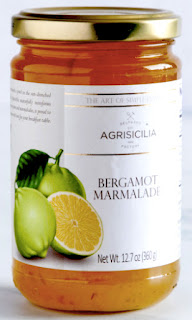
Earl Grey tea is characterized by a flavor called “bergamot,” which comes from a citrus fruit called the bergamot. In Nose Dive: A Field Guide to the World's Smells, author Harold McGee describes this fruit as "a cross between lemon and sour orange." McGee cites several uses for the flavor derived from the bergamot in perfume and in food flavorings.

There’s a commonly held belief that this exotic member of the citrus family was named for the town of Bergamo in Italy. (I was in Bergamo once, after a red-eye flight from the US to the Milan airport, which is not far from Bergamo, so I've always been a bit curious about the fruit and its name.)

McGee explains the real origin of the name Bergamot, which is even more exotic than the incorrect attribution to the little town of Bergamo:
"The fruit's unusual name apparently comes not from the Italian city Bergamo, but from the resemblance of its slightly elongated shape to that of another highly regarded fruit, the bergamot pear, whose name came from the Turkish beg-ármûdi "the prince's pear." It may have arisen somewhere in the Mediterranean and is now produced mainly in the southern Italian region of Calabria. The whole fruit is sometimes made into a fragrant marmalade." (p. 326)

I am finding McGee's book very interesting, though challenging to read. I have read about half of it, and will no doubt find a few more obscure things to mention in my blog as I continue. I may never feel confident enough to write a review of the entire book! 

 Blog post © 2022 mae sander.

Sunday, February 06, 2022

At the Art Museum

The year of the tiger started this week, and here’s a lovely tiger headrest from the
Chinese collection at the University of Michigan Museum of Art. 


This is Lady Ma, a Chinese courtesan and artist
from the 1500s. I love the details of this silk tapestry.

She is carrying a porcelain tea set,

 
I wonder what the little sweets piled on a dish tasted like.

Is this bird a pet? Or just some type of symbol?


The museum rotunda.

A special exhibit that we only saw briefly.
We hope to return and see it carefully.

The museum lawn.

This the first time in two years that we have visited our local museum, which was closed for over a year, though it's now been open for 6 months. Guests must wear masks, though there’s a maskless coffee shop -- which we did not visit. Because of the tea set, I plan to share this post with the Tuesday tea party at Elizabeth’s blog.

  
Blog post and photos © 2022 mae sander.


Saturday, February 05, 2022

What I did while the snow was falling or not falling

My cart at Trader Joe's: note the delicious jelly candy along with healthy lettuce and tofu.

Monday of this week the weather reports threatened us with a terrible storm, expected Wednesday. I decided to go to Trader Joe's and stock up my kitchen before the crowds that always descend on all shopping venues one day in advance of a big snowfall. There were plenty of other shoppers (almost all masked) but not overwhelming numbers, and the shelves had everything I wanted. 

The quite well-stocked produce and dairy shelves at TJ's.

I think the markets really did get crowded on Tuesday, but as the weather was still clear, we finally (after many months) went to the appliance store and ordered a replacement for our over-the-range microwave oven, which stopped working exactly a year ago. As soon as I had shopped, we started eating the goodies from TJ's.

Lunch Tuesday: strawberries and yogurt from Trader Joe's.

Dinner Tuesday: mushroom pancakes testing out my new griddle.
It works perfectly!

Wednesday was the scheduled storm. Indeed, in its wake the the snow and wind left many people across the South and the Midwest stranded and without electricity, but we had only a modest amount of snow and it was no big deal. 

Frost on our window: it's really rather cold outside!

Thursday we acted as if we were shut in, but that was in fact our own choice. All week, I spent most of the time reading, and writing blog reviews of the books I read: Tucci's Taste was the most exciting. Friday, I started reading Nose Dive by Harold McGee. It's a challenging book full of chemistry diagrams, but I'm persisting.

Friday the new microwave installation took place. In our house, any installation is fraught with uncertainty, but this time there were no obstacles. (We hired our favorite contractor, not the installer sent by the appliance store!)

The new microwave oven, installed.

Saturday morning we tested the new microwave by making oatmeal. Yay! It works. A year ago, when we bought a countertop microwave oven as a temporary replacement for the over-the-range one that stopped working, we did the same thing. The countertop oven was a space hog!

The space-hog countertop oven one year ago.

Back to normal: here's the freed-up space in use by the crock pot, making stock from a TJ's chicken.
The countertop oven occupied the space for a year. Today is a good day!

Blog post and all photos © 2021,2022,  mae sander.

Friday, February 04, 2022

Tucci's "Taste"

"The Muscoot was named after the reservoir it was adjacent to, one of many reservoirs in upstate New York that supply the drinking water for New York City. Built in the 1920s, it was a narrow, dilapidated shack of a building with a floor that sloped like a perpetually keeling ship. It was dark and dingy, with a battered wooden bar and about twenty checkered tablecloth–covered tables. Cold beer on tap, Miller High Life or the like, was served in scratched glass pitchers for about $2 each. Iceberg lettuce salads were served in those small flimsy 'wooden'  patchwork bowls that still grace tables in certain diners all over America. However, regardless of the crumbling surroundings and I believe a multitude of health violations, the place did a hearty business, because the thin-crust pizza was delicious. ... My family would go to the Muscoot maybe two or three times a year as a special treat, and besides a hamburger at the Mount Kisco Friendly’s after our annual doctor’s checkup, that was my experience of dining out." (Stanley Tucci, Taste: My Life Through Food, p. 50).


Stanley Tucci is an accomplished actor and director with a long list of movie and other acting credits. He also loves to eat and has written two cookbooks. His memoir, Taste, My Life Through Food, (published 2021) reflects this thought: "food was not just a huge part of my life; it basically was my life."  (p. 277). 

The book begins with descriptions of Tucci's Italian-American family and of the remarkable food prepared by his mother and grandparents, who gardened, bottled tomatoes, preserved other produce, raised chickens, went fishing in the polluted Hudson River, and more. Above all, they were very skilled cooks. Tucci's memories resemble those that have been shared by many Italian-American food writers, but he makes everything vivid by documenting just how his mother and grandmother made a number of dishes, and how his mother managed her home and family.  He also includes descriptions of his later domestic life and how he cooked and ate with his two wives (of whom the first died quite young) and many children.

Anyone who picks up this book will hope for some sort of description of what it's like to be a famous movie star. Tucci doesn't disappoint the reader. He drops lots of Hollywood stars' names -- and apologizes for it. He includes meals at lots of famous or just fabulous restaurants all over the world. But the best of the movie star description was about the catering operations that were put in place to feed the actors and workers on movie sets. The food supplied for these very high-profile people was for the most part terrible. While big budget films have big-budget high quality food available to the workers, Tucci writes less enthusiastically about the rest: 

"On most films there is one truck with a few beleaguered caterers doing their best with minimal funds to keep a cast and crew well fed and vaguely happy. The caterers, who are actually the first to arrive, at some ungodly hour, begin cooking two meals for a minimum of about fifty people every day. The quality of ingredients isn’t usually of the highest caliber, and their resources (and unfortunately often their talents) are stretched to the limit attempting to provide a variety of dishes every day for what could be up to an eight-week shoot." (pp. 160-161). 

As a lifelong fan of Julia Child -- and also of Norah Ephron -- I enjoyed reading about Tucci's feelings about playing Paul Child in the film Julie and Julia. His enthusiasm for this role connected to the fact that his mother had loved Julia Child's cooking shows on PBS, and he remembered watching them when he was a child. Besides his description of the film, Tucci also created a wonderful description of a meal at a small French restaurant in Deauville, Normandy, where he, Meryl Streep, and a few others made the extreme mistake of ordering the infamous French sausage called andouillettes. (If you don't know about this dish, you should read his description!)

The final chapters of Taste aren't as upbeat as the ones about his earlier life. A few years ago, Tucci was diagnosed with a very nasty cancer, and he had to undergo agonizing treatments that prevented him from eating, much less enjoying any food as he always did. The description is also agonizing to read, but very well presented. After relating this experience, Tucci also presented how he lived during the covid lockdowns in London, where he makes his home with his current wife and his children of various ages. Let's just say he didn't enjoy it any more than the rest of us did!

My next adventure, I hope, will be watching at least one more of Tucci's films. I loved Julie and Julia, and look forward to seeing Big Night, which somehow I missed although it's 25 years old. There are a few others that I also have missed, though I did like Tucci's role as Puck in A Midsummer Night's Dream.

Just for fun, and to give you an idea of how he writes, here's Tucci's list of what he ate on any given day when he was a teenager:

Breakfast: Two or three bowls of cereal with milk, Rice Krispies or similar; two pieces of toast with butter and jam or jelly (usually Welch’s grape jelly, which is really like sweet purple aspic); some orange juice.

"Lunch: Three peanut butter and jelly sandwiches on white bread, usually Wonder, or half a loaf of Italian bread filled with veal cutlets, eggplant parmigiana, or whatever was left over from the previous night’s dinner; a piece of fruit; a packaged store-bought sweet—Twinkies or the like. 

"After-school snack: One or two American cheese or Velveeta (is it still made legally?) sandwiches on white bread with mayonnaise, or three or four open-faced peanut butter sandwiches, often layered with sliced banana; a few glasses of milk; another packaged sweet; some fruit. 

"Dinner: Two or three bowls of pasta and three or four chicken or veal cutlets, or two pork chops, or two helpings of London broil (I have only ever seen this cut of beef in America. Never in London. I must find out where it got its moniker), or a lot of whatever other entrée my mother made; vegetables; green salad; dessert. 

"Late-night snack: Two of any of the aforementioned sandwiches, or a large bowl of leftover pasta, or any of the leftover entrées, probably sandwiched between two pieces of Italian bread." (p. 62-63)

It's a fun read. Thank you to all my fellow food-bloggers who recommended it.

Review © 2022 mae sander. 

Wednesday, February 02, 2022

Waiting for a Snow-Pocalypse. So far No-Pocalypse.

A terrible snow storm has been menacing us since last night,
but this morning at first light, it was only raining.

By early afternoon: a slight accumulation.
Remember, this is Michigan! We are ready for snow!

At dusk, there's still not a lot of snow compared to past years.
Our driveway has been shoveled and then snowed on a little more.

Maybe overnight we'll still get some real Michigan snow!
Not that I want it. But it seems wrong that so many things were
cancelled just for this. Even the groundhog in Howell, Michigan,
is waiting until Saturday to come out and make a prediction.

Photos © 2022 mae sander.


Tuesday, February 01, 2022

Conspicuous Consumption


Two Kindle books that I've been reading: 

  • Dress Codes: How the Laws of Fashion Made History by Richard Thompson Ford, published 2022. 
  • The Theory of the Leisure Class by Thorstein Veblen, first published 1899. 
Ford's book contains a marvelous number of specific examples about the way that modern fashion for both men and women emerged in around the 18th century, how it has evolved over the centuries, and how a variety of written and unwritten dress codes have tried to control clothing and fashion. Veblen's book, is lastingly famous and often cited; specifically, Ford often quotes Veblen's theories of conspicuous consumption and conspicuous waste.

Ford's detailed descriptions of how fashion has been used at various times is very interesting. There are some illustrations -- I would have liked to see more. Modern fashion, Ford shows, simultaneously developed from the modern idea of individualism:
"The idea that we are, above all else, individuals, with personalities that transcend our social status, occupation, and family heritage, is relatively new. Individualism emerged in the late Middle Ages and the Renaissance—alongside fashion." (Ford, p. 41).

Eventually, as Ford shows, people's use of sumptuous clothing to display social superiority, wealth, and inherited position no longer could be enforced by legal means -- so a different way to signal status emerged:

"Hence the eighteenth and nineteenth centuries saw the birth of a new sumptuary code that inverted the ancient values of the older ones: if the law could not deny luxury to upstarts and the nouveaux riches, then luxury alone would no longer be a sign of high status. From then on—and up to the present moment—a new reverse snobbery declared that too much opulence was a sign of poor taste and low breeding." (Ford, p. 102).  

When I was reading Veblen, I often thought of how his observations applied to the specific historic points made in Ford's book. For example, Veblen says:

"Throughout the entire evolution of conspicuous expenditure, whether of goods or of services or human life, runs the obvious implication that in order to effectually mend the consumer’s good fame it must be an expenditure of superfluities. In order to be reputable it must be wasteful. No merit would accrue from the consumption of the bare necessaries of life, except by comparison with the abjectly poor..." (Veblen, p. 32).  

Early in the 19th century, Ford explains, men gave up elaborate and highly decorative clothing along with wigs and many other accessories, which had been worn both by men and by women. Men alone adopted a more and more uniform way of dressing: specifically, the business suit and very strictly defined formal dress clothing. However, the ostentatious show of wealth through clothing, jewelry, hair dressing, etc. did not disappear, but "men only abandoned the cumbersome and increasingly obsolete symbolism of conspicuous ornamentation to women." (Ford, p. 109). 

Both Ford and Veblen describe how men's clothing created greater freedom of movement in the 19th century, while women's clothing developed in the opposite direction. Veblen, writing while women still wore skirts almost exclusively, wrote: "The substantial reason for our tenacious attachment to the skirt is just this: it is expensive and it hampers the wearer at every turn and incapacitates her for all useful exertion." (p. 56). 

The origins of fashion in the 19th century are very interesting, but even more so is Ford's description of the many uses of fashion in the 20th century, particularly in the defining of political and social change groups in the 1960s and more recently. For example, he describes the 1960s Radical Chic and Black Power movements: 

"Black Power challenged the unstated norms and practices that benefited whites at the expense of Blacks. Black Power sought self-sufficient Black-controlled institutions organized around ideals and values developed by, and suitable for, Black people. Fashion and aesthetics were an important part of the Black Power agenda, a priority reflected in the slogan 'Black is Beautiful.' ... For this younger generation of activists, pride—or lack thereof—in one’s appearance was far from trivial; it was among the most profound political issues facing the Black community." (pp. 182-184).

Ford also points out that "dress and dress codes have been a surprisingly important part of the struggle for racial justice," and talks about the choice of the early civil rights demonstrators to wear their best and most conformist clothing when participating in marches or sit-ins. Through this choice, they commanded the respect of the witnesses to their struggle and their demands for fair treatment. (p. 211).

In the author's own very recent experience, conforming to expectations at interviews for jobs or college can be an important way that non-traditional students can make a good impression -- he writes:

"Even when an interviewer has the best of inclusive and egalitarian motivations, small transgressions of style can affect an all-important impression. What are my obligations as an educator and mentor to these students? ... Most of our students at Stanford grew up surrounded by professionals—they don’t need instruction on professional norms. But we leave the few who might need it—those from 'underprivileged backgrounds' and 'underrepresented groups' who we congratulate ourselves for recruiting and admitting—to work out a lifetime’s worth of knowledge on their own." (Ford, pp. 210-211).

Dress Codes contains a very large collection of wonderful historic and contemporary examples of groups and individuals who have created their own dress styles, and who have influenced the changes in fashion over time -- or not. For example, he explores the societal meaning of the red-soled shoes that by law can be produced only by one high-priced manufacturer. In contrast, his discussion of the politics of style in regard to Islamic women's headscarf decisions is a deep study of how clothing becomes fraught with many and maybe not consistent meanings: "Its significance was a matter of context and perspective: it could be a defiant stance against Islamophobia or a symptom of a religious fundamentalism; an escape from sexual objectification or a moral fetish for religious misogynists; a matter of free individual choice or of overwhelming social pressure." (Ford, p. 284). 

Very high-status tech workers and similar successful men, Ford points out, can violate otherwise mostly observed norms while less privileged people can't. He observes that "a Black man in a hoodie and jeans is more likely to be treated like Trayvon Martin than like Mark Zuckerberg." (p. 326). Ford also discusses the ambiguity of the term "cultural appropriation," as applied to clothing and other fashion choices, in a very insightful way.

Ford's book is so rich in detail that I really can't do it justice. Let me quote the last sentence: "Even by renouncing clothing, one can’t escape the defining power of dress codes." (p. 374). 

Veblen's lasting classic work is full of very memorable statements about consumption, waste, and human economic attitudes and behavior -- in many areas, not limited to clothing and fashion. Here's one Veblen observation that seems to have become even more true after 12 decades: "The thief or swindler who has gained great wealth by his delinquency has a better chance than the small thief of escaping the rigorous penalty of the law; and some good repute accrues to him from his increased wealth and from his spending the irregularly acquired possessions in a seemly manner. A well-bred expenditure of his booty especially appeals with great effect to persons of a cultivated sense of the proprieties, and goes far to mitigate the sense of moral turpitude with which his dereliction is viewed by them." (p. 38).

I enjoyed reading these two books, and I enjoyed the way that they reinforce each other through many insights that they both offer.

Blog pos © 2022 mae sander for mae food dot blog spot dot com.

Monday, January 31, 2022

January Cooking and Reflections on Food Issues

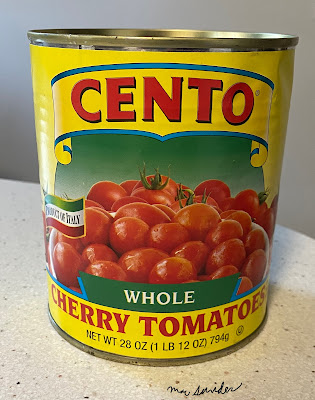
A can of cherry tomatoes.
In my kitchen (and in my overflow shelves in the basement) I have been keeping a lot of canned goods. The new wave of the pandemic caused by the omicron strain has forced us back into a narrowed-down lifestyle. For the past month, I've been confining myself to less supermarket shopping, and trying to keep my pantry well-stocked. Although shortages this time are erratic and temporary, I'm nervous about shopping in person -- what if I can't even go to Costco and Trader Joe's? During the worst of the pandemic in 2020, I resorted to ordering canned goods from amazon.com -- the cherry tomatoes are among the last of the panicky amazon purchases.

This blog post about my kitchen and kitchen thoughts will be shared with a group of bloggers who contribute their own kitchen thoughts to Sherry's blog event each month (http://sherryspickings.blogspot.com/). 

Now for what I did with a can of cherry tomatoes:

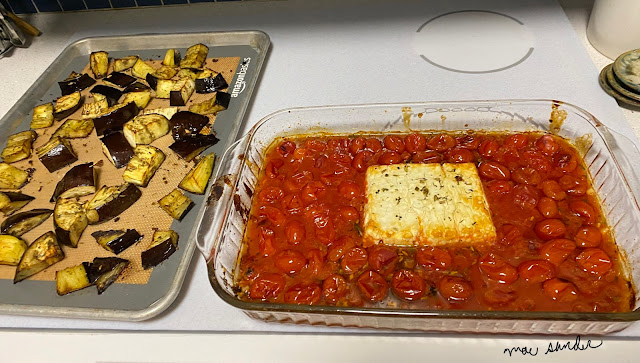
Last year, a TikTok fad was baking feta cheese with spices and cherry tomatoes.
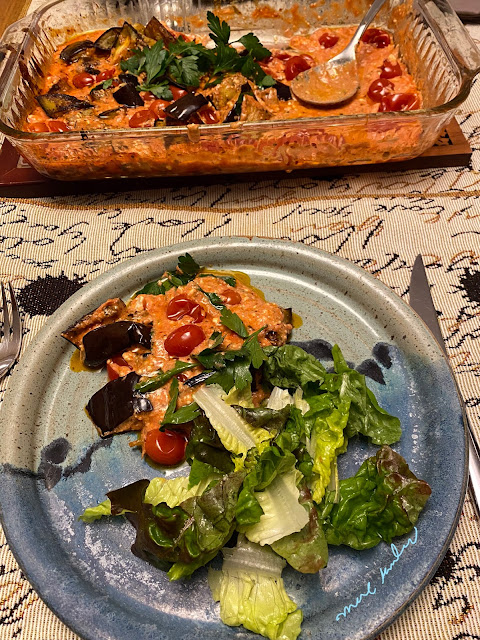
It was good (despite the faddishness). Here it is again. In the same oven, I made a tray of roasted eggplant.

I combined the eggplant with the tomato-feta sauce. The leftovers were reheated with pasta.

I cooked many other dishes in January, including both old favorites and new experiments. Most of these dishes, along with my new cookbooks and food reading, have already appeared in my earlier blog posts this month. As we decided in mid-2020, we continue to eat much less meat than we did before the pandemic, and to try new plant-based recipes. 

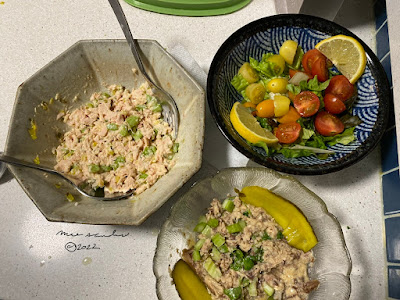
Old favorites: sardine salad, tuna salad, lettuce & tomato salad.

New in my Kitchen: A Replacement Griddle


I haven't used my new griddle yet. This is the advertising photo of it.
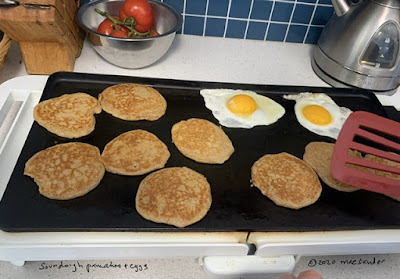
My old griddle gave up the ghost after many years of pancake making.

I wish I could claim to consider the impact my choices have on the environment when I shop for new kitchen items, but this is almost impossible. Environmentally responsible products are a dream that's hard to fulfill. The difficult facts:
"There are very few things you can purchase that are actively beneficial for the climate. Unless you’re buying a tree that will suck carbon from the air, most products require land, water and fossil fuels to produce and use. New stuff — clothes, appliances, bath products, toys, etc. — inherently comes at some environmental cost. ... In many situations, the 'greenest' product you can buy is … nothing" (The Washington Post, 2020)

 Obviously, the best choice is to keep using what I already have — if it keeps working!


The old griddle in use. It blew a fuse and no longer heated up.
Otherwise I would have used it forever.

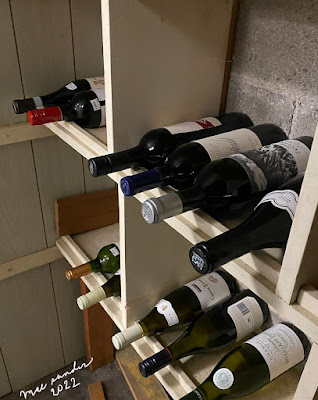
Our Wine Cellar

Although it's in the basement, our wine is part of our kitchen, and wine shopping is part of our weekly grocery expeditions. I'm including this photo especially to send to Elizabeth's blog and her readers who share images of beverages each week.


The Rest of the World

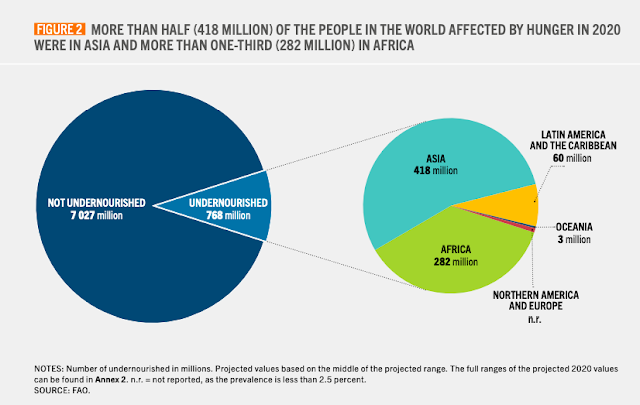
I'm aware of how lucky I am to have a well-stocked kitchen and plenty of food sources with all kinds of choices. In this context, I'm also concerned about the rest of the world outside my little isolated bubble. Statistically, the pandemic, beginning in 2020, contributed to a significant increase in the number of people on the planet who are affected by hunger. A UNICEF report estimates that there are 768 million undernourished people in the world. 


This diagram, from a UNICEF report, presents the worldwide distribution of hunger: most of the suffering is in Asia, Africa, and Latin America. Source: The State of Food Security and Nutrition in the World 2021. Transforming food systems for food security, improved nutrition and affordable healthy diets for all. (Rome, FAO. https://doi.org/10.4060/cb4474en)

That's not to say that hunger is confined to the third world. Is our own country -- my country, America -- doing enough for those who suffer from food insecurity? According to Feeding America, the USDA counts "more than 38 million people, including 12 million children" who are food insecure. I want to reflect on this as I look back on what's in my own kitchen this month, and how fortunate we are. In a recent write-up of the 50th anniversary of the book Diet for a Small Planet by Frances Moore Lappé, writer Marion Nestle quoted this passage:

But I have learned that hunger can exist anywhere, within any society that has not accepted the fundamental responsibility of providing for the basic needs of its most vulnerable members—those unable to meet their own needs. And ours, sadly, is such a society.  I found myself feeling ashamed when I learned that other societies with which we might compare ourselves—France, Sweden, West Germany—demonstrate by their welfare programs that they do accept this social responsibility. In a recent study of social benefits to needy families with children in eight major industrial countries, the United States ranked among the lowest. (p. 101).

Nestle writes: "She could have written this yesterday." (source: Weekend reading: Diet for a Small Planet at 50; Nestle's blog, Food Politics, also directed me to the UNICEF article.)

Blog post and photos © 2020, 2022 mae sander.