Monday, January 28, 2013

Eighteenth-Century French Kitchens

Kitchen Maid Peeling Turnips by Chardin, 1740
I'm reading A Revolution in Taste: The Rise of French Cuisine by Susan Pinkard. Among many interesting ideas in the book, I was interested to learn of the genre paintings of kitchen scenes by Jean-Baptiste-Simeon Chardin, which I found here. I love the way that Chardin depicts humble women and their workspace. Chardin's art, writes Pinkard, "came to be admired not only for its verisimiltude but also for its authenticity, that is, the trueness of the subject to itself." (p. 183)

Another Kitchen Maid by Chardin
Woman Drawing Water from an Urn by Chardin
The revolution in taste that the book describes appears cyclical. Cuisine in France became more and more elaborate for a while, and then cooks and discerning eaters would rediscover the taste of fresh seasonal produce, more basic ingredients, and simpler dishes. Sometimes of course these dishes were deceptively simple, requiring hours in the kitchen to produce what seemed to be a plain slice of meat with a glaze on it.

The characteristics of cooking that was modern in the 17th century at times seem to have been discovered anew in the 20th century. "A skillful modern cook achieved variety not through fanciful invention, exotic seasonings, or complex combinations -- paths that had been well trodden by his medieval predecessors -- but by subtly highlighting the elemental properties of raw materials," writes Pinkard. "By the 1650s, proponents of delicate cooking  had evolved a series of techniques and novel recipes -- including a new class of silky sauces that were emulsified with butter, cream, or egg yolk or thickened with roux -- that were intended to highlight the goût naturel of carefully chosen principal ingredients." (p. 64)

Health and taste were both motives in the development of 17th and 18th century cuisine in France; some of the prescriptions also sound as if they were reinvented in the 20th century. One practitioner suggested reducing consumption of meats and alcohol while increasing "vegetables, grains, dairy products, and mineral water." If that didn't make one feel healthy, he suggested "lowering" diets "that sequentially eliminated meats and fish, and then eggs, fruits, and vegetables." Eventually one might end up eating only milk and "seeds such as oatmeal, rice, and sago." (p. 167)


I've also been reading The Expert Cook in Enlightenment France by Sean Takats. The book covers the same era, but concentrates on the responsibilities, the life, the environment, and the reputation of cooks. Most of the cooks worked in private kitchens, as public dining was in its earliest stages at the time. Their pay could be very high -- the cook was often the best-paid employee of the house. They not only cooked but they were responsible for elaborate purchasing of all the food and material for the kitchen. They had to be expert at account-keeping to inform their masters where the large sums of money were going. Many cooks had to be aware of new trends in cooking and theories of health and cleanliness.

The chapter on kitchens was especially interesting. One debate about kitchens at the time was where they should be located. Kitchens were feared; fumes from charcoal stoves and noxious smells from foods that had gone off were clearly dangerous. However, even if a large home or chateau had space, if the kitchen was too far from the dining room the food would arrive cold and extra servants would be required for carrying and serving it.

The Salad Maker by Etienne Jeaurat 1752
The author mentioned the painter Jeaurat's depiction of a salad maker -- L'Eplucheuse de Salade, above -- as showing some of the furnishings and equipment in an 18th century kitchen. Cooking equipment involved a large number of tin-lined copper pots, as well as various strainers, ladles, and equipment for cooking on the kitchen hearth as well as on the charcoal-burning stove that was typical. However, cooks in private homes didn't own any of the elaborate and expensive equipment that they needed to prepare the wide variety of foods that were expected. "A single copper cooking vessel could cost the equivalent of several days of a cook's wages." (p. 70)

On the death of the head of a household, cooks and other staff lost their jobs and the kitchen tools were often sold at an estate sale. Obviously, the records of these sales are now valuable as primary sources, as are the newspaper ads and other notices in which cooks sought new employers.

Saturday, January 26, 2013

Tu B'Shevat

jwc 1
Fruit and Wine for Tu B'Shevat Celebration
Saturday is Tu B’Shevat, a Jewish holiday that honors trees, especially fruit trees. Although it's in the depth of our winter, it falls in the earliest part of spring in Israel. In antiquity, this was the traditional time to plant trees. Modern celebrations for Tu B'Shevat include eating a wide variety of fruits and nuts, especially the “seven species” – wheat, barley, olives, dates, pomegranates, figs, and grapes (for eating and for wine). Each of these items has many special associations and symbolic meanings in rituals, Jewish literature, and Biblical lore.

Although the exciting parts of the menu for Tu B’Shevat rituals are the delicious fruits, especially those that grow on the trees, the holiday expands to celebrate barley and wheat as well. I find the history of grains and how they were eaten in Biblical times to be a very interesting subject. Wheat wasn’t just ground into flour for bread or fermented into beer, but was eaten as a kind of whole-grain or wheatberry pilaf; some wheat could even be eaten raw right from the fields before it became too hard. 

Freekeh is a middle eastern dish that offers a way to understand what the ancients did. It's made from fresh, green wheat berries. Recently in food articles I've seen some references to it, and I think it has appeared on menus at trendy restaurants. According to an article in this week's L.A. Times freekeh “in Aramaic means ‘the rubbed one,’ a reference to rubbing off the roasted husk to reveal the grain, still green because it has to be harvested when young.”

The cookbook Jerusalem by Ottolenghi and Tamimi gives two recipes using either a whole or a cracked form of freekeh: spicy freekeh soup with meatballs (p. 148) and poached chicken with sweet spiced freekeh (p. 182). The authors write: "We use it for making pilafs, in salads, and for serving with lamb or chicken... . Its earthy flavor and slightly coarse texture go particularly well with sweet spices."

An article in Gastronomica “Roasting Green Wheat in Galilee” describes a few Arab farmers in Israel who still harvest and prepare unripe wheat, which they call farike. Their methods are much the same as  in ancient times. Timing is essential – “there is a short interval of a few weeks during which the mature wheat, though still green, is soft and full of starches and protein. This is the only moment at which the wheat can be eaten fresh from the stalk, and the time when farike can be prepared.”

The article explains the connection to Biblical tradition: “Roasted grain (kali in Hebrew) is mentioned several times in the Old Testament. It appears in the list of foods that Isaac commands his sons to bring to their brother Joseph in Egypt, and it is the love offering that Boaz extends to Ruth as they rest on the threshing floor. Different English translations of the Bible refer to roasted grain as ‘parched corn’ (corn being a British term for grain) or ‘parched grain,’ yet in Arabic biblical translations the term that is used is farike.”

Wheat berries from mature wheat are available at farmers’ markets and various stores; however, the pilaf that I have made from them is probably quite different from the interesting and historically relevant dish described in these articles. Some time, I’ll have to try one of the many recent freekeh recipes.

Grains both ripe and green were important nutritionally and culturally in the past; references to bread in Biblical passages show how central it was to the ancient diet. Tu B'Shevat makes us aware that the tree fruits of Israel 2000 years ago and more were also central and also much loved for their tastes and aromas. Centuries before sugar arrived in the Middle East, date honey – a sweetener extracted from dates -- was an important internationally traded commodity. Cleopatra Queen of Egypt demanded to own the orchards near the Dead Sea that produced the best dates and date honey in the Roman world. Having one's own "vine and fig tree" was a symbol of peace and security. And in modern times, citrus orchards became one of the keys to the economic success of the state of Israel.

jwc 2
More fruit for Tu B' Shevat -- also bright green olives
Earlier this week, I attended an event to learn more about Tu B’Shevat, including how to prepare some traditional and modern foods, such as date-oatmeal bars, platters of dried fruits, and decorative arrangements of totally non-biblical fruit such as chocolate-covered strawberries, pineapple, and blueberries. Our hostess for the evening says that her preferred tree fruit to eat for the holiday is carob -- another Biblical species though not in the traditional list of seven. I knew little of this holiday until one of our visits to Israel in the 1990s, when we went to a secular Israeli celebration with similar platters of dried fruits and arrangements of fresh produce. I’m delighted to think of the numerous meanings and possibilities of the celebration of trees.

Thursday, January 24, 2013

Right-Side Out Cookies

miriam1921
Right-Side Out Cookies

Alice and I baked these cookies during her visit last week. She suggested that we make "Inside Out" cookies. We found a Betty Crocker recipe on the web but we changed it a little -- here it is as we made it:

Right-Side Out Cookies

INGREDIENTS

1 cup sugar
3/4 cup packed brown sugar
1 & 1/4 cup butter or margarine, softened
1 teaspoon vanilla
2 eggs
2 & 1/2 cups all-purpose flour
1/2 cup Hershey's cocoa
1 teaspoon baking soda
1/4 teaspoon salt
1 & 1/2 cups white or chocolate baking chips OR 54 Hershey Kisses
1 cup chopped nuts (we used pecans)

METHOD
  1. Heat oven to 350ºF. Measure and mix together the flour, soda, cocoa, and salt.
  2. Cream sugars, butter, vanilla and eggs in large bowl of mixer until smooth. Slowly add dry ingredient mixture. Add the chips (if you are using them) and the nuts.
  3. Drop dough by rounded teaspoonfuls about 2 inches apart onto ungreased cookie sheet, leaving room for the cookies to spread out. If using kisses, unwrap them and press one into each cookie.
  4. Bake 10 to 12 minutes or until set. Cool slightly; remove from cookie sheet. Cool on wire rack. Makes 54 cookies.

Napkin Folding


Miriam folded the napkins into beautiful flowers for a dinner last weekend. Alice set the table. The menu included Ellen and Alec's Texas Red. Also some refried black beans (a separate dish -- is this ok?) and salad.

Wednesday, January 16, 2013

Jerusalem, Continued

Ingredients for stuffed eggplant
The completed eggplant
Butternut squash spread with tahini
Miriam ready to eat Israeli food

I am continuing the attempt to make a number of recipes from my new cookbook -- Evelyn, Tom, Miriam and Alice arrived this evening and I had several dishes all ready. I'll post the recipes I made today when I have more time. For earlier posts about this ongoing project see:

Sunday, January 13, 2013

Ottolenghi Inspired


If you were surprised a couple days ago to learn that I carefully followed three entire recipes from my new cookbook, so was I. (For details, see my last post, Jerusalem: A Cookbook, in which I described how I made authors Ottolenghi and Tamimi's recipe for spiced carrots, Pilpelchuma pepper and garlic spice blend for the carrots, and chicken with fennel and tangerines.) I continued reading this cookbook, and today during a visit to Barnes and Noble I even looked through Ottolenghi's other cookbook, Plenty, a vegetarian cookbook -- lots of recipes for eggplant, salads, and grains. He's quite an inspiring recipe author.

Tonight for dinner, I intended to make even more recipes from Jerusalem. I thought I was ready. I ended up just taking some inspiration and following my own ideas, however. I expected that this would happen eventually but didn't realize it would be so quick. I have reasons.

First of all, I had bought some lamb chops, which I thought would be a good choice for middle eastern food. As it happens, all of the lamb recipes in Jerusalem are for lamb meatballs or similar dishes using ground or minced lamb, not whole chops. So I had to improvise, and use some of the Pilpelchuma as a rub, adding a bit of lemon juice and rosemary. I braised them with a bit of really good red wine that Lenny got out of the wine cellar.

Second, I planned to make roast potatoes with prunes -- a delicious-sounding recipe which Ottolenghi says is inspired by the Ashkenazi dish tzimmes. Oops, I waited too long and there wasn't enough time to boil then roast potatoes and to make caramel as the recipe calls for. If I'm in a hurry caramel is too scary since it can burn up if you so much as look the other way at the wrong moment or have some bad result if you mess up when adding the ice water to it. Please, Mr. O, could I be a coward and just use honey? Oh, never mind, I want to try the real recipes.

Tonight, though, I just made mashed potatoes, using the microwave to cook them in their jackets and then mashing them while the lamb simmered. Instead of using prunes with the potatoes, I put them in the pan with the braised lamb chops. The result was actually quite delicious. Pipelchuma is quite a nice spice rub, and the prunes were a nice taste contrast with the meat and potatoes. The photo shows how I put the potatoes on a platter surrounded by chops, prunes, and sauce. Inspired, I felt.

I definitely plan to select, shop for ingredients, and try other recipes in detail. I mean it. Honest.


Friday, January 11, 2013

Jerusalem: A Cookbook


Yotam Ottolenghi, an Israeli Jew, and Sami Tamimi, an Israeli Arab, work together at Ottolenghi’s restaurant in London. Their recently-published cookbook presents the foods of their native city: Jerusalem. They describe the era of their childhood as a much more peacful and harmonious time than the present, and hope for peace which they think might come through a shared love of hummus. I wish they would prove to be right.

The book is beautiful. Abundant photos illustrate a variety of Jerusalem city scenes, restaurant interiors just as I remember them from past trips, and totally appetizing recipe presentations. Narratives about the foods and the relationships (often troubled) between the many communities mingle with the recipes.

One recipe particularly appealed to me because its ingredients are so perfect for a winter dinner in the frozen north -- though thanks to a perturbed upper atmosphere, Jerusalem has received far more snow this year than my home Ann Arbor, Michigan. I made the recipe this afternoon, and we ate it for dinner -- fresh fennel, clementines, and chicken marinated and roasted with a delicious sauce. Anise-flavored liqueur and fennel seeds, along with the chicken and produce, emphasize the flavor of the fresh fennel bulbs. The recipe calls for Arak, an anise liqueur made in Beiruit, Lebanon; or Ouzo, the Greek version; or Pernod an anise-flavored French apéritif. I chose Pernod.


Here’s the chicken recipe as I made it.

Ottolenghi and Tamimi’s Roasted Chicken with Clementines

Ingredients

6.5 Tbsp (100 ml) Pernod
4 Tbsp olive oil
3 Tbsp freshly squeezed orange juice
3 Tbsp freshly squeezed lemon juice
2 Tbsp mustard (I used Dijon, orig. calls for mustard with seeds)
3 Tbsp brown sugar
2.5 tsp salt
1.5 tsp fresh-ground black pepper
2 medium fennel bulbs (1 lb) trimmed & cut in 6 to 8 wedges
1 chicken cut in 8 to 10 pieces
4 clementines (skin included) cut in ¼ inch slices
1 Tbsp thyme leaves
2.5 tsp fennel seeds, lightly crushed

Chopped flat-leaf parsley as a garnish

Method

Mix first eight ingredients together. Whisk well to make marinade.

In large bowl place marinade and all other ingredients except parsley garnish. Combine well with your hands. Optional: marinate for several hours or overnight. I did so for around 4 hours.

Preheat oven to 475 degrees F. Place chicken skin-side up and all other ingredients in a single layer in a large roasting pan (around 12 by 14.5 inches).  Place in preheated oven and roast for 35 minutes. At this point, my chicken was cooked through but pale -- to obtain the color shown in the book’s photo, I put it under the broiler for another 5 minutes to get really brown.

Remove chicken, fruit, and vegetables from pan to a serving dish, and boil down the sauce a bit. I put the sauce in a separate serving bowl from the chicken, though the recipe says just pour it over the chicken. Garnish with parsley.

Side Dishes


I tried a couple of other recipes from the cookbook for tonight’s dinner as well. I made a spicy carrot dish, which I believe I once ate in a restaurant in Tel Aviv where our cousin Janet took us. It contains carrots (serendipity: I was making stock from the chicken trimmings so I cooked the carrots in the stock), fried onion, sugar, cider vinegar, and a spice blend called Pilpelchuma (recipe in the condiment section). The carrots are served with arugula.


I also served some cucumbers with Greek yogurt sprinkled with some newly-bought zaatar spice blend, and I put out some mixed Mediterranean olives since I have never been to an Israeli restaurant that didn’t serve some olives.

I just love this cookbook!

Tuesday, January 08, 2013

Hooray for Ellen and Alec!


Dinner tonight: Alec and Ellen's Award-Winning Chili, made according to their recipe, using their special Texas chili seasoning mix. I'm so glad to have more of this great spice blend. As shown in the photo, I also made cornbread (using a New York Times recipe) and a salad of avocado and grapefruit sections from TEXAS grapefruits.

I followed the recipe carefully -- it makes enough for 8 or 10 servings, but I only warmed up enough for the two of us. As instructed I did not put any beans in it!

Link to first post on Texas Red: http://maefood.blogspot.com/2006/11/texas-red.html

Tuesday, December 25, 2012

And later, a movie...


Jay and Ruby


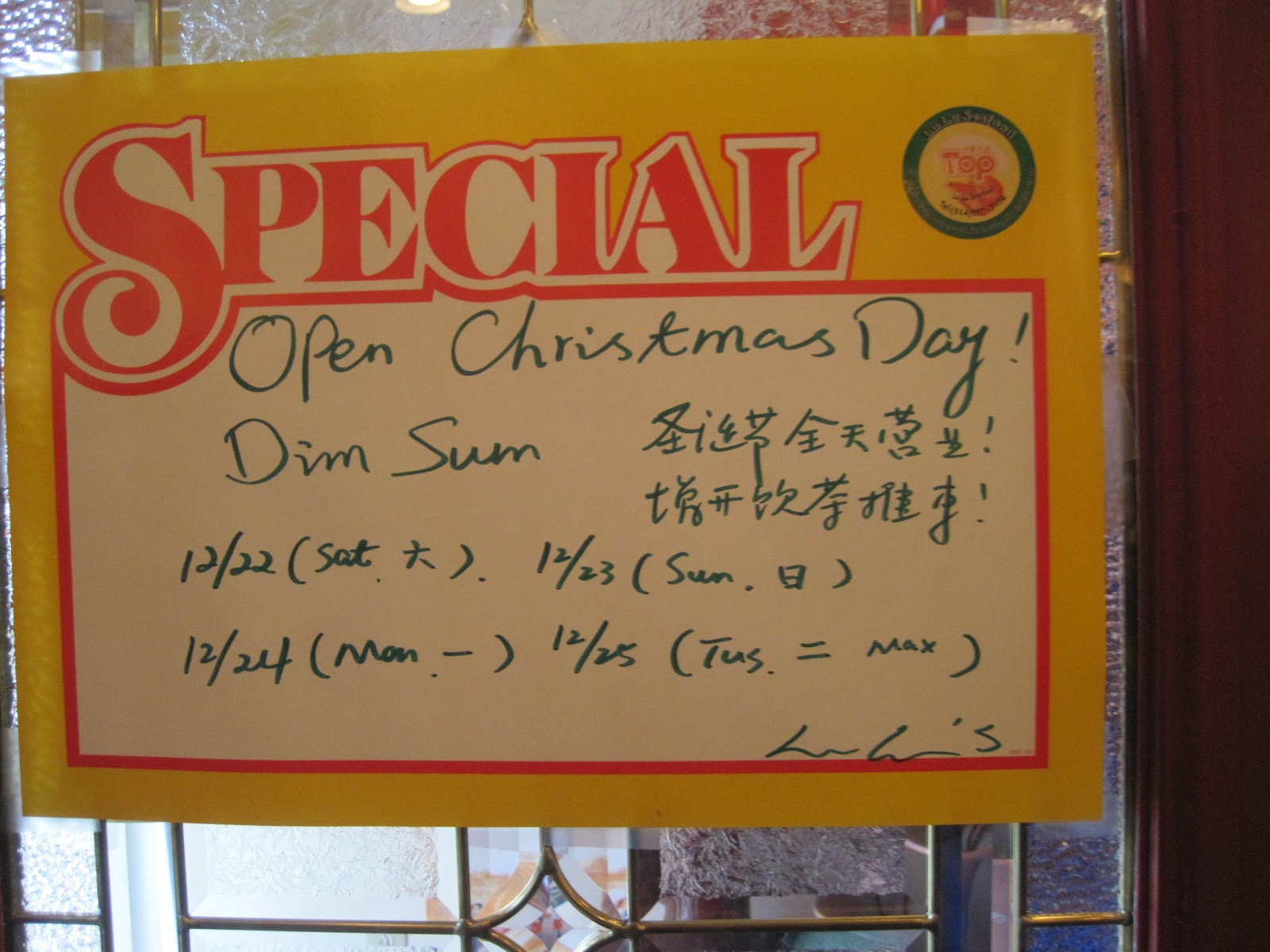
Other things we selected from the dim-sum carts: potstickers, pork buns, almond and mango pudding, three kinds of shrimp dumplings, red-cooked pork, cucumbers in vinegar, sticky rice. Things we wished we could have eaten too: greens, chicken feet, lots of other kinds of dumplings...


LuLu's Chinese seafood restaurant near Olivette, Mo. Note that the dragon's eye is a Christmas light.

Sunday, December 16, 2012

Tequila!

I am reading Tequila! A Natural and Cultural History by Ana G. Valenzuela-Zapata and Gary Paul Nabhan. Science and poetic description combine beautifully as the author describes the taxonomy of the agave plant used in the beverage, its long history beginning in prehistoric Mexico, and the lives and traditions of the Mexican agricultural workers who plant, cultivate, and harvest the agave crop. Valenzuela-Zapata describes their hard physical labor and the taxing heat and aridity of the fields, the simple meals they cook and eat while working, and their "quixotic" oral tradition.

"Mescaleros are forever spinning yarns about mescal -- the plant and the spirit -- while working in fields or resting in the nearby shade, and while jiving on the street corner or drinking in the cantina on the village plaza," writes the author. "They keep up their running commentary while bolting for cover during a sudden downpour, or cursing the sun as it bakes the plants they have tended for seasons." (p. 31)

The labor continues in the distilleries where huge harvested "pinas" are roasted and their liquid fermented, possibly with sugar, into a variety of tequilas. The lore continues, backward and forward in time, in many traditions of eating and drinking the fruit of this very widespread plant.

Two images kept recurring in  my mind. One was of a worker taking care of huge agave plants at Lotus Land, an eccentric botanical garden in Santa Barbara that I visited in 2003; you can see the large pine-cone-like agave bulb similar to that used to make tequila:


The second image is of Mayahuel, Aztec goddess of agave, mentioned at various points in the book:


I'm looking forward to a lively discussion of the book in my culinary book club next week.

Saturday, November 24, 2012

Turkey Sushi


For lunch, we couldn't go out for sushi since we still had a lot of turkey and other leftovers from Thanksgiving dinner. So I made Thanksgiving sushi, as illustrated above. Then we got in the car and drove from Lafayette to Ann Arbor where we are safely home. We have no leftovers here so maybe we'll have fish sushi or some other not so Thanksgiving-y dinner.

Friday, November 23, 2012

Fresh Eggs


The whitish green eggs are from a hen named Jello and the brown eggs are from a hen named Marguerite. Jello and Marguerite and another hen all live in the back yard of our neighbors, who gave us these wonderful eggs. We brought them along for our Thanksgiving visit to Lafayette.

When I cracked them open, I could see how fresh they looked:


I made them into a tortilla espanola, that is, a potato omelet.


We have eaten it all! We are thankful to our neighbors for the lovely eggs.

Thursday, November 22, 2012

Dinner!


Turkey, cranberry sauce, plum chutney, and several vegetables


Ready to eat...


Apple pie, chocolate pie, cranberry bread


Our turkey centerpiece

Vector Field with Garlic


Thanksgiving Underway

By the time we arrived here in West Lafayette, the turkey was in the oven and almost everything ready to cook for Thanksgiving dinner, which will be later this afternoon. Also, Elaine had lunch all ready for us. What luxury!

After lunch, she recruited Len and Larry to make some roast vegetables on the grill outside. It's over 60 degrees -- perfect for a bit of outdoor cooking:


Delia was doing a little cooking in a frisbee before actually playing frisbee or jumping rope with Joel:


Vegetables cooking

Wednesday, November 21, 2012

More Thanksgiving Math

From the incomparable mathemusician Vi Hart, here is another video. She now has 4 Thanksgiving videos, and a Halloween video with a sierpinski gasket made from 6 bags of (triangular) candy corn.


Thanksgiving Mathematics

Saturday, November 17, 2012

The End of the Twinkie

I had my last Twinkie a couple of years ago for Twinkie Day -- April of 2010. The funny thing, I wrote then, is that I remember thinking they were new when I first ate them as an elementary school child. That was long after 1930 when they were invented. Actually, I liked them. So after twinkieless years, I bought a package of 10 individually wrapped Twinkies. Despite the mile-long list of industrial ingredients, it tasted pretty good (the second helping, not so much).

And now there will be no more Twinkies. The newspapers are full of reports on the final dissolution of Hostess Brands -- the Washington Post even wrote an obituary: "A eulogy for the humble Hostess Twinkie." People are stocking up on them, though the recipe and process may be sold as part of the defunct corporation's assets, and thus the Twinkie may rise again.

I read a book about Twinkies once. Here's a selection from my report, also from 2010:

Twinkie, Deconstructed: My Journey to Discover How the Ingredients Found in Processed Foods Are Grown, Mined (Yes, Mined), and Manipulated into What America Eats

"Twinkies' buttery flavor provides the richness we expect from cake and likely also helps to mask their oiliness. Since due to cost and rancidity issues there's no room in a packaged cake like Twinkies for fresh butter, artificial butter is the answer. ... The most surprising thing about it is that it really stinks." In fact, we learn, many flavor chemicals smell "positively awful." Even natural flavors like vanilla have so many different flavor elements that some of them have unappealing notes, at least to some people.

"Memory is also important to taste.... When we eat a favorite snack cake, we expect it to taste exactly as we remember from last time, or from childhood." And we expect it to feel the same. In Twinkie Deconstructed, author Steve Ettlinger provides an ingredient-by-ingredient analysis of just how Twinkies are put together: the flavors of sugar, vanilla, and butter; the texture of filling and cake; and the way the cake stays dry and the filling stays creamy. I sort of reacted to this when I took a bite of the Twinkie, but I could also detect some of the chemical notes in its composition.

In all Ettlinger counted 39 ingredients listed on the package of Twinkies a few years ago. He points out that the recipe subtly changes over time -- my Twinkie box was indeed just a bit different, but of course sugary-buttery cake and creamy vanilla filling predominate. Two of the three main flavors, vanilla and butter, are present only in artificial form, and another expected component, eggs, is mainly there as artificial stabilizers, with maybe 1/500 of a real egg in each Twinkie.

I decided to buy a copy of Twinkie Deconstructed when I celebrated Twinkie Day as I described above. I found the book quite fascinating. I liked the description of each ingredient's function in creating taste or texture in the baking process, the history of the product or the story of its invention, and the descriptions of how each one is made.

In his quest to deconstruct the Twinkie, the author visited the manufacturing plants where most of them are milled, refined, mined (yes, chemical leavening comes from mines), assembled or derived (mostly from petroleum), and often secretly manufactured (as in the case of vitamins). His sense of panic when deep down in a soda mine was especially memorable. His text lists of other processed foods that use each of the components, especially the artificial ones. Even flour, the least processed ingredient, is a pretty highly processed substance. Did you know that some of the fat in Twinkies is from beef? Me neither. Wow!

Friday, November 09, 2012

Calder's Fork


In the Los Angeles Times Today: "Alexander Calder's fanciful kitchen utensils" -- he'd make them for his wife when she needed something. I'm a big fan of his fanciful wire and metal objects, such as portraits and his circus. I wonder if I can find the book, Calder at Home, that these images are from.

Wednesday, November 07, 2012

Franz Werfel: The Forty Days of Musa Dagh


“The most horrible thing that had been done was not that a whole people had been exterminated, but that a whole people, God’s children, had been dehumanized.” – The Forty Days of Musa Dagh, 2012 edition, p. 727)

I found The Forty Days of Musa Dagh – which I had never before read in any form -- amazing in a number of ways. I devoured the dense, nearly 900 page novel in just a few days, unable to put it down. I read the newly-published translation of Franz Werfel’s 1933 masterpiece, which includes about 25% more narrative than the previous English version.

I should write a long review, including some research into Werfel himself, but right now I only want to cover a few generalities about the wonderful quality of the book.

First, I admired Werfel’s research into the 1915 massacre of Armenians by the Turks. I think the history of these events was already being suppressed by the late 1920s when Werfel began writing. His description of the ragged, starving, perishing Armenian masses of men, women, and children from the village of Zeitun was vivid. His descriptions of the Turkish authorities and their rationale for the genocide (not yet given a name) were overwhelming.

The day-by-day description of the people of seven Armenian villages near the Syrian coast who hid in the woods on the mountain Musa Dagh and resisted the deportation to nowhere being inflicted by the Turks is powerfully drawn. Each episode is based on true stories, particularly the survival of a few thousand villagers on Musa Dagh and their rescue by French troop ships.

Werfel maintained a remarkable balance between descriptions of collective suffering and of individual agony, so that the reader’s consciousness is drawn in both directions. He occasionally mentions acts of mercy by non-Armenians, but clearly shows that the moral bankruptcy of the Turkish leaders (quite a few directly taken from history) corrupted the common people, who are mostly depicted as looting and then resettling the villages whose inhabitants have been forced out. Also corrupted: the military, civil, and police authorities who directly deprived the Armenians of life and property.

On the political side, I kept thinking: how could Werfel write a Holocaust analogy before the Holocaust began? But I know the tragic answer: he was trying to warn of the terrible future that somehow he saw so clearly. Although he clearly admires the German Pastor Johannes Lepsius, another of the historical characters depicted in the book, he had no illusions about the meaning of the events to the mainstream German observers. While Lepsius begs everyone who will listen to act to save the Armenians, almost no one will listen to him; what aid he musters is too little too late. My very sad reaction to Werfel’s attempted warning was that the main learners who took a lesson from the massacre of the Armenians were the Nazis, not the humanitarians and not any future victims.

On the novelistic side, I was also impressed by the author’s choice of central characters, the French-educated Gabriel Bagradian. While the history is powerful, I thin Werfel keeps the reader’s attention through the depiction of Bagradian, his family, his determination to save his fellow Armenians, and his close relationships. Bagradian’s conflicts between his self-interest and his loyalty to his people, his developing identity from identification with France and Europe to embracing of an Armenian identity, his developing leadership in military and political affairs, and his tragic ending create a perfect story against which Werfel presents the historical themes.