Showing posts with label Nobelist writers. Show all posts

Sunday, January 11, 2026

On the Weekend

 Brunch at Alice’s Apartment


Dinner at Home


Pork chops and snow peas with mushrooms.


Recent Reading Failures

I’m finding it hard to follow this book, which varies from one location, from one
set of characters, from one mindset, and then switches to another place, time, person, scene.
When I began reading Tokarcuk’s Flights, it was a relief to read well-formed sentences
and well-thought-out phrases, no stupid analogies (see next book)!
But then I bogged down and only read half.

Free book from amazon.com. It stinks. Bad writing, bad characterization, 
bad in every way. I tried hard but only read around 30%,

And a hoped-for reading success…

An insanely long book (over 700 pages), but maybe I’ll read it all.

Blog post © 2026 mae sander

Tuesday, December 30, 2025

Iceland


The overpowering theme of this book by the only Icelandic Nobelist — Halldor K. Laxness — is hunger. It’s a hunger that modern readers have almost surely never experienced. Especially in spring (a season of hunger for farming people everywhere that’s been forgotten by people like us) the lack of fresh food or perhaps the lack of any food is unimaginable. The food that was put away in the fall (or the money put away to buy food) may not last until the first produce of spring comes in. 

In Independent People, the entire focus is on one sheep-raising family who are trying to make a living from a farm in the wilds of Iceland. Sheep are their livelihood and their obsession. The author describes their spring expectations:

“They would feel reasonably sure of surviving the winter, and of getting enough rye meal, refuse fish, and coffee to rear the kids on, those at least that didn’t die (the others were forgotten), always provided that they restricted themselves to the customary one meal a day in the spring.” (p. 17)

The central character, Bjartur of Summerhouses, lives in this extremely isolated area some time in the early 20th century, beginning before the First World War and continuing until shortly afterwards. Bjartur is a semi-secret poet and his verses are part of the novel. He seems naive in many ways.

His story, in brief: his first wife dies, he remarries, several children are born, and some other people live with the family on the farm. They always seems isolated by the distance from the isolated farm to the small settlement nearby, the incredible distance to Reykjavik (where none of them have ever visited), and the unimaginable distance to the wider world, which hardly seems to them even to exist. Eventually, they are made rich by the war and its need for the local resources, and then made poor by the aftermath when their products were no longer demanded by the wider world.

Bjartur has a number of fixed ideas that vary between comic and tragic. 

“You should beware of believing things you see in books. I never regard books as the truth, and least of all the Bible, because there’s no check on what they can write in them.” (p. 64)

In a recent introduction to the English edition of Independent People, here is a summary of this character: “Bjartur is for me one of the great twentieth-century literary characters—one of the immortals, like Humbert Humbert or Jay Gatz/Gatsby or Gregor Samsa or the four Makioka sisters. He is petty-minded and heroic; brutal and poetic; cynical and childlike.” (p. xvii) I don’t agree with this comparison, but I’m including it because it’s probably more standard than my own views.

Bjartur isn’t the only character in the novel whose desperate poverty and eccentric views define him — here’s a description of one of the others, a Bailiff:

“His trousers were so worn that the original cloth no longer held the patches and was giving way at the stitches. Turned up over the bottoms was a pair of yellowish socks, undyed, and the down-at-heel horsehide shoes on his feet lent support to the theory that he was newly returned from a thoroughgoing inspection of the stables, stronger testimony being provided by the smell. In clothing and general appearance Bjarter of Summerhouses was far superior to this tramp-like Bailiff.” (p. 104) 

Also, a description of Bjartur’s second wife: 

“She would go drooping off home just before nine to boil the fish, but very often she could not get the fire to draw. She brought him his fish, rye bread, and coffee out to the meadow. ‘There’s no need to be stingy with that muck,’ he said of the sugar, for he always spoke slightingly of sweet things.” (p. 38) 

And a description of some of his fellow farmers and craftsmen:

“New men on the croft, famous master builders who turfed the ewe-house walls in such a fashion that the courses took on a herring-bone pattern; a journeyman carpenter with foot-rule, pencil, and saw, mental arithmetic in his eye; the fresh scent of shavings blending with the smell of autumn’s mud and rain; boisterous conversation at meal-times, fragrant snuff, poetry, merchants and co-operative societies, sheep, sheep again, interesting information from irrelevant quarters, unknown phrases, brawls, sweet coffee.“ (p. 239) 

The novel Independent People is one of those sagas of the early 20th century that now seems to develop with painful slowness. Characters die. Children grow up and try to understand the world around them. Life is hard, and from their earliest years they all have to work in terrible conditions, sometimes with their clothing soaked and freezing, sometimes when they are too tired to continue, etc. etc. The character sketches vary between irony (even satire) and sympathy. Their concerns are sometimes taken seriously and sometimes — I think — viewed as primitive or even childish. It’s not a book that satisfies current tastes any more, and I wouldn’t recommend reading it except for historical curiosity, as it’s extremely long, repetitive, and overburdened with descriptions.

Birds and Sheep

A pair of phalaropes we saw in Svalbard, another island in the far North.

Birds are everywhere in the landscape of this novel, and I was fascinated by the author’s descriptions of them. Though I did not see the specific birds on my trip to Iceland, I did see many in Norway. Of the many species named, I especially like hearing of the phalarope:

“On every pool of the river there was a phalarope to make her a bow; no bird in all the marshes is so courtly in its demeanour on Midsummer Eve.” (p. 193)

“Soon the marshes would be green and humming with life the same as they were last year, with the phalarope preening itself in courtesy on the surface of the deep pools. And the little waterfall up in the mountain would be flowing backward in the sunny breeze.“ (p. 246)

Of course there’s also constant mention of the sheep.  


These sheep we saw on Runde, an island in Norway,
 but the landscape is comparable to that in Iceland.


Some photos of Iceland that I thought about when reading:

From our trip to Iceland in 2021.


Blog post and photos © 2021, 2025 mae sander

Monday, August 14, 2023

Yasunari Kawabata: Repost from 2009

For a long time, I have been fascinated by Japanese film and literature. This month, I have been rewatching and rereading some of the classics, and also trying some that are new to me. I also wanted to look back at some past choices that I've written about. The following post, from August 4, 2009, describes a book by Yasunari Kawabata (1899-1972). Thousand Cranes was originally published in serial form from 1949-1951, in book form in Japanese in 1952, and in English translation in 1958. Kawabata became Japan's first Nobel-prize winner in literature in 1968.

The Tea Ceremony

Yasunari Kawabata's Thousand Cranes takes place in Japan soon after World War II. The central character is a 25 year old man whose late father was a collector of rare old tea ceremony objects and a practitioner of the traditional tea ceremony. Quite a few of the key scenes take place in the now-mildewing tea-ceremony cottage in the family garden, and the collected objects play a major role in this psychological drama.

The focus of the book is the young man's relationship with his father's two mistresses and the daughter of one of them. An unnamed maid and another young woman are the only other characters in the book: it's almost like a stage play with only a very small cast.

Several times, there is an enactment of the tea ceremony or some part of it, at a critical emotional point. Water boils. A tear falls on the iron kettle. The choice of rare and special water vessels, tea bowls, and decorative objects creates atmosphere and they become symbols to the characters and to the story. Sometimes a meal is served.

Nothing, basically, is ever said about the characters' tasting the tea, eating the food, or even noticing what food is being served. The tea ceremony is all about ritual and proper behavior. The way it affects the characters is important in the drama of their interaction and their individual problems. However, I find it very telling that the actual content of the tea vessels is not part of this drama, as I believe it would be in an actual tea ceremony. Savoring the tea is listed in documentary books as part of the ritual -- personally I find the tea at tea ceremonies unbearably bitter, and couldn't appreciate it.

I'm not able to tell if this lack of sensual participation or tasting the small snacks or the meal of tea time would be a meaningful symbol for a Japanese reader. It may be too late to know this, as the traditions described in the book are much rarer now than they were 50 years ago when the action took place.

Copyright © mae sander 2009

Tuesday, July 11, 2023

Annie Ernaux: La Place


My goal for this week was to read a work by Annie Ernaux (born 1940) in the original French. I picked La Place, a rather short memoir of her father's life. Reading it was not as hard as I had feared, though I did look up quite a few words in the online translation tool Deepl.com. Ernaux wrote La Place in 1982-1983, looking back at her father's life from his birth in 1899 until his death in 1967. The English translation, which I did not read, is titled A Man's Place. Ernaux won the Nobel Prize for literature in 2022.

Respect for her father is the principal theme of Ernaux’s narrative. She begins with a description of his death, and then tells his history in chronological order, starting with a review of the life of his father, who worked as a farm laborer and never learned to read. As a youth, her father was in a semi-military boys’ school/camp in World War I. He was always a working man, at first as a laborer and later in his life a small businessman. 

Above all, she presents her father’s life without sentimentality or maukishness. In writing about him, she also develops her own story in relation to him: she develops the contrast between her father and herself with clarity and a light touch. Born during the start of the fighting, as her parents were fleeing the battle front, she was a “child of the war” who survived despite the privations during Nazi occupation. Later, she was a successful student in the local schools in the small town where they lived, and went on to higher education and success as a teacher and later as a writer. Her father was in some ways uncomprehending of her academic success, though also very proud. In the same way as it began, this short book ends with her father’s death, at the time when the author was just beginning her career as a school teacher. 

In the 1980s when she wrote this piece Ernaux wasn't yet a world-famous author, but she had already published at least three books which were well-recieved. This is only the second of her books that I have read, and I find it interesting and readable. I think the engagement of a writer in the events of her life as depicted in this memoir represents an original type of literature, though I believe it has had a variety of imitators. I am often puzzled by the selection process of the Nobel committee, which is in fact quite controversial, and I can’t say I have a clue why this one was chosen for the prize last year, unless the author’s political activism was an influence, which is always possible.

Review © 2023 mae sander for maefood.blogspot.com
Shared with Paris in July


Saturday, June 03, 2023

Annie Ernaux Buys Groceries

"Here, existing together on three levels, are all the shops and payable services that a given population is likely to need: a supercenter, fashion boutiques, hair salons, a medical center and pharmacies, a daycare center, fast food restaurants, cigarette-magazine-newspaper vendors, etc. There are free restrooms, and wheelchairs on loan.  (Annie Ernaux, Look at the Lights, My Love, p. 10).  

"In the world of the superstore and the free-market economy, loving children means buying them as many things as possible." (p. 21). 

Annie Ernaux won the Nobel Prize for literature in 2022, so of course her minor works are quickly being translated into English. Look at the Lights, My Love is a very short piece of 60 pages, published as a stand-alone kindle book (at full kindle price, by the way). It's a diary of her trips to the superstore, a huge supermarket with much more merchandise than most American supermarkets. She made the observations during the span of roughly a year. When I purchased this book  (at full kindle price, by the way), I was expecting something more but I blame myself for not paying enough attention and then being disappointed. 

I enjoyed one scene where another shopper recognized her as a famous author:

"At the checkout, where quite a few people are waiting, a customer with a wheeled shopping basket offers me her spot. As I vigorously decline (do I look that tired? that old?), she smiles and says she knows my writing. We converse about the store, about the children, plentiful on Wednesdays. Placing my items on the conveyer belt, I think a little uneasily that she is going to look at what I’ve bought. Every item suddenly takes on loaded meaning, reveals my lifestyle. A bottle of champagne, two bottles of wine, fresh milk and organic Emmental, crustless sandwich bread, Sveltesse yogurt, kibble for spayed and neutered cats, English ginger jam. It is my turn to be observed, I am an object. (p. 46).

Even though Ernaux also writes a bit about the parking lot, the book store, the newsstand, and a few other peripheral businesses, this is actually a book about groceries and above all, about her fellow shoppers. It acknowledges that both poor and rich people need groceries, and shop at this store. It mentions that clothing sold in the clothing department included garments made at the sweat shop in India where a large number of people died in a major accident during the time she was journaling her visits there. It comments about the advertising posters throughout the store, for example, one that the claimed a portion of meat was less than 100 grams; she notes that this wouldn't be very satisfying, but would end up being rather expensive for a limited budget. 

A few mentions of famous French writers were amusing:

"I don’t see Alain Robbe-Grillet, Nathalie Sarraute, or Françoise Sagan doing their shopping in a superstore; Georges Perec yes, but I may be wrong about that." (p. 35). 
 
"Nothing has changed since Émile Zola’s The Ladies’ Paradise; women are always the primary—consenting?—targets of commerce." (p. 51). 

I've read a lot of books about grocery stores in the US, but never one like this which is entirely personal experiences. It's interesting but not especially original, profound, or political. I guess. I think I need to read something else to understand why this author won the Nobel.

Review © 2023 mae sander 


Wednesday, February 01, 2023

"The Books of Jacob"


Olga Tokarczuk won the Nobel Prize, and her novel, The Books of Jacob, was mentioned by the prize committee as one of her great accomplishments. The subject of this historical novel is the Jewish “Messiah” Jacob Frank, who lived from 1726 to 1791. It’s a wide-ranging novel, almost 1000 pages long, with an enormous number of vividly presented characters of many ethnicities, especially Jews. A large number of these characters change their names part way through the book, adding to the challenge of reading. 

Also challenging to read: the main characters constantly travel to a large number of places in Poland and the Ottoman Empire of that time, and meet many political leaders. Maybe I’m wrong, but I wonder if this is another politically motivated Nobel prize winner, as evidently some of the Polish authorities would prefer not to be reminded about Jewish history in Poland.

Most of the events in this novel are realistic, but there are also examples of supernatural occurrences, such as Jacob Frank's head emitting a mysterious light, or various characters who can predict the future. Throughout the novel we hear of a woman named Yente, a relative of the characters in Frank's life; Yente has swallowed an amulet that gives her eternal life and the ability to float over the landscape and see it from above. As she lives longer and longer, watching her descendants and their associates, her undead body somehow moves to a cave where she remains until she's joined there in 1942 by Jews fleeing the Holocaust. 

The historic Jacob Frank was acclaimed as a Messiah; he attracted many followers, and was seen as a successor to the earlier failed Jewish Messiah Sabbatai Tzvi (1626-1676). Both Tzvi and Frank had outsize influence among the Jewish communities in Europe — this part of history is little known. Under Frank's influence many Jews repudiated traditional Jewish rituals and laws, and converted to the Catholic faith in a set of events that has remained rather obscure. Actually, both Polish and Jewish history are somewhat obscure areas of European history. Historians that dealt with Frank and his Messianic claims (to the best of my knowledge) have mainly been Jewish scholars specializing in Jewish history. This makes this fictional treatment quite unusual!

Here’s the subtitle, encompassing the multiplicity of plots and locales:

The style of writing in this long narrative is like a fable. It reminds me of Grimm's Fairy Tales or other 19th century folk stories, a bit simple. This simplicity is deceptive: it's a long tough read with many plot lines. The wide-ranging lives of the characters takes place in mostly unfamiliar towns and cities of Poland and the Ottomans, in an atmosphere that seems alien from modernity, but the author does occasionally remind us that despite the distant setting, it’s the age of Benjamin Franklin, Mozart, Moses Mendelssohn, and in general the Enlightenment. The author also reminds us that the settings are very exotic, and includes many vivid descriptions of bazaars, rich fabrics, and colorful and unusual clothing.

Mainly, it’s a novel of the details of the lives of Jacob Frank, his followers, and some others — their love lives and marriages, how they earn money and how they lose it, the food they eat when rich and when poor -- there's lots of food described in mouth-watering detail! The book depicts experiences of hardships and the times of wealth reflected by where they live and revealed by choices of clothing that show their status as well as their religion. It documents the religious fervor that gripped these followers, and how they agreed to Jacob’s demand for their  mass conversion from their traditional Jewish religion to the Catholic religion. The converts tried to adjust to being mainstream Christians instead of marginal Jews, a conflicted and complex social effort that only succeeded with the next generation.

The reviewer in the Guardian offers this summary:

"The Books of Jacob by the Nobel laureate Olga Tokarczuk is an epic chronicle of the life and times of Frank and his followers. Over a thousand pages long, dense with history and incident, it is vast enough to make this reader’s knees buckle. As crowded as a Bruegel painting, it moves from mud-bound Galician villages to Greek monasteries, 18th-century Warsaw, Brno, Vienna and the luxurious surroundings of the Habsburg court. It takes in esoteric theological arguments, diplomatic history, alchemy, Kabbalah, Polish antisemitism and the philosophical roots of the Enlightenment. It is a dauntingly ambitious piece of work and one of the responses it arouses is just plain amazement at the patience and tenacity that have gone into its construction." (source)
 

A Comet Foretells the Future 

A comet was in the sky during one year of the novel’s timeframe: very frightening to people back then.
Right now, February 2023, a comet is in the sky: my brother took this photo of it.
A comet, I think, is longer seen as an omen.

About the comet that "appeared in the sky on March 13, 1759" in the town of Ivanie where Frank and his followers were living:

"The comet resembles a scythe aimed at humanity, a naked glistening blade that might slice off millions of heads at any moment, and not only the ones on the craned necks in Ivanie, but also city dwellers’ heads, Lwów heads, Kraków heads—even royal heads. There is no doubt it is a sign of the end of the world, a harbinger of angels rolling up the whole show like a rug." (p. 492 [counting backwards]). 
 

I'm Probably Wrong but...

One of my impressions of the novel is very uncomfortable. I think the subtext is that Judaism is somehow incorrect or misguided. Here's one example: the pages count down: the first page is numbered 965 and the last page number is 1. Purportedly this is because the author's view is that Hebrew books are written backwards. Of course, Hebrew is written from right to left and Hebrew books have the spine to the right: this is simply different from books written in the Roman alphabet. Making the pages of a Polish book (or English translation) go “backwards” seems to me meant to show that Hebrew is somehow wrong. 

In the afterward, the author's explanation is this: "The alternative numbering of the pages in this book is a nod to books written in Hebrew, as well as a reminder that every order, every system, is simply a matter of what you’ve gotten used to." (p. 5 [counting backwards from 965]).

Throughout this long-winded and rambling book, I felt that the underlying attitude was that the Jews and their religion were aberrant. This is despite many comparisons of Jews and non-Jews as being similar in both wealth and poverty; for example: "On the street, women in tattered rags gather dung and wood shavings for fuel. It would be hard to say, based on their rags, whether this is a Jewish poverty, or Eastern Orthodox, or Catholic. Poverty is nondenominational and has no national identity. (p. 954 [counting backwards]). 

A particular area that worries me is that many passages in the novel dwell at length on the blood libel, the story that Jews require the blood of Christian children for their rituals. As you may know, throughout history, this story was repeated often as a way to ignite violence against Jews, or to make excuses for killing Jewish leaders or expelling Jewish communities from their homes. Repeatedly, the author introduces the "proof" that the Jews were guilty of this crime, though modern scholars of all persuasions see it as an excuse for persecution, without foundation, and without documented cases. Though the "proofs" are always stated by characters in the book, the net result is distasteful and harmful, as the author must have known. 

The official view of the church about a particular such event in the town of Å»ytomierz was ignored by the Polish priests and by the people. And it's less powerful in the context of the book than the descriptions of claimed Jewish crime. Officially, the church view, as given in the text, is that "the Holy Office, after a thorough examination of the question of the accusations of the use of Christian blood in Å»ytomierz and the alleged ritual murder, asserts that the same are utterly without foundation. And that all further accusations of this kind are to be dismissed, as the letting of Christian blood has no basis in the Jewish religion, nor in the Jewish tradition." (p. 270 [counting down]).

So difficult! What reviewers said:

The Guardian reviewer says: 

"The reader’s task is to deduce a higher order out of the patchwork of scenes and fragments. It does require patience – and I’m not sure that I would recommend newcomers to Tokarczuk’s work start here. But The Books of Jacob, which is so demanding and yet has so much to say about the issues that rack our times, will be a landmark in the life of any reader with the appetite to tackle it." (source)

The New York Times reviewer has many admiring paragraphs about the novel; but in conclusion says:

"Yet the characters remain at a distance. ‘The Books of Jacob’ rarely touches the emotions. No page, for me, turned itself. A word from 'Finnegans Wake' came to mind: thunderslog
 
"I don’t mean to dissuade. As with certain operas, I’m glad to have had the experience — and equally glad that it’s over." (source)

The Washington Post reviewer says:

"In terms of its scope and ambition, 'The Books of Jacob' is beyond anything else I’ve ever read. ...What can explain the willingness of people to dedicate their lives, their fortunes, their souls to leaders who lead them astray? Tokarczuk lets the branching narratives of this novel respond to that perennial conundrum. 'The truth is like a gnarled tree,' she writes, 'made up of many layers that are twisted all around each other.' In that sense, 'The Books of Jacob' is a whole forest of such trees — haunting and irresistible." (source)

And a bookish character in The Books of Jacob says:

“'Literature is a particular type of knowledge, it is'—he sought the right words, and suddenly a phrase came ready to his lips—'the perfection of imprecise forms.'” (pp. 15-14 [counting backwards]). 

Review © 2023 mae sander.

Tuesday, December 14, 2021

The Buddenbrooks Family Christmas Celebration

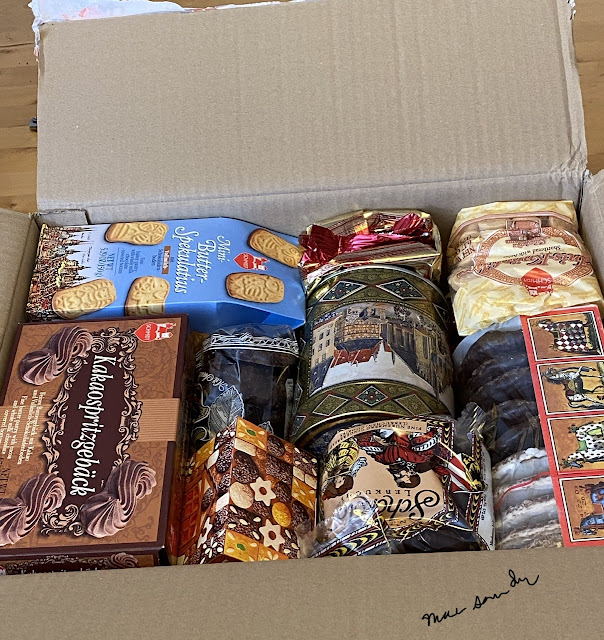
Gingerbread -- Lebkuchen -- was served at the family Christmas dinner in the novel Buddenbrooks.
In the picture you can see the Lebkuchen ready for the holidays at Evelyn and Tom's house this year.

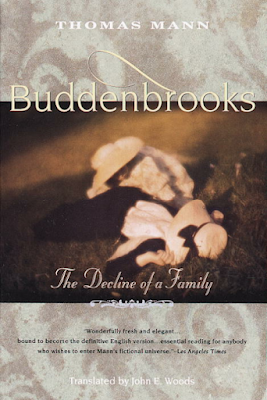
Buddenbrooks: The Decline of a Family was published in 1901 by the now-famous author Thomas Mann; soon after publication it became a sensation. Mann's 1929 Nobel Prize for literature cited it as a major accomplishment. Obviously, whatever I have to say about it has probably already been said! Therefore, I've decided to offer some quotations about the time that the Buddenbrooks family was still prosperous and confident. 

Specifically, the novel included a very long description of the family Christmas celebration in approximately 1870. Because many American Christmas traditions originated in Germany, reading about the family Christmas dinner is fun as well as appropriate for sharing this month. The Buddenbrooks' celebration started early in December. The youngest child, Johann, only son of Thomas Buddenbrook the head of the family awaited Christmas eagerly:

"With a pounding heart Johann counted the days, tearing them off one by one from the Advent calender Ida had made for him, until the day of days would arrive—the page with a Christmas tree on it. There were more and more signs of its coming. On the first day of Advent, a colorful, life-size picture of St. Nicholas was hung on the wall in Grandmama’s dining room." (p. 514). 

Soon after, an old man dressed as Saint Nicholas comes to the door. Johann must say the Lord's Prayer to  convince Saint Nicholas that he is a good boy. As a reward, he is allowed to reach into the sack that's for good children, and he receives gifts. As December advances, the weather becomes colder, and mysteries appear throughout the house and in the town:

"The doors to the grand salon were kept closed, guarding mysteries; marzipan and gingerbread appeared on the table. And it was Christmas out on the streets, too. Snow fell, it turned cold, and the sharp, clear air was full of the cheerful and melancholy melodies of black-mustached organ-grinders, Italians who had come to town dressed in velvet jackets for the holidays. Dazzling Christmas displays appeared in the shop windows. And the gay, colorful booths of the Christmas fair had been set up around the tall Gothic fountain on the market square. Wherever you went, you could smell the sweet fragrance of fir trees being sold for the holiday." (p. 515).

Gift giving and family meals continue through December 23 and Christmas Eve. Poor families come to the door for gifts, the employees of the family firm are given treats and presents, and before the family Buddenbrooks' dinner, choirboys from the local church sing carols for them. As they prepare to dine, a family member reads the Christmas story aloud. Four generations gather around a candle-lit tree in the very much decorated dining room and sing "O Tannenbaum." Then they open their lavish gifts, and finally their servants (about whom they don't think very much) serve sweets followed by a magnificent meal.

"Mamselle Severin and the housemaid now moved about the room with refreshments, and Hanno found time to look about him as he sat dunking a cookie in his tea. Chatting and laughing, people stood beside the table or walked up and down alongside it, showing off their own gifts or admiring those of others. There were objects of every sort—made of porcelain, nickel, silver and gold, of wood, silk, and linen. On the table was a long row of gingerbread cakes, glazed and sprinkled with almonds, alternating with loaves of marzipan bread, so fresh they were still moist inside. The presents that Frau Permaneder had wrapped or decorated—a needlework bag, a doily to put under a potted plant, a hassock—were trimmed with large satin bows." (p. 523)

"Since they had all eaten lunch earlier than usual today, they consumed large amounts of cookies and tea. But no sooner had they finished than a large crystal bowl filled with a yellow, grainy puree was passed around: almond crème, a mixture of eggs, ground almonds, and rosewater. It tasted quite wonderful, but one spoonful too much and you ended up with the most awful stomach ache. Nevertheless, even though Madame Buddenbrook begged them 'to leave a little corner for dinner,' they helped themselves freely. And Klothilde performed miracles. In grateful silence, she spooned up almond crème as if it were porridge. And now came little glasses of sabayon to refresh their palates—served with English plum cake...."

"As always on Christmas Eve, the table had been set in the columned hall. Madame Buddenbrook said the traditional grace with great fervor: 'Come, Lord Jesus, be our guest and bless what Thou hast given us.' As always on Christmas Eve, she concluded with a little admonition, the primary thrust of which was that on this holy night they should remember all those who were not as fortunate as the Buddenbrook family. And once this was taken care of, they sat down with a good conscience to a lengthy meal, which began with carp in drawn butter and a vintage Rhenish wine. 

"The senator slipped a few of the fish scales into his wallet so that it would not lack for money throughout the coming year.... The turkey, stuffed with chestnuts, raisins, and apples, was praised by all. Comparisons were made with birds of years past, and it was concluded that this was the largest in a long time. There were roast potatoes, plus two kinds of vegetables and two kinds of stewed fruit, the bowls heaped so full that each looked like a hearty filling main course, rather than a side dish. They drank vintage red wine ...."

"Little Johann sat between his parents and managed to force down a piece of white meat and some dressing. He certainly could not eat as much as Aunt Thilda, and he felt tired and a little queasy. But all the same, he was proud that he was allowed to dine with the adults, proud that one of those tasty buns strewn with poppyseed had been placed on his napkin, too, and that there were three wine glasses set at his place, whereas normally he drank from the little gold beaker that Uncle Kröger had given him at his christening. But then, when Uncle Justus began pouring some oily, yellow Greek wine in the smallest glasses and the iced meringues appeared—red, white, and brown—his appetite returned. He ate a red one, although it hurt his teeth something awful, and then half of a white, and had to sample at least a little of the brown one, filled with chocolate ice cream. He nibbled on a little waffle, too, and sipped at the sweet wine while he listened to Uncle Christian, who was talking now. ..."

"Before the last course of butter and cheese was served, old Madame Buddenbrook used the opportunity for another little speech. Even though not everything had turned out over the years quite the way one, out of shortsightedness, might have wished, she said, nevertheless there still remained such manifold and obvious blessings that their hearts should be filled with gratitude." (p. 525-530) 


Thomas Mann's ponderous novel is charming, but full of tragedy and human folly. His depiction of the merchant class of the Germany of the mid-19th century (that is, before he was born in 1875) was not always sympathetic, and he clearly questions their values and their lack of appreciation for education, the arts, music, and literature. But Mann's gift for visualizing the faces, expressions, inner and outer lives, and even clothing, houses, streets, and home furnishings in that time is irresistible. 

Blog post © 2021 mae sander.


Saturday, September 11, 2021

Dr. Faustus


Thomas Mann's famous novel Dr. Faustus, published in German in 1947, is usually described as the story of Adrian Leverkühn, a German composer of great genius, who sells his soul to the devil in exchange for 24 years of brilliant musical production. Adrian, born in 1885, was a near-contemporary of Mann (1875-1955), and his life paralleled the dramatic events of the early twentieth century. Sometimes the novel is described as an allegory of the fall of German culture, an allegory of the Nazi project and its downfall, or as a critique of German bourgeois life, but that's oversimplifying, in my opinion.

The narrator of Dr. Faustus is Adrian's childhood friend, Serenus Zeitblom, a modest man who presents himself as a simple biographer, putting together the important facts of his famous friend's life and work. Serenus often says "this is not a novel," but of course it's a novel! And the reader has to try to understand both characters: the narrator and his subject, to see what Thomas Mann was doing. Serenus isn't exactly an unreliable narrator -- maybe he's too reliable, too detailed, too apologetic and self-effacing, too insistent on his unworthiness. But in any case, it's a novel about two men, not a biography of one man.

Narrator Serenus, who lived in Germany, began his biographical task after Adrian's death in 1940, and his writing takes place during the worst times of World War II. He is highly aware of the significance of the advancing armies that are conquering Germany as he is writing. His narrative dwells constantly on German choices, German responsibility, and German shame: his word. He's humiliated at the failure of German culture: and German culture is a major theme of his narrative. It's not evident that Adrian was particularly aware of these events, and in any case Adrian's conscious life ended in the early 1930s. As a result there's a kind of tension between the political consciousness in the two intellectual lives intertwined in the novel.

Many features of Adrian's life and work are of great interest to Serenus. In particular, the novel includes very detailed information about Adrian's musical theories and his compositions. At one point, music is described as a kind of direct link to thought and mind, a kind of pure abstraction. Obviously, the book can't include actual music that the reader can hear. Thus, the music in the novel really is mental only, though it has been identified with the 12-tone works of contemporary composers, particularly Arnold Schoenberg. Most of Adrian's music is vocal music, including settings of poems by famous German poets, operas and oratorios based on Shakespeare's work, and the like. These textual references also help to bring the non-existent music to life.

Just half-way through the novel, there's a long chapter detailing Adrian's encounter with the devil. The devil is a very vivid character who radiates penetrating cold and speaks in a very eerie way. This chapter is presented as a document written by Adrian himself. Serenus doesn't speculate as to whether Adrian's experience with the devil is real or entirely in his head, though Adrian (both at that time and later) is completely convinced of the objective existence of the devil and his bargain. The complete lack of speculation about this reality is one of the interesting characteristics of Serenus as a narrator.

Thomas Mann was indisputably a fantastic writer, especially an observer of incredible detail. I was amazed at his descriptions of faces, that made me able to image the individuals that he was describing, and even of his characterization of certain pet dogs that were present in the lives of the characters. I was bothered by some of the stereotyping of women and especially of Jewish people, which I found a bit dated and uncomfortable. However, I see that these features are meant to characterize the rather oblivious Serenus, not necessarily to reflect Mann's own thinking.

As always, I look for descriptions of food in a novel, and there were several passages where food was used to characterize a household or a person. For example, at the beginning of the book, Adrian's mother  offers visitors "the grainy dark bread with fresh butter, the golden honey in the comb, the delicious strawberries in cream, the curds in blue bowls sprinkled with black bread-crumbs and sugar." (p. 11-12) Later, the landlady with whom Adrian was to live most of his productive life "promised him light diet, milk, eggs, toast, vegetable soup, a good red beefsteak with spinach at midday, and afterwards a medium-sized omelet, with apple sauce -- in short, things that were nourishing and agreeable to a delicate stomach like his." (p. 256)

My very old copy of
Dr. Faustus.

Why did I read this novel? I chose to read it because I'm planning to read Colm Tóibín’s new novel, The Magician, which is a fictionalized biography of Thomas Mann. As the amazon review of Tóibín’s book says: "The Magician is an intimate, astonishingly complex portrait of Mann, his magnificent and complex wife Katia, and the times in which they lived—the first world war, the rise of Hitler, World War II, the Cold War, and exile." I decided to read something by Mann himself before I read the novel. This is the second time I have read Dr. Faustus, both times reading the English-language edition from 1948, which originally belonged to my father. (I probably should have made the effort to get a later, and better, translation.)

Here's something puzzling: when it was first published, Dr. Faustus was a selection of the Book-of-the-Month Club (though my father's copy seems to have been a regular commercial edition). It's hard for me to imagine the mainstream and not very intellectual subscribers of this "Book Club" at that time dealing with this ponderous book, but maybe it was simply chosen because of Mann's reputation and fame -- he had won the 1929 Nobel Prize for literature, and was admired for his politics and for fleeing Nazi Germany. The New York Times review from October, 1948, remarked: "Members of the Book-of-the-Month Club, whose co-selection for November it is, are in for a shock when they tackle 'Doctor Faustus.'" (source)

Blog post/review © 2021 mae sander.

Thursday, March 04, 2021

More Kazuo Ishiguro

"Niki, the name we finally gave my younger daughter, is not an abbreviation; it was a compromise I reached with her father. For paradoxically it was he who wanted to give her a Japanese name, and I -- perhaps out of some selfish desire not to be reminded of the past insisted on an English one. He finally agreed to Niki, thinking it had some vague echo of the East about it." (First paragraph of A Pale View of Hills)

So begins A Pale View of Hills, the first novel by Kazuo Ishiguro. This sentence embodies the tone and themes of the entire novel: the narrator's paradoxical view of her life with her late husband (an Englishman who is rarely mentioned in the remainder of the book), her complex relationship with Niki, her younger daughter, and her difficult emotions about her past, that is, her early life in Japan. By the end of the first page, we also learn that her older daughter, Keiko, had recently died, and that Niki did not attend her funeral.

Etsuko, the narrator, quickly reveals the essentials of her life. She was born in Nagasaki before World War II. In the war, she lost her family. Later she lived with her Japanese husband in a modern apartment building, not, as would have been traditional, with her husband's father who had a house elsewhere. All around her are survivors, as well as memories of a devastated city that had been partially rebuilt. Evidently, she moved to England with a new husband, raised her daughters, and suffered his death. As she narrates the story, she is living in a large house in the English countryside, where Niki is visiting her from London. During the few days of Niki's visit, Etsuko has a series of memories of life in Japan just before Keiko's birth. 

As I reread this book for the first time in many yers, I found it, like Ishiguro’s others, an example of hi's ability to turn a simple story into a complex question about reality. The life Etsuko recalls in recovering Nagasaki includes her household duties, such as serving tea to her husband, her father-in-law, and her husband's guests, as well as preparing meals for her husband, who is very demanding. They seem financially secure -- he is a rising manager in a technology firm, but many of the other people in her remembered life are on a very insecure footing. One feature of Etsuko's descriptions especially interested me: she never mentions eating food, only preparing it. There's an especially interesting passage where she is making an omelet to add to some leftovers in a lunch box for her father-in-law. He watches her make the omelet, and requests that she teach him to cook so that he can avoid buying all his meals at a lunch counter. 

Food as Etsuko mentions it, is one of the indications of alienation in the novel, both in post-war Nagasaki and in much later life in England. During Etsuko’s life with her first husband, she has two friends, one living in a run-down hut without a job, the other who owns a noodle shop. The impoverished friend, by her influence, gets a job in the noodle ship, where she works at all the jobs, including the hard work of preparing shrimp — an unpleasant task, especially as the friend feels too good to work in the noodle shop at all. The owner of the shop herself reflects the disrupted social order of Nagasaki -- her family had had high status before the war, but her husband and four of her five children had died and she had to go into business, a real come-down. She is upbeat, but Etsuko’s friend is highly aware of the low status of this noodle shop; her father-in-law also has this in mind as he eats and constantly says the noodles are “delicious,” on his one visit there later in the book. The reader is not given any indication of what exactly is in the noodle bowls of the shop.

In contrast, in the later Ishiguro novel Never Let Me Go, there's not a single mention of actual food or the act of eating it — an even more alienating indication for the unfortunate characters in the novel (which I wrote about here). I find this a significant absence -- for example the characters use the line for the dining room as an important place to talk confidentially to one another, but the descriptions never have them go in and see or eat food. In one scene a character is described as acting as if they were about to serve tea and scones, but it never happens. This increases the impression of alienation of the pathetic creatures whose life is meant only to turn them into organ donors. I often find that food and meals are very significant in novels, so the absence of food either as sustenance,  as a sensual experience,  or just having it be a chore to prepare it, is a very interesting choice in Ishiguro's two books. Obviously there’s much more to both of them than I have indicated here.


A Pale View of Hills was published in 1982. Ishiguro has now published 8 more novels, the most recent being Klara and the Sun, which was released this week. In 2017, he won the Nobel Prize, and Klara is his first publication since then. My copy from amazon is promised for delivery later today, and I'm looking forward to reading it, and to watching Ishiguro’s ways of portraying alienation in the new book, a key theme which has been mentioned in various reviews.

Review © 2021 mae sander.

Tuesday, March 02, 2021

What is a soul? Ishiguro’s Never Let Me Go

Kazuo Ishiguro's novel Never Let Me Go explores a number of questions, subtly. For most of the book, Kathy, the narrator, systematically relates her memories of growing up at a special school called Hailsham somewhere in the English countryside, as well as her life afterwards.

To begin, Kathy explains that currently, at age 31, she works as a "carer" with responsibility for "donors." That is, organ donors. Many of these donors, the ones to whom she feels the strongest connection, also spent their early lives at Hailsham. As she introduces herself, she makes clear that Hailsham no longer exists, and that in fact she doesn't know exactly where it once stood. 

But it’s evident that she too will soon become an organ donor — and that in fact her entire cohort belong to a class of creatures that were created solely for the purpose of donating organs to the real, natural humans. While those who were brought up at Hailsham were privileged with a traditional education in the arts and humanities, others were not. Thus Kathy and her fellows are a kind of elite, but their looming fate is the same. The intensity and consciousness of the lives of Kathy and her fellow students contrasts to their status in society: not quite human, despite their deep and meaningful relationships and emotional lives. Above all, they cannot choose how to live or what do do with their own lives: they have only one future.

Ishiguro, who won the Nobel Prize in 2017, is renowned for writing simple and direct stories that force the reader to confront painful and profound questions. In this story, the question is what is a soul? Do these clones whose emotional and personal lives are both normal and vivid have souls? Reading this book again for the first time since it was published in 2005, I found it deeply painful. The parallels to actual social outcast groups are clear but it’s left to the reader to think about them — never is there a direct comparison to the world we actually inhabit. 

I chose to reread Never Let Me Go because Ishiguro’s newest book is being published this week, and amazon has promised that my copy will arrive Thursday. I have read several reviews of the new book along with Ishiguro’s small body of work (just 8 novels and a story collection before the new one). I believe it’s very hard to capture just what it is he is doing in his powerful yet seemingly simple novels. The more times I read them, the more challenging I find them. I’m really looking forward to the new one.


This review © 2021 mae sander.


Thursday, October 13, 2016

Bob Dylan!

As a longtime fan of Bob Dylan, I'm thrilled that he has been awarded the Nobel Prize.

My favorite album (yes, it's really an album). When I bought it I would never have believed this day would come.

From the New York Times article "Bob Dylan Awarded Nobel Prize in Literature" --
Mr. Dylan’s many albums, which the Swedish Academy described as having “a tremendous impact on popular music,” include “Bringing It All Back Home” and “Highway 61 Revisited” (1965), “Blonde On Blonde” (1966) and “Blood on the Tracks” (1975), “Oh Mercy” (1989), “Time Out Of Mind” (1997), “Love and Theft” (2001) and “Modern Times” (2006). 
“Dylan has recorded a large number of albums revolving around topics like the social conditions of man, religion, politics and love,” the Swedish Academy said in a biographical note accompanying the announcement. “The lyrics have continuously been published in new editions, under the title ‘Lyrics.’ As an artist, he is strikingly versatile; he has been active as painter, actor and scriptwriter.” 
The academy added: “Since the late 1980s, Bob Dylan has toured persistently, an undertaking called the ‘Never-Ending Tour.’ Dylan has the status of an icon. His influence on contemporary music is profound, and he is the object of a steady stream of secondary literature.”

Sunday, November 23, 2014

Patrick Modiano: "Missing Person"

When Patrick Modiano won the Nobel prize last month, I -- like most ordinary readers of English -- had never heard of him. His books were so obscure that amazon.com immediately ran out, or maybe they hadn't even had them in stock. I was very curious to read this obscure French author, so I patiently waited until amazon shipped me a copy of Missing Person, with the Nobel-winner sticker affixed.

The narrator of Missing Person is a man with amnesia. He begins with the sentence "I am nothing," and painfully and slowly tries to reconstruct his identity by finding strangers who may have known him before his loss of memory. Obviously, the book is about a much broader sort of quest for memory and identity, indicated by the history of the narrator.

Paris geography is the underlying reality of the story. The narrator meets his previously unknown informants in cafes, apartments, churches, restaurants, and bars with completely specific names and addresses in the city. His recall of similar locations (or of old experiences at the same locations) becomes a set of clues to the specific events that caused the loss of his name and past, events that took place during the war in the 1940s. The unreality of his amnesiac life is built through all kinds of very specific details. Instead of places of memory -- lieux de mémoire as French philosopher Nora called them -- he seems to have places of no memory.

Yes, food and drink are part of his experience. In cafes, he drinks with the stranger/informants, and in restaurants he eats with them. In a restaurant in Porte de St-Cloud they eat galantine, wine, sweetbreads. In a cafe near Rue Chardon-Lagache he watches a taxi driver eat a pâté sandwich with beer. In one of several photo collections the strangers give him he sees Russian dinner parties from 1914. At the Bar-Restaurant de l'Île he has Baltic herring, mineral water, cucumber and a banana for dessert. The cafe "A la Marine" on the Quai d'Austerlitz has a "smell of lard in the air." He remembers, or almost remembers, once being with a little girl eating "green and pink ice cream." At a wine bar/grocery store he sees shelves with "exotic food products: teas, Turkish delight, rose-petal preserves, Baltic herring." (pages 8, 17, 26, 29, 92, 96, 123)

Even one of the photo collections comes in a cookie box labeled "Biscuits Le Febre Utile-Nantes." He seems to be partial to the liqueur Marie Brizard, but desperately tries to recall the name of a particular cocktail, thinking that if he only could remember, "it would awaken other memories, but how?" (p. 63, p. 109)

In particular, one of his informants is a "gastronomical columnist" who is "always obliged to eat." At their meeting the critic has to eat sweetbreads, fish bouillon, meat pies, salad, and a piece of fruit. He complains of having "just returned from the Golden Tripe competition ... I was one of the judges. We  had to swallow a hundred and seventy pieces of tripe over a period of one and a half days." And in the conversation, he does manage to offer some very good information that the narrator is seeking. (p. 50)

In a recovered memory, at last dredged up by all his contacts and travel with strangers, the narrator recalls the terrible experience that probably led to his forgetfulness. During a stay at a chateau near the Swiss border, he had spent quite a bit of time with a number of the people whose identities have emerged from his long series of interviews and researches into archives and other sources -- I won't spoil the ending completely by telling the rest. One part of the memory: "Gay Orlov made borscht for us every day." (p. 147)

Food is just one of the many types of details that build the fascinating atmosphere and suspense of this novel, but I find the choices really captivating, and I ponder what the very specific foods might mean. They aren't exactly typical French food, but provide a glimpse into the types of people that were emerging as the narrator's lost friends -- particularly as they were all from other places including Russia and South America.

I feel that the Nobel committee has presented me with a new and fascinating writer. I have also read the stories in the newly-published Modiano book Suspended Sentences, an exploration of many of the same themes of lost memory and identity.


Wednesday, October 31, 2012

Mo Yan: The Garlic Ballads


I don’t understand China, but I decided to read The Garlic Ballads by this year’s Nobelist in Literature, Mo Yan. I don’t understand the book any more than anything else about China. I can follow the narrative, which is not in chronological order, but still not too complicated -- I just find the culture to be a challenge.

At the beginning of each chapter of The Garlic Ballads, we hear a few lines about garlic and politics, sung by a blind street singer named Zhang Kou. At the beginning:
“Pray listen, my fellow villagers, to Zhang Kou’s tale of the mortal world and Paradise! 
The nation’s founder, Emperor Liu of the Great Han, 
Comanded citizens of our country to plant garlic for tribute…” (p. 1)
Who is Emperor Liu? I don’t know. Why garlic? We’ll find out.

After a few lines of ballad starting each chapter, the author slowly introduces a number of characters: dirt farmers in the village, the poor and mistreated of China. They have planted garlic for the 1987 harvest because it was selling for a lot of money – and because the planners told them to. They are very poor. They complain all the time because of rapidly rising prices of the things they need, such as pork and fertilizer for their garlic fields. The peasant women even have to stand in line at the birthing center. They constantly have to bribe the officials, who live much better than they do.

When it’s time to sell the garlic, the market collapses and the farmers are left worse off than ever. Communist ideals of earlier days have been betrayed as this new free enterprise enables whole new abusive situations under the onus of bureaucracy. I think that this life doesn’t make sense to the characters, and that’s a reason why it doesn’t make sense to me.

The first chapter tells of the arrest of one of these farmers, Gao Yang, who seems to have no idea what crime he was being accused of. Soon we meet another character named Gao Ma, who is also accused of a crime – starting a riot at the local city hall. A third arrestee, who appears somewhat later, is a woman of the village with a complicated relationship to the others. The chapters bob and weave back and forth between the horrible conditions in their jail cells, the filth, the lice, the smells, the abusive fellow prisoners. We follow the prisoners’ memories of their lives, from the time their fellow elementary school students mistreated them, through the recent garlic debacle, and up to the time of their arrest.

Garlic is everywhere. Green shoots in the fields. Piled in the farmers’ carts pulled by cow or donkey. In everything the farmers eat. Overflowing the warehouses. Confiscated in shakedowns by petty officials. Rotting in the street. An ingredient in many very unappetizing meals. Garlic everywhere! The crop should have sold for lots of money. As the blind poet said,
“Sing of the brilliant Party Central Committee… Elders and brothers, get rich on garlic, remake yourselves!” (p. 205)
Food is one of the principal elements in the characters’ lives. Most of the time they eat coarse flatbread “hard and resistant as a frozen rag.” In jail, one prisoner receives a bowl of noodle soup to make others jealous, so they will abuse him – their normal ration is “one steamed bun and a ladleful of soup.” (p. 87) The best meal in book is for a prisoner on death row -- a last dinner of fatty pork, potatoes, wafer cakes fried on a griddle and stuffed with green onions, and bean paste. (p. 247) Prison buns are made from stale mildewed flour with a few vegetables – and garlic, “raw, cold garlic,” “cold garlic broth” (pp. 79, 123)

Sometimes I felt as if I was reading an even grimmer version of the “laughter through tears” style of Yiddish writers like Sholem Aleichem, whose characters endured similar mistreatment -- though not really as degrading. Reviewers have compared Mo Yan to Dickens, to Faulkner, or to South American Magical Realists. Hmmm.

Comedy or tragedy? There’s a comic scene when Gao Ma attempts to take a bride whose family had promised her elsewhere. But her tragic suicide is in no way amusing. The failure to sell garlic involves some comic scenes. But as the discouraged farmers, who had waited in a line of “farmers, trucks, oxcarts, horsecarts, tractors, bicycles, even motorbikes” (p. 130), dragged their garlic back home, one dies a tragic death when struck by a drunken official driving an unlicensed car. The riot in government offices is somewhat comic. I guess.

Jail time is too humiliating to be funny, as are lives of mistreatment in memories; one charater says “dogs are better off than we are. People feed them when they’re hungry, and as a last resort, they can survive on human waste.” (p. 124) Finally, one accused prisoner stands up to the judges at his trial, and a seemingly true voice of a noble soldier pleads for a better society.

The epigraph to the entire novel is attibuted to Joseph Stalin, “Novelists are so concerned with ‘man’s fate’ that they tend to lose sight of their own fate. Therein lies their tragedy.” I say attributed, since the only google hits for the quote are in articles about The Garlic Ballads, not about Stalin. I don’t understand this book.