Showing posts with label German cooking. Show all posts

Tuesday, December 14, 2021

The Buddenbrooks Family Christmas Celebration

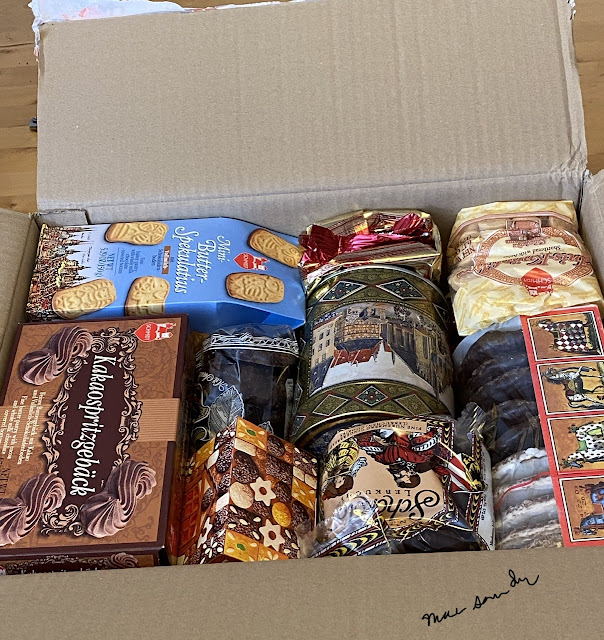
Gingerbread -- Lebkuchen -- was served at the family Christmas dinner in the novel Buddenbrooks.
In the picture you can see the Lebkuchen ready for the holidays at Evelyn and Tom's house this year.

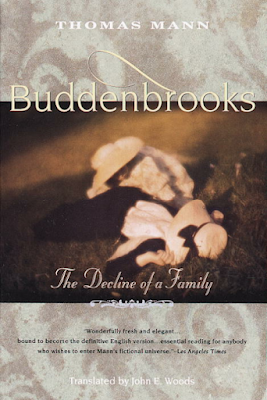
Buddenbrooks: The Decline of a Family was published in 1901 by the now-famous author Thomas Mann; soon after publication it became a sensation. Mann's 1929 Nobel Prize for literature cited it as a major accomplishment. Obviously, whatever I have to say about it has probably already been said! Therefore, I've decided to offer some quotations about the time that the Buddenbrooks family was still prosperous and confident. 

Specifically, the novel included a very long description of the family Christmas celebration in approximately 1870. Because many American Christmas traditions originated in Germany, reading about the family Christmas dinner is fun as well as appropriate for sharing this month. The Buddenbrooks' celebration started early in December. The youngest child, Johann, only son of Thomas Buddenbrook the head of the family awaited Christmas eagerly:

"With a pounding heart Johann counted the days, tearing them off one by one from the Advent calender Ida had made for him, until the day of days would arrive—the page with a Christmas tree on it. There were more and more signs of its coming. On the first day of Advent, a colorful, life-size picture of St. Nicholas was hung on the wall in Grandmama’s dining room." (p. 514). 

Soon after, an old man dressed as Saint Nicholas comes to the door. Johann must say the Lord's Prayer to  convince Saint Nicholas that he is a good boy. As a reward, he is allowed to reach into the sack that's for good children, and he receives gifts. As December advances, the weather becomes colder, and mysteries appear throughout the house and in the town:

"The doors to the grand salon were kept closed, guarding mysteries; marzipan and gingerbread appeared on the table. And it was Christmas out on the streets, too. Snow fell, it turned cold, and the sharp, clear air was full of the cheerful and melancholy melodies of black-mustached organ-grinders, Italians who had come to town dressed in velvet jackets for the holidays. Dazzling Christmas displays appeared in the shop windows. And the gay, colorful booths of the Christmas fair had been set up around the tall Gothic fountain on the market square. Wherever you went, you could smell the sweet fragrance of fir trees being sold for the holiday." (p. 515).

Gift giving and family meals continue through December 23 and Christmas Eve. Poor families come to the door for gifts, the employees of the family firm are given treats and presents, and before the family Buddenbrooks' dinner, choirboys from the local church sing carols for them. As they prepare to dine, a family member reads the Christmas story aloud. Four generations gather around a candle-lit tree in the very much decorated dining room and sing "O Tannenbaum." Then they open their lavish gifts, and finally their servants (about whom they don't think very much) serve sweets followed by a magnificent meal.

"Mamselle Severin and the housemaid now moved about the room with refreshments, and Hanno found time to look about him as he sat dunking a cookie in his tea. Chatting and laughing, people stood beside the table or walked up and down alongside it, showing off their own gifts or admiring those of others. There were objects of every sort—made of porcelain, nickel, silver and gold, of wood, silk, and linen. On the table was a long row of gingerbread cakes, glazed and sprinkled with almonds, alternating with loaves of marzipan bread, so fresh they were still moist inside. The presents that Frau Permaneder had wrapped or decorated—a needlework bag, a doily to put under a potted plant, a hassock—were trimmed with large satin bows." (p. 523)

"Since they had all eaten lunch earlier than usual today, they consumed large amounts of cookies and tea. But no sooner had they finished than a large crystal bowl filled with a yellow, grainy puree was passed around: almond crème, a mixture of eggs, ground almonds, and rosewater. It tasted quite wonderful, but one spoonful too much and you ended up with the most awful stomach ache. Nevertheless, even though Madame Buddenbrook begged them 'to leave a little corner for dinner,' they helped themselves freely. And Klothilde performed miracles. In grateful silence, she spooned up almond crème as if it were porridge. And now came little glasses of sabayon to refresh their palates—served with English plum cake...."

"As always on Christmas Eve, the table had been set in the columned hall. Madame Buddenbrook said the traditional grace with great fervor: 'Come, Lord Jesus, be our guest and bless what Thou hast given us.' As always on Christmas Eve, she concluded with a little admonition, the primary thrust of which was that on this holy night they should remember all those who were not as fortunate as the Buddenbrook family. And once this was taken care of, they sat down with a good conscience to a lengthy meal, which began with carp in drawn butter and a vintage Rhenish wine. 

"The senator slipped a few of the fish scales into his wallet so that it would not lack for money throughout the coming year.... The turkey, stuffed with chestnuts, raisins, and apples, was praised by all. Comparisons were made with birds of years past, and it was concluded that this was the largest in a long time. There were roast potatoes, plus two kinds of vegetables and two kinds of stewed fruit, the bowls heaped so full that each looked like a hearty filling main course, rather than a side dish. They drank vintage red wine ...."

"Little Johann sat between his parents and managed to force down a piece of white meat and some dressing. He certainly could not eat as much as Aunt Thilda, and he felt tired and a little queasy. But all the same, he was proud that he was allowed to dine with the adults, proud that one of those tasty buns strewn with poppyseed had been placed on his napkin, too, and that there were three wine glasses set at his place, whereas normally he drank from the little gold beaker that Uncle Kröger had given him at his christening. But then, when Uncle Justus began pouring some oily, yellow Greek wine in the smallest glasses and the iced meringues appeared—red, white, and brown—his appetite returned. He ate a red one, although it hurt his teeth something awful, and then half of a white, and had to sample at least a little of the brown one, filled with chocolate ice cream. He nibbled on a little waffle, too, and sipped at the sweet wine while he listened to Uncle Christian, who was talking now. ..."

"Before the last course of butter and cheese was served, old Madame Buddenbrook used the opportunity for another little speech. Even though not everything had turned out over the years quite the way one, out of shortsightedness, might have wished, she said, nevertheless there still remained such manifold and obvious blessings that their hearts should be filled with gratitude." (p. 525-530) 


Thomas Mann's ponderous novel is charming, but full of tragedy and human folly. His depiction of the merchant class of the Germany of the mid-19th century (that is, before he was born in 1875) was not always sympathetic, and he clearly questions their values and their lack of appreciation for education, the arts, music, and literature. But Mann's gift for visualizing the faces, expressions, inner and outer lives, and even clothing, houses, streets, and home furnishings in that time is irresistible. 

Blog post © 2021 mae sander.


Tuesday, September 26, 2017

Bruno's Cookbook

Martin Walker's series of detective books features Bruno, the chief of police in St. Denis, a fictitious small town in the Périgord region in Southwestern France. I've enjoyed all the Bruno books, from Bruno Chief of Police, published in 2008 through this year's new book, The Templar's Last Secret.

One great feature of these books: they include mouth-watering descriptions of the foods that Bruno cooks, eats, and enjoys. Most of Bruno's cuisine features intriguing products purchased, bartered, or gifted from local farmers and producers (who often also furnish clues about whatever terrible crime he's trying to solve). As a result, trying to recreate these meals in an American kitchen would be a big challenge. But there's a chance to try: Walker has recently written a cookbook.

ALAS! The only publication of this book is in German. I don't know exactly why no English edition seems to be forthcoming -- a long thread on Walker's blog has described for several years the reluctance of English publishers to go through with it. Around a month ago, at the end of this thread, he says he still doesn't know why it's not progressing. The German edition recently won a prize. Walker's blog explains: it won "'World's Best Book on French Cuisine' at the Gourmand International awards, in Yantai, China, home of China's booming new wine industry." (link and link)

I looked through a copy of Brunos Kochbuch that belongs to Evelyn. I definitely would love to have a copy in English! Here are a few photos that I took of the many beautiful pages of this book:

Photos remind one of the delightful communal food events that take
place in the detective novels. Here: a hunter's meal.
Local markets and local producers appear in a number of images.
You can only dream about some of the recipes, such as the ones that use
fresh truffles. Whatever else you read, truffles really don't retain their flavor
after long shipping: even if you could afford the hundreds of dollars they cost.
However, some recipes look quite achievable. With a little help from my German-fluent relatives, I think I'll try this one, for
an onion tart with a goat-cheese custard. I can almost figure out what it says to do!

Friday, November 18, 2016

A movie and dinner


"Arrival" is a recently-released sci-fi movie about the great success of heroine Louise Banks, a linguist who has to help the army fight against an invasion of "heptapods" who land worldwide in sleek black flying saucers. We saw it this afternoon and quite enjoyed it. As you can kind of see in the above screen shot from the trailer (on Youtube here), the alien invaders are octopus-like, or to be more exact, they seem to resemble Cthulhu, the terrifying monster from the stories of H.P. Lovecraft. The resemblance is only physical, though -- but no more spoilers here.

I wanted to see "Arrival" because of rather unusual interest from the writers at the blog Language Log; linguist Ben Zimmer wrote there: "I'd heartily recommend it to all Language Log readers. The film, despite its science-fiction trappings, does a remarkably good job of depicting how a linguist goes about her work." (link here)

After the movie we went to dinner at Metzger's German restaurant. It's exactly like we remember it throughout all the years we've been in Ann Arbor, and probably has changed little since its founding in 1928. The owner and chef belong to the third and fourth generation of the founding family. Only difference: it moved from downtown to a shopping center out near the movie theater, where we seldom go. Metzger's serve Swabian food including real veal bratwurst, German potato salad, German meat patties, schnitzel, Zwiebel Kuchen (described as "onion pie -- a heaping serving of baked sweet onions with spices and eggs, cream cheese, and a puffed pastry crust"), and so on -- I ordered German chicken livers with German potato salad and red cabbage. Lots of beer steins on the bar and other kitschy decorations everywhere.

Badly lit photo of my dessert: Metzger's apple strudel with ice cream.

Sunday, September 25, 2016

"The Cuisines of Germany"

"We had Dampfnudeln yesterday,
Dampfnudeln again today
We have Dampfnudeln every day,
We like it fine that way.

Dampfnudel hamma gestern g'habt,
Dampfnudel hamma heut
Dampfnudel hamma alle Dag
Weil's uns halt gefreut!


This nursery rhyme about Dampfnudeln (a type of steamed bun) is typical of the little literary touches in The Cuisines of Germany, a book I bought recently. The many regions of Germany each have special ways of making traditional dishes, sometimes reflected in the works of famous German authors and in folklore.

In this interesting cookbook published in 1990, Horst Scharfenberg (1919-2006) collected historic recipes, recipes from restaurants, recipes from home cooks, and literary quotations to demonstrate the wide variety of German dishes and food traditions. His approach reminds me of Waverly Root's books on France and Italy -- but with lots of recipes.

Earlier this summer, I blogged a guest post by Evelyn here: German Food. She agreed with Scharfenberg that culinary critics often underestimate the range and quality of German food. She said: "Yes, wurst, potatoes, schnitzel, and spaetzle are common dishes, but the unsung German emphasis on fresh unadulterated ingredients, and the willingness to place those ingredients front and center of a meal are exactly what the entire slow food movement is based on."

The Cuisines of Germany begins with a region-by-region summary of traditional and twentieth-century German foods including seasonal foods and fresh foods. Each recipe has an introduction, including a description of the sources of the recipes, which sometimes come from quite old cookbooks. Consistent with what Evelyn said, Scharfenberg often refers to Germany's high standards of ingredients and sources, pointing out that many of them originated centuries ago, and that EU regulations at the time he wrote were often less exacting.

The first region discussed in the book is Bavaria, where Evelyn was visiting her in-laws when she wrote her post. Tom, Miriam, and Alice were learning quite a few family recipes during their visit, and they've made us some excellent ones. Scharfenberg is most enthusiastic about Bavarian cuisine. In the course of the book he gives recipes for quite a few special Bavarian dishes Evelyn and Tom have mentioned or cooked for us, such as Bee-Sting Cake, Zwetschgendatschi (damson plum tart), dampfnudln, and Falsche Hase (a meatloaf). Scharfenberg also talks about some Christmas dishes:  poppy-seed pudding, Nurenberger Lebkuchen, and weisswurst, which we have enjoyed with the family.

When we first arrived in Ann Arbor, the main choices for eating out here were several German restaurants -- specifically Swabian restaurants run by members of the German community that had immigrated to this area in the late-19th and early 20th century. Scharfenberg includes recipes for many of the dishes I remember in these restaurants. Some of the foods that I remember most: Maultaschen (filled noodles), spaetzle (a type of dumpling), herring salad, zwiebelkuchen (onion cake), and various types of meatballs. The restaurants we liked the best closed some years ago in favor of brew pubs and other more trendy places, and though some incarnations still exist, I consider them extinct.

Scharfenberg often describes his favorite dishes in a rather colorful way, for example:
"I suspect that Maultaschen would have very good chances in a four-way international competition with ravioli, won tons, and pirogi for the championship of the Roughly Rectangular Pasta with Meat (plus Miscellaneous) Filling division." (p. 130)
Many types of potato salad, cabbage slaws and other cabbage dishes, old-style game dishes, and traditional ways to cook chickens, ducks and geese all show up in intriguing sections of The Cuisines of Germany. Fish dishes include many species of fish caught and eaten in the Baltic areas. Preserved fish such as salt cod and preserved herring are eaten in the land-locked parts of the country. Smoked trout, we learn, came to Germany from America -- European native trout are quite rare and limited to high mountain areas, so American species have been introduced into German streams. Scharfenberg mentioned various recipes and preserved foods that he had not eaten since East Germany became inaccessible, years before he was researching his book.

This is a rather obscure book, long out-of-print. Scharfenberg had a career in German TV and radio food broadcasting, and I believe this is his only work that's appeared in English. Uncomfortably, I learned, he was employed during World War II as a propagandist: "Während des Zweiten Weltkriegs diente er in einer Propagandakompanie als Kriegsberichterstatter," says his German Wikipedia page. The automated translation is "During World War II he served in a propaganda company as a war correspondent." He doesn't seem to have an English Wiki page.

I haven't tried any of his recipes yet, but eventually I hope to do so. And I have often enjoyed the family versions of these dishes.

Tuesday, July 19, 2016

German Food: Guest Post by Evelyn

Fresh strawberries!
"German food definitely has a bad rep in culinary circles, and I would say undeservedly," writes Evelyn from Augsburg, where she and her family are spending the summer with her in-laws. She continues:

Yes, wurst, potatoes, schnitzel, and spaetzle are common dishes, but the unsung German emphasis on fresh unadulterated ingredients, and the willingness to place those ingredients front and center of a meal are exactly what the entire slow food movement is based on.

Germans view strawberry fields the way Americans view cupcake shops - the place is full of them. We were thankful to end a hot dehydrating run next to a strawberry field. If you can't make it to a strawberry field, then you can buy your strawberries from one of the popup strawberry stands in the shape of a strawberry that appear every couple of miles all over the country in season.

Gottingen2


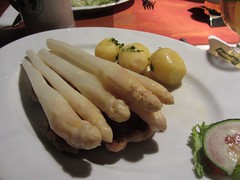
This time around, we missed white asparagus season, but people go crazy for it. My first experience was many years ago when a cousin got a tip on a farmer who was about to harvest his white asparagus. He took orders from all the aunts, uncles, and cousins in the family, drove to the farm before sunrise -- if it is not harvested before sunrise, the asparagus turns green and chewy rather than pristine white. He spent the rest of the day on family deliveries. I was told that pretty much every stalk of white asparagus in the country is coveted in this way. (Illustration from a previous trip in season by Mae.)

Munich, the Viktualienmarkt  

Chanterelle mushrooms: Pfifferlinge.
The Viktualienmarkt in Munich contains many stands featuring chanterelle mushrooms: Pfifferlinge. Every traditional German restaurant and Gasthaus has an added seasonal Pfifferlinge section of the menu.
Spices and other good things in a shop window.
Olives at the market.
Prepared food counter at the market.
Bakery counter.
We got our sandwiches from Nordsee, a chain featuring seafood dishes. At two for 4 Euro, I chose pickled herring on a baguette (known as a Bismarck Bagette) and smoked salmon with hard boiled egg slices and aoli. For an extra Euro, I picked up a water flavored with lemon and fresh mint.

Cheaper than water.
One just has to live with the fact that ordering tap water is not a legitimate option. One might be calmed by knowing:
  • Tips are 10%, so overall the price will be less inflated by water cost than in the US and
  • Most restaurants have an exclusive contract with a local brewery, implying that beer is literally cheaper than water.
Munich brew pub.

Home Baking


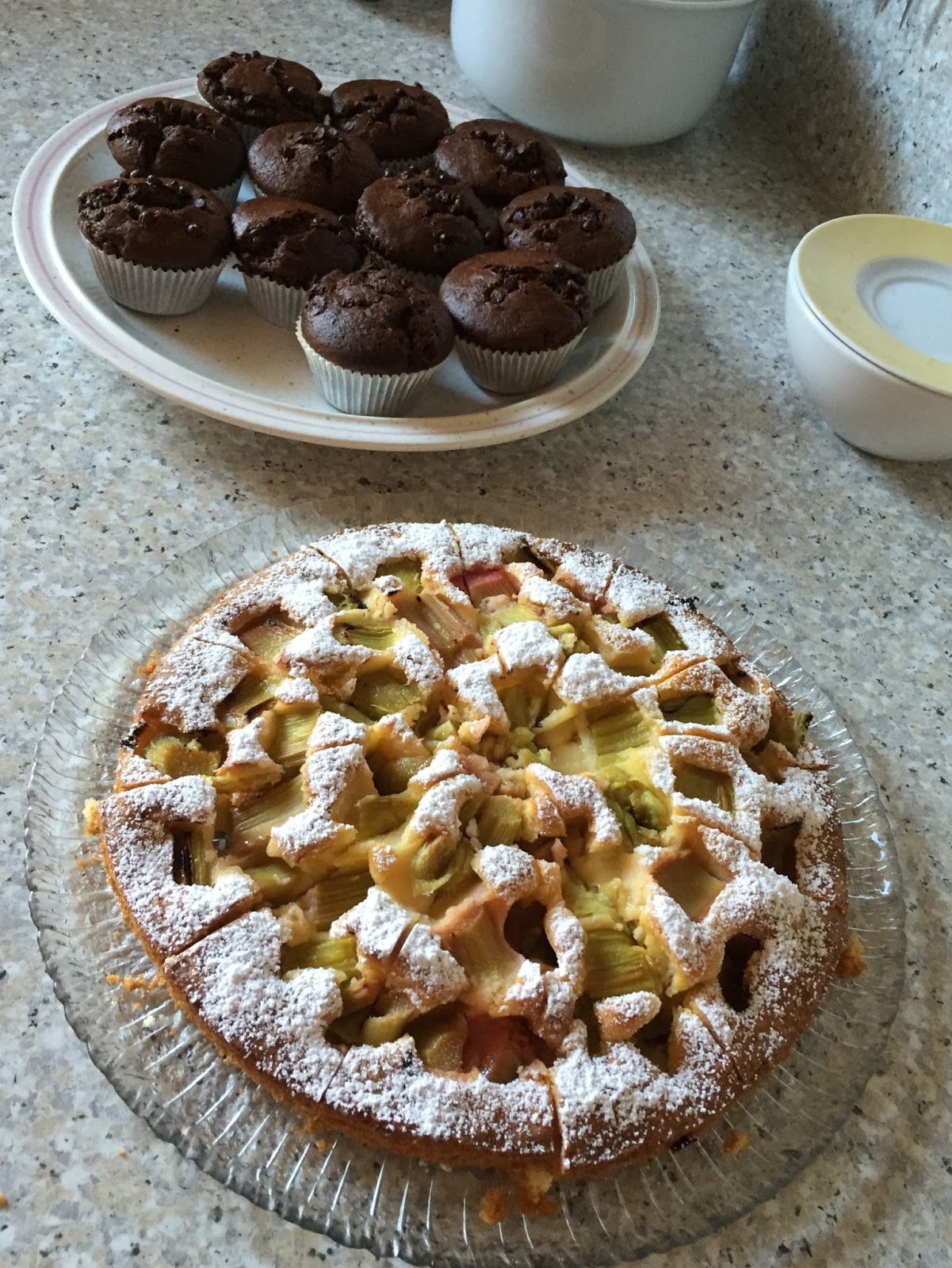
Home-made cake in Augsburg.
Perhaps the cakes already have the reputation they deserved. In the last two days, we have had home baked rhubarb cake (photo), apple tart, and a "bee sting cake" - a cream filled cake topped with almonds and honey.

My personal favorite cake is a prune plum cake called Zwetschgendatschi. It is a local specialty only available in this particular region and only in the prune plum season. Every local person seems to have their own special recipe. 

Zwetschgendatschi is of sufficient importance that it features prominently in the children's story Der Räuber Hotzenplotz, in which two children must go on a quest to retrieve a grandmother's stolen coffee mill. If they are unsuccessful, the grandmother threatens that she will never make another Zwetschgendatschi.

Dining outdoors with cousins.

Friday, December 25, 2015

Merry Christmas!

Christmas at the Henry Ford Museum


Note the actual airplane behind the Christmas tree.
Christmas decorations in the model train display.
We visited the Henry Ford Museum on Wednesday.

Christmas Eve at Home

Bavarian tradition: sausages and Bavarian potato salad.
Dessert: Buche de Noel from Zingerman's Bakery with a few raspberries. I had always wanted to try a Buche de Noel.

Star wars Lego!


Merry Christmas, Everyone!

Thursday, December 25, 2014

Chinese Dinner and Movies for Christmas

Christmas Eve: "Interstellar."
We spent Christmas Eve and Christmas Day with Elaine and Larry who are visiting from Indiana. Of course our plan was movies and Chinese food, which we quite enjoyed. At 2:30 PM on Christmas Eve we went to a theater to see "Interstellar," which some of us liked a lot, some liked a little, and one hated. On Christmas Day we watched two movies on streaming video, took a walk in the park despite the gloominess and damp, and cooked and ate some Chinese food.
Christmas Morning: "Laura" (1944). Beautiful visuals in this film noir.
Christmas afternoon: "Insomnia." Rather strange movie.
Cooking Chinese Christmas dinner. You can see the package of Trader Joe's
pot stickers at left, and the rice cooker at right.
Stir-frying vegetables.
Pot stickers.
Stir-fried vegetables with roasted salmon.
Zingerman's gingerbread cake after we ate most of it.

Friday, November 15, 2013

Happy Bundt Pan Day


Here's my empty Bundt cake pan, posing in the afternoon sunshine. Today is Bundt Pan Day, in honor of the 60-somethingth anniversary of the first Bundt pans being sold by the Nordic Ware company in Minneapolis. I'm not making a cake for Bundt Pan Day for a variety of reasons, but I took out my pan just for fun. You can see that the old-style nostick finish is somewhat scratched: not surprising, since I've had the pan since some time in the 1960s, possibly even before the famous Tunnel of Fudge winner of the Pillsbury bake-off in 1966. Anyway, my Aunt Bernadine gave it to me around that time, and I've used it -- just not today.

Here's a quote from the website of Nordic Ware about the founder, H. David Dalquist, who died in 2005:
"In 1950, the landmark pan was introduced, after the Minneapolis Chapter of the Hadassah Society asked Dave and Dotty to produce a kuglehof pan, similar to the one the society's president had received from her grandmother in Germany. Dave produced the pan from cast aluminum for the Hadassah Society and a few for the Nordic Ware trademark, which he sold to department stores using the name, bund pan. (The word bund means a gathering--thus a bund cake, with its characteristic fluting, was a cake suitable for a gathering or party.) Nordic Ware created the pan and filed for a trademark to protect its creation, renaming the pan the Bundt pan."
For its first 10 years or so, the bundt pan was mainly popular among American-Jewish women, who were recreating traditional cakes from their Eastern European and German-Jewish origins. According to Wikipedia (which has convincing footnotes for the claim) -- "Uses of the word 'bund' to describe cakes outside of Europe can be found in Jewish-American cookbooks from around the start of the 20th century. The alternative spelling 'bundt' also appears in a recipe as early as 1901." These references are to two famous Jewish cookbooks: Aunt Babette's Cookbook (1889) and The Settlement Cookbook (1901).

I thank Louise at Months of Edible Celebrations for pointing out Bundt Cake Day!

Friday, June 28, 2013

Eating in Gottingen

gott-food1717
A very fancy greengrocer: we bought our fruit and vegetables
at a supermarket where it looked just like at home.
gott-food1732
Gaudi Restaurant -- I guess it was our favorite
gott-food1734
We asked for Gaudi's English menu, which used the Spanish names for tapas and other foods.
We had tapas including apricots wrapped in bacon, meatballs, octopus, and serrano ham.
A little bite of herring with beets and cream was served before anything else.
How do you say "amuse gueule" in German, Spanish, or English?
gott-food1739
Gaudi: ravioli with tuna
gott-food1741
Gaudi: Cherries with ginger sauce and ice cream
gott-food1679
Sausalito: a Tex-Mex restaurant with a very multi-lingual menu.
The German menu was full of both English and Spanish mixed together.
gott-food1678
Sausalito's version of enchiladas. Note the red cabbage in the salad.
Corona beer tonight...
gott-food1618
German food at Ratskeller Restaurant Sunday night:
herring with boiled potatoes and a stein of beer.
gott-food1778
Paulaner "Zur Alten Brauerei" Thursday
gottfood1783
Rosti potatoes with herring (front) or salmon (back) and more beer.
Click on any of these photos to see more Flickr photos of Gottingen.