Friday, March 23, 2018

Camels and Dates

A camel was tethered by the restaurant near the Dead Sea where we ate lunch today. If you go to Israel,
you really should not miss seeing at least one camel. We saw two: the other was parked at the next restaurant.
I ordered these stuffed dates.
The stuffing for the dates was lightly-spiced ground meat. Garnishes included slivered almonds, fried onions, and "Silvan" or date syrup, decorating the plate. It was delicious! On the menu was also a dish with chicken, dates, and lemon.
We've seen quite a few date orchards, especially near Eilat. In this photo,
you can see the large machines that harvest the dates, and the mesh bags
used for ripening them.
Date palms near Eilat.
Today's lunch included hummus, of course: in this case served with kabob meat. 
Alas! No falafel today. The restaurant had run out of it. After lunch we had Magnum bars, but as it's a kosher meat restaurant, we were required to eat them outside. That was ok: a large number of buzzards, kestrels, storks, and eagles were flying over, migrating from Africa northwards.

A strange mural was on the restaurant wall, along with many
music and film posters and photos from the 1950s.
Birding: we saw this little clamorous warbler in some reeds at a refuge near the Dead Sea.

Wednesday, March 21, 2018

The Nightingale


A bird in the hand is not worth anything compared to one in the bush -- at least not when you are on a birding trip! However, this is the only nightingale I have ever seen. Nightingales are really secretive! This one had just been banded and we got to look at it for a few moments before it was released. So at least I've seen a nightingale at the bird research center of Eilat.


Here's a very good bird on some barbed wire. It's called the Turkistan shrike, and has been seen on migration through Israel only very rarely. We spent a lot of time and effort to find it, and our guide (whose hand is shown above) says he's seen it only twice in 25 years of birding.

We had lunch at a restaurant and food boutique, where they grow dates and raise goats and make goat cheese. My view is that it was a very traditional type of place, with a shady outdoor dining area and a well-lit indoor dining room. One of our fellow birders saw a very nice cat outdoors, but I didn't see it.


Our very nice goat cheese platter: sour-cream type cheese with herbs and olive oil, cubes of feta-like goat cheese, and
a hard goat cheese served with salad, bread, pita, and a few slices of fruit. I really enjoyed it!


Tuesday, March 20, 2018

Israeli Cats and a Few Birds

Cats were originally native to the Middle East, and are still viewed here as animals to be respected and well-treated.
Semi-tame cats often live around people, and beg at restaurants or picnic areas. Here's one at a dumpster.
I lured this cat with a bite of my tuna sandwich a few days ago. It looked
quite well fed. We met the cat at an Aroma Cafe (a chain found at many
highway rest stops). Though the Aroma's sandwiches are quite good,
they aren't much to look at! So no food photos.
This cat lives in the outdoor dining area of our hotel in Eilat.
Also looks well-fed and well groomed, though it probably doesn't
"belong" to anyone, and is definitely a begging type.
I wonder how many of the endangered bird species that interest us so much are menaced by the numerous cats of this region! We have definitely encountered the Israeli cats on previous trips, often more aggressive and less obsequious individuals that thought they had a right to eat your leftovers (and maybe even your food).

First thing this morning, we went up to another mountain top hoping to see more migrants and local species of birds. This is where we were and one of the birds we saw: another species of wheatear:


Unfortunately it's a hot day, and fewer birds than usual are out in the open or flying over. Our second birding spot was the International Birding and Research Center, Eilat. We saw a tiny warbler that had just been banded, and waited at the salt ponds of the refuge for some of the other birds that have recently been seen here, but it was a slow day for birds. 

Many fanciful sculptures and art works are displayed on the grounds of the bird observatory.

Monday, March 19, 2018

Most Beautiful Bird of the Day

Little Green Bee Eaters. Eilat, Israel.

Israeli Food

Array of salads before grilled meat, restaurant in Eilat.

Hotel Breakfast buffet: hot foods such as quiche, shakshuka.
Hotel breakfast buffet: fish.
Cafe 40 near Egyptian border.

Ice cream from the dairy at Yotvata Kibbutz.


And what does this bird, a black-eared wheatear, eat for lunch? A cricket bigger than his head!

Sunday, March 18, 2018

Cormorants at Dusk

Birding today was beautiful. We watched eagles and other raptors near the Egyptian border,
and watched many water birds at sunset in sight of the Jordanian border. In between we walked
at several other sites near Eilat. Just after these birds flew, we heard the jackals howling.

Saturday, March 17, 2018

Sde Boker and Ein Avdat

This morning we visited Sde Boker, a park where David Ben Gurion, one of the founders of Israel, is buried.
Nearby is Ein Avdat, a small desert canyon with a beautiful stream bed.
Ibex live on the cliffs and in the park. Some are unafraid of people. 
David Ben Gurion's grave.
The cliffs at Ein Avdat where very interesting eagles, griffon vultures,
and other vultures are nesting and flying.
A Bonelli's Eagle flying above Ein Avdat.

Friday, March 16, 2018

Three Owls

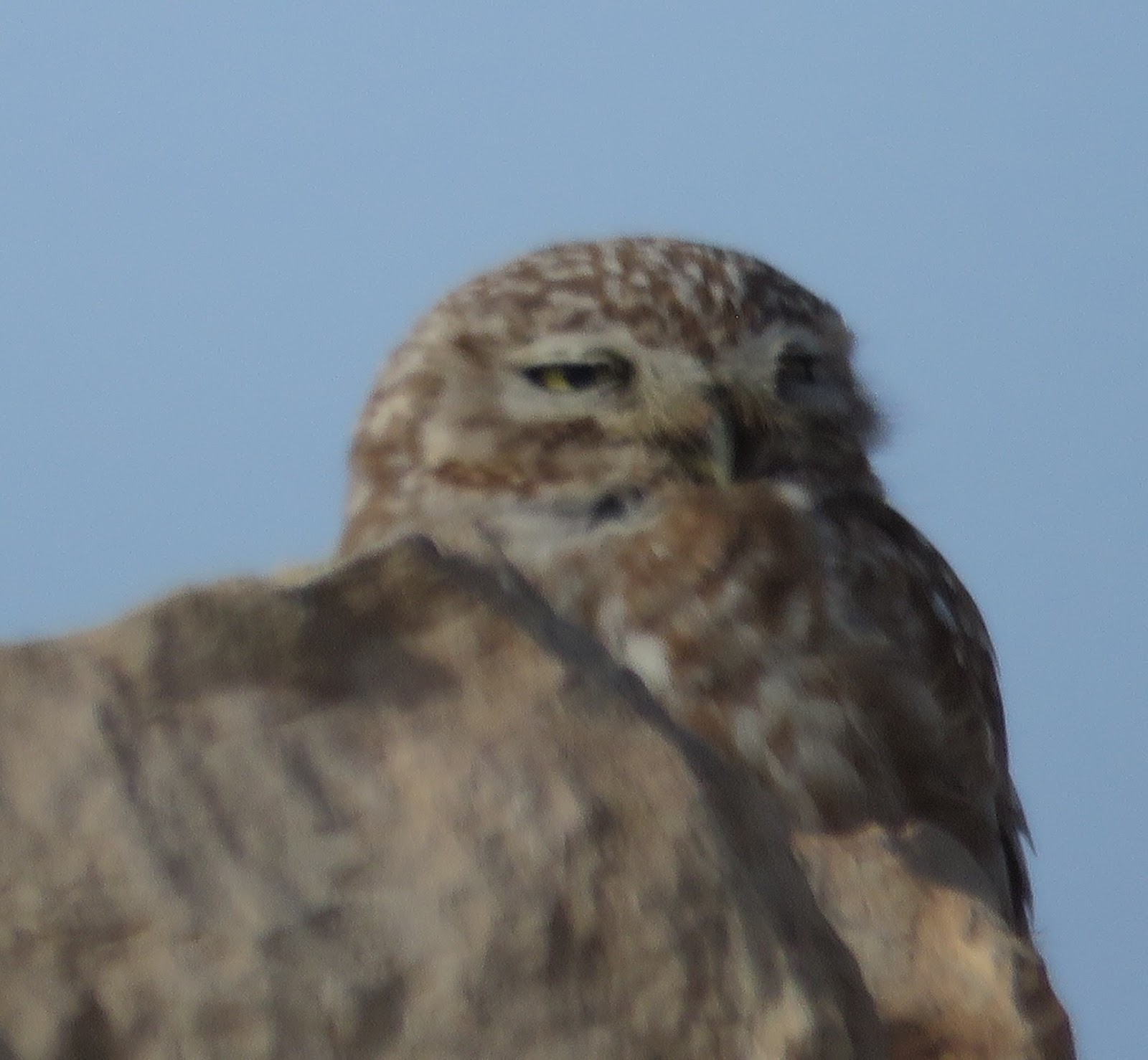
A Little Owl that we saw on our walk yesterday in the wadi.
Another Little Owl, seen today. A different sub-species.
After dark, our guides hooted out a long-eared owl in a tree near where we are staying. We saw it fly over us, very close, making sounds by clapping its wings together, and then saw it in a tree. No photos of this one. 

We had another very long birding day with lots of variety of scenery including desert and oases, and including many species of birds. Our first location was very close to the border of Egypt. Israel is such a small country -- you can drive from one border to the other in maybe 3 hours or less.

Thursday, March 15, 2018

Things We Saw on Day 1 of Birding

Getting started in the morning. 
Butterflies.
We were walking in a Wadi where local residents have sheep and use pack animals as this shows.
The sheep and men tending them.
This is a large brown iris, one of the wild relatives of our garden flowers.

I took these photos of the scenery and things we saw during our walks at a wadi in Har Amasa just south of Hebron and just inside of Israel -- the West Bank is just over the hills. Len took many fantastic bird photos of an owl, a cuckoo, kestrels, an eagle in flight, a masked shrike, and many others, which I will post at another time. 

Wednesday, March 14, 2018

We Made It!!

We arrived in Tel Aviv early and have a bit of unexpected time here at the Isrotel Tower Hotel.
This is the view from the balcony of our room on the 13th floor. We meet our tour for dinner in an hour.
From the plane: crossing the Alps!
View as the plane was landing.
Tomorrow we begin our birdwatching tour of the Negev Desert and the south of Israel. Birds migrating from Africa to Europe and Asia fly through this area, and we hope to see some interesting ones. Will post more when we can.

Monday, March 12, 2018

Comfort food in two stories

"At noontime the next day she made Zach tomato soup from a can and a grilled cheese sandwich. He bent his head close to the bowl and ate half the sandwich with his thin fingers, then pushed back the plate. When he looked up at her with his dark eyes, for a moment she saw him as the small child he'd once been, before his social ungainliness had been fully exposed, before his inability to play any sport had hindered him irredeemably, before his nose became adult and angular and his eyebrows one dark line, back when  he had seemed a shy and notably obedient little boy. A picky eater, always." (The Burgess Boys, p. 33)
Elizabeth Strout's novel The Burgess Boys tells a story of three middle-aged siblings in crisis: Susan, her twin brother Bob, and their older brother Jim. Susan's son Zach is in trouble with the law and as the three siblings attempt to protect Zach, they reconnect. Individually and separately they relive their past lives, their various marriages both failed and successful, and their memories of their own mother, Barbara. Susan and Zach always seem to eat ready-made food, frozen pizza and the like, and it never seems to comfort them!

Bob, Jim, Bob's ex-wife Pam, and Jim's wife Helen all live a fairly glamorous life in New York, having escaped from small-town Maine where Susan and Zach still live. Several scenes take place at dinner parties and tony restaurants -- but the past is important. In a flashback to the relationship of Bob and Pam, Bob describes his childhood with Jim:
"Whatever I ate, he wanted to eat the same thing. 'Tomato soup' he'd say, when Mom asked what he wanted for lunch. Then he'd see I had vegetable soup, and he'd say, 'No, that's what I want.'" (p. 106) 
Before Bob and Pam were married, she was close with the family, including Susan and Barbara.  Their life at that time is characterized, again, by food:
"While the Burgesses seemed to have no knowledge of, or interest in food (there were meals of scrambled hamburger covered with an unmelted sheet of orange cheese, or a tuna casserole made with canned soup, or a chicken roasted without any spices, not even salt), Pam discovered that they loved baked goods, and so she made banana bread and sugar cookies...." (p. 107)
Sad people, but it's a good book about sad people. Elizabeth Strout's earlier book Olive Kitteridge introduced me to her great talent for presenting characters. To wrap up this very brief review: I think this quote summarizes a great deal about the book: "No one wants to believe something is too late, but it is always becoming too late, and then it is." (p. 254)

"No More Maybe"
Illustration of Gish Jen's story
by JooHee Yoon.

Unrelated except by very contrasting comfort food is a newly published story, "No More Maybe," by Gish Jen. It just appeared in the New Yorker this week.

The narrator of "No More Maybe" is a young woman who recently immigrated to the US from China with her husband, an academic. She describes how his parents are visiting her to help with a baby that she's expecting in two months. Her narrative succinctly and effectively portrays the four characters: husband, mother-in-law, father-in-law, and narrator. They argue, they eat meals, they talk of many things comparing life in the US and China, and their relationships are very interesting. A final interchange with an American neighbor also shows Gish Jen's penetrating ability to observe people.

The mother-in-law's comfort food -- designed to be perfect for a pregnant woman -- especially portrays the contrasts between the western-educated people and their more folkloric Chinese background:
"Actually, I help a lot when she cooks for me. Especially, I help with the shopping and the chopping. But she does the planning and the cooking, because my baby will be born in two months now, and she wants me to eat all kinds of special food. On the outside, my mother-in-law is a modern sportswoman. But inside she is a traditional type. So I take American prenatal vitamins and calcium and DHA, of course. But also she feeds me steamed egg porridge with rice, and millet porridge. I have a glass of milk, red dates, fruit, and nuts every day. Tofu and bean sprouts every other day. And a lot of soups: pork-rib soup with lotus seeds or Chinese yam. Hen soup with mushrooms and more red dates. Soybean-and-pork-trotter soup. Even swallow’s-nest soup, which is very expensive. Because I am in my seventh month and my body has heated up, and because my mother-in-law has an app that says it’s O.K., I am allowed to have some cooling foods I could not have before. For example, some of her blueberries with a little ice cream. In China, there are pregnant women who eat a lot of blueberries. They think it will make their baby’s eyes shiny and round. But my mother-in-law says that is illogical thinking. She will let me have only a few."
Gish Jen is a very wonderful author, and I have been looking forward to reading this story -- I follow her on Facebook and she talked about editing it! One quote from this story also seems designed to summarize its theme: "No more maybe, in other words. Because that is just what happens. One day it is maybe, and then you just know."

Saturday, March 10, 2018

"Dinner for Threshers" by Grant Wood


"'American Gothic' is, by a very wide margin, [Grant Wood's] most effective picture—though not his best, for which I nominate 'Dinner for Threshers' (1934), a long, low, cutaway view of a farmhouse at harvesttime that brought to disciplined perfection Wood’s strong suit, imaginative design."
Thus writes Peter Schjeldahl in the current New Yorker: "Beyond 'American Gothic'" (source). For most people including me the only familiar work by Grant Wood (1895-1935) is "American Gothic" (1930). You surely know it: a portrait of two people stiffly standing in front of a gothic-style building, the man, rather elderly, holding a three-tined pitchfork and staring at the viewer, the woman with her face sort of scrunched up and her eyes on the man. In the gallery of the Art Institute of Chicago there's usually a small crowd around "American Gothic," though nothing like the crazed selfie-taking tourists that mob the Mona Lisa. Wood's painting is not only famous. It's one of the most parodied works of American art -- though not as parodied as the Mona Lisa, I suspect. Memories of the parodies probably crowd out mental images of the real art work for many people.

Detail of "Dinner for Threshers" -- a fascinating kitchen scene.
I was entirely unfamiliar with "Dinner for Threshers." I looked it up and found it utterly fascinating. I've searched for American paintings of kitchen scenes -- there aren't vast numbers of them. Such detail! The wood stove, the cat near the rag rug, the woman holding a bowl of mashed potatoes, the red pump at the sink, the white coffee pot on the stove, the hutch full of white china... Really an image of food being prepared in a real farmhouse kitchen, I think.

I learned a lot about Wood in Schjeldahl's New Yorker article, particularly about Wood's politics. He links Wood with regionalist, anti-modernist artists of his time, but contrasts this with similar movements in today's art world:
"In the thirties and forties, in ways that became art-world conventional wisdom, some critics equated regionalism with the blood-and-soil mystique of Nazism and/or socialist realism. But Wood, Benton, and Curry were sturdy Roosevelt liberals. (Wood headed Iowa offices of the New Deal programs that supported artists during the Depression.) Some sophisticates, in New York and Hollywood smart sets, took these artists’ works in stride as populist chic. Collectors of Wood included Cole Porter, Alexander Woollcott, Edward G. Robinson, and King Vidor. Then, as perhaps now, there was a recuperative urge among metropolitans to make nice with the disgruntled heartland—an uphill process, as witness a recent protest movement against a terrific Benton mural, at Indiana University, that features Ku Klux Klan figures, never mind that Benton meant to denigrate them."
I wish I could see the Grant Wood retrospective at the Whitney Museum in New York, the inspiration for the article.

Art reproductions from Wiki Art.

Friday, March 09, 2018

"The Lunar Men" by Jenny Uglow

"The circle met often. ... Their meetings were as much for pleasure as business. As the years rolled on, they tried to dine at two o'clock, and usually planned to stay until at leas eight. The wine flowed (despite Darwin's later advocacy of temperance) and the tables were heavy with fish and capons, Cheddar and Stilton, pies and syllabubs. At dinner the wives sometimes joined the men and the children dashed in and out. But wen the meal was cleared away, out came the instruments, the plans and the models, the minerals and machines. ... They were sharing an exuberant spread of knowledge.... The Lunar men were joined in a shared hunt for illumination, a quest that would bind them ever more closely together as the decades passed." (pp. 124-125)

Jenny Uglow's book The Lunar Men, about a group of scientists and industrialists during the eighteenth century, fascinated me when I first read it. I've thought and spoken about it many times in the decade since then. As I was reading again, I noticed that the above paragraph particularly illustrates how the author combines descriptions of the domestic lives -- including wives and many children -- of the famous group members. My memory of this as a very amazing book was confirmed by my rereading.

I wrote a very detailed review of it on my other blog at the time, and I've decided to reproduce it now.

Blog post from August 29, 2007, "Lunar Men"

I just read The Lunar Men: Five Friends Whose Curiosity Changed the World, by Jenny Uglow. The subject is a group of remarkable 18th century colleagues, whose accomplishments contributed to scientific, social and technological change in their time. Seeing history from this perspective contrasts to the many literary-focused books I've read: though it mentions Blake and Coleridge it's just not about that side of the century!

In its 500 pages, the book covers a great deal of the political, commercial, and scientific history of England in that century, making it both fascinating and challenging. The Lunar Men were ahead of their time with creating new inventions and processes, they contributed to emerging explanations of natural phenomena like electricity, and they were in on the era's important discoveries about plants, human biology, and geology. They met Benjamin Franklin and the French chemist Lavoisier; they read works by Linnaeus and other scientists outside their circle.

Among the dozen or so members of the Lunar Society -- which met on evenings with a full moon so that they could safely walk home in less-than-total darkness -- I found the following men especially interesting:
  • Joseph Priestley (1733-1802), a scientist best-remembered for experiments with oxygen, who was also a social activist.
  • Josiah Wedgwood (1730-1795), founder of the famous pottery works but also an experimenter in chemistry and developer of industrial and crafts processes.
  • Erasmus Darwin (1730-1802), recognized for his skill as a physician as well as for his works about the natural world. Darwin's son married Wedgwood's daughter, making them co-grandfathers of Charles Darwin.
  • James Watt (1736-1819), scientist and inventor of steam engine technology.
  • Matthew Boulton (1728-1809), innovative manufacturer of consumer goods and industrial equipment. He partnered with Watt in developing steam power, and did many other things such as found a mint with new efficient coin-stamping capability.
Theirs was the era of the Industrial Revolution, the American Revolution, and the French Revolution. They were engaged by all three. Although there were many differences of opinion among the Lunar Men, a prevalent reaction on their part was sympathy for the working man and for the new ideas about liberty, freedom of speech, and human rights. Most agreed with many ideas of reform and especially opposed slavery, though were uneasy with violent revolution.

Ironically, the conservative English reaction, which they didn't like, actually favored their business interests. For example, though anti-slavery, Boulton and Watt sold industrial equipment to slave-owning colonies like Trinidad. About the years after the French Revolution, Uglow says: "... as the war with France dragged on, the Lunar men still looked forward. And while the poor and the landed classes suffered, the industrialists did well out of the war, the Lunar men among them. Armies had to be fed, clothed and armed. ... Furnaces and forges poured out steel and iron, and coal production soared.... Just over the horizon lay the era of smoking factory chimneys and sweated labour -- the age of the machine." (p. 465)

Even more ironically, the common men in England opposed revolution and favored the old monarchy and fundamentalist religion. The masses hated the Lunar Men, who were well known for their various accomplishments and controversial ideas. They blamed them for being "philosophers" and for their suspected sympathy with the French revolution. On one sad occasion, a mob burned Priestly's house and destroyed his library and laboratory.

Their commitment to science and rational thought characterized much of their lives. Darwin wrote that philosophy -- equal to experimental science -- had always endeavored to oppose ignorance and credulity, which had "misled and enslaved mankind." He continued "philosophers have on this account been called unbelievers: unbelievers of what? of the fictions of fancy, of witchcraft, hobgoblins, apparitions, vampires, fairies; of the influence of the stars on human actions, miracles wrought by the bones of saints, the flight of ominous birds, the predictions from the bones of dying animals ... ." (p. 482)

Darwin, two generations before his grandson, already proposed that the layers of stone and fossils he observed were millions of years old -- opposing belief in the Biblical creation story and its 6000 year age for the earth. He was one of the first to describe geological strata including prehistoric bones, and suggested an early version of evolutionary theory. Among the many fascinating themes of Uglow's book, I find great appeal in how similar are some of the issues these men fought to issues still not resolved in our own society. We should know better by now, after 200 years!

Thursday, March 08, 2018

"The Moving Toyshop"


Today's reading: The Moving Toyshop by Edmund Crispin, first published in 1946. I find this book very funny, almost a send-up of the more conventional British detective novels such as those by Dorothy Sayers or Agatha Christie. It's also a kind of send-up of books about pompous academics: the setting is Oxford and the amateur detectives are a literature don, Gervase Fen, and a poet named Cadogan. Not quite as funny as a Bertie Wooster novel... but close. And furthermore, it is actually suspenseful.

Beyond the humor about people and situations, the plot of this tale is so improbable that even the characters in the story comment on it:
"'I don't think this is going to work,' Mr Beavis remarked with some apprehension.
"'It will work,' Fen responded confidently, 'because no one expects this sort of trick outside a book.'" (p. 147)
The novel takes place in a single day, beginning with the poet's negotiation for an advance from his publisher in London because he needs a vacation, and continuing as he takes a train to Oxford for this needed break. His train trip is interrupted because there are no further trains from a station almost to Oxford. Thus he has to hitchhike with a strangely literate truck driver (who gets back into the story later, quite improbably). As he walks toward the center of town, he randomly enters a toyshop whose door is standing open, and he witnesses the result of a murder. 

Thus the tale begins. Cadogan enlists Gervase Fen, Oxford literary don, to help find the culprit. They engage in a rather madcap rush to understand both the disappearance of the murder victim and the disappearance of the toyshop where the murder took place, and to find the guilty perps. And indeed, the day of crazy risks and chases on foot, by bicycle, in Fen's own sports car, in a stolen car, in the previously mentioned truck, and even by punt on the river, is wrapped up by the following evening. What classical unity!

I often notice how a detective story can be punctuated by stops for meals -- such pacing helps to ground the detectives in a kind of real world. With each meal, we see how time is passing. Descriptions of food and eating places can reveal insights about the character of the detectives. Meal times in The Moving Toyshop come off in a somewhat off-beat way. Fen and Cadogan come close to eating at least a couple of times, but instead keep chasing after and confronting a larger and larger collection of bizarre and eccentric suspects.

First they miss lunch in an Oxford dining hall thanks to being briefly kidnapped by a couple of mysterious thugs involved in the crime cover-up. After an escape from this peril, they reach Fen's Oxford chambers:
"Fen, who had been arranging about tea for them all with an elderly, mirthless individual who proved to be his scout, returned to the room, unlocked a drawer in his untidy desk, and took out a small automatic pistol. For a moment conversation was still: something of the implication of that act was borne in on everyone present. 
"'I'm sorry I shall have to desert you,' he said, 'But this interview really won't wait....' 
"Curiosity, and the desire for tea, were conducting a mimic battle in Cadogan's brain; curiosity emerged triumphant. 'I'm coming too,' he announced." (p. 113)
Another failed chance to eat! Finally, they do manage to have a bit of food later that afternoon:
"Cadogan had finished the buttered scones and was eating a piece of angel-cake. 'The Episode of the Guzzling Bard,' said Fen as he lit a cigarette." (p. 128) 
And just as he finishes eating, one of the possible witnesses they have been seeking turns up in the very same café! The pursuit of suspects and discovery of more and more surprises continues until the improbable wrap-up. Read it and chortle!

Edmund Crispin was the pseudonym of Robert Bruce Montgomery (1921-1978), who wrote scripts and film scores for quite a few non-detective films, and also an entire series about Gervase Fen. He is quite obscure compared to the still-popular authors of the Golden Age of crime fiction before World War II. Still, his books, especially this one, make it onto various lists of "best detective novels." Though Agatha Christie's work, for example, continues to be turned into film on a regular basis, I can find only one such treatment of The Moving Toyshop, a TV show aired in 1964, listed on IMDB -- but with no available way to watch it. 

Note: Authors of Crispin's era whose detectives stopped to eat while detecting include Christie, Sayers, Georges Simenon, Dashiell Hammett, Raymond Chandler, Rex Stout, and many others. Detective stories throughout the 20th century continued to feature meals in one form or another.  I've written about this often! In much more recent "cozy" mysteries, this trope has been forced into something different, which I don't admire nearly as much. 

Wednesday, March 07, 2018

Mud-Luscious


[in Just-]

in Just- 
spring          when the world is mud- 
luscious the little 
lame balloonman 

whistles          far          and wee 

and eddieandbill come 
running from marbles and 
piracies and it's 
spring 

when the world is puddle-wonderful 

the queer 
old balloonman whistles 
far          and             wee 
and bettyandisbel come dancing 

from hop-scotch and jump-rope and 

it's 
spring 
and 

         the 

                  goat-footed 

balloonMan          whistles 
far 
and 
wee


**************************************

Mud-luscious -- what a remarkable and original word from this perfect spring poem by e.e. cummings. Maybe your teacher read it to you in school some time in the past; I think it's a popular poem for classroom use. But it's also a powerful poem, and when poets make up words like mud-luscious you don't forget them.

As I walked around a woodland trail the other day, squelching into the mud puddles and crunching through stretches where snow hadn't yet melted, I kept thinking "mud-luscious." The photos here are my effort to capture the early-spring feel of this walk, especially the bluebirds that were perching in one part of the woods, and the shoots coming up in the mud by the stream.

Luscious is a food word, though I don't use it often or see it in other people's food descriptions. I'll have it in mind, though, for the next time I taste a deeply sweet and satisfying dessert or a flavorful bowl of luscious soup. But for now, I have paths in the woods that are mud-luscious.

That's my word for Wordy Wednesday! Thank you, e.e. cummings. And thank you, Poetry Foundation, for the text of this poem, which I remember from long ago.

Friday, March 02, 2018

Snowy Morning


We are so lucky to have had just a few inches of heavy wet snow, not like in the East where power outages seem to be everywhere! And much melted by evening.