Showing posts with label books. Show all posts

Tuesday, May 12, 2026

Uncertainty


How to Not Know

This book — just published today — offers a combination of interesting insights (from time to time) with a lot of conventional and somewhat banal or predictable advice. Like the advice you find in newspaper columns. Not terrible, but I guess on the whole I found it somewhat a waste of time. I kind of speed read it. I’d say: don’t bother.

Thursday, June 19, 2025

So Much to Learn!

 Books!

My longtime favorite little library. Around a mile from our house.
(Yes, they still keep going.)
I seem to read everything on ebooks.

Our Garden


Serious Book


Quotes from The Light Eaters by Zoƫ Schlanger

“Electricity is a wily force. It itself is not alive, but it is very often the best sign of life. It’s a proxy for aliveness.”

“Already, scientists have found compelling evidence that language is not entirely confined to the human realm; prairie dogs appear to use adjectives, specific repeated sounds they use to describe the size, shape, color, and speed of predators. Japanese great tits have syntax; they use distinct strings of chirps to instruct their comrades to scan for danger, or tell them to move closer. We’ve heard about songbirds using backchannels for alarm calls, and risk-averse chipmunks screaming at the slightest spook. Perhaps it would be small-minded of us to foreclose on the possibility of a sound-based plant language emerging too.”

“If plants can’t do something for themselves, they find other things that can do it for them. But when those other things are living creatures with their own agendas, that might take a little bribing—or manipulation. Legumes, for example, form associations with bacteria in their roots to lock in a steady supply of nitrogen fertilizer.”

“Agency is an organism’s capacity to assess the conditions it finds itself in, and change itself to suit them. Yes, we do this all the time. So do plants.”

“Intelligence is a loaded word, perhaps overly connected to our ideas of academic achievement. It’s been weaponized against fellow humans for millennia, used to divide people into hierarchies of worth and power. I wouldn’t want to apply that schema to a whole additional category of life. Yet it is, by its very definition, still a word that contains the germ of what we mean by alert, awake to the world, spontaneous, responsive, decision-making. From the Latin interlegere: to discern, to choose between. So science may or may not ever deign to use it for plants, for exactly the reasons of the social implications; humans have contaminated the word with their humanness. But words are merely symbols. They draw a perimeter around a feeling for which there is no language. In that sense, intelligent might be the tightest word-perimeter we’ve got to describe what we are seeing plants do.”

Not-so-Serious Book


The Kamogawa Food Detectives is a light-hearted book, but unfortunately it’s quite repetitive. Each chapter begins in the secretive restaurant of the Kamogawa family, the father, Nagare, and the daughter, Koishi. In each case, a person comes into the restaurant with a request to the “detectives” to identify a blurry food memory, usually from their early childhood. 

Before hearing about this request, Koishi and Nagare serve him or her a remarkable, delicious, and ultra-traditional Japanese meal. The descriptions of these over-the-top Japanese meals really seem to be the main motivation for the novel. Here’s an example:

“‘From top left,’ began Nagare, tucking the tray under his arm, ‘Miyajima oysters, simmered Kurama-style, miso-glazed baked butterburs with millet cake, bracken and bamboo shoot stew, chargrilled moroko, breast of Kyoto-reared chicken with a wasabi dressing, and vinegared Wakasa mackerel wrapped in pickled Shogoin turnip. In the bottom right you have a hamaguri clam broth thickened with kudzu starch. Tonight’s customer asked me to create something that evoked both the lingering winter and the onset of spring, which led to the dishes you see here.’”

After the client eats and describes the food memory they wish to recapture, Nagare travels to somewhere in Japan where the seeker lived as a child. This consistently requires two weeks, after which he will prepare the dish that haunted their client. In contrast to the lavish meal served two weeks before, these nostalgic dishes are usually very simple — in one case, it’s a simple dish of spaghetti with hot dogs, served in a special way; usually it’s a simple food typical of Japanese childhood, but also slightly unusual in some way. 

Each chapter is so much like the others that I quickly got tired of reading. There’s even a cat that makes an appearance at the same point in each story. Note, however, that I did finish all 201 pages of the book.

UPDATE: A recent New York Times cooking article described the Japanese “Spaghetti Napolitan” that featured in the story I mentioned. It’s spaghetti fried with seasoned ketchup — based on Italian cuisine, but invented in Japan, and a definite favorite of kids there. (NYT Article Here)

Alice in Amsterdam

Alice sent me some photos of her visit. I love this street art!

At the Reijksmuseum


Wonderful dollhouses. I try to see them whenever I am there.

“The Nightwatch” is being cleaned. A previous time it was cleaned was in 1976, and we
(Len, Evelyn, and I) saw it then, in a workshop. So it’s funny that Alice is seeing the same thing.

I’m sharing this weekend post with Eileen’s critters, Sami’s murals (The Nightwatch is DEFINITELY a mural!) and with Deb’s Sunday Salon. © 2025 mae sander.

Tuesday, April 01, 2025

Too Short or Too Long?


Things Like These by Claire Keegan.
Reminds me a lot of James Joyce (not just because it’s Irish).
Very good book, but too short. Shortlisted, too.

Raven Black by Ann Cleeves. Lots of good characters!
Good book but too long, gets kind of lost in the misdirections.

The Shortest Way to Hades  by Sarah Caudwell.
Unfortunately a very discursive and frustrating book to read. 
It would be a good plot — almost a locked room situation —
except for excessive detail about legal matters and TOO LONG!


Monday, March 24, 2025

Good Books


I enjoyed reading the novel Eleanor Oliphant is completely fine. It was a top bestseller in 2018 when it was published. Along with several other books, it’s been on my list for a long time. I thought that the author, Gail Honeyman, did a good job of building a character who had been very damaged as a child by neglect and uncaring authorities who were responsible for her welfare. The first-person narrative works very effectively at portraying a person who doesn’t have a good grip on what really happened, but who learns to be more and more honest in attempting to attain insights — one might almost say enlightenment — about her experiences. 

The word FINE is used throughout the book as a kind of touchstone about Eleanor’s experiences. She always says she is fine. A search discloses use of the word over 80 times in the text. At the end, she points out that saying she is fine was always the only way she was allowed to describe her condition. And thus she was never allowed to develop any insight into what was being done to her or how she authentically felt. My summary sounds trite, but her way of using the word “fine” is much more nuanced.

Near the end of the book, she finally grasps the significance of her childhood and also her adult isolation:

“I woke again. I had not closed the curtains and light was coming in, moonlight. The word connotes romance. I took one of my hands in the other, tried to imagine what it would feel like if it was another person's hand holding mine. There have been times when I felt that I might die of loneliness. People sometimes say they might die of boredom, that they're dying for a cup of tea, but for me, dying of loneliness is not hyperbole. When I feel like that, my head drops and my shoulders slump and I ache, I physically ache, for human contact—I truly feel that I might tumble to the ground and pass away if someone doesn't hold me, touch me. I don't mean a lover — his recent madness aside, I had long since given up on any notion that another person might love me that way — but simply as a human being. The scalp massage at the hair-dressers, the flu jab I had last winter— the only time I experience touch is from people whom I am paying, and they are almost always wearing disposable gloves at the time. I'm merely stating the facts.

“People don't like these facts, but I can't help that. If someone asks you how you are, you are meant to say FINE. You are not meant to say that you cried yourself to sleep last night because you hadn't spoken to another person for two consecutive days. FINE is what you say.” (p. 393)


I also loved the book Remarkably Bright Creatures by Shelby Van Pelt, which was also a bestseller. after its publication in 2022. The center of this book is an octopus named Marcellus, who lives in a display tank in an aquarium. Marcellus narrates some of the chapters of the book, and he has an incredible grasp of what he has seen, with uncanny insights into the people who maintain and visit the aquarium. However, the author doesn’t overdo the insightful narrative of this remarkable invertebrate creature — most of the book is narrated from a conventional omniscient point of view.

Here are a few of the words of wisdom from Marcellus:


“IF THERE IS ONE TOPIC OF CONVERSATION HUMANS never exhaust, it is the status of their outdoor environment. And for as much as they discuss it, their incredulity is ... well, incredible. That preposterous phrase: Can you believe this weather we're having?

“How many times have I heard it? One thousand, nine hundred and ten, to be exact. One and a half times a day, on average. Tell me again about the intelligence of humans. They cannot even manage to comprehend predictable meteorological events.

“Imagine if I were to stride over to my neighbors, the sea jellies, and, while shaking my mantle with disbelief, make a comment such as: Can you believe these bubbles these tanks are putting out today?

Preposterous.

“(Of course, this would also be preposterous because the jellies would not answer. They cannot communicate on that level. And they cannot be taught. Believe me, I have tried.)”  (p. 149)


More of the wisdom of Marcellus:


“I have observed humans at every life stage, and they are, at all times, undeniably human. Even though the human baby is helpless and must be carried by its parent, no one could mistake it for anything else. Humans grow from small to large and then sometimes recede again as they approach the end of their life span, but they always have four limbs, twenty digits, two eyes on the front of their heads.

“Their dependence upon their parents is unusually prolonged. Certainly it makes sense that the smallest children require assistance with the most basic of tasks: eating, drinking, urinating, defecating. Their short stature and clumsy limbs make these activities difficult. But as they gain physical independence, oddly, their struggle continues. They summon mother or father at the slightest need: an untied shoelace, a sealed juice box, a minor conflict with another child.

Young humans would fail abysmally in the sea.“ (p. 117)


I enjoyed Remarkably Bright Creatures, both for the wonderful creation of Marcellus, the sentient octopus, and for the human story that’s partly observed by Marcellus.


I mentioned in an earlier post that I was in the middle of reading Bluebird, Bluebird by Attica Locke, and I have finished reading it. The suspense and the tightly-wound plot all are sustained until the end. This author is really adept at creating complicated characters!

Here’s an example that shows the author’s portrayal of a character — and also shows the way Locke uses food scenes:


“By the time he pulled into the parking lot at Geneva's, the sun was setting. Randie left the truck first, lifting the bottle of bourbon from the backseat and walking it into the cafe.

“She chased it with sips of ice-cold Dr Pepper, kept a sweating bottle of it at her side as they waited for their food. Thin slices of pork, ringed in fat crisped in its own grease in the pan, dirty rice, and grilled onions, with pickled cabbage and sliced tomatoes on the side.

“The first two drinks went down on an empty stomach, and Randie grew strangely quiet, her fingertips grazing the tabletop in time to the slide guitar coming from the jukebox.” (p. 339)

Unfortunately, drinking and overeating don’t agree with Randie! Sometimes there’s an overdose of realism in this book. 


Reviews © 2025 mae sander

Friday, March 14, 2025

Recent Books


Library books. I have read one so far.
UPDATE: I read 100 pages of Girl, Woman, Other. It had no plot and I lost interest.


One view of my Apple Books page.

A very old favorite! With a puppy for Eileen.

Sea of Tranquility by Emily St. John Mandel.
Not usually a sci-fi fan, I still found this an enjoyable read.
Yes, the contradictions of time travel! Yes, life on distant planets!

Trust by Hernan Diaz.
Nested stories that constantly surprised me! Especially the surprise ending.

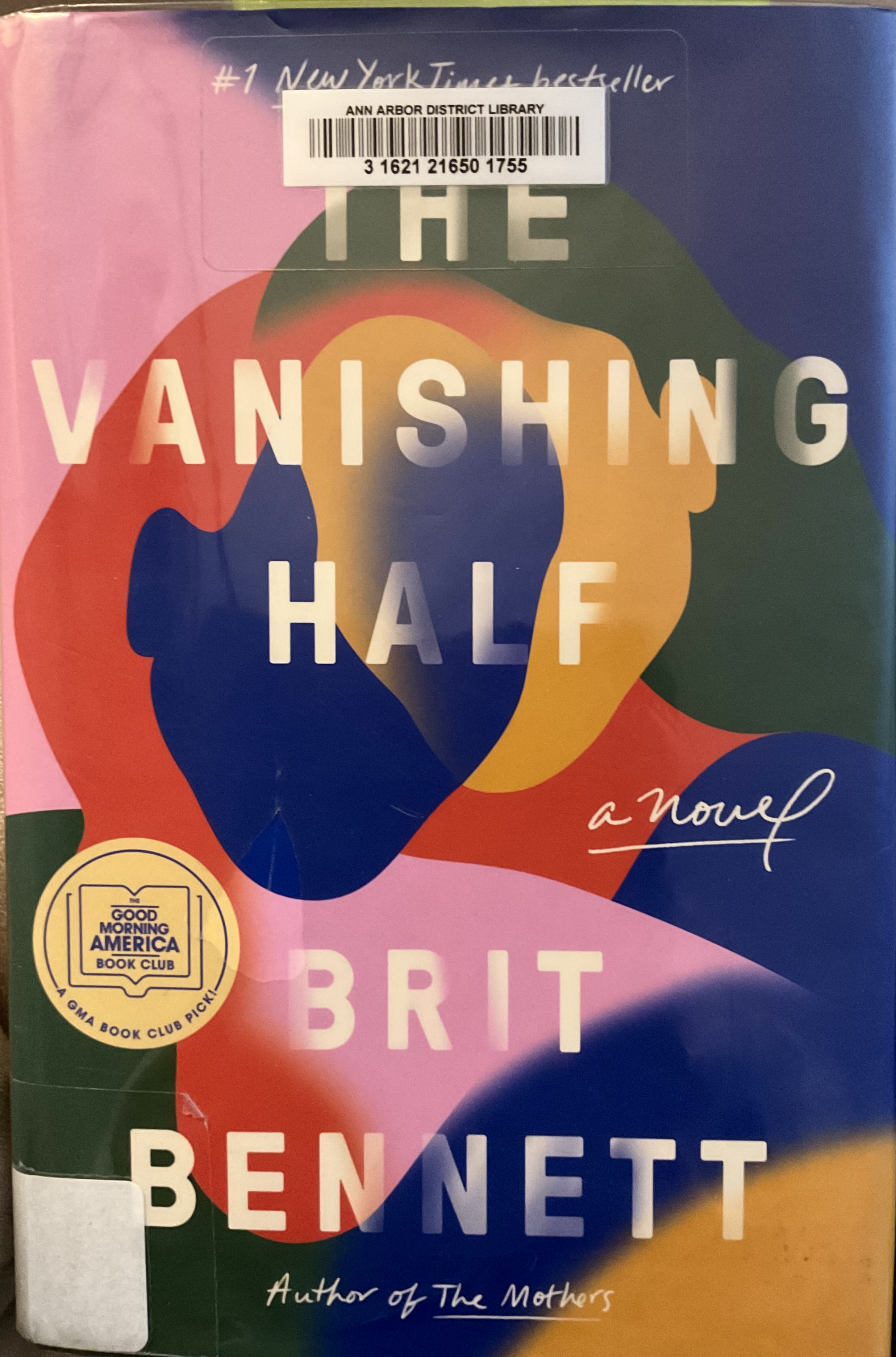
The Vanishing Half by Brit Bennett.
Twins are always a good metaphor for something. Good read!

The Adventures of China Iron by Cabezon Camara.
I really did not like this book at all! Very forced and mannered writing.

Reading now: Eleanor Oliphant is Completely Fine by Gail Honeyman.
Finished it: it’s good.

And In Our Neighborhood


Finally: A few spring flowers among last fall’s dead leaves.

Mainly this week was busy with Evelyn’s very quick visit. We did a few things together, cooked good dinners, took some nice walks, and ate lunch out a couple of times — NO STRESS! Although I did finish some books, I didn’t have time to write the kind of reviews that I like to write: those DO take time and thought.

“Bombay Fish Tacos” at Cafe Zola. Mango with Urfa Pepper is delicious!
Evelyn had shakshouka, Len had the mezze platter. All good.


Blog post © 2025 mae sander. 
Shared with Sunday Salon at Readerbuzz and Eileen’s critters.

Sunday, July 23, 2023

Street Art and a FIre

This interesting mural appears in an unexpected location in Ann Arbor: on the site of a destructive fire that
gutted two businesses last January. I am sharing this mural with Sami's Monday Murals.


The building that was next to the mural is now rubble, left after the fire and demolition of the destroyed structure.
The fire started in a restaurant kitchen at the back of the building. Fortunately, no one was inside.

A few years ago, I belonged to a writers' group that met in the basement of the building which was then a cafe.
I always had a terrible fear of fire that would trap anyone who was sitting at the bottom of a narrow stairway leading down to the basement.

I never saw the mural when the building was standing, but now it's very visible.

The Library Game in Ann Arbor


Advertised widely: the library summer reading game. The truck has the message!

Yard signs throughout the neighborhood show participation in the game.


Blog post © 2023 mae sander.


Tuesday, January 03, 2023

Reading, Watching, Cooking

 Obviously, it’s winter and we are spending a lot of time indoors trying to amuse ourselves. Here are a few of the choices from the last several weeks, some good, some not-so-good.

Alejandro Zambra may be a famous Chilean author. I don’t know.
I hated this book and I can’t imagine why I read the whole boring thing.

I loved “Knives Out” and I loved “Glass Onion.” Both fabulous.
So clever to have a sequel that is totally different from the first film.

Midsomer Murders is back for the 1,000,000-th season. The plots are implausible,
the characters are cartoonish, and I can’t stop watching. It’s cute.
Example: Detective Winter dives into a swiftly-moving millrace and rescues a near-victim.
He comes out, puts a towel around his shoulders, and doesn’t take off his tie.

Inspector Gamache is back. I watched one or two episodes.

New season: "Death In Paradise" -- Len's favorite. I watch inattentively.

Seeking new recipes: Fuchsia Dunlop’s classic cookbook.


Tuesday, August 30, 2022

Books I Read in August

While traveling and since I've returned,  I've read several books, but I've never taken the time to write any blog posts about them. The Kindle App makes it easy to have lots of reading material even while traveling light! So you can see above, my Kindle screen with books I've read. Before the month is over, I wanted to list and briefly describe them, but if I try to review them, I'll never catch up. 

  • Hunting and Gathering by Anna Gavalda. I would call this a romantic novel, in a very French style. The characters are quirky and mainly lovable, and they develop deep relationships and commitments to one another in the course of the story. One of them is a hard-working chef -- unlike many American novels about Paris restaurants, this shows the painful and abusive side of life in a restaurant kitchen in Paris.
  • Death in Brittany by Jean-Luc Bannalec. This is a great police procedural, set in Pont-Aven, Brittany, where Gauguin and other artists lived in the 19th century. The memory of the artists is at the center of this suspenseful murder mystery. I especially enjoyed reading about the wonderful meals that the characters ate, for example:
    • "They ordered straight away, without much discussion. Belon oysters harvested from the river a few hundred metres away, followed by grilled monkfish with fleur de sel, pepper and lemon, washed down with a chilled, very young red wine from the RhĆ“ne valley." (p. 250).
  • The Dance Hall of the Dead by Tony Hillerman. This is the second of the novels about policeman Joe Leaphorn, written around 40 years ago and still wonderful to read because it's so knowledgeable about the lives of the Navajo and Zuni people in the Southwest. And very skillfully constructed. Hillerman was a master! Over the years, I've read the whole series and I'm starting over.
  • The Far Traveler: Voyage of a Viking Woman by Nancy Marie Brown. I reread this to connect with all I was learning about the Viking settlements of Greenland beginning in the 10th century. It was wonderful to learn about events that took place 1000 years ago in the exact locations that we visited.
  • Quake: A Novel by Auưur Jónsdóttir. I enjoyed this interesting psychological novel by an Icelandic writer. There are so many Icelandic writers -- considering the very small size of the country, and I'm planning to read more. The New York Times recently published a tempting list: "Read Your Way Through ReykjavĆ­k"
  • The Daughter of Dr. Moreau by Silvia Moreno-Garcia. This is a scary horror story based on the work of H.G.Wells. Moreno-Garcia is excellent at turning the standard horror genre into something different, where women are more powerful and less victimized, somehow.
  • The Island of Dr. Moreau by H.G.Wells, one of the inventors of Sci-Fi as we know it. I had to read the original as well as the knock-off. This was first published in 1896. There are at least two movie versions, which also influenced Moreno-Garcia, I think.
  • Ant Farm by James M. Jackson. When our fellow passenger Jim on the Explorer told us that he had written a series of detective novels, of course I had to read one. This is the first Seamus McCree novel in his series. I liked the hard-boiled style of the mainly first-person narrative, and I enjoyed the references to many types of birds (Jim is an avid birder) and also the numerous meals that he mentioned. Here's one of Seamus's descriptions:
    • "I drowned my pancakes in maple syrup—the real thing from Vermont. Years ago Paddy [Seamus's son] had insisted I ditch the supermarket plastic-bottle stuff. He claimed maple syrup was the one sweetener that didn’t impede mineral absorption, or some such. I admired his eating habits, but usually didn’t want to emulate them. He’d live longer than I, but I was unwilling to give up meat to gain a few years of life expectancy. In this case, I didn’t care what his reasons were; real tasted better." (p. 83).
Jim Jackson and his wife Jan in the lounge of the Explorer.


Blog post © 2022 mae sander.


Wednesday, January 26, 2022

Library Shelfie Day

A bookcase in my living room.

 A very new celebratory day: Library Shelfie Day. Today for the seventh year, on the fourth Wednesday in January, is a day to celebrate your library shelves with a photo. You can celebrate your Kindle too. When I read about this obscure celebration, I couldn’t resist!

My Kindle bookshelf showing most recently read books.

A corner of my bookcase featuring a recently-purchased reprint of a book by Edouard de Pomiane
which I hope to read soon, and other books by or about this author, some in their early-20th-century editions.

Blog post and photos © 2022 mae sander.