Showing posts with label Travel Challenges. Show all posts

Friday, June 24, 2022

American Food

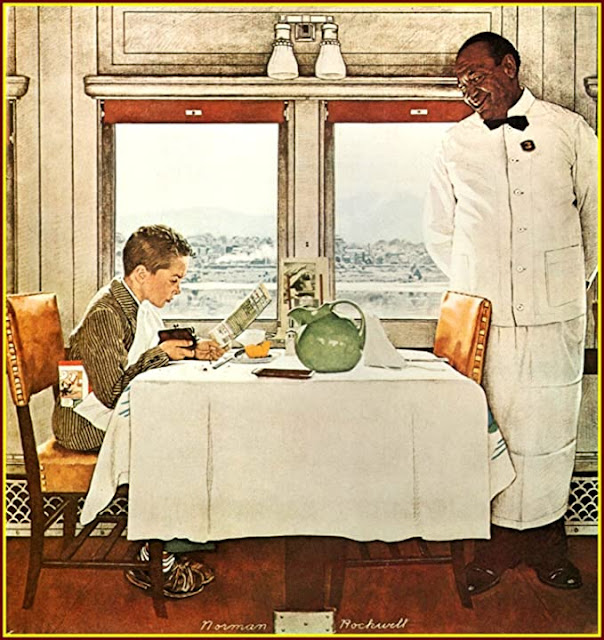
Norman Rockwell, "Boy in Dining Car," 1946. (Source)

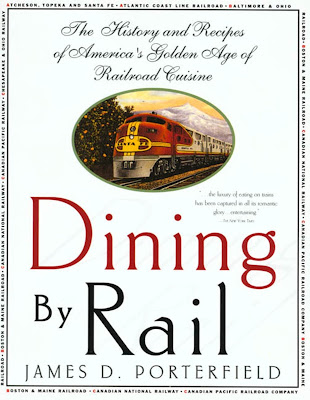
James D. Porterfield' book Dining by Rail: The History and Recipes of America's Golden Age of Railroad Cuisine brings to life what it must have been like to travel by train during the 100 years or so of the glory days of rail travel. His focus: the evolution of the dining car, and all the ingenuity that went into its technology, particularly the role of the Pullman company in inventing and leasing the cars to the major rail lines. The extraordinary hard work done by the chefs, cooks, porters, and other RR employees also has a major role in this history.
Dining cars were especially notable on the Western routes of the great train companies. Railroad management made a commitment to ensuring high quality of meals, impeccable service by uniformed waiters, and the luxury of elegant tableware and linens in their well-appointed dining cars. Such amenities were a key factor in competition for passengers on the various railway lines with common destinations. I learned -- to my amazement -- that meal service was always provided at a loss to the rail line; for $1 that a passenger paid the railroads would spend as much as $1.85 (though mostly not quite that much). 

The cost of labor was the main factor in the expenses of a dining car. Porterfield provides a very interesting study of the men -- and rarely women -- who prepared, served, cleaned, planned, and ordered the provisions. All cooking, all bread-baking, and all washing-up was done on the moving train, in very close quarters, with the cooks subject to the extreme heat of the tiny dining-car kitchens. Unlike in restaurants, every employee had several duties including all types of cooking, dishwashing, sorting linens, polishing silverware, and other work in the kitchen or dining room.

Because of a variety of circumstances, the majority of these workers were Black. The fact that they had good, long-term jobs had a role in Black American history; however, that's not my subject for today.

As I read both the historic part of Dining by Rail and also the cookbook part of the book, I felt more and more that these foods, these recipes, these experiences embody the answer to the repeatedly asked question: 

What is American Food?

If any cuisine was ever AMERICAN, this is it: American ingredients made for primarily American travelers. The dining cars obtained their major supplies from the endpoints of their routes -- cities like Chicago, Kansas City, St. Louis, and cities on the West Coast, as well as some purchases along the way. Rail lines on the east coast, the south, and Canada were handled similarly. Fresh fish and game, as well as fresh produce and meat, played a central part in railway cuisine. Each regional railroad company (and there were many) had its own special style and recipes, as did individual chefs on some of the lines, often reflecting the dishes of the region.

"In an age when caloric intake was not a consideration, a typical dinner menu might offer sirloin, tenderloin, porterhouse, or venison steak, prairie chicken, snipe, quail, golden plover, blue-winged teal, woodcock, broiled pigeon, mallard, widgeon, canvasback or domestic duck, wild turkey, veal, mutton, chicken, roast pork, sixteen relishes, eleven clam and oyster dishes, five fish dishes, fifteen kinds of bread, as well as many soups." (p. 148)

Dining car menus were extraordinarily long, with many choices of appetizers, entrees, desserts, wines, and breakfast specials. Porterfield offers a number of recipes for one particular breakfast favorite: French toast. He includes the French toast of the Northern Pacific line, where the cooks first made a special bread for the French toast. Also, the French toast recipe from the Soo Line, from the Pennsylvania Railroad, and from the Union Pacific. Most famous was that of the Santa Fe Railway, as perfected by Fred Harvey chefs in 1918. They all sound delicious, and despite the term "French," they are very definitely American. When you read about the dining car breakfasts, you can clearly see how the now-popular menu of the modern diner descends from railway cuisine.

As I read through the recipes in the book, I recognized the American style of food that is relatively simple, though influenced by techniques from haute cuisine in France and New York. Restaurant dining wasn't as common a pastime in the mid-19th century when restaurant cars were first introduced, so the menus had to please sophisticated customers and also those who had no familiarity with the ordering procedure and service of the dining car. Further, space was often limited, so the luxury of eating slowly and having time between courses was not available -- at times, there many people waiting a turn at the table. In fact, customers would fill out an order form at their seats in the train in advance of their arrival, so that the kitchen could have their meals ready to serve as soon as they were seated at their table. This all worked because of the high number of very skilled personnel who staffed the dining cars.

For the cookbook part of Dining by Rail, Porterfield chose among thousands of recipes that survived in the archives of the railroad lines and in published books or articles. Obviously, he only included foods that were available to modern cooks: for example, he offers no recipes for antelope steaks! No recipes for cooking birds that can now be seen only by birdwatchers -- like prairie chickens, a once-common game bird that's now only found in a very few locations (how I would love to see one)! But I digress; the variety in the choice of recipes in this book is amazing, as are the recipe titles, which reflect both American regional cooking and influence from abroad.

Favorites included dishes that remain just as popular today, like many ways to make apple pie. There are recipes for pumpkin pie, stuffed ducks and other roasts, a variety of gravies, donuts, chicken pie and other meat pies; tourtieres, a Canadian pork pie served on the Canadian railways; baked or fried ham, fried chicken,  deviled crabmeat, classic salads, special versions of the stuffed baked potato, cinnamon buns, potato rolls, and many more. For example, I'm intrigued that Chicago, Milwaukee, St. Paul & Pacific fudge was special to the Chicago, Milwaukee, St. Paul & Pacific railroad. 

Recipes often had regional or ethnic names that would be recognizable to the dining car customers, such as "Creole," "Mexican style," "Irish lamb stew," "Wisconsin," "Illinois," "Curried Chicken Colombo," "Puget Sound Clam Chowder," "Chesapeake Bay Oysters," and "Indian Pudding." These all had a pretty specific meaning in American cuisine in the golden age of railroad dining!

Recipes with an exotic flare often used a foreign place-name to signal a particular ingredient. "Hawaiian" as you would expect, usually means the dish contains pineapple. "Arabian Peach Salad" contained dates. The ethnic confusion of "Terrine of Ragout à la Deutsch" may have had a specific meaning that I don't recognize, all I know is that it was beef, veal kidneys, green peppers, onions, and mushrooms in brown sauce. There were dishes labeled "Bretagne," "Venetian," "Normandie," "Spanish," "Pourtagaise [sic]," "Romanoff," "Athens," "Parisienne," "Hungarian," "Hong-Kong style," "Roman dressing," the "Cuban Sandwich," and more -- but as far as I can see from the lists of ingredients and cooking methods, the influence of all these far-away places was small, and the actual foods would have tasted familiarly American.

The more I read the recipes, the more I became convinced that this is a menu of truly American food, made according to the best recipes and techniques that our country still has to offer. The skill of the chefs and cooks, who often spent many years working for the same railway company, was legendary -- and deserved to be legendary. Indeed, I'm sure that railroad cuisine and the romance of the dining car left its mark on American food ways.
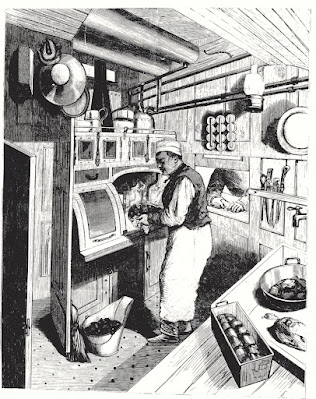
An early dining car kitchen. (Source)

Looking Back and Looking Forward

Railroad memories are profound and inspiring, especially many people's memories of eating in the dining car -- or by now, impressions left by older family members or friends who described such meals. Collectors of dining car menus, flatware, silver, and china are numerous. Actually, people were collecting this stuff during the glory days: in fact, one railroad printed especially attractive menus that the diners could take home, in  hopes of distracting them from stealing the silverware! (p. 189)

Besides the cuisine, the railroad dining car established new concepts of eating in a hurry. Time constraints on a train resulted because too many passengers wanted to eat in the dining car at each meal. Train timetables and scheduling demands meant there was always time pressure. In response to these requirements, the rail dining cars, café cars with less extensive offerings, and station lunch counters were the first "fast food" or "quick lunch" outlets in American history. The techniques of preparing a large number of meals quickly in a crowded space was worked out by rail employees with the technology developed by Pullman.  

As I've mentioned, the still-popular diner with its speedy service and traditional menu is the descendant of railway dining cars: the original diners. There were various other unexpected innovations due to the dining car and its personnel. For one example, a railroad chef in charge of baking developed a method of pre-blending flour, shortening, and other ingredients before mealtime rush in order to serve hot biscuits to order at lunch or dinner. A General Mills employee observed this preparation technique, and he then developed the product Bisquick: the first such commercial mix, introduced in 1931. (p. 142)

When Amtrak took over the passenger lines in the 1970s, fine dining was phased out and replaced by disgusting packaged food, a trend that was getting worse in 1993 when Porterfield published Dining by Rail. By now, Amtrak has a long and tedious history! For several years, there have been no dining cars whatsoever; however, this year, 2022, has seen the reintroduction of dining cars on several long-distance Amtrak trains in the West, and two lines in the East. They plan to offer high-end dining car service, especially for first-class passengers; I have seen no reviews of how it's going. For details see: "Updated Dining Options on Amtrak Long-Distance and Acela Trains."

If you have the least interest in social history, railroad history, or American cuisine, Dining by Rail is a good read! It was first published in 1993, republished in 1998, and is still in print, which shows its staying power as a good history book.

Review © 2022 mae sander

Thursday, May 03, 2018

To Travel by Train

"There may be no better method of job creation ever invented than a railroad."
(from Train by Tom Zoellner, Kindle Locations 1026-1027).
The railroad, invented in England, was a major development of the industrial revolution, specifically invented to carry coal from the mines, but soon put to many other purposes. At first sight, humans found trains with their huge engines unnatural and often terrifying. They had never seen such a source of steam and fire, and they had never experienced such incredible speeds -- over 10 miles an hour to begin, and becoming faster and faster.

In Tom Zoellner's book Train: Riding the Rails That Created the Modern World-from the Trans-Siberian to the Southwest Chief the early reactions are described in a quote from the historian Thomas Carlyle, who never forgot his first rail journey:
"'To whirl through the confused darkness, on those steam wings, was one of the strongest experiences I have experienced,' he wrote. 'Out of one vehicle into another, snorting, roaring we flew: the likest thing to a Faust’s flight on the Devil’s mantle.'  
"These metaphors were dramatic, but they were correct in naming the railroad as an essentially chthonic machine, born underground. The primary fuel for its engine, the most important cargo, its entire economic reason for being— all of these critical elements were a direct result of the velvety rock that lay in shallow deposits under the soil of northern England." (Kindle Locations 379-383). 
"Chthonic" is a vivid and obscure word that refers to Greek gods or other spirits or demons that inhabit the underworld. Zoellner often choses such words to portray the effect of trains on a variety of countries and cultures. Railroads, as he documents them, have become important factors in these countries' economy, their landscapes, the creation of their cities, the transport of goods, their access to a varied diet, and the movement of people.

Zoellner talks about the 19th century railroad barons who made huge fortunes and then maybe lost them, but whose successes shrank the continents. He also talks about modern developments of bullet trains, and modern neglect of some of the once great passenger lines such as Amtrak and English rail lines. He discusses some of the famous palatial railroad stations and what's become of them. With great insights, I think, he discusses the force of the railroad as a way to create employment and contribute to economic well-being. Of freight trains he writes: "a central truth about the railroad: there remains no better mechanism for hauling heavy commodities." (Kindle Locations 3948-3949).

The heart of the book, however, is Zoellner's love of passenger trains. In each chapter he concentrates on his own personal journey on a train line of his choice. He weaves his experiences with the history and economic development of the rails in that country. In the UK Zoellner went by train from the north of Scotland to the farthest south he could. In the USA he traveled by the Acela from New York to Washington, DC, and then on Amtrak all the way to Los Angeles. In China he took the incredible rail line to Tibet. In India he experienced the national railway's filth; he witnessed its vast commitment to using human labor and not automation. In the Peruvian Andes he rode on the steepest train tracks on earth. Zoellner attempted the famous train ride from European Russia to the end of the trans-Siberian railway; however, his voyage was interrupted when a potentially rabid dog bit him and he rushed home for preventative treatment. All fascinating.

Zoellner's descriptions make his experiences vivid. He says little about the food (on Amtrak, he recommends the dining cars not for the cuisine, which he finds "reliably mediocre," but as a place to find people to talk to; in other countries, it's worse). But his descriptions of the aromas, odors, smells, and stinks of trains throughout the world are very revealing! Here are a few of his descriptions, including olfactory ones, to give you a sense of this enjoyable book:
"The Northeast Regional train to Washington lay idling like a silver python. I stepped onto it and immediately smelled the unmistakable fragrance of Amtrak: blue toilet fluid, old socks, a lacing of diesel fuel." (Kindle Locations 1720-1721).
"The Southwest Chief was called for a 3: 00 P.M. departure, and I went out onto the platform to board it. ... a lower berth, which smelled of the usual blend of diesel and bleach." (Kindle Locations 2322-2318). 
"Practically every rail journey from Moscow through Siberia starts from Yaroslavl station, a handsome hulk built in 1904 and designed to look like a Russian Orthodox convent. ... The bunks were coated in vinyl and padded with approximately two micrometers of stuffing. .... Though the train was not yet moving, a strong odor of coal smoke and human body pervaded the carriage." (Kindle Locations 3005-3015). 
"Laziness and dissipation are inevitable on the Trans-Siberian.... I had grown used to the smell of sour feet and onions and had done as almost everyone else was doing by the way of meals— that is to say, avoiding the dining car. Instead I bought cartons of sodium-soaked ramen noodles from the babushkas who gathered by the tracks." (Kindle Locations 3140-3146). 
"Riding through the Tibetan plateau inside a train compartment feels like cheating. ... All a traveler needs to do these days is gaze out the window at the unfolding subarctic plain where he never belonged but nevertheless has a kind of unlikely intercourse. ... A woman in a hooded garment was bending over to pick up a disk of yak dung which is used as everyday household fuel. I smelled some in a fireplace later, and it burns as clean and odorless as balsa wood." (Kindle Locations 3773-3784). 
"We soon came to the town of La Oroya [Peru], which is one of the filthiest places I have ever seen. The cliffs surrounding the town have been wiped clean of all vegetation and sport a bizarre white coating that looks as if ten billion tons of bird guano or cake frosting had been dropped on them and slowly oozed downward. This is the remnant of the sulfuric-acid clouds from a nearby smelter. ... A waiter came out to the back porch to serve cups of tea brewed from coca leaves, and it numbed the inside of my mouth. The air smelled of wet grass and fresh metal, and as we climbed, the sky became a weird pastiche of angled sun and clouds and snow." (Kindle Locations 3998-4018).

Thinking about train rides... 

A childhood memory: St. Louis Union Station with the Milles Fountain.
Image from Wikipedia.
In my own life, I've had a few memorable train trips. Zoellner inspired me to think about trains I have known.

In St. Louis, I was introduced to trains as a child, specifically by my first train trip which was 8 minutes long. We went from the Wabash Station at the west edge of the city to the big, downtown Union Station, an introduction thought up by a friend of my father. She accompanied me and my sister on this exciting first trip while my father dropped us off at the Wabash Station and then drove downtown to pick us up. Also, I remember the beauty of the sculpture by Carl Milles which still stands in front of the station, though it's now mainly used for other purposes.

Snacks on the train, California, 2014.
In the last several years, I've been lucky to make some interesting train trips. One was from Warsaw to Krakow and back the same day -- a very long day! On a different trip to Europe, I traveled by TGV (the French bullet train) from Paris to Avignon, on to Arles, and then back to Paris. In 2014 I enjoyed a beautiful train ride beside the Pacific Ocean from Santa Barbara to Delmar near San Diego and back. I also had a tormented night on a very late train from Germany to Paris, where our reserved seats were taken by other passengers. I don't think I'd have the patience or the nerve to do the ambitious train travel that Zoellner did, but I loved reading about it.

Wednesday, November 02, 2016

Hills

David Hockney, Rocky Mountains and Tired Indian.

Albert Bierstadt, Pike's Peak.
Paul Cezanne, Mount Sainte Victoire

Hokusai, Mount Fuji.
J.M.W. Turner, Red Rigi.

Marsden Hartley: New Mexico.

Mi Fu, Mountains (Chinese, 12th Century)

Georgia O'Keeffee, The Pedernal, New Mexico.
The hills of Donegal in her Irish homeland inspired this week’s travel challenge -- hills -- from blogger Ailsa Prideaux-Mooney at Where's My Backpack. Quite a few other bloggers have responded with hill photos from Australia, Spain and around the Mediterranean, Southeast Asia, Midwestern USA, the British Isles, and elsewhere. As I looked, I was thinking about paintings of hills and mountains: Georgia O'Keeffe in New Mexico; Cezanne in Provence; Hokusai at Mount Fuji... . Since these photos really speak for themselves, I'm also sharing this to Wordless Wednesday (well, almost wordless).

Saturday, October 22, 2016

Playing: A Game of Pétanque

Here we are: back home in Ann Arbor, and I'm reading other people's blogs. At the blog titled "Where's my backpack," Ailsa Prideaux-Mooney has challenged her readers to create posts on the theme "PLAYING." To me, this is a great idea, as in fact, I rarely get photos of activities that would be considered "play." 

Birdwatching? I do it all the time for fun, but it's not really play. Eating and cooking? Some of the motives are similar -- but it's not really play. In my two recent trips, very few of my photos concern any conventional images of "play." I didn't, for example, take photos of musicians playing, the subject of several of the other blogs on the subject. Though I attended an opera performance, the musicians playing in fact seemed very very serious.

As I thought about play, I remembered watching a game of Pétanque in the small town of Saintes-Maries-de-la-Mer in France last April --


... and also remembered a few similar photos from the Luxembourg Gardens in Paris a week later:


From the "Discover France" website, an explanation of this game and its popularity in France:
"The game of boules, otherwise known as pétanque, is perhaps the sport that is closest to French hearts. Similar to British lawn bowling or Italian bocce, the French version is traditionally played with metallic balls on a dirt surface beneath plane trees, with a glass of pastis at hand. The local boulodrome is a social focal point in southern France. 
"The object of the game is to throw your balls — usually with somewhat of an arched back-spin — so that they land closer to the small object ball (cochonnet) than those of your opponent, or strike and drive the object ball toward your other balls and away from your opponent's."
I've seen the game played elsewhere, including in the park a few blocks from my home, but these photos seem the most playful for the blogger theme.

Tuesday, October 11, 2016

Enlightenment

An Irish blogger named Ailsa Prideaux-Mooney wrote recently about her chagrin at the American election. She wrote: "To counteract this bleakness, I have resolved to actively seek out all that is enlightened, noble and beautiful about being human – and that’s what this week’s travel theme is about. I hope you’ll join me in celebrating the joy of the human condition."

I accept her challenge: to post photos from recent travels that make one think of enlightenment, and help to look forward from the current election season to what one hopes will be an enlightened woman in the Presidency. I am linking to her post, Travel Theme: Enlightened

My selection of photos I've taken in the past 6 months that have that meaning for me:

Paris, Museè D'Orsay, Statue of Liberty (one of various copies by the original French sculptor
Frédéric Auguste Bartholdi).
Gutenberg's Printing Press. Printing Museum, Provo, Utah.
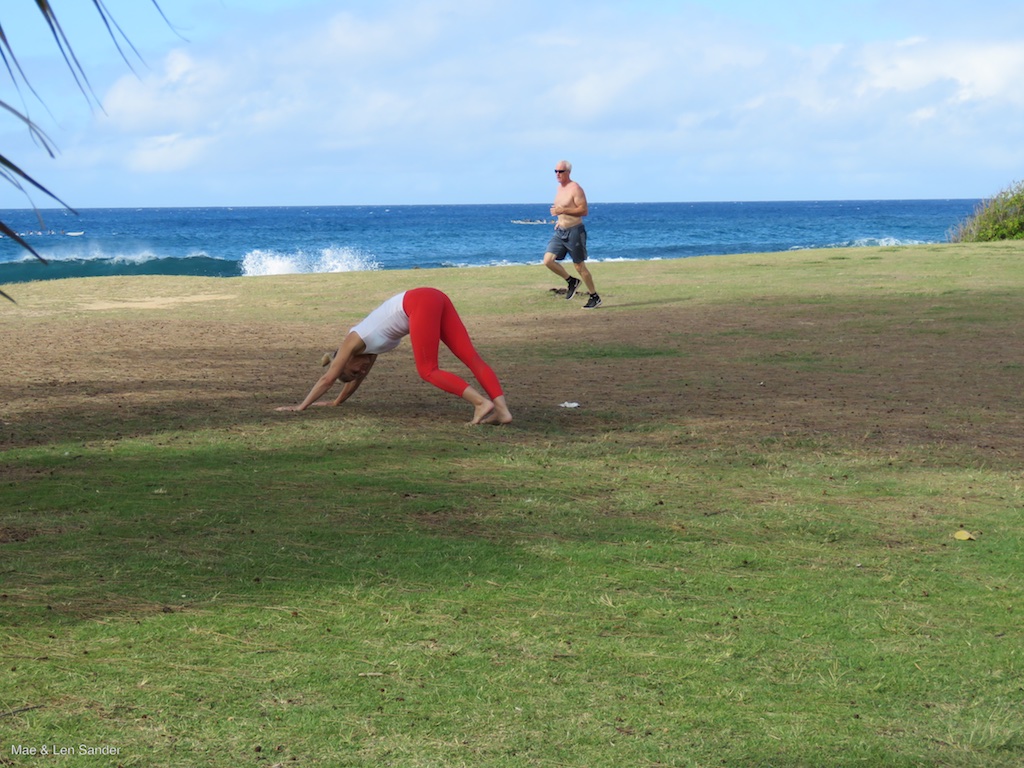
Woman doing Yoga by the Pacific Ocean. Kauai, Hawaii.

Hawaiian Rainbow.

Native Hawaiian Owl. While it denotes wisdom in our culture,
in Hawaiian culture the owl is a protector.
Chinese Scholar's Study, Victoria & Albert Museum, London.