 |
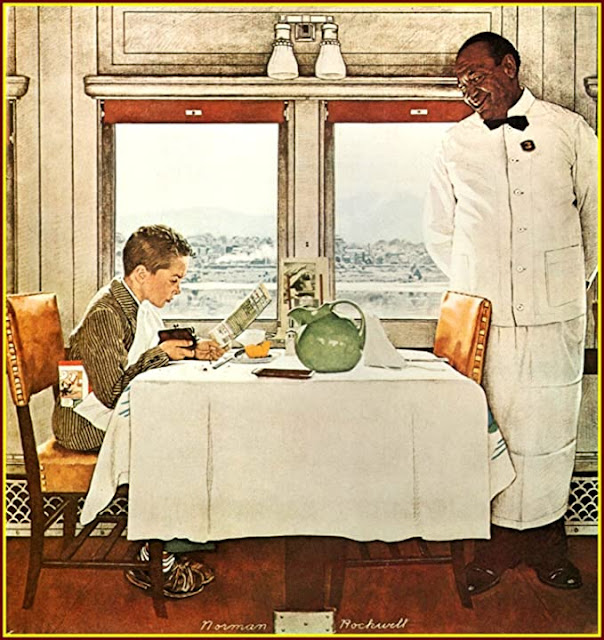
| Norman Rockwell, "Boy in Dining Car," 1946. (Source) |
James D. Porterfield' book
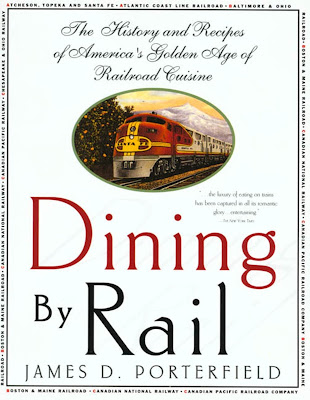
Dining by Rail: The History and Recipes of America's Golden Age of Railroad Cuisine brings to life what it must have been like to travel by train during the 100 years or so of the glory days of rail travel. His focus: the evolution of the dining car, and all the ingenuity that went into its technology, particularly the role of the Pullman company in inventing and leasing the cars to the major rail lines. The extraordinary hard work done by the chefs, cooks, porters, and other RR employees also has a major role in this history.
Dining cars were especially notable on the Western routes of the great train companies. Railroad management made a commitment to ensuring high quality of meals, impeccable service by uniformed waiters, and the luxury of elegant tableware and linens in their well-appointed dining cars. Such amenities were a key factor in competition for passengers on the various railway lines with common destinations. I learned -- to my amazement -- that meal service was always provided at a loss to the rail line; for $1 that a passenger paid the railroads would spend as much as $1.85 (though mostly not quite that much).
The cost of labor was the main factor in the expenses of a dining car. Porterfield provides a very interesting study of the men -- and rarely women -- who prepared, served, cleaned, planned, and ordered the provisions. All cooking, all bread-baking, and all washing-up was done on the moving train, in very close quarters, with the cooks subject to the extreme heat of the tiny dining-car kitchens. Unlike in restaurants, every employee had several duties including all types of cooking, dishwashing, sorting linens, polishing silverware, and other work in the kitchen or dining room.
Because of a variety of circumstances, the majority of these workers were Black. The fact that they had good, long-term jobs had a role in Black American history; however, that's not my subject for today.
As I read both the historic part of Dining by Rail and also the cookbook part of the book, I felt more and more that these foods, these recipes, these experiences embody the answer to the repeatedly asked question:
What is American Food?
If any cuisine was ever AMERICAN, this is it: American ingredients made for primarily American travelers. The dining cars obtained their major supplies from the endpoints of their routes -- cities like Chicago, Kansas City, St. Louis, and cities on the West Coast, as well as some purchases along the way. Rail lines on the east coast, the south, and Canada were handled similarly. Fresh fish and game, as well as fresh produce and meat, played a central part in railway cuisine. Each regional railroad company (and there were many) had its own special style and recipes, as did individual chefs on some of the lines, often reflecting the dishes of the region.
"In an age when caloric intake was not a consideration, a typical dinner menu might offer sirloin, tenderloin, porterhouse, or venison steak, prairie chicken, snipe, quail, golden plover, blue-winged teal, woodcock, broiled pigeon, mallard, widgeon, canvasback or domestic duck, wild turkey, veal, mutton, chicken, roast pork, sixteen relishes, eleven clam and oyster dishes, five fish dishes, fifteen kinds of bread, as well as many soups." (p. 148)
Dining car menus were extraordinarily long, with many choices of appetizers, entrees, desserts, wines, and breakfast specials. Porterfield offers a number of recipes for one particular breakfast favorite: French toast. He includes the French toast of the Northern Pacific line, where the cooks first made a special bread for the French toast. Also, the French toast recipe from the Soo Line, from the Pennsylvania Railroad, and from the Union Pacific. Most famous was that of the Santa Fe Railway, as perfected by Fred Harvey chefs in 1918. They all sound delicious, and despite the term "French," they are very definitely American. When you read about the dining car breakfasts, you can clearly see how the now-popular menu of the modern diner descends from railway cuisine.
As I read through the recipes in the book, I recognized the American style of food that is relatively simple, though influenced by techniques from haute cuisine in France and New York. Restaurant dining wasn't as common a pastime in the mid-19th century when restaurant cars were first introduced, so the menus had to please sophisticated customers and also those who had no familiarity with the ordering procedure and service of the dining car. Further, space was often limited, so the luxury of eating slowly and having time between courses was not available -- at times, there many people waiting a turn at the table. In fact, customers would fill out an order form at their seats in the train in advance of their arrival, so that the kitchen could have their meals ready to serve as soon as they were seated at their table. This all worked because of the high number of very skilled personnel who staffed the dining cars.
For the cookbook part of Dining by Rail, Porterfield chose among thousands of recipes that survived in the archives of the railroad lines and in published books or articles. Obviously, he only included foods that were available to modern cooks: for example, he offers no recipes for antelope steaks! No recipes for cooking birds that can now be seen only by birdwatchers -- like prairie chickens, a once-common game bird that's now only found in a very few locations (how I would love to see one)! But I digress; the variety in the choice of recipes in this book is amazing, as are the recipe titles, which reflect both American regional cooking and influence from abroad.
Favorites included dishes that remain just as popular today, like many ways to make apple pie. There are recipes for pumpkin pie, stuffed ducks and other roasts, a variety of gravies, donuts, chicken pie and other meat pies; tourtieres, a Canadian pork pie served on the Canadian railways; baked or fried ham, fried chicken, deviled crabmeat, classic salads, special versions of the stuffed baked potato, cinnamon buns, potato rolls, and many more. For example, I'm intrigued that Chicago, Milwaukee, St. Paul & Pacific fudge was special to the Chicago, Milwaukee, St. Paul & Pacific railroad.
Recipes often had regional or ethnic names that would be recognizable to the dining car customers, such as "Creole," "Mexican style," "Irish lamb stew," "Wisconsin," "Illinois," "Curried Chicken Colombo," "Puget Sound Clam Chowder," "Chesapeake Bay Oysters," and "Indian Pudding." These all had a pretty specific meaning in American cuisine in the golden age of railroad dining!
Recipes with an exotic flare often used a foreign place-name to signal a particular ingredient. "Hawaiian" as you would expect, usually means the dish contains pineapple. "Arabian Peach Salad" contained dates. The ethnic confusion of "Terrine of Ragout à la Deutsch" may have had a specific meaning that I don't recognize, all I know is that it was beef, veal kidneys, green peppers, onions, and mushrooms in brown sauce. There were dishes labeled "Bretagne," "Venetian," "Normandie," "Spanish," "Pourtagaise [sic]," "Romanoff," "Athens," "Parisienne," "Hungarian," "Hong-Kong style," "Roman dressing," the "Cuban Sandwich," and more -- but as far as I can see from the lists of ingredients and cooking methods, the influence of all these far-away places was small, and the actual foods would have tasted familiarly American.
The more I read the recipes, the more I became convinced that this is a menu of truly American food, made according to the best recipes and techniques that our country still has to offer. The skill of the chefs and cooks, who often spent many years working for the same railway company, was legendary -- and deserved to be legendary. Indeed, I'm sure that railroad cuisine and the romance of the dining car left its mark on American food ways.
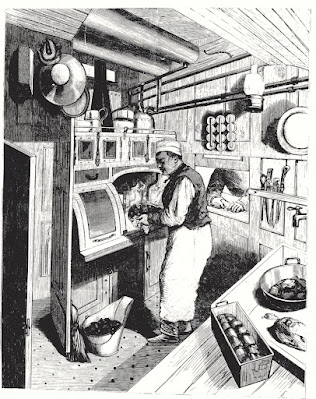 |
| An early dining car kitchen. (Source) |
Looking Back and Looking Forward
Railroad memories are profound and inspiring, especially many people's memories of eating in the dining car -- or by now, impressions left by older family members or friends who described such meals. Collectors of dining car menus, flatware, silver, and china are numerous. Actually, people were collecting this stuff during the glory days: in fact, one railroad printed especially attractive menus that the diners could take home, in hopes of distracting them from stealing the silverware! (p. 189)
Besides the cuisine, the railroad dining car established new concepts of eating in a hurry. Time constraints on a train resulted because too many passengers wanted to eat in the dining car at each meal. Train timetables and scheduling demands meant there was always time pressure. In response to these requirements, the rail dining cars, café cars with less extensive offerings, and station lunch counters were the first "fast food" or "quick lunch" outlets in American history. The techniques of preparing a large number of meals quickly in a crowded space was worked out by rail employees with the technology developed by Pullman.
As I've mentioned, the still-popular diner with its speedy service and traditional menu is the descendant of railway dining cars: the original diners. There were various other unexpected innovations due to the dining car and its personnel. For one example, a railroad chef in charge of baking developed a method of pre-blending flour, shortening, and other ingredients before mealtime rush in order to serve hot biscuits to order at lunch or dinner. A General Mills employee observed this preparation technique, and he then developed the product Bisquick: the first such commercial mix, introduced in 1931. (p. 142)
When Amtrak took over the passenger lines in the 1970s, fine dining was phased out and replaced by disgusting packaged food, a trend that was getting worse in 1993 when Porterfield published
Dining by Rail. By now, Amtrak has a long and tedious history! For several years, there have been no dining cars whatsoever; however, this year, 2022, has seen the reintroduction of dining cars on several long-distance Amtrak trains in the West, and two lines in the East. They plan to offer high-end dining car service, especially for first-class passengers; I have seen no reviews of how it's going. For details see: "
Updated Dining Options on Amtrak Long-Distance and Acela Trains."
If you have the least interest in social history, railroad history, or American cuisine, Dining by Rail is a good read! It was first published in 1993, republished in 1998, and is still in print, which shows its staying power as a good history book.
Review © 2022 mae sander


