Showing posts with label Susan Vreeland. Show all posts

Sunday, February 02, 2025

Girl in Hyacinth Blue


I have now read almost all of Susan Vreeland’s books, and enjoyed them all. Girl in Hyacinth Blue tells the story of a painting, an imaginary painting by Johannes Vermeer (1632-1675), the indescribably wonderful Dutch painter. Though the painting in the novel is imaginary, it’s described vividly as it seems to several characters who are enchanted by its power:

“The girl in the painting had a blue smock. How glorious to drape oneself in blue—the blue of the sky, of Heaven, of the pretty little lake at Westerbork with the tiny blue brooklime that grew along the banks, the blue of hyacinths and Delftware and all fine things.” (p.76)

I enjoyed reading this book, which is a series of small stories about several owners of the imagined painting going back in time until we meet the artist. The awe in which the work of Vermeer is held in the book is something that I can really grasp, as every Vermeer painting I have ever seen has captivated my thoughts and stayed with me as a vivid memory. I believe that in the course of visiting many museums, I have seen over half the surviving works by Vermeer. I’m adding some images of Vermeer paintings that I was thinking about as I read the novel.

Two Vermeer Paintings of a Girl in Blue 


Lady Seated at a Virginal

Woman Reading a Letter

Seeing Vermeer Paintings


Last year we visited The Haague and saw the Vermeers at the Mauritshaus. one of the best museums in the world because it is small and every painting is a masterpiece.

Vermeer’s View of Delft as we saw it.

The tiny figures on the shore.

The museum.


Blog post © 2025, photos © 2023 mae sander


Saturday, June 17, 2023

Reading


A quick read: Sarah Caudwell’s light-hearted mystery novel The Sirens Sang of Murder (published 1989). Improbably, this book is about a group of lawyers and financial advisers, and is chock-a-block full of really uninteresting details about British tax law. The characters are somewhat eccentric, and the plot, though somewhat thin, is not too bad. What kept me reading was some of the funny British eccentric parody. Some examples:

  • “The chagrin of a woman displaced in her lover’s affections is as nothing compared with that of a barrister superseded in the favour of a leading firm of solicitors.” (p. 15)
  • “We were driving through one of those bits of France where the hills have vines growing all over them and the names on the signposts make you feel as if you’re driving through the wine list in a rather high-class restaurant.” (p. 165)
  • “It seems to us that the readers who want fiction to be like life are considerably outnumbered by those who would like life to be like fiction.” (p. 11)
  • “I told her she was talking bilge, because even if she isn’t being followed, it doesn’t mean she’s loopy. People do follow people, so if you think you’re being followed by someone and you’re not, that’s not being loopy, it’s just being wrong—being loopy is if you think you’re being followed by purple elephants, unless you are of course.“ (p. 51)
I have read one other of this series of novels, titled Thus was Adonis Murdered. I may not read more.

Finding more books to read.


My stack of library books ready to check out. This branch library is architecturally beautiful, and serves many purposes besides the traditional library functions. The low bookcases make it very spacious looking.

First Library Book I Read.


"A 'historical novel' is a novel which is set fifty or more years in the past, and one in which the author is writing from research rather than personal experience." -- Historical Novel Society

This excellent and concise definition applies well to each of the historical novels by Susan Vreeland that I have read. Lisette’s List (published 2014) is set in Paris and in a village in Provence beginning as World War II was threatening to begin, in 1937, and continuing until the post-war era. The characters suffer numerous bereavements and deprivations during the war, particularly the loss of many men who have gone to fight. 

Villagers in the novel suffer from the lack of many essentials, such as gasoline for transportation and such as construction materials. There are many descriptions of the food shortages they experience, even though they live in an agricultural village: a French version of the wartime rationing that I wrote about earlier this week. However, the author downplays many of the atrocities of the war: vicious Nazi reprisals happened in other villages, not this one, and serious issues of the occupation, especially of the disloyal collaboration by French citizens, are glossed over in order to create a more romantic story. This soft-pedaling of wartime suffering is a flaw of the book.

For me, reading Lisette’s List evokes many memories, as over the years I have visited Paris and a number of cities and villages in the area where the story takes place. I also love the artists who are at the center of the story: Chagall, Pissarro, Cézanne, and Picasso and works by these painters all are important to the narrator. Lisette actually (fictitiously of course) meets Chagall and his wife as they are fleeing the Nazis; another character, her husband’s elderly grandfather, shares his own memories of the impressionist painters, as well as owning several of their paintings, which play a major role in the novel.

The beauty of France and the losses caused by the war are central to the novel, and to the title character/narrator, Lisette. She is a warm, intelligent and deeply thoughtful human being. Her day-to-day experiences and her deep passions are portrayed in a fascinating way, mingled with larger themes of art and history. Tomorrow I will post some photos illustrating the novel's connection to my memories and experiences in the French countryside.

Note: I found a good review with images of the paintings and places that appear in the novel here: American Girls Art Club.

One of Chagall’s painting that Lisette loves.

More Library Books.


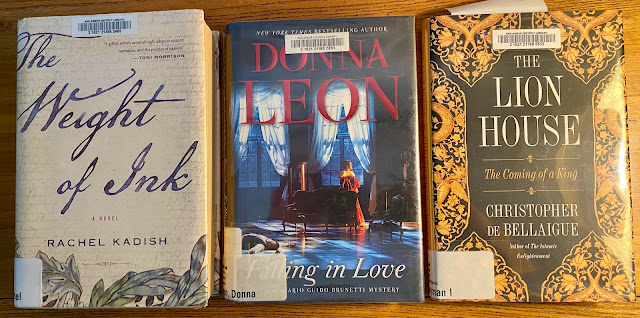
More library books that I intend to read: another historical novel, a Donna Leon mystery, and a history book.

Also, I watched a film.

A great Paris classic: Irma la Douce.


Blog post © 2023 mae sander
Shared with the Sunday Salon at Readerbuzz.


Wednesday, February 10, 2021

"Klee Wyck" by Emily Carr

Emily Carr statue, Victoria, B.C.
by Barbara Peterson, 2010. (source: Tripadvisor) 

 "It must have hurt the Indians dreadfully to have the things they had always believed trampled on and torn from their hugging. Down deep we all hug something. The great forest hugs its silence. The sea and the air hug the spilled cries of sea-birds. The forest hugs only silence; its birds and even its beasts are mute. When night came down upon Ucluelet the Indian people folded themselves into their houses and slept." -- Emily Carr, Klee Wyck, p. 10.


Klee Wyck by Emily Carr is a memoir in the form of short sketches describing events, adventures, and people from her experiences as a painter in British Columbia, Canada. She published it in 1941, when she was seventy years old and in poor health, fearing that she would no longer be able to continue with her art. Yesterday, I reviewed Susan Vreeland's novel The Forest Lover, a fiction based on Carr's life (blog post here). I was so interested that I decided to read Carr's own autobiographical writings.

Many of the sketches describe Emily Carr's lifelong interactions with the native people of western Canada. She gained their trust at a time when European colonizers of Victoria, Vancouver, and the villages of the province were abusing Indians and when there were few good relationships among whites and non-whites. She was especially compassionate with the mothers who lost so many children to disease and poor conditions.

Emily Carr's travel to the villages often involved frightening trips in small boats along the waterways connecting the islands of British Columbia. She suffered from hunger, cold, soaking rainstorms, crowded small quarters on the boats, seasickness, and fear that the sailors would forget to return to pick her up from some of the abandoned villages, but she always persisted, making sketches of the native art and the wild landscapes to take back in order to create full-scale oil and watercolor paintings. She worked for years to create a unique style and to preserve the spirit of native art works, and received recognition only when she was more than 50 years old.

The totem poles in native villages were especially fascinating to Emily Carr. At the time she visited the villages, many of these magnificent works of art were decaying or being destroyed. A few were sold to Canadian collectors (and still are on display in museums) but most were falling into disrepair as the native villages were forcibly de-populated, or were devastated by Western illnesses. 

Carr writes of the totem poles in one remote village:

"They looked like mere sticks in the vast sea of green that had swallowed the old village. Once they, too, had been forest trees, till the Indian mutilated and turned them into bare poles. Then he enriched the shorn things with carvings. He wanted some way of showing people things that were in his mind, things about the creatures and about himself and their relation to each other. He cut forms to fit the thoughts that the birds and animals and fish suggested to him, and to these he added something of himself. When they were all linked together they made very strong talk for the people. He grafted this new language on to the great cedar trunks and called them Totem poles and stuck them up in the villages with great ceremony. Then the cedar and the creatures and the man all talked together through the totem poles to the people. The carver did even more— he let his imaginings rise above the objects that he saw and pictured supernatural beings too. The creatures that had flesh and blood like themselves the Indians understood. They accepted them as their ancestors but the supernatural things they feared and tried to propitiate."(pp. 86-87).

I found so many wonderful and fascinating descriptions of the native villages and their inhabitants as Carr visited them. Some of her sketches interestingly describe the foodways. For example:

"One day after work I found the Douse family all sitting round on the floor. In the centre of the group was Lizzie. She was beating something in a pail, beating it with her hands; her arms were blobbed with pink froth to the elbows. Everyone stuck his hand into Lizzie’s pail and hooked out some of the froth in the crook of his fingers, then took long delicious licks. They invited me to lick too. It was 'soperlallie,' or soap berry. It grows in the woods; when you beat the berry it froths up and has a queer bitter taste. The Indians love it." (p. 180).

Food preferences -- along with many other issues -- were a mark of distinction between the native people and the Missionaries who often lived in the native villages and tried to change their ways, by force or by persuasion. In one case, Carr's travel to a native village included a daughter of Missionaries:

“We’ve took the Missionary’s daughter hunting devilfish,” chuckled Louisa, as she passed me. We ate some of the devilfish for supper, fried in pieces like sausage. It was sweet like chicken, but very tough. Miss Missionary ate bread and jam. 

“Father would not like me to eat devil,” she said. She told me the hunt was a disgusting performance. (p. 26). 

Klee Wyck is full of fascinating insights about the beliefs and religious traditions of the native people, such as this conversation about an Indian supernatural figure named D'Sonoqua:

“Who is D’Sonoqua?” 

“She is the wild woman of the woods.” 

“What does she do?” 

“She steals children.” 

“To eat them?” 

“No, she carries them to her caves; that,” pointing to a purple scar on the mountain across the bay, “is one of her caves. When she cries ‘OO-oo-oo-oeo’, Indian mothers are too frightened to move. They stand like trees, and the children go with D’Sonoqua.” 

“Then she is bad?” 

“Sometimes bad . . . sometimes good,” Tom replied, glancing furtively at those stuck-out ears. Then he got up and walked away. (pp. 61-62). 

More about a statue of D'Sonoqua that Carr saw in the woods:

"Like the D’Sonoqua of the other villages she was carved into the bole of a red cedar tree. Sun and storm had bleached the wood, moss here and there softened the crudeness of the modelling; sincerity underlay every stroke. She appeared to be neither wooden nor stationary, but a singing spirit, young and fresh, passing through the jungle. No violence coarsened her; no power domineered to wither her. She was graciously feminine." (p. 68). 

Finally what do the words of the title mean? "Klee Wyck," in the Chinook language, was the name that her native friends called her. She described the first time she heard it: she was being called by a native woman named Mrs. Wynook. She thought the call as hostile -- "Klee Wyck, come back, come back." She ran from Mrs. Wynook to the missionary woman who was hosting her in the village: 
"Mrs. Wynook put her thumbs into the corners of her mouth and stretched them upwards. She pointed at me; there was a long, guttural jabber in Chinook between her and the Missionary. Finally the Missionary said, 'Klee Wyck is the Indians’ name for you. It means Laughing One.’” (p. 9). 

This review © 2021 mae sander. 

Tuesday, February 09, 2021

Who Was Emily Carr?

The Forest Lover, published 2004.
Reading about places that I've been is always a great pleasure: a pleasure I enjoyed when reading Susan Vreeland's novel The Forest Lover. Vreeland created a fiction based on the life of Canadian painter and memoirist Emily Carr (1871-1945). Carr lived and painted in British Columbia with a one-year stay in Paris to study art. A major subject of Carr's paintings was the art of the native American villages in the Vancouver-Victoria area. She also visited Sitka, Alaska, where native art was dramatically visible. I have visited these places which intensified my enjoyment of the book, though I do not recall seeing Carr's works in the Canadian museums we have visited. 

Carr is one of many highly creative people who was ahead of her time, and was rebuffed and rejected in her efforts to be recognized for her work. The narrow-minded, anti-woman, anti-modern-art, anti-intellectual, and pompously religious attitudes of the Canadians of her time is very well depicted in Vreeland's novel. Carr was attempting to use the vision of Parisian artists of the pre-World-War I era to depict the beauty of the Canadian forests and of the native wood carvings, including especially the many historic totem poles that were being neglected and destroyed as the native people were being dispossessed. Her struggle to preserve her visionary appreciation of native art, which was held in contempt by her peers, is a fascinating story.

Emily Carr’s painting of Sophie, a native woman
who was a major character in her life and in Vreeland’s novel.
This image is from Carr’s memoir Klee Wyck, -- my next read.

In 2018, I paid a very memorable visit to Alert Bay, BC, a village where a great deal of Vreeland's novel takes place. Alert Bay is particularly remembered in history because of a shameful episode where the Canadian officials confiscated the tribal possessions, especially the masks used in their ceremonies. I learned about this on our visit to the town, and thus I was fascinated by the novel's treatment of Carr's eyewitness experience of the terrible mistreatment of the Kwakwaka’wakw tribe of Canadian First People in Alert Bay. I wrote about my visit and about the history of Alert Bay and the dramatic return of their property in the 1960s here: 

While I found the novel and its depiction of Emily Carr engaging, I was captivated by the art works themselves, as I looked them up while reading Vreeland's description of her struggles to create them. Carr was finally recognized, after years of rejection for her creative use of the style of the cubists, the fauves, and the other moderns, and these works were finally included in major Canadian art shows late in her life. My review of the novel is © 2021 -- the following images are credited with their sources.

Illustration from Carr's journal of her trip to Alaska in 1907 (source)

Carr, Indian Village Alert Bay, 1912. (source)


War Canoes in Alert Bay, 1912 (source)

Tanoo, Queen Charlotte Island, BC, 1913 (source)

Big Eagle, Skidegate, BC, 1930 (source)

The Burial Ground at Alert Bay, BC. From our trip in 2018. In Vreeland's book, Emily Carr saw the totem poles
in burial grounds of native villages falling into disrepair. Now, 100 years later, they are treated with respect.

Tuesday, August 04, 2020

"Luncheon of the Boating Party"


Renoir Self-Portrait, 1875.
Susan Vreeland's novel Luncheon of the Boating Party is a fictional account of how Pierre-Auguste Renoir created his very famous and much-loved painting of the same name. Fourteen faces appear in the painting of a beautiful luncheon outdoors at a restaurant along the Seine River in what was then the more rural part of Paris (now enveloped in the much larger city). All these figures (except one mystery face) have been identified: they were friends and acquaintances of Renoir. The painter did not include a self-portrait in this masterpiece, but I have included one that he painted in 1875, a few years before he painted the boating party.

Vreeland has woven a complex and highly enjoyable story of his relationships with this group, telling much about who they were and how they lived. Fortunately, a Wikipedia article has called them out with thumbnails of their faces from the painting, and I've selected a few favorites out of the fourteen faces in the painting, which I'll introduce to you here, while trying to give an idea of what's in the book:

 Louise-Alphonsine Fournaise – the girl leaning on the railing – was the daughter of the family that owned the water-side restaurant where Renoir's luncheon – and much of the action of Vreeland's book – took place. She worked in the restaurant, helping her mother who was the cook and helping her father with the customers. She was a remarkably self-educated woman, who knew about art and who encouraged Renoir's difficult task of painting a huge multi-person portrait outdoors from life: a very complex endeavor.

We often see her in connection with the food served in the restaurant, for example,
"Alphonsine brought up a plate of green beans, fried potatoes, and grenouilles, frog legs sautéed with garlic and parsley, a common dish here because frogs in marshy areas jumped right into your hand." (p. 22). 
"The main course was canard à la paysanne, braised duck garnished with carrots, turnips, onions, celery, bacon, and fried potatoes. Auguste didn’t know how he could sit still and eat. He was conscious only of the painting moving before his eyes. Conversations separated, blended, jumped from one topic to another. He didn’t follow them. Alphonsine brought out two large raspberry tarts. The light on her raised cheeks issued from within. She cut generous pieces, and lingered by the railing watching intently as each person took a bite. 'Did you make these?' Auguste asked. 'With a little help from the sun and rain.'" (p. 98).  
"She was amused by her mother announcing the entrées as she and Maman set the platters on the table. 'Pâté maison and asperges d’Argenteuil en conserve. The best quality in France, grown less than five kilometers from here. 'Pretty as a picture, madame,' Charles said and helped himself to quite a few spears. 'I love asparagus so much I had Manet paint them for my dining room, as a hint to my cook to prepare them more often.'" (p. 158).
Aline Charigot – shown with her little dog – was a beautiful but uneducated and nearly illiterate young woman. She appears in Renoir's neighborhood when he stops for a coffee:
"La Crémerie de Camille was crowded with young women chatting over their café au lait before heading to work at milliners’ shops or dressmakers’ lofts or laundries. Auguste greeted Aline, a seamstress with a Burgundian accent and a creamy complexion, and Géraldine, a pork butcher’s assistant with a meaty fragrance but with a silk rosebud pinned to her gray frock." (p. 59). 
Although Aline was not among the original subjects for the painting, once she's made part of it her importance becomes very obvious. Renoir begins to adore her and he has to convince her protective and untrusting mother to let her pose every Sunday at the boathouse.

Among other things, he tempts her with the fine meals they eat before each sitting for his painting:
“Every Sunday we have one of Mère Fournaise’s delicious meals. So far we’ve had canard à la paysanne with artichauts à la vinaigrette, poulet forestière with asperges d’Argenteuil en conserve, lapin en gibelotte, friture d’ablettes, de gardons et de goujons.' 'Mm. The duck must have been nice, but I’m sorry I missed the rabbit stew. It reminds me of home.' 'And for dessert, raspberry tarts and apple pastry.'"  (p. 260). 
At the end of the novel, one learns that soon after the painting was finished Aline began to live with Renoir. She married him after 10 years of living with him, and was the mother of his children.

Gustave Caillebotte was a very rich art collector, patron, and a highly original painter. He was very much a part of the boating party because he was also such an avid boat owner and boat racer. Part of the suspense – will Renoir be able to finish the painting? – is due to an upcoming boat race, which will require all the space on the restaurant terrace and thus disable Renoir's project. Caillebotte and his boats were very much involved in this race!

Caillebotte is famous today because he sponsored and subsidized the Impressionists while also painting in their style, and his collection and vision was critical in creating their long-term reputation. The circle included Claude Monet, Camille Pissarro, Alfred Sisley, Paul Cézanne, Berthe Morisot, and a few others.


Paul Lhôte was another associate who supported Renoir's project. One of his friends describes him:
“Paul Lhôte. A loose screw. Hungry for experiences. Reckless. A writer of articles and an amateur painter. He escapes his deadly conventional post at a shipping company by collecting unconventional adventures.” “Such as?” “Stowing away to South America on a packet ship. He lost his post for that escapade, so he immediately stowed away to Asia. On the isle of Jersey once he dared me to dive from a high cliff out over the rocks into furious waves. I thought he was crazy, but he did it, bare-assed, and came up laughing.” (p. 96).

Charles Ephrussi – the man with a top hat – was a wealthy art collector, and member of the circle of friends of Renoir and other Impressionists. The Ephrussi family is the subject of the book The Hare With Amber Eyes, which I wrote about here and here.

One of the other members of the boating party characterized him thus:
“Charles Ephrussi, only son in a line of wealthy Russian bankers. Self-taught art connoisseur who buys and sells profitably. He’s tapped his ebony walking stick on the marble floors of every bank on rue Lafitte....Always razor-sharp creases in his trousers. Always dignified, the true flâneur strolling the boulevards, observing, then retreating to his plush study to write esoteric articles about his observations while snacking on caviar on toasted rye. But here, ha! A fish out of water. Wait till he discovers that he’ll be posing with two sweaty men in singlets, undergarments to him, one with the air of a carefree sailor, the other as brawny as a pirate.” (p. 155).
An additional description of Ephrussi's palatial home and art collection:
"Even Ephrussi’s outer office was redolent with sandalwood incense, the exotic aroma of his past as the heir of a corn-exporting dynasty in Odessa. Although Japanese prints adorned the anteroom, Auguste knew he’d find paintings by his friends in Ephrussi’s private office." (p. 142). 
Vreeland's description discretely omits a fact about Charles Ephrussi that would have surely been quite important in Renoir's time: the Ephrussi family were not just Russian bankers, but were Jewish. Everyone would have been aware of this, as antisemitism was a critical factor in France during the final years of the 19th century. The closest Vreeland comes to mentioning Jewishness is in a quote about Pissarro, who was also Jewish: “Pissarro has no use for Degas because Edgar’s an anti-Semite." (p. 70).

How accurate was Vreeland's narrative?

Somehow Vreeland brings all fourteen characters together every Sunday when it's possible for Renoir to paint them, and describes all the complications of getting such a crowd to pose for an unimaginably complex group portrait painted entirely live, never in a studio. What a book!

Vreeland's magnificent descriptions are perfectly integrated into the action and the amazingly fast-moving plot and interactions among the characters. She provides a wealth of detail about the food, the lives of actresses and women of the demi-monde as well as of the artists and the working class people they know, the rivalries and arguments within the Impressionist group, the exact names and costs of the pigments that Renoir needed for his painting, the poverty suffered by most of the group, and a wide variety of other topics.

Evidently, Vreeland did a substantial research to make it accurate. She wrote:
"My research included such broad topics as the history of the nineteenth century in France, French society and culture, as well as such specific topics as the Franco-Prussian War, the Siege of Paris, and the Commune; the changes in the marketing of art from the Salon to independent galleries, along with the famous art dealer Paul Durand-Ruel; the practice of the duel; dressmaking and couture of late-nineteenth-century Paris; Baron Haussmann’s sweeping changes in the look of Paris streets and squares, Montmartre, and quarters where Gustave Caillebotte, Charles Ephrussi, and Madame Charpentier lived; operas current at the time, cabarets and cabaret songs and singers, dance halls and dances, cafés; canotage, the new leisure of boating, styles of rowing craft, the specifics of river jousting, the organization of sailing regattas; transportation and currency; oil paints available at the time, art-supply dealers, color theory, Renoir’s palette and his preferred types of brushes; other painters who figure in the novel, Monet, Cézanne, Caillebotte, Degas, Bazille, Sisley; the tension among the Impressionist painters and the eventual break up of the group; publications popular at the time; the French character, gender roles, and early feminism." (source)
Earlier this week, I posted a set of Renoir paintings that relate to the famous Luncheon of the Boating Party (here).  This review is copyright © 2020 by mae sander. Images are as credited.

Monday, August 03, 2020

Renoir’s Tea Drinkers

Pierre-Auguste Renoir (1841-1919) was one of the most famous of the Impressionist painters in Paris in the late 19th century. Everyone is familiar with his most famous paintings, especially several variations showing two young girls playing a piano. A generation ago a reproduction of one of these variations hung in a large number of homes, often above the family piano. Today you can see one of his original versions at the Musée d'Orsay in Paris, the Metropolitan Museum of Art in New York, and the Musée de l'Orangerie in Paris.

Another of Renoir's most famous works, Luncheon of the Boating Party, is the subject of a very enjoyable book of the same name by Susan Vreeland, published in 2007. I've been reading it this week, and finding it very fascinating and full of wonderful details about Renoir and his friends, who were also very accomplished painters, art collectors, and writers.

The Luncheon of the Boating Party (Déjeuner des Canotiers). Philips Collection, Washington, DC.

One very striking feature of Renoir's painting is the wonderfully disarrayed table where the people in the painting have been eating lunch and drinking wine. I started to think about how often Renoir painted food and drink, and did some searching for more paintings where he depicted wine, tea, coffee, and more. I found many still-life paintings and scenes of people enjoying various beverages. Here are a few of these Renoirs:

Cup of Chocolate, 1914. Barnes Collection.
Oranges, Bananas, and Teacup, 1908, Barnes Foundation.
Lemons and Teacup, 1912
The McNay Art Museum, San Antonio, Texas. Wikimedia Commons.
The Cup of Tea. 1906-1907. WikiArt.
La Fin du Déjuner, 1879. Städelsches Kunstinstitut, Frankfurt, Germany
Tea Time, 1911, Barnes Foundation.
Dance at Le Moulin de la Galette. 1876. Wikiart.
When I finish reading Vreeland's historic fiction, where she researched and imagined how Renoir painted the boating party, I'll write a review of the book. (UPDATE: done here) Today, however, I wanted to share these images with two blog parties: the Tuesday tea party at Altered Book Lover, and the August extension of Paris in July at the blog Thyme for Tea. This post is copyright © 2020 by mae sander; images of Renoir paintings are as credited.