Wednesday, December 22, 2021

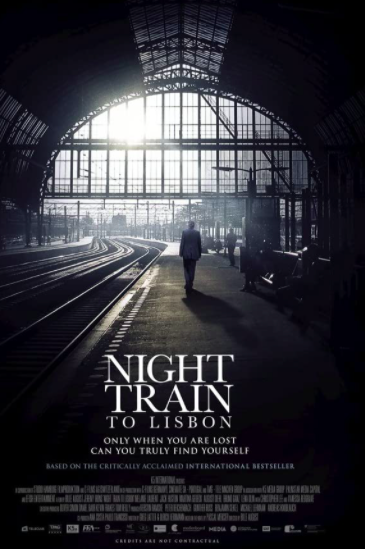
"Night Train to Lisbon"

Night Train to Lisbon: the movie (2013)

Night Train to Lisbon
by Pascal Mercier (2004)

I started reading the novel Night Train to Lisbon, but I found it way too dense and full of excessive and very long descriptions and philosophizing. When I discovered that the book had been made into a movie by director Bille August, starring Jeremy Irons, I decided that instead of continuing to read, I'd just watch the movie. Good call! The movie was actually pretty fast paced and full of dramatic moments. 

Raimund Gregorius (played by Jeremy Irons) is a high-school teacher in Bern, Switzerland. One rainy day on his way to teach, in the first scene of the movie, he sees a young woman standing on the edge of a bridge railing. He drops his briefcase and students' papers fly onto the wet pavement; he grabs her to prevent her from jumping. It's a suspenseful scene, in contrast to the same beginning in the novel, which includes many details that don't really contribute to an exciting start to the story.

As the movie continues, the young woman comes to class with him, but runs away within a few moments. He takes her red leather coat and tries to follow -- abandoning his students who are starting a tedious translation from Latin. The novel goes on and on about how he's a classics professor and what his life has been like -- the movie literally cuts to the chase as he follows her. Then he loses her and looks in her coat pocket where he finds a book by a mysterious Portuguese writer and a train ticket. He uses the ticket and the next scene is in the exotic streets of the city -- the novel has way too much detail about his train trip before we get there.


Here's Raimund Gregorius in a cafe in sunny Lisbon, taking a call from the school to which he's steadfastly not returning. This is more or less where I stopped reading and just watched the movie instead. Instead of citing long passages from the book he had found, the movie enacts Gregorius's search for the the writer of the book, who he says thinks the same thoughts that he's been having for all the years while he was doing nothing with his life but teach. The book's writer, it turns out, was a member of the resistance against the Portuguese dictator Salazar. As Gregorius interviews one friend of the author's after another, we see flashbacks to the very active and violent lives of the resisters, which occurred during the mid-1970s. These flashbacks are definitely the most enjoyable part of the movie, though Gregorius's relationship to the aging members of the author's past are also interesting.


The book's author, Amadeu, had been best friends since boyhood with one of his later companions in the resistance. The head teacher of the school they attended was Father Bartolomeu, played by Christopher Lee. He offers Gregorius an interesting memory of the school under the hideously repressive situation in the past. The drama of these scenes is intensified because the school where Gregorius meets Father Bartolomeu is in ruins, with papers on the floor and crumbling old corridors, while of course the flashbacks show a very living institution.


The critics were mixed about the novel, but they were really negative about the movie. So don't listen to me -- it's probably a horrible movie and I just don't see it that way. To quote the first sentence of the review in the New York Times: 
"Early in 'Night Train to Lisbon,' Raimund Gregorius ..., a stuffy academic, remarks that his wife left him because she found him boring. Oh how right she was!"

Or the start of the review titled "Night Train to Nowhere: Bille August’s Latest Is a Snoozer" in The Independent:

It never ceases to amaze me how many people manage to waste money producing movies so bland, empty and pretentious that nobody will ever see them. Don’t they read the scripts before they sign the checks? We’ve had several this year. Now here’s another. Night Train to Lisbon sounds enticing—like one of those dark flicks about Cold War spies in East Berlin with Richard Burton or William Holden. Check your enthusiasm at the door."

What's wrong with me that I didn't hate this movie? 

Tuesday, December 21, 2021

Inspector Galileo

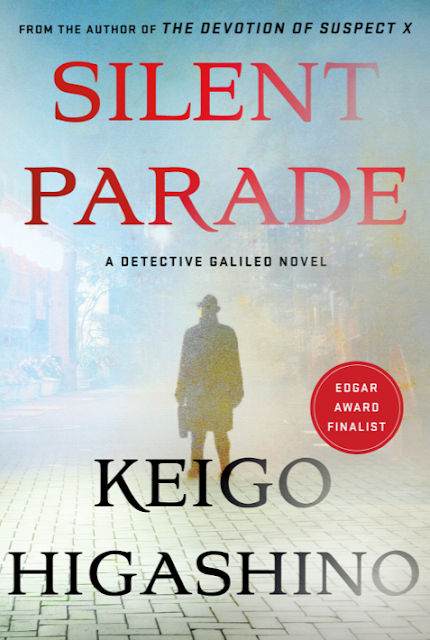
Silent Parade by Keigo Higashino, published December14, 2021.
Much of the novel is centered in a family restaurant in a Tokyo neighborhood.
So there's lots of food in the novel, as in most of Higashino's fiction.

Keigo Higashino (1958- ) has written dozens of detective stories and novels and many other works. He is one of the most popular authors in Japan and much of Asia, though not as well-known or popular in the US. Higashino's most recent novel, Silent Parade, features "Detective Galileo," a physics professor (actually named Manabu Yukawa) who also consults with the police in solving particularly perplexing murders. Silent Parade is fourth in Higashino's series of Detective Galileo novels -- I had it pre-ordered and I read it as soon as it became available. And when I finished, I re-read two of the earlier ones. 

I am totally fascinated by these novels. In each one, a murder is described at the very beginning. For the most part, the perpetrator is revealed to the reader. However, the exact method of the perpetrator is concealed. The challenge to police detectives Kusanagi, Kishitani, and Utsumi, and to Detective Galileo is to discover how the crime and the cover-up or alibi was set up. Each of the criminals is completely ingenious, and they come very close to success. While the three detectives are often quite obtuse, Detective Galileo applies his scientific reasoning to the case, looking for solutions that are unexpected and not obvious. 

In each novel, Galileo's opponents -- the perpetrators -- have thought of almost every angle from which their crime would be analyzed, and have worked out ways to deceive their opponents. As Galileo questions the suspects, and as he directs the detectives to question them and search for evidence, he gets closer and closer to understanding their methods. And they become more and more desperate. However, the police and the reader are not in on his train of thought. It seems hopeless. But the brilliant physicist always figures out the real story. 

Higashino, in my opinion, is one of the most ingenious crime novelists ever. Each of the novels that I've read had a completely different plot from the others: always suspenseful and very intricately worked out. I highly recommend him to any fans of this type of fiction. This review © 2021 mae sander.

Another very good plot,just not quite
as amazing as The Devotion of Suspect X
My favorite because Inspector Galileo pits his
intelligence against a math genius, and the battle of wits
is amazing.


Monday, December 20, 2021

Must be Santa

Santa and Coke: inseparable for over 90 years!
This 1950 Coke ad is one of many iconic images of the man in the red suit with his Coke.


Illustrator Haddon Sundblom created the most famous Coke-Santa ads, beginning around 1930. Before these ads, there were many different popular images of Santa -- including the chubby man in a red suit, but also skinny Santas with other types of clothing. Most of the description of Santa, his beard, his sleigh, and his reindeer, had in fact appeared in the poem “‘Twas the Night Before Christmas,” published in 1823. The Coke ads reinforced this Santa image, which has lasted ever since. However, despite frequent claims — Coke didn't invent our Santa.

In 1930, Santa drank a coke at the soda fountain in the Famous-Barr department store in St.Louis.
As I grew up in St.Louis I remember the store (but not the soda fountain). The illustrator here: Fred Mizen.

But wait... Was Coke always Santa's favorite beverage?


In 1915, Santa had a different favorite: White Rock Sparkling Water.
Here he is in an ad from the San Francisco Examiner.

By 1916, Santa was flying a biplane -- with more White Rock!


In the 1920s, Santa liked whiskey with his White Rock Ginger Ale!
This ad appeared in a comic magazine called "Life" -- a predecessor of the better known Life.
Did it occur to you that Prohibition started in 1920? Santa's booze must have been bootleg.

Another White Rock Santa ad from the 1920s. Before Coke!


Ho, ho, ho, cherry nose
Cap on head, suit that's red
Special night, beard that's white
Must be Santa, must be Santa
Must be Santa, Santa Claus

-- Song by Hal Moore and Bill Fredericks. 

For more Santa history see "Was Coca-Cola the first..." and "Meet Haddon Sundblom..." I'm sharing these vintage ads with the weekly blog event hosted by Elizabeth.


Sunday, December 19, 2021

New Mural at Burns Park School

New mural at our local elementary school. Photos © 2021 mae sander.


The world is full of misfortunes! This mural was on a school that has been overwhelmed by the La Palma
volcanic eruption. Photo from The Guardian, December 16, 2021. (Link)

Saturday, December 18, 2021

Christmas Time in the Greenhouse

Pointsettias are featured at the Matthieu Botanical Gardens this month.


Bonsai are also on display.


 Blog post © 2021 mae sander

Thursday, December 16, 2021

Christmas Overdrive?

A house a few blocks from us is decorated with scores of Christmas critters…

… and lit up every evening.


By Day


Tuesday, December 14, 2021

The Buddenbrooks Family Christmas Celebration

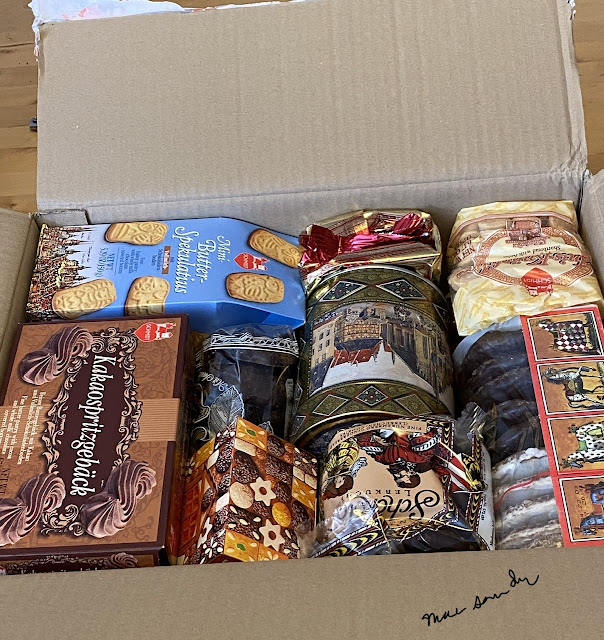
Gingerbread -- Lebkuchen -- was served at the family Christmas dinner in the novel Buddenbrooks.
In the picture you can see the Lebkuchen ready for the holidays at Evelyn and Tom's house this year.

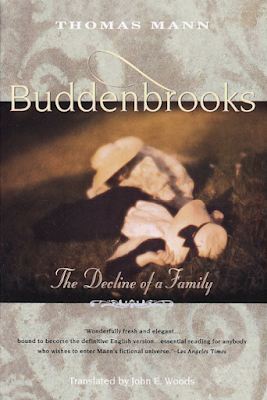
Buddenbrooks: The Decline of a Family was published in 1901 by the now-famous author Thomas Mann; soon after publication it became a sensation. Mann's 1929 Nobel Prize for literature cited it as a major accomplishment. Obviously, whatever I have to say about it has probably already been said! Therefore, I've decided to offer some quotations about the time that the Buddenbrooks family was still prosperous and confident. 

Specifically, the novel included a very long description of the family Christmas celebration in approximately 1870. Because many American Christmas traditions originated in Germany, reading about the family Christmas dinner is fun as well as appropriate for sharing this month. The Buddenbrooks' celebration started early in December. The youngest child, Johann, only son of Thomas Buddenbrook the head of the family awaited Christmas eagerly:

"With a pounding heart Johann counted the days, tearing them off one by one from the Advent calender Ida had made for him, until the day of days would arrive—the page with a Christmas tree on it. There were more and more signs of its coming. On the first day of Advent, a colorful, life-size picture of St. Nicholas was hung on the wall in Grandmama’s dining room." (p. 514). 

Soon after, an old man dressed as Saint Nicholas comes to the door. Johann must say the Lord's Prayer to  convince Saint Nicholas that he is a good boy. As a reward, he is allowed to reach into the sack that's for good children, and he receives gifts. As December advances, the weather becomes colder, and mysteries appear throughout the house and in the town:

"The doors to the grand salon were kept closed, guarding mysteries; marzipan and gingerbread appeared on the table. And it was Christmas out on the streets, too. Snow fell, it turned cold, and the sharp, clear air was full of the cheerful and melancholy melodies of black-mustached organ-grinders, Italians who had come to town dressed in velvet jackets for the holidays. Dazzling Christmas displays appeared in the shop windows. And the gay, colorful booths of the Christmas fair had been set up around the tall Gothic fountain on the market square. Wherever you went, you could smell the sweet fragrance of fir trees being sold for the holiday." (p. 515).

Gift giving and family meals continue through December 23 and Christmas Eve. Poor families come to the door for gifts, the employees of the family firm are given treats and presents, and before the family Buddenbrooks' dinner, choirboys from the local church sing carols for them. As they prepare to dine, a family member reads the Christmas story aloud. Four generations gather around a candle-lit tree in the very much decorated dining room and sing "O Tannenbaum." Then they open their lavish gifts, and finally their servants (about whom they don't think very much) serve sweets followed by a magnificent meal.

"Mamselle Severin and the housemaid now moved about the room with refreshments, and Hanno found time to look about him as he sat dunking a cookie in his tea. Chatting and laughing, people stood beside the table or walked up and down alongside it, showing off their own gifts or admiring those of others. There were objects of every sort—made of porcelain, nickel, silver and gold, of wood, silk, and linen. On the table was a long row of gingerbread cakes, glazed and sprinkled with almonds, alternating with loaves of marzipan bread, so fresh they were still moist inside. The presents that Frau Permaneder had wrapped or decorated—a needlework bag, a doily to put under a potted plant, a hassock—were trimmed with large satin bows." (p. 523)

"Since they had all eaten lunch earlier than usual today, they consumed large amounts of cookies and tea. But no sooner had they finished than a large crystal bowl filled with a yellow, grainy puree was passed around: almond crème, a mixture of eggs, ground almonds, and rosewater. It tasted quite wonderful, but one spoonful too much and you ended up with the most awful stomach ache. Nevertheless, even though Madame Buddenbrook begged them 'to leave a little corner for dinner,' they helped themselves freely. And Klothilde performed miracles. In grateful silence, she spooned up almond crème as if it were porridge. And now came little glasses of sabayon to refresh their palates—served with English plum cake...."

"As always on Christmas Eve, the table had been set in the columned hall. Madame Buddenbrook said the traditional grace with great fervor: 'Come, Lord Jesus, be our guest and bless what Thou hast given us.' As always on Christmas Eve, she concluded with a little admonition, the primary thrust of which was that on this holy night they should remember all those who were not as fortunate as the Buddenbrook family. And once this was taken care of, they sat down with a good conscience to a lengthy meal, which began with carp in drawn butter and a vintage Rhenish wine. 

"The senator slipped a few of the fish scales into his wallet so that it would not lack for money throughout the coming year.... The turkey, stuffed with chestnuts, raisins, and apples, was praised by all. Comparisons were made with birds of years past, and it was concluded that this was the largest in a long time. There were roast potatoes, plus two kinds of vegetables and two kinds of stewed fruit, the bowls heaped so full that each looked like a hearty filling main course, rather than a side dish. They drank vintage red wine ...."

"Little Johann sat between his parents and managed to force down a piece of white meat and some dressing. He certainly could not eat as much as Aunt Thilda, and he felt tired and a little queasy. But all the same, he was proud that he was allowed to dine with the adults, proud that one of those tasty buns strewn with poppyseed had been placed on his napkin, too, and that there were three wine glasses set at his place, whereas normally he drank from the little gold beaker that Uncle Kröger had given him at his christening. But then, when Uncle Justus began pouring some oily, yellow Greek wine in the smallest glasses and the iced meringues appeared—red, white, and brown—his appetite returned. He ate a red one, although it hurt his teeth something awful, and then half of a white, and had to sample at least a little of the brown one, filled with chocolate ice cream. He nibbled on a little waffle, too, and sipped at the sweet wine while he listened to Uncle Christian, who was talking now. ..."

"Before the last course of butter and cheese was served, old Madame Buddenbrook used the opportunity for another little speech. Even though not everything had turned out over the years quite the way one, out of shortsightedness, might have wished, she said, nevertheless there still remained such manifold and obvious blessings that their hearts should be filled with gratitude." (p. 525-530) 


Thomas Mann's ponderous novel is charming, but full of tragedy and human folly. His depiction of the merchant class of the Germany of the mid-19th century (that is, before he was born in 1875) was not always sympathetic, and he clearly questions their values and their lack of appreciation for education, the arts, music, and literature. But Mann's gift for visualizing the faces, expressions, inner and outer lives, and even clothing, houses, streets, and home furnishings in that time is irresistible. 

Blog post © 2021 mae sander.


Monday, December 13, 2021

Doors Open and Close


Two gnomes at the gate of the Matthaei Botanical Garden.

During the pandemic, the gates of the inner garden at Matthaei were closed, and no one could enter. It was a wonderful relief when these doors reopened. Now we can enjoy the gardens, which are beautiful in all seasons. At Christmas, the gates are guarded by gnomes, to whom I've given some wine to drink in my altered photograph.

All four gnomes guarding the gate (without the wine)
A number of bloggers who create interesting arts and crafts are currently producing images using the theme of doors opening and closing. I've found this a theme appropriate in so many ways, especially as the beginning of each year is always seen as one door closing and another opening -- going back to the Roman door god Janus who had two faces looking forward and backward. I found the following poem on the same theme.

Doors opening, closing on us

By Marge Piercy

Maybe there is more of the magical
in the idea of a door than in the door
itself. It’s always a matter of going
through into something else. But

while some doors lead to cathedrals
arching up overhead like stormy skies
and some to sumptuous auditoriums
and some to caves of nuclear monsters

most just yield a bathroom or a closet.
Still, the image of a door is liminal,
passing from one place into another
one state to the other, boundaries

and promises and threats. Inside
to outside, light into dark, dark into
light, cold into warm, known into
strange, safe into terror, wind

into stillness, silence into noise
or music. We slice our life into
segments by rituals, each a door
to a presumed new phase. We see

ourselves progressing from room
to room perhaps dragging our toys
along until the last door opens
and we pass at last into was.

Sunday, December 12, 2021

The World of Banksy in Milan

The world of Banksy, the immersive experience

"After the success of his works being displayed in Paris, Barcelona and Prague, Banksy’s masterpieces return to Milan with an engaging, unauthorised exhibition at Teatro Nuovo. Featuring more than 60 works by the British artist and 30 murals. “The World Of Banksy – The Immersive Experience” gathers both private property works and reproductions of murals by young anonymous artists from all over Europe." -- Milan City Guide

In the train station in Milan, Italy, opening this week: "The world of Banksy, the immersive experience" is a recreation of Banksy's famous graffiti. Although admission to the exhibition hall is ticketed, the sounds of trains from the station creates a special atmosphere for the viewers. 

The elusive and secretive street artist Banksy receives more attention than any other. When he stealthily paints one of his stenciled creations on a wall, the building's owner can sell it for huge amounts of money -- if a vandal doesn't destroy it first. Banksy's works often seem to comment on current events or the current state of the world, but Banksy himself is silent and his identity is unknown (though suspected). He doesn't support exhibitions of his work unless he himself organizes them, so this exhibition is "unauthorized." 

The curators arranged for a recreated look of the walls on which the artist originally painted:

Banksy’s street art has been recreated by young European artists and installed against backgrounds mimicking their original street setting. “When it was a brick wall, we made a brick wall, when it is a cement wall we made a cement wall, when they are dirty from time and pollution we made them dirty with special effects,” the show’s curator, Manu De Ros, said during a preview Thursday. -- Miami Herald

Here are some images from articles about this exposition:

-- source

-- source
-- source
Travel for us right now is very restricted -- as it is for most people. But how I would love to see an exhibit like this! And go to a big European train station! I'm sharing this with the other lovers of street art who post at Sami's weekly blog event.

Saturday, December 11, 2021

Swedish Cardamom Knots for Breakfast

Len baked these wonderful sweet rolls today. Cardamom is more subtle than cinnamon.
 
Rolling, filling, cutting, and knotting the rolls is tricky!

The recipe is from Epicurious: "Cardamom Knots." The wonderful Swedish name is: "KARDEMUMMABULLAR," A contestant on the Great British Baking Show once made a very complicated version (recipe here), but I think the epicurious recipe is perhaps close to the traditional one.

Fresh from the oven!

Thursday, December 09, 2021

"Cloud Cuckoo Land"

"Pseudepigrapha are falsely attributed works, texts whose claimed author is not the true author, or a work whose real author attributed it to a figure of the past." (Wikipedia)

Cloud Cuckoo Land by Anthony Doerr.
Published 2021.
What a very strange novel! Six different stories are told alternately. One is titled "Cloud Cuckoo Land;" it is a fragmentary narrative supposedly by an ancient Greek writer named Diogenes, translated by a twentieth-century man named Zeno. The narrative of this Zeno's life in Lakeport, Idaho, is the second alternating story. Also in Lakeport is the story of a boy named Seymour. From outer space decades in the future is the story of a rapidly traveling space ship with a young passenger named Konstance. Finally, two stories come from the fifteenth century, in and near Constantinople under siege by the Turkish Sultan: the story of Anna, who works in an embroidery studio, and the story of Omeir, who begins life in a village somewhere in the Balkans.

One theme ties the disparate stories together: the characters' great love of nature, especially birds, and above all, owls. In every story, the world is fragile, and there's a constant awareness in the twenty-first-century and future times of the decline of all species, of all the natural world. Somehow, thanks to the strange choices of times and places, this great fear for all living things does not become polemical, just phenomenal.

A challenging element of the novel is the presence of pseudo-ancient Greek texts, written in Greek characters, which I think the reader is expected to try to memorize and grasp, especially as the characters, especially Anna and Zeno, try to learn to read the text of the pseudepigraphic story by Diogenes. (A Greek author named Diogenes did exist, but his works are lost and Doerr made up the story in the novel.) I did not rise to this challenge, but just enjoyed reading the stories and their emerging connections. I also appreciate the role that the fictitious text plays in the other main theme of the novel, which is the idea that human literary accomplishment is fragile, and that wonderful books are constantly being lost, and vast numbers of great classics were lost long ago. 

Absolutely anything else I would like to say about this amazingly readable book and the intricate way it weaves its six stories, would be a spoiler. Each character is highly sympathetic. Each story is very suspenseful and well-crafted. You could think of a wide variety of reasons why this book wouldn't work. It does work.

Here is a quote from author Anthony Doerr:
"The fragments that we still have of ancient Greek novels indicate that many of them were more experimental and playful than were originally thought: they apparently played with metafiction and historicity, even as they fell over themselves to be entertaining. Though we only have a few extant fragments of Antonius Diogenes’ writing, it’s clear he was interested in mashing up genres: myths, travel narratives, natural histories, romances, ghost stories, historical treatises, etc. I wanted my book to embrace that sense of playfulness, too, and I wanted to continually rotate the story around the running theme of a sieges-inside-sieges, libraries-inside-libraries, worlds-inside-worlds. Because what is a book if not a little self-contained universe that you get to hold in your hands? So, yes, I think it’s safe to say that Cloud Cuckoo Land was my attempt at a literary-sci-fi-mystery-young-adult-historical-morality novel." (source)

Book review © 2021 mae sander.

Wednesday, December 08, 2021

Birds

Greek vase depicting a scene from Aristophanes' "The Birds."

Costumes for "The Birds." My impression is that the comic elements of the plays
depended on costumes and gestures, not only the words that have come down to us.

An owl.

"The Birds" is a comedy by the Greek dramatist Aristophanes, written in 420-415 BCE. The two main characters in the play travel to the land of birds, and talk with the hoopoe who is their leader. These somewhat dim men want to found a bird kingdom which will challenge the authority or even replace the kingdom of the gods headed by Zeus and Hera. My reading of this classic hasn't been very successful. I really don't have the background to understand what it all means, and I'm left rather confused. As a birder, I loved the characterizations of all the different birds -- owls, eagles, the nightingale, the ostrich, the goldfinch, and many more. But I'm afraid I don't really grasp what the play was trying to say. As I mentioned, I think it was funny because of costumes and actions, not just because of the text.

I decided on this rather weird choice of reading because the bird kingdom in the play is called "Cloud Cuckoo Land" -- it's the source of that expression, meaning a crazy-mixed-up world. And that expression is the title of Anthony Doerr's new book, which I also tried to read. The book, too, is difficult and it has a lot of classical references, including quite a bit about "The Birds." I wanted to improve my comprehension -- but I'll talk about that later when I finish reading the novel.

More importantly -- when I was fairly far into reading, I realized that the Kindle edition of Cloud Cuckoo Land that I had purchased from amazon was defective -- missing the last 100 pages or so. In particular, the copyright page was missing! I seemed to have a pirated edition. Although this kindle version was listed on the main page for Doerr's novel, it was very cheap, and when I looked carefully, it was from a rogue publisher, not Scribner, the real publisher. So I returned it and decided instead to buy the hardback edition which should be reliable. I decided to read the play while waiting for delivery.

I have tried to contact either amazon or Scribner's to report to them that this fake and incomplete Kindle book is listed on the main amazon page for the novel, but there isn't any way to contact either of them over this problem. I guess publishers don't want to be bothered with communications, as too many people would be trying to convince them to publish their books. And I guess amazon.com just doesn't want to be bothered with anything. I did get my money back, that works.

It’s here!

UPDATE, December 9, 2021: The pirated kindle version seems to  have disappeared from the amazon website. I wonder if my seemingly futile efforts to inform them actually worked, or if a lot of people bought and returned the defective counterfeit edition.

Monday, December 06, 2021

Mona Lisa and Wine

My hobby for a long time has been collecting parodies and reworkings of the Mona Lisa. It's been a while since I added to my collection or posted anything, but I decided to look for new material. Here are a few images I found online in various places. So many people collect and post Mona Lisa images online that the same ones come up over and over, often attributed to different people and often modified a lot or a little. As a result, I'll just show you the images -- that's all!


One more Mona Lisa that's not wine-related, but comes from a famous painter with a clear source:

Jasper Johns, "Racing Thoughts" (1983)

I'm sharing this with all the bloggers at Elizabeth's weekly event where all the participants feature a drink!