Showing posts with label Higashino. Show all posts

Monday, September 11, 2023

"Newcomer" by Keigo Higashino


Keigo Higishino (b. 1958) is a very popular mystery writer and winner of a number of Japanese awards for his work. His two most famous characters, each the hero of a series of novels, are Detective Galileo and Detective Kaga. I have read three of the novels in each series, which I believe are the only ones translated into English. I've been enjoying a lot of Japanese fiction recently, and I might read even more. 

Higashino's Newcomer, published in Japan in 2009 and in the US in 2018, features Detective Kyoichiro Kaga, a very observant policeman. While investigating a murder, Kaga succeeds in noticing and connecting all the small details about actions and motives of many people. Some were bystanders; others might have been involved with the victim: a woman found strangled on the floor of her apartment by a friend. He scrutinizes every lead he can find, despite the impatience of his end-of-career partner, who just wants to pin the crime on someone and go home.

In reading Newcomer, I especially liked Higashino's choice of starting with a number of short chapters written from the point of view of the potential witnesses. As he observes their demeanor, their homes, their businesses, their way of life, and how they reacted to his questioning, we learn about the detective and his methods. It's clear in the early stages of the investigation that Kaga has no theories or suspects, but is simply finding out all he can.

This series of interviews, mainly in small and very retro shops, reveals a lot about the neighborhood where the victim lived. She had often made small purchases in the shops -- particularly, just a short time before her death. Besides illuminating the environment of the crime, Higashino provides a delightful tour of these small, out-of-date businesses, which manufacture and sell old-fashioned merchandise like rice crackers, traditional sweet pastries, hand-made toys, custom tools, and old-fashioned clocks. Whether the shopkeepers and their families had any role in the murder or not, these vignettes of Old Tokyo life are a pleasure to read.

Once these interviews are completed, the author builds suspense very effectively (as you would expect from a prize-winning writer of detective fiction). The identity of the murderer is never obvious, and narrowing down the search is a fascinating endeavor. Kaga is masterful! I enjoyed this novel quite a bit. I've also read quite a few of the others by Higashino that are available in English translation, and I hope to read the next one that is scheduled to be published soon.

A small, traditional shop front — from my visit to Tokyo in 2011.

Blog post and photo © 2011, 2023 mae sander

Friday, December 16, 2022

"A Death in Tokyo"


Nihonbashi Bridge, Tokyo. (source)
A beautiful historic bridge, built in 1911, with a huge freeway structure awkwardly built above it.

Keigo Higashino's most recent publication in English is the mystery novel A Death in Tokyo. Like his earlier novels (of which I have read several), it's cleverly and intricately plotted, though I found the pace a little slow. The very first scene of the novel is the death by stabbing of a man named Aoyagi, who runs out onto the bridge and dies beside the elaborate light post that's in the image above. 

As the police investigation proceeds, the bridge becomes more and more important, as are the two statues of mythical winged and horned beasts called Kirin. The center of the bridge, the detective mentions at one point, was “Kilometer zero for all the roads in Japan. This was people’s jumping-off point for journeys all over the country.” (p. 233)

I enjoyed the details of Tokyo landmarks and the Tokyo neighborhoods that were important in the novel. In an attempt to find the murderer, the two main police investigators must visit a number of shops, religious shrines, secondary schools, diners, bars, workshops, and other types of businesses. They question people at woodworking shops, bookstores, specialty paper sellers, and others. They interview the owners and service people in eating places, trying to reconstruct the last hours and the associates of the victim, Aoyagi. As they do so, they also try a number of different foods, which also help to produce the fascinating atmosphere of the story. 

Food, in fact, plays a big role here, as it does in just about every one of the previous novels that I have read by this famous author. As in many well-plotted detective novels, meals help the reader to have a sense of time passing and a sense of location. In this novel, I think we also learn a lot about what fairly ordinary people eat in Tokyo, and I find these details to contribute very much to the effectiveness of the narrative and creation of a vivid picture of the victim and the suspects. A few examples (just because I like them) —

“According to the member of the staff they spoke to, Aoyagi had been there at least twice. He couldn’t recall precisely what Aoyagi had ordered, but he remembered him because he said something complimentary about the food. Since they had the opportunity, Matsumiya and Kaga decided to eat lunch there themselves. Matsumiya had cold soba noodles. They were nicely al dente while the broth was delicious with a real depth of flavor.” (p. 124)

“Kaga split his disposable wooden chopsticks and picked up some salted fish guts. ‘Ooh, that’s good,’ he murmured, and took a swig of beer. … Their food was brought to the table. ‘Looks delicious,’ said Kaga, his eyes sparkling. Matsumiya used his chopsticks to help himself to a piece of lotus root deep-fried with pollock roe. The taste and texture were in perfect balance. … As they ordered chilled soba with dipping sauce, they showed her a photograph of Takeaki Aoyagi.” (p. 128-130)

At another restaurant, the policemen are anxious to interview some potential witnesses. The owner calls and says these witnesses have just sat down to eat:

“The two of them [the detectives] hurried off to the prix fixe restaurant. They caught the owner’s eye and nodded good evening. A group of four typical businessmen were drinking at a table for six. They had sashimi, a rolled Japanese-style omelet, and deep-fried chicken in front of them.” (p. 184)

One more meal:

“Their food was brought to the table. The croquettes were fragrant and went down easily with the beer. The deep-fried shrimp was crisp and smelled delicious. The chunks of meat in the beef stew melted in the mouth.” (p. 262)

While Higashino’s reputation and popularity aren’t as significant in the English-speaking world as they are in Asia, I think a lot of people were waiting eagerly for the publication of this newly-translated work. I was very happy to read it!

I was curious about the appearance of the bridge before the freeway was built over it. (source)


Review © 2022 mae sander

Tuesday, December 21, 2021

Inspector Galileo

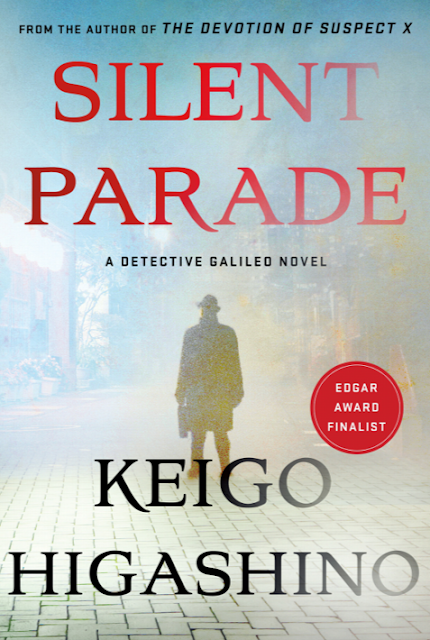
Silent Parade by Keigo Higashino, published December14, 2021.
Much of the novel is centered in a family restaurant in a Tokyo neighborhood.
So there's lots of food in the novel, as in most of Higashino's fiction.

Keigo Higashino (1958- ) has written dozens of detective stories and novels and many other works. He is one of the most popular authors in Japan and much of Asia, though not as well-known or popular in the US. Higashino's most recent novel, Silent Parade, features "Detective Galileo," a physics professor (actually named Manabu Yukawa) who also consults with the police in solving particularly perplexing murders. Silent Parade is fourth in Higashino's series of Detective Galileo novels -- I had it pre-ordered and I read it as soon as it became available. And when I finished, I re-read two of the earlier ones. 

I am totally fascinated by these novels. In each one, a murder is described at the very beginning. For the most part, the perpetrator is revealed to the reader. However, the exact method of the perpetrator is concealed. The challenge to police detectives Kusanagi, Kishitani, and Utsumi, and to Detective Galileo is to discover how the crime and the cover-up or alibi was set up. Each of the criminals is completely ingenious, and they come very close to success. While the three detectives are often quite obtuse, Detective Galileo applies his scientific reasoning to the case, looking for solutions that are unexpected and not obvious. 

In each novel, Galileo's opponents -- the perpetrators -- have thought of almost every angle from which their crime would be analyzed, and have worked out ways to deceive their opponents. As Galileo questions the suspects, and as he directs the detectives to question them and search for evidence, he gets closer and closer to understanding their methods. And they become more and more desperate. However, the police and the reader are not in on his train of thought. It seems hopeless. But the brilliant physicist always figures out the real story. 

Higashino, in my opinion, is one of the most ingenious crime novelists ever. Each of the novels that I've read had a completely different plot from the others: always suspenseful and very intricately worked out. I highly recommend him to any fans of this type of fiction. This review © 2021 mae sander.

Another very good plot,just not quite
as amazing as The Devotion of Suspect X
My favorite because Inspector Galileo pits his
intelligence against a math genius, and the battle of wits
is amazing.


Monday, February 26, 2018

"The Name of the Game is a Kidnapping" by Keigo Higashino

"Keigo Higashino (東野 圭吾) is one of the most popular and biggest selling fiction authors in Japan—as well known as James Patterson, Dean Koontz or Tom Clancy are in the USA." (source: Goodreads)
Higashino's suspense novel The Name of the Game is a Kidnapping (Japanese publication 2002; English translation published 2017) has the same fast-paced psychological interest as the four of his other novels that I have read. It also has a surprise ending, which I will not give away. The others were police procedurals, but with an emphasis on the suspects, their position in society, and how they behave in extreme circumstances.

In The Name of the Game is a Kidnapping, the entire focus of the story is on a man, Sakuma, who is almost randomly drawn into a convoluted plot by other people.  He is the narrator, and thus his point of view is the only one we receive. From the publisher:
"Battle-tested project leader at a PR firm and slippery bachelor, Sakuma sees himself as a player. His smug self-regard doesn’t seem entirely unfounded, both in love and at work. When is idea for a mini-theme park is dismissed as too costly and vacuous at the last minute by a major client he seems to have met his match.

"Katsuragi, an heir and executive at the global car maker, Nissei Auto, is back from a marketing stint in the US with an authentic conviction that everything is a game. Once the man’s daughter by a former mistress teams up with Sakuma so she can come into her inheritance in an expeditious manner – Juri is indeed her father’s flesh and blood – the game is good to go!

"And the name of this game is a kidnapping!" (source)
Juri and Sakuma team up to deceive her father -- and as a result, she hides out at Sakuma's bachelor apartment. One of the only things she can do while passing away the time there is cook, so as in other Higashino novels, there are some very interesting food descriptions used to emphasize the situation of these two people. For me these highlight differences between Japanese food preferences and those in America -- even when the food is supposed to be western style. For example, she makes a dish called cream stew, which I had never heard of; it turns out to be chicken and many vegetables cooked in a white sauce, often using a packaged sauce. It's based on western food, and became popular partly because it was served as Japanese children's school lunch. From the novel:
Cream stew from Wikipedia.
"When I got home, Juri was cooking something in the kitchen. I tried to guess what she was making based on the smell.  
"'Did I have the ingredients to make cream stew?' I asked standing at the kitchen entrance. 
"'I scrounged through your fridge. Your vegetables were going bad, but I got to them in time.' I remembered I had bought them intending to make gratin." (Kindle Locations 1344-1348).
As it happens, not foreseeing the cream stew, Sakuma has brought home a bento box for dinner.
"She looked into the bag and then at me.  
"'A bento from Yasuman. Wow. The chef there sometimes goes on TV. Then I’ll have this instead.' 
"'What about the stew?'  
"'Who cares now?' Juri returned to the pot and turned off the burner." (Kindle Locations 1356-1359).
Well, what does happen to the stew? They eat it for brunch. Several other instances of what they eat for breakfast or brunch also suggest his tastes in food. For example, in the first scene, we see his bachelor life, and we also heard why the vegetables for cream stew were in his refrigerator. It strikes me that this is the type of attention to detail that makes the suspense build so effectively! The passage:
"I fried some ham and eggs, toasted bread, and warmed up canned soup for my breakfast. 
"Lately, I was lacking vegetables. There had to be some cauliflower in the refrigerator so I decided I’d have a gratin with a lot of that in it tonight." (Kindle Locations 76-77).
Staying with him at his apartment, Juri sleeps in his bed, he on the living room couch, and he has to fix her breakfast:
“Just wait. I’ll make something now.” I got up and went to the kitchen. The morning menu I decided on was toast, boiled eggs, and vegetable juice. Putting on coffee was a bother." (Kindle Locations 1178-1179). 
Or later when she is still with him, she gets up and says:
"'I just woke up. It looks like you prepared breakfast for me.' ... 
"Ham, eggs, vegetable soup, toast, and coffee made up the menu. It wasn’t what you’d call cooking, but considering the contents of the refrigerator, she couldn’t have done any better."(Kindle Locations 2094-2098).
 Are these typical Japanese breakfast foods? Well, to my knowledge, they lean more western than the older traditional Japanese breakfasts of miso soup, rice, pickles, and other savory and fermented things that don't seem like Breakfast to me! I think these details are characterizing Sakuma as leaning very much toward a western lifestyle.

In any case, breakfast in a suspense novel always means one sure thing: the author uses meals to punctuate time going by and to emphasize the need of characters to stay in the moment. Higashino does this with mastery. It's a very readable and enjoyable book.

Wednesday, September 07, 2016

Okonomiyaki

Okonomiyaki (from Wikipedia)
"Part omelet, part crepe, okonomiyaki (pronounced oh-ko-no-mi-yaki) is to Hiroshima what deep-dish pizza is to Chicago. Layered like a lasagna, it is as customizable as its Italian cousin and is as much a part of this Japanese port’s identity as its notoriety as the first city to be hit by a nuclear weapon." 
What are okonomiyaki? I would have simply answered that they were Japanese pancakes and that they were a specialty of Osaka. On one visit to Tokyo, we had them at a specialty restaurant with purpose-built okonomiyaki griddles. When we hosted a Japanese student, she made them for us once, I think. Or maybe just told us about them.

Okonomiyaki restaurants sometimes appear in recent Japanese novels I've read. Several scenes in Keigo Higashino's A Midsummer's Equation take place in such a restaurant, where the owner, Muroi, tells his story:
"'I was born up here,' Muroi told him. 'But when I was in middle school, my family moved down south to Osaka. There was this fantastic okonomiyaki place down the street from us there, and it was always my dream to have a restaurant like that of my own.' Muroi stirred a bowl of batter while he talked. His hands moved with an effortlessness that bespoke long years of practice.'" (p. 172). 
In today's L.A.Times I read much more about this Japanese dish and the special sauce that normally accompanies it. The article is "War can change what we eat. Just ask Hiroshima."

Though my sense that the dish is an Osaka specialty is partly right, okonomiyaki were invented in Hiroshima after the war:
"Before the war, the savory crepes — whose lineage can be traced to Chinese pancakes known as jianbing — were sold as kids’ snacks throughout Hiroshima. Then, after 1945, war widows anxious to make ends meet started opening okonomiyaki stalls and some converted rooms in their homes into small restaurants. 
"They threw in whatever ingredients they could get their hands on, such as oysters and squid and soba noodles cooked by their fellow stall owners, along with ration ingredients provided by the U.S. occupiers. The elaboration was all well and good, because okonomiyaki literally means 'whatever you like — grilled,' and in the lean years after the war, cheap one-dish meals were all many Hiroshimans could afford."
The Osaka connection came later. Though there are around 1,000 okonomiyaki shops in Hiroshima now, "Osaka, which has its own distinct style of okonomiyaki ... can call itself Japan’s okonomiyaki capital, with 2,850 eateries."

The L.A. Times article includes a fascinating description of the Otafuku Corporation, which makes the special sauce used for okonomiyaki throughout Japan. It profiles a chef that work for the corporation at their iconic, egg-shaped okonomiyaki museum. The chef develops new recipes and also teaches at a cooking school where tourists, local home cooks, and restaurant cooks can learn new recipes and techniques for the now-traditional dish. The corporation hopes this way to assure a continued interest -- and thus a market -- for their product.

From the L.A. Times:
"Students learn how to make okonomiyaki at the Otafuku Sauce Co.’s
museum and cooking studio in Hiroshima."

Thursday, June 30, 2016

Another Inspector Galileo Mystery

 Keigo Higashino is "the most widely read author in Japan, with hundreds of millions of copies of his books sold worldwide and nearly twenty films and television series based on his work," according to the author page in my Kindle edition of A Midsummer's Equation. It's the fourth Higashino book I've read, and I continue to enjoy them for the multi-dimensional characters, the clever plots, and the local color and food descriptions. I must say, though, that this, the third available book in the Inspector Galileo series, doesn't have quite as surprising a plot as the first two did.

At the beginning, we meet Kyohei, a fifth-grade boy traveling alone on a train. His parents don't want to bother with him during summer vacation, so they're sending him to a tiny seaside resort where an aunt and uncle have a small hotel. The boy is a major character throughout the story, which in itself is an innovative device in a mystery novel.

Immediately, we find out what Kyohei has for lunch:
"The train lurched into motion. Kyohei opened his backpack and took out a plastic bag with his lunch inside. The rice balls wrapped in aluminum foil were still warm. A small Tupperware container held some fried chicken and grilled egg, both favorites of his. He drank some water out of a bottle and crammed one of the rice balls into his mouth. He could already see the ocean outside the window. There was a blue sky today, and sunlight glittered off the waves in the distance, beyond the white spray closer to shore." (A Midsummer's Equation: A Detective Galileo Mystery, p. 2)
Kyohei's slightly drunk father's promise to him was that the food would be good at his aunt and uncle's place: "The food’s great down there," his father said. "I’ll tell your aunt to stuff you full of fresh fish.” (p. 3).

In fact, the reader finds out quite a lot about the aunt's cooking both for hotel guests and for the family in the course of the novel. Upon Kyohei's arrival, he learns that two guests are staying at the hotel. One is a retired police officer who soon dies a mysterious death. The other is Manabu Yukawa, Assistant Professor of Physics, Tokyo Imperial University, whom we've met before -- he's known to the police, whom he often helps out in investigations, as Inspector Galileo. (p. 15)

The boy and the physicist establish a very nice relationship, as Yukawa takes charge of teaching the boy some science while he's also consulting for a mining company AND helping the police. Quite a character! I was especially amused at several scenes in the middle of the book where Yukawa and Kyohei eat dinner together at the hotel. Yukawa is always served a high-end fresh fish or sushi dinner, while Kyohei has the family meal such as meatloaf, egg over a ball of rice, or pork cutlets. Eventually Yukawa requests to have the family's dinner served to him instead of the food intended only for guests. The aunt's cooking turns out to provide a critical clue in Yukawa's solution of the mysterious death of the police officer and the events from the distant past that were associated with it (but no spoilers here).

Quite a number of police officers and detectives participate in the case of the retired policeman's death, including two competing and not-fully cooperating teams from the local resort town and Tokyo. Several of their discussions take place while they are eating at a variety of restaurants with intriguing Japanese special foods -- the combination of detecting and dining is extremely enjoyable to read!

A woman detective named Utsumi is responsible for quite a lot of the pavement-beating work that's needed to locate information about both victims and criminals. She and Kusanagi, one of the detectives, have one meeting at a restaurant with a special food that's pretty unusual for American readers:
"Utsumi’s favorite spot to grab a late dinner in Asakusa was right next to the Azuma Bridge, a little place on a narrow alleyway wedged in between the main road and the Sumida River. Lucky for Kusanagi, there was a parking lot just across the way.  
The two sat down at a table fashioned from the cross-section of a large log. They both ordered Utsumi’s recommendation: the cow tongue platter.  
"'Well, let’s hear it,' Kusanagi said, pulling an ashtray over and lighting a cigarette. 
"Utsumi pulled a navy-colored notebook out of her shoulder bag." 
She informs Kusanagi of her detecting efforts as they wait for their food.
"'I showed the picture to everyone I talked to, but nothing.' Kusanagi frowned. 'Yeah, that would’ve been too easy.' 
"Their dinner arrived. Each one of them had seven pieces of cow tongue on a large tray, surrounded by a small bowl of grated yam, a bowl of boiled rice and barley, salad, and oxtail soup. 
“This looks fantastic,” Kusanagi said, snuffing out his cigarette."
They discuss the discoveries she's made about the whereabouts of one of the important targets of their investigation and they eat their dinner:
"Kusanagi took a bite of his cow tongue and whistled. The combination of texture and taste was sublime. 'That is good. Dammit. Now I want a beer.'" 
"'Where would he have gone, then? An Internet café?'  
"Kusanagi nodded, pouring his grated yam over the rice and barley. 'That’s where all the drifters, young and old, wind up these days. Cheaper than budget places in Sanya, and they’ve got showers. Wow, this yam rice is amazing too.' 
"'Okay,' Utsumi said, 'I’ll try the Internet cafés tomorrow, then. We still haven’t figured out why Tsukahara was looking for Senba in the first place, though.'" 
"Kusanagi sipped his oxtail soup, gave a little sigh, and reached for his jacket on the chair next to him. He pulled his notebook out of the inner pocket and flipped through the pages." (p. 149-150) 
On a different occasion, an interchange between Kusanagi and a witness took place at a restaurant run by the person he wanted to interview:
"Kusanagi stood outside a restaurant that served okonomiyaki pancakes a short walk from Azabu Juban Station. ... The tables all had hot plates in the middle so customers could cook their own okonomiyaki. ... 
"'How many years were you at Bar Calvin?” Kusanagi asked. “Twelve, exactly. ...,” Muroi said, pouring the batter out on the hot plate in front of them. There was a loud sizzle as drops of oil began to dance on the plate.
As the detective questions the owner about the his long-ago experiences that will help to catch the perp, he also enjoys some of the special pancakes:
"Muroi paused to check how the okonomiyaki was coming along before leaning forward in his chair. 'Actually, I heard a rumor about that.' 
"Muroi flipped one of the pancakes and said, 'It wasn’t just me who saw him. A few of the other guys at the bar were talking about it, wondering why he was so worked up.'"
The questioning and the pancake flipping alternate as the detective learns more and more about the people who interested him. He wraps up when he has all the info he needs:
"'Right,' Kusanagi said, putting away his notebook in his pocket. It was over twenty years ago, as it was. He hadn’t been expecting Muroi to even remember as much as he had.  
"'All done— eat up while it’s hot,' Muroi said, spreading some rich, dark sauce on the okonomiyaki before sprinkling it with seaweed and bonito flakes and cutting it on top of the hot plate. 'Oh, almost forgot the beer.'  
"'Can’t drink while I’m on duty...' " (Quotes are from p. 170 - 174). 
During this interchange, we the readers learn more and more about the motives for murder AND more and more about okonomiyaki, the special Japanese pancakes. (I ate them in an oknomiyaki place in Tokyo once and they were fantastic!)

All things considered, I love the combination of suspense, gastronomy, police rivalries, and clever characters in this novel, though I don't feel the need to summarize the story, just to give these few hints about the way the book is constructed. I'm actually a little surprised that the author, so famous in Japan, isn't better known here.

Thursday, May 26, 2016

Inspector Galileo Solves a Mystery

“The very word restaurant sounded like something alien. Would she have to go to a restaurant and eat now? Would she have to pretend to smile with this black lump in her chest?” (p. 284).
The Devotion of Suspect X by Keigo Higashino is an impressively well-plotted police procedural. Throughout the novel, Yasuko, a former bar girl who works in a bento shop and her teenage daughter Misato try to lead a normal life to prevent the police from knowing that they are guilty of murder. One way they do this is to agree to eat in restaurants when they don’t feel like it, as indicated in the quotation.

The intense characterization of Yasuko, Misato, and several other characters goes beyond what's usual in detective fiction. The characters all live in Tokyo where the action takes place. Besides the two already mentioned they are:
  • Yasuko’s ex-husband (not her daughter’s father), whom she and her daughter murder right at the beginning of the book. 
  • Ishigami, her neighbor, who comes to her assistance in attempting to cover up the crime. Ishigami taught math in high school while doing deep research in mathematics at night. He was a loner until he secretly fell in love with Yasuko.
  • Kusanagi, the detective assigned to the case. 
  • The university professor/physicist Yukawa, an associate of the detective. Yukawa is known as "Inspector Galileo" for his keen ability to solve mysteries. “Inspector Galileo” and Ishigami had been students together some time in the past, and each respected the other’s abilities in math and physics. Eventually the novel boils down to a duel of wits between them as the clever way Ishigami had provided Yasuko with an alibi finally is revealed. 
As always, I was interested in the way that food is used to create the atmosphere, delineate the characters, and advance the plot in a mystery novel. First, there's the bento shop where Yasuko works. Ishigami has made a habit of buying his lunch there: specifically whenever he knew she was there, usually asking for “the special” which is not further described. He used it as a way to have frequent though brief contact with her. After the murder, helping her to cover up provides him with a whole new way to interact with her and (he hopes) to win her affection.

Yasuko works at the counter of the shop and also helps in the kitchen; this work becomes an important background to her efforts to avoid having the police verify their suspicions of her. As she becomes more and more nervous, her behavior at the shop helps convey suspense to the reader: “Yasuko passed a fried chicken meal across the counter to the last customer in line and glanced up at the clock. Only a few minutes until six.” (p. 265).

We learn more about her when she eats in restaurants with Kudo, a man who was once her customer when she was a bar girl, and who reappears in her life during the investigation. “They had eaten the last of the shrimp, and the wine bottle was empty. Yasuko drank the last sip of wine from her glass and breathed a sigh of contentment. She couldn’t remember the last time she had been out for real Italian food.” (p. 127).

Her daughter, in contrast, is uncomfortable in such places; when her former client asks to include Misato at their next meeting  Yasuko says: “I don’t know. I think she prefers watching TV and eating pizza to a place like this. She’s not fond of formal dining — or anything else where you have to act proper.” (p. 129)

Later she thinks: “You can drag a teenager to a good restaurant, but you can’t make her enjoy it.” With her admirer, she and her daughter “had come to a Chinese place in Ginza for dinner. Kudo had insisted that Yasuko bring her daughter, and so she had dragged Misato along, despite the girl’s protests. In the end, Yasuko had convinced her to come by telling her that it would seem unnatural for them to avoid going out — that it might make the police suspicious.” (pp. 226-227).

Yasuko and Misato themselves do not know what their neighbor did to protect them and create an alibi for them. Thus, the primary mystery throughout the book is WHAT DID ISHIGAMI DO TO CONCEAL THE MURDER? We know the result of his work as detail after detail is discovered by the police and analyzed by "Galileo," but only at the end do we learn what really happened (no spoilers here, though).

I plan to read more in the Inspector Galileo series!