Friday, March 11, 2022

In Our Town

In the Greenhouse

After an outdoor walk at Matthaei Botanical Gardens, we spent a little time in the
greenhouse, especially looking at the spring blossoms in the cactus section.


On the University of Michigan Campus


One of the natural history buildings is decorated with organisms.


What's Really On My Mind


Blog post and photos © 2022 mae sander


Thursday, March 10, 2022

Recent Reading

All the time, I’m thinking about the war. I’m looking at news sites to see if there’s anything new (there isn’t). I’m feeling terrible for the suffering of the victims of Putin and his willing executioners. But I have to do something else, and that’s reading. As it stands here, I don’t really have the energy to review the last few books, so here’s a simple summary of what I’ve read. Every book is by an author that I already know and have read several of their books.

Julie Otsuka, The Swimmers.

The Swimmers is a hard book to read, because it's a remarkably penetrating portrayal of dementia, which I don't want to think about. There are some good memory parts, though, like memories of odors -- "She remembers the smell of incense and pickled cabbage in the kitchen." (p. 63).  Julie Otsuka is a wonderful writer, so her masterful prose makes up for her depressing subject matter, but if you want to read one of her books, I suggest that you start with The Buddha in the Attic or When the Emperor was Divine.

Louise Erdrich, The Night Watchman.

Louise Erdrich's characters, mainly native Americans, are really a pleasure to read about. I loved every individual in The Night Watchman, which takes place in the early 1950s. The locale is mainly on the reservation where the tribe's treaty rights are about to be revoked. The main plot line is how the members of the tribe, led by the main character named Thomas, peacefully challenge the government threat against them. The sub-plots are equally fascinating, about the struggles of very poor but proud and imaginative people against a variety of challenges. As I have with every one of Erdrich's books that I've read, I also loved the descriptions of the food the people cook and eat, and I love the occasional humor.

Arnaldur Indridason, Voices.

Although I enjoyed the local color of the Icelandic hotel in mid-winter where most of this novel takes place, the characters and events -- especially the murder at the center -- are all a bit too sordid and ugly for me to really like it. The previous two books in the series are also similarly extreme.

Elly Griffiths, The Woman in Blue.

Slowly, I'm working my way through the many books in the Ruth Galloway series by Elly Griffiths, watching the lives of the characters as they solve one murder mystery after another. I think I was more enthusiastic about the earlier ones, but they are a tempting distraction from reality, so I'll probably read more (and more).

Reviews © 2022 mae sander.
 

Tuesday, March 08, 2022

Artists who were born in Ukraine

As I think of the tragic destruction right now of two culturally important cities, Kyiv and Odessa, I'm thinking of the many creative people who were born there, and how earlier catastrophes and persecutions affected their lives. Several well-known twentieth-century innovators in the arts were born in Ukraine -- or in cities that are now in Ukrainian territory. I was surprised that not one of them remained in Ukraine for their mature career, and in fact almost all emigrated to the US or to Western Europe, some as a part of the great exodus of Jews from the region to the Land of Opportunity (same reason that I'm here!) 

The complexities of art and history in the 20th century have many causes. While the arts flourished in the west and in the very early days of Russian Communism, artists were generally suppressed or persecuted under Soviet power. Soviet Realism became the required art style, which squelched creativity very effectively. 

Kasimir Malevich, Self Portrait, 1908 or 1910-1911. (Wikipedia)

Kasimir Malevich (1879-1935) was a leader in the avant-garde art movements of the early 20th century, particularly the Futurists. Malevich was born in Kyiv, Ukraine. As a young man, he attended art classes at the Kyiv Art School, and later studied in Moscow, where he remained through his creative years. His life and work were disrupted by the Communist government, which did not agree with his innovative, modernist style. For a complete biography see: https://www.theartstory.org/artist/malevich-kasimir/life-and-legacy/

Sonia Delaunay, "Prismes électriques," 1914. (Wikipedia)

Sonia Delaunay-designed swimsuits, 1920s. (source)

Sonia Delaunay (1885-1979) was born in Odessa and educated in Moscow, though she is generally identified as a French artist, and spent most of her career in Paris. She is known for her art, and also for fashion design. She worked with her husband, the painter Robert Delaunay on an art movement called simultané, "which Sonia and Robert were to practise all their lives.... What was it? A movement, a style, an aesthetic adventure? (Cendrars called it a “technique”.) A Russian-French fusion, it rejoiced in the movement and contrast of colours and their loquacity."  For a review of her life and work, see "Sonia Delaunay: the avant-garde queen of loud, wearable art"

Alexander Archipenko, The Ukrainian Poet Taras Shevchenko, 1935.
(Detroit Institute of Arts)

Archipenko, Statuette, 1959 (source)

Alexander Archipenko (1887-1964) was born in Kyiv, where he began his studies in fine art -- but like so many Ukrainian-born artists, soon moved on. In Paris in 1909, he had his own studio, and met other artists and writers such as Modigliani, Léger, Apollinaire, Cendrars and others; his work was well-regarded. During World War I, he took refuge in Nice, France, with other artists. In 1923, he opened an art school near Woodstock, New York, and worked in the US for the rest of his career, mainly as a sculptor. He was one of the first to use plastic as a medium for his sculpture. For a biography and overview of his art see: http://www.archipenko.org/life-and-work.html

Louise Nevelson, "Black Wall," 1959.
(Tate Museum, London)

Louise Nevelson (1899-1988)  "was born Leah Berliawsky in Pereiaslav-Khmelnytskyi, Russia (now Ukraine). In 1905, her family immigrated to Rockland, Maine, due to the terrible abuse inflicted by the Tsarist Russians on the Jewish community that she grew up in." Nevelson is famous for her large sculptural installations: "The stories embodied within her works resulted from her cumulative experiences - as a Jewish child relocated to America from Russia, as an artist training in New York City and Germany, and as a hard-working, successful woman." Source: https://www.theartstory.org/artist/nevelson-louise/

Weegee, Mona Lisa Distortion, 1958. (source)

More Mona Lisa Distortions by Weegee — remember these images were made in a
dark room, long before computer manipulation of images was invented.

Weegee (1899-1968), an American art photographer, was born as Usher Fellig in Lemberg, then part of Austria, but now Zolochiv, Ukraine. Like many Jews from Ukraine and elsewhere in Eastern Europe, the Fellig family immigrated to New York in 1911, where Usher's name was changed to Arthur. After a very impoverished childhood, he learned to be a photographer. Weegee's works depicting street scenes and people in New York and various experiments with photo distortion (including a number of Mona Lisas) influenced several famous artists and photographers including Diana Arbus and Andy Warhol. For a complete biography: https://www.theartstory.org/artist/weegee/life-and-legacy/

Musicians from Ukraine

I haven't found many musicians from Ukraine who are familiar to me, though Wikipedia lists many obscure ones. Reinhold Glière (1875-1956), born and educated in Kyiv, is the only composer on these extensive lists that I've even vaguely heard of.

My greatest familiarity is with Vladimir Horowitz (1903-1989), the world-famous pianist, who was born in Kyiv, Ukraine. His training was at the Kyiv Conservatory, and his early performances took place in Ukraine. Then he toured Russia for several years. In 1925, he left for the West, and performed in most major concert venues for the rest of his life; he only returned to Russia once, in 1986. He settled in the US, and became a US citizen, like many other accomplished Ukrainian artists and performers. I attended a concert by Horowitz on October 9, 1977, at Hill Auditorium on the University of Michigan campus. At that time, he performed only at 4 PM on Sundays. (Link to concert program)

The Arts in Ukraine Now

Art in Ukraine is very much alive -- or was until last month!
An art gallery in Kyiv now houses refugees. (source)

The concert house in Kharkiv, Ukraine, before and after bombing March 1, 2022. (source)

Yes, the barbarians are attacking all human and cultural targets, killing children, and destroying everything they can. Inhuman!

In My Neighborhood


Blog post by mae sander, © 2022. Photos as credited.

Monday, March 07, 2022

Drinking Tea in Ukraine

Many news reports described Ukrainians offering tea to a Russian soldier who was captured last week.

Old Russian/Ukrainian Samovar
(source)

Last year, I wrote about the love of tea in Russia and in Ukraine, which was formerly culturally and politically part of the Russian Empire and then the Soviet empire. Tea drinking has been a part of Ukrainian-Russian culture since the seventeenth century, when Chinese merchants negotiated an agreement for importing tea for the Russian aristocracy, who also owned estates in Ukraine. In the 19th century, the Ukrainian port of Odessa, which had been founded in 1794, became the location where tea arrived in the Russian empire, making it more affordable for everyone. And of course who can help thinking about Odessa, now threatened with being bombed by the Russians.

The samovar, an important part of Russian and Ukrainian tea culture, is large water-boiler that stands on a table top. The samovar used liquid fuel, charcoal, or (later) electricity to keep hot water ready at any time without using the stove. A small teapot with very concentrated tea would sit atop the samovar. To make a cup of tea, one would take some of the strong tea from the teapot and mix it with the boiling hot water from the larger vessel. Often, a spoonful of jam or a lump of sugar would be added to the cup. A guest might also be offered cakes or fruit with the tea. The samovar became widespread during the 19th century, and continued to be used in the 20th century. Ukrainian herbal teas and infusions, made from local berries and plants, are also popular there. I have tea and samovars on my mind as part of my thinking about Ukraine and the ongoing tragedy there.

Kasimir Malovich, "Samovar," 1913, Malevich was a Kyiv-born artist
of the early 20th century, a leader of avant-garde art styles.

In my blog post about the samovar last year, I wrote that the poor Jews in Eastern Europe drank tea, but really rich people would enjoy it with many more delicacies. Tevye the dairyman, the fictitious narrator of a number of stories about a village in Ukraine by Sholem Aleichem (and later the hero of the musical "Fiddler on the Roof") described the lavish life of the rich people this way:

They carried out hot samovars with glasses of tea, sugar and preserves, delicious omelets, fresh, wonderful-smelling butter cakes, and afterward all kinds of food, the most expensive treats, rich, fatty soups, roasts, geese, along with the finest wines and tarts. I stood off to the side and marveled at the way, kayn eyn horeh, the rich folks from Yehupetz eat and drink, God bless them. I’d pawn everything I own, I was thinking, if only I could be rich. The crumbs that fell off their table would have fed my children for a week, at least till Saturday. (Tevye the Dairyman, p. 53)

Note that Yehupetz was a Yiddish term for a far-away big city, namely Kyiv. It can also mean something like the middle of nowhere. When I was a child and I heard someone mention Yehupetz, it always seemed so far away; now Kyiv and the horrors of war there seems further away than ever. And kayn eyn horeh was a Yiddish expression meant to keep away the evil eye, which seems like a good idea at the moment even if you aren't superstitious.


This blog post is to be shared with Elizabeth at the blog Altered Book Lover, where each Tuesday many bloggers share memories, photos, or other ideas about a drink, especially tea. Blog post © 2020, 2022, mae sander.

Sunday, March 06, 2022

Looking at a global tragedy

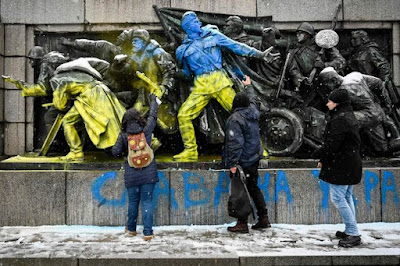
Street art has its finger on the pulse of the world. New murals reacting to the criminal Russian killing in Ukraine are being painted in many places, and internet searches offer a constantly changing variety of photos from around the world, with quite a few articles dedicated to showing them. Here are just a few that I found appealing in a quick browse around the internet.

England

India

Bulgaria: Soviet monument repainted!

Austin, Texas

France

Helsinki, Finland

Images from a Google search for street art responding to the invasion of Ukraine.

Art Before the Destruction

Before the criminal attack on Ukraine, the city of Kyiv had many museums and cultural institutions, and there were many murals on the walls of buildings. As I looked for pre-war images, I found quite a few examples of this art, including some virtual tours of what was there, before. I hate to think of what has happened to these art works. 

From 2015: a mural in Kyiv. Featured on the tour "Kathmandu & Beyond."

From 2019: Mural by London-based Ukrainian artist Anastasia Belous, painted 2016. 
Featured on the tour "Kiev is an Amazing Hub for Street Art

And In My Neighborhood

Bake sale for Ukraine by kids at the local elementary school.
All cookies were sold by the time we got there!

Friday, March 04, 2022

In My Neighborhood


Solidarity.

Very early snowdrops. In a few days, they should be everywhere.

Artichoke season is starting. I don’t know where these grew, but definitely not here!

Thursday, March 03, 2022

Making a Prosperous Country into a Wasteland

"Ukrainian President Volodymyr Zelensky Tuesday called the Russian attacks on civilians in Kharkiv a 'war crime' and 'state terrorism.' On Wednesday, the International Criminal Court said it would 'immediately proceed' to begin an investigation into Russian military war crimes in Ukraine after 39 countries petitioned it to do so. There are credible reports of cluster bombs being used in civilian areas." (Washington Post: "Opinion: Ukrainians in Kharkiv won’t let Putin break their will") 

Near Odessa, Ukraine, March 2, 2022. Odessa was a cultural center in Tsarist Russia.
(New York Times: "Anxiety Grows in Odessa as Russians Advance in Southern Ukraine")

As we all know, the Russians are waging a criminal war of destruction on the cities of their neighbor Ukraine. Watching this horror show unfold, I've been trying, as I read the news reports, to think about the accomplishments of people from Ukraine. Unfortunately, Ukrainians had little opportunity during the long era when the region was dominated by Russia until it achieved independence 30 years ago. And even more unfortunately, the Russians seem hell-bent on returning it to its unequal and unfavorable status again – after destroying the cities and productive capacity of the country.

Famous Writers Born in Ukraine

Sholem Aleichem's Ukrainian Village as interpreted by Hollywood:
"Fiddler on the Roof"
I must admit that I am not familiar with any literature that was originally written in the Ukrainian language. However, several writers who were born in Ukraine and wrote in Russian or Yiddish have made a big impression on me, and I'm thinking about them as I watch this week's devastating news. These are:
  • Sholem Aleichem (1859-1916) was a Yiddish humorist and story-teller. He was born in a Ukrainian shtetl named Pereiaslay. He us most famous for the tales of Tevye the Dairyman. The Tevye stories are the basis for the musical "Fiddler on the Roof."
  • Isaac Babel (1894-1940), a writer, was born in Odessa. His first language was Yiddish, but his literary work was in Russian. He is known for stories of the Russian Revolution and colorful tales of the criminal underground in Odessa.
  • Nikolai Gogol (1819-1898), was a Russian writer born in the Ukrainian Cossak town of Sorochyntsi. His family were minor Russian nobles with an estate in that region. His famous works are the novel Dead Souls and several short story collections.
  • Yevgeny Petrov (1902-1942) and Ilya Ilf (1897-1937) were both born in Odessa. They were journalists and collaborators on two novels: Twelve Chairs and The Little Golden Calf. Their writing is in Russian.
  • Mikhail Bulgakov (1891-1940) was born in Kyiv. He wrote a novel, The White Guard, about Ukraine. I very much enjoyed his more famous novel, The Master and Margarita.
I haven't read the works of Kiev-born novelist Ilya Ehrenburg (1891-1967); Odessa-born poet Anna Akhmatova (1889-1966); or Nobel-Prize winning journalist Svetlana Alexievich (b. 1948) who lives in Belarus but was born in Ivano-Frankivsk, Ukraine. And there may be others.

Please tell me if I have missed out on reading any other important Ukrainian writers! I have already added Bulgakov to the list.

Other Famous Ukrainian-Born People

Quite a few people from Ukraine emigrated to the US or to Israel during the twentieth century. Among them are many highly accomplished individuals, both those who were educated in Ukraine, and those who received their educations elsewhere. 

Famous scientists who were born in Ukraine include the physicist George Gamow (1904-1968), born in Odessa, and aviation inventor Igor Sikorsky (1889-1972), born in Kyiv. 

A number of well-known Zionists and Israeli politicians were born in Ukraine, notably Ze’ev Jabotinsky (1880-1940), Golda Meir (1898-1978), and Natan Sharansky (b. 1948). The port of Odessa was the starting point for many of the earliest Israeli pioneers from Ukraine and Russia in the pre-World-War I era. In the 1980s and later, Israel was a refuge for many persecuted Jews from the Soviet Union including Ukraine.

Several famous economists were born in Ukraine. Ludwig von Mises (1881-1973), was born in Lviv, Ukraine. He was a leader of the Austrian school of economics, but fled the Nazis in 1940 and spent the rest of his career in American universities. Jacob Marshak (1898-1977) was born in Kyiv. He participated in the Russian Revolution, was later educated in Germany, fled to England to escape the Nazis, and finally became a prominent American academic.

What Next?

I have tried to think positively. That is crazy in these crazy times! As I write this, a Ukrainian nuclear power plant is on fire, a result of shelling by the Russian troops. Firefighters can't reach it. If the fire is not contained, the resulting disaster could be ten times as bad as Chernobyl, a Ukrainian site that the Russians already hold. I can't fathom how any humans could do this.

Wednesday, March 02, 2022

Food from the Ukraine (and thinking about the devastation)

Civilian housing destroyed in Zhytomyr, Ukraine, March 2, 2022.
My ancestors immigrated to the US from a village
near Zhytomyr. (From the Guardian live updates)

Thinking about the war crimes being inflicted by Russian military on the population of Ukraine is very depressing. The invasion in progress right now is intended to seize key Ukrainian cities. Its intensity is increasing today. Stark threats to the population of these cities obviously include the danger that their homes will be destroyed. But even if their lives and property are spared, they face devastating shortages of food and necessities, as well as a lack of fuel to stay warm in severe winter temperatures. Humanitarian aid currently has little chance to reach them. Hundreds of thousands of people have already fled, or are trying to escape the war zones and get to safety across the border. Like most Americans I can't grasp how this must feel to these victims of war and tyranny. Like most of us, I'm filled with admiration for the ongoing leadership and effective public statements of Ukrainian President Volodymyr Zelensky.

How can I think about cuisine at a time like this? Well, thinking about Ukrainian cooking makes me feel closer to these besieged people. The foods I've been familiar with all my life include many Jewish-Ukrainian dishes, and some of them are probably familiar to most Americans. Because Ukraine was governed as a region of Russia for several centuries, Ukrainian food is often considered a regional version of Russian cuisine; in fact, there are many regional variations of quite a few of the most famous dishes. I have several Russian cookbooks and food books that were published before the independence of Ukraine, and thus view the country as part of Russia, and view the food as a local variant -- especially true in books by Darra Goldstein and Anya von Bremzen.

Ukraine is a very productive agricultural region (one reason why the Russians covet it); thus many of the dishes use the major produce of the region, including wheat, potatoes, and sunflower oil. In the past, residents of poorer villages used potatoes as their major source of nutrition, as my father often reminisced. (He was born in a village in Belarus, very near the area where Russian troops are assembling on their way to invade Kiev. History repeats itself: this area was a major battlefield during World War I, when my father was a child, and his family became refugees.)

Here's a list of the traditional foods that I find most memorable:
  • Borscht is one of the most famous of the Ukrainian foods. The term can refer to almost any soup. The versions from my family are vegetarian beet borscht, vegetarian spinach borscht, and cabbage borscht with meat. 
  • Blintzes are thin pancakes, usually filled with a mixture of cheese and eggs: one of the most delicious dishes of the Ukrainian-Jewish cuisine. A Ukrainian version of these pancakes uses buckwheat batter. Every cuisine in the region has some type of pancakes!
  • Kasha, a pilaf of whole grain and vegetables, is another way to use buckwheat, Ukrainian Jewish style, a dish my mother made and I also still make. It's often served with varnishkes, that is, bow-tie pasta. 
  • Kugel, a sweet or savory egg-noodle casserole, has many variations in Ukrainian cooking as well as in Eastern European-Jewish cuisine. It's a favorite with American Jews who have made it sweeter and sweeter as time has gone on. Some Ukrainian versions include bacon, which distinguishes it from any Jewish version!
  • Other favorites in Ukraine and the surrounding area include cabbage rolls stuffed with meat and rice and pierogi, or meat-filled dumplings. Everyone has a personal recipe for these!
  • Latkes, or potato pancakes are traditional for Chanukah. A very similar variety is called deruni in the northern part of Ukraine (source), and other versions are widespread, since potatoes are a major crop.
  • A variety of plum and prune dishes and other tree fruits are popular in Ukraine with both Jews and non-Jews. Many types of plum cake are once-a-year favorites when the fruit is ripe, and the dried fruit is used in compotes and pastry fillings around the year. For example, Hamantaschen, for the upcoming festival of Purim, often use prune filling.
  • Honey and poppy seeds are two typical Ukrainian flavors for cakes and sweets, as mentioned in the cookbook A Taste of Russia by Darra Goldstein. Honey cake and poppyseeds on rolls or bagels were definitely a part of my family's tradition, as well as poppy seed Hamantaschen.
  • Pork dishes are an important part of non-Jewish Ukrainian traditions, but obviously are not allowed in any Jewish foods. Pork and prune stew, and pork with caraway seeds are two examples from Please to the Table, a cookbook by Anya von Bremzen.
Although my mother's family immigrated to the US from a village near Zhytomyr, Ukraine, in 1905, I do not think I have any relatives at all in this besieged country, because virtually the entire Jewish population was murdered during the Holocaust. Most of them were shot to death by Nazi mobile killing units, operating not far from the villages where the Jews had lived. For comparison: approximately 5 million non-Jewish Ukrainians died in the conflict. Some details about World War II in Ukraine:

"An estimated 1.5 million Ukrainian Jews perished, and over 800,000 were displaced to the east; at Baby Yar (Ukrainian: Babyn Yar) in Kyiv, nearly 34,000 were killed in just the first two days of massacre in the city. The Nazis were aided at times by auxiliary forces recruited from the local population." (Encyclopedia Britanica
 
"Based on present-day borders, one in every four Jewish victims of the Holocaust was murdered in Ukraine." (The Holocaust by Bullets
 
"Babyn Yar, or Babi Yar, is a ravine on the outskirts of Kyiv where, over two days in September of 1941, more than 33,000 Jews were shot to death by Nazi-led killing squads in a campaign against the Soviet Union." (Russian missile hit site of Babyn Yar Holocaust Memorial)  
 
"Last year, on the 80th anniversary, Mr. Zelensky unveiled a modern art installation at the site [Babyn Yar]. Peter Hayes, a professor emeritus of Holocaust studies at Northwestern University, said that it only started to become a more formally recognized landmark since Ukrainian independence in 1991." (Jewish Groups Condemn Strike near the Babyn Yar Holocaust Memorial)

I don't  know  how this war will end, or how bad it will be for the population of this country that was peaceful and prosperous until last week. As I say, history repeats itself, and it is totally horrifying to think of the repeat of the devastation of the two World Wars on a nation that had in many ways changed to be modern, democratic, and much more open-minded than in the past. Clearly, President Zelensky, who says he had "an ordinary Soviet Jewish upbringing" is mindful of the horrible historic precedent of the events of World War II, when his great-grandfather and all of his grandfather's brothers were killed because they were Jewish (source).

Blog post © 2022 mae sander.


Tuesday, March 01, 2022

Spring Plumage

The return of red-winged blackbirds tells us that it's almost spring. On a recent walk in the woods at Kensington Metropark, we saw a few of these harbingers, showing their spring plumage. Hearing their song really signals that spring is coming, even though it is cold and snow is still on the ground.


Quite a few other birds were flying around, landing in the trees, and hopping through the bushes as we walked. Some were eating seeds from the hands of other visitors to the park. For many years, near the Kensington MetroPark Nature Center, people have been feeding the birds. The birds that are the biggest beggars are the titmice, the chickadees, and a few other small songbirds. The seeds also attract other species.
  
Doves pick up the seeds that have dropped when people
were hand-feeding the other birds.


These doves seem to be feeling the cold!

Red-tailed hawk.

White-breasted nuthatch.

Downy woodpecker.


Red-bellied woodpecker.

A number of sandhill cranes now live in the park year-around,
and are rather tame. They too are in breeding plumage.

Warning signs in the park say you should not feed the cranes.

The reeds are still very dry and wintery.


Blog post © 2022 mae sander. Photos by Len Sander.