Showing posts with label Oregon 2021. Show all posts

Friday, November 05, 2021

A Remarkable Bird, The Coot

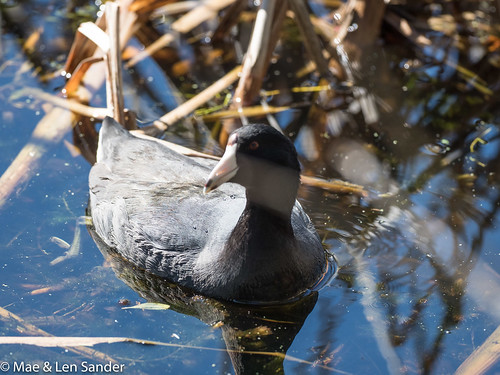
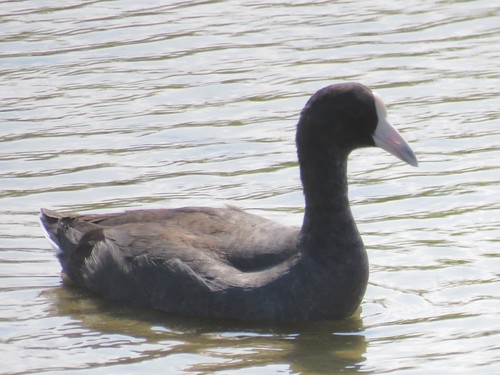
Coots on the water in Oregon, from our trip last month.

The coot is a bird that most birdwatchers ignore and disdain. Coots have a funny walk, big knobby feet (not webbed like ducks’ feet), and an awkward way of taking off from the water’s surface. There are usually too many of them, too easy to find. Seeing coots is very different from seeing their close relatives, the rails, which are so elusive that they are a kind of birdwatchers' holy grail. It's true that the coots' young are quite colorful, but the adults are just grey, black, and white with a red eye: kind of dull. 

A coot with her chicks. Tucson, Arizona, last May.

When coots are around, you can usually find a few more exciting water birds nearby. Herons, ducks, swans... there's always the temptation to look away from the coots. In the South you can even find some of their more colorful close relatives, the moorhens. Coots inhabit most of the USA; they breed here in Michigan and then go south for the winter. Year-round populations of coots live in most of the more southern states and down through Mexico and Central America.

Here are some of Len’s cool coot photos:

celerybog-1
Celery Bog, West Lafayette, Indiana

SCbirds-6
South Carolina.

Kaloko-Honokōhau3
Kona, Hawaii

In 1998, Smithsonian Magazine printed an article titled "Let's Root for the Coot" by Kenneth Brower. As you can probably tell by the title, the author would like to drum up some appreciation for this common bird. The article begins with the unfavorable dictionary definition of the coot:
"The disrepute of the coot is entrenched in our language. 'They are stupid and fly slowly, and can hardly be classed as game birds,' according to Webster's second edition, published in 1959. In its first sense, 'coot' refers narrowly to the genus Fulica, the coot proper; in its second sense, to surf ducks or scoters; and in its third, to 'stupid fellow; gull; simpleton; as a silly coot.'"

Brower includes quite a bit about coot behavior. The most intriguing coot trick, which I’ve never seen, is fighting. He writes:

"Coots fight like kangaroos, leaning back in the water and striking each other with their oversize feet. They specialize in dirty tactics, like holding and hitting. The basic coot combination—the old mud hen one-two-three-is to grip the opponent with one foot and slap him silly with the free claw, slip the shiv of the beak in, then attempt to force him over onto his back and hold him underwater. A coot fight is spectacular—a small, local hurricane of beating wings and white water."

Another view of the coot chick in Arizona.
The biggest surprise, I think, is the oddball appearance and color of the coot chick:
"The hatchling has a bald, pink- purple pate, above which levitates a mist of nearly invisible down. The naked skin of the brow, in a semicircle above either orbit, is painted an iridescent lavender-purple. From the base of the red beak, stubby orange feathers spread backward across the face. The chick wears a frazzled cape of sparse, lone, filamentous orange or yellow feathers over its dark underdown. The parable of the Ugly Duckling is turned upside down in coots."

I've been meaning to write about coots since one of the naturalists on our Oregon trip gave a talk based on Brower's work, and gave us a copy of the article. I definitely have more appreciation of coots, though in fact, I would rather get a look at a sora rail or a bittern.

Blog post © 2021 mae sander. Photos by mae and len sander.


Sunday, October 31, 2021

October Kitchen Activities

Food of the season. Does red wine go with Oreos? Yes. Especially spooky Phantom wine and BOO Oreos. Happy Halloween!

Away from my kitchen: food exhibits that we saw while traveling.

In mid-October, we spent a week on the Lindblad-National Geographic Quest, going from Astoria, Oregon to Idaho on the Columbia and Snake Rivers. We visited several places where food or food preparation were represented. The salmon that swam in the rivers have been a key food source for centuries, first for the Native Americans who lived along the river, and more recently for fisheries and canneries. Unfortunately, the salmon runs have been in terrible decline, worse this year than ever. We also saw a variety of places visited by Lewis and Clark in 1805-1806, and a some interesting museums and historic re-creations.

The food storage and preparation area at Fort Clatsop, Oregon (reconstruction of original.)
Lewis and Clark and the people of their expedition spent the winter of 1805-1806 in this location.

Hood River, Oregon, The Western Antique Aeroplane and Automobile Museum.
Among the historic planes and jeeps, we saw this display of a portable kitchen from World War II.

Astoria, Oregon: Columbia River Maritime Museum.
Display of labels from canning of salmon and other seafood, once a major activity along the
Columbia River. The museum had many displays about the history of the fishing industry.

Salmon in a fish hatchery in Oregon.
  
Jam and syrups made from Oregon produce at a farm stand in
Mount Hood, Oregon.

In my kitchen in October.


Magnets from the trip: places in Oregon and Idaho. Also here.

A sample jar of Oregon marionberry jam.
We ate it all up.

What's been cooking in my kitchen?

Before a weekend visit from the family, my refrigerator was stuffed
with food for the family visit.

Red and green pasta, with garlic bread and feta cheese, for six people.
The green pasta had broccoli, pesto, and tubetti pasta.
The red pasta had classic home-cooked tomato and mushroom sauce.

Garnishes for a Mexican-type meal: tomatoes, salsa, sour cream,
lemon wedges, cilantro, avocado, and hot sauce.

Miriam's plate with a quesadilla, black beans, picadillo,
savory squash, and all the garnishes.

A meal for the two of us: smoked Michigan whitefish from 
the Ann Arbor Farmers Market.

Single-serving apple crumbles.

Candy for trick-or-treaters. I plan to wear a mask. Not the usual sort for Halloween.

Blog post and photos © 2021 mae sander.
Shared with In My Kitchen at http://sherryspickings.blogspot.com/

Thursday, October 28, 2021

Indian Culture


My recent trip on the Lindblad/National Geographic Quest left me very curious about the Native Americans who once lived along the Columbia and Snake Rivers where we traveled, particularly about the many tribes who were encountered by Lewis and Clark during their expedition of 1804-1806. Traders, trappers, and other Europeans had already made contact with the numerous tribes of the region; Lewis and Clark also were responsible for trying to explain to the Indians that they were now part of the United States, to which they were encouraged to become loyal. The expedition also had a mandate to learn about Indian culture, as well as to explore and map the newly acquired Louisiana Territory from St. Louis to the Pacific coast in Oregon. Lewis and Clark in fact did all these things.

“Because Lewis could handle clothing and observe it with his keen naturalist’s eye, he filled his journal with words about moccasins, leggings, shirts, robes, and ornaments. Every piece of clothing, and often its method of construction, was described with his typical attention to detail. But no article in the Shoshoni wardrobe so captivated the explorer as the ermine tippet given to him by Cameahwait. Lewis described it as ‘the most eligant peice of Indian dress I ever saw.’”

Thus wrote James P. Ronda in Lewis & Clark among the Indians. Yesterday, I wrote about some of the food observations in this book, and now I would like to introduce some of the other examples of material culture that the author describes. First, some examples of ermine head coverings.

Our speaker, JR Spenser from the Nez Perce tribe, wore a traditional headdress
and beaded vest for his excellent talk to the guests onboard the Quest.

In the museum at the Nez Perce reservation, we saw a
similar hat.

Onboard the Sea Bird two years ago we enjoyed several lectures by the Cultural Specialist Owen B Walker. 
For his lecture on the First Nations and their fishing methods, he wore a traditional hat including ermine fur.
Lewis and Clark and the other members of the expedition were very enthusiastic about these woven hats,
made by the Puget Sound tribes and also made by the native people further south where we were.

More images from the museum in The Nez Perce National Historic Park near Lewiston, Idaho.


Beaded cradle board.


Not far from the museum: the site of an amusing legend about the trickster coyote and two other beasts:
an ant and a yellow-jacket, who fought at the site of the arch in the photo, and ended up turned to stone.

A mural in The Dalles, Oregon, a location important to the tribes visited by Lewis and Clark.

Who was Sacagawea?

Very little about Sacagawea was said in Ronda’s book. In a note at the end, he explains that while this very famous woman contributed to the success of the expedition, her role has been mythologized and greatly exaggerated. The story is irresistible: of how she was kidnapped from her tribe and became the property and wife of Charbonneau, a French trapper and interpreter, and how she then accompanied Lewis and Clark while her infant son Jean Baptiste rode on her back. Several fictionalized versions of her life also stated that she lived a very long time, while she actually died at about the age of 25, not long after the expedition. Ronda writes:
“Perhaps the most persistent Lewis and Clark myth is that Sacagawea ‘guided’ the party to the Pacific. In countless statues, poems, paintings, and books she is depicted as a westward-pointing pathfinder providing invaluable direction for bewildered explorers. In the interest of correction, there has been a tendency to underestimate Sacagawea’s genuine achievements as a member of the Corps of Discovery. Not as important as George Drouillard or John Ordway, the young woman did make significant contributions to the expedition’s success.”

One of many statues of Sacagawea.


Another statue, at Fort Clatsop historic park on
the site where Lewis and Clark spent the last winter of their expedition.

Beautiful Places


Blog post and photos © 2019, 2021 mae sander.

Wednesday, October 27, 2021

Corn, Beans, Squash, and Sunflowers

George Catlin, “Mandan Village.” 1833 (Wikipedia)

Autumn is here. As we celebrate our two American festivals, Halloween and Thanksgiving, several symbolic foods appear over and over, especially corn and pumpkins (which are a type of squash). These are both essential foods that Native Americans grew, along with another native food plant, the sunflower. and various others that are now obscure. Of course salmon in the Pacific region, wild game of all types, and other fish throughout the continent were also key foods, but the produce was the basic element of the native diet. Another Halloween food, chocolate, also originated in the New World, but was only cultivated and consumed in Mexico and other warmer climates.

Lewis and Clark among the Indians by James P. Ronda is a study of the experiences of the famous expedition of Meriwether Lewis and William Clark from 1804-1806. On our recent trip on the Columbia and Snake Rivers in Oregon, Washington, and Idaho, we passed by many of the same places that the expedition records described, though the river is much changed now, mainly by the many dams that have been built. One of our lecturers told us that one thing that was always true of the Lewis and Clark explorers was that they were hungry! The following quotations illustrate how constantly trade for food was essential to Lewis and Clark and the members of their expedition, and how the local natives at every location along the Missouri and  Columbia Rivers cultivated the same basic crops:

 “Earth lodges, fortifications, and extensive fields of corn, beans, and squash were all signs of the culture of the Missouri Valley villagers.”

“Welcomed into Pocasse’s lodge, the Americans sat on woven mats and were served by the chief’s wife. They were brought a bowl of beans and corn, the staple of Arikara fare.” 

“For the Sioux, corn was more important than blood.”

“At that market one could find Spanish horses and mules brought by the Cheyennes, destined for Assiniboin herds; fancy Cheyenne leather clothing for Mandan dandies; English trade guns and ammunition eagerly sought by villagers and nomads alike; and the ever present baskets of corn, beans, squash, and tobacco upon which Mandan and Hidatsa economic strength was built.” 

“Lewis and Clark were not the first white men to see the Mandan and Hidatsa villages and their surrounding fields of corn, beans, squash, and sunflowers.”

“The Mandan diet of beans, corn, squash, and meat appealed to him [Ordway, a diarist of the expedition], and in his simple style he reported that the Indians ‘live very well.’ Methods of storing food also attracted his attention. Villagers had long constructed elaborate underground bell-shaped food caches to preserve corn, beans, sunflower seeds, and dried squash over the winter.”

“Throughout the afternoon the expedition’s camp was filled with Indians eager to exchange corn and cornmeal bread for a variety of trade goods.”

Corn and pumpkins for Halloween: these foods are still 
key to agriculture, though maybe not as critical as in the past.

American families have their own traditions for Thanksgiving: many Thanksgiving dinners end with pumpkin pie. Another tradition: the mid-20th-century recipe for Jiffy corn pudding usually repeating the identical recipe that originated as an advertising brochure from the Jiffy company in Chelsea, MI. We associate these foods with the New England settlers and the “first Thanksgiving” but in fact they were essential to Native Americans across the entire continent, all the way to the Pacific Ocean where Lewis and Clark reached the farthest extent of their voyage. 

Paul Kane, “Interior of a Chinook Lodge,” 1847.
Illustration from Ronda’s book.

NOTE: I’ve written in the past about the history of Thanksgiving:
and the way that Old World traditions were adapted into American Halloween customs:

Blog post © 2021 mae sander. Illustrations as credited.

Tuesday, October 19, 2021

A Few Beautiful Places


Riding on a Zodiac from our last excursion, which was kayaking and just lovely.
The trip had many really nice parts, as well as the long bus rides that made me complain!

Columbia-SnakeRivers-10


Sunrise on the last morning, just before we left for the bus ride to the airport.
Of  course we are now at home.

Sunday, October 17, 2021

Almost Home! A Post from the Airport.

One night on the ship I decided to try an actual cocktail while we went through another set of locks.
The bartender recommended this: “The Bee’s Knees” made with Tanqueray gin. I told him I wanted
something exotic.


The first winery we visited in Idaho was called “Rivaura” — it’s not well-known elsewhere.
The wines were ok but not super memorable; however, the scenery was quite beautiful.
The fields were used to grow alfalfa until around 7 years ago when the owner switched to vineyards.


Another Idaho vineyard, our last stop on the trip. All the grapes have been harvested,
and the 2021 vintage is already fermenting.

The wines from the last vineyard are sold mainly thorough the vineyard’s wine club. This winery uses grapes grown on the surrounding lands (which were formerly wheat fields) and also purchases grapes grown in eastern Washington. The wines were also ok, but we didn’t buy any.

For our taste, the trip included too much time on buses and not enough time outdoors viewing nature and wildlife. We saw only a few birds, and not enough of the rivers, other than from the boat. It was great to get away from home, and there were some fun times and nice conversations, but all in all this week was a bit disappointing. Several of our fellow-passengers agreed with this reaction.

I’ll be back to several of my blogging activities this week, and decided while waiting for the last leg of the plane trip, to feature some drinks we enjoyed on the trip, to share with the bloggers at Elizabeth’s weekly blog party.

Blog post © 2021 mae sander.