|
| Coots on the water in Oregon, from our trip last month. |
The coot is a bird that most birdwatchers ignore and disdain. Coots have a funny walk, big knobby feet (not webbed like ducks’ feet), and an awkward way of taking off from the water’s surface. There are usually too many of them, too easy to find. Seeing coots is very different from seeing their close relatives, the rails, which are so elusive that they are a kind of birdwatchers' holy grail. It's true that the coots' young are quite colorful, but the adults are just grey, black, and white with a red eye: kind of dull.
 |
| A coot with her chicks. Tucson, Arizona, last May. |
When coots are around, you can usually find a few more exciting water birds nearby. Herons, ducks, swans... there's always the temptation to look away from the coots. In the South you can even find some of their more colorful close relatives, the moorhens. Coots inhabit most of the USA; they breed here in Michigan and then go south for the winter. Year-round populations of coots live in most of the more southern states and down through Mexico and Central America.
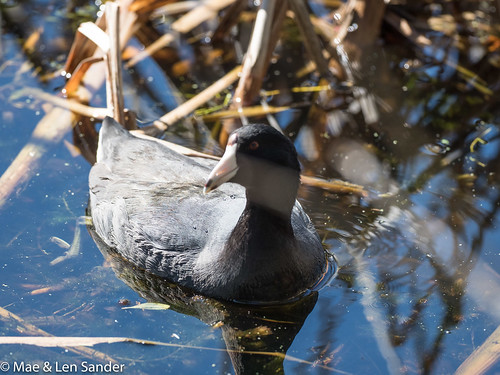
Here are some of Len’s cool coot photos:
 |
| Celery Bog, West Lafayette, Indiana |
 |
| South Carolina. |
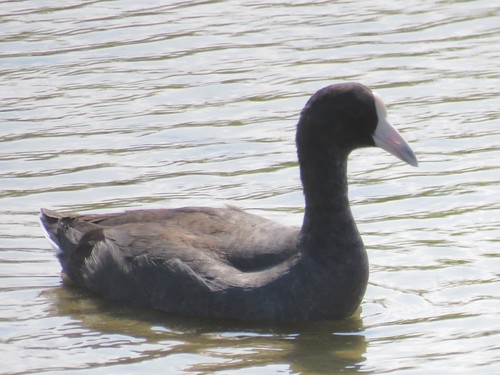 |
| Kona, Hawaii |
In 1998, Smithsonian Magazine printed an article titled "Let's Root for the Coot" by Kenneth Brower. As you can probably tell by the title, the author would like to drum up some appreciation for this common bird. The article begins with the unfavorable dictionary definition of the coot:
"The disrepute of the coot is entrenched in our language. 'They are stupid and fly slowly, and can hardly be classed as game birds,' according to Webster's second edition, published in 1959. In its first sense, 'coot' refers narrowly to the genus Fulica, the coot proper; in its second sense, to surf ducks or scoters; and in its third, to 'stupid fellow; gull; simpleton; as a silly coot.'"
Brower includes quite a bit about coot behavior. The most intriguing coot trick, which I’ve never seen, is fighting. He writes:
"Coots fight like kangaroos, leaning back in the water and striking each other with their oversize feet. They specialize in dirty tactics, like holding and hitting. The basic coot combination—the old mud hen one-two-three-is to grip the opponent with one foot and slap him silly with the free claw, slip the shiv of the beak in, then attempt to force him over onto his back and hold him underwater. A coot fight is spectacular—a small, local hurricane of beating wings and white water."
 |
| Another view of the coot chick in Arizona. |
"The hatchling has a bald, pink- purple pate, above which levitates a mist of nearly invisible down. The naked skin of the brow, in a semicircle above either orbit, is painted an iridescent lavender-purple. From the base of the red beak, stubby orange feathers spread backward across the face. The chick wears a frazzled cape of sparse, lone, filamentous orange or yellow feathers over its dark underdown. The parable of the Ugly Duckling is turned upside down in coots."
I've been meaning to write about coots since one of the naturalists on our Oregon trip gave a talk based on Brower's work, and gave us a copy of the article. I definitely have more appreciation of coots, though in fact, I would rather get a look at a sora rail or a bittern.
Blog post © 2021 mae sander. Photos by mae and len sander.