Showing posts with label Chicago 2017. Show all posts

Saturday, November 28, 2020

Jaume Plensa Sculpture

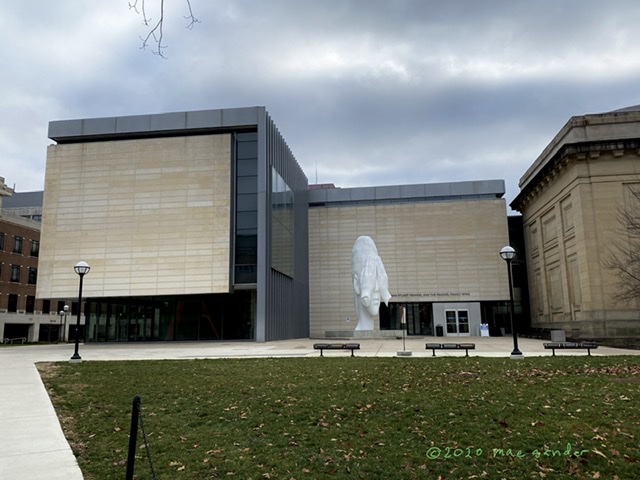
 “Behind the Walls” by Jaume Plensa.


"Behind the Walls" is the title of a newly-installed outdoor sculpture by Jaume Plensa at the University of Michigan Museum of Art. The work, which is a gift to the museum, is made of polyester resin and marble dust, and most recently stood in Rockefeller Center in New York.

Spanish artist Jaume Plensa's work "argues for art's capacity to produce powerfully a sense of public place and expression," according to museum director Christina Olsen (The University Record, November 16, 2020, p. 1). In my opinion, part of its power comes from its really impressive size: it stands 25 feet tall. I looked at it from nearby and from a distance, and it seems to me that it is perfectly proportioned for the space in a corner of the modern wing of the museum. I have seen a work by this sculptor before, in Chicago in 2017: the Crown Fountain in Millennium Park.

Crown Fountain in Millennium Park, Chicago, 2004. The black granite pool between two glass brick towers is 232 feet long, 48 feet wide, and 1/8 inch deep, and is open for people to walk through.


About Crown Fountain in Chicago:
"The fountain consists of two 50-foot glass block towers at each end of a shallow reflecting pool. The towers project video images from a broad social spectrum of Chicago citizens, a reference to the traditional use of gargoyles in fountains, where faces of mythological beings were sculpted with open mouths to allow water, a symbol of life, to flow out." (source)

Blog post and original photos © 2017, 2020, mae sander.

Tuesday, January 29, 2019

Ann Patchett: "Commonwealth"

Ann Patchett's ability to create believable, likeable characters is amazing. In Commonwealth she presents something like 14 vivid characters; maybe more. Her center is a large, blended family with four parents and two or three divorces. The novel spans over 50 years,  meaning that many other partners enter and leave the lives of this huge ménage.

Commonwealth seems to be named for the Commonwealth of Virginia, where we view the critical events in the life of the six children. Besides Virginia, there are scenes in Los Angeles, Chicago, Iowa, New England, Switzerland, and maybe some other places I've overlooked. Further, it's not in precise chronological order, but moves around, sometimes as an ordinary narrative, sometimes as flashbacks.

There are only a bit more than 300 pages for all these developments of time, space, relationships, and themes of love and death and more, including hints that Commonwealth means more than just Virginia. Does this sound like it would make you dizzy? It made me dizzy. But I enjoyed it very much, and in the end it didn't seem that random.

Franny, a daughter of one of the fractured couples, is one of the most in-focus characters in the novel. In fact the first chapter takes place at her parents' home in Los Angeles, where they are celebrating her Christening. There's a free-wheeling atmosphere in this suburban, summery party, where oranges from the back-yard trees are squeezed and mixed with vodka and other booze, and where sandwiches and cookies are devoured by kids and adults.  Of course demons lurk: at the party, Franny's mother meets a colleague of her father and all the children are fated to be shuttled between the resulting rearranged homes.

Food and drinks are always a part of Franny's life. After dropping out of law school, she works as a cocktail waitress at the Palmer House in Chicago (where we stayed a couple of years ago, as it happens: this made the book more vivid for me!) She then lives with a famous writer whose works she loves, perhaps more than she loves him;  he's 32 years older than she is. Another party, in the middle of the book, lasts for weeks during a vacation stay in a mansion in New England.

During this vacation, Franny gets stuck with cooking and shopping for groups of the writer's friends and colleagues, who treat her like a servant and demand that she wait on them, making every one of them a different kind of eggs for breakfast and slaving over dinners while scarcely being noticed. This cringe-inducing sequence of meals is a key to Franny's identity, I think. There are many other keys too as she goes through life relating to her siblings, step-siblings, parents, step-parents, and so on.

The sunny parties in California and the New England vacation house contrast with a wintery party at the end of the novel over 50 years later. Refreshments again are organized by Franny's mother, Beverly, but this time with hired waiters and caterers. The scene at the Christmas party seems to wrap up many of the themes about Franny and her mother that started at the very beginning of the book:
"Franny found her mother at the breakfast table by herself, arranging petits fours on a tray. 
"'You know there are people here who will do that for you,' Franny said.
"Her mother looked up and gave her an exhausted smile. 'I'm hiding for just a minute.' ... 
"Beverly put out the last of the tiny square cakes from the box, pink and yellow and white, each one crowned with a sugared rosette.... 
"Franny picked up a pale-yellow petit four, the color of a newly hatched chick, and ate it in a single bite. It wasn't very good, but it was so pretty that it didn't matter." (p. 311-312)
Palmer House Hilton Hotel where we stayed in Chicago and where Franny worked.

Monday, January 28, 2019

Exploring the Work of Carl Milles


At Brookgreen Gardens in Litchfield, S.C. last week, we enjoyed the outdoor sculpture collections, particularly the Fountain of the Muses by Swedish sculptor Carl Milles (1875-1955). I fondly remember seeing several other Milles fountains. In particular, I remember the Meeting of the Waters, a large fountain in front of the Union Station in St. Louis where I grew up; Sunday Morning, a fountain near the Michigan League in Ann Arbor where I've lived for many years; and a number of works at Cranbrook around 50 miles from Ann Arbor.
 
A figure from the Fountain of the Muses in Brookgreen Gardens.
This is said to be a spiritual representation of Milles himself.
I also remember that a Milles fountain was in the middle of the dining room in the Metropolitan Museum in New York, which strongly impressed me on a visit there when I was in college -- having a work of art inside of a restaurant seemed incredible to me at the time! Out of curiosity, I started looking up these fountains and the life and work of Carl Milles. To my surprise, I learned that the Fountain of the Muses that we saw last week was in fact the same work that was once on display at the Met:
"New Yorkers might well have a sense of nostalgia for his Fountain of the Muses (inspired by the story of the goddess Aganippe), which once lent an air of grandeur to the cafeteria of the Metropolitan Museum of Art but was packed off in 1982 to Brookgreen Gardens outside Charleston, S.C., during a period of reconstruction at the museum." (A Stockholm Sculpture Garden by Gunilla Martensondec, NYT, December 27, 1987)
The Fountain of the Muses in the dining room of the Metropolitan Musuem, 1955. (photo source)
This area of the museum is now the Greek and Roman section as documented in this article:
Redesigning the Met’s Home for Greek and Roman Art
Of course my earliest memories of Milles are of his fountain at Union Station in St.Louis.

This 1940s post card captures the way I remember the Milles Fountain at Union Station. My mother impressed on me
what a wonderful work of art this was! She must have remembered when it was installed in 1940.
"Sunday Morning" on the University of Michigan campus, which I photographed during a recent Ann Arbor Art Fair.

The Triton Fountain by Milles in the courtyard of the Chicago Art Institute. Photo from our visit in 2017.


This photo of the Orpheus Fountain at the Cranbrook Art Museum is courtesy of TripAdvisor.
Milles was on the faculty of the Cranbrook Academy near Detroit from 1931-1951.
Update January 29: I just checked on some of my older photos, and found that I've also seen Milles works at Shaw's Garden in St. Louis: 
"Two Girls Dancing (1914-1917) is Milles’ earliest work in the Garden. Later works Sunglitter (1918) and Orpheus Fountain Figures (Male and Female) (1936) border on the east and west of the three angels with musical instruments, from 1950, in the center basin." (source)
My photo from Shaw's Garden, April, 2011.
Background: the iconic Climatron and some glass
sculptures by Chihully.

Saturday, August 19, 2017

Art Institute, Chicago, A Brief Tour

Walking towards the facade of the Art Institute with its iconic lions last Saturday morning.
Famous painting: "Paris Street; Rainy Day" by Gustave Caillebotte.


Even more famous: "A Sunday Afternoon on the Island of La Grande Jatte" by Georges Seurat
Renoir: "Fruits of the Midi." I love the eggplant and peppers in this still life.
Special exhibit: "Gauguin, Artist as Alchemist." A fabulous collection of his art, including works in wood, ceramics, oil,
and other media. His works from Paris, Brittany, Provence, and the South Pacific were all included.

Ceramic vase in the foreground, and a painting of the same vase on the wall. The exhibit had a number of illustrative examples of how Gauguin often explored the same image in multiple media.

The Art Institute seen from the Willis Tower, 103 stories up and at least 1/2 mile away.
Souvenirs: a magnet of the lions out front, and a magnet of one of the
paintings from the Gauguin exhibit.

Thursday, August 17, 2017

Poké and other Chicago Treats and Trends

Poke Poké is a new restaurant in Chicago which follows what I understand to be a hot new trend! We've seen the traditional Hawaiian version in grocery-store counters and local eateries in Hawaii, though I don't recall trying any on our many visits to the Big Island and elsewhere. The title of a Washington Post article says it all: "Hawaiian poke has never been trendier. But the mainland is ruining it."

Publicity photo from Poke Poké restaurant in the Palmer House building in Chicago.

Neon Signage in the restaurant -- Miriam's photos.
We all enjoyed various poké bowls for lunch as we were about to drive back from Chicago to Michigan last Sunday. I had a vegetarian bowl with some quite delicious sauces. Authentic? Well, I really don't care about that as much as Maura Judkis, the WaPo writer!

"It’s not just that poke tastes better when you’re in Hawaii," says Judkis. "It’s that mainland restaurateurs, bandwagoning on what they see as the biggest trend of the year, have changed it into something altogether different — something that people from Hawaii say doesn’t respect their cultural heritage. It plays into an impassioned debate in the food world now about whether a dish prepared outside its original context is an homage or crosses the line into appropriation."

I find that debate pretty tired. Trends are trends, and poke from Hawaii was already a type of fusion cooking with ingredients and flavors from several sources. According to The Food of Paradise, Rachel Laudan's encyclopedic book on Hawaiian cuisine, "Hawaii's unique contribution to fish cuisine... is considered to be poke." (p. 37)

However, the first appearance of poke in Hawaiian cookbooks and references, Laudan says, was in the 1970s; Hawaiians who left the island prior to that did not remember it, though earlier raw fish preparations like lomi and also sushi were known and probably influenced the invention of poke. Laudan says: "The Hawaiians contributed the name and he seasoning with salt and seaweed" as well as the natural love of the local ocean fish, "the Japanese contributed seasonings of soy sauce and the preference for deep-ocean fish," while other Asian and local influences contributed flavors like hot sauce, sesame oil, green onions, and more. (p. 38)

Besides our trendy lunch, we had a very enjoyable dinner on Saturday night at a gastropub called The Gage. Here are a few of our menu choices -- all good!

Thai curry. My main course was trout with delicious roasted vegetables. Len had halibut.
Venison burger and fries (and Evelyn's shirt). 
Strawberry-rhubarb cheesecake.

A sundae with chocolate chips and a chocolate chip cookie. Our third dessert: chocolate creme brulee.


Wednesday, August 16, 2017

Colorful Chicago

Red rug in front of the Peacock Door, Palmer House Hilton Hotel where we stayed in Chicago last weekend.
Crown Fountain, Millenium Park, bathed with color at night...
By day: boy in red playing in the water at the Crown Fountain.
"Flamingo" by Alexander Calder, Federal Plaza.
"Flamingo" viewed from 103 stories high on the SkyDeck at the Willis Tower.
Red curtain, Pritzker Pavilion, Millennium Park. 
At the Art Institute, several paintings and Chagall's famous stained-glass windows impressed me with their use of vivid primary colors.

One of the Chagall windows.

Gino Severini, "Still Life (Centrifugal Expansion of Colors)."
Alexis Jawlensky, "Girl with the Green Face."

Otto Dix, "Pregnant Woman."
Max Pechstein, "The Red House." 
Lyonel Feininger, "Carnival in Arcueil."


Monday, August 14, 2017

Chicago Light and Darkness

Sunday morning in Chicago: a view from the Willis Tower (formerly the Sears Tower).
Chandelier in the Empire Room of Palmer House Hilton Hotel where we stayed.
Wall sconce, Palmer House lobby/bar.
Chagall's stained glass windows, Art Institute.

Sunlight on the fountain in the courtyard of the Art Institute.

View from a window of the Art Institute.

Night view of the Crown Fountain in Millennium Park, designed by Jaume Plensa.


As we walked through Millennium Park we heard music -- Tchaikovsky. It was a free classical concert in
the Pritzker Pavillion, attended by a huge crowd. We listened for a few minutes and continued around the park.
"Cloud Gate" -- also called "the bean" -- a sculpture by Anish Kapoor in Millennium Park.
Day and night it reflects the admiring and fascinated crowds and the facing skyscrapers on Michigan Avenue.


In 24 hours we saw quite a bit, ate several good meals, and walked until I, at least, was ready to drop. I will be posting more photos of the Art Institute, the food, and the Willis Tower -- especially the glass-bottom balconies where one is suspended 103 stories above the ground.