Showing posts with label Jiffy Mixes. Show all posts

Wednesday, October 27, 2021

Corn, Beans, Squash, and Sunflowers

George Catlin, “Mandan Village.” 1833 (Wikipedia)

Autumn is here. As we celebrate our two American festivals, Halloween and Thanksgiving, several symbolic foods appear over and over, especially corn and pumpkins (which are a type of squash). These are both essential foods that Native Americans grew, along with another native food plant, the sunflower. and various others that are now obscure. Of course salmon in the Pacific region, wild game of all types, and other fish throughout the continent were also key foods, but the produce was the basic element of the native diet. Another Halloween food, chocolate, also originated in the New World, but was only cultivated and consumed in Mexico and other warmer climates.

Lewis and Clark among the Indians by James P. Ronda is a study of the experiences of the famous expedition of Meriwether Lewis and William Clark from 1804-1806. On our recent trip on the Columbia and Snake Rivers in Oregon, Washington, and Idaho, we passed by many of the same places that the expedition records described, though the river is much changed now, mainly by the many dams that have been built. One of our lecturers told us that one thing that was always true of the Lewis and Clark explorers was that they were hungry! The following quotations illustrate how constantly trade for food was essential to Lewis and Clark and the members of their expedition, and how the local natives at every location along the Missouri and  Columbia Rivers cultivated the same basic crops:

 “Earth lodges, fortifications, and extensive fields of corn, beans, and squash were all signs of the culture of the Missouri Valley villagers.”

“Welcomed into Pocasse’s lodge, the Americans sat on woven mats and were served by the chief’s wife. They were brought a bowl of beans and corn, the staple of Arikara fare.” 

“For the Sioux, corn was more important than blood.”

“At that market one could find Spanish horses and mules brought by the Cheyennes, destined for Assiniboin herds; fancy Cheyenne leather clothing for Mandan dandies; English trade guns and ammunition eagerly sought by villagers and nomads alike; and the ever present baskets of corn, beans, squash, and tobacco upon which Mandan and Hidatsa economic strength was built.” 

“Lewis and Clark were not the first white men to see the Mandan and Hidatsa villages and their surrounding fields of corn, beans, squash, and sunflowers.”

“The Mandan diet of beans, corn, squash, and meat appealed to him [Ordway, a diarist of the expedition], and in his simple style he reported that the Indians ‘live very well.’ Methods of storing food also attracted his attention. Villagers had long constructed elaborate underground bell-shaped food caches to preserve corn, beans, sunflower seeds, and dried squash over the winter.”

“Throughout the afternoon the expedition’s camp was filled with Indians eager to exchange corn and cornmeal bread for a variety of trade goods.”
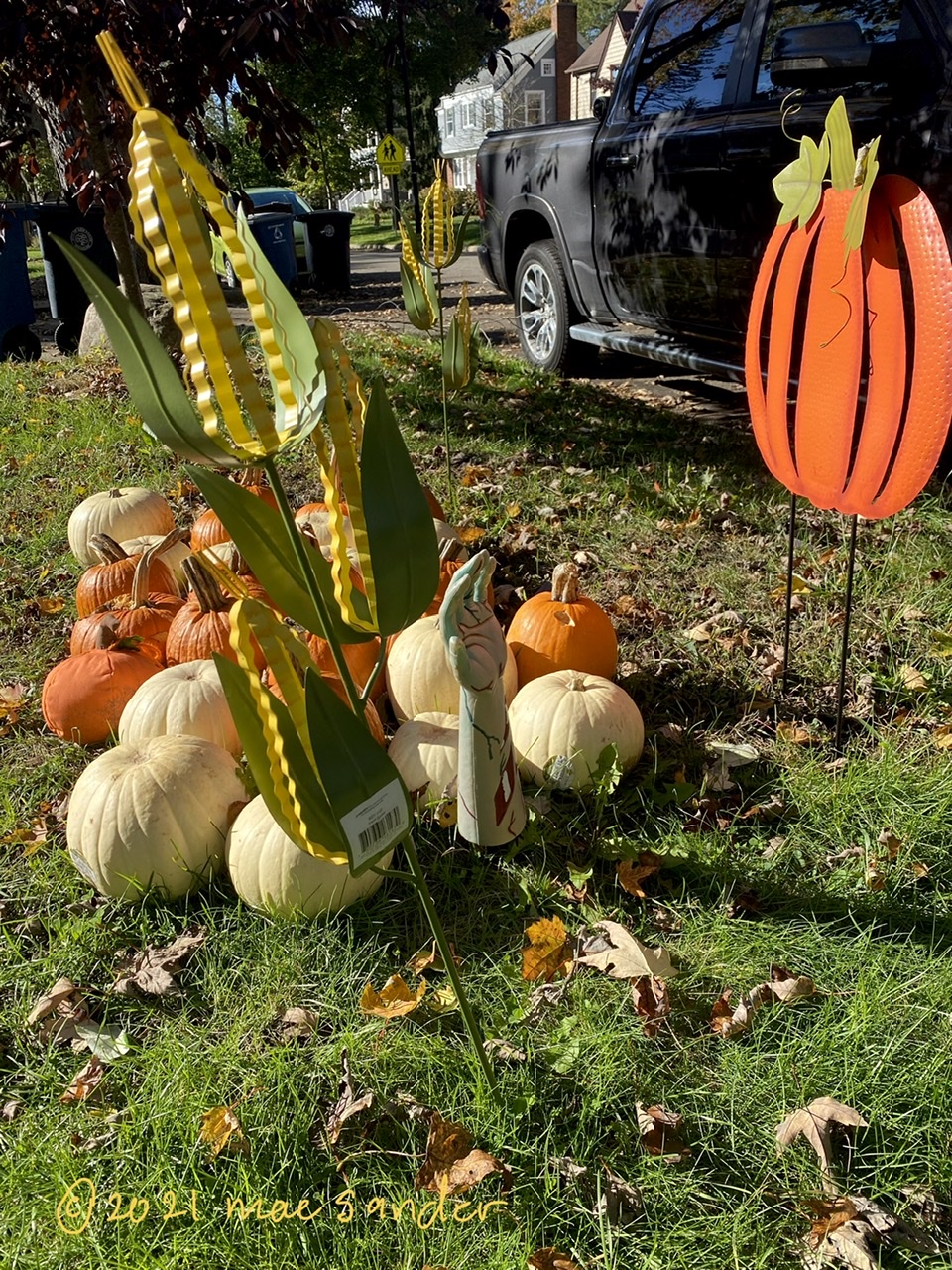
Corn and pumpkins for Halloween: these foods are still 
key to agriculture, though maybe not as critical as in the past.

American families have their own traditions for Thanksgiving: many Thanksgiving dinners end with pumpkin pie. Another tradition: the mid-20th-century recipe for Jiffy corn pudding usually repeating the identical recipe that originated as an advertising brochure from the Jiffy company in Chelsea, MI. We associate these foods with the New England settlers and the “first Thanksgiving” but in fact they were essential to Native Americans across the entire continent, all the way to the Pacific Ocean where Lewis and Clark reached the farthest extent of their voyage. 

Paul Kane, “Interior of a Chinook Lodge,” 1847.
Illustration from Ronda’s book.

NOTE: I’ve written in the past about the history of Thanksgiving:
and the way that Old World traditions were adapted into American Halloween customs:

Blog post © 2021 mae sander. Illustrations as credited.

Saturday, July 27, 2019

At Four-Mile Lake

On summer evenings an hour or so before sunset, over 100 sandhill cranes gather on the shore of Four Mile Lake,
which is a bit east of Chelsea. This year a very rare whooping crane has joined the flock. Less than 600
whooping cranes still survive -- but that's excellent, because at one point there were only 15 of them. (source)

Whoopers are very large birds! We have seen a few in Texas and Florida,
where most of the survivors spend the winter. At most one or two come to Michigan.  
We watched as more and more sandhill cranes landed for the night.
Sometimes they call to each other with an almost barking cry.
While enjoying the sight and sounds of the cranes, we also watched bees and
other birds and enjoyed the late evening sunset.
The trees at the lakeshore are home to a flock of cedar waxwings.


Photos published at maefood dot blogspot dot com. All content copyright © 2019 by Mae & Len Sander. If you read this post at another blog, it's a pirated version.

Sunday, April 07, 2019

Murals in The Common Grill

Inside the Common Grill Restaurant in Chelsea, Michigan: a mural that channels "Nighthawks" by Edward Hopper.
The relevant bit of "Nighthawks," which is in the
Art Institute of Chicago.
A mural of the towers of the Jiffy Mix factory on another wall of the Common Grill Restaurant, where we had
a delicious lunch recently. I love their cheesecake! For another post on Chelsea and its Jiffy Mixes,
see this post: Chelsea, Michigan: The Jiffy Plant.

The view from the corner of Middle Street and Main Street, Chelsea.
That is, just across from the Common Grill. Same view of the towers.
Years ago, Chelsea downtown was a sort of farmers' center, and the location
that's now the Common Grill was a hardware store. This mural in the restaurant
seems to refer to that era. I have no idea of whether this was actually once an
outside wall with an advertisement, or whether it's a reproduction.

Old outdoor advertisements are one form of street art that's often valued now (often after a long time of being hidden).
We saw this chewing tobacco ad on an old brick wall in Alexandria, Virginia, recently.

Tuesday, June 26, 2018

What's Cooking?

Cuban Sandwiches

Classic ingredients for Cuban sandwiches: ham, roast pork, dill pickles, cheese, and mustard.
 A Cuban sandwich should be toasted on a panini press, but I used
a frying pan because that's what I have. I used lots of butter!
Served with crudités, mostly locally grown. We definitely enjoyed them!

Cornbread with Bell Peppers and Cheese

Preparation for making cornbread: the dry ingredients, the liquid ingredients, the cheese, bell peppers (barely visible
in blue measuring cup), and the baking dish with butter to flavor the crust. Stir it all together when the oven is ready!

I've also been looking up the history of this type of cornbread. My recipe has pretty much sugar, so it probably is of Southern origin -- in the North, cornbread was savory and usually flavored with bacon fat. Going back further: in colonial times, Europeans preferred wheat to corn, which was considered inferior. Scarcity of wheat often required adding cornmeal to yeast breads which were then called cornbread, though were different from the modern baking-powder versions. Corn pone and similar unleavened dishes were eaten, but wheat was generally the preferred grain. In the 19th century, the development of chemical leavening and then commercial baking powder for quick breads enabled modern type cornbreads. By the 1870s, published cookbooks offered a variety of cornbread recipes. The Jiffy Mix (which I didn't use) was invented in 1930.

Just enough for lunch.
I have written about cornbread a number of times. This week's recipe is HERE. I made a double batch (9 x 13 inch pan rather than 8 inch pan) and used roasted red bell peppers instead of hot peppers.

Monday, November 20, 2017

How to Cook for Thanksgiving: Vintage Ads Tell Us!

My mother did make pumpkin pie with canned pumpkin and Pet milk. She also made
a stellar apple pie, which I believe my sister is going to make for us on Thursday!

McCormick has been packaging and advertising spices since 1889.
Our family dinners long ago used most of these spices. Also now!
Most of us really don't much like pumpkin pie these days.
From 1902: another brand of seasoning. I found many ads for Thanksgiving
menu items on the web and in my old magazines. Most of the ads (except
this very old one) make me think of the Thanksgiving dinners of the
past and how our tastes have changed without giving up the classics.
This ad from 1924 illustrates how long American cooks have been making sweet
potato casserole topped with marshmallows. (Actually it started quite a bit earlier!)
My aunts used to make this for Thanksgiving, but we've moved on to a more
savory sweet potato recipe with garlic, cilantro, and no added sugar.
Another random ad from the internet.
Ocean Spray canned cranberry sauce is an old-time
classic. Some time ago, I started making several cranberry
recipes from scratch instead of just slicing it up.
This ad could appear right now and no one would think anything of it.
Unless you are actually supposed to recognize the name Margaret Rudkin (google doesn't).
From our local food corporation, Chelsea Milling Company, comes the
corn muffin mix used in the Thanksgiving favorite corn casserole.
Jiffy Mixes aren't advertised much, so I didn't actually find an ad for this.
This ad really looks unappetizing -- and pathetic. Not so vintage, either.
I feel sorry for anyone who eats like this! We always make our own gravy.
I don't remember this classic green bean casserole as a family tradition,
but it sure does get a lot of attention in food histories and recipe collections.
Campbell's introduced it in 1955. It seems to have swept the Nation.
Whatever.
This ad really makes me sad, reminding me of how normal smoking once was.
My father smoked Camels for most of his life: until it was too late.

Tuesday, December 20, 2016

Cold Weather Food


Chili with cornbread -- classic for winter! It was really cold today, though it's somewhat warming up: current temperature is in the mid-twenties. By Saturday it might go above freezing.

Chili with sour cream, grated parmesan, and red bell pepper.
The chili was spicy so the garnishes were mild: sour cream, bell pepper, olives, grated parmesan cheese, clementine sections. The muffins are from a Jiffy-Mix box that I bought last summer when I toured the Jiffy plant in Chelsea, Michigan. In fact, I bought too many Jiffy mixes, and have now donated quite a few of them to the food pantry in Ypsilanti. Making cornbread or muffins from cornmeal, flour, etc. instead of using a mix isn't that hard. You have to add milk and egg either way.

Wednesday, September 21, 2016

Chelsea, Michigan: The Jiffy Plant

In Chelsea, Michigan, this morning: I was getting ready to meet a friend for lunch and a tour of the Jiffy Plant. We learned that in the plant, flour is milled from the grain held in these grain elevators. Wheat and corn for the Jiffy mixes are raised mostly in Michigan. 
The Jiffy grain elevators create one part of Chelsea's distinctive skyline.
Across from the plant, also next to the railroad tracks, the Chelsea clock tower is another distinctive landmark.
Before our tour, we ate lunch at the Common Grill just down the street from the plant. 
It's lobster month in Chelsea, and my friend and I both ordered lobster rolls.
For dessert: Meyer lemon sorbet.
Here's my friend: Jeanie, from The Marmelade Gypsy blog with our Jiffy tour guide. Jeanie drove from Lansing to meet me.
Unfortunately photography wasn't permitted inside the fascinating factory, where close to 300 workers make millions of packages of corn muffin mix and other mixes, as well as 25-pound bags of mixes for hospitals, military cafeterias, and other institutional kitchens.

The noise level is incredible. Sometimes the floor of the plant seems to vibrate or tremble. I loved seeing and hearing the large number of machines and conveyor belts. Some machines assemble the colorful and recognizable little boxes from flat printed sheets of cardboard; other machines fold and insert the wax-paper box liners.

Elsewhere, the newly-milled flour or cornmeal is mixed with shortening, sugar, and other ingredients for corn muffins, apple muffins, brownies, pizza dough, and other mixes. Sometimes the boxes are conveyed overhead as they go from one machine to another, and sometimes they just seem to be circling endlessly around the factory floor. After the boxes of Jiffy mix are filled, they move on to be placed around 24 at a time into larger corrugated boxes. Finally, at the loading dock trucks pick them up for shipment to grocery stores across the country.

I purchased a 12-pack of various mixes, and made some Jiffy cornbread for dinner when I got home. Since the grain is grown in Michigan and the Jiffy plant is right here too, this is definitely a local food!


I added some chopped hot pepper (grown in Michigan) and cheese on top...
Very nice!

Friday, November 29, 2013

Thanksgiving Dinner 2013

First thing in the morning:
aprons combine Hanukkah and Thanksgiving!
I never use mixes except for corn pudding!
Delia and Alice
Candles, turkey, latkes, brussels sprouts and around 10 other dishes...

Table decorations and butter
Alice, Illana, Miriam, Delia
Pie