Showing posts with label Bee Wilson. Show all posts

Tuesday, December 09, 2025

The Joys and Sorrows of Household Objects


The essence of this book is in these quotes: “Certain kitchen objects become loaded with meaning in a way that we are not fully in control of.” and “Certain articles of kitchen equipment can also make us feel safe and at home when in reality we are neither.” (pp. 4, 31)

This book is fun to read because it explores the many and varied ways that so many objects acquire meaning in our lives as cooks and as eaters. Some of the stories are personal, involving Bee Wilson and her family. Other stories are taken from friends and even from books, but all concentrate on kitchen gear and how even a large stand mixer can have emotional significance. 

A quote I liked, putting the love of crockery into a special perspective with respect to history and also of her friend Paola’s relationship to her pressure cooker (a special thought for me, because my mother had a special relationship to her pressure cooker) —

“It was only with the adoption of cooking pots – which happened as long as 16,000 years ago in East Asia and 12,000, give or take, in North Africa – that what we think of as cooking emerged. For the first time, hunter-gatherers could nourish themselves with grains and a wide variety of plants which needed long cooking in water to make them digestible. For Paola, the pressure cooker has been as transformative as those first cooking pots thousands of years ago. ‘It enabled me to cook certain vegetables that take time’ is how she summarised it when we met. She used this giant hissing pan to boil potatoes, soften cannellini beans, stew peppers to oily sweetness. More than that, it is a tool that has enabled her to eat deliciously and healthily in good times and in bad.” (p. 127)


From an online search: a pressure cooker like the one my mother used
 in the 1950s.

Family Objects in My Kitchen Now

Reading The Heart-Shaped Tin made me think about the few remaining things that I still have from the household where I grew up. Many years ago, I had a large number of such family hand-me-downs, but over time they wore out in one way or another and have been replaced (including that for a long time, I used my mother’s pressure cooker and her stand mixer, both now replaced, as well as her heart-shaped cake pan). 

Reading Bee Wilson’s stories of kitchen objects that represented family memories made me try to think of the few remaining items that I received from family.

My mother’s rolling pin and a more recent one.

Salt shakers that once belonged to my mother.


My great-grandmother’s platter, used for Thanksgiving Dinner this year.

Blog post © 2025 mae sander

Wednesday, September 25, 2024

We Are All Ultra-Processed


It is depressing to read about the destructive effects of a great deal of the food we eat! I just reread Ultra-Processed People by Chris Van Tulleken (reviewed it here last January), and read The Dorito Effect by Mark Schatzker. Both books clearly define the topic of ultra-processing — a term that denotes a type of food processing that is recent, growingand demonstrably dangerous. Ultra-processed foods (UPFs) are the subject of many other books and articles, but these two present a very large part of the facts that are currently known.

The major characteristic of UPFs is the presence of industrial additives that have been developed in the last century, mainly quite recently. The first of these was saccharine, the artificial sweetener. Now there are thousands of them, with an incredible variety of effects on the taste, texture, shelf-life, and nutritional content of foods. Van Tulleken offers a list of such additives that might be listed on a package. If you see them, you know the product is ultra-processed. The list includes: monosodium glutamate, MSG, disodium guanlyate, disodium inosinate, torula, hydrolyzed protein, autolyzed yeast, saccharin (Sweet Twin, Sweet’N Low, Necta Sweet), aspartame (NutraSweet, Equal, Sugar Twin), acesulfame potassium (Ace-K, Sunett, Sweet One), sucralose (Splenda), neotame (Newtame), advantame, and stevia.

A huge percent of food consumption is made up of UPFs, especially in the US and the UK, but also inmany other countries, including a growing segment of the poorest third-world countries. UPFs are much more difficult to resist eating in large quantities than foods without such additives: the food manufacturers view this as an advantage because (obviously) if you eat more they make more money. As Van Tulleken says:

“Sometimes entirely novel products and textures are created – things like gummy sweets or lentil-foam crisps – but usually the aim of UPF is to replace the ingredients of a traditional and much loved food with cheaper alternatives and additives that extend shelf life, facilitate centralised distribution and, it turns out, drive excess consumption. Pies, fried chicken, pizza, butter, pancake mix, pastries, gravies, mayonnaise – all these began as real food. But the non-UPF versions are expensive, so their traditional ingredients are often replaced with cheap, sometimes entirely synthetic, alternatives.” (Van Tulleken, p. 20)

The key here is that food manufacturers and retailers care primarily about making money, not about promoting health or about quality. Schatzker’s view is that agricultural development of larger yields from plants like corn and tomatoes and animals like cattle and chickens have resulted in a loss of flavor, which makes the additives even more necessary. He writes:

“The real reason food companies keep jacking spices and taking aim at specific receptors is that we need them to. Chicken is different now. Tomatoes are different now. Corn, pork, wheat, strawberries, broccoli, collard greens, melons, barley, celery, lettuce, and radishes are different now. All food is different. It’s been diluted. It’s gotten worse. It needs help.” (Schatzker, p. 63)

A vicious circle results. The evidence (which I’m not even trying to summarize) is enormous. In other words: the objection to UPFs is not merely about taste, overeating, or nutrition. Scientific studies have repeatedly shown that UPFs do substantial harm to their consumers. They cause many diseases, and they promote obesity at a very dangerous level. The studies have been validated many times, and results correspond to statistical observations about current human populations. It’s both sad and terrifying. 

For a summary of the unhappy truth about processing and food additives, see this article by Bee Wilson: “How ultra-processed food took over your shopping basket” (link) Though published in 2020, it has an excellent summary of the issues discussed at greater length in the two books and also in many other places. Here is her useful explanation:

“Why should food processing matter for our health? ‘Processed food’ is a blurry term and for years, the food industry has exploited these blurred lines as a way to defend its additive-laden products. Unless you grow, forage or catch all your own food, almost everything you consume has been processed to some extent. A pint of milk is pasteurised, a pea may be frozen. Cooking is a process. Fermentation is a process. Artisanal, organic kimchi is a processed food, and so is the finest French goat’s cheese. No big deal.

“But UPFs are different. They are processed in ways that go far beyond cooking or fermentation, and they may also come plastered with health claims. Even a sugary multi-coloured breakfast cereal may state that it is ‘a good source of fiber’ and ‘made with whole grains.’ Bettina Elias Siegel, the author of Kid Food: The Challenge of Feeding Children in a Highly Processed World, says that in the US, people tend to categorise food in a binary way. There is ‘junk food’ and then there is everything else. For Siegel, ‘ultra-processed’ is a helpful tool for showing new parents that ‘there’s a huge difference between a cooked carrot and a bag of industrially produced, carrot-flavoured veggie puffs’ aimed at toddlers, even if those veggie puffs are cynically marketed as ‘natural.’”

What’s in my pantry? What’s in your pantry? Are we doomed to eat this way? I don’t know.

Review © 2024 mae sander 

Tuesday, May 16, 2023

Bee Wilson’s Sandwich


Unanswered question: Was John Montagu, the Earl of Sandwich really the inventor of the sandwich in the mid-18th century, or does history tell us some earlier origin story about this globally popular food? Author Bee Wilson, in her book titled Sandwich: A Global History, has researched the subject and finds “a frustrating lack of evidence for sandwiches before 1762.” She found a number of references to combinations of bread and meat or bread and cheese etc. but not any clear reference to a food item placed between two pieces of bread. 

“Many people must have combined cheese and bread into a ‘sandwich’. Others, however, may have chosen to spear their cheese on their knife and eat it that way, or placed the cheese on a single piece of bread without adding a top layer, or munched on alternate chunks of bread and cheese.”

What does Wilson find distinctive about the Earl's choice of two slices of bread with roast beef between?

“The answer, I would propose, is that what was new about John Montagu’s sandwich – and we cannot entirely discount Grosley’s reference to it as a ‘new dish’ in 1765/1770 – was not the fact that he ate it but the fact that he called for it ready-made. Countless anonymous others must have constructed their own sandwiches from a plate of bread and meat over the thousands of years that bread and meat were eaten. But only aristocratic Montagu – too busy to leave his desk – asked for the bread and meat to be assembled in advance on his behalf, so that he would not have to stop work for even a moment. It was not the eating that was novel but the ordering. This would explain, too, how it took on his name.”

Fun with history 

The makings of a sandwich from the 17th century? (link)
Wilson covers a lot of prior sandwich-like preparations, including the nearly 2000-year-old "Hillel Sandwich" (two pieces of matzoh with horseradish and charoset between them) that's traditional at modern Passover Seders. She discusses various types of falafel sandwiches. And demonstrates that sandwich foods were included in Dutch Golden Age still-life paintings such as the one shown here: "a pink and white cooked ham on a white tablecloth with a crusty roll and some mustard." There are a wide variety of other hints that sandwiches could have preceded the Earl's famous request, but none quite qualifies as a sandwich until the eponymous creation for the work-obsessed Earl of Sandwich. 

Once she's done with the precursors, Wilson offers many examples of sandwiches throughout the centuries and throughout the world. She cites cookbooks from the 19th and early 20th century. In early days, upperclass British sandwiches were very thin and delicate, she explains, while the lower classes ate huge ungainly but nutritious combinations on thick slices of bread. She describes club sandwiches, Reuben sandwiches, hero sandwiches, Philly cheese steak sandwiches, and many many more, and mentions how each one is the subject of conflicting claims about who invented them! In contrast, she gives examples like Dagwood sandwiches and Elvis sandwiches of which the origins are totally clear.

Our Local Sandwich Maker

These days, of course, the sandwich often consists of a huge, thick and sometimes overwhelming tower of meat between the two (or more) bread slices. I'm thinking of our famous local sandwich shop Zingerman's (not mentioned in the book). For around $20 you get massive quantities of deli meat, cheese, condiments, and a pickle.

From Zingerman's menu: Pastrami & yellow mustard on double-baked, hand-sliced Jewish Rye bread.


A Few More Sandwiches

But I digress from Bee Wilson's book. So many examples… here’s an interestingg one: 

“Like all great sandwiches, Bánh mì … has immaculate balance: the sour freshness of the vegetables and herbs offset the richness of the pork. Any suspicion of dryness is warded off by the pâté. It is a true global concoction, illustrating how a sandwich may be assembled from many disparate cultures and countries yet retain its own delicious integrity.

This Vietnamese sandwich as you probably know is the result of colonialism in Vietnam. The French baguette came to Vietnam when it was a French colony, and the traditional fillings of pâté, pork, pickles, and butter or mayo, which are also introduced Western ingredients. The result is completely distinctive and characteristic of Vietnamese traditions, which were brought to the US by immigrants after the Vietnam War.

I liked Wilson’s diescussion about breakfast sandwiches:

“Bonnie and Clyde bought sandwiches for breakfast on the very morning that they were finally apprehended and shot by the police, opinion differs as to whether their final sandwich, bought from Ma Canfield’s café in Gibsland, Louisiana, was a fried bologna or a BLT. But the remains of Bonnie’s sandwich was still on her lap when she was killed, wrapped neatly in a paper napkin.It’s worth noting that Bonnie and Clyde saw sandwiches as a breakfast food. In Britain the choice of breakfast sandwiches is essentially limited to the ‘greasy spoon’ bacon or sausage sarnie (though some cafes do now do Panini filled with an all-day British breakfast of egg and bacon). In America, however, breakfast sandwiches are plenteous and various.”

Many types of American breakfast sandwiches are mentioned, including the Egg McMuffin of course. While Sandwich is a rather short book, it’s packed with lots of examples, names of sandwich-centered cookbooks from many eras, and lots of historical detail — or maybe trivia. And it ends with a list describing 50 sandwiches which all (or mostly) sound very delicious: the best thing is you don’t need a recipe for a sandwich,  just a description. I’m afraid though that she missed the great Israeli sandwich called the Sabich.

Saturday, November 30, 2019

Cooking in my Kitchen


In my kitchen in November, it's been very quiet. It's a new season, and the prolific fruit and vegetable harvests of the early autumn are over. I've been making salads with vegetables from far away, enjoying the colorful tomatoes, lettuce, avocados, and bell peppers that aren't growing around us, now that the cold has set in: we did have a real cold snap with deep snow in mid-November. The biggest November kitchen event is Thanksgiving, but we are spending this holiday with our family in Virginia, as very thoroughly reflected in a series of blog posts on Thursday!

Although no new kitchen items appeared this month, I still wanted to participate in Sherry's blog party, so I'm sharing some pictures of what we have eaten this month, beginning with some very plain salads -- one is shown at the top of this post. For more exciting kitchen news, check the blog
where many bloggers post their kitchen news. Sherry herself lives in Australia, along with many of the other participants, so you'll find lots of wonderful spring foods, fresh berries, apricots coming into season, and more in their kitchen posts. Fun to read from here, so far and so cold! This post and all the photos are copyright © 2019 by this blog: maefood dot blogspot dot com. If you see this elsewhere, your are reading a pirated edition.

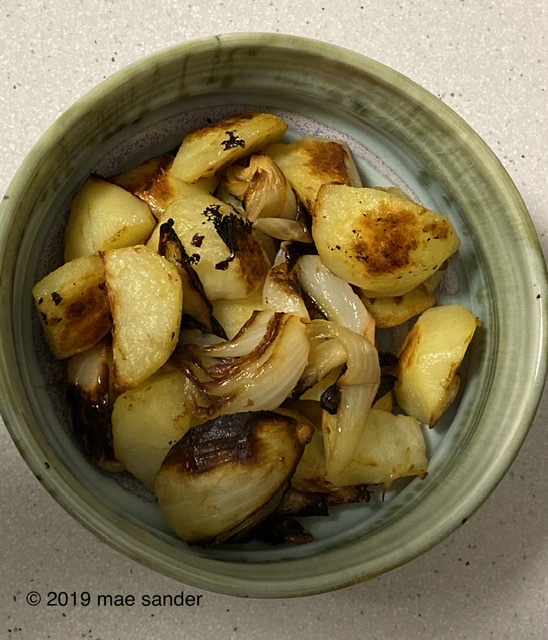
Oven-roasted potatoes and onions, a side dish with roast chicken.
Pork chops with braised red cabbage.
The leftovers were in the salad below.
Salad of lettuce, tomato, and the leftover pork and red cabbage.
I made sure that each bite-sized piece of meat had some good mustard on it.
Really good mustard!
Lettuce, tomato, red pepper, and tuna salad made with mayo, celery, and pickle relish.
Savory pancakes from sourdough starter discard.
Served with salsa, sour cream, and fried onions.
Smoked salmon and hard-boiled eggs with capers, lemon, mayo, and vegetables.

As I say, November was a very quiet month at home. Besides the books I reviewed on the blog, I also read two books that I didn't write anything about (at least not yet) --
  • Amos Oz, Dear Zealots: Letters from a Divided Land, first published a year ago at the time of the author's death.
  • Edmund Wilson, Axel's Castle: A Study of the Imaginative Literature of 1870-1930, which was published in 1931, but first made available on Kindle this month. It's been on my list for a very long time!
And we subscribed to HBO, for at least as long as we find things to watch. What we have watched but I haven't written about:
  • The first episodes of "His Dark Materials," based on the Philip Pullman books, which is being released on a week-by-week basis. So far it's watchable but not fantastic, and I don't have much to say about it.
  • Len watched the 10-episode series "Our Boys," a recently-released Israeli police drama about real events that took place in 2014. I listened to some of it.
  • Finally -- we watched the film Crazy Rich Asians, which I've been wanting to see.  Its food scenes are wondrous, especially those in the markets of Singapore. I didn't write about this film because at the time of the release virtually every food magazine on- and off-line had detailed articles about how these scenes were staged and filmed and what they signified.
December will be busier, but like November, maybe will not involve my kitchen very much.

Thursday, August 24, 2017

The Chef is Angry


The Angry Chef by Anthony Warner is an important book, which was published in England in June, but will not be available in the US until January. I was very excited by a review in the Guardian called "Why we fell for clean eating: The oh-so-Instagrammable food movement has been thoroughly debunked – but it shows no signs of going away. The real question is why we were so desperate to believe it" by Bee Wilson. As a result, I ordered a copy of the book from England, and I'm glad I have read it. If you can't get your hands on the book yet, I urge you at least to read the review.

What makes the chef angry? He hates the fact that large numbers of people are adopting truly harmful diets and food lifestyles because attractive -- though completely unqualified -- writers, celebrities, and bloggers are promoting them. Very few of the bogus claims are harmless. Followers of these fads may become malnourished. Some of the diet advice may foster underlying eating disorders. Adherents may harm their children by withholding needed nutrition. Above all, gullible victims of a variety of illnesses may fail to obtain rational treatments for themselves or their children. Most harrowing are the author's specific cases of people who have refused mainstream cancer treatment and died because they believed they could cure cancer through food choices.

Some of the promotors of these misguided claims are fooled by their own malarky. Others have commercial motives or just want to advance their popularity. As with many other anti-science movements in our self-deluding and celebrity-worshipping society, the reason why people fall for such con jobs is complicated. Anthony Warner does a good job of explaining a number of misguided ideas, unproven claims, outdated science, and outright hoaxes.

One extreme case he describes is "Dr." Robert O. Young, who successfully promoted a crackpot diet involving "acidic" and "alkaline" foods, and collected lots of money from desperate health seekers. Young is now in jail for several crimes including practicing medicine without a license. And in the news right now is an item that's also very relevant to the book: "Ad Watchdog Group Calls For Investigation Into Gwyneth Paltrow’s Goop" -- reported August 24, 2017, in the Consumerist website from Consumer Reports. Much debunking about this website appears in The Angry Chef!

If you have been tempted by "clean eating," detox diets, extreme food restrictions, the so-called paleo diet, or similar misguided claims, please read this book as soon as you can. You might find a better way to become healthy, you might gain insight into why you think self-styled experts can help you, and you might save money by not paying for worthless junk.

Wednesday, June 29, 2016

Contemplating Free-Range Britain

Illustration from Bee Wilson's New Yorker Article.
Author Bee Wilson, whom I quite admire, has an article in the current New Yorker about the coming changes in the relationship between Britain and Europe: "What Brexit Means for British Food."

Wilson points out that one of the now-nearly-forgotten motives that drove the formation of the European Union was hunger, as experienced especially during and immediately after World War II. The founders, she writes, hoped "to insure a plentiful food supply for entire populations." Their dream was "for Europe to become as self-sufficient as possible in food."

A number of very interesting points are made in the article, which does not buy the theory that the regulatory effect of Brussels has been negative and damaging. One impact she mentions, is the increase in variety and flavors since Britain joined. Wilson writes:
"The E.U. can’t take sole credit for the fact that the British now know pesto from salsa verde. Probably some kind of food revolution would have happened here anyway, just as it did in the States and Australia over the same period. But to contemplate Brexit is to see the extent to which Britain is not a food island. We eat food cooked by French and Italian chefs using European ingredients. More than a quarter of those working in food manufacturing in Britain are immigrants from within the E.U. We could not eat as we do without them. ... Over all, the impact of the E.U. on the British diet has entailed,... 'cultural exchange on a massive scale.'”
All in all, a very interesting article, which I recommend. I learned about it from a roundup of articles about the result of Brexit in Marion Nestle's blog, "Food Politics." Particularly interesting among her sources is an article in the Guardian titled "Britain's meal ticket? Food and drink at heart of referendum debate" (written before last week's referendum took place).

Nestle writes: "It’s obvious from reading all this that the effects of the Brexit decision are largely unknown. not easy to predict, but unlikely to be good."

Monday, October 27, 2014

Devil in the Details

Underwood Deviled Ham: 1899.
"An honest New England product put
up under the nicest, cleanest conditions."
Mark Bittman is famous for his remark that you shouldn't eat foods your grandmother wouldn't recognize. Unlike Bittman, I think that unrealistic nostalgia is the only reason why anyone would believe that food was better or safer 100 or even 200 years ago. The basic inventions that enabled canning are around 200 years old. The food industry back then poisoned a lot of people while they were figuring out what they had to do -- like make sure the contents of the cans wouldn't rot or produce botulism toxin.

Plenty of experiments with food additives in the past were much worse than what we find now, both in canned and other processed foods. Well-meaning food producers even poisoned kids by overdosing them with vitamin supplements, according to Bee Wilson's book Swindled, which I wrote about last week. If you read Swindled, you'll see that modern people who believe that impure and unhealthful food is a new phenomenon are victims of what Language Log calls "the recency illusion."

In this post I'll focus on one particular canned food that came on the market in 1870: Underwood Deviled Ham, which I mentioned in a recent discussion of Halloween foods. Evidently, the product was recognized as food in the days of our several-times-great grandmothers. It's exactly the type of food that I think modern purists are rejecting. (I'll skip the fact that my grandmother, being traditionally Jewish, shunned pork, and just talk about the product. Mark Bittman is every bit as Jewish as I am, and we both eat pork now, but that's beside the point.)

Consumer worries about food safety and purity seem to have been around throughout the life of this product -- over 140 years -- as reflected in the way Underwood promoted Deviled Ham and other similar canned goods. Facsimiles of Underwood's numerous print ads are easy to find on the web -- I think the Devil Logo attracts collectors of ads. It's interesting just to follow the development of the Devil logo, now the oldest trademark in continuous use, as well as to examine the types of persuasive arguments the ads included.

Underwood ads appeared in women's magazines and other publications for much of the 20th century. Like the one at the top of the page, they frequently emphasized that the contents of the can are clean, safe, and pure -- which shows how they expected the public to think of canned meat. Clearly, over 100 years ago people were just as worried about additives and dangerous foods as they are today.

1906. The emphasis is on pure ingredients:
"FIT FOR THE GODS...Made only of the finest sugar-cured
ham and the choicest of spices: always the same"
Along with the clean new-England kitchen where Deviled Ham was canned, both the ingredients and the cooking method received a great deal of emphasis. So did the "delicious taste." Words like this: "ham seasoned with salt and sugar and hickory smoke; boiled en casserole to imprison the good ham taste; ground fine, with mustard and 42 spices, which is the famous Underwood Deviled Dressing." One ad even stated that the product required no changes as a result of the first Pure Food and Drug laws:

1908: "Honestly Made and Truthfully Labelled for 85 years ...
The recently enacted Pure Food Laws have made no change in
UNDERWOOD'S PLANTS, PRODUCTS or LABELS, for all were
passed with highest praise by every State Board of Health that
examined them and by the U.S.Government."


These ads all promote purity,
for example, the "clean,
sunlit, New England kitchen"
where Underwood products are
made.

1914. "You don't have to be good at
guessing games, to guess what makes
Underwood Deviled Ham the Big Taste
for "partynics" and picnics of every kind!

No date, but appears to be a very early ad: "There is not one particle
of coloring matter nor preservative in Underwood's goods.

Deviled Tongue was another Underwood product at one time. In the ad on the left, during World War I:
"Conservation today is the world's crying need. In order to save lives, we are saving not only coal, sugar, wheat, fats -- but also many essential forms of meats. Every American  housewife  can serve Underwood Deviled Tongue with a clear conscience, knowing that she is thereby helping  to save those 'essential' meats for our soldiers and Allies overseas."
Underwood ads from the 1930s, 40s, 50s, and onward emphasized a variety of reasons why one would love their canned meat products, but I'm focused on the attitudes of approximately a century ago, so I'm not going to reproduce any here.

On Underwood ham labels now, in 2014, the list of ingredients is "Ham (Cured with Water, Salt, Brown Sugar, Sodium Nitrite) and Seasoning (Mustard Flour, Spices, Turmeric)." I wonder if the old ads conveniently left out the nitrite and other additives traditionally used to cure the ham. I bet they did! And I'd love to know how much their 19th century canning plant resembled a "clean, sunlit, New England kitchen." 

Sunday, October 19, 2014

Food Fraud

I have just read Bee Wilson's book Swindled: The Dark History of Food Fraud, from Poisoned Candy to Counterfeit Coffee. Food adulteration with poisons (like lead-based or cancer-causing dyes), with unreasonable additives (like alum in bread), or with cheaper substances (like adding water to milk or injecting chickens with dilute broth) has been a problem for centuries, as documented throughout the book. Outright cheating by false labeling, false weighing, or overcharging customers is another fraud that's far from new.

"The rich can eat unadulterated food without much bother, whereas for most of the poor, it is a constant effort." (p. 101) Poor people have suffered more than those with the resources to purchase better quality foods and the time and energy to pay attention to what is happening. But money is far from an adequate protection against food frauds. "The motive to swindle -- greed -- is a constant in human history," Wilson writes. (p. 322)

Swindled is closely related to several other books I've read, but has an interesting approach to the topic of food safety and food regulation. Wilson profiles a number of crusading chemists, medical doctors, journalists, and others who have attempted to inform the public about major problems in the food supply. Their efforts were sometimes successful, sometimes not, but she uses their discoveries to illustrate exactly what frauds were common at several times in the past. Wilson also adds a number of other historic and ongoing frauds into her narrative, up through recent baby-milk scandals in China. Swindled was published in 2008: I wish it continued right up until the present.

Here are some of the most interesting people I learned about:
  • Frederick Accum (1769-1838) wrote A Treatise on Adulterations of Food, and Culinary Poisons in 1820. Wilson says: "It would be an exaggeration to say that this book changed everything; after it was published, the swindlers carried on swindling, and more often than not they still got away with it; no food laws were changed on account of Accum... . But his treatise finally opened people’s eyes to the fact that almost everything sold as food and drink in modern industrial cities was not what it seemed; and by being not what it seemed, it could kill them." (p. 1)
  • Arthur Hill Hassall (1817-1894) discovered how to use a microscope to detect adulteration of food. He documented the widespread use of alum in falsifying white bread, adulteration of coffee, artificial substances in mustard, impure drinking water, and many other frauds.
    "Hassall analysed more than 2,500 samples of food embracing 'all the principle articles of consumption, both solids and liquids' and found that purity was the exception, adulteration the rule. Earlier writers might say vaguely that cinnamon was 'often' or 'sometimes' adulterated (with cassia, wheat, mustard husks, and colouring), whereas Hassall could state with absolute certainty that out of nineteen samples of ground cinnamon, only six were genuine; that three consisted of nothing but cassia; that ten were mixed up with bulking agents such as sago, flour, or arrowroot; and that these faked cinnamons were not always cheaper than the real thing, meaning that the public was being consistently cheated in the purchase of cinnamon.Unlike the scaremongers, Hassall was not afraid to say when a food was not adulterated." (p.127)  
  • Thomas Wakley (1795-1862) was founder and editor of The Lancet, dedicated to enlightening the public about medical affairs. The power of the free market was a given at the time in English politics -- and the idea was especially applied to food, for which there was no regulation.  "Wakley argued for public health in the widest sense—and this necessarily entailed a frontal assault on the evils of adulterated food." (p. 126) In disseminating the facts about food fraud in his day, Wakley particularly publicized the work of Arthur Hassall. Under their influence the first pure food act was passed in 1860, though it was weak.
  • Harvey Wiley (1844-1930) was a strong advocate for regulating food during the administration of Theodore Roosevelt. Eventually he was the author of the first food and drug laws in the US. His role in developing the FDA has come up in other books I've read. (See my recent post titled Food Safety and its History).
  • Caroline Walker (1950-1988) was an advocate for better food regulation in England in the 1980s. She wrote The Food Scandal with Geoffrey Cannon. 
  • Mark Woolfe at the time Wilson wrote was head of the British Food Standards Agency (FSA) and more recently has been a member of the RSC's Analytical Methods Committee. Woolfe's role in developing DNA tests to identify falsely labeled Basmati rice, as described in Swindled, is an interesting study in modern technology that just barely manages to stay ahead of the fraudsters!
Swindled is an enjoyable book despite the depressing subject matter, because it's engagingly written. I enjoyed the many anecdotes and factual discussions of food frauds in the past, including examples of recipes for "mock" dishes that playfully imitated real foods without including the "real" ingredients. The book also offers lots of amusing illustrations like this one (p. 98):

Sunday, February 09, 2014

Utensils

"There have been books on potatoes, cod, and chocolate, and histories of cookbooks, restaurants, and cooks. The kitchen and its tools are more or less absent. As a result, half the story is missing. This matters."

Consider the Fork: A History of How We Cook and Eat by Bee Wilson is about much more than the often repeated history about how nobody used a fork until whenever it was supposed to have been discovered (or maybe re-discovered, since maybe the Romans used forks).

This highly amusing and interesting book talks not only about the fork, but about the spork. It also describes the history of the hearth and various types of cook stoves and spit roasting devices; cook pots and pans and skillets; rice cookers; knives, Chinese cleavers, and other cutting or mincing tools; egg beaters; spoons; the blender; ice boxes and refrigerators; and other interesting devices. The author explores the history of level measurements in the US and of measuring by weight elsewhere. She talks about the history of canning food, and the very slow development of an effective can opener.

Many elements affect the way people eat. One that's explored in a way that's new to me is how the supply of firewood or other fuel affects the way food is cooked. I knew that the combination of Chinese cleaver to cut food in clever small bits and the use of the wok to cook quickly was a response to scarce fuel, and Wilson explores the result of this fact. Less obvious: the habit of roasting huge cuts of meat, even sides of beef or whole smaller animals in an open fire was available in England because fuel was plentiful. However, the supply of cooking fuel in France was less plentiful, so other techniques of cooking became more prevalent. So the French call the English "les Rosbifs."

Wilson discusses how slaves or servants in the kitchen have affected attitudes towards labor-intensive cooking, quoting various people including the Roman philosopher Seneca: "I like food that a household of slaves has not prepared, watching it with envy, that has not been ordered many days in advance or served up by many hands." And in our own time, she points out that we depend on invisible workers far from our own kitchens. "We do not see the hands in the chicken factory that boned the breasts… nor the workers who labored to assemble the parts of our whizzy food processors. We only see a pile of ingredients and a machine ready to do our bidding. Alone in our kitchens, we feel entirely emancipated."

I particularly liked Wilson's awareness in the book of the differences among various social classes when it came to cooking and kitchen equipment. She quotes a great comment from Laura Ingalls Wilder -- "The rich get their ice in the summer, but the poor get theirs in the winter."

Friday, May 16, 2008

Famine?

All the while that I'm blogging my essentially frivolous thoughts on food, I am also in parallel thinking about the looming food insecurity of the third world. Every day new events and problems are the subject of various articles, to which I make no comment. I don't have any enlightening ideas or facts.

I would like to mention a particularly interesting article on this subject in the New Yorker: "The Last Bite: Is the world’s food system collapsing?" by Bee Wilson. In this article, Wilson discusses several books: The End of Food by Paul Roberts; Stuffed and Starved: The Hidden Battle for the World Food System by Raj Patel, Bottomfeeder: How to Eat Ethically in a World of Vanishing Seafood by Taras Grescoe, and In Defense of Food: An Eater’s Manifesto by Michael Pollan.

A few quotes from Wilson's article:
"The world seemed to have been liberated from a Malthusian 'long night of hunger and drudgery.' Now the 'dark tints' have returned. The World Bank recently announced that thirty-three countries are confronting food crises, as the prices of various staples have soared. From January to April of this year, the cost of rice on the international market went up a hundred and forty-one per cent. Pakistan has reintroduced ration cards. In Egypt, the Army has started baking bread for the general population. The Haitian Prime Minister was ousted after hunger riots. The current crisis could push another hundred million people deeper into poverty."

"All of these authors agree that the entire system of Western food production is in need of radical change, right down to the spinach. Roberts opens with a description of E.-coli-infected spinach from California.... Industrial farming means that even those on a vegan diet may reap the nastier effects of intensive meat production. It is no longer enough for individuals to switch to 'healthier' choices in the supermarket. Schlosser asked his readers to consider the chain of consequences they set in motion every time they sit down to eat in a fast-food outlet. Roberts wants us to consider the 'chain of transactions and reactions' represented by each of our food purchases—'by each ripe melon or freshly baked bagel, by each box of cereal or tray of boneless skinless chicken breasts.' This time, we are all implicated."

"So, yes, cheap food can be nasty, not to mention bad for farmers and the environment. Yet it has one great advantage that neither Patel nor Roberts fully grapples with: people can afford to buy it. According to the World Bank, four hundred million fewer people were living in extreme poverty in 2004 than was the case in 1981, in large part owing to the affordability of basic foodstuffs. The current food crises are the result of food being too expensive to buy, rather than too cheap. The rioters of Haiti would kill for a plate of affordable chicken, no matter how pale, soft, and exudative. The battle against cheap food involves harder tradeoffs than Patel and Roberts allow. No one has yet discovered how to raise prices for the overfed rich without squeezing the underfed poor."

Read it! Weeping optional.