Monday, April 24, 2023

Missing Tupperware? -- Not me.

Thoughts on Tupperware as the company goes out of business.

As far as I can remember, I only ever went to one or two Tupperware parties in the 1970s.
The only reason anyone I knew would host a Tupperware party was that there was always a lottery at each party.
The winner received some fabulous piece of Tupperware. The loser had to host a party. The pressure was on!

Basically, virtually no customers want to host or to attend promotional parties any more. The Tupperware company, which is in deep financial trouble, finally started selling their products at Target last fall. However, this departure from their 77 years selling only at parties is probably too late to save them. Both the party and the product are effectively obsolete. You can buy containers that are as good or better from Oxo or Rubbermaid or ZipLock or several other manufacturers. As an expert quoted in CNN earlier this month said: “The company used to be a hotbed of innovation with problem-solving kitchen gadgets, but it has really lost its edge.”
 
Women wore dresses to mid-century Tupperware parties. There were games, and prizes for odd things about
your clothing. At one party, I won some small Tupperware thing because (get this) my dress had a side zipper!
You probably never heard of a dress with a side zipper. Don't ask.

The Tupperware company utterly failed to keep up with modern times.
Among other things, many people don't want to use plastic where it can be avoided.

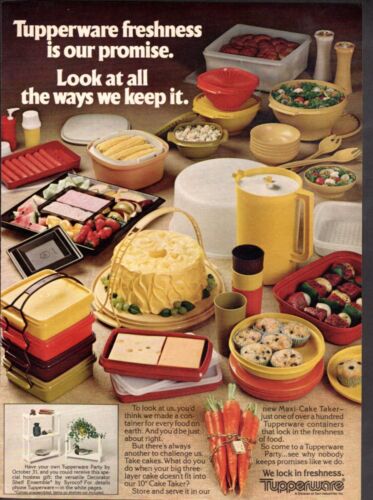
Vintage Tupperware juice pitcher. I never thought it was that exceptional.
A favorite was the cake lid, but it didn't seem that great to me.

More vintage Tupperware. Lots of plastic mugs, tumblers, and
other beverage containers as well as ice buckets, ice-cube trays, and more.
Perfected for the tastes of housewives of the 1940s, 50s, 60s 70s...

I had virtually no Tupperware and never saw what the big deal was about the products, which always seemed overpriced. The parties were kind of silly and didn't appeal to me or to my friends. When we lived in Berkeley in the 60s, I heard rumors about a bunch of hippies who volunteered to host a Tupperware party. The naive Tupperware saleslady didn't realize that her prospects were all high on some then-very-illegal substance. The guests definitely thought the whole sales pitch and all the games were hilarious!


This is the Tupperware toy every mother that I knew thought her child should have. You can still buy them.

The history of the Tupperware company, which first created a new type of plastic and then innovated the in-home sales parties is fascinating. An article in the Washington Post summarized the roles of Earl Tupper, the engineer who invented self-sealing plastic containers and lids, and Brownie Wise, who invented the Tupperware party. She became the leader of "a raucous women’s world of guerilla sales and marketing." I guess everyone has a Tupperware story, but I feel no nostalgia! (Washington Post, April 23, 2023)

Blog post © 2023 mae sander.
All photos taken from random internet sites.
Shared with Elizabeth's Tuesday blog party.

Sunday, April 23, 2023

Visiting NorthEast, Maryland


NorthEast, Maryland, is a small town at the north end of Chesapeake Bay. It's name is a mystery to me! Last week, we had a very nice seafood lunch on a patio at a creek-side restaurant in NorthEast, after watching eagles and vultures at the Conowingo Dam, which is around a half-hour drive away. While the shops in the town are a disappointingly touristy, I enjoyed seeing several murals, and noticed a few nicely painted old houses.


I’ve seen quite a few of these angel wings, and had to try them out.

I drew myself an angel dress to go with the wings.


I was happy to see a Little Free Library.

One of the eagles we saw at Conowingo Dam.

Blog post © 2023 nae sander,
Shared with Sami’s Monday Murals.


Saturday, April 22, 2023

Colson Whitehead: “The Underground Railroad”


The Underground Railroad, published 2016.

Imagining what it would be like to be a slave in the Old South is so painful that mostly, we don’t exert ourselves and do it. Colson Whitehead’s imagination in The Underground Railroad is so powerful that reading this narrative of slavery and dispossession of one’s own self forces me to imagine the horrors of being owned and having no agency to do anything but suicide or infinitely risky flight from home. He conveys with feeling the existential dread of how you and your parents or you and your children could be sold separately and never be reunited. 

Whitehead’s narrative creates such a vivid picture of both the mental and the physical torments suffered by American slaves before the Civil War that it’s almost unbearable to read. Despite the pain, it’s worth reading not only because it’s history but also because he’s a great writer. The plot is suspenseful and absorbing, the characters are likable or despicable, and the details are vivid. The facts about atrocities like the Fugitive Slave Laws and the resulting vicious Slave Catchers are compelling, moreso than in normal history books. A poignant device Whitehead uses is quoting of advertisements for runaway slaves at the start of each chapter: these contemporary descriptions of human chattel have always been an object lesson on the terrors of the institution of enslavement. Above all, what I found important in this book is that it's written entirely from the point of view of kidnapped Africans and their descendants.

The title of the book, The Underground Railroad, evokes a historic image, but in the novel, one does not find the famous Underground Railroad that existed before the Civil War which was a network of safe houses and secret routes known to “conductors” like Harriet Tubman and other infinitely brave heroes of American history. Whitehead’s novel creates a metaphoric version that paradoxically, is a literal railroad, with engines and freight cars that runs through underground tunnels to take escapees away from their enslavers. This concrete visualization of surreal underground tunnels and frightening engines contributes to the unreality of the whole historic nightmare. The Guardian review explained it this way: "Whitehead has taken that historical metaphor – the network of abolitionists who helped ferry slaves out of the south – and made it into a glistening, steampunk reality."

The New York Times review by Michiko Kakutani describes the book as “a potent, almost hallucinatory novel that leaves the reader with a devastating understanding of the terrible human costs of slavery.” The following quote from this review provides an insight about the variety and depth of the writing:

“One of the remarkable things about this novel is how Mr. Whitehead found an elastic voice that accommodates both brute realism and fablelike allegory, the plain-spoken and the poetic — a voice that enables him to convey the historical horrors of slavery with raw, shocking power. He conveys its emotional fallout: the fear, the humiliation, the loss of dignity and control. And he conveys the daily brutality of life on the plantation, where Cora is gang-raped, and where whippings (accompanied by scrubbings in pepper water to intensify the pain) are routine.” 

Whitehead also plays with history in various other ways, especially the way he portrays and exaggerates the extreme anti-black laws of North Carolina. The result of his counter-historical choices is to highlight the attitudes and evils of the enslavers; for example in his version of the town where the character Cora is hiding, a lynching occurs almost every day. 

Museums and historic houses that one visits may present the history (including slave cabins) of the Africans who did the work in the Old South, made their enslavers rich, and never received the profits, even for their distant descendants, even to this day. In the novel, a "museum" in the North Carolina town forced the hiding fugitives, including Cora, to play a role in very falsified narratives about the transport of Africans to the US and about their lives on the plantations. Cora was forced to enact a false image of slavery in this museum. Her thoughts as she looked out of the exhibit where she and other fugitives played the role of a boy on a slave ship or a woman servant:

"The stuffed coyotes on their stands did not lie, Cora supposed. And the anthills and the rocks told the truth of themselves. But the white exhibits contained as many inaccuracies and contradictions as Cora’s three habitats. There had been no kidnapped boys swabbing the decks and earning pats on the head from white kidnappers. The enterprising African boy whose fine leather boots she wore would have been chained belowdecks, swabbing his body in his own filth. Slave work was sometimes spinning thread, yes; most times it was not. No slave had ever keeled over dead at a spinning wheel or been butchered for a tangle. But nobody wanted to speak on the true disposition of the world. And no one wanted to hear it. Certainly not the white monsters on the other side of the exhibit at that very moment, pushing their greasy snouts against the window, sneering and hooting. Truth was a changing display in a shop window, manipulated by hands when you weren’t looking, alluring and ever out of reach." (p. 116). 

Compared to the imaginary museum where Cora is on display, the African American History Museum in Washington, which I visited last week seems to me to be sincerely honest and accurate, as well as historically broad and detailed. However real and accurate it is in conveying the injustices done to African Americans for 400 years, though, this museum  didn’t work on my emotional imagination the way that Whitehead’s narrative does. He forces me to perceive enslavement in its true raw and poisonous viciousness, and to portray those who owned other humans as something below humanity themselves.

Note: This is the first time I have read this prize-winning novel, and I have not seen the TV miniseries based on the book. I've read a couple of other books by Colson Whitehead and I'm looking forward to the upcoming publication of his new novel Crook Manifesto next July.

Review © 2023 mae sander

Friday, April 21, 2023

French food is authentic because they say so

Making charcuterie in France. 
The French take authenticity in food so seriously that it’s hard to contemplate. For example there is the “Association Amicale des Amateurs d'Andouillette Authentique” (Amicable Association of Adorers of Authentic Andouillette), which is dedicated to preserving a particular kind of tripe sausage. This is a stinky kind of sausage that many people find revolting, and that is offered as kind of a challenge to eaters who claim to be brave. (The Adorers say it’s not stinky if it’s made properly.)

A couple of years ago, the AAAAA president Jacques-Louis Delpal said that the society:   “‘was born as a joke,’ when five food critics began hosting regular andouillette-focused gatherings in the 1950s.” (Source: The Misunderstood French Sausage That Has Its Own Association).

We heard of the sausage and also of the society during our trip to France years ago. One of our friends took us to a wine bar where it was among the regional specialties on offer, and challenged us to eat some —  I think Len did so, and I suspect it was the authentic, certified, made-right version of this dish. The Association (and in fact the sausage itself) is the kind of obscure gastronomic phenomenon that some of our French friends find very amusing. What it is specifically:

“Andouillette boasts several regional variants, but its most well-known form is associated with the city of Troyes: pork tripe is soaked, scalded, sliced, and seasoned with aromatics like onions, nutmeg, and even Champagne. It is then threaded by hand (‘à la ficelle’) into its casing and simmered for several hours before being sold.”

This is only one example of how French people value, in fact almost worship, authenticity in food. Although gastronomy in France has been a constant scene of reinvention for several hundred years — including at least two times that the term “nouvelle cuisine” was used — they also love to claim very ancient traditions at work. They also love to write, often bombastically, about food, talk about food, form organizations to promote their ideas about food, and so on. For example:
 
“In 1996, several well-known French chefs including Joël Robuchon … and Alain Ducasse, probably the most famous French chef alive today, issued a manifesto denouncing the ‘globalisation of cuisine’ and innovation for its own sake. Eighteen months after the reactionary manifesto, opposing chefs of equal stature – known as the ‘group of eight’ – fired back, rejecting nostalgia in favour of experimentation in the kitchen.” (Source: The rise and fall of French cuisine)

Here’s another example of the French interest in authentic food: an entire book of essays dedicated to the traditional dish pot-au-feu. It's an entirely fascinating book, and inculdes many obscure things about the history of the dish, its reputation, old sayings and kids' rhymes that refer to the dish, ways that people view the ‘authenticity’ of the dish, and the glories of the many variations of the dish throughout the French nation. In fact, the French King Henri IV (d. 1610) said he hoped to reign in a land where every peasant could afford a poule-au-pot, a dish that's a type of pot-au-feu.

Some regions have special versions of pot-au-feu: several articles in the book contain a great deal of detail about these preparations. The most famous is bouillabaisse, the fish stew that's the specialty of Marseilles and of fishing villages along the Mediterranean coast; a rather long chapter offers incredible detail about this dish. There's a chapter on kig ha farz, the classic dish of the Finistére region of Brittany. The potée (soup) of Lorraine, the garbure (vegetable soup) of the south-west, and the bréjaude of the Limousin are also described in detail, along with the attitudes and feelings of the people of these regions. (For my complete review of this book, see this blog post)

Over the years, I’ve written about French food and the constant reinvention of traditions and authenticity often. I’m aware that French legislation constantly protects tradition and authenticity, for example, defining the meaning of  “fait maison” (made in house) and the logo (shown in the picture) to designate restaurants that prepare all food in house rather than buying from huge warehouses full of  ready made restaurant meals. Over 30 percent of Paris restaurants were doing this a few years ago— I don’t know if the law has helped. But it shows how they worry about it. And it’s only one of the numerous French laws regulating the quality and accuracy of French cuisine and the training required to be a baker, a chef, or other food trades.

I started thinking about the way the French deal with the idea of authenticity because earlier this week I was reading about authenticity in other cuisines, which made me think about the association to preserve andouillettes. In fact, a bit of reading and I discovered this:

“There are also many gastronomic associations that celebrate and preserve specific dishes and maintain the traditional versions of tête de veau, cassoulet, andouille, boudin and regional specialities such as the black figs of Caromb and cherries of Venasque. These associations confer and organise awards, badges, dinners, festivals and competitions. I once met two representatives of the Association to Safeguard the Oeuf Mayonnaise, who were very happy to explain, without any irony, the criteria for an excellent example of the form. ‘It depends on the eggs, their freshness, how well they are cooked, and then the nap of the mayonnaise must be perfect – it should cover the eggs and not fall down too easily.’” (Source: The rise and fall of French cuisine)

And notice that I didn’t even get around to mentioning the extreme French views about the quality and provenance and history of bread! French food is a topic with infinite possibilities.

Blog post © 2023 mae sander.
Photos as credited.


Thursday, April 20, 2023

Authentic Italian Food?

Pizza in our own kitchen.

"Of course, it goes without saying that many Italians and Italian-Americans alike have vested, entrenched opinions about their foods. So when Alberto Grandi — an Italian academic and a professor of history at an Italian university in Parma — made some especially controversial comments about the provenance of certain Italian dishes in a recent interview with the Financial Times, it's no surprise some feathers were ruffled."

This is the beginning of an article in Salon.com, "Pasta, pannetone, Parmegiano and pizza are obviously Italian . . . right? Some commonly accepted 'truths' about the origins of Italian food may actually be myths" by Michael La Corte, which analyses a recently-published interview in the Financial Times. The FT article was by food writer Marianna Giusti, who talked with an Italian expert named Alberto Grandi. Grandi is a "Marxist academic, reluctant podcast celebrity and judge at this year’s Tiramisu World Cup in Trevino.... Grandi has dedicated his career to debunking the myths around Italian food; this is the first time he’s spoken to the foreign press. When his 2018 book, Denominazione di origine inventata (Invented Designation of Origin), started racking up sales in Italy, his friend Daniele Soffiati suggested they record a spin-off podcast."

The complex questions of Italian food history have fascinated me because they are so often misrepresented, so I was delighted by both of these articles. My favorite example of counter-factual food history, in fact, is tiramisu, which historical novels often mention in settings very much earlier than it really should be. The FT article cites several examples of much more recent inventions of "classic" dishes than popular culture believes, continuing:

"Tiramisu is another example. Its recent origins are disguised by various fanciful histories. It first appeared in cookbooks in the 1980s. Its star ingredient, mascarpone, was rarely found outside Milan before the 1960s, and the coffee-infused biscuits that divide the layers are Pavesini, a supermarket snack launched in 1948. 'In a normal country,' Grandi says with a smile, 'nobody would care where [and when] a cake was invented.'” (Financial Times)

Grandi is quite a character! According to the FT article:

"Grandi has made himself unpopular in some quarters by criticising Italy’s mighty food and drink sector, which, by some estimates, accounts for a quarter of GDP. On the podcast, he jokes he should only leave his house 'with personal security guards, like Salman Rushdie.' In 2019, the Italian ambassador to Turkey reprimanded Grandi at a conference in Ankara after Grandi ridiculed Italy’s 800 protected designations, products whose quality is recognised by the EU as inextricably linked to their area. At Les Mots literary festival in Aosta in 2018, he was attacked by a Roman presenter who, offended by Grandi’s claims about carbonara, 'called [him] every name in the book' in front of a dumbfounded live audience." (Financial Times)

Also, the FT article discusses in detail the role of the Italian diaspora, especially in the US. There are several specific examples, about pizza, carbonara, and other Italian-American fascinations and fabrications. In addition to reporting on Grandi's ideas, the author did interviews of some older Italians, asking about their food memories in response to Grandi. For example, she writes:

"Mozzarella comes from the south of Italy .... To find out more, I call a friend’s Sicilian great-aunt. Ninety-five and a little deaf, Serafina Cerami answers the phone immediately. 'We ate a lot of mozzarella in Sicily before the war!' she shouts down the line. Like pizza, mozzarella was fast-tracked to global fame through the funnel of mass migration to America from the Italian south. Comparing her recollections with those of my grandmother, it’s clear that Sicily’s elevated 'Sunday' dishes (aubergine parmigiana, cannoli, pasta con le sarde) were the ones that went mainstream, thanks to the south’s contribution to the Little Italys of the US. My grandmother, on the other hand, grew up eating tordelli alla massese (large fresh tortelli with a meat filling, cooked in a ragú sauce) and cappelletti in brodo (fresh tortelli in chicken broth), dishes that are almost entirely unknown outside the region." (Financial Times)

The Salon.com article is intended to put the FT article in perspective. The author interviews an American food writer, Ian MacAllen, author of a book titled "Red Sauce: How Italian Food Became American." Here is an interesting excerpt from the interview:

Michael La Corte: "As far as you know, did carbonara, panettone or pizza actually originate in the US or by American chefs? Or were they authentically Italian creations?"

Ian MacAllen: "Carbonara has a lot of mythology behind it and much of it is just made up. The phrase is often credited to the black ration packs US Soldiers carried in World War II, but also attributed to a secret society known as the carbonari, who maybe served the dish at their secret meetings or maybe because of the charcoal workers who cooked it at their forest camps. Renato Gualandi, a chef who cooked a banquet for high ranking allied commanders in World War II is often credited with inventing the dish using ingredients in American soldiers' ration packs. For this reason Luca Cesari describes it as an 'American dish invented in Italy.' One of the earliest documented instances of a Spaghetti Carbonara recipe is in 'Vittles and Vice' by Patricia Bronte indicating the recipe originated in a Chicago restaurant. But it is also possible that Carbonara existed before the war under a different name."  (Salon)

Although it discusses both Italian and Italian-American foodways, the original story in the FT by Marianna Giusti was intended for a British audience. Therefore, expectations about Italian food are very different in the minds of her readers than they would be in an American audience. Her interview subject, Alberto Grandi, in fact, writes and podcasts for Italian readers/listeners, not for Americans OR Brits! To clarify this, the analysis in Salon points out:

"The United Kingdom has a very different relationship to Italian food than Americans have. The United States has literally millions of Italians come to the country between 1880 and 1940. It has become a huge part of American culture — but it's also tied to that time and place where and when these people came to the United States. Italians come to America today and if they end up working at an Italian American restaurant they are cooking dishes that have little connection to what they knew in Italy, but it is very American. In the United Kingdom, the relationship has been different. Italians had free movement to the island when it was a member of the EU. And this happened across all of Europe — Italians moved to those countries and brought with them contemporary Italian cuisine. That food is very different from Italian American cuisine or even contemporary American-Italian cuisine." (Salon)

Both articles are very clear on how extremely recent are many supposedly ancient Italian food traditions and the current insistence on correctness in recipes and ingredients. Giusti concludes:

"Indeed it’s hard to imagine that people who survived the second world war eating chestnuts, as my grandfather did, would be concerned about using pork jowl instead of pork belly in a pasta recipe. Or as Grandi puts it, 'Their "tradition" was trying not to starve.'  (Financial Times)

La Corte, Giusti, and their interview subjects offer lots of fun facts about Italian and Italian-American foods and about frequently repeated myths and fallacies on the subject of Italian cuisine. My summary only includes a very small number of the interesting details. The highly politicized atmosphere of Italy today also causes food to be a political issue, and the FT article has quite a bit on this subject, which I haven't touched. Whether you think you know about Italian food or not, if you are a fan of food history, you should  check out the two articles.

I love Italian food! Anywhere!

On a trip to Sicily in 2007, we were delighted by the food we ate, especially fresh fish.
Many Italian dishes can’t be duplicated because Mediterranean fish from day boats
are unavailable except at the docks and local markets.

— SOURCE


At a restaurant where we ate in Sicily: presumably authentic.

Authentic Italian-American food from St. Louis, my native town: “Toasted Ravioli.”
Along with pizza, one of my first-ever Italian foods that I tried when I was in high school.
On a trip to St.Louis a few years ago, I ate this memory-jogging dish and took this photo.

Ottolenghi, a London restaurateur and cookbook author, invented this version of cacio e pepe.
 I’ve made it. It’s good! Photo from Ottolenghi’s website.

Trader Joe’s Ravioli. Product of Italy.
Made for dinner this week. I love it!

Tiramisu at a restaurant in Fairfax, VA, 2015.

Costco Tiramisu: totally American? No, made in Italy.
I love it too.
 

Blog post © 2023 mae sander.
 

Wednesday, April 19, 2023

Authenticity in Cuisine?

"The famous Somali poet Warsan Shire once wrote: 'no one leaves home unless / home is the mouth of a shark / you only run for the border / when you see the whole city running as well.'”

Somali chef Ifrah F. Ahmed quotes this poem in a fascinating article: "On Fusion, Forced Migration, and Somali Food:How Somali food in the diaspora holds the history of forced migration." She describes her thoughts about authenticity in cuisine as she expresses it in her cooking for her popular food truck and pop-up restaurants in Los Angeles, Seattle, and Brooklyn. Because I am very fascinated by the concept of authenticity in cuisine and how this concept is often, in my opinion, misused and historically muddled, I found her thoughts about how migration affects cuisine -- and authenticity -- very insightful. I particularly like her conclusion: "there are millions of ways to belong to a diaspora and to live authentically within a culture."

Somali chef and writer Ifrah F. Ahmed from Hiiraan Online

Ahmed writes about her family's forced migration from Somalia when she was a child, and how they eventually settled in Seattle, where she grew up, learning an immigrant version of the traditional cooking that they brought with them. Her fascination with cooking led her to become a chef, entrepreneur, and food writer for the New York Times and other publications. She developed recipes that interpreted her family traditions and built on them, continuing with the tradition and flavors of her heritage. 

Many people, especially her fellow Somalis, challenged the authenticity of the very popular foods she served at her food truck, particularly reacting to her specialty, "a Somali-style wrap — spongy and sour anjero-wrapped breakfast burritos filled with soft scrambled eggs, fuul (fava bean stew), and spicy vibrant green basbaas (Somali hot sauce)." She explains the inspiration for the dish: "I grew up eating fuul, eggs, and anjero. For me, serving the burrito was an opportunity to share a favorite family breakfast that was reimagined in its design; the only difference was rolling the ingredients into the soft sourdough bubble-lined pockets of the anjero. The burrito was a new thing and yet the original contents were the same."

Being alienated from the land they fled resulted in efforts for her family and her fellow immigrants to cling to the memories and traditions of their native cuisine, and to object to any changes, which they suspect of being "fusion food," and of deviating from authenticity. "Forced migration made it so we clung to what was most familiar, while trauma made it so we felt that we needed to protect and maintain what we once knew, just as we knew it."

This experience of cultural change combined with efforts at continuity very much parallels my understanding of the evolution of many immigrant cuisines in the 19th century when America became the home of many ethnic groups and nationalities. Though their departures from their original homes may not have shared the extreme desperation of modern forced emigration in the face of wars and famines, the wish of the earlier groups to continue family traditions seems to me to have been parallel to the experiences that Ahmed's family shared. 

Ahmed's thoughtful definitions of authenticity in the face of the critiques of her fellow immigrants are very enlightening. She writes: 

"Our dishes and traditions remained unchanged by time as we became dedicated to preserving the classical and 'purest' forms of culture and cuisine, because that was the last thing we had known. Forced migration made it so we clung to what was most familiar, while trauma made it so we felt that we needed to protect and maintain what we once knew, just as we knew it. ...

"No wonder, then, that it’s mostly in the diaspora where cuisine could be considered 'classic.' This adherence to 'classic' forms of culture and cuisine is a bridge connecting those in the diaspora to their homelands, a thread sewing the lost to what they left behind."

The New York Times has published some of Ahmed's recipes, such as Fuul, the fava bean stew that figures in her breakfast burrito. I haven't tried it, but it sounds quite delicious, and looks good in the image from the NYT article. (Note that NYT recipes require a subscription, so you may not be able to see this recipe.)

Recently, I've been thinking a lot about the meanings and misuses of food history, and how the idea of authenticity is misused, so I found this excellent article very interesting. I've also been thinking about the current global refugee crisis, and Ahmed's family story is very relevant to this as well.

The Ongoing Global Tragedy of Forced Immigration

The tragedy of forced immigration, where families have to struggle to create a new life in a new place (or often live in desperate and impossible circumstances) is horrifyingly common and increasing. Most tragic is that millions of people have lost their homes and have nowhere to go at all. The wars in Ukraine and Syria, the dictatorship in Afghanistan, and the famines in Africa have created millions of desperate people displaced from their homes and in need of all necessities of life.

Somalia has been one of the most desperately affected areas for a long time, and according to the charitable organization Concern:

"At the end of 2017, there were over 986,000 [Somali] refugees. While the numbers went up a bit in 2022, at just over 799,000 it’s still a significant decrease compared to five years ago. However, the situation is nevertheless dire for many. For the last several decades, a cycle of crisis in Somalia has been fuelled by drought, conflict, and hunger. The country is at the epicenter of the current Horn of Africa crisis, which could lead to a new famine being declared in the region. Even if it doesn’t, the UN still estimates that the effects could be similar to the country’s 2011 famine." (source)

Monday, April 17, 2023

Leaving Lancaster

Yes, pretzels from the Lancaster Farmers’ Market!

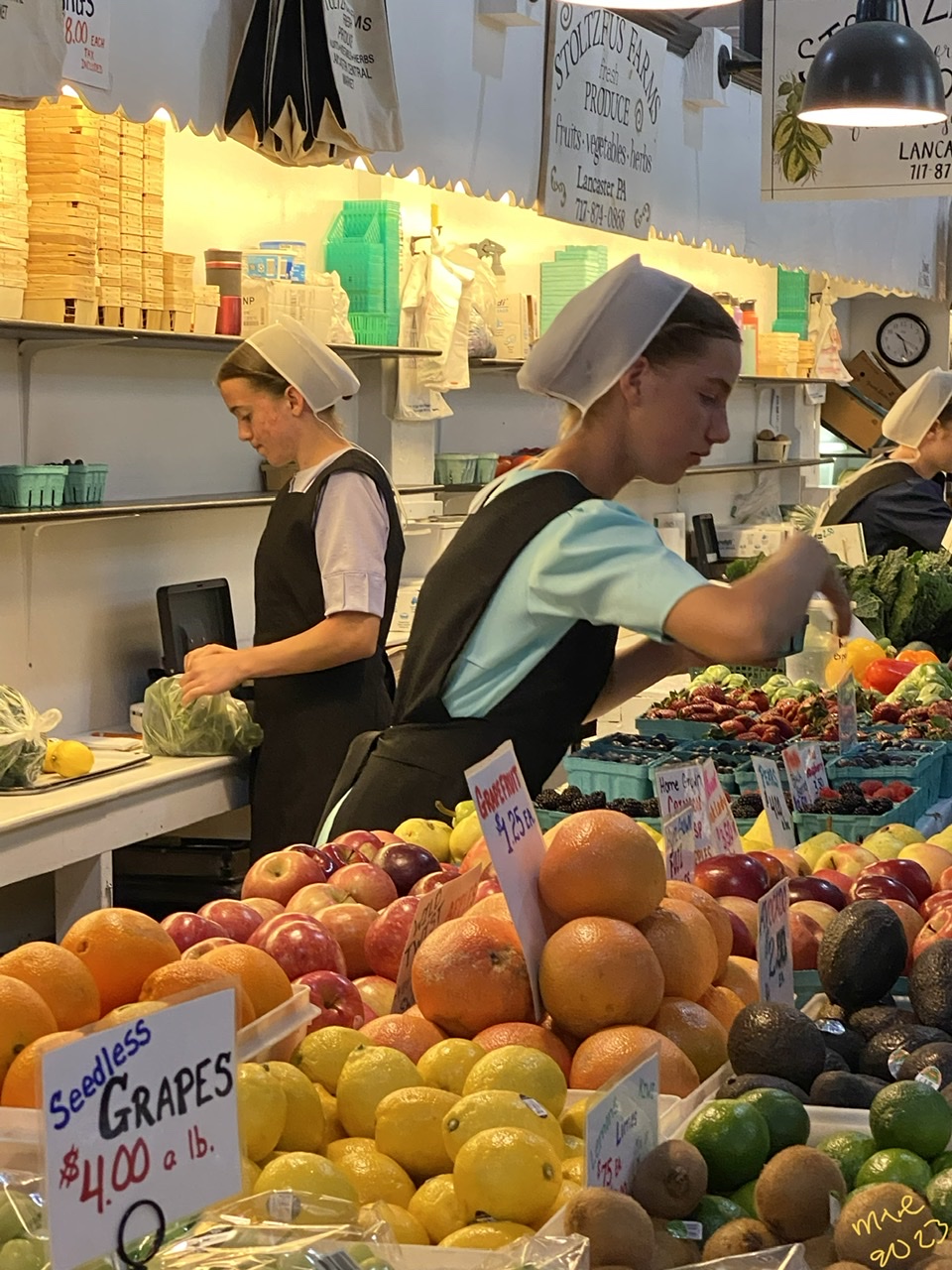
We drove home to Ann Arbor on Sunday, after a very pleasant visit with our relatives in Virginia and Pennsylvania. Saturday morning we spent some time exploring the Lancaster Farmers’ Market. We have a feeling that it’s a bit different from earlier visits; specifically, there are more stalls selling commodity foods (like commercial candy and imported vegetables from Mexico and ordinary souvenirs). Quite a few of the Amish and Mennonite vendors are still there, just more others. 


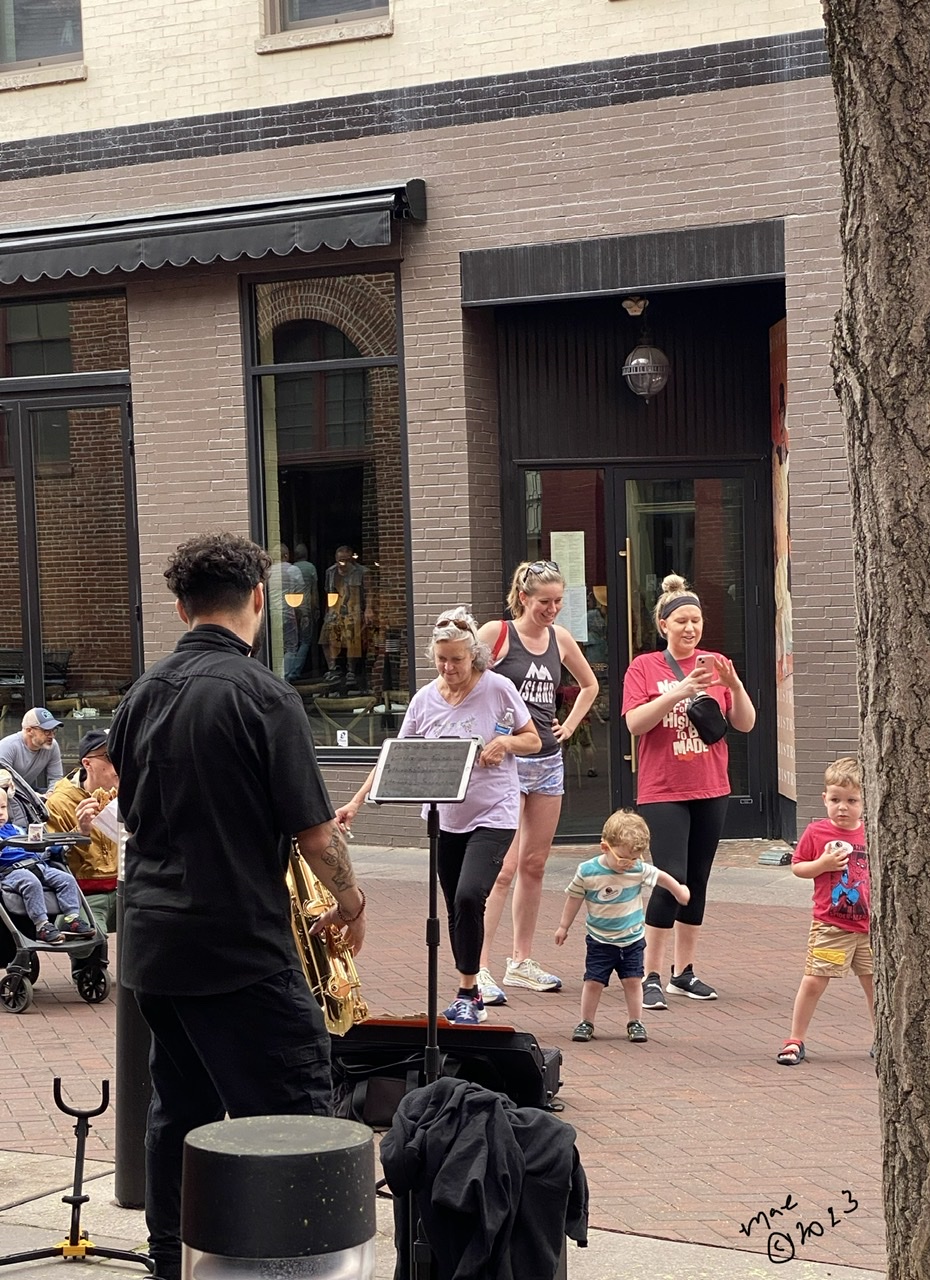
A street musician playing the saxophone outside the Market.

These seem to be local vegetables from hoop houses or greenhouses.

The produce in this stall is just like that in a supermarket, though the vendors are local.

/


Why an electric fan? Because the fumes from the horseradish are so strong.
You can see the horseradish being made in the big pot. We brought some home with us.


A few more good moments from the trip 

Lunch beside a creek in Maryland, with my Diet Coke.

Dinner at a Bar & Grill near my brother & sister-in-law’s condo.

A cafe depicted in one of Lancaster’s many murals.

Longwood Gardens 2023
The orchids at Longwood Gardens.

Longwood Gardens 2023
Indoors at Longwood Gardens. Several of the enormous greenhouses and also the lily ponds are being rebuilt.

Blog post © 2023 mae sander

Sunday, April 16, 2023

Street Art in Lancaster, PA

Starting with the parking garage near the Lancaster Farmers’ Market, we saw all kinds of street art.

Also at the parking garage.

Did you ever notice the artistic markers of which floor you are on?

One more as we exited the garage.

Many shop windows have beautiful decorations.


Great murals at several different locations in town.


We didn’t just appreciate the llama on the sign, we ate the delicious Peruvian arepas sold at this food truck,
which has a permanent location including outdoor picnic tables. We took home some for our lunch.


Meanwhile, in Lancaster, my brother, whom we are visiting, was taking photos of the night sky.
This is the Whirlpool Galaxy (Messier 51).


Blog post © 2023 mae sander