Tuesday, June 24, 2014

The Picnic Game 2014

chicken-piccata5
Chicken Piccata for Louise's Picnic Game, 2014 

Chicken Piccata is an old favorite, featured at traditional restaurants and often cooked at home, for example by my sister-in-law. Thanks to her mentioning it, I started thinking about this classic.

Served with garlic mashed potatoes, Chicken Piccata is on the menu at Merriman’s Cafe in Waikoloa on the Big Island of Hawaii where we are currently on vacation. The cafe is a spin-off of Merriman’s restaurant, one of the originators of Pacific Rim cuisine in the 1980s. Perhaps oddly, Italian/Mediterranean food is very much a part of Pacific Rim cooking. (We speculate that it's because of the longstanding Italian traditions of San Francisco, which IS on the Pacific Rim!)

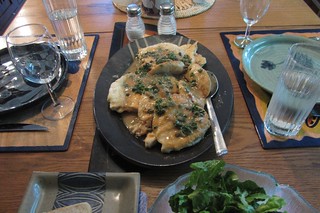
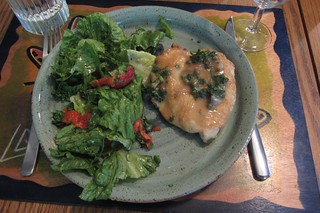
When I decided recently – a few weeks before my trip –  to try making Chicken Piccata, I found a recipe on Epicurious, but I changed it in several places and especially, I simplified the cooking technique. My recipe made around 5 servings. We ate some hot from the oven with salad (shown above) and some cold with additional parsley: perfect for a picnic.

Specifically, it’s just the thing for the 2014 Picnic Game
sponsored by Louise at Months of Edible Celebrations.

To start the game, all participants have promised to go through the alphabetical list up until the letter of our own contribution, just like the old kids’ memory game. In this game, though, we link to the blog post and recipe of the other picnic goers: just click on the caption of the images for A and B below.

So here it is: I’m going on a picnic and I'm bringing:

B -- Basil Leaves in Caramelized Prawns 
chicken-piccata4
and C -- Chicken Piccata, my contribution:
Check Louise's blog on July 1 for a list from A to Z!
Recipe

Chicken Piccata Ingredients
chicken-piccata1
4 boneless chicken breast halves or equivalent amount boned by hand – skin optional
3 tablespoons butter (less if you left some skin on the breasts)
4 teaspoons flour to make kneaded butter
Additional flour, salt, and pepper for dredging the chicken
2 tablespoons olive oil for browning the chicken
1/3 cup dry white wine
1/4 cup fresh lemon juice plus lemon zest (Don't forget to grate lemon zest before squeezing juice!)
1/4 cup canned chicken broth ... or use homemade stock from the chicken bones
1/2 large shallot, chopped or sliced very thin
1/4 cup drained capers
1/4 cup chopped fresh parsley

Method
chicken-piccata2 chicken-piccata3
  1. If using whole unboned chicken breasts: remove bones and cut meat into ¾-inch-thick cutlets. Optionally, use the bones and some carrots and onion or shallots to make stock. If you remove the skin, also use it to make the stock.
  2. Make kneaded butter: mix 1 tablespoon of butter and 4 teaspoons of flour in small bowl until smooth.
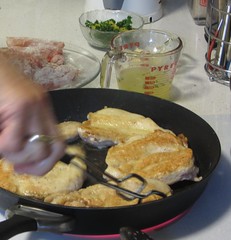
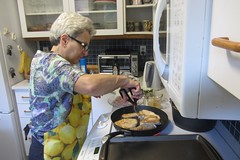
  3. Preheat oven to 350 degrees. Dredge chicken cutlets at last minute in flour-salt-pepper mixture. Brown chicken in batches in a frying pan in olive oil, and put them on a cookie sheet. When all are browned, bake them in the oven until done while making sauce in the same frying pan. Baking time depends on how thick you cut them, somewhere around 15 minutes.
  4. In pan juices in the frying pan, brown a few slices of shallot. Add wine, lemon juice and broth to frying pan and simmer for around 5 minutes over medium-high heat with shallots and additional butter as needed. Whisk in butter-flour mixture and simmer until sauce thickens slightly, about 2 minutes. Leave on low heat until chicken is done. Add more stock if needed.
  5. Assemble dish. To the frying pan add the capers, parsley, lemon zest, and remaining 2 tablespoons butter (if needed). Season sauce to taste with salt and pepper. Place chicken on serving platter, pour sauce over chicken, and serve. Or place chicken breasts in storage container, pour sauce over chicken, and chill until needed, adding more freshly chopped parsley before serving.

Saturday, June 21, 2014

Lilikoi

I love the flavor of lilikoi -- that's the Hawaiian name for passion fruit.
Lilikoi fruit growing on a tree in Maui when we were there a few years ago
Ono with several vegetables and
passion fruit sauce, Keei Cafe
Last night at the Keei Cafe (an old favorite where we go almost every visit to Hawaii) both my entree and my dessert included a sauce flavored with this delicious, citrusy fruit. Usually they offer fresh locally caught fish with Thai curry sauce, lemon-caper sauce, or peanut-miso sauce. Last night they added a special choice: passion-fruit flavored sauce. I loved it! Like lemon only more complex. The sides were mushrooms, potato puree, asparagus, wilted spinach, one broccoli floret, and julienned peppers and carrots -- just a little of each vegetable. Len had the same preparation but with seared ahi (tuna).

For dessert there's lilikoi cheesecake or coconut flan with lilikoi sauce. I had the flan, also delicious. Of course it was a different sauce than that served on the fish, but in fact it was quite tart which contrasted delicately with the sweet, silky flan. Remember, that volcano tart I had the night before was a lilikoi tart. 

I think you could adapt any lemon-based recipe to use lilikoi. I know that people here with a lilikoi tree freeze the fruit or pulp and use it lots of ways.

But I have to eat it here: I really can't find any lilikoi/passion fruit flavorings at home, I've tried!

Friday, June 20, 2014

Dinner at Lava Java

Dessert first: a volcano made from a passion fruit-meringue tart.
Delicious! I actually ate it after my entree. I love passion fruit!
Sunset from Lava Java on the longest day of the year is to the north. 
Len's main course: fish tacos made from ono. 
My main course: salade nicoise, which I've ordered before at
Lava Java in downtown Kona.

Thursday, June 19, 2014

Local Food, Kona, Hawaii


A banana from Hamakua Springs. According to their website: "Hamakua Springs Country Farms, located on the slopes of Mauna Kea in beautiful Pepe‘ekeo on the Big Island of Hawai‘i, is run by three generations of the Ha family."


Our condo cupboard in Kona came supplied with a few ounces of 100% Kona coffee, salt, pepper, and a few bottles of vinegar. Refrigerator: empty. So this morning after drinking some of the coffee, which is wonderful, we went off to the nearby supermarket, the KTA. We've shopped there on many previous trips, and it seems to me there is more local produce than in the past -- and even local meat.

As always bread comes from the Punalu'u bakery, including several flavors of special Hawaii sweet rolls. You can see the Hawaii banana label on Lenny's banana -- I was happy to see Hawaiian bananas in the market, and to learn from the farmer's website that their business is expanding. There have always been local papayas, Maui onions, tomatoes -- and sometimes bananas, but sometimes Central American bananas. This time we also found lettuce, avocados, and cucumbers grown on farms around the island. In the past, I think we would have had to go to the Farmer's Market for such variety.

100% Kona coffee used to be unusual in the supermarket: now there's around a ten-foot stretch of shelf dedicated to local coffee growers. The prices vary. All are high, but I think Kona coffee is worth it.

I don't know which market forces and trends have been at work here, but I suspect that more Big Island farms are now producing more food for local grocery stores, not just for boutique restaurants. The Hamakua Springs website implies this. Beef cattle on the ranches in the center of the Big Island were established close to 200 years ago, but the cows used to be sent to feedlots on the mainland. The beef we ate for dinner was chewy, as if it was grass-fed. But I have no real information, only speculation and very subjective memories.

Of course we aren't really here for the food, but to enjoy the beautiful ocean. On a beach walk this afternoon, we saw a variety of birds and a turtle sunning himself under a pile of sand he had thrown on himself, using his flippers.

At first sight, I wasn't sure what I was seeing in the sand.
I approached, but not too close. Turtles need their space.
The turtle throwing nice warm sand onto his back.

Saturday, June 14, 2014

Molecular Gastronomy

French scientist and author Hervé This claims to be the inventor of molecular gastronomy. He and physicist Nicholas Kurti invented the name molecular gastronomy in 1992. Their goals were to explore recipes; collect and test cooking lore; invent new dishes; introduce new tools, utensils, ingredients; and use cooking to popularize science in general. While these goals have changed over time, molecular cuisine is still expanding and producing new research results and new influences. (The Science of the Oven, Kindle location 161)

Hervé This is also active in molecular cuisine: that is, cooking that applies the knowledge from molecular gastronomy. Under the influence of himself and his fellow molecular scientists, he says, "today's cooks use liquid nitrogen to make their ice cream and sorbet, and ... they distill, infuse, and jell with the aid of jelling agents long used by the food industry." (The Science of the Oven, Kindle location 173)

Hervé This from Nature article
The laboratory of Hervé This has been a major source of techniques for the inventions of molecular cuisine, including the world-famous innovative ideas of Spanish chef Fernand Adrià. An article in the Guardian described their relationship: "Adrià's scientific approach [was] inspired by the work of, among others, French physical chemist Hervé This, who led Adrià to deconstruct ingredients and dishes." (source/link)

An interview in the journal Nature provides some insight into his methods. He states:
"Meat, fish, fruits and vegetables are organized mixtures of compounds. Cooking traditionally means mixing mixtures, and is not precise. This is why I proposed the concept of note-by-note cooking — using specific compounds to build consistency, taste and odour. It is difficult, but a huge unexplored continent is ahead of us." (Nature, vol 464, March 18, 2010, p. 355)
In the book The Science of the Oven Hervé This reviews a wide variety of research on specific reactions that take place during cooking or food preparation. He talks about "note by note" cooking, an advance beyond the original molecular cuisine. Purified flavors (specific molecular extracts) are added to a dish one by one, in contrast to the normal way using basic foods. Recognizable food products such as vegetables or chicken have many flavors -- in  his view, too many unpredictable flavors. He asks: "In the twenty-first century, why could we not produce a sauce beginning with water, glucose, tartaric acid ... and polyphenols, such as certain producers extract from grape seeds, for example?" (Kindle location 2654)

In one example, Hervé This explores the question of whether one can make a jelly from tea. The chemicals in a cup of brewed tea aren't compatible with gelation -- so he suggests making the tea, removing the chemicals that prevent jelling, and adding back distillations of the flavor molecules. (Kindle location 1512)

To me this sounds like what industrial food processors do. In fact, many of the techniques used by Hervé This and the chefs under his influence sound like an artisanal version of industrial food to me, and he seems to admire some of the work of food chemists who work in their laboratories. In the Nature interview, he says: "The food industry already recaptures and reincorporates ‘essential oils’ that are lost during cooking processes. As a result, jams and orange juice, for example, are now much better." I wonder if he's read some of the American books about the food industry and how they manipulate consumers' tastes! Or similar French ones, if there are any.

Unfortunately, in his books  Hervé This often repeats various linguistic quibbles, such as his dislike of the word "flavor," or his attacks on the term "applied science," where he spends a lot of time on peevishly attacking the names of a lot of existing university applied science departments, research programs, and publications. Aside from this annoyance, Hervé This is a very interesting author of many books, at least five available in English, and teacher of influential courses.

Hervé This acknowledges a variety of predecessors in exploring science as it relates to cooking. One of these is Edouard de Pomiane, the medical scientist and cookbook author that I've been researching. The book Cours de gastronomie moléculaire n° 2: Les précisions culinaires (not translated into English) offers a several page biography of Pomiane and summarizes many of the books he published between 1920 and his death in 1964. While acknowledging Pomiane's accomplishments, Hervé This is critical because Pomiane didn't do the type of laboratory research that has been done recently. He points out that Pomiane made some mistakes, or uncritically accepted commonly held ideas about (for example) the process of making mayonnaise and other chemical or physical reactions. He doesn't accept that Pomiane was a scientist -- though he's a little harsh considering that some of the science was still in the future.

Monday, June 09, 2014

At the World's Fair, 1939

"It is possible for the collector of wine and food books to do a bit of international browsing at our World's Fair." So began a New York Times article published July 30, 1939, titled "New Editions, Fine & Otherwise: International Gastronomy or Notes for the Xenomanic Pantophagist" by Edward Larocque Tinker.

The article provides readers first with a description of cocktails and rum drinks that appeared in an "educational leaflet" at the Cuban Pavilion, continues with a few notes on the Brazilian, Swedish, and Swiss reading materials, and finally reaches the French Pavilion, naming five books on sale, including their prices -- which can be compared to the 75-cent admission fee to the fair (eventually reduced to 50 cents), and similar additional fees for specific attractions.

The list begins with Auguste Escoffier's Le Guide Culinaire at $2.50. "Its author, who was born in 1847 and died only four years ago, was the most famous chef of the last two centuries, greater, some think even than Carême," Tinker says. Escoffier's Guide, with 5000 very sketchy recipes meant for professionally trained chefs, had been in print for a couple of decades by this time. A current edition of this classic is depicted at left; it's available in English translation as well.

Next: "La Bonne Cuisine de Madame E. Saint-Ange" ($1.50), described as "a useful book for the house-keeper exhausted with the arranging of daily menus," including "800 recipes and 500 planned meals."Madame E. Saint-Ange had written for a cooking magazine called "Le Pot au Feu" for years, and "La Bonne Cuisine" was a compendium of her writings that had been published in 1927. An English translation became available only relatively recently.

For "families who live on a more modest scale," the bookshop offered "La Véritable Cuisine de Famille" by Tante Marie. It was "designed to achieve an intelligent economy" and included 1000 recipes, 500 seasonal menus, and a glossary.  I've checked and Tante Marie's popular book had been in print in various editions since at least 1903. Tante Marie was probably fictitious, sort of like Betty Crocker, but very little information about her appears to have survived. The front cover of one of the many early editions is shown at right. The book is still popular enough to merit an English-language Kindle edition!

The next book on the list is by Pomiane, the author I've been researching. (In fact, I found this article when searching for information about him.) Tinker writes:

  "A very different kind of book is Edouard de Pomiane's '365 Menus, 365 Recettes' (90 cents). The author is a physiologist who, in accordance with the latest scientific discoveries, balances each menu with the proper relative quantities of fats, carbons, proteins, vitamins, etc. A preface contains a general discussion of the chemical role food plays in keeping us in  health and a treatise on diets for different ages and for those suffering from various diseases. Under each meal's menu is printed the recipe for the main dish."

The final two books from the French Pavilion were "L'Art Culinaire Moderne" by Henry-Papul Pellaprat, and "L'art du Bien Manger" compiled by Edmond Richardin. There may of course have been other books available, not mentioned in the article.

The French Pavilion at the New York 1939 World's Fair is a famous source of American gastronomy. At the French Pavilion (shown in a postcard, right) the French government decided to install a completely French restaurant, with restaurant professionals and all food products sourced from France. This was a major undertaking, but its importance long outlasted the fair itself because several of the French staff remained in the US after the end of the fair to work in restaurants in New York. The most famous offshoot was the restaurant Le Pavillon, run by Henri Soulé who had been the maitre-d'hotel at the fair.

Soulé and Le Pavillon have been written up numerous times. For example, in an article a few years ago, Le Pavillon was classified as one of the ten best restaurants ever in New York City:
"Under restaurateur Henri Soule, Le Pavillon began life as Le Restaurant du Pavillon de France, the eating establishment of the French pavilion at the 1939 World's Fair. The food it presented was a revelation to New York diners, who were still eating French food directly descended from Delmonico's, with heavy cream-based sauces and massive portions. Le Pavillon presented the cuisine for the first time in its evolved form." -- From "Our 10 Best NYC Restaurants," by Robert Sietsema, Jan. 14, 2011, Village Voice blogs. 
The enduring fame and influence of Soulé has been covered in the press ad infinitum and maybe ad nauseum if like me you don't appreciate New York restaurant snobbery. I find this list of historic cookbooks, which seem more or less forgotten, to be of at least equal interest.

Saturday, June 07, 2014

Becoming a Cookbook Author

"Looking back to the earliest days of my youth, I remember the chestnut sellers at the corners of the Paris streets, close to the wine shops at the onset of winter. 
"'Hot chestnuts! Hot chestnuts!' cried the Auvergnat with the fur cap as we passed in groups on the way to school, and later to the lycée. The richest among us bought a sou's worth -- in those days, seven chestnuts -- and, when it was very cold he lent a couple to one or two of his comrades, who put a chestnut in each pocket to warm their hands. On arriving at school we gave them back to the 'rich' boy. We had benefited a little from his opulence, and we didn't resent it. In those days humanity was perhaps, in some ways, better than now." -- a memory from Cooking with Pomiane, page 177

At the start of World War I, a medical researcher at the Institut Pasteur in Paris named Edouard Pozerski took leave from his research to be a military doctor, working in an ambulance company that treated front-line troops. In the course of his duties, he saw many young men who were poorly nourished. When he returned to his research in 1918, he also began to expand his professional interest in the chemistry of digestion with an interest in cooking. His scientific career is summarized in a biographic sketch published by the Institut Pasteur.

Under his alternate family name, Edouard de Pomiane, in 1922, he published a cookbook based on his expanded interest. In writing, he developed and shared his perception of the information home cooks needed to make themselves and their families better nourished. The preface to this book, Bien Manger pour Bien Vivre (Eat well to Live Well), was by Ali Bab, pen name of Henri Babinski, also a Polish-Frenchman and author of an earlier successful cookbook.

In 1923, Pomiane began to broadcast a weekly radio show about food and nutrition. Radio was very new, and the process of broadcasting regular programming was just becoming established. Pomiane's show became very popular. From this point he became a well-known personality and expert in cooking -- an accomplishment added to his prestige after more than 20 years as a scientist at a major research laboratory.

Each week docteur de Pomiane, as he was known, discussed a single topic from his many interests. The science of cooking which he called gastrotechnie was an important part of his material: he included what he knew about the process of cooking and tried to show how to apply this science for better results in the kitchen. He suggested menus for good health and digestion. He talked about economies in the kitchen -- how his listeners could save money without giving up nutritional value; for example he pointed out how much less expensive fish was compared to meat. That's not at all true any more, is it?

Sometimes he described his life as a boy in Montmartre, as in the example at the top of this post. And he gave recipes for a wide variety of dishes. Transcripts of his radio presentations were collected in two volumes called Radio Cuisine, published in 1933 and 1936. These transcripts were also used by the compilers of Cooking with Pomiane, a translation that's still in print.

In his broadcasts he described various aspects of his background as a Polish-Frenchman. Edouard Pozerski de Pomiane was born in Paris on April 20, 1875, and he grew up in Montmartre, then a poor neighborhood. His parents belonged to a community of Polish expatriates, many of whom had, like them, fled from Poland because they had been involved in its struggles for independence, especially in the large uprising of 1863. His mother's cooking was an influence on him: she often cooked Sunday dinner for groups of these friends -- dinners that included many Polish dishes.

Both French and Polish traditions contributed to his repertoire, along with recipes collected from his travels. He gave recipes for dishes such as pierogi and borscht; his methods of cooking vegetables come from both French and Eastern European traditions. Sometimes he made comparisons: for example, in one episode transcribed in Radio Cuisine, he describes a very elaborate preparation for fois gras. The recipe used a 900 gram whole fattened goose liver. I'm sure  his listeners were thinking just as I did when I read this: who could afford such a luxurious piece of meat? Fois gras has always been expensive: today in France 900 grams of it would cost upwards of 160 euros/$225. However, after describing the preparation, he proceeds to explain that as an alternative, one could make a delicious but much less costly Polish-style dish from pork liver, as his mother did in the old days when they lived on his beloved Butte Montmartre. (Radio Cuisine, pages 202-204)

In 1921, Pomiane began to teach at l'Institut scientifique d'hygiène alimentaire as well as continuing his medical research at Institut Pasteur. During the 1920s his work, both technical and popular, was prolific. His cookbook publisher was the prestigious Albin Michel.

As well as his first cookbook, Bien manger pour bien vivre, essai de gastronomie théorique, in 1922 he published a technical work titled Hygiène alimentaire, under the name Pozerski. In 1924 he published Le Code de la Bonne Chere, translated in 1932 as Good Fare -- dust jacket of the translation is shown at left. In it he presented his ideas on scientific cooking and how to plan meals for better health, as well as a large collection of recipes.

Pomiane also became a sort of ethnologist: he was interested in the cooking of the Jews he met or saw in Paris. On trips to Poland after World War I he made many observations of the customs and foodways of Jewish communities in Warsaw, Cracow, and other Polish cities in Poland, which had finally become an independent country after 1918. He published a book on Jewish cooking titled Cuisine Juive: Ghettos Modernes in 1929 (translated in 1975 as The Jews of Poland: Recollections and Recipes). I wrote about it here.


By 1927, Pomiane was widely recognized as an authority on cooking, as reflected in a contest where 5000 chefs and gourmets voted to choose the "Prince of Gastronomes." Pomiane was a runner-up in this competition, along with the famous chef Escoffier. The winner was the cookbook and guidebook writer: Curnonsky. (Though he sounds like another Polish immigrant, Curnonsky was pseudonym of Frenchman Maurice Edmond Sailland).

Pomiane published his most lastingly popular book, La Cuisine en Dix Minutes, or Cooking in Ten Minutes, in 1930, and continued publishing throughout his life. Today, I've tried to show how he emerged as a cookbook author. If you follow this blog you know that I'm reading quite a lot about him, including trying out recipes from several of the originals and translations of his cookbooks. I'll be continuing to explore his career and accomplishments in later posts.

Edouard de Pomiane (1875-1964)
Photo from 1961; published in the Guardian article in 2010 naming
Cooking in Ten Minutes one of the 50 best cookbooks of all time.

Sunday, June 01, 2014

Chelsea

Chelsea, home of your corn muffin mix.
We ate lunch in Mike's Deli this afternoon after a
morning of outdoor activity. The sandwiches were good,
but not photogenic.
Arny took this photo of us in a canoe on South Lake after our morning walk. 
A lady-slipper orchid on our earlier walk in the woods.

Friday, May 30, 2014

Can Chefs Change the World?

Yesterday I wrote up the book The Third Plate by Dan Barber. He presents an interesting argument that if chefs change their menus and use a wider range of foods, then home cooks will follow and this change can make a real difference. To summarize yesterday's post, Barber believes that chefs can by example improve the way people use resources. He states that consumption of all the products of organic farms and fisheries (including the less-popular rotation crops, the less-popular cuts of beef and chicken, and the less-desirable fish) instead of wasting them would lead to a more effective set of changes than he's seen result from "farm-to-table" dining and small-scale agriculture.

I didn't comment on why -- though I find his ideas compelling -- I don't think he's right. That's what I want to say now.

First, I am entirely unconvinced that the influence of chefs at upscale New York restaurants have any significant potential impact on the behavior of more than a few people outside their rich, self-absorbed, picky customers. I live in the midwest and I think I can say that New York chefs' impact extends at most to a very few chefs here, whose products don't influence what people buy or eat every day. I doubt that even the people who often eat in these refined places change their daily diet or home cooking (if they do any) as a result of eating there. It's way too much work!

Changing the overall American diet even a tiny bit is an incredible ambition. If you don't believe me, read the news of the debate in Congress this week about backing out the few changes that  have been made to the school lunch program! Try this: "The Campaign for Junk Food" by Michelle Obama or this: "The House Appropriations Committee on Thursday passed an agriculture budget bill that ... would allow schools to opt out of White House nutritional guidelines passed in 2012."

Second, I'm unconvinced that -- outside of trendy restaurants -- people are willing to eat food that's harder to cook, harder to chew, and harder to get used to. If you don't believe me, read one of the many books about how the food processing industry creates food that appeals to our primal tastes. For example, Mindless Eating by Brian Wansink, Salt Sugar Fat: How the Food Giants Hooked Us by Michael Moss, The End of Overeating: Taking Control of the Insatiable American Appetite by David Kessler, or one of many other books on that topic.

Finally, Barber seems really out-of-touch with the organic food industry as it presents itself to American consumers. He seems to think that the New York chefs are on the forefront. I think it's more likely that people are aware of (say) the Safeway house brand of organic food. Or with produce from Whole Foods Markets. Organic agriculture is already a mainstream trend; however, the label "organic" is defined by the government, and no longer represents small-scale agriculture anything like what Barber is talking about. This is a very complicated set of issues, which I don't want to belabor. I just feel  he's not in touch with any significant segment of consumers. He's out of touch with other things too, but I think I've made my point.

Thursday, May 29, 2014

"The Third Plate"

Recently I read an excerpt -- "What Farm-to-Table Got Wrong"-- from The Third Plate by Dan Barber. I found this New York Times piece so compelling that I immediately bought the Kindle edition of the just-published book. Barber challenges commonly held assumptions about organic, sustainable, and alternative agriculture. He suggests that recent changes to the way people eat are superficial and not likely to last in an effective way.

"In celebrating the All-Stars of the farmers’ market — asparagus, heirloom tomatoes, emmer wheat — farm-to-table advocates are often guilty of ignoring a whole class of humbler crops that are required to produce the most delicious food," he writes. Because of this waste, he says, a few changed attitudes can't rescue the deeply flawed system of mainly big farms in America today. While many writers have made this point before, the problems that he points out seem unusual and very insightful.

"Feeding Time" from the Blue Hill Farm website
Barber, who is chef and co-owner of the well-known and highly admired Blue Hill and Blue Hill at Stone Barns restaurants in New York, emphasizes the role of the chef in creating demand for foods and in inspiring food trends. He asks: can chefs inspire people to eat local foods and thus "reshape landscapes and drive lasting change?" His answer: "More than a decade into the movement, the promise has fallen short. For all its successes, farm-to-table has not, in any fundamental way, reworked the economic and political forces that dictate how our food is grown and raised."

Why? Crop rotation -- traditionally growing legumes and other restorative plants on the land where wheat is grown instead of using chemical fertilizer -- is a fundamental part of growing organic wheat, but it's much less productive of wheat than large-scale farming. Chefs and home cooks want organic wheat, but they don't want the other products of crop rotations, especially not at high organic prices. This means organic farming of wheat isn't becoming very sustainable -- not enough payback to farmers. Surpluses of alternate crops are wasted or turned into less-profitable animal feed.

There are a number of other parts to this argument, but the bottom line is that chefs and the home cooks they influence have not accepted the implications or the long-term needs of organic agriculture: they still shop and cook as if they were buying from Big Agriculture. He has a lot to say about wheat and how it fits into both Big Agriculture and smaller sustainable practices in past, present, and future American farming. In the book he also points out how the meat-raising industry has adapted to modern times: "A farm raising only chickens would have been as unique and unlikely a hundred years ago as a multispecies animal farm like Stone Barns is today," he writes. And he gives a brief history of how chicken became such a commodity: mass-produced and harmful to the land, to the workers, and even to the chickens. (p. 146)

The Third Plate presents parallel descriptions of problems with growing wheat, with raising livestock, and with deep-sea fishing and fish farming. He believes that chefs create unsustainable demand by featuring not only boutique-raised wheat but also by featuring the best cuts of meat -- "the seven-ounce slab of protein on your dinner plate" -- and the meatiest and most tender fish species in preference to smaller uglier by-catch. Just as chefs and home cooks reject the non-wheat crops in crop rotation they also leave less attractive beef parts to be tossed in the garbage. Industrial fishing boats waste a high proportion of edible fish that are brought up in their huge destructive nets, keeping only what sells best. Poultry processors consign non-white chicken parts to be made into cheap exports. Much food that could be eaten by humans ends up feeding pets or other livestock, or is simply trashed. All kinds of ill effects and bad incentives are inherent in the situation, especially considering that fish supplies in the ocean are nearly wiped out.

Barber also goes into detail about the higher quality and better taste of foods from smaller-scale farms, and how tastiness has been lost as food production became large-scale and cheaper. He describes a number of kitchen experiments that he and his coworkers have done to make less popular foods into something truly delicious, including developing recipes for offal and baking methods for whole-grain bread and brioche.

Throughout the book, Barber highlights the need to use all the products of crop rotation, animal raising, or fishing, and attempts to show how this might be done. "Our job," he writes, "isn't just to support the farmer; it's really to support the land that supports the farmer. That's a larger distinction than it sounds like. Even the most sustainably minded farmers grow crops and raise meats in proportion to what we demand. And what we demand generally throws off the balance of what the land can reasonably provide." (p. 181)

From the Times excerpt: "Perhaps the problem with the farm-to-table movement is implicit in its name. Imagining the food chain as a field on one end and a plate of food at the other is not only reductive, it also puts us in the position of end users. It’s a passive system — a grocery-aisle mentality — when really, as cooks and eaters, we need to engage in the nuts and bolts of true agricultural sustainability. Flavor can be our guide to reshaping our diets, and our landscapes, from the ground up."

Unfortunately I didn't find the book to be as compelling, on the whole, as the excerpt. It has too many long-winded anecdotes about farmers and fishermen, especially several such encounters in Spain where Barber seems not-quite-able to explain how the examples apply to the American situation. He gives far more detail about these practitioners of very particularized small-scale agriculture than I find necessary to convince his readers about his central points. (Though I did like the portrayals of some of the experimental seed makers in the last chapter about seed development.) Even worse are his also-long accounts of interactions with famous fellow chefs and with food writers. I felt that these amounted to a kind of snobbish name-dropping. He's a chef, and he defends his view that chefs lead American consumers in many of their food choices. I'm not fully convinced.

Much in the book, as in the excerpt, is very thought provoking, but it's very tedious to read through all the vast material about Spanish farms and restaurants, famous chefs, and aqua-culture that become his object-lessons. This makes me sad because my normal response to such portraits is to be enthusiastic. I enjoyed much of the book, but also found it hard to get through all of it.

Update:  Why I'm not convinced despite finding the book compelling: "Can Chefs Change the World?"

Wednesday, May 28, 2014

Miriam's Birthday Party

Miriam's 13th Birthday Dinner, May 25, 2014


Alice


Sunday, May 25, 2014

Peacock Pie, Oysters, and Grasshopper Tacos

At the National Gallery of Art in Washington DC: a new painting,
"Still Life with Peacock Pie" by Pieter Claesz (1627)
We visited the National Gallery yesterday, and I paid special attention to the food. The peacock pie with the peacock attached was a typical presentation in that era. Reminded me of the "Stargazy Pie" (left) that my friend Sheila had on a cruise around England and Cornwall recently! It was decorated with little upward-facing fish heads, thus "stargazy" and was made by a Cornish chef. Seems to me an interesting echo of the foods of the Renaissance and a bit after, when pies were decorated with feathers or whatever, like the Peacock Pie!
More food at the National Gallery. Closeups from the following --
"Governors of the Kloveniersdoelen" by Bartholomeus van der Helst, (1655)
"Dishes with Oysters, Fruit and Wine" by Osias Beert the Elder (1620/1625),
Flemish Tapestry (1525/1550),
"Still Life with Asparagus and Red Currants" by Adriaen Coorte (1696)
Our lunch at a nearby restaurant named Oyamel: tableside guacamole, an artistic version of huevos rancheros,
a "gazpacho" made of cubes of fruit, jicama, and cucumber, and most dramatic, Miriam and Alice's
grasshopper tacos. Ultra modern food? Or echoes of some time long ago?

Monday, May 19, 2014

Poulet Canaille

French cookbook author and medical researcher Edouard Pomiane (1875-1964), as I've written, published his first cookbook shortly after World War I, became one of the first radio journalists to have a food show, and continued to publish books on cooking throughout his life.

He also appears to have been the first to publish a recipe for chicken with many cloves of garlic -- though his version calls for 30 cloves for one chicken, not the 40 cloves later made widely popular by James Beard and others in the 1970s. (I've been unable to determine the exact history of this recipe in popular American cooking, but it seems to have appeared in Beard's American Cookery in 1972.)

Continuing my project to try some of Pomiane's recipes, I decided to make his version, titled "Poulet Canaille" -- a recipe name that he also seems to have invented, though I can't be sure. I have two books that contain the recipe: in English, Cooking with Pomiane, and in French, À Table Avec Édouard De Pomiane, a collection edited by Ginette Mathiot.

Both versions use identical ingredients and methods, based on Pomiane's radio broadcast transcripts, but the presentation of material is quite different. Cooking with Pomiane includes his brief history of garlic since "the beginnings of Western civilization," as it was used by the builders of the pyramids and eaten by the ancient Hebrews. Mathiot's version gives the recipe in the first person, beginning by mentioning that one should buy a chicken already plucked, not bother with this step oneself.

Here is some documentation of my efforts:

Preparing ingredients for Pomiane's Poulet Canaille: his list:
1 cut-up chicken, 10 chopped shallots, 30 unpeeled garlic cloves,
olive oil and butter for browning the chicken, 1 glass of white wine.
(I used 2 chickens and increased the other ingredients.)
Browning the shallots after the chicken is browned:
I don't have a stove-top casserole big enough for 2 chickens,
as the original recipe suggests,
so I used oven dishes and baked the dish for 40 minutes instead.
Poulet Canaille, ready to eat
Pomiane says:
"Everyone receives a portion of chicken and 6 cloves of browned garlic. 
"Eat some chicken and then put a clove of garlic into your mouth. 
"Bite it and the inside will slip out. It is exquisite. Spit the skin discreetly onto your fork and slip it onto the rim of your plate. You can repeat this pleasure five times more, sipping as you do so a very dry white wine." (Cooking with Pomiane, p. 145-146)


The main course: Poulet Canaille, asparagus, roast potatoes, white wine --
it was really impressively delicious! After the main course I served
green salad (just lettuce & vinaigrette), which is the French/Pomiane style.
A note on the recipe's name: Simone Beck in Simca's Cuisine includes a menu called "Un dîner canaille pour joyeux amis/An earthy dinner for high-spirited friends." She explains: "The word canaille means something with a very highly developed, very pronounced flavor. For example, there is a seasoning for oysters, called canaille, that is only vinegar and raw shallots sprinkled over the oysters. The word has another connotation, and in this sense it is perhaps best translated by the British expression 'racy' -- a little fast, a little spicy, a little 'low.'" (Simca, p. 144-145)

Another Update, August, 2017: In Luc Sante's book The Other Paris a chapter is titled "La Canaille" which is an uncomplimentary term for the lower classes, derived from the Latin word for dog. A song popular in 1865 was titled "La canaille." (Sante, p. 76)

Friday, May 16, 2014

The Worst Kitchen in Literature

There must have been dozens of paperbacks of
Down and Out in Paris and London
Last night my literary book club discussed Orwell's Down and Out in Paris and London. My culinary book club, a different group of people, discussed it a couple of years ago.

What a dark book! Orwell's Hotel X in Paris, where he worked 17 hours a day as a dishwasher and a servant of the lowest other employees, must be the filthiest, most inhumane, and least appetizing kitchen workplace depicted in all the books I've read. It was awful despite a sense of honor among the workers and despite being among the dozen most expensive such establishments in the city. We talked about this and many other issues.

The sheer misery of working in the extreme heat and abusive atmosphere was the part that Orwell really wanted to convey. He had to walk and run 15 miles a day and was under terrible pressure to complete many tasks quickly -- he calls it order in chaos. Workers with slightly more authority routinely cursed and abused their inferiors, though outside of work they may have been friendly or even helpful. Jobs were terribly scarce, so one had to perform accordingly.

Orwell's intention clearly was also to reveal the enormous gap in conditions between the front and back of the house. In the dining room, patrons ate in luxury and assumed their food was of the highest quality, while in the kitchens, clean-up areas, pantries, and cold storage Orwell knew filth, vermin, and extreme carelessness, and "fearful noise and disorder during the rush hours." (p.75)

Orwell distinguishes between the boulot -- obligation to duty felt by the workers -- and the way they did nothing extra:
"The dirt in the Hotel X ... was revolting. Our cafeterie had year-old filth in all the dark corners, and the bread-bin was infested with cockroaches.... The others laughed when I wanted to wash my hands before touching the butter. Yet we were clean where we recognized cleanliness as part of the boulot. We scrubbed the tables and polished the brasswork regularly, because we had orders to do that; but we had no orders to be genuinely clean, and in any case we had no time for it." (p. 79)
He embellishes the story with anecdotes from other high-end Paris restaurants of that era, around 1928. Bugs. Rats. Roast chickens dropped on garbage-strewn floors, but still to be served by formally dressed waiters. Horrible odors. Inspectors who dip their unwashed fingers in the sauce, clean the rim of the plate with spit, etc.

The second half of the book is about real destitution in and near London, where Orwell had no job and lived in terrible conditions, much worse than his Paris life. In sum it's a fascinating account of poverty and desperation, a huge contrast to the usual stories of that era in Paris.

Wednesday, May 14, 2014

New Toy

At right: my new Breville compact oven. At left and further forward so it looks bigger: my more-than-thirty-year-old Black and Decker Toast-R-Oven. Soon after I bought this now-antique appliance, Black and Decker sold their small appliance division to GE, so most people think of this model as a GE Toast-R-Oven. Amazon and Consumer Reports all love Breville ovens with all their features and complexity. However, in user reviews ordinary people often mention how much they would like to just replace their old GE. I would have done that too, but nobody makes a super-simple device with just an on-off switch and a dial for how dark you like your toast. So here we are.

My new oven at this moment is still in its preliminary heating cycle to remove noxious coatings from the heating elements, so I can't yet give any reaction. I must admit that the very fat user manual makes it sound like you need at least elementary programming skills to master the toast, bagel, pizza, cookie, broiling, and other settings within the Breville. Not to mention the "frozen" button and the "Farenheit-Celsius" button. I am brave and will soon be the master of all I survey, at least in my own kitchen.

BTW: the top heating element on the Toast-R-Oven stopped working or I would have kept it forever.