Friday, May 12, 2023

Magee Marsh 2023

Spring mmigration at Magee Marsh on the shore of Lake Erie east of Toledo is a remarkable birding magnet. Large numbers of bird species migrate through this small wetland preserve each May, attracting birders from many parts of the country. We usually spend at least one day enjoying the beautiful woods and fantastic birds at the marsh (and I have posted about many of these birding trips). Beautiful weather made this year’s birding day even more special.

My Prettiest Birds

Red-Headed Woodpecker


Wood Duck

An eagle, not far from the nest.

Two eaglets in the nest.

Rose-Breasted Grossbeak

Scarlet Tanager

Screech Owl

Nesting Yellow Warbler

Another Yellow Warbler. Well over 30 species of warblers are commonly seen at Magee Marsh.

Baltimore Oriole

For detailed information on visiting Magee Marsh, and about the annual birding festival held there, see “Birding Magee Marsh,” the official website of the wildlife area.

Birders in their native habitat


Amish and Mennonite communities in Ohio have many active birders.
We saw this group of young men several times as we walked the boardwalk and the trails.
For information about Amish/Mennonite birders and their continuation of phone hotlines no longer
needed by the rest of the birding community, see this: “Where have all the rare bird alerts gone?”

Photos © 2023 mae sander
 

Thursday, May 11, 2023

Blume Lempel

“Blume Lempel used stream-of-consciousness, flashback, and free association in her writing to create unique stories with themes rarely seen in Yiddish literature: eroticism, incest, and rape. Born in Galicia, Lempel began to write while living in Paris between 1929 and 1939. — https://jwa.org/encyclopedia/article/lempel-blume

Blume Lempel (1907 -  1999) was a Yiddish author of stories about life in Paris, Ukraine, and New York. Translations of some of her stories only appeared recently, in particular the volume Oedipus in Brooklyn, published in 2016. In this collection many stories depict escapees from the Holocaust, often agonizingly haunted by what happened to them, or mainly what they witnessed happening to their family or fellow villagers. 

The individuals in Blume Lempel’s stories are distinct in many ways, but they all remember. In the last story of the collection — though perhaps the order is made by the translators — she summarizes:

“Each according to his ability must convey what he saw, what he lived through, what he thought, what he felt. You did not survive simply to eat blintzes with sour cream. You survived to bring back those who were annihilated. You must speak in their tongue, point with their fingers.”

Elsewhere she describes the life and then the death of a young woman:

“A German put a bullet in her belly and left her lying in the street with her guts spilling out. The sight was so unsettling that the peasants crossed themselves in fear on their way to church that Sunday. In my mind I lift her up and carry her far away from human eyes. Surely if a wolf came upon her in the forest he would devour her. A cannibal would make a feast of her. Yet her ultra-civilized murderer left her lying in the street to show the world what he could do.”

“Through the skylight of my Parisian garret I used to look up at the tiny rectangle of heaven that fortune had allotted me and conjure up Zosye’s lush, slumbering garden. How I cursed the fate that had stranded me in Paris on my way to Israel! Zosye did not want to go to Israel, nor did she need to. For her, the vine was abloom with all the brilliant hues of the bejeweled peacock that resides in the dreams of every young woman. How could she have known, as she played the piano, that the civilization of those magical notes was even then writing her people’s death sentence? How could she have known that form and harmony were but the seductive song of the Lorelei, the façade behind which the cannibal sharpened his crooked teeth?”

The book is also full of life, of the life before and after the death camps, the obliterated villages, the tormented Jewish villagers. Here’s a description about a family, an aunt and a grandmother and how they make a living:

“She and my grandmother run a one-day restaurant for the market folk. Each customer receives a bowl of soup containing a quarter of a roast chicken with parsnip, dill, and other delicious things whose fragrance fills the house and wafts out into the market square.”

And the torment of the experience: “Zoesye picks up a stalk of straw …. She thinks mostly about eating. Not about the wild strawberries with sweet cream that her mother used to serve, but about bread with salt, perhaps with a clove of garlic.”

What’s even more fascinating, the book is full of evidence of a totally modern intellectual writer, with characters who read Madam Bovary, Anna Karenina, the poems of T.S.Eliot, the Greek tragedies (including Oedipus, the parallel to the title story). One character goes on a trip to Yosemite with “a pair of binoculars, a warm coat, some candy for energy, and the inevitable camera.” Another volunteers with the residents of a home:  “Dressed in black, I go often to the old age home. Once a week I read aloud from Isaac Bashevis Singer’s Stories from Behind the Stove in Yiddish. After I read, the audience peppers me with questions having nothing to do with the book.” These characters seem to be versions of the author herself, but as a reader one never knows. But they live in a present that is very familiar. One story begins:

“Lying under my apple tree, I make a conscious effort to detach myself from the outside world. Eyes closed, I attempt to follow the teachings of Zen Buddhism and rise above the stifling heat, the children’s racket, and the airplanes swooping overhead like birds of prey. It’s the middle of July. Apollo 11 has landed safely on the moon, a great human achievement that leaves a strange taste in my mouth, a taste I can neither swallow nor spit out.”

How can I relate to these stories? 

Dara Horn (in the book People Love Dead Jews, blogged here) observed that stories told by those who actually lived through the torments of destruction of their way of life were very different from the fake feel-good Holocaust stories that are so popular now. It’s much more agonizing to read Blume Lempel’s characters’ actual memories, of horrors too great to grasp and events so brutal that the hardly seem real to the teller. Occasionally there’s a story of revenge, which is also satisfying and unusual. In the entire collection, there’s never a story of redemption through some good deed by some exceptional gentile like the current fictional renditions often present. In real life this may have happened, but not here.

Blume Lempel’s hometown was a traditional Eastern European shtetl, such as is often idealized by the vivid film of Fiddler on the Roof (and by the many amateur productions of the musical). Blume Lempel escaped in 1929, intending to go to Palestine; on the way she stopped in Paris, where she lived for a decade;  then in New York for the remainder of her life. During her stay in Paris, she started to write stories and novels in Yiddish, her native language. She was first published in the 1940s in various Yiddish publications. 

Lempel’s characters often have early memories in their village homes, which at times seem to be her own first-person story, but these are stories mainly of their current lives in New York or Paris, the memories form a painful background to their subsequent lives and relationships. Being survivors and witnesses is in the background of their experience. Above all, Blume Lempel was a wonderful writer, creating characters and short histories that spark to life as one reads. I’m glad that a recent message from the Yiddish Book Center reminded me finally to read this book.

Review © 2023 mae sander

Tuesday, May 09, 2023

Another Dollhouse Post

This is a blog post I wrote in 2006 about the dollhouse I had as a child.


First, meet Mrs. Bendy, the dollhouse mother. Notice that she has plastic legs that bend at the knees, and her arms also bend. That's why we called her Mrs. Bendy. Mr. Bendy, the dollhouse father, wore a blue suit. We had a lot of little pink babies and also a bigger brother and sister. They all lived in our doll house.

Mr. and Mrs. Bendy were about three inches tall. Mr. Bendy's leg was broken, and had been mended with tape, so he could not sit down comfortably. The babies were about 1 inch tall.

I found these photos on the web, showing stencilled metal dollhouses like ours with furniture pretty much like the furniture we had (and of course the photo of Mrs. Bendy). I learned that the house came from a factory in New York called T. Cohn, and a toy company called Renwal made our dollhouse furniture and dolls.

Elaine and I got our dollhouse for a present one Christmas when we were very little, and played with it for a long time. Our dollhouse had six rooms and a porch. Each room had plastic furniture. It looked pretty much like the furniture in these photos (though some of the photos with furniture are of a different type of dollhouse).

Dollhouse Interiors

Mr. and Mrs. Bendy's bedroom had beds and a dresser with mirror. I clearly remember the funny little lamps for their bedside tables.

A full bathroom set included a clothes hamper -- something we didn't have in our own house.


The Bendys had couches, chairs, tables, a radio, lamps (that didn't light up), and a phone for the livingroom. I think they also had something that's unusual in homes today: an ash tray on a stand. People back then (and I guess dolls) smoked cigarettes in their houses, and placed the ashes in an ash tray.

In the kitchen were a stove, refrigerator, sink, table, and chairs. The refrigerator did not open up, it was just a plastic shell. The dining room had a table, chairs and a buffet.


Added in 2023: a dollhouse dining room from
the Renwal Dollhouse Company.


In the children's room were a crib, baby buggy, potty chair, and a playpen for the many babies and some toys like a tricycle.

The dollhouse windows were all made of metal, as was the outside, with pictures stencilled on the insides of the rooms, the floors, and the walls.


I think my favorite dollhouse item was the floor-model radio. I used to hold it up to my ear and pretend that I could hear music. I had this radio and a few other things before we got the metal dollhouse. My mother had made us a dollhouse out of an orange crate. She painted the crate dark green on the outside, and put light blue wallpaper in the rooms. There was only one big room upstairs and one downstairs in the orange crate, and the ceiling was much too high. The next photo shows me riding my tricycle next to the very orange crate that became a dollhouse. The back of the photo says so!


I don't remember what happened to our dollhouse, except that my mother gave it to other children when she thought we were too old for it.

The dollhouse that I have now is very different from the one we had as children, except for one baby that somehow was never given away. This baby now has different toys, a different crib, and a different family, but she doesn't mind: after all, she's old enough to be a grandma!

Blog post © 2006, 2023. Photos from resale/collectible websites.

Monday, May 08, 2023

My Baby Has a Drink


In the doll house. Scale is one inch to one foot.


It's been a long time since I posted photos of my doll house. Here, my favorite baby is having
a drink with the mother doll while the other dolls are in the living room playing music.
I have had favorite baby since I was a small child: the only remainder from my childhood doll house.

Photos © 2023 mae sander
Shared with Elizabeth's weekly blog party.

Saturday, May 06, 2023

Elly Griffiths Says Goodbye


Elly Griffiths is the author of fifteen novels about the forensic archaeologist and amateur detective Ruth Galloway. I've now read them all! And I'm disappointed to learn that Griffiths is sunsetting the series -- at least for now. She writes:

"I’ve been so touched by the way that people have taken Ruth to their hearts. At first, I wasn’t sure if readers would take to a slightly grumpy, unglamorous heroine who frankly prefers cats and books to people. But Ruth seemed to touch a chord and I regularly get messages from readers who love her company and that of DCI Nelson, Cathbad the druid and the rest of the cast. This was particularly moving during lockdown when many people told me that Ruth and co. had kept them company through months of isolation. So, when I announced that Book 15 would be the last book (for now), I knew that some devotees would be upset. I wasn’t prepared, though, for the avalanche of messages on social media talking about bereavement and betrayal. ‘I’ll never forgive Elly Griffiths’ was a common line. ‘Please reconsider,’ begged others.

"But I thought it was time for the series to come to an end. ‘For now’, as I kept emphasising. This was my instinct as a writer. There is an on-going ‘will they, won’t they’ love story in the books and, with the best will in the world, there comes a time when you have to say whether they will or they won’t. Readers will find out in Book 15, The Last Remains (the clue is in the title)." (source: Elly Griffiths on Knowing When to Say Goodbye)

I read this farewell statement before I bought the final volume in the series, so I decided to give Ruth (and Elly) a good farewell. Over the last few years I've been enjoying a slow read through all of the novels, though I did not review every one of them on the blog. I read Books 13 and 14 earlier this year. This week, in preparation for the last one, I reread the first Ruth Galloway novel, titled The Crossing Places, and I reread Book 14, titled The Locked Room, which is a remarkable tale of the covid epidemic in the spring of 2020. In retrospect, I loved the way Book 1 introduced so many of the characters that appeared repeatedly in the series, especially the very eccentric Druid whose nom-de-guerre is Cathbad.

Both times I read The Locked Room I found myself reliving the eerie experience of lockdown and the knowledge that hundreds of people were dying of the new, dangerous virus while everyday chores such as shopping and cooking became more and more difficult, and seeing anyone outside one's household was unpardonable and dangerous. Griffiths really captured that in the experience of Ruth, while still creating a suspenseful plot. As in all the books, I find the central characters colorful, the guilty criminals often satisfyingly creepy, and all entirely enjoyable to read. The setting of Ruth’s life in the marshes near King’s Lynn, England, is always leveraged in imaginative ways, as well as the academic setting where she works, with its department politics and various good and evil characters, and the technical and human details of her work as a hands-on archaeologist.

This statue of a civic hero in Ruth’s town of King’s Lynn was enhanced
(or in some opinions, defaced) by the famous street artist Banksy in 2021.
The city fathers quickly removed Banksy’s addition. Ruth’s town in the news!

Unlike many detective and police series where the characters never age or change much (they just solve one crime after another), it’s an interesting feature that Ruth Galloway ages one year for each book, as does her daughter Kate, who is born in Book 2 and goes through the baby, toddler, early schoolchild, and now early adolescence stages. In The Locked Room, Ruth’s experience being shut in with Kate and having to home-school her while continuing her own university teaching job struck me as especially real and pressing. The near-death covid experience with one of the main characters (whom I won’t spoil the book by naming) was also very emotional and beautifully written.


The Last Remains, Book 15, is for now the last Ruth Galloway book. I found that it maintained the excellent quality of plot, characters, local color, and suspense that kept me reading throughout the series. Each of the books advances Ruth’s relationships with the other characters, especially her very insecure romance with Harry Nelson, the policeman who investigates the crimes central to each plot, and who is also the father of Ruth’s daughter Kate.

In reading this last book, I also appreciated the character of Tony, a newer policeman in Harry Nelson’s department. Tony is Asian, and in the course of the investigation he visits his family home. When his mother, Min, offers him supper, he considers her cooking, and how it doesn’t meet the expectations of his peers who have always stereotyped him:

“‘I bet your mum’s a great cook,’ is one of the less offensive things people say to Tony. But, in truth, Min has never been keen on the labour-intensive dishes of her native Guangdong province. She was quick to embrace convenience foods, especially when she was training to be a nurse. Hao, Tony’s dad, was a better cook and, at weekends, would produce slow-boiled soup and shahe noodles.” (Book 15, p. 89)

Ruth, in contrast, is a bit stereotyped in her allergy to domesticity, and her workmanlike approach to chores like cooking. At one point, Nelson for the first time spends an afternoon and evening at her house with Kate, Nelon’s dog Bruno, and Ruth’s cat Flint:

“They are sitting in the garden, Nelson with a beer and Ruth with a glass of red wine. Kate is upstairs in her room. Bruno is lying panting on the grass. Flint is watching from the lower branches of the apple tree, looking like the Cheshire Cat. It’s domestic bliss, of a sort. There’s even a casserole in the oven. Lancashire hotpot. Ruth took the recipe from a packet of stock cubes. She hopes Nelson will appreciate the northern connection.” (p.139) 

Nelson loves real British cooking, which he has always received from his wife Michelle. Here’s how he reacts when she has just come home from a stay at her mother’s house, and he enters to be greeted by Bruno the dog:

“But it’s not just the canine welcome that stops Nelson on the doormat. It’s the smell. Nelson is suddenly catapulted back through the years, a feeling that is both pleasurable and slightly dizzying. He’s a teenager coming home from football practice, he’s a DS in Blackpool and he can hear his children’s voices in the garden, he’s older but not much wiser, returning from a crime scene in King’s Lynn. All these memories are linked to the fact that someone inside the house is cooking shepherd’s pie.” (p. 274)

At an earlier point in The Last Remains Nelson and his wife, their adult daughters, and their very young son George go out for a Father’s Day dinner to an upscale trendy restaurant: I enjoyed the description of his reaction to the meal:

“Lunch seems to go on for ever. Nelson orders things almost at random but, when they arrive, they are unrecognisable, swimming in green sauce or arranged in a tower with berries on top. The girls say it’s delicious. So does Michelle although Nelson notes that she doesn’t eat much. George demands chips but the nearest thing the restaurant can provide are thin wafery things that, according to George, taste of poo. Nelson tries one and agrees with his son. He can’t be entirely sure that they’re not beetroot.” (p. 226)

I love the way Elly Griffiths uses food to portray the characters in these and numerous other snippets from her books! 

If you haven’t read the Ruth Galloway books, and if you like well-crafted mysteries, I recommend that you try them. I advise you to start at the beginning and read in order, because there’s really a lot character and relationship development in the stories. And until Elly Griffiths changes her mind and writes another book, we have to be satisfied that Ruth and Nelson’s relationship has reached a final point after all the many years of uncertainty.

Blog post © 2023 mae sander

Friday, May 05, 2023

No Mow May

A bunny contemplating my growing grass. Is he wondering about no-mow May?
Or is he contemplating a nibble from our just-emerging hostas which he also ate last year?

The Ann Arbor City Council recently adopted a resolution encouraging property owners to reduce mowing in the month of May, and making it legal for lawns to grow between 6 and 12 inches high. The resolution notes that “Pollinator populations and water resources are threatened due to habitat loss, pathogens, parasites, and widespread use of pesticides, including neonicotinoids and other toxic chemicals,” and “Research suggests that bees and other pollinators make use of less-intensively maintained lawn spaces.”

Allowing lawns to grow higher not only benefits pollinating species, but also reduces the use of fossil fuel for maintaining the grass, reduces noise levels, decreases compacting of soil, and thus enables better stormwater flow. Households in Ann Arbor are encouraged to let lawns grow to 6-12 inches, as well as to reduce the removal of leaves in the fall and to plant more native species in their gardens.

Our house is situated on a rather small lot, as we are in the older center of Ann Arbor in a neighborhood that was subdivided 100 years ago from a farm that had occupied this area.The design of homes and gardens in this neighborhood featured mowed-grass lawns in the front and back of every house, as had already become traditional in the 19th century. City ordinances have required the maintenance of short grass, not weeds or natural native plantings; this is specifically changed by the proclamation above.

At present, many of our neighbors continue to cultivate standard all-grass weed-free lawns, but several  of the houses on our block have some combination of grass and other plantings, and a few have no grass at all. We have left only a small part of our yard as grass, and we do not use chemical fertilizer, herbicides, or pesticides; in fact, by usual standards we have a TERRIBLE lawn. This means we should be very good at No-Mow May!

Thinking of the Pollinators

A bee working in a flower in our neighborhood last summer.
We hope to do our small part encouraging bees, grasshoppers, butterflies, and other species.

Bee City USA is an organization dedicated to encouraging wildlife, especially pollinators, by cultivating flowering plants rather than standard, chemically enhanced grass. They write: 

“The start of the growing season is a critical time for hungry, newly emerged native bees. Floral resources may be hard to find, especially in urban and suburban landscapes. By allowing it to grow longer, and letting flowers bloom, your lawn can provide nectar and pollen to help your bee neighbors thrive. Mowing less creates habitat and can increase the abundance and diversity of wildlife including bees and other pollinators.”

Note that the lawn-maintenance industry and a few other sources have published discussions claiming that not mowing your lawn is bad in several ways, including bad for pollinators (lots of trade-off info here). In particular, dandelions may or may not be an especially good source of pollen for bees and other insects, so if you end up with a big crop of them you might not be doing a good thing (excessive detail here).The arguments against minimized mowing mainly apply to very well-tended, chemically treated lawns, so I’m ignoring these nay-sayers. 

Why do we have lawns, anyway?

The tradition of having a broad green expanse around one’s home began several hundred years ago:

“Closely shorn grass lawns first emerged in 17th century England at the homes of large, wealthy landowners. While sheep were still grazed on many such park-lands, landowners increasingly depended on human labor to tend the grass closest to their homes. Before lawnmowers, only the rich could afford to hire the many hands needed to scythe and weed the grass, so a lawn was a mark of wealth and status.” (source)

Mount Vernon
Lawn bowling and other games were played on the short grassy expanses. In front of George Washington’s mansion on his plantation at Mount Vernon is a wide lawn referred to as a bowling green. Washington carefully planned the landscaping at Mount Vernon, including the lawn, to be impressive to the many visitors who came to see him after his retirement as President (source). It’s painful to realize that the extreme amount of labor required for his lawn was performed by the slaves who worked on his estate.

Washington’s vast lawn was one of the models for the American ideal of a personal garden space, first only for the rich, and increasingly for middle and lower-middle class households. By the end of the 19th century, lawns were common in American urban environments.

Throughout the 20th century, private lawns became more and more socially expected, and suburban housing developers created increasingly large lots to accommodate them. The expanding obligation of keeping up these lawns included possession of motorized mowing and trimming machines, use of chemicals for enhancing grass and killing anything that interfered with its growth, and devotion of personal leisure time to lawn care. 

The result is that grass is the largest crop in America. The details:

“There are somewhere around 40 million acres of lawn in the lower 48, according to a 2005 NASA estimate derived from satellite imaging. ‘Turf grasses, occupying 1.9% of the surface of the continental United States, would be the single largest irrigated crop in the country,’ that study concludes. Conservatively, American lawns take up three times as much space as irrigated corn.” (Source)

Can we collectively free ourselves from the obligation to maintain our lawns? Or will climate change free us whether we like it or not? I guess we have to wait and see what happens.

Blog post © 2023 mae sander

Thursday, May 04, 2023

Food News

Interesting trends and fads in food have been the subject of several recent articles. Restaurant news maybe should make me feel put down because I rarely go out to eat any more when I am at home, but a couple of bits of restaurant news have amused me with their exaggerated trendiness. Also, I’ve been reading a bit about environmental issues related to the food supply. Here are a few summaries (with links if you want to read the full articles).

Veggie Burgers

Thank God, Veggie Burgers With Actual Vegetables Are Making a Comeback by Bettina Makalintal in Eater is about fake meat and its rise and decline. This topic reminded me how three years ago, when our household decided to reduce the amount of meat we were buying, we often purchased imitation meat -- specifically, Beyond Burgers -- and quickly got tired of them. Later, we experimented with the Impossible brand of artificial meat. Our use of Impossible meat lasted longer, but we've also become tired of this product. I think we have learned how to create more vegetable-based meals without meat substitutes. The article points out a general decrease in demand for these artificial products and the corresponding corporate losses. It seems that a lot of people had parallel experiences to ours. 

This article notes the decline of fake meat on fast food menus:

"Its many problems aside, corporate fast food is a good indicator of consumer interest. What it puts on the menu is what it assumes to be appealing to a broad swath of American consumers. (It’s clearly not always right, as is the case with its unsuccessful fake meat experiments.) But this big reappearance of the definitely-vegetables burger suggests that people are interested in a return to form after trying out tech burgers. ... Finally, fast food brands are recognizing what vegetarians have long known: There is so much potential in making real, recognizable vegetables and legumes taste good, in patty form, without the need to approximate beef."

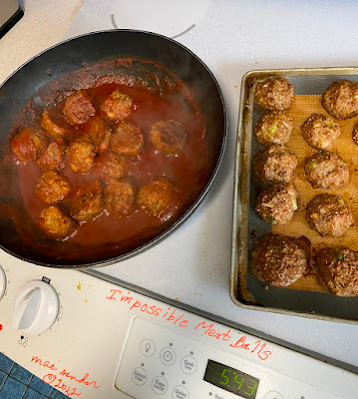
In photo: Impossible Meatballs that I made last year. I guess I'm not doing that any more! If I have to have meat, it will be real meat, and mostly I'll try to eat vegetables.


Luxury Bread

Goodbye to the Bread Basket. Hello to the Bread Course by Rachel Sugar in the New York Times is subtitled: "Chasing a pandemic-era interest in lovingly made loaves, restaurants are charging a premium for bread that’s anything but filler." Baskets of house-made bread priced in the $20 range are now on the menu in fancy New York restaurants where I will never eat. However, it's always interesting to see what these self-satisfied and self-declared leaders in food trends are pushing this week. 

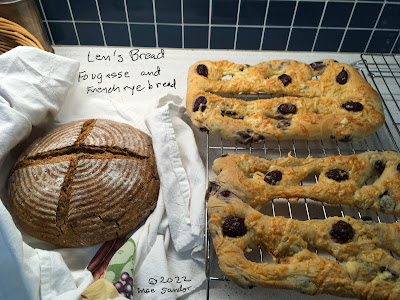
In the photo you can see one of Len's many bread baskets from last year. He made a French rye bread called Meteil, traditional in Auvergne, and a loaf of fougasse, a ladder-shaped olive bread from Provence. We love bread, and can see how this trend could emerge.

Beans!

Are Beans Good for You? by Sally Wadyka, published in Consumer Reports in August, 2020, and updated this April, declares: "Lentils, kidney beans, black beans, and more offer unique health benefits." 

Specifically, as most of us know, beans provide protein, antioxidants, vitamins, and minerals, such as calcium, iron, potassium, and magnesium. Beans contain fiber, and also a carbohydrate called "resistant starch," which doesn't go right into your blood stream like other starch. (That's a good thing.) And besides having measurable health benefits, beans are cheap! It's always interesting to review the detailed facts about a familiar issue.

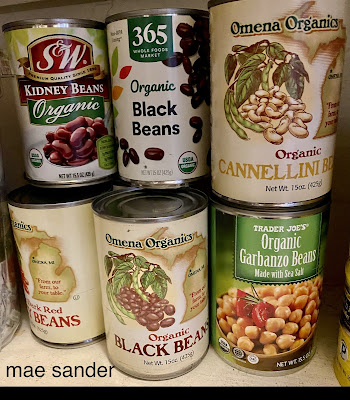
In the photo you can see my pantry shelf of various types of beans: black beans, cannellini beans, garbanzo beans, and red kidney beans, destined for a variety of recipes. I try to rotate various bean dishes in our attempted vegetarian diet.

How bad is plastic wrap?

To Wrap Or to Not Wrap Cucumbers? by Chandrima Shrivastava and four other authors, published by Frontiers in Sustainable Food Systems, is a scientific research article about the environmental effects of plastic containers and wrappers for food packaging. It is very interesting and the conclusion is counter-intuitive: "using plastic wrapping for cucumbers clearly reduces the overall climate change impact." The research was very detailed, but here's the bottom line showing this reduction in climate change impact and how it can be measured:

"This is primarily because the benefit of a reduction in food waste is much more than the additional impact caused by the plastic wrapping. ... The benefit of using plastic packaging in reducing food waste is almost 4.9 times higher than the negative environmental impact due to the packaging itself. This impact will likely be larger, as we did not account for the reduced food waste at the consumer level due to wrapping. ... It was found that every single cucumber thrown away equals the impacts of the plastic packaging needed to wrap 93 cucumbers."

Another Threat to the Food Supply

Fungal attacks threaten global food supply, say experts by Damian Carrington, published in The Guardian, warns: “The impact of fungal disease is expected to worsen, the researchers say, as the climate crisis results in temperatures rising and fungal infections moving steadily polewards. Since the 1990s, fungal pathogens have been moving to higher latitudes at a rate of about 7 km a year.” So many threats, so little time!

Too many good things to read! I can't keep up.


Blog post © 2022, 2023 mae sander.

Wednesday, May 03, 2023

Celery

 Why am I thinking about celery? I don't know but here are some ideas.


Some people like celery. Some find it very uninteresting. And some dislike its characteristic flavor. Stalks of celery rarely appear as the main ingredient in frequently-served American or French recipes. The ingredient is more often in the background of complex dishes; for example, celery contributes flavor to stocks and stews. I often save the leafy tops from a package of celery, freezing them along with the stems of herbs like parsley or green onions and a few nice chicken bones for the stock pot.

Some classics like tuna salad, coleslaw, or Waldorf salad use celery for extra crunch as well as for the added flavor. French dishes like celery remoulade and celery puree use celery root (also called celeriac) which is pictured above. The Larousse Gastronomique, an encyclopedia of French cuisine, offers quite a few celery preparations, though these seem kind of obscure. It can be cooked in butter or stock or served raw with various salad dressings. Many of the specified dishes follow a recipe originally written for some other vegetable (such as artichokes) and say just substitute celery, for example Celery a la Grecque, made with the standard ingredients including olive oil and spices like coriander seeds and cilantro leaves. 

It's strange, but I've never tried Campbell's cream of celery soup, or for that matter any other celery soup -- though that's another classic use for this vegetable. Braised celery (which is simply celery browned in butter and cooked in stock) is another dish I haven't tried, though I intend to try it some time. Of course I am quite familiar with celery included as one of several roast vegetables along with potatoes and carrots, or as a flavor and texture booster in the most commonly-made stuffing for the Thanksgiving turkey. 

A Little History and Botany

Celery is a member of the same family as carrots, parsley, and parsnips, and the name is derived from the Greek word for parsley: the plant originated in Greece and other Mediterranean countries. Celery is a two-year crop: the first year the plants produce the stalks and leaves, while the second year the plant flowers and produces seeds. Celery grows best in areas with cool temperatures and plenty of moisture; that is much of the US and Europe. Although low in calories, it contains vitamins and minerals as well as the characteristic aromatic flavors. 

From the Larousse Gastronomique:

CELERY. CÉLERI- A cultivated form of wild celery.

Used a great deal by the Romans, celery did not come into cultivation until the sixteenth century. In some cases growers have tried to develop the leaves, in others the root.

This plant contains an essential oil, which is highly aromatic. According to the different varieties, either the stems are eaten, elongated by trussing or culture in the dark, or the roots (celeriac). Both are eaten raw, in salad, or cooked.


Although for a lot of people the celery fin turkey stuffing is an essential element of Thanksgiving dinner, the celery plant wouldn't have made it from Europe to the American continent in time for the first Thanksgiving. In fact, celery didn't become popular here until the late 18th century: by 1806, four varieties of celery were being grown in the US. Nowadays, we mainly only see one variety -- this seems to be the way things go, a small number of varieties of vegetables and fruit, or just one, seem to dominate the markets! For more information on the history and cultivation of celery, see  Celery: A Brief History

Asian Dishes with Celery

Some of my Chinese cookbooks feature celery as a central ingredient, often combined with meat or fish. These recipes sound a lot more flavorful than western celery preparations; for example celery with hot peppers and garlic! Two exotic-sounding dishes I found are titled "Squid and Celery" and "Cold Kidney and Celery." These appear in The Chinese Cookbook by Craig Claiborne and Virginia Lee (published in 1976) which I would say was ahead of its time. Fuchsia Dunlop's cookbook Every Grain of Rice (published 2012) also offers several recipes that feature celery. Stir-fried celery with lily bulb and macadamia nuts is most intriguing!

Online searches turn up other interesting Asian recipes, such as several ways to include celery in the famous Korean condiment Kim Chee, and several Vietnamese soup recipes containing celery. I also found a few recipes for Chinese celery, which is a different type of celery than the American/French standard. From The Spruce Eats website:

"Chinese celery is somewhat different from the celery that typically lines most produce shelves in American supermarkets. It has a much stronger flavor than Western celery, and the stalks of Chinese celery are thinner, often with a hollow middle. Although more slender than the celery we use for tuna salad and Bloody Marys, it is recommended that you gently crush the celery stalks before adding to a recipe, which will result in better texture and more flavor. Chinese celery is rarely eaten raw as it is pungent and somewhat peppery; when cooked, however, it becomes sweet and mellow with a pleasant, soft texture."
 

Celery Remoulade Right Now!

The knob of celery root pictured at the beginning of this post has now become a dish of celery remoulade, which is julienned celery root mixed with mayonnaise, lemon juice, and other flavorings. I served it on lettuce leaves garnished with capers, a lemon wedge, and red pepper, along with some cottage cheese, as illustrated. This would definitely not be the way I would expect to see it in France!

How might this dish be served in France? Celery remoulade or alternatively, celery root in a vinaigrette sauce, often appears in the standard appetizer called crudités.  We often saw this on menus in small, modest restaurants in France: celery root, shredded carrots, sliced tomatoes, julienned beetroot or other similar vegetables in vinaigrette. The term crudités can designate any fresh vegetables. In the US now it refers to just about any snack-like vegetable platter or if you are really sophisticated, could mean vegetables arranged on a board. 

As an aside, it's amusing to recall that word crudités became an issue in a recent election to the US Senate, when one candidate (whom I prefer to forget) seemed snobbish for employing the French word instead of English. The other candidate, John Fetterman, tweeted: "In PA we call this a veggie tray." As you no doubt know, Fetterman won the election -- and served a veggie tray at his victory party.

Blog post and photos © 2023 mae sander

Monday, May 01, 2023

At Our Local Cafe and Far Away on May Day

 Happy May Day!

\
First not local here; a sign on the Greene Man Pub in England, which I'm including to
commemorate today, May Day, and the old May Day customs of Green Men and the many
legends about them. We don't  have a Green Man in Ann Arbor, but here are some photos
I took at the Argus Cafe a few blocks from my house. (source: Wikipedia)

My coffee at Argus Cafe.


Sometimes I think a lot of people need one of these signs.


Photos © 2023 mae sander.
Shared with Elizabeth's weekly blog party.