Thursday, April 14, 2016

Cooking with Spices

Some of the ingredients for sauce for meatball sandwiches, including several spices in the new jars I bought and filled recently.
My reorganized and expanded spice shelf has made me want to cook with spice. Here are a few of the dishes I've been making:
  • West-Indian curried lamb and vegetables without really following a recipe, but starting here.
  • Mediterranean food: falafel with a Turkish eggplant salad from Claudia Roden's book Mediterranean Cookery.
  • Italian-spiced tomato sauce for meatball sandwiches. No recipe at all, I improvise my tomato sauce.
  • And I'm thinking about South American and more Mediterranean experiments.
Curried lamb with carrots, turnips, and coconut milk; served with fresh fruit and vegetables and plum and mango chutneys.
Spices in the curry: ground ginger, curry powder, allspice berries, cumin,red onion, garlic, and canned jalapeno peppers.
Falafel (from Trader Joe's), a Turkish eggplant salad, and a cabbage salad with tahini dressing.
The whole eggplant was charred at 400° until soft, chopped, and mixed with lemon juice, yogurt, parsley, dill.
Garnishes on the eggplant include black olives, tomatoes, red onion. On the side: pita bread, lemon slices, and yogurt.
Meatballs with spiced tomato sauce on toasted buns with melted cheese.

Tuesday, April 12, 2016

Edna Lewis, Born April 16, 1916

My books by Edna Lewis and Toni Tipton-Marton,
whose book The Jemima Code describes many cookbooks including those of Lewis.

Edna Lewis had a long and fascinating life, from April 16, 1916 until February 6, 2006. She wrote several highly respected cookbooks, which have been re-issued quite a number of times with a variety of dust jackets. I've reproduced a few of them here, as well as the US postage stamp with her picture on it, issued in 2014.

I recently acquired my first of her books: the thirtieth anniversary edition of The Taste of Country Cooking, a memoir of her girlhood in Freetown, Virginia (published in 2006). Lewis describes events for each season of the year during her girlhood, with recipes illustrating what her family ate. Freetown, she writes "wasn't really a town. The name was adopted because the first residents had all been freed from chattel slavery and they wanted to be known as a town of Free People." Around a dozen families lived in the town; their houses stood in a circle around the house of her grandparents. (From the Introduction.)

I originally thought that I would try some of the recipes in The Taste of Country Cooking, but in the end I decided not to do so. When I read them closely, I came to the conclusion that they are deceptively simple. I suspect that they would in fact be very challenging to make as they should be. Quite a few of them require ingredients that are not easily obtained or that I don't normally use, such as lard, rabbit and other game, sorghum molasses, special types of cornmeal, and guinea fowl (which is not a chicken!).

I suspect that even the ingredients that are familiar and easily available might differ from the ones that were used in rural Virginia almost a century ago -- after all, Lewis left Freetown when she was a teen-ager. For example, I considered making her gingerbread recipe, but I doubted that I could really replicate the flavor she described. Here's her description, which I think makes clear why I find her memoir wonderfully vivid but don't think I could achieve anything similar:
"Warm gingerbread was uppermost in our minds when the sorghum cane began to ripen, because sorghum molasses was such an important ingredient in gingerbread. Sorghum is a plant that looks very much like corn, with the exception of the grain which is formed in the tassel. ... Most farmers grew a small patch of sorghum. It was harvested in the fall, tassel and leaves removed. The cane was put into a mill driven by two horses moving in a circle, clockwise, pressing out the juice as they walked around. When it was all pressed out it was poured into a large vat and cooked to a heavy, sugary syrup known as sorghum molasses.
"The aroma of the new crop filled the kitchen. There would be molasses for breakfast and gingerbread galore until the novelty wore off. ... Warm gingerbread with fresh, skimmed, heavy cream was an exotic treat after a meal of fresh pork or game on a chilly fall evening." (p. 255)
Why is Edna Lewis so important? Here's what chef Alice Waters says in the introduction to the anniversary edition of The Taste of Country Cooking, which was originally published in 1976:
"Thanks to this book, a new generation was introduced to the glories of an American tradition worthy of comparison to the most evolved cuisines on earth, a tradition of simplicity and purity and sheer deliciousness that is only possible when food tastes like what it is, from a particular place, at a particular point in time. ... Back then, most of us were more or less resigned to the industrialization of our food, the mechanization of our work, the trivialization of our play, and the atomization of our communities. But with her recipes and reminiscences, Miss Lewis was able to gently suggest another way of being, one on a human scale, in harmony with the seasons and with our fellow man." (p. xi) 
Edna Lewis's fame is highlighted in this paragraph from The Jemima Code: Two Centuries of African American Cookbooks by Toni Tipton-Martin:
"I was awed by Lewis from the first moment I saw her, some years ago at a professional meeting of registered dietitians in Los Angeles. I noticed a small crowd in the hotel lobby buzzing around a statuesque African American woman with a magnetic smile, her graying hair swept neatly into a bun worn low at the neck. I shamelessly joined the groupie gaggle, which was clamoring for autographs in the way that paparazzi scratch and claw for snapshots of superstars. The regal lady leaned in close, whispered a few words of encouragement, then signed the paperback edition of her first cookbook... As we got to know each other better, I told her about my desire to reclaim the reputation of black cooks. Her tales of achieving culinary mastery as an executive chef and champion of artistic African American cooking strengthened my resolve. She emboldened me with a precious handwritten letter and an exhortation: 'Leave no stone unturned."" (p. 133)
I chose the Edna Lewis cookbooks for this Cookbook Wednesday to celebrate her 100th birthday. I also want to call attention to the remarkable book, The Jemima Code, an important work of American cookbook history. I will write more about it in the future.

Cookbook Wednesday is a blogging event organized by Louise at Months of Edible Celebrations.
Cookbook Wednesday

Monday, April 11, 2016

Beautiful French-Canadian Meals with Inspector Gamache

A pudding du chômeur à l’érable from the blog FoodNouveau.
"The guests watched the sun set ... and enjoyed course after course, beginning with the chef’s amuse-bouche of local caribou. Reine-Marie had the escargots à l’ail, followed by seared duck breast with confit of wild ginger, mandarin and kumquat. Gamache started with fresh roquette from the garden and shaved parmesan then ordered the organic salmon with sorrel yogurt. ... 'And for dessert?'...'For Madame, we have fresh mint ice cream on an éclair filled with creamy dark organic chocolate, and for Monsieur a pudding du chômeur à l’érable avec crème chantilly.'*... Finally, when they could eat no more, the cheese cart arrived burdened with a selection of local cheeses made by the monks in the nearby Benedictine abbey of Saint-Benoit-du-Lac." Louise Penny, A Rule Against Murder, pages 21-22)
That's just the first meal in over 400 pages of country living, detecting, and dining by Inspector Armand Gamache and his wife Reine-Marie. It's a rather long-winded, description-heavy book -- the murder doesn't happen until page 111. Though the plot is fairly tight and the suspense relatively good, I'm tempted to say that food descriptions are my favorite part.

Here few more of MANY food descriptions, which I'm citing without explaining at just which point in the investigation breakfasts, dinners, snacks, and lunches appeared:
"Gamache looked down at a tray of frothy cold soups with delicate mint leaves and curled lemon rind floating on the top. Another tray held platters of open-faced sandwiches, roast beef, smoked salmon, tomato and Brie. The final tray held bottles of ginger beer, spruce beer, ginger ale, beer and a bucket with a light white wine on ice." (p. 146) 
"... sipping his cold cucumber and raspberry soup. There was a bit of dill in it, a hint of lemon and something sweet. Honey, he realized." (p. 204)
"He put a lobster salad in front of her. And Beauvoir got a hamburger and string fries. For the last twenty minutes they’d smelled the charcoals warming up in the huge barbecue in the garden, with the unmistakable summer scents of hot coals and lighter fluid. Beauvoir hadn’t stopped salivating. Between that and the sweating he thought he should order a cold beer. Just to prevent dehydration. The chief thought that sounded good, as did Lacoste, and before long each had a beer in a tall frosted glass." (p. 300)
"... on the village green, waving to the people tending the glowing embers around the stuffed lamb au jus wrapped in herbs and foil and buried before dawn. The meshoui, the traditional Québécois celebratory meal. For Canada Day." (p. 356)
The meals contribute to the Québécois atmosphere which the book works very hard to create. Though the descriptions are very enjoyable, in a way I feel as if all these details, including descriptions of the Auberge where the murder and investigation take place, are a bit forced. I think I like my mystery stories to keep the focus more thoroughly on the detecting.

I'm resisting the urge to compare the way Agatha Christie only suggests and sketches the surroundings, and gives details mainly when they show how time is advancing or when they will turn out to be clues. That said, I enjoyed this and one other of author Louise Penny's Armand Gamache detective stories, and most likely will read a few more.

Author Louise Penny with British actor Nathaniel Parker, who played
Insptector Gamache in the one and only TV movie of a book from the Gamache series.
I'll probably watch it soon, though the reviews were not superb.
UPDATE: Have watched & liked it.

*Chômeur à l’érable avec crème chantilly is a classic Quebec dessert -- in English, called poor man's maple pudding. It's a cake with a thick sauce made from maple syrup, garnished with whipped cream. And yes, maple syrup plays a large role in the cuisine in this book!


Saturday, April 09, 2016

Who is the Brilliant Friend?

Vesuvius from Naples at Sunset (Wikipedia) -- often mentioned as
visible from "the neighborhood," the impoverished area where narrator
lives for most of her life.
Brilliant in a wold that doesn't value brilliance. Sensitive in a world full of dishonesty, violence, and death. Seeking identity in a world that subjugates women to men. The two women in Elena Ferrante's Neapolitan novels are irresistible. I've now finished the third and fourth of the series; I wrote about the first two books here: Prosciutto, Symbol of Abundance Amidst Poverty.

The two women are the narrator, Elena Greco, and her friend Lina or Lila or Raffaella Cerullo, both born in 1944. The four books cover the characters' entire lives from their time as star pupils in elementary school through old age. Throughout the first book, I thought that the "brilliant friend" was Lila, but at the end Lila says to the narrator: "you’re my brilliant friend, you have to be the best of all, boys and girls.” (Kindle Location 4173).

I think each regards the other as her "brilliant friend." At the end of the last book: "Now I was a mature woman with an established profile. I was what Lila herself, sometimes joking, sometimes serious, had often repeated: Elena Greco, the brilliant friend of Raffaella Cerullo. From that unexpected reversal of destinies I would emerge annihilated." (The Story of the Lost Child: Neapolitan Novels, Book Four pages 459-460).

The first book begins with Lila's disappearance, reported to Elena by her son Rino: "It’s been at least three decades since she told me that she wanted to disappear without leaving a trace, and I’m the only one who knows what she means. She never had in mind any sort of flight, a change of identity, the dream of making a new life somewhere else. And she never thought of suicide, .... She meant something different: she wanted to vanish." (My Brilliant Friend: Neapolitan Novels, Book One, Kindle Locations 173-176).

The final book ends with this disappearance. By now the reader too knows what is meant. As I read, I often felt that the book was not about two women, but about one woman whose life had two possibilities, which somehow she realized simultaneously. The book is obviously how chance and choice create their two separate destinies from what I see as a single beginning.

The four volumes follow a progression that seems familiar from feminist novels of earlier times, such as the early novels of Doris Lessing. To summarize these elements of parallel feminist life stories:

  • We begin with unaware girlhood -- Lila and Elena start out with similar promise, similar poverty, similar families, similar fears of the powerful forces in "the neighborhood."
  • For Lila: dropping out before high school and early marriage to a shopkeeper. For Elena: high school and university education, success as a novelist, marriage to an intellectual; above all, respectability. 
  • Children/domestic misery -- here the fact that the women take two paths and especially start domestic life at very different ages means another set of contrasting experiences.
  • Elena leaves the neighborhood and lives in several other Italian cities, as well as in another part of Naples. Lila never leaves the neighborhood.
  • Lila leaves her marriage while still a teenager. She takes a lover, Nino; breaks up with him; then supports herself and her son, first working at a terrible and exploitative factory job. Eventually she studies the newly emerging computer technology and becomes a successful business owner in partnership with a man who eventually is also a life partner.
  • In their early twenties: social awareness. Communist activism, political idealism/ideology for Elena. Lifelong indifference or hostility to conventional politics for Lila. For both: disillusion with male-dominated and doctrinaire politicians and hatred of neighborhood bosses. 
  • Feminism in its militant 1970s form for Elena.
  • Elena leaves her husband over a decade later than Lila -- with the same man, Nino, who has obsessed her since childhood.
  • Throughout, the women's relationship to their children is very important. The children's births, early lives, emergence as adults, and their relationships to each other and to their various fathers provide a major element of the overall plot of the books.

  • A more standard version of a woman's life in the 1970s would have Elena's feminist consciousness liberate herself and become self-sufficient, using her income from being by this time a well-respected writer. Instead of liberating herself, however, Elena lives in the shadow of Nino, giving up her ambitions for a time until she finally does free herself. Though she can't accept how flawed Nino is, her narrative makes the reader highly aware of what a weak and selfish man he is. During this time, she returns to Naples and to long years of closeness to Lila, eventually ended by another break.

    The book shows the two women's constant awareness of the politics of "the neighborhood" in Naples, where they are born and mostly live. It depicts their interaction with the various powerful figures of the neighborhood; events such as the major earthquake of 1983; the politics and struggles of Italy in the era (such as the death of Aldo Moro); and a general awareness of the world at large. The four books create a vast panorama set against the ugliness of urban poverty, the beauty of the sea and Mount Vesuvius, the constantly changing Naples landscape, and the complexity of life for all.

    Friday, April 08, 2016

    Extending My Spice Shelf

    New spice shelf in the middle.
    For a long time, I've thought about a third shelf for my spices. This week, Len made one for me, carefully matching the two that were built into the pantry when we had our kitchen remodeled years ago. As the paint on the new shelf was drying, I thought about improving on some of the very old containers, which I regularly refill from one of several bulk spice shops in town, mainly Whole Foods. Therefore, I ordered 12 new ones with shiny chrome-plate tops.

    New jars washed and ready to fill and label.
    New arrangement.
    Besides the extra room from the new shelf, changing from some of the more unwieldy old bottles to new, smaller ones enabled me to take some spices out of plastic bags and store them more neatly. With all the spices I keep on hand, I'll probably never have entirely consistent containers: that would be boring, anyway!

    Something made with spices: red sauce for linguini,
    here served with fried eggs and artichoke hearts.
    A list of spices on my shelves: allspice, almond extract, basil, cloves, cumin, whole & ground coriander, celery seed, cardamom, whole & stick cinnamon, caraway seed, curry powder, cocoa, dill, fennel, fines herbs, five-spice powder, juniper berries, ginger, garum masala, herbs de provence, kefir lime leaves, lavender buds, marjoram, whole & ground mustard seed, mint, orange-flower water, oregano, parsley flakes, poppy seeds, chile powder, white pepper, red chile flakes, cayenne pepper, Hungarian paprika, hot & mild Spanish smoked paprika, rosemary, sage, saffron, star anise, turmeric, tarragon, thyme, cream of tartar, vanilla extract, vanilla powder, and zatar. A few more are still in plastic bags in another container, and my whole nutmeg is stored with its grater, but that's all I need on the shelves for now.

    A note on refilling spice containers: the spices in the bulk section of Whole Foods and at the specialty shops are fresher and much less expensive than buying a new little bottle of spice whenever it's used up or starts to go stale. As I understand it, ground spice and dried leaf spices become stale rather quickly, while whole spices like nutmeg or juniper last quite a long time. I've been keeping track of the dates on my spice refills for a number of years -- probably the most organized thing I do in this chaotic life.

    Wednesday, April 06, 2016

    "Impressionist Picnics" and Coq au Vin


    For the first Cookbook Wednesday after months of inactivity, I've chosen the cookbook Impressionist Picnics by food historian Gillian Riley.

    Renoir: The Luncheon of the Boating Party (1880-1881)
    Riley's chapter "Auguste Renoir's Day on the River" begins with his famous painting of a luncheon along the river and the words "They took Paris with them wherever they went."

    Renoir, she writes, would enjoy summer weekends on the river with his friends, including his future wife Aline Charigot (wearing a straw hat in the painting above). Riley continues:
    Renoir: The Inn of Mother Anthony (1866):
    the image on the page with Coq au Vin, as
    mentioned in the quoted passage.
    "The food was that of the new, fashionable Parisian restaurants, very different from the traditional cooking of country inns like the Auberge of Mère Antoine at Marlotte near Fontainebleau where, back in the 1860s, Renoir had painted a group of young artists in a rustic, unsophisticated setting. A familiar lament was already becoming heard in the land for those unspoilt little places now ruined by trippers, where simple food and a glass of the patron's wine were being replaced by sophisticated menus and décors." (page 17)

    Impressionist Picnics is mainly interesting for the images of paintings and the artists' biographic details it offers. However, it does contain recipes, and I chose to make Riley's recipe for Coq au Vin as it appears in the Renoir chapter. When planning how to make the dish, I also checked the Julia Child version of this classic in my much-used copy of Mastering the Art of French Cooking. You can find the recipe online here courtesy of WGBH, the TV station that originally ran "The French Chef" beginning over 50 years ago.

    Though Riley's recipe is much more sketchy than Julia Child's, she did make one very useful suggestion, which is to make a red-wine-based stock prior to cooking the chicken, and thus perform the time-consuming reduction of liquid before cooking rather than at the last minute. Riley also suggests a shorter way to prepare the onions; however, I used a bag of frozen pearl onions, which I simply heated in butter until they were golden brown, an even more total shortcut!

    No matter how you make coq au vin, it's a labor-intensive dish involving several pots and pans and a lot of time. My total time was something like 3 hours. I began by cutting up a whole chicken. I simmered the backs, wing tips, etc. along with some aromatic vegetables, herb stems, water, and half a bottle of red wine as directed. Then reduced that stock. And this is the quick way.


    After frying pancetta in the pan, one sets the crisp bits aside and
    continues by frying chicken parts in the same pan.

    My separately browned mushrooms and onions here waiting in the pan
    until it's time to add them to the sauce. Green peas are a side dish
    allowed by Julia Child.
    Green peas, parsley potatoes, French bread, and coq au vin, on the table ready to eat. One bottle of wine goes into the dish;
    another bottle is for drinking. Yes, really, a whole bottle of wine goes into coq au vin!
    (Note: the amount in the serving dish is half the total, which would serve quite a few more than 2 people.)

    Edouard Vuillard: The Meal (1800):
    another image from Riley's wonderful selection.
    In conclusion: Impressionist Picnics is an enjoyable and informative book to read, look at the pictures, and get ideas about food, but not really a useful cookbook. For making new dishes, I'd go to Julia Child or another more carefully tested recipe source. No wonder they put her picture on a US Postage Stamp!
    Cookbook Wednesday is inspired by
    Louise at Months of Edible Celebrations

    One reason I wanted to use the Impressionist theme for the return of Cookbook Wednesday is that the theme of the book, with its many Impressionist and post-Impressionist paintings, connects to a theme I've been exploring recently -- click to see these posts:

  • ° Still Life
  • ° Thinking about the Impressionists
  • ° Luncheon with Monet


  • Monday, April 04, 2016

    Still Life

    Cezanne: Still Life with a Plate of Cherries (1887)
    Manet: Still Life with Fish (1864) 
    Chaim Soutine: Still Life With Fish (1921)
    Matisse: Still Life with Oranges (1898)
    Still thinking about the Impressionists and Post-Impressionists and their food paintings. Images from Wiki Art.

    Saturday, April 02, 2016

    Prosciutto, Symbol of Abundance Amidst Poverty

    Elena Ferrante's series of four Neapolitan novels have been reviewed with great admiration since the first was published in 2012. Finally, I've begun reading them, and have now finished the first two, My Brilliant Friend and The Story of a New Name.
      
    I'm enjoying this wonderful author and her writing, and I hope to post more about the books when I have read all four of them. For now, I want to describe how the author uses an ordinary food item, prosciutto, as a way to offer insights about the two main characters of the books: Elena Greco, the narrator, called Lenuccia or Lenù and her lifelong friend Raffaella Cerullo, called Lina, or Lila.

    In the first two books, Elena and Lina are growing up in poverty in a working class neighborhood in Naples. Both had been born in the spring of 1944, both were bright and promising, but they chose or to some extent were forced into very different lives. During the second book, they are between 16 and 22 years old. Lina had dropped out of school before high school. She had been married at age 16, at the end of the first book. Meanwhile Elena, despite her brilliance, was struggling as a high school and university student because of her parents' lack of support or understanding.

    In the following paragraphs, Elena describes a visit to Lina at the well-furnished modern apartment where Lina lived with her husband, a small-time shopkeeper:
    "She made me a sandwich with prosciutto, cheese, salami— anything I wanted. Such abundance was never seen at my parents’ house: how good the smell of the fresh bread was, and the taste of the fillings, especially the prosciutto, bright red edged with white. I ate greedily and Lila made me coffee. .... 
    "Maybe the wealth we wanted as children is this, I thought: not strongboxes full of diamonds and gold coins but a bathtub, to immerse yourself like this every day, to eat bread, salami, prosciutto, to have a lot of space even in the bathroom, to have a telephone, a pantry and icebox full of food, a photograph in a silver frame on the sideboard that shows you in your wedding dress— to have this entire house, with the kitchen, the bedroom, the dining room, the two balconies, and the little room where I am studying... ." Elena Ferrante, The Story of a New Name: Neapolitan Novels, Book Two (Kindle Locations 729-744). 
    Soon afterwards, Lina's husband Stefano opens a grocery store where she is to work. Prosciutto continues to illuminate her relative wealth, along with her carelessness of the importance of her good fortune and her resentment of her husband. During the grand opening of the expanded grocery store:
    "She went on to slice prosciutto and stuff sandwiches, handing them out free to anyone, along with a glass of wine. And this last move was so successful that the store had scarcely opened when it was jammed with customers; she and Carmela were besieged, and Stefano, who was elegantly dressed, had to help them deal with the situation as he was, without an apron, so that his good clothes got all greasy." (Kindle Locations 1600-1602). 
    I'm fascinated by the way that prosciutto becomes a symbol of many things that are happening in this compelling book. The comfort of food -- just a sandwich, but filled with good meat -- contrasts to the deprivations of the working class neighborhood and the coldness of Elena's parents. Her view of what it means to have enough to eat highlights the challenge of her struggle to get an education, as well as highlighting the choices of her friend to skip an education and marry a good provider despite his flaws. The complexity increases. Later, as Lina becomes more and more embittered, Elena (also called Lenù) quotes these words from her friend:
    "When we opened this place, Stefano showed me how to cheat on the weight; and at first I shouted you’re a thief, that’s how you make money, and then I couldn’t resist, I showed him that I had learned and immediately found my own ways to cheat and I showed him, and I was constantly thinking up new ones: I’ll cheat you all, I cheat you on the weight and a thousand other things, I cheat the neighborhood, don’t trust me, Lenù, don’t trust what I say and do." (Kindle Locations 2001-2004). 
    And finally, Lina leaves her husband. Elena, home from her studies, finds Lina (also called Lila) living in a slum and working in a sausage factory:
    I emerged among women in blue smocks who worked with the meat, caps on their heads: the machines produced a clanking sound and a mush of soft, ground, mixed matter. But Lila wasn’t there. And I didn’t see her where they were stuffing skins with the rosy pink paste mixed with bits of fat, or where, with sharp knives, they skinned, gutted, cut, using the blades with a dangerous frenzy. I found her in the storerooms. She came out of a refrigerator along with a sort of white breath. With the help of a short man, she was carrying a reddish block of frozen meat on her back. She placed it on a cart, she started to go back into the cold. I immediately saw that one hand was bandaged." (Kindle Locations 6469-6474).
    I enjoyed seeing the way the author depicts two women facing their choices in life and attempting to control their fates. These food scenes make up just one small detail in a vastly complex book, but I think they offer a way to understand how the author crafts her fascinating and "gripping novels about the rich and complex lives of women — as mothers, daughters, wives, writers" as the New York Times describes them.

    Jacob Meyer de Haan: Still Life with Ham (1889), Norton Simon Museum

    Friday, April 01, 2016

    Fool Moon and Sushi

    April-1-2016 3
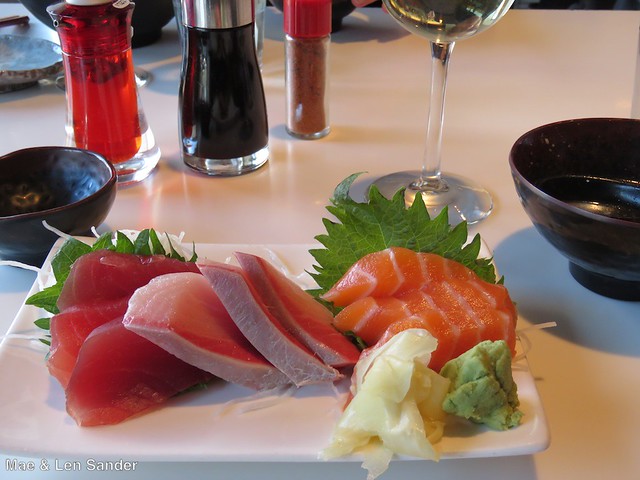
    Before we went to the Fool Moon celebration, which started at dusk, we ate sushi and ramen at Slurping Turtle.

    April-1-2016 13

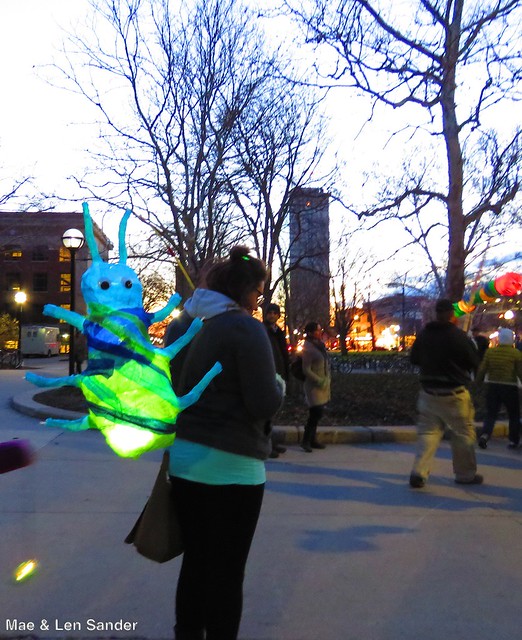
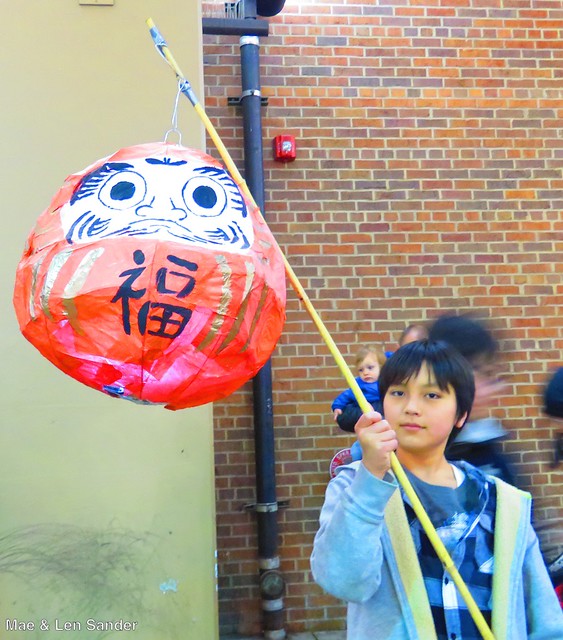
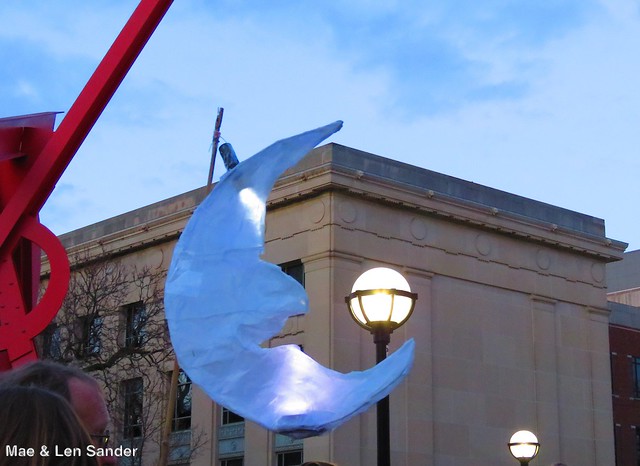
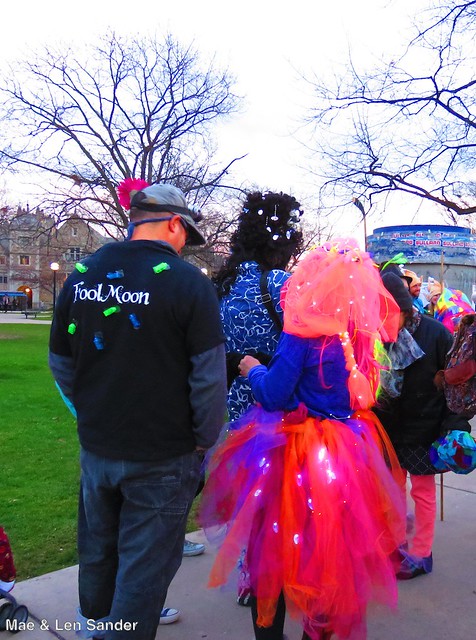
    April 1 is the Fool Moon Festival in Ann Arbor. All kinds of people informally gathered this evening in front of the University Art Museum. Many carried luminaria -- decorative paper lanterns -- that they had made for the event. Many of the luminaria represented the moon or the stars, but also a wide variety of creative shapes including bugs and caterpillars, cats and dogs, birds and butterflies, and even the Japanese figure Daruma. One woman wore a full Easter Bunny costume made entirely out of balloons. Others wore elaborate hats, suits, or wigs covered with blinking lights.


    April-1-2016 6

    To the beat of several drums, the crowd marched through the University of Michigan Diag, across State Street, through the Nichols Arcade, and onward to meet other groups somewhere in town. We stayed with the parade for a while, not all the way downtown. There was no distinction between participants and spectators; we all marched or strolled or if we were babies we rode in strollers.

    April-1-2016 8

    April-1-2016 10

    April-1-2016 16

    April-1-2016 18

    April-1-2016 19

    Sunday will be the follow-up to Fool Moon, the downtown parade called FestiFools.

    Thursday, March 31, 2016

    In a Box in My Kitchen

    One bookcase stands in my kitchen, holding the cookbooks that most often provide recipes that I actually cook. In the living room and dining room I keep my cookbooks and food history books that less often supply actual recipes. And up in the attic: books I don't like and don't use.

    Also in the kitchen bookcase is my old, retro, file box with alphabet tabs for recipes and a random collection of cards and a few menus from restaurants where I've eaten.
    Among the cards, I found this, from a restaurant where we held
    a reunion with former Fulbright Fellows in 1996.
    Our next reunion is now in the planning stages.

    I admit that I've never kept very careful tasting notes when it comes to restaurant food, and there's really almost no information added by hand to the restaurant cards. I sometimes added a date when I was really being systematic; very rarely I noted what we ate.

    A few more examples from the hundreds of items in my cherished file box:
    Recipe cards for Spicy Mexican Cornbread and my absolute favorite Butterscotch Bars.
    Although I've entered all the recipes into my computer files, I still use the cards occasionally.
    Left: old notes for Daube de Cotignac, a recipe by my friend Michelle who had a house near the town in southern France.
    Right: one of several information cards from our local supermarket in Paris explaining unusual fruits and vegetables.
    A few of the many restaurant cards from our visits to France. Some of these establishments are still in business; many aren't.
    A selection from the many cards from restaurants in California, Hawaii, and other Western states.
    I also have cards from many other European countries, from Hong Kong, Japan, New Zealand, and other US states.
    My newest card documents our take-out
    pupusas and tamales in Fairfax Saturday.
    And one new kitchen item: this magnet from the
    Cherry Blossom Festival that I attended last weekend.
    I've become an avid participant at the blogger event "In My Kitchen." This is my entry for the month, with thanks to Maureen for hosting the event on her blog.