Showing posts with label african masks. Show all posts

Saturday, July 20, 2024

The Ann Arbor Art Fair

Art and People

Evelyn and Miriam at the ceramic fish artists’ booth. The family is spending the weekend here,
partly to visit the Art Fair.

Two of the ceramic fish.


Skin art (we saw lots of this)!


After over a 24 hour delay, thanks to the airline chaos this weekend, Alice is here in time for the end of the Fair.


Food at the Art Fair

Friday: a black bean burger. Saturday: candy-coated nuts.

At the Carl Milles Fountain

The beautiful Carl Milles Fountain is always surrounded by Art Fair goers and food stalls.


Appreciating the fountain.


Ibrahim, the Vendor of African Art


As we often have done in the past, we found Ibrahim, who deals in African tribal art.
He usually finds a place to set up (unofficially) but this year he was disallowed,
so he only spent a few hours selling from the back of his van.

Some of Ibrahim’s selection of masks: not the one we bought.


In the center of our mantlepiece: the sculpture we bought this year.
The other two sculptures are from earlier years at Ibrahim’s stall.

Saturday Night Dinner


Blog post and all photos © 2024 mae sander

Friday, March 18, 2022

The Kreeger Museum, Washington, DC


A gallery at the Kreeger Museum, formerly the home of the founders, David and Carmen Kreeger.

The Kreeger Museum in Northwest Washington, DC, is a small collection of masterpieces, mainly from the 20th and 21st century. While numerous museums on the National Mall near the Capitol (around 6 miles from the Kreeger) display many more works by a much wider range of artists, I think it's a lot of fun, and very relaxing, to see a limited number of paintings and sculptures in a beautifully designed atmosphere. I was especially pleased to see some works by familiar artists that were new to me. The building, which was designed by Philip Johnson and Richard Foster in 1963, is also surrounded by a delightfully landscaped sculpture garden, with many modern sculptures. 


The Inventions series by John L. Dreyfuss encircles the Reflecting Pool.

Claude Monet, The Cliffs at Petites-Dalles (1884)

Face Mask. Songye Peoples, Zaire.

Pablo Picasso, Still Life with Ears of Wheat (1943)

Arshile Gorky, Untitled (1936)

Vincent Van Gogh, Vase with Flowers, 1886.

The Kreeger also contains a selection of works by local Washington, DC, artists, a few works of Asian art, and far more paintings and sculptures that I would have liked to include in this post!

Blog post © 2022 mae sander.

Wednesday, December 29, 2021

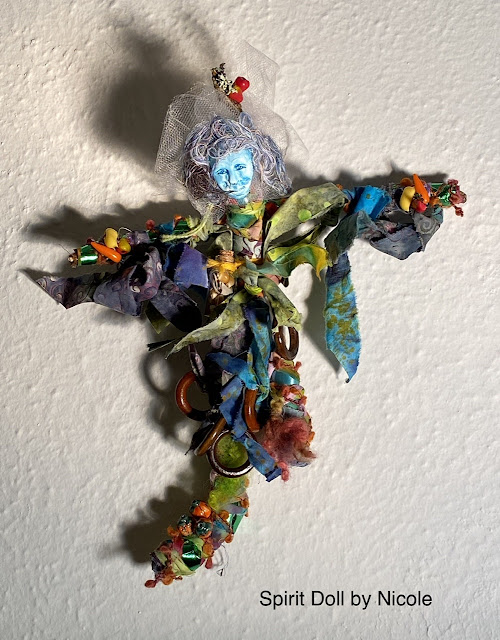
A Spirit Doll

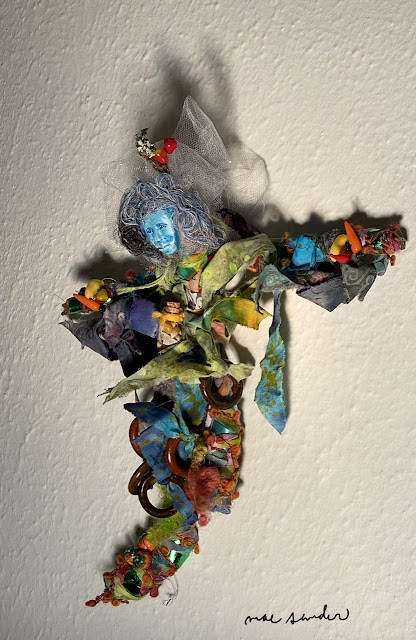
My blog friend Nicole makes and sells beautiful spirit dolls on her website, Beadwright. I'm a great lover of dolls. Nicole's spirit dolls are made from hand-formed faces, sticks, fabric, and leather, cloth, and bead embellishments. They really appealed to me, so I ordered one from the website. Amazingly, the package from Nicole arrived from her home in Oregon in just two days, right before Christmas.

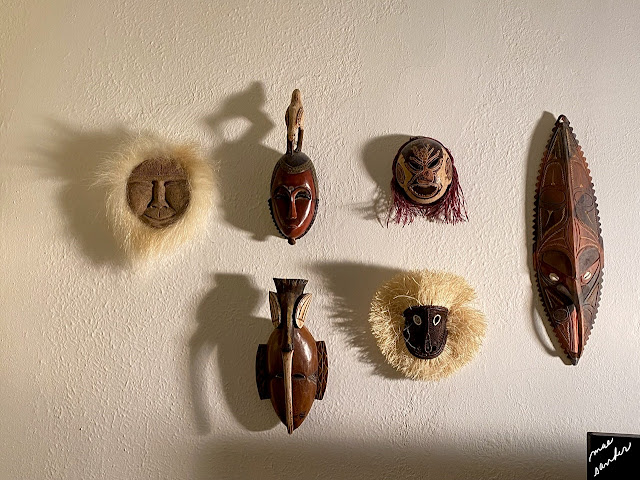
What a lovely doll! She's on display on my living room wall, along with a number of masks from a variety of cultures. I feel a sense of identity in all these masks also, and I think the doll is very compatible with them.


Nicole wrote me that she particularly made this doll to inspire balance, and to help to balance the life of its owner: me! "Balance is a tricky thing," Nicole says. "Just when we think we have it, life throws something else at us. Be it big or small. Look for the balance, the yin and yang, the hot and cold, the go and stop of it all." I feel this balance in the doll. I think she's beautiful. Nicole says "there is so much positive energy and love in her." Yes.

Masks that we've had for several years. The one on the left is Yupik from Alaska, the next two are African,
the next two are from a village in the upper Amazon and Costa Rica, and the far right one is from New Guinea.
We have a number of other masks and carvings as well.


Blog post © 2021 mae sander.
 

Saturday, March 21, 2020

Sorcery and Witchcraft: Sickness masks from the Congo

Disease has always been mysterious. Only in the past two centuries has Western medicine understood the effect of microorganisms. Now we are facing a new global threat: illness caused by the coronavirus may not be mysterious but it is definitely not under control. Most Americans this week have had to face the consequences of widespread contagion; their responses vary, as you have no doubt read in the press. I know that some readers of this blog are still clinging to the idea that there's no real threat, while most are trying to prepare. As I've written, I've been keeping away from others as we are advised.

Among the Pende people of the Congo, one way to deal with disease was to fight the witchcraft that they thought was the cause. Dancers called Mbangu performed ceremonies  to fight the witchcraft that was causing disease. Alien though such efforts may seem, I think we are all learning to understand the motives for such ceremonies.

In my collection of African masks I have a Pende Mbangu mask that vividly evokes the condition of a sick person (at least I think it does).

masks0055
Our Congolese mask, used in ceremonies to cure disease and witchcraft.
From the website of the University of Michigan Museum of art, an image and explanation of a sickness mask, which was the first one I saw and which definitely made me curious about this tradition:

From the museum's documentation:
"The twisted face and dramatic opposition of black and white identify this mask as an Mbangu mask, which represents infirmity and sickness—conditions that are often attributed to witchcraft. According to a common Pende explanation, Mbangu’s half-white, half-black face represents the scars of someone who fell into the fire due to sorcery, while the asymmetry of the face and the marks on the black side are an indication of various other medical conditions. When the mask appears in performance, the dancer limps on a cane to convey the physical weakness of Mbangu, and he wears a humpback pierced with an arrow in reference to sorcerers who shoot their victims with invisible arrows." (LINK)
Many Mbangu masks appear in museum collections, in books on African art, and also on a variety of websites, as illustrated in this screen shot of a search for them:


At the website RandAfricanArt.com I found an especially good description of the Mbangu dancers and images of a number of wonderful masks, including an image of the dancers which was originally on a part of the Smithsonian website:

Unfortunately the website does not give any information about this image, and the link provided does not
explain anything about it. Link here: http://www.randafricanart.com/Pende_sickness_mask.html
Wishing good luck and good health to everyone who reads this! 

This blog post copyright © 2020 mae sander for mae food dot blog spot dot com.

Tuesday, July 23, 2019

African Wood Carvings

A Baya wood sculpture of a wise man, from the Bambara people of Mali. Our Art Fair purchase last week.

We bought our new sculpture from Ibrahim, a dealer in African art.
Over the years, we have bought a number of masks from him.
He is not part of the "official" art fair, but just a sidewalk vendor.
Our sculpture as Ibrahim displayed it. Sitting in the gutter? OK.
Our wise man is more respected on the mantle above our fireplace.
In 2009, I took this photo at Ibrahim's art fair sale. The sculpture is very similar
to the one I bought this year, but obviously not the same one. The hands on
the two statues are mirror images, for one thing. And the eyes are different.
African mask of Elvis. Mid-20th century.
I wanted to include this very interesting mask from the Chewa people of Malawi which we saw on Saturday in the Detroit Institute of Arts. Elvis's image was a tool to warn young people about undesirable Western values that Elvis and others represented to their culture. "Members of the Nyau, a secret society among the Chewa, wore this mask with an iconic image of the King of Rock and Roll during ceremonies and rituals." (Information from museum label.)

For more posts on African masks in my collection and ones that I've seen in museums, you can go to this link at my travel blog: http://maetravels.blogspot.com/search/label/African%20Masks or to the African Masks link at the bottom of this post.

All photos copyright 2019 by Mae & Len Sander. This blog post was created by Mae for maefood dot blogspot dot com. If you read it elsewhere, it's been stolen.

Monday, April 15, 2019

The Art Museum

Bird from a late Roman Bird Mosaic. We enjoyed the art from Greece,
Rome, ancient Roman Egypt, and the Byzantine era.
The Saint Louis Art Museum has been a favorite of mine since my early childhood when I was growing up here. This weekend, we mainly visited relatives, but we did spend several hours in the museum, enjoying many works of art that we didn't remember from our many earlier visits. Here are just a few... when I return home, I'll do more posts on our visit.

We liked this Viennese tea set dated 1901-1902.
Designer: Jutta Sika (1877-1964).
The twentieth-century collections of the museum are wonderful!
We also saw art from Africam, Oceanian, pre-Columbian Americams,
and Native American artists, including weaving, pottery, metalwork, etc.
This mask is recent, from Nigeria.


Author of this content is Mae's food blog: Maefood dot blogspot.com. 
If you are reading it somewhere else, it's been stolen!

Tuesday, November 27, 2018

Primitive Art and Cubism


At the beginning of the exhibit "Cubism" currently at the Centre Pompidou is a display of primitive art objects that once belonged to the artists. Documentation throughout the exhibit pointed out how these objects influenced Picasso and his fellow cubists to see new ways to depict faces and other objects. Various displays of African art, mainly from the French colonial possessions of the early 20th century, awakened the interest of Picasso and others in his circle of artists.
 
Picasso's 1910 portrait of art dealer Daniel-Henry Kahnweiler includes a sketchy
African mask in the top area. African and primitive art was an influence on the cubists.
Kahnweiler and other dealers sold African masks as well as the work of the cubists.
Picasso's famous portrait of Gertrude Stein (1905) showed
the influence of African masks in the delineation of her features.
Visiting the other galleries of the museum last Saturday, we saw several primitive sculptures that were similarly influenced.
This is a 1912 sculpture by Modigliani, who exhibited with the cubists before developing his unique style of painting.

A work by Brancusi that shows this influence.
An African mask displayed at the Musée de l'Orangerie also relates to
the Picasso works and others on display there in the collection of dealer
Paul Guillaume, who sold African art as well as the works of the cubists.
At  l'Orangerie.  
At  l'Orangerie. 
The studio of André Breton (1896-1966) is now reconstructed in the Musée d'Orsay. Breton was a founder of the Surrealist movement,
and his appreciation of works from many primitive cultures is one of the defining features (in my opinion) of
many movements in modern art, beginning a few years before he became active in the 1920s.
Breton collected primitive work from many cultures throughout the world.
I wrote about Breton's ownership of a mask from the native people of
Alert Bay, B.C. when we visited there recently.  See the historic note
at the end of this post: "Alert Bay..." for details.
Two temporary art exhibits and one permanent collection that we visited in Paris last week featured the work of Picasso and his contemporaries, and also included some of the primitive art:
  • "Picasso. Blue and Rose" at the Musée d'Orsay, September 18, 2018-January 6, 2019 included a very large number of the painter's early paintings and sculptures from collections all over the world. It was fascinating to see such a young man emerge with so many incredible creative ideas, and to think that after the impressive accomplishment of this era he still would be a leader for another 70 years!
  • "Le Cubisme" at the Centre Pompidou, October 17, 2018-February 25-2019, presented a large number of works by the major and minor cubists, especially Picasso. Essentially this exhibit started at the moment when the Orsay exhibit left off, and showed Picasso's next period of creative life. We also viewed the permanent collections which include related works.
  • The Jean Walter-Paul Guillaume Collection at the Musée de l'Orangerie includes works by Renoir, Cézanne, Gauguin, Monet, Sisley, Picasso, Matisse, Modigliani, Marie Laurencin, Douanier Rousseau, Derain, Utrillo, Soutine and Van Dongen. Paul Guillaume (1891-1934), an art dealer in Paris from 1914 until his death, was the originator of this collection, which was donated by his wife and her second husband, whom she married after his death. The collection includes examples of African art, which he introduced to the cubists and other moderns.